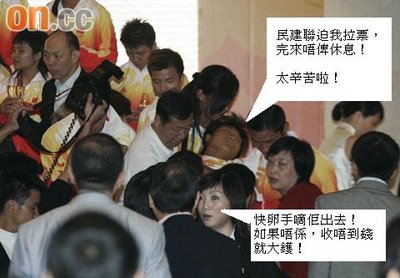
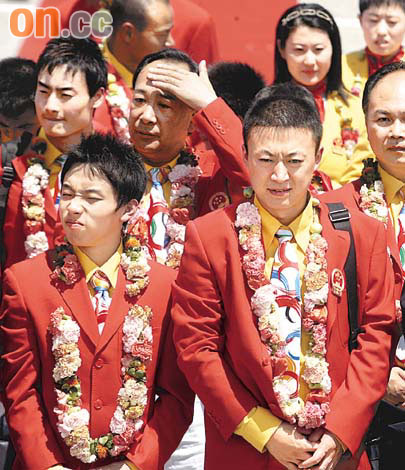
"The Democratic Alliance for the Betterment and Progress of Hong Kong forced to come here to canvas votes for them. I had no time to rest. This is too hard!"
"Please f*cking drag her out quickly! Otherwise, it would be a disaster if we don't get paid!"
(Reuters via Guadian.co.uk)
China dispatched its Olympic heroes to Hong Kong on Friday for a well-timed celebratory tour that could give pro-Beijing candidates a boost before crucial September legislative elections. ...
The former British colony returned to Chinese rule in 1997 with the guarantee of a high degree of autonomy, since when it city has maintained its free-wheeling business and social lifestyle. But its politics has been largely defined along a political axis separating pro-Beijing or pro-business forces from an opposition democratic camp, seeking direct elections but weakened by scant resources and infighting.
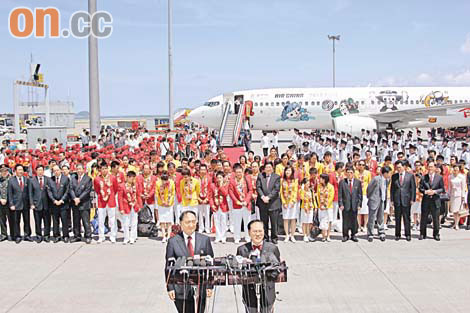
In a repeat of 2004, when 50 Athens Summer Games champions descended on the financial centre before elections to the Legislative Council, or mini-parliament, 63 Olympians, including diver Guo Jingjing and gymnast Yang Wei, arrived in Hong Kong for three days of photo ops, Disneyland visits, banquets and sports demonstrations.
The athletes were welcomed to a big fanfare by cheering primary school children at the airport. "The serendipity of the visit is quite good," said Michael DeGolyer, a politics analyst at Hong Kong Baptist University.
[ESWN Comment: Actually, a superior election tool would be to entice someone to make this an issue and then announce: "Due to comments (from western media and Hong Kong pan-democats) about the propriety of the Chinese gold medalists coming to Hong Kong before the election, the visit has been cancelled. Since the Chinese gold medalists will be disbanded before the election takes place, Hong Kong will not be able to see them in person." What will the reaction be? Here are the relevant polling data (Hong Kong Research Association) :
Q9. Are you looking forward to the visit by the Chinese Olympic gold medalists at the end of the month?
59%: Yes
10%: No
31%: No opinionAs an aside, where are the protestors? What happened to the Students For Free Tibet? Christina Chan? Leung Kwok-hung? Anyone else? There are protests, but you will need a fine toothcomb to locate them in the news. Here is the only item that I can find.
(The Sun) After the gala evening show, "Ms. Long Hair" Lui Yuk-lin and others displayed funeral wreaths and a snow mountain Free Tibet flag outside the sports grounds. There was a moment of chaos as people threw water bottles at them. The police had to use a megaphone to ask citizens to calm down.]
(Ming Pao) At the Saturday evening show, the Chinese Olympic gold medalists were all lip-synching during their singing. When Guo Jingjing, Wu Minxia and Qin Ke sang <Invisible Wings> with Joey Yung, the three kept conversing among themselves and seemed to be unaware that they were supposed to be singing with Joey Yung. When Charlene Choi sang with the women's quadruple sculls gold medal team, the sound suddenly stopped but they kept moving their mouths.
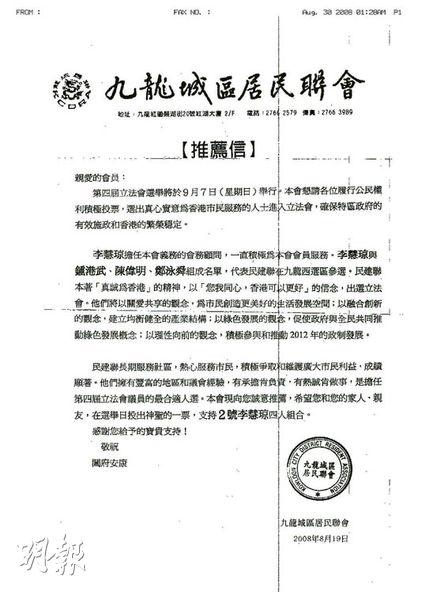
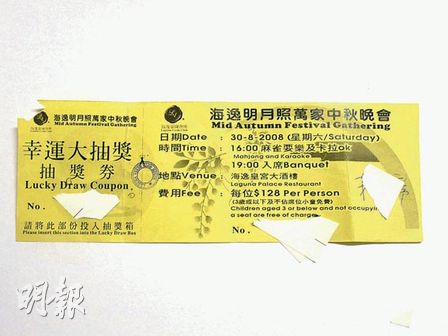
A complaint was filed yesterday by a Kowloon City resident who received (1) a letter of recommendation from the Kowloon City District Resident Association to vote for Starry Lee (DAB) and (2) an invitation to attend a mid-autumn festival gathering on August 30, 2008 at the Laguna Palce Restaurant with admission fee of $128 per person. An unnamed person who attended the function said that nobody asked him for admission fee.
According to a worker at the Kowloon City District Resident Association, they only wrote a letter of recommendation to their members and the DAB was responsible for mailing. He had no knowledge about any meal ticket.
According to Starry Lee, the DAB party mailed more than 2,000 letters of recommendation. But she denied knowing anything about the meal tickets being enclosed. In fact, she claimed to have no knowledge about the meal tickets whatsoever.
(SCMP)
At an election rally in the Kowloon West constituency, lawmaker Lau Chin-shek, who is also chairman of the Confederation of Trade Unions, was urged to withdraw from the race after a watchdog group labelled his performance in Legco as "very unsatisfactory". A man distributing leaflets titled "Lau Chin-shek, quit the election" to people at Mr Lau's rally refused to disclose his identity. Mr Lau said it was not surprising to be attacked during an election.
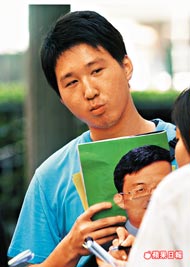
Lau Chin-shet was at an election rally in Mei Foo yesterday during which time a young man was distributing a stack of leaflets to ask Lau to quit instead of blocking the path of others. This young man was very mysterious. When the reporter asked for his name, he kept silent. When the reporter asked for his organization or political party, he said that there was none. The strangest part of it all is that he kept using a poster of Democratic Party candidate James To to cover his face. If he were To's man, would he show off in this manner? This was obviously a frame-up.
Apple Daily asked James To whether he sent someone out. He denied it bluntly and directly, and pointed out that someone was framing him up.
The pan-democrats are fighting for votes in Kowloon West, and some candidates want to raid Lau's votes. Since Lau's supporters are mostly grassroot citizens, it is logical to deduce who is doing this frame-up.
(Ming Pao)
Yesterday a citizen was distribution leafets that say, "Lau Chin-shek, quite the election." When the reporter questioned him, he said: "I'm not with the League of Social Democrats, I am not with the Democratic Party. I just don't want someone who does nothing in that seat." He left after saying that. Lau Chin-shek said that everyone has the right and freedom to distribute leaflets.
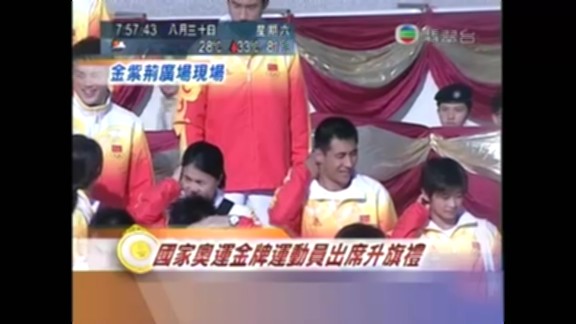
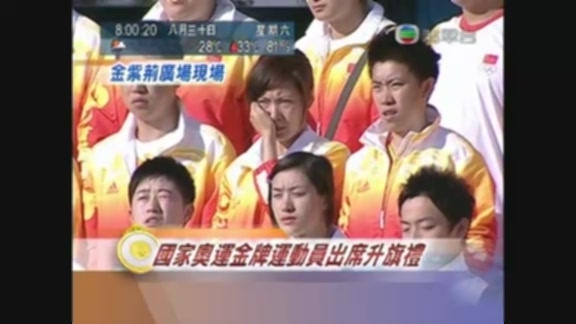
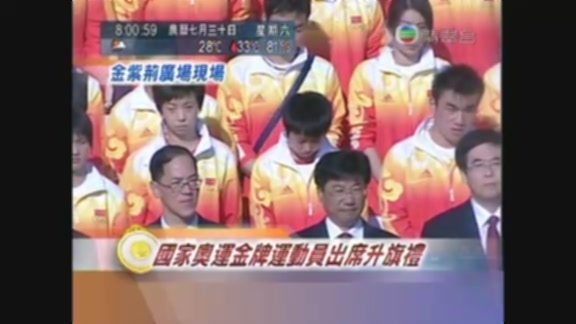
But do not expect this to be a positive-message PR coup, because netizens have no respect for anything. At Tianya Forum, someone went through with screen captures of the athletes in various degrees of distress and boredom:
(People's Daily Online) August 29, 2008.
The dismissal of Dieter Klaus Hennig from the senior editor position with SID (Der Sport-Information-Dienst), a German sports news agency, in early August has given rise to widespread concern of German media, and most of the German local media deem that Hennig has been ousted for his prolonged pro-China stance.
Is sports editor Dieter Klaus Hennig really imbued with an apparent "pro-China stance"? His boss or ex-employer, Michael Cremer, supervisor and president of the SID, has given a clear, explicit answer. Cremer said he insisted that his SID reporters need to keep certain distance from Beijing and should be beyond the hoopla and type of the Games with an implication that Hennig's reports were not "clean". In other words, Hennig should have made his stories dirtier or "filthier" with his reports of China's sports events. This has obviously posed the out-and-out double standards for the press media.
As a matter of fact, shortly after the incident relating to Dieter Klaus Hennig occurred, some media organs doubted and even questioned the so-called press freedom of the SID. The core point is that if there was a full freedom of the press, it did not matter at all whether Dieter Klaus Hennig had taken a "pro-China stance". Moreover, his reportage is well-grounded, and "neat and tidy".(China Daily) August 29, 2008.
A Chinese woman working at Germany's DW-Radio has been suspended from her job following remarks she made in the media on human rights and other issues in China, the German press has reported.
Four days before the opening of the Beijing Olympics, Zhang Danhong, an editor with the German broadcaster's Chinese program, reportedly said that "The Communist Party of China has more than any political force in the world implemented Article 3 of the Declaration of Human Rights", referring to the Chinese authorities pulling more than 400 million people out of poverty.
Similarly, in a TV talk show in late July, Zhang reportedly said the Chinese government had done a lot to protect local culture in Tibet and criticized German Chancellor Angela Merkel for sapping relations with Beijing.
The German media is said to have reacted strongly to Zhang's remarks.
On Aug 11, German magazine Focus attacked Zhang as someone who was "courting" China's Communist Party. On Aug 20, the Berliner Zeitung newspaper quoted parliamentary representative Dieter Wiefelsputz as saying that Zhang's performance was a "catastrophe".
Two days later, the same newspaper confirmed Zhang's suspension from work.
(Deutsche Welle) August 30, 2008.
[in translation]
... during a certain discussion program, she said some things that were inconsistent with the guiding principles of Deutsche Welle, which includes advocating democracy, freedom and human rights.
Deutsche Welle is obliged to conduct an investigation of the matter. Per standard practice, the principal cannot participate in any public activities (including broadcasting) until the investigation has been completed. This is how Deutsche Welle is handling the matter of Ms. Zhang Danhong.
Here are two possibly relevant Internet posts. I'll let you draw the inferences.
(Boxun) By Zhu Xueyuan. August 30, 2008.
[in translation]
... I don't think that Ms. Zhang Danhong is a member of the Fifth Column. She is a Chinese person who studied in the west and became an "angry young person" who did not join the mainstream. Therefore, she communicated her discontent directly to the Beijing correspondent of Xinhua who asked the world: "She angrily said that Germany has always advocated 'freedom of press' but can anyone detect it from her personal experience?" That is to say, "When a country does not speak out on behalf of the Chinese Communists, it does not have freedom of press."
That is not how it is. In the west, people can watch CCTV and read People's Daily, although these media outlets do not draw any audience. The German taxpayers are paying for Deutsche Welle which must therefore express the voice of the German people. This voice must also be mainstream because it is the public opinion upon which the foreign policies of the German government are based.
The so-called "freedom of press" does not mean that "my mouth" must speak "your words." It is really about me allowing you to speak. If Ms. Zhang Danhong wants to speak for Beijing on Deutsche Welle, it is asking them to do the impossible. This is not freedom of press. Ms. Zhang Danhong should find a way to get on Voice Of China to speak in German to order to wake up the stupid citizens of the western world.
In the western world, pro-China people have the right to express their own views. But that does not mean that they can use Voice Of America or Deutsche Welle to do so. They should build their own opinion space to do so. In fact, the Chinese government has made a great deal of investment which the western governments are not blocking. As a result, the Chinese government has made some outstanding progress. But to turn Deutsche Welle into Voice Of Chinese Communists is not very smart under the circumstances.
[Note: Zhu Xueyuan's post includes a more-detailed Chinese-language Xinhua dispatch on the case of Zhang Donhong, where the allegation is that Deutsche Welle succumbed to pressures from a certain religious cult which is interested in truth, beauty and tolerance.]
(Life is but an empty dream ...) August 16, 2008. (Note: The blogger is an Apple Daily (Hong Kong) political reporter)
[in translation]
... In Hong Kong, the media are not under restrictions. But the self-imposed restrictions here are no less than in mainland China. Without the Hong Kong or central governments saying anything, many sensitive news are automatically diluted and replaced by more official news. Such is the sorrow of the 'leftist' newspaper workers. "This cannot be reported" is their common refrain.
This is not to say a 'pro-democracy' newspaper does not have taboos, which are perhaps fewer in the sense that only one or two people that the boss detests do not get exposure. While one may disagree with these low-down tactics to make people disappear from view, there is nothing a media worker can really do. Nobody wants to 'try' something that will infuriate the boss. Who wants to smash one's rice bowl?
Although the environments of the Hong Kong and mainland Chinese media are different, it all boils down to: "The media workers are just tools for a certain person or organization to achieve a certain objective." So how can media workers not feel sorry for themselves?
[ESWN Comment: If you really want to speak whatever is on your mind without restrictions, blog!]
23-year-old Jia Zhipan was a fourth-year student majoring in computer science at the Xian Eurasia University. At around 8pm on May 29, he was in his dormitory room using his computer to access the Shaanxi Provincial Earthquake Administration website. Before leaving, he noticed that there was an administrator's link at the bottom.
"I am a computer science major. I know that many websites have administrative flaws. I wanted to see what it is like inside," Jia Zhipan said. So he clicked on the link and entered the password "123456." Amazingly, Jia Zhipan was allowed to enter. At that moment, he got the idea to run a "prank." So at 20:53pm, he composed and posted the notice: "There will be severe earthquakes tonight at 23:30 in Shaanxi and elsewhere!" The notice said that Shaanxi and Sichuan geologists have determined that the frequent and intense earthquakes around the Wenchuan plate are moving up in the northeastern direction with a a magnitude 6 to 6.5 earthquake due at 23:30 in Gansu Tianshui, Baoji, Hanzhong, Xian and other places. People were asked to take precaution. This notice was posted on the front page of the Shaanxi Earthquake Adminstration's website.
Afterwards, he went to use the restroom and drank some water. About 10 minutes later, he came back and saw that 767 people had already read the notice. He realized that this was getting serious and he immediately deleted the notice.
After the notice was published, many people called the Shaanxi Earthquake Administration, which realized that its website had been hacked and issued a rumor-clearing notice.
The police were called in, and they basically locked in the IP address of the perpetrator. On June 4, Jia Zhipan re-entered the Shaanxi Earthquake Administrator website. This time, the police tracked him down. The Shaanxi Xian City Yanta District Procuratorate charged Jia with disseminating a false message that created public panic.
During the court trial, the prosecutor and the defendant's lawyer did not disagree over the facts. But they argued vigorously whether the fake messahad caused people to be afraid. The defendant's lawyer said that 767 is not a lot of people and the telephone calls were mainly to ask whether the information was true or false, and this showed the public was skeptical.
Jia Zhipin made a personal statement in court: "I did not send out the information with malice at heart. I was just trying to satisfy my curiosity. I have let the country, the university and my parents down. I have caused trouble for the Earthquake Administration. I am sorry for the impact that this false information had on people ..." Tears were flowing down, and his parents were crying in court too.
The judge found Jia Zhipin guilty of disseminating false earthquake information and creating public panic and disorder. He sentenced Jia to 18 months in prison. Jia and his family were relieved because they thought that the sentence would be a lot heavier.
(Ming Pao via Yahoo) August 29, 2008.
HKU POP interviewed 3,447 registered voters on August 19-27. For the Kowloon West district, Claudia Mo (Civic Party) has fallen from her original 17.5% in third place to 12.1% in fourth place. The eloquent Raymond Wong has finally crossed over the 10% mark for the first time. Chinese University of Hong Kong Political and Administrative Studies senior lecturer Choi Chi-keung said that Claudia Mo is not familiar with election campaigning and lost to Wong during the televised debates. That was why her numbers are sagging.
(Apple Daily) August 30, 2008.
HKU POP interviewed 388 Kowloon West registered voters on August 24-28. The results showed that Frederick Fung (ADPL) had 13.0% support, Starry Lee (DAB) at 11.2%, Claudia Mo (Civic Party) at 10.1%), James To (Democratic Party) at 9.8% and Raymond Wong (League of Social Democrats) at 9.1%.
[Technical note: Ming Pao excludes people who are undecided, while Apple includes them in reporting their respective support levels].
Why is this absurd? At a sample size of 388 for August 24-28, the 95% confidence interval for a 10% support level is (6%, 14%). In other words, at a sample size of 388, Frederick Fung, Starry Lee, Claudia Mo, James To and Raymond Wong are in a statistical tie. The sample size for August 19-27 is about double which means that the 95% confidence interval for a 10% support level is (7%,13%). In other words, Claudia Mo and Raymond Wong are in a statistical tie.
If people want to build mountains out of molehills, that is their prerogative. But it is not obvious whether good/bad news will help/hurt. You want good news because it means your opponents are faltering. You want bad news because it will motivate to vote. So the media outlet trying to help you may be hurting you, and vice versa. Who know? But it is entertainment for the reader who follows the length that media will go through to spin.
Yesterday I saw the Hong Kong SAR government gave a warm welcome to the Chinese Olympic gold medalist. The Hong Kong SAR arranged for a solemn formal reception. Hong Kong SAR Chief Executive Donald Tsang went to the airport to receive them personally. Several days ago, when the Hong Kong Olympians returned, our Chief Executive was nowhere to be seen. A cocktail party took place later, but it was sparsely attended. This was a strong contrast with the high-profile reception yesterday for thte Chinese Olympic gold medalists.
Well, Oriental Daily has a different interpretation about this ceremonious recepton.
(Oriental Daily via Sina.com.hk) Donald Tsang Was Truly Impolite. August 30, 2008.
The chartered airplane arrived at around 11am and stopped at the pre-designated spot. At 11:10am, the cabin door opened and the delegation descended. 110 elementary school students had been sent there to shout "We welcome you warmly!" as well as wave the Chinese national and HK SAR flags. There were some flower presentations, handshaking and photo-taking. All this took place in an open area under the midday sun.
Next, Hong Kong SAR Chief Executive Donald Tsang delivered a speech in the Cantonese dialect with the Olympic gold medals serving as the backprop. Prop is the operational keyword of the day, as Tsang is obviously like to use this occasion to prop up his sagging popularity. The most recent HKU POP poll showed that the confidence index for him has gone into the negative (39% confident, 41% not confident) for the first time during his tenure.
Donald Tsang is being rude here, because he turned his back to the athletes and spoke in Cantonese, which the majority of the athletes do not understand.
The delegation stood more almost 20 minutes in the area. The athletes were bothered by the intense sun and they sweated profusely. Even worse off were the elementary school students and the media who were in position an hour beforehand.
How is that for snatching defeat from the jaws of victory as a PR gimmick?
Q6. The Beijing Olympics are now over. Overall, do you think that the Beijing Olympics was successful?
1.6%: Very unsuccessful
2.1%: Somewhat unsuccessful
25.8%: Somewhat successful
68.7%: Very successful
1.7%: Don't know/hard to sayQ7. Which of the following is the most important standard by which you judge the success of the Beijing Olympics
4.9%: The number of gold medals won by China
57.1%: Beijing was able to complete the Olympics safely and smoothly
2.0%: The number of foreign VIP's attending the Beijing Olympics
31.1%: The media were able to report the Olympics and the situation in China
2.7%: Other
3.5%: Don't know/hard to sayQ8. Are you proud of China hosting the Olympics?
41.2%: Very proud
43.4%: Somewhat proud
12.9%: Not proud
1.6%: Not proud at all
1.0%: Don't know/hard to sayQ9. Do you feel that the Beijing Olympics has changed the image of China?
1.2%: Became worse
7.9%: No change
89.5%: Became better
1.4%: Don't know/hard to say
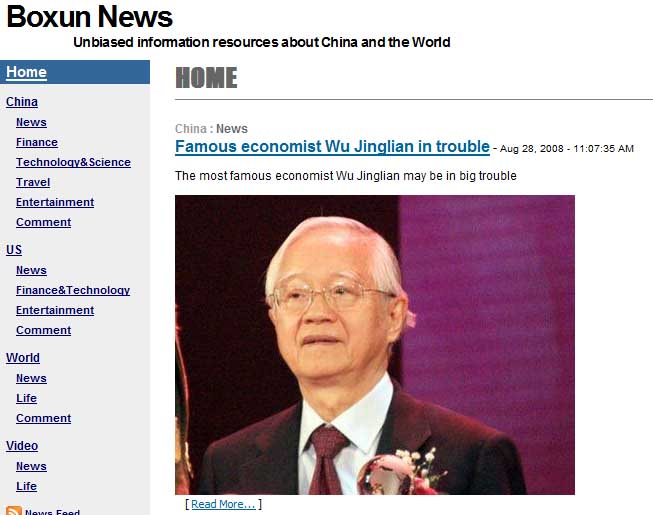
For the details of this case, please read The internet reports: Famous economist is a spy! (from Joel Martinsen, Danwei.org).
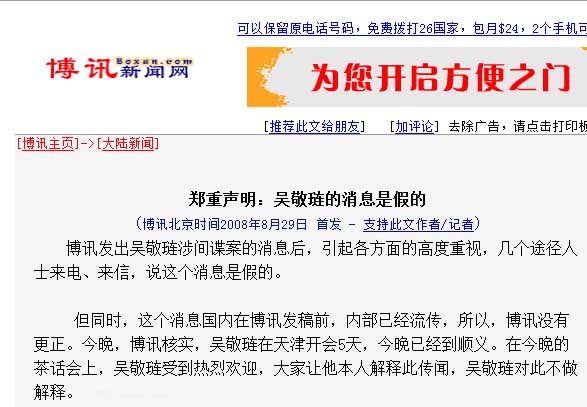
Since then, Boxun has issued a solemn announcement to the effect that the story about Wu Jinglian was false (see link):
[in translation] When Boxun released the news that Wu Jinglian was involved in an espionage case, it drew high interest from various quarters. Information from various channels says that the story is false. Since the information was already available inside China before Boxun published it, Boxun did not issue any corrections. This evening, Boxun confirmed that Wu Jinglian was attending meetings in Tianjin for five days and he has arrived in Xunyi this evening. At the meeting tonight, Wu Jinglian was warmly welcomed. When people asked Wu Jinglian to comment on this rumor, he declined.
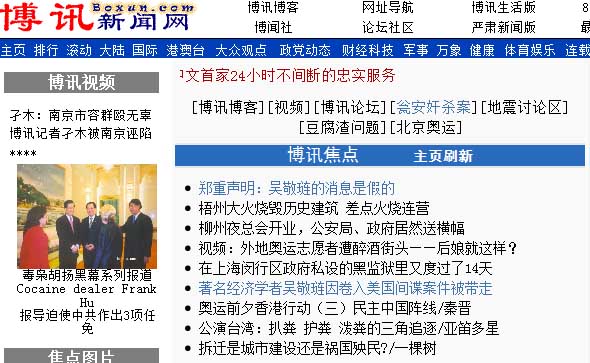
[ESWN comment: Is Boxun in the truth business after all? Let me suggest that you take a look at the front page with the hottest topics.
Next to the Sichuan earthquake, the tofu school buildings and the Beijing Olympics, they have "the case of the Weng'an rape-murder." This might have been the case with the initial Internet rumors. As more facts emerged, this is no longer tenable. Why do they still position this way? Is it about the pursuit of truth? (reference: The Weng'an Mass Incident).]
(Washington Post) Taiwan's Ex-Security Chief Accused of Hiding Presidential Cash Scheme. By Jane Rickards. August 29, 2008.
Taiwan's former security chief was indicted Thursday for allegedly covering up suspected money-laundering activities by former president Chen Shui-bian and his family.
...
Prosecutors are seeking 2 1/2 years' imprisonment for Yeh Sheng-mao, chief of the Bureau of Investigation under Chen, for allegedly concealing documents given to his bureau by the Egmont Group, an international organization that collects data on suspicious financial activity. The Egmont documents expressed suspicion that the money wired into a Swiss bank account belonging to the daughter-in-law involved money laundering.
...
Subordinates at Yeh's bureau, which deals with white-collar crime and internal security, notified Yeh when they received the Egmont documents in January and recommended that the bureau take legal action, the Taipei District Prosecutor's Office said in a statement.
But Yeh reportedly told them the matter was so confidential and sensitive that only he was equipped to deal with it. He then concealed the documents, quashing any possible investigation, the statement said.
The above report is based upon the press release from the prosecutor's office. It may be factually correct, but it is not very exciting. Here is the detective story as reported in UDN, which is much more exciting.
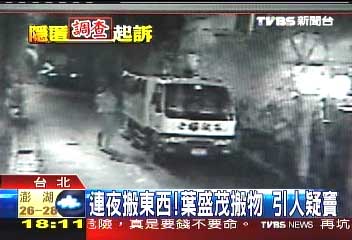
According to prosecutors, after the money laundering case broke open, Yeh Sheng-mao hired the Kongfu Moving Company on August 17 to come to his residential home to move his official documents and several dozens of bottles of wine to his private office.
Later on, the prosecutors were suspicious that they could not find anything on their initial search of Yeh's house. So they reviewed the surveillance tape outside Yeh's residential home and saw the Kongfu Moving Company truck on a drizzly night. The moving process took about one hour and then the truck left.
The prosecutor then located the driver of that truck and asked him to lead them to his destination that night. When the driver and the prosecutor arrived at the building that housed Yeh's private office, they saw another moving company crew moving things out. The Kongfu Moving Company driver told the prosecutor that he recognized the stuff as that which he had moved the other night. The prosecutor observed the proceedings and followed this truck to its new destination, which is the warehouse of a friend of Yeh.
The prosecutor then informed his superior, who judged that this is likely connected to the money laundering case. An emergency search order was obtained from the court and the residential home of Yeh Sheng-mao and the warehouse of his friend were then searched. The Egmont documents were recovered this way.
Previously Yeh Sheng-mao claimed that he had misplaced the Egmont documents. But they were right there. The circumstances are very clear, and this explains why Yeh Sheng-mao was prosecuted so quickly.
Chen Shui-bian is customarily referred to as "former president Chen" (陳前總統). In a Freudian slip of the tongue, the press release from Chen Shui-bian's office included the sentence: 檢方並未就陳錢總統之海外存款是否即為選舉結餘款,對陳鎮慧女士提出詢問. The key point is to note that 陳前總統 ("former president Chen") was mistyped as 陳錢總統 ("money president Chen"). At this point, that may be the more apt descriptor.
[in translation]
Under the proportional representation system, the Hong Kong Legislative Council elections may be determined less by the years of accomplishments and the political party effect than by strategic voting in the final stages.
The so-called strategic voting refers to a voter who prefers candidate A first. But since candidate A was either certain to win (or lose), the voter decided not to waste his vote and therefore votes for the second or third choice instead, because the latter appears to be on the verge of winning and this vote will have a material impact.
There is a paradox in strategic voting: If too many voters do so, the election results may be distorted because the sure winner can actually lose. In the 2004 Hong Kong Island Legco elections, Cy Ho was defeated as a result ...
Under these circumstances, the voter perception of who might be winning or losing becomes very important. The public opinion poll results published by the media can be very influential. By effectively controlling the public opinion polls, it is possible to manipulate voter perceptions and cause them to vote strategically in a certain direction.
In the HKU and CUHK polls published by the media, there are some big differences. Since the two organizations do not differ too greatly in terms of sampling and interviewing methodology, the only explanation is the sampling error arising from small samples sizes. These two polls often have just over 200 respondents in the Kowloon East and Kowloon West districts. At the 95% confidence, a candidate with a 10% rating is really between 6% and 14%. In New Territories East and New Territories West, the sample sizes are more than 400 respondents but the 95% confidence interval for a candidate with a 10% rating is between 7% and 13%.
With the rolling samples, several dozen respondents are added each day ... It may be the case that if we compare the numbers of the beginning of August versus the end of August, we may be able to discern certain trends. But it is not statistically sound to look at the latest polls each day and proclaim this party is surging or that party is collapsing.
The main point of this discussion is that the poll results reported in newspapers can only give a rough picture. For example, those candidates with less than 2% support will unlikely be elected. As another example, the DAB list in New Territories probably has the highest level of support. But the polls will not accurately tell what the true numbers are. In some districts, the difference between winning and losing is just 1% or 2%, so the outcome will be hard to predict. If the voters use these numbers to guide their strategic voting decisions, some unexpected things may happen.
In the absence of objective "truth," various people will create certain impressions to influence the election results. A certain newspaper releases poll results selectively each day to push certain candidates. Today, Tsang Kwok-fung is said to have a chance as the second member of his list (even though the poll says that he has less than 2%). Tomorrow, Lee Wing-tat says that his situation is critical (but the newspapers will not report that Lee Cheuk-yan had issued an emergency appeal already).
Since the HKU and CUHK polls results are somewhat different and since most voters will not systematically gather all the relevant data to make analytical comparisons, the political parties and candidates can choose a particular poll result that is favorable to them in order to boost support. The candidates on the edge between winning and losing will cite the worst possible poll result to show that they are in critical condition; the candidates who are sure winners will cite the best possible poll result to show that a second seat is possible for their list.
When the newspapers and political parties selectively use poll results to guide voters to make strategic votes, the polls are no longer objective and neutral reflections of reality. Instead, they have become strategic tools. Nevertheless, the fact is that neither the voters, the media nor even the candidates have accurate information to judge how many votes the candidates are getting in order to make the strategic voting decisions. If the voters end up using manipulated information to vote strategically, the outcome may be even more distorted.
When an election system has a vast number of strategic votes, it is a bad system because it does not accurately reflect and represent the will of the public. The polls are not completely accurate and the media are selectively reporting whatever they need from the polls. This means that the voters cannot make accurate strategic votes. Therefore, the smartest thing to do is to vote according to your original preference.
Aug 18-27 Geographical Constituency List Party Hong Kong Island 1 Lam Chui Lin Liberal Party <2 2 Ho Sau Lan Cyd Civic Act-up 7.4 3 Kam Nai Wai, Yeung Sum Democratic Party 11.4 4 Tsang Kin Shing League of Social Democrats <2 5 Tsang Yok Sing Jasper, Choy So Yuk DAB 16.3 6 Siu Man Wa Myra <2 7 Lo Wing Lok 8.9 8 Chan Tanya, Eu Yuet Mee Audrey Civic Party 28.7 9 Ip Lau Suk Yee Regina, Shih Tai Cho Louis 25.3 10 Lai Chi Keong Joseph <2 Kowloon East 1 Wu Chi Wai Democratic Party 5.2 2 To Kwon Hang Andrew League of Social Democrats 5.4 3 Chan Kam Lam DAB 17.5 4 Leong Kah Kit Alan Civic Party 23.9 5 Li Wai Ming Democratic Party 21.8 6 Wong Kwok Kin Hong Kong Federation of Trade Unions 26.2 Kowloon West 1 Chong Wing Charn Francis <2 2 Lee Wai King Starry DAB 17.8 3 Lung Wai Man James <2 4 To Kun Sun James Democratic Party 17.8 5 Mo Man Ching Claudia Civic Party 12.1 6 Lam Yi Lai <2 7 Leung Mei Fun 7.7 8 Wong Yuk Man League of Social Democrats 10.8 9 Tien Michael Puk Sun Liberal Party 7.0 10 Fung Kin Kee Frederick ADPL 18.0 11 Lau Chin Shek 6.1 12 Lau Yuk Shing <2 13 Tam Hoi Pong <2 New Territories East 1 Tien Pei Chun James Liberal Party 13.6 2 Siu See Kong Party for Civic Rights & Livelihood of the People of Hong Kong Limited <2 3 Lau Wai Hing Emily The Frontier 8.1 4 Wong Shing Chi Democratic Party 7.9 5 Leung Kwok Hung League of Social Democrats 5.8 6 Lee Chi Wing Alvin <2 7 Cheng Kar Foo Andrew Democratic Party 16.4 8 Tong Ka Wah Ronny Civic Party 18.9 9 Pong Scarlett Oi Lan 6.1 10 Lau Kong Wah, Chan Hak Kan DAB 21.9 New Territories West 1 Cheung Chiu Hung Civic Party 6.0 2 Lee Cheuk Yan Hong Kong Confederation of Trade Unions 13.1 3 Tam Yiu Chung, Cheung Hok Ming DAB 22.5 4 Ho Chun Yan Democratic Party 11.8 5 Tandon Lal Chaing ADPL <2 6 Yuen Wai Chung <2 7 Chan Wai Yip Albert League of Social Democrats 6.1 8 Chow Ping Tim <2 9 Wong Kwok Hing Hong Kong Federation of Trade Unions 3.5 10 Cheung Yin Tung <2 11 Leung Suet Fong Blue Intelligent Union <2 12 Chow Liang Shuk Yee Selina Liberal Party 10.1 13 Leung Yiu Chung Neighbourhood and Worker's Service Centre 13.1 14 Lee Wing Tat Democratic Party 10.5
Aug 1-8 Aug 15-26 Geographical Constituency List Party Hong Kong Island 1 Lam Chui Lin Liberal Party 1.2 0.4 2 Ho Sau Lan Cyd Civic Act-up 4.4 7.2 3 Kam Nai Wai, Yeung Sum Democratic Party 16.0 10.2 4 Tsang Kin Shing League of Social Democrats 17.6 0.8 5 Tsang Yok Sing Jasper, Choy So Yuk DAB 4.4 20.1 6 Siu Man Wa Myra 0.4 0.4 7 Lo Wing Lok 4.4 7.2 8 Chan Tanya, Eu Yuet Mee Audrey Civic Party 22.8 24.2 9 Ip Lau Suk Yee Regina, Shih Tai Cho Louis 23.6 25.9 10 Lai Chi Keong Joseph 5.2 3.8 Kowloon East 1 Wu Chi Wai Democratic Party 5.0 8.3 2 To Kwon Hang Andrew League of Social Democrats 5.0 10.6 3 Chan Kam Lam DAB 20.8 18.4 4 Leong Kah Kit Alan Civic Party 35.2 33.4 5 Li Wai Ming Democratic Party 15.7 11.9 6 Wong Kwok Kin Hong Kong Federation of Trade Unions 18.3 17.4 Kowloon West 1 Chong Wing Charn Francis 1.3 0.4 2 Lee Wai King Starry DAB 18.9 16.7 3 Lung Wai Man James 0.6 0.4 4 To Kun Sun James Democratic Party 19.5 24.6 5 Mo Man Ching Claudia Civic Party 8.2 8.8 6 Lam Yi Lai 1.3 0.9 7 Leung Mei Fun 10.1 9.7 8 Wong Yuk Man League of Social Democrats 5.0 8.3 9 Tien Michael Puk Sun Liberal Party 11.3 5.7 10 Fung Kin Kee Frederick ADPL 13.2 14.5 11 Lau Chin Shek 9.4 8.8 12 Lau Yuk Shing 0.6 0.4 13 Tam Hoi Pong 0.6 0.9 New Territories East 1 Tien Pei Chun James Liberal Party 14.5 12.3 2 Siu See Kong Party for Civic Rights & Livelihood of the People of Hong Kong Limited 1.2 1.8 3 Lau Wai Hing Emily The Frontier 12.1 10.1 4 Wong Shing Chi Democratic Party 4.8 4.6 5 Leung Kwok Hung League of Social Democrats 7.2 10.1 6 Lee Chi Wing Alvin 0.6 0.3 7 Cheng Kar Foo Andrew Democratic Party 13.3 17.2 8 Tong Ka Wah Ronny Civic Party 16.9 17.5 9 Pong Scarlett Oi Lan 2.4 1.8 10 Lau Kong Wah, Chan Hak Kan DAB 27.1 24.2 New Territories West 1 Cheung Chiu Hung Civic Party 4.9 3.3 2 Lee Cheuk Yan Hong Kong Confederation of Trade Unions 11.4 14.8 3 Tam Yiu Chung, Cheung Hok Ming DAB 26.0 29.8 4 Ho Chun Yan Democratic Party 15.5 14.8 5 Tandon Lal Chaing ADPL 1.2 0.7 6 Yuen Wai Chung 0.4 0.3 7 Chan Wai Yip Albert League of Social Democrats 2.0 4.3 8 Chow Ping Tim 0.4 0.3 9 Wong Kwok Hing 6.1 4.6 10 Cheung Yin Tung 0.8 1.3 11 Leung Suet Fong Blue Intelligent Union 0.4 0.7 12 Chow Liang Shuk Yee Selina Liberal Party 10.6 8.9 13 Leung Yiu Chung Neighbourhood and Worker's Service Centre 8.1 8.9 14 Lee Wing Tat Democratic Party 12.2 7.5
Q1. Did you watch more of the Olympics than four years ago?
83%: More
5%: Less
8%: About the same
4%: No opinionQ2. Which Olympic events did you like to watch the most?
8%: Athletics
11%: Table tennis
18%: Volleyball
10%: Swimming
18%: Diving
5%: Basketball
21%: Gymnastics
4%: Others
7%: No opinionQ3. Which is the most memorable episode of the Olympics?
23%: Chinese male/female table tennis players sweeping all the gold medals
24%: Liu Xiang dropping out of the 110m high hurdles due to injuries
12%: Usain Bolt of Jamaica winning three sprint gold medals while setting world record times
4%: Russian Isinbayeva setting a new record in the pole vault for the 24th time
19%: American Phelps winning 8 gold medals
11%: Other
7%: No opinionQ4. Are you satisfied with the performance of the Chinese national team at the Olympics?
93%: Satisfied
2%: So-so
2%: Dissatisfied
3%: No opinionQ5. Are you satisfied with the medals won by the Chinese national team?
93%: Satisfied
2%: So-so
2%: Dissatisfied
3%: No opinionQ6. Are you satisfied with the overall arrangements of the Beijing government about the Olympics?
85%: Satisfied
8%: So-so
2%: Dissatisfied
5%: No opinionQ7. Do you think that the Beijing Olympics is helpful towards raising the international image of China?
91%: Yes
4%: No
5%: No opinionQ8. Are you satisfied with the arrangements of the Hong Kong SAR government about the equestrian events?
51%: Satisfied
28%: So-so
9%: Dissatisfied
12%: No opinionQ9. Are you looking forward to the visit by the Chinese Olympic gold medalists at the end of the month?
59%: Yes
10%: No
31%: No opinion
Q1. Satisfaction with President Ma Ying-jeou's job performance (%satisifed/%dissatisfied)
2008/04/29: 52%/17%
2008/06/17: 41%/37%
2008/07/16: 30%/49%
2008/08/07: 32%/47%
2008/08/26: 41%/40% (100 days into the term of president Ma Ying-jeou)Q5. Overall, do you think that President Ma Ying-jeou is leading our national policies in the right direction? (%right/%wrong)
2008/06/17: 54%/17%
2008/08/26: 49%/25%Q10. Are you satisified with how the Ma Ying-jeou administration is handling various corruption cases surrounding former president Chen Shui-bian? (%satisifed/%dissatisfied)
2008/06/20: 24%/49%
2008/08/26: 38%/42%Q11. If you can vote all over again, whom would you vote for?
23%: Frank Hsieh
52%: Ma Ying-jeou
26%: No opinion
The graft case of former president Chen Shui-bian is expanding as more of his aides are invited to chat with the prosecutors.
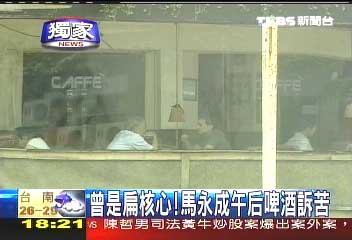
On the day before yesterday, Ma Yong-cheng was questioned by the special investigative team. But yesterday, Ma Yong-cheng showed up in a coffee shop to speak to a man. Who was that man? None other than senior staff reporter Hsieh Chung-liang of Next Weekly. Hsieh Chung-liang also happened to be the younger brother of PFP spokesman Hsieh Kung-ping. The two were spotted by a TVBS camera crew.
From afar, Ma Yong-cheng kept talking and gesturing. Meanwhile, Hsieh Chung-liang kept taking notes and said very little.
What were they talking about? The TVBS crew approached them. Hsieh quickly used his hands to shield the camera. Ma recognized the TVBS reporter who had interviewed before, got up to shake hands and said, "Please, no filming!"
Ma: Thanks, thanks, thanks, thanks.
TVBS: Have you not been in contact with former president Chen for some time already?
Ma: Thanks, thanks. Sorry. Please. Fine, fine. I am sorry but I cannot take this interview. Sorry.
TVBS: How have you been recently?
Ma: Fine, fine. Fine. Thanks, thanks.
TVS: Have you been in contact with Ah Bian's family?
Ma: Let's find another time to talk, okay?So is that Next Weekly interview a public interview, or it going to be attributed to an anonymous informed source?
Aug 6-13 Aug 11-17 Aug 14-20 Aug 18-24 Aug 21-24 Geographical Constituency List Party Hong Kong Island 1 Lam Chui Lin Liberal Party 0.4 0.4 0.8 0.4 0.0 2 Ho Sau Lan Cyd Civic Act-up 7.2 7.0 7.7 6.7 5.9 3 Kam Nai Wai, Yeung Sum Democratic Party 12.6 12.1 11.4 10.5 10.1 4 Tsang Kin Shing League of Social Democrats 2.0 0.8 1.2 3.4 3.4 5 Tsang Yok Sing Jasper, Choy So Yuk DAB 13.5 14.5 15.3 14.6 14.8 6 Siu Man Wa Myra 0.0 0.0 0.0 0.4 0.4 7 Lo Wing Lok 6.0 7.4 6.9 8.8 8.9 8 Chan Tanya, Eu Yuet Mee Audrey Civic Party 34.9 34.2 33.7 30.9 29.5 9 Ip Lau Suk Yee Regina, Shih Tai Cho Louis 23.0 22.7 22.2 23.8 25.3 10 Lai Chi Keong Joseph 0.4 0.8 0.8 0.6 1.6 Kowloon East 1 Wu Chi Wai Democratic Party 3.3 7.2 7.2 6.6 11.2 2 To Kwon Hang Andrew League of Social Democrats 4.9 5.6 6.8 6.1 8.8 3 Chan Kam Lam DAB 16.9 17.3 14.9 16.5 14.0 4 Leong Kah Kit Alan Civic Party 34.4 30.5 31.5 31.8 28.0 5 Li Wai Ming Democratic Party 19.7 19.5 14.9 13.3 15.2 6 Wong Kwok Kin Hong Kong Federation of Trade Unions 20.8 20.0 24.7 25.7 22.8 Kowloon West 1 Chong Wing Charn Francis 0.0 0.6 0.6 0.0 0.0 2 Lee Wai King Starry DAB 14.5 12.0 12.7 8.8 11.6 3 Lung Wai Man James 0.0 0.0 0.6 0.6 0.0 4 To Kun Sun James Democratic Party 22.3 16.0 15.0 18.9 18.1 5 Mo Man Ching Claudia Civic Party 17.5 15.5 13.2 10.8 11.0 6 Lam Yi Lai 0.0 0.6 0.6 0.6 1.3 7 Leung Mei Fun 10.2 11.4 10.5 8.8 9.0 8 Wong Yuk Man League of Social Democrats 6.6 11.4 13.2 14.5 12.9 9 Tien Michael Puk Sun Liberal Party 9.0 10.3 7.1 10.0 12.2 10 Fung Kin Kee Frederick ADPL 14.5 14.3 17.7 18.2 14.9 11 Lau Chin Shek 5.5 6.8 7.7 7.6 7.8 12 Lau Yuk Shing 0.0 0.0 0.0 0.0 0.0 13 Tam Hoi Pong 0.0 1.1 1.1 1.3 1.3 New Territories East 1 Tien Pei Chun James Liberal Party 15.8 15.2 12.3 11.8 13.4 2 Siu See Kong Party for Civic Rights & Livelihood of the People of Hong Kong Limited 0.0 0.5 0.5 0.4 1.4 3 Lau Wai Hing Emily The Frontier 6.5 7.7 8.4 6.5 8.0 4 Wong Shing Chi Democratic Party 6.8 8.1 8.7 8.9 8.2 5 Leung Kwok Hung League of Social Democrats 4.3 5.1 5.0 5.3 3.8 6 Lee Chi Wing Alvin 0.5 1.2 1.4 1.0 2.1 7 Cheng Kar Foo Andrew Democratic Party 16.3 15.2 17.8 17.4 14.5 8 Tong Ka Wah Ronny Civic Party 23.1 20.3 18.2 17.4 17.2 9 Pong Scarlett Oi Lan 2.9 4.2 5.9 5.9 6.9 10 Lau Kong Wah, Chan Hak Kan DAB 23.8 22.4 21.8 25.3 24.5 New Territories West 1 Cheung Chiu Hung Civic Party 5.5 8.5 9.2 7.4 7.4 2 Lee Cheuk Yan Hong Kong Confederation of Trade Unions 12.2 12.1 11.5 11.5 11.0 3 Tam Yiu Chung, Cheung Hok Ming DAB 20.5 16.9 17.9 20.1 19.3 4 Ho Chun Yan Democratic Party 15.9 15.1 13.8 14.4 13.0 5 Tandon Lal Chaing ADPL 1.1 0.3 1.2 1.6 1.3 6 Yuen Wai Chung 0.3 0.7 0.3 0.9 1.1 7 Chan Wai Yip Albert League of Social Democrats 5.0 3.6 3.4 4.0 6.0 8 Chow Ping Tim 0.0 0.0 0.7 0.9 0.7 9 Wong Kwok Hing 5.0 5.5 5.0 5.7 6.0 10 Cheung Yin Tung 2.6 3.4 2.8 2.0 0.7 11 Leung Suet Fong Blue Intelligent Union 0.0 0.3 0.3 0.0 5.3 12 Chow Liang Shuk Yee Selina Liberal Party 9.0 8.7 9.2 8.1 7.4 13 Leung Yiu Chung Neighbourhood and Worker's Service Centre 12.2 14.2 15.4 15.8 13.4 14 Lee Wing Tat Democratic Party 10.8 10.9 9.4 7.4 7.7
At 8:08pm on August 8, 2008, the Beijing Olympics opening ceremony commenced. The success of the event showed the might and dynamism of China to the world. But at the same time, there was the revelation that Lin Miaoke was lip-synching. This drew lots of criticisms. The person who revealed the story to the world was none other than the music director of the Beijing Olympics opening ceremony, Chen Qigang.
The disclosure that Lin Miaoke was lip-synching allowed the western media to finally find a point of attack against the Beijing Olympics. Chen Qigang was outraged. He thought that the western media used a double standard. He criticized the western media as being interested only in a small detail for a malevolent purpose.
Chen Qigang said that at the Sydney Olympics opening ceremony, there was a brass band of 1,000 persons running in different formations. But the sound was not being captured by microphone. At the Athens Olympics opening ceremony, the drummers were playing on vehicles and there were no microphones. So the music was pre-recorded. This is common knowledge at all large-scale events, and nobody feels the need to talk about it.
After the Beijing radio interview, some western media described Chen Qigang as a representative of the Chinese government who tossed out the factoid on Lin Mialoke during an interview in a callous manner. Other western media described Chen Qigang as a political dissident who had to disclose the facts as a matter of conscience. Those two versions cannot both be correct. The truth is that both are lies. Chen Qigang may have been the first person who revealed the lip-synching episode, but he did so at the behest of the director and he was not trying to do an exposé.
Chen Qigang said that the western media have been hostile to the Beijing Olympics. From the reporting on the Tibet riots to the Olympic torch relay, the western media showed persistent contempt of China. For political reasons, they often magnified certain minor matters out of proportion. For the opening ceremony, none of the western media (including Reuters, AFP and CNN) bothered to interview the director team. But on account of the Lin Miaoke affair, the western media suddenly found unlimited "kindheartedness" and "humanity." Every day afterwards, they pursued Chen Qigang in the hope that he would come out as a dissident who is willing to reveal more "dirt" that would lead to more chaos.
Chen Qigang actually cursed the western media out. He accused them of being totally disinterested in anything positive. It made him wonder just what their mission is.
(China Times via ifeng.com)
What is a figurehead? That probably began with Luo Guanzhong's <Romance of the Three Kingdoms>. In chapter seventeen, Cao Cao's army was short on food and so Cao Cao ordered his quartermaster Wang Hou to mete out food in small containers. The soldiers were complaining. So Cao Cao summoned Wang Hou for a meeting. He told Wang: "I need to borrow something from you in order to firm up morale." Wang said, "What might that be?" Cao said: "I want to borrow your head." Cao Cao then ordered Wang to be decapitated and his head was hung up high for all to see next to the public notice: "Wang Hou deliberately used small containers to steal food from the solders. He has been punished according to military law." The soldiers were happy and they went out to win the battle the next day. Thereafter, the term 'human head' (=figurehead) is used to describe a scapegoat.
In Taiwan, when a gang leader is in trouble, a gang member will admit to committing the crime. Like Cao Cao's quartermaster, the gang member is lending a modern version of "human head" to his leader. Interestingly, when Chen Chih-chung and his wife returned to Taiwan, he told the media at the airport: "We were figureheads for our mom!" Chen's mother Wu Shu-jen, who is the wife of former president Chen Shui-bian, had handed them documents to sign in order to open overseas bank accounts and they signed unquestioningly without even understanding the nature of the action.
In the past, we have only heard gang leaders saying that the crime was committed the figurehead, or the figurehead claiming that he had committed the crime. Who has even heard of a figurehead saying that he is acting as the figurehead for his leader? Who has heard of a son saying that he is the figurehead for his mom?
In like manner, the dad Chen Shui-bian has also broken new grounds. Like the gang leaders who says, "How would I know what my underlings are doing?" he said "How would I know what my wife does with my money?"
People who study law (and both Chen Shui-bian and Chen Chih-chung studied law) would know if Cao Cao were caught for ordering Wang Hou to shortchange the soldiers, they are regarded as co-conspiring criminals. If the people who study law know that a figurehead is equally guilty, why would they continue to say that they are figurehead and even volunteer to name the mastermind?
On August 20, the UK netizen "markm49uk" wrote at the Apple-related website marrumos.com: "I don't know if this is normal but I just initialized my brand new iPhone and I saw that someone had set a photo as the wallpaper!!! Perhaps the people working at the production line thought this is fun -- has anyone else seen the same thing?"
Then he provided the photos, which showed an Asian factory girl with a bright smile. Once this was reported in the British media, the story bounced quickly back to China. As of last night, the Google.cn search engine had 19,200,000 results corresponding to iPhoneGirl. Someone posted a human flesh search engine request at Hexun Forum: "That is such a lovely smile. The beautiful iPhone was made by such a girl. She is a small component of the global industrial supply chain, but she is also great. We don't know her age or history. We can imagine that this girl loved the iPhone. Although she is a member of the production team, she cannot own one. So her teammates took photos of her. If you know her, please leave word."
In China, the iPhone's are made by FoxConn, which has many factories in Bao'an district, Shenzhen city, Guangdong province. FoxConn has several hundred thousand employees and it would be like searching a needle in a haystack to find this one girl.
In England, someone registered the domain URL www.iphonegirl.net solely to collect all mentions of the term all over the world. In turn, the domain URL www.iphonegirl.cn appeared.
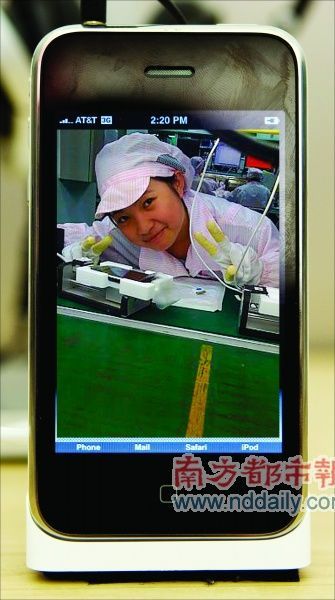
What happened to iPhoneGirl? One netizen claimed: "This girl is a quality control workers on the fifth floor of building CO3 of FoxConn in the Guanglanyuan district, Shenzhen City. After the photos were published, the girl was fired together with her colleagues and some managers."
(AFP) 'Beautiful mistake' makes China factory worker a celebrity.
A Chinese factory worker has become a celebrity after her smiling face was accidentally loaded onto an Apple iPhone and shipped to the other side of the world, her employer said Wednesday.
The unidentified worker flashed a smile and made a peace sign to a co-worker whose job was to test the device's camera in the southern city of Shenzhen, said a spokesman for Foxconn, which assembles the phones for Apple. The woman's colleague apparently forgot to delete the photo from the phone, which was sold to a consumer in Britain, who posted it on the Internet, Foxconn spokesman Liu Kun told AFP on Wednesday.
He said so far only one phone was known to be affected. "Small mistakes are unavoidable," Liu said. "I would call this a beautiful mistake."
The photo created a stir on Internet forums after the British consumer, who identified himself only as Mark M., shared his discovery on the MacRumors.com website. Some customers joked on the website that they were considering returning their phones because they did not come loaded with the woman's photo.
Liu said the factory worker was unsettled by the sudden fame after her photo appeared on websites and newspapers, and that her bosses had assured her that her job is safe. He said the company would not release her name or any details. "Even passers-by recognise her face and can't help noticing her," Liu said. "She is quite nervous right now because she never experienced this much attention."
The photo was taken in the testing department as part of normal procedure and no rules were broken, Liu said. He said Apple was very understanding and that the Taiwan-based manufacturer was working with the computer giant to prevent similar incidents from reoccurring. But that might come as a disappointment to some.
As one person wrote in an Internet post: "It would be great for every Chinese worker who makes your iPhones to take a snap of herself or her factory friends ... a hello from a person you would never otherwise meet. Globalisation in practise."
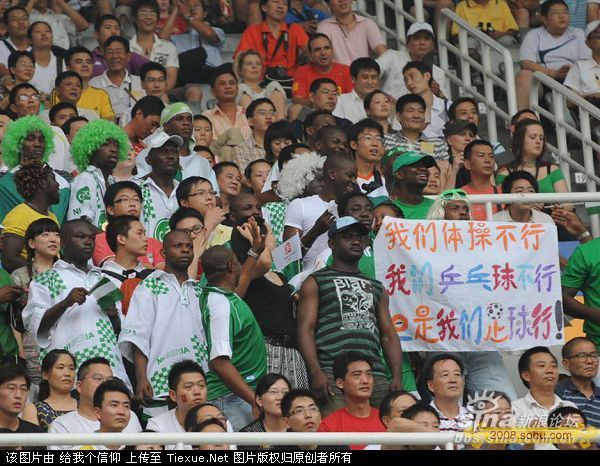
We are no good in gymnastics
We are no good in table tennis
But we are good in soccer!Thus wrote the Nigerian fans at the Beijing Olympics as they cheered their silver medal team even as the Chinese team bombed.
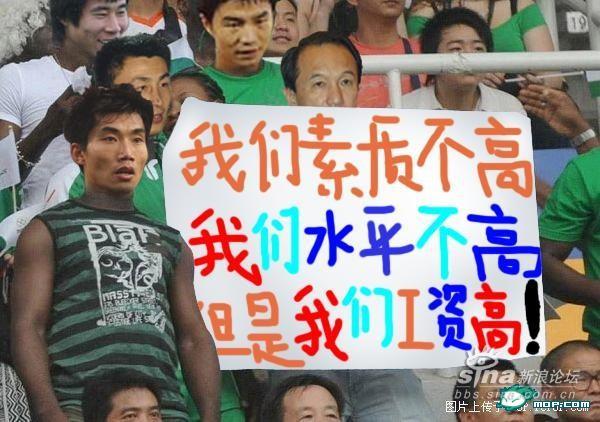
Facts are facts, and the Chinese netizens could not even come up with a wave of "hurt feelings." Instead, the most popular counter-post was this PhotoShop job:
We don't have good quality
We don't have good standards
But we earn high wages!
[Note: The transplanted faces are those of the director and players of the Chinese national soccer team]
The great Beijing Olympics might be over, but the great portals of China was continuing their own Olympics.
On the day after the Olympics, the three major ports all published their summary reports on their Olympic coverage.
Tencent (QQ): As soon as the Olympics began, Tencent quickly found that it was in a different league than its competitors. Its traffic volume became a test for itself." According to the the research studies conducted by the Tsinghua University Media Research Laboratory, the four major portals accounted for more than 60% of the Olympics-related traffic between August 9 and 22. Among the four, Tencent had a wide lead with as much as 1.85 time more than the second place portal.
Sina.com: The data from many authoritative Internet research companies showed that Sina.com once again established a legend with its Olympic coverage. During the Olympics, the number of users and page views at Sina.com led all the portals with an absolutely advantage. The numbers of users and page views are both 200% higher than the average of the four portals, and Sina.com stayed in the lead for 15 days in a row. Sina.com is the reporting champion among the Internet media.
Sohu.com: Various research data reports on Olympic coverage showed that the first choice among netizens is Sohu.com, while the second-place saw Sina.com and Tencent flip-flopping. 92.51% of netizens were satisfied with the Olympic coverage at Sohu.com. Sohu.com had a solid hold of first place among portals.
There is only one gold medal, so who gets to win? They can't all be number one? What happened to NetEase which did not release any statement?
Personally, I am inclined to believe that Tencent is number one. I need to use QQ every day. When I did that, the Olympic coverage appears on the personal page, the public notice bulletin, the mini home page and even underneath the chat window. Is it even possible not to see it? Of course, the other websites (Sohu.com, Sina.com, NetEase) have pop-ups, but nobody can rape you thoroughly as Tencent ...
Tencent was the first to issue an Olympic report card. Tencent cited data from Nielsen and Alexa. Nielsen claimed that among netzens age 18-30, 58% learned about the first gold medal through China, which was 44% higher than the next portal; Alexa's latest data showed that Tencent held first place among the top four portals with 1 billion page views per day (and that is record-setting among Chinese-language websites).
Sina.com used the data from ChinaRank of the China Internet Society to support its case. ChinaRank data showed that the numbers of users and page views at Sina.com was almost twice the averages of the four major portal. Sina.com also held the top position fifteen days in a row. According to this report, Tencent was second and Sohu.com was third. Sina.com also cited the data of netizens in 128 Chinese cities collected by CCTV's CTR research service to show that 39.68% of the netizens watched the Olympics via Sina.com, and that was easily tops among the major portal.
Sohu.com procued information from iResearch, Chinese Internet Network Information Center, CTR, wRating, DCCI Internet Data Center, Analysis, Tsinghua University Media Research Laboratory and ChinaRank to show that these different survey methodologies all showed that Sohu.com was the top choice for netizens. Sohu.com cited CTR data that showed that 76.7% of netizens used Sohu.com to search for Olympic information.
NetEase did not make a big case, but it claimed that it had more than 350 million hits on its Olympic videos, and that it was number one on unique users and page views.
If China does not apply to host the Olympics, they say that the European and American countries are rich and strong and they apply regularly whereas poor China can only watch from the sidelines.
If China applies to host the Olympics but loses out, they say that China should be embarrassed for applying when it is quite unqualified.
If China applies to host the Olympics and wins the bid, they say that China should be ashamed for expending its national resources on an image-building project.
If the opening ceremony in China is not good, they say that the director is lousy and the Chinese people are of poor quality.
If the opening ceremony in China turns out to be good, they say that billions of dollars were wasted on the spectacle.
If China runs the Olympics frugally, they say that the Chinese government is embarrassing the nation in front of the world by running the Olympics when it cannot afford to.
If China runs the Olympics lavishly, they say that the Chinese government is wasting taxpayers' money on the Olympics.
If we don't understand the opening ceremony held in a foreign country, they say that we don't understand other people's culture.
If we understand the opening ceremony held in a foreign country, they say that the foreign culture is just too grand and universal.
If foreigners don't understand the opening ceremony in China, they say that we are uncultured.
If foreigners understand the opening ceremony in China, they say that it must have been too shallow and superficial.Before the Olympics, they say that China won't get a lot of gold medals because the Chinese athletes are inferior to the Europeans and Americans.
If China gets too few gold medals, they say that China is a weak sports nation with frail people, whereas the Europeans and Americans have fine people who win plenty of gold.
If China gets too many gold medals, they say that it is due to a distorted system of sports administration and it does not prove that China or its people are strong.If foreign athletes game the rules, they say that it is smartness.
If foreign athletes do not game the rules, they say that it is strength.
If Chinese athletes game the rules, they say that China is very devious.
If Chinese athletes do not game the rules, they say that China is very stupid.If a foreign nation wins many medals in a sport, they say that the foreign athletes are gifted and strong.
If China wins many medals in a sport, they say that this is against the spirit of the games and that sport ought to be eliminated as an Olympic event.If a foreign nation does not administer/manage sports, they say that developed countries don't have to do so.
If China does not administer/manage sports, they say that China is backwards for not doing that.If foreign athletes pay for their own training, they say that this shows the sporting spirit without spending taxpayers' money.
If Chinese athletes pay for their own training, they say that China does not value sports.If a foreign nation wins only one gold medal, they say that it is just a gold medal which does not really matter.
If China wins only one gold medal, they ask how can China win only one gold when it has a population of 1.3 billion?If a foreign athlete makes a fundamental error, they say that the spirit of sports is about participation and losers can still enjoy the Olympics.
If a Chinese athlete makes a fundamental error, they say that the pressure was too big and Chinese athletes are not mentally ready.If a foreign athlete cries after winning a medal, they say that this is a genuine expression of the Olympic spirit.
If a Chinese athlete cries after winning a medal, they say that it is the result of the over-emphasis on winning medals.If the foreign athlete is a university student, they say that this is an amateur as distinct from the professional Chinese athletes.
If a Chinese athlete is a university student, they say that people should not be allowed to attend university solely on account of sporting talents.If a foreign athlete makes a TV ad, they say that this is a commercial activity which funds the training.
If a Chinese athlete makes a TV ad, they wonder how can any good results be achieved when money is the most important factor?If China wins too few gold medals, they say that China is not good enough.
If China wins too many gold medals, they say wonder what gold medals are good for and they want the money to be given to socially vulnerable groups.
If China wins too many gold medals, they say that the ranking should be based upon the total number of all medals because that is the true reflection of the sporting level.
If China leads in the count of total medals, they say that the ranking should be based upon the number of medals per capita because that is the true reflection of sporting level among the people.
If China leads in the number of medals per capita, they say that China has a national sports system and therefore China should be ashamed to compare itself against amateur athletes.In the end, China got the most number of gold medals. They say, "What the f*ck good is that to me? I am not getting a pay raise or a new house as a result."
[This is a very popular post because the phenomena are quite prevalent. But why should China care about what people say? That would happen only if China is unsure and insecure about its position in the world.]
[in translation]
There are only 12 days before the Hong Kong Legislative Council elections and the overall atmosphere is cool. If the elections do not heat up and the voter turnout becomes low, the situation will favor those political parties that are well-organized, hold loyal votes and can even bus the voters to the polling stations. Conversely, the situation would not favor those political parties that are unorganized and rely on the free will of the voters. Simply put, the former includes the Democratic Alliance for Betterment and Progress of Hong Kong, the Confederation of Trade Unions and other pro-establishment parties, while the latter are the pan-democratic political groups.
The reason why the election atmosphere is cool is mainly because the media had been focused on the Olympics and thus ignored the Legco elections which mean much more to the fate of the people of Hong Kong. The Olympics has ignited the self-pride of the people and this will no doubt help the patriotic political parties with respect to public opinion. For the three days beginning this Friday, the Chinese gold medalists will be in Hong Kong to extend the patriotic Olympic passions. The pro-establishment folks will use the gold medal mania to get exposure. By the time that the gold medalists leave Hong Kong, the Legco elections will just be a few days away. It is hard to say if there were political considerations in Beijing's decision to send the gold medalists to Hong Kong immediately after the Olympics were over.
The situation with the pan-democrats is very grim at the time. Apart from the Olympic effect, the pan-democrats have failed to coordinate their candidate lists. As a result, they look like loose sand particles and they end up attacking each other. A pan-democrat with a vote in hand does not know which list to vote for. This creates a situation that is favorable to the pro-establishment parties. Although there is some competition within the pro-establishment camp, the persons of authority in Sai Wan has mediated in the process, and organized voters are relatively more likely to obey their organizations. Therefore, their situation is more stable.
Let us take the case of Hong Kong Island as an example. The latest Hong Kong University Public Opinion Programme poll showed that the Regina Ip-Louis Shi list has gone past the Civic List of Tanya Chan-Audrey Eu for the first time. This means that both Ip and Shi will be elected, whereas the Civic Party may only have Tanya Chan while the goddess of democracy Audrey Eu may fail to be re-elected. For the Democratic Party, it is almost certain that only Kam Nai-wai will be elected while the veteran legislator Yeung Sum will not be elected.
Overall, the pan-democrats will have great difficulty in getting 21 combined seats in the geographical and functional constituencies. Some people even think that it would be hard to win 18 seats.
The incoming Legislative Council will determine the election rules to be enacted for 2012. The pan-democrats will need at least one-third of the seats in order to maintain veto power. If not, the government can offer a conservative plan for the 2012 Legislative Council elections, and this will create a Legislative Council that will render the 2017 and 2020 universal suffrage meaningless, thus rendering all the work that the Hong Kong people had done to strive for universal suffrage quite worthless.
Apart from the impact on the 2012 Legco elections, we should not ignore the role of the new Legislative Council to monitor the government. From the hiring of the political assistants through the taxes on the foreign domestic helpers to the Leung Chin-man affair, the government appeared to be lawless and careless, as well as indifferent to possible government-business collusion to exchange interests. The pro-government legislators opposed the establishment of a special investigative commission, and one of them even described the criticisms of Leung Chin-man as a "Cultural Revolution." This series of incidents showed that the current Legislative Council does not monitor the government adequately because there are some legislators in the functional constituencies who have no intention to monitor the government as well as other pro-government legislators who have given up the task due to political interests. If these two factions should become the majority in the Legislative Council, the pan-democrats will be unable to monitor effectively.
On the day before yesterday, the Catholic Monitors on Legislative Councillors issued a report that showed that among the ten Legco members with the worst records, only one of them (Lau Chin-shek) is a directly elected member and the other nine are from the functional constituencies. Amongst them, Timothy Fok was the worst for not having made any proposals seven years in a row. Lau Chin-shek was the only directly elected Legco member who did not make any proposals or amendments this year. Some Legco members also chose to disappear during voting time in order not to take positions on record. If the Legislative Council has to depend on these people to monitor the government, it would be crippled.
The Catholic Monitors on Legislative Councillors particularly lauded Yeung Sum, for being the only Legco member who had a zero non-attendance record. More ironically, six of the ten worst Legco members will be re-elected automatically whereas this lauded Legco member will be ousted in the upcoming direct elections.
The organizational structure of the Legislative Council is the result of the perverse election system. But even a bad law is still a law, and we should follow the law and use the votes in our hand to elect those Legislative Councils who are wiling to monitor the government.
Over the weekend, I went back to the family home. I did not anticipate that the hometown folks would be so enthusiastic about the Olympics. The conversations with my peasant father and uncles inevitably drift to the Olympics ...
In the evening, I wanted to watch Hu Yifu's program on Phoenix TV. Previously, I had watched the episode of the epic clash between Fan Meizhong and Guo Songmin with them, and my parents got interested in this program afterwards. They called it the "quarrelsome" program. But this time, I was vetoed. My younger sister strongly demanded that we watch the men's 10m platform diving, and my parents took her side. So I asked them, "What has the gold medal got to do with you?" Although no one was able to articulate, their determination to watch the Olympics could not be altered.
When I spoke to them about the Olympics, two figures are most frequently mentioned: Liu Xiang and Lang Ping. My maternal uncle was convinced that "Liu Xiang" was "rotten" for being a coward with no fighting spirit. As for Lang Ping and her American volleyball team, my mother's attitude during the USA-Japan match was that she would rather Japan win. Her reason was not just because Lang Ping coached the Americans to a win over China, but she should not have become a coach to any foreign national team.
...
So it would seem that the thinking of the home folks is still stuck in the pre-reform days. Please pardon me for thinking so and I have no prejudice. I am only citing the examples of my relatives -- their views are very much dichotomized -- things are either good or bad; it is either patriotic or not; one is either a winner or a loser ... I admire and I am touched by their simple patriotism, but I am worried about their single-minded and stubborn thinking.
So I relented. When the diving began, I stepped out of the house and looked at the starry night. It was extraordinarily quiet all around. This village in which I had lived for more than two decades did not appear to have changed at all. At night, the village quiets down to cover up all the conflicts between the desires for prosperity and stability. During the Olympics, they had more topics to talk about and this has diluted the usual discussion about state policies. This is no different from my experience and the history that I did not personally experience. They speak about Chairman Mao, Premier Zhou, Deng Xiaoping and the list of succeeding leaders, and their views never change. They begin with these views as the foundation, and they extend them to everything else including Liu Xiang, Lang Ping and the American women's volleyball team.
The notion of the nation is the only thing whose interests cannot be violated under any circumstance. They use Zhou Enlai as the standard because he was a good Premier of the people. Thus, all those who oppose Zhou Enlai or do not support Zhou Enlai are the enemies of the people. Of course, there are exceptions such as the descendant of a landlord who dissents on account of his personal experience during political campaigns.
The withdrawal of Liu Xiang is going to cause a huge negative effect. To my uncles, he lost a gold medal and therefore he deserves to be cursed out. As for Lang Ping, she was a "Chinese traitor" just as Ni Weiping said.
At the same time, my maternal uncle said something interesting about the opinion atmosphere around the Olympics. Opinion -- this was the actual term that he used -- he said that the opinions were well handled during the Olympics, as they were particularly imbued with "human character." I don't know where he perceived the "human character," but I can detect from my maternal uncle that public opinion around the Olympics this time was really well handled.
(BBC as quoted at Tianya Forum)
The dancing was a bit straggly in the " London " routine . After seeing all the cyclists taking part, the Chinese will think "Nobody can afford cars in London "
The British "teaser" was ok, but we were disappointed to see the performer in the wheelchair was not in fact disabled but was leaping around later in the dance.
Did anyone else this the 'London 8 minutes' presentation was - dare I say it - rubbish!? Leona sang her heart out on top of a ladder, on top of a bus whilst 20 contemporary dancers did their stuff way below. It was just so low key relative to what had gone on before it.
But oh, our offering at the closing ceremony was embarrassing. A red bus, a pop singer, an ageing rocker and an overpaid ball kicker was awful. Where was our great Island heritage portrayed in all this flummery? Organisers - please do better for us in 2012.Oh my the Chinese will be a hard act to follow. What a shambles the British effort was, very embarrassing indeed. A double-decker bus, beckham, an xfactor winner, a sweaty aging rock star, dancers with umbrellas throwing newspapers everywhere. I guess a good symbol of modern day Britain. I fear our efforts will always be second class to China. This might show new labour off for what they are and what they have done to our once great country
(Tianya Forum) Try to use one phrase to describe the 8 minute video from London.
Dancing demons
People running for their lives at the end of the world
Wasn't it longer than 8 minutes?
Really trash
Waste of time
Uninteresting
"Resident Evil"
I'm pretty dense because I don't understand it
A mess
No substance
No idea what it is saying
What was that?
Incomprehensible?
I watched those eight minutes and all my remaining anger against Zhang Yimou is gone ... director Zhang, I blamed you wrongly ...
Really pointless
Zombies on the march
I didn't understand it
Pointless and uninteresting
I waited a long time for becks to come up, he kicked a ball and then that was it?
I felt the eight minutes were chaotic ... I was hoping that Beckham would do more ... when they finished, I asked my dad, "What about the rest?"
The happiest person was the guy who got the soccer ball.
Londoners crowding onto a bus
The many umbrellas at the end tells the people around the world that it rains in London and they better bring their umbrellas when they come.
They are making a sarcastic statement about how people board buses in China, especially when it rains.
Cultural differences ... in any case, I didn't understand it. Who was that female singer?
She has very thick legs.
I watched it and I summarize it with one word: "Sorry!" Of course, I am saying sorry to Zhang Yimou whose own eight-minute video four years ago was unattractive but it was better than this London one.
Low cost zombie movie production
Those eight minutes were very artistic -- I am full of anticipation for the London Olympics
This type of post-modernism is not bad -- it is closer to real life than the art based upon waves of humans.
Street circus.
Very trashy, with a theater show + singing concert. No atmosphere. Demons dancing, but what is it saying?
Cheap ... they were saving money ...
Low cost, low degree of difficulty.
It reportedly cost 2 million British pounds (at 250,000 British pounds per minute).
So this is how the Brits squeeze onto buses ... so why do we Chinese bother with lining up in an orderly manner?
It would be better if they just passed out fish and chips.
You don't get it, do you? This harmonious performance is filled with passionate humanity. If you don't think that this is good, it only shows that your spiritual state has not reached a level where you can accept this most beautiful and precious light of universal values.
I congratulate you for attaining that spiritual state. May your family be the most beautiful and precious.
After watching China's closing ceremony, I have zero expectations for London. After watching those eight minutes, the feeling grew deeper. They are just not in the same class.
I wouldn't bother watching the London Olympics opening ceremony.
When I see that British girl stepped on the black man and the Indian to get on the bus, I feel that the Colonialists will always step upon the Colonies, and the Colonized People will never rise up.
There are too many foreign music concerts already ... too tiresome ...
I was left in a fog ...
They threw newspapers around to pollute the environment. They have no civic quality.
I think that is appropriate to the theme of an Olympics of youth. This is very youthful and it presents an ordinary view of London.
Do you think that ordinary citizens have the chance to audition to be actors in "Resident Evil"?
Very British, very London. The red bus is the symbol of the city of London. The performances were dramatic. Classical British-style rock 'n roll music. The bicycles are environment-friendly. The eight minutes presented the British symbols of modern culture, soccer, rock 'n roll music, etc.
(1) (Wikipedia)
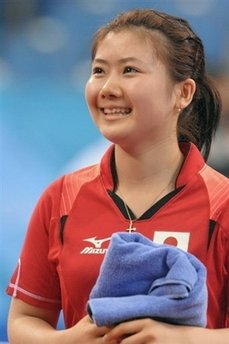
Ai Fukuhara is trained by her father and her coach, Chinese former table tennis player Liu Yang, and Japanese mother Chiyo Fukuhara.
That's interesting, but that's hardly enough. She needs looks and personality.
(2) (Wikipedia)
Her first name, Ai, means "love" and she is often referred to as "Ai-chan" (愛ちゃん) in Japan. Her youth and talent has made her a popular sports star in Japan, especially among young students.
But that is not necessarily going to make her popular in China, because Japanese teen idols are a dime a dozen and they don't play well in China.
(3) (Wikipedia)
Ai Fukuhara has appeared in two Japanese table tennis video games, including Ai Fukuhara's Table Tennis, released on June 24, 2004 and Got to do! Hot Spring Table Tennis!!) released December 21, 2001, both for the PlayStation 2.
No, these games are not popular in China.
(4) (SMH)
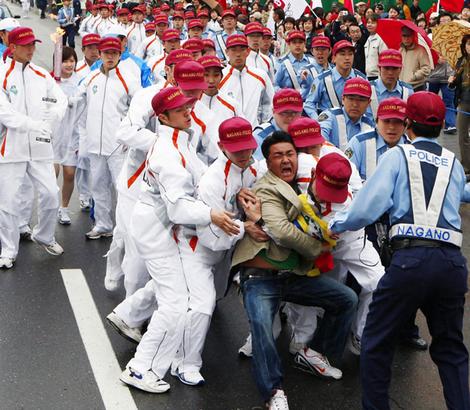
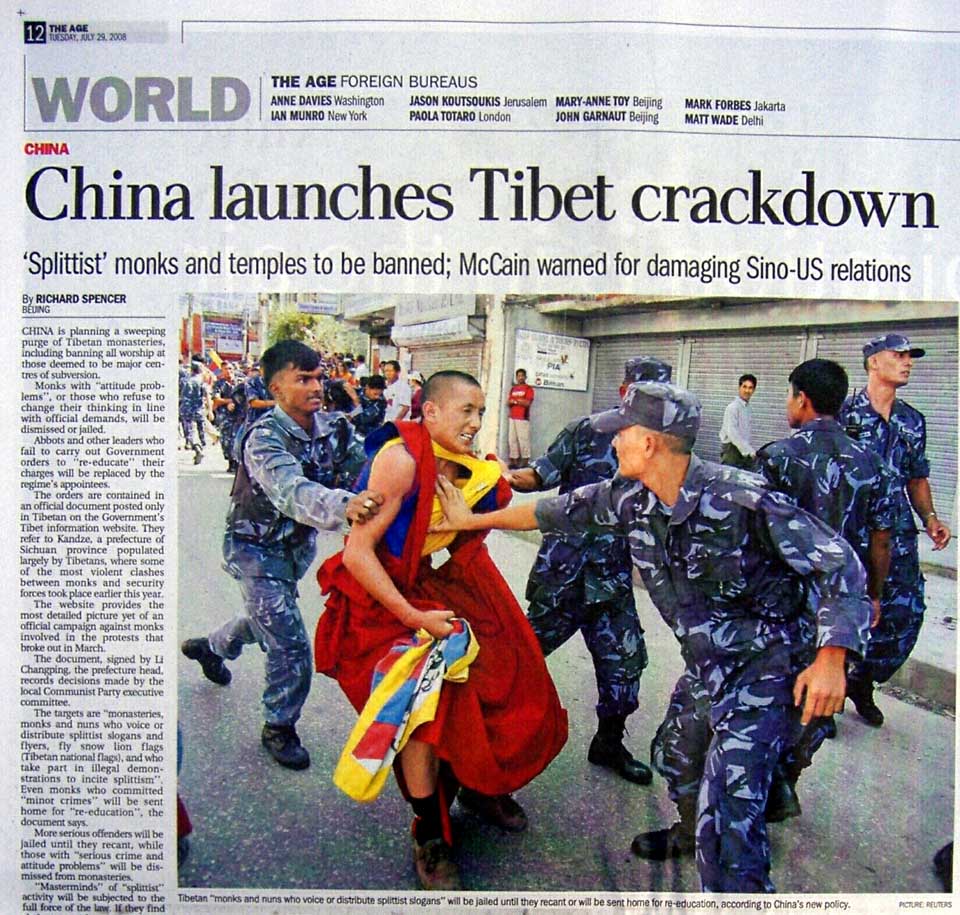
A man carrying a Free Tibet flag was arrested by security personnel when he tried to seize the Olympic torch being carried by Japanese table tennis player Ai Fukuhara.
No, this was not well-known in China.
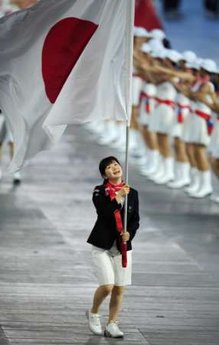
(5) Ai Fukuhara was the flag bearer for the Japanese delegation at the Beijing Olympic opening ceremony.
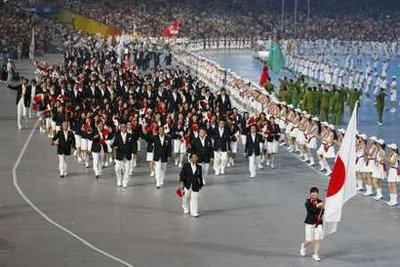
No, the Chinese will clap politely but they are not going to go head-over-heels over her just for that.(6) (Daily Yomiuri)
Ai Fukuhara's campaign at the Beijing Olympics ended Thursday with a one-sided loss to world No. 1 and defending champion Zhang Yining in the fourth round of women's table tennis. Although Fukuhara showed flashes of the brilliance that made her a child prodigy, the Japanese teen just couldn't match Zhang and fell 11-8, 11-2, 11-5, 9-11, 11-8 in 32 minutes.
No, everybody lost to "Sister Number One" Zhang Yining so there is no exceptionalism here.
(7) The real answer is this: Ai Fukuhara had trained with the Liaoning provincial table tennis team and she speaks fluent putonghua with a northeastern accent. Here is one netizen's recollection of his first encounter: "I was lying in bed listening to the audio of the television coverage of the Beijing Olympics. Some woman with a northeastern accent was being interviewed. She said that she was proud to be a flag bearer, and she looked forward to playing the top Chinese table tennis players. I remembered that Yao Ming had carried the flag for China. Who was this woman? I sat up and looked at the television screen. It was Ai Fukuhara! And she was so cute with her northeastern accent." That was how the "Porcelain Doll 瓷娃娃" Ai Fukuhara reached unimaginable fame in China.
How cute? Here is a video of an interview with Ai Fukuhara about the Sichuan earthquake. She was wondering if there was anything that she could do. It is alleged that at around the 32nd second of this video, Ai Fukuhara said in her northeastern-accented putonghua: "Japan sent 60 people over there. How the f*ck is that enough? (从日本去了60个人,那他媽哪儿够啊)" All of a sudden, the Chinese netizens see one of their own and even more endearing because no Chinese athletes would ever be caught using obscene language on CCTV!
"No opening is not ceremonious, no closing is imperfect, no speech is unimportant, no resolution is not passed, no praise is not lofty, no heart is not inspired, no leader is not attentive, no procedure is not smooth, no problem is not solved, no mission fails to exceed expectations, no accomplishment is not huge, no reception is not warm, no hostility is present between China and Japan, no negotiation is not serious, no conference ends in dissatisfaction."
The forum post <Latest discovery about CCTV's Joint News Broadcast> and its many variations have provided the greatest amount of amusement on the mainland Chinese Internet apart from the Beijing Olympics during the last two weeks. So let us guess whether the Joint News Broadcast next Monday will be along the following line -- here I mean the official government media's judgment of the Beijing Olympics: "The 29th Olympiad of Beijing was successfully completed after the closing ceremony on August 24. The Olympics were held successfully, and received high praises from the athletes, trainers and spectators from various nations."
...
The Beijing Olympics is the third one held in Asia, so it is easy to compare it against the 1964 Tokyo and 1988 Seoul Olympics. Apart from the sport feats, what are the achievements and legacies of the Beijing Olympics? That is an interesting question.
The achievement and legacy of the Beijing Olympics are a further consolidation of the governance of the Chinese Communists. In the hearts of the Chinese people, the Chinese Communist will become even more irreplaceable. The safely executed Olympics and the large haul of gold medals had been the goals of the Chinese Communist leaders, and they got those. They had complete management of all the aspects of the Beijing Olympics, and they controlled all the potential negative factors. Many reporters said that the most frequently heard phrase each day was: "This way, please." The athlete had to go from Point A to Point B, and every step has been carefully arranged beforehand. In the television coverage, the athlete receives a gold medal and goes to hug the trainers, friends and relatives. Within one minute, a hostess will stretch out her hand to invite the athlete back into the rest area. In the men's 10,000m race walk, an athlete collapsed on the ground after crossing the finish line. In 15 seconds, three workers came out to carry him off. These tight arrangements showed that there existed extremely detailed plans that seem more like the minute-by-minute itinerary of the president of the United States.
The Hong Kong citizens have seen how the Chinese Communists were adamant that nothing goes wrong with the Olympics. They saw how Ji Jingping lectured the Hong Kong SAR government officials over the Olympics. Apart from controlling the number of gold medals won by China, the all-powerful state apparatus controlled everything else. This degree of control is probably not ever going to be matched by any other city hosting the Summer of Winter Olympics in the future -- traffic congestion was controlled, air pollution was controlled, doping by athletes was controlled (note: Beijing was probably sorry to let Hong Kong handle the equestrian events because they would have made sure that the horses weren't doped), public safety was controlled, demonstrations were controlled and even terrorists were controlled. These broad, deep measures of governance could not be implemented by any country based upon a pure market economy. Can America do it (no, because someone will sue the government for interfering with personal freedom)? Can the United Kingdom do it (no, why would the proud Englishmen accept the directives issued by some haughty officials?)? Can Russia do it (no, because why would the terrorists listen to them?)? Can Japan do it (perhaps, because this is possible in another collectivist nation)? But the solid facts showed that only China can control everything from people to objects and from friends to enemies over the course of these 17 days.
It is not possible to accomplish all this with just a couple days of preparation. For sixty years, the People's Republic of China and its more than 1 billion population have been living this way. Things appear very chaotic, but there is an underlying system that decides everything. When a leader wants to visit a place, an order is issued and suddenly, the prostitutes are gone, the robbers are gone, the clothes hung out to dry are gone, and even the old man sleeping on the chair in the backstreet is gone. When American president Richard Nixon visited China in 1971 in the dead of winter, he was amazed that all the accumulated snow on the roadside from the airport to the city center had been swept clean. Henry Kissinger was amazed that Premier Zhou was reviewing the editorial of the next day's <People Daily>. The Beijing Olympics reflect the normal execution of Chinese Communist governance -- Lin Miaoke was cute-looking, so she got to stand on front stage; Yang Peiyi was losing her baby teeth, but her voice was good; the weather was bad, so electronic fireworks effects were shown on the television screen. It is all no big deal. Everything is premised upon on one saying: "The national interest is more important than all else." Yang Peiyi said that she didn't mind, the television viewers said it was alright to look at computer effects, and the minor inconvenience to the public during the Olympics reflects the dialectical relationship between the individual and the greater good.
Western societies emphasize individual freedom, whereas the Beijing Olympics holds a different view. It is hard to say which one is right. In the west, the individual is more important than the group; in China, the group is more important than the individual. The system determines the values, existence determines consciousness, and it is meaningless to debate which political system/culture is superior in the framework of the Beijing Olympics. Given that the Beijing Olympics was carried out successfully in both spiritual and material terms, the Chinese Communist collectivism showed that its system works at a certain point in time and space. As the Beijing Olympics come to an end, the 1.3 billion Chinese citizens are convinced more than ever about the axiom that "there is no new China without the Chinese Communist Party." They believe that only the Chinese Communist Party can carry out the Olympics, and the legitimacy of the Chinese Communist Party rule is now recognized and accepted by more people than before August 8.
For these reasons, the tears that Cheng Fei shed after falling off the beam and the decision by Liu Xiang to withdraw from his race were all the more valuable. The system could not control the emotions of a 20-year-old girl, and the system could not control the decision by a 25-year-old man. I will forever remember these two moments of human radiance from the Beijing Olympics.
In the case of the alleged money laundering activities by the family of former president Chen Shui-bian, former Executive Yuan Vice-president Chiou I-jen and family doctor Huang Fang-yen of the Shin Kong Hospital were interviewed by the investigators. Chiou and Huang came as witnesses and they are not suspected of any wrongdoing.
According to Chiou and Huang, former president Chen Shui-bian reported to the Central Election Commission that his election expenses for his two presidential election campaigns were NT$ 900 million and NT$ 1,200 million respectively. In truth, the actual expenditures exceed these numbers by vast amounts. In turn, the actual amount of campaign donations exceeded the actual expenditures by vast amounts too.
The witnesses stated that Wu Shu-jen would even interfere personnel decisions. Sometimes, the Democratic Progressive Party held a meeting and came to a decision. But Wu Shh-jen can turn the decision over on her say-so. Everybody in the Democratic Progressive Party knew that.
The witnesses stated that during the presidential campaigns, the election headquarters had six groups (including finance, administrative, organization and mobilization) under the chief executive. The campaign donations that the finance committee obtained were all turned over to former President Chen Shui-bian's wife Wu Shu-jen. Only Wu Shu-jen knew the total figure of the campaign donations.
Although Huang Fang-yen held the title of convenor of the finance committee, he told the prosecutors that he was just a figurehead and all monies were turned over to Wu Shu-jen.
Some people contributed in cash and some people don't even need receipts. When people donate cash, the campaign headquarters forwarded the money to Wu Shu-jen. When donors demand receipts, the campaign headquarters forward the request to the Democratic Progressive Part headquarters, but the money was turned over to Wu Shu-jen.
When Wu Shu-jen was interviewed by the prosecutors on Aust 22, she had a similar explanation. But she claimed that she cannot remember the total amount of campaign contributions for the two Taipei city mayoral campaigns and the two presidential campaigns.
But the investigators believe that it is impossible not to keep a record when there is so much in campaign donations. Although Chen Shui-bian and others have said that they want to cooperate in the investigation, Wu Shu-jen has not produced the financial books and account information to the investigators.
Concerning the role of Huang Fang-yen, he admitted to wiring USD 1.77 million and NT$ 70 million to Singapore. It is rumored that these two sums (which total NT$120 million) was the commission for Huang Fang-yen for introducing special interest financial groups to Wu Shu-jen and getting involved in the SOGO ownership affair. But Huang denied that today. He said that his family is wealthy and that the NT$120 million belongs to himself.
(TVBS)
According to former Legislator Shen Fu-hsiung, "If Wu Shu-jen sent word down, nobody can talk to her. If we encounter a problem which requires an answer from Wu Shu-jen, people will push the assignment back and forth. So who ended up going to talk to her? It was Huang Fang-yen. So he went to talk to her and he came back and told us what happened. He said, 'I went to talk to her and she didn't care. Or else she is clipping her nails and saying 'I know ... I know what you want to ask and I am telling you no way ...''"
(TVBS)
Former president Chen Shui-bian issued a press release through his office. He said that his son Chen Chih-chung worked hard to be accepted by the University of Virginia Law School, got registered and even obtained his student identity card. But the Taiwan reporters went to the school and told the administration that this student must not allowed to attend. To avoid the hassle, the university administration informed Chen Chih-chung that he will not be allowed to study. So Chen Chih-chung lost his chance to study.
(TVBS)
The media went back to ask the University of Virginia administration, which emphasized that the answer was the same one that they already provided on August 20. At the time, the university said that Chen Chih-chung did not register or attend new student orientation. The university spokesperson said: "Mr. Chen did not attend the orientation for new students and therefore he cannot register as a student.
The media also reported that the tuition fees that Chen Chih-chung will be refunded to him after his failure to register. The university administration denied that there was any media pressure.
The university administration said that after Chen Chih-chung paid the tuition fees, the university assigned him a computer ID number. But that is not the same thing as a student ID number. The university administration emphasized that the Chen family had it wrong because if Chen Chih-chung still wants to study at the University of Virginia, he'll have to re-apply next year.
(The Age) China Launches Tibet Crackdown. Richard Spencer, Beijing. July 29, 2008.
CHINA is planning a sweeping purge of Tibetan monasteries, including banning all worship at those deemed to be major centres of subversion.
Monks with "attitude problems", or those who refuse to change their thinking in line with official demands, will be dismissed or jailed.
Abbots and other leaders who fail to carry out Government orders to "re-educate" their charges will be replaced by the regime's appointees.
The orders are contained in an official document posted only in Tibetan on the Government's Tibet information website. They refer to Kandze, a prefecture of Sichuan province populated largely by Tibetans, where some of the most violent clashes between monks and security forces took place earlier this year.
The website provides the most detailed picture yet of an official campaign against monks involved in the protests that broke out in March.
The document, signed by Li Changping, the prefecture head, records decisions made by the local Communist Party executive committee.
The targets are "monasteries, monks and nuns who voice or distribute splittist slogans and flyers, fly snow lion flags (Tibetan national flags), and who take part in illegal demonstrations to incite splittism". Even monks who committed "minor crimes" will be sent home for "re-education", the document says.
More serious offenders will be jailed until they recant, while those with "serious crime and attitude problems" will be dismissed from monasteries.
"Masterminds" of "splittist" activity will be subjected to the full force of the law. If they find shelter at another monastery, its management committee, even if appointed by the Party, "will be considered a supporter and protector of splittists and disruptive elements". This threat suggests the Government may be having difficulty controlling its own appointees in monasteries.
The most drastic action is promised against monasteries where a substantial percentage of monks are involved in protests. "All religious activities at the monasteries will be halted," it says. "Movements of monks will be closely monitored."
All monks or nuns at these monasteries will be required to "re-register". Those who fail loyalty tests will be dismissed and their accommodation demolished, the document says.
China has warned US presidential candidate John McCain to stop "supporting and conniving with" the Dalai Lama, saying that his meeting with the Tibetan spiritual leader hurt Sino-US relations. The call came after the Republican nominee met the Dalai Lama on Friday during the Tibetan's visit to the United States, and praised him as a "transcendent international role model and hero".
"China is seriously concerned about the report," foreign ministry spokesman Liu Jianchao said, according to a statement on the ministry's website, adding that the Tibet issue was a Chinese domestic affair.
Mr Liu urged Americans to recognise that the Dalai Lama was trying to separate China and was aiming to destroy social stability in the country's western region "under the cloak of religion".
They should "stop supporting and conniving with the Dalai Lama and the separatist forces for 'Tibet independence'," a tactic Mr Liu said was damaging Sino-US relations.
Senator McCain has criticised China's record on human rights in Tibet, which was thrown into the international spotlight in March during a crackdown on protests against Chinese rule that began in the capital, Lhasa.
The protests spread to other parts of China that have Tibetan populations, with the government-in-exile saying 203 Tibetans were killed in the crackdown.
Beijing insists that only one Tibetan was killed, and has in turn accused the "rioters" of killing 21 people.
China has ruled Tibet since 1951, a year after sending in troops to "liberate" the remote Himalayan region.
The Dalai Lama fled his homeland in 1959 following a failed uprising and has since lived in exile in India.
China accuses him of being a separatist, but he insists he does not want independence for Tibet, seeking only greater autonomy and an end to religious and cultural repression.
Now Anti-CNN.com has an actual scan of the print edition of the same article:
The caption for the photo: Tibetan "monks and nuns who voice of distribute splittist slogans" will be jailed until they recant or will be sent home for re-education, according to China's new policy.This Reuters photo shows police officers in Nepal, which is not part of China.
In Chinese, there is a saying 画蛇添足 (Draw a Snake and Add Feet to It). It means going too far is sometimes worse than not going far enough. Whatever point there was in the article is now completely overwhelmed by the fakery. The photo did not come from the reporter Richard Spencer; it came from an over-enthusiastic page editor for The Age who thought that the boring text needed to be brightened up with a powerful image.
The Democratic Progressive Party spokesperson Cheng Wen-tsang announced the results of a public opinion poll conducted on August 20-21. The sample consisted of 896 respondents age 20+ who were selected by random digit dial from the telephone directory with the last two digits randomized.
With respect to whether the judicial departments were handling the money laundering case of Chen Shui-bian case in a fair manner,
Yes: 38.7%
No: 46.0%
Among the pan-greens, the NO% is 69%; among pan-blues, the NO% is 37.9%; among the independents, the NO% is 40.9%.Cheng Wen-tsang said that there were a lot of unconfirmed information from the investigation of the state affairs fees case to the money laundering case. The allegations coming from certain political figures and media outlets make one wonder whether justice is being served. Cheng Wen-tsang said that Taiwan abides by the rule of law and the ability of the judiciary to make independent judgments reflect Taiwan democracy. When the judiciary is unfair so that even ex-presidents are unprotected by the legal process, then how can the world see that Taiwan has democracy with rule of law.
Concerning the detailed disclosures of the details of Chen Shui-bian's money laundering activities by KMT legislator Chu Yi, Cheng Wen-tsang said that Chu simply makes these allegations first. If Chu Yi really has the evidence, he should turn it over to the prosecutors; if the information aired by Chu Yi invades personal privacy, then he is guilty of violating the banking laws.
[ESWN Comment: This is a bit perplexing. If you ask "Is Chen Shui-bian being dealt with fairly by the judiciary?" and the answer is NOR, what do you think? There are actually two possibilities: (1) he is being given a raw deal by the KMT-dominated judiciary; and (2) he is being given a sweetheart deal that would never happen to an ordinary citizen who would have been tossed in jail with the key being thrown away. This poll does not appear to make the distinction.]
(The Times) International Olympic Committee launches probe into He Kexin's age.
The International Olympic Committee has ordered an investigation into mounting allegations that Chinese authorities covered up the true age of their gold-medal winning gymnastics star because she was too young to compete.
An IOC official told The Times that because of "discrepancies" that have come to light about the age of He Kexin, the host nation’s darling who won gold in both team and individual events, an official inquiry has been launched that could result in the gymnast being stripped of her medals.
The investigation was triggered as a US computer expert claimed yesterday to have uncovered Chinese government documents that he says prove she is only 14 - making her ineligible to compete in the Olympics - rather than 16, as officials in Beijing insist is her age.
Mike Walker, a computer security expert, told The Times how he tracked down two documents that he says had been removed from a Chinese government website. The documents, he said, stated that He’s birth date was January 1 1994 - making her 14 - and not January 1 1992, which is printed in her passport.
...
The man who uncovered the allegations about the underage athlete told The Times that he was not even a sports a fan, but decided to investigate the issue to determine if Chinese authorities were lying. He eventually discovered that two Excel spreadsheets on the Chinese government’s official sports website - www.sport.gov.cn - that mentioned her name had recently being removed.
"There was a conclusion here," Mr Walker said. "These documents existed, on a state-wide website, and now they don’t exist, and this change has taken place recently. I was interested because these were documents that no-one could find. If there’s information to be found on the internet I’m a citizen journalist - it was a challenge."
He turned to a Chinese search engine, Baidu. In its cache he found both documents. "The listing in there, quite clearly, is He Kexin’s birth date, January 1, 1994," Mr Walker said.
That makes her 14 years and 220 days old and too young to compete. The lists were compiled by the General Administration of Sport of China.
...
Under his blog name Stryde Hax, Mr Walker wrote: "Much of the coverage regarding Kexin’s age has only mentioned ‘allegations’ of fraud, and the IOC has ignored the matter completely. I believe that these primary documents, issued by the Chinese state ... rise to a level of evidence higher than ‘allegation’. How official are these documents? Pretty dang official - they were issued by the General Administration of Sport of China."
(Washington Post) This 'Inquiry' Falls Flat. Sally Jenkins. August 23, 2008.
Even in the best possible interpretation of events -- set aside your suspicions of whitewashing and collusion, and give everyone, including the blameless gymnasts, the benefit of the doubt -- Olympic officials engaged in a head swiveling process on Friday that left everyone confused and no one satisfied. First, the IOC requested that the International Gymnastics Federation (FIG) conduct an "inquiry" into the ages of the Chinese girls because "of a number of questions and apparent discrepancies," according to IOC spokeswoman Giselle Davies. Just a short time later, after expressions of indignation by Chinese coaches and officials, and before FIG had so much as issued a statement, the IOC announced itself satisfied that there was no wrongdoing. Huh? It was like a jury reaching a verdict during opening statements. Then, FIG announced late Friday evening that it had requested additional documentation on the ages of five Chinese gymnasts from the Chinese Gymnastic Association. The one thing we couldn't find in all of this intrigue was transparency.
(NBCOlympics.com) Sweet 16? Really? Alan Abrahamson. August 22, 2008.
...
The U.S. Olympic Committee's chief executive, Jim Scherr, said it had on Friday sent a letter to FIG and to the IOC making sure the issue is "put to rest one way or the other."
To be clear:
The IOC has not ordered a formal "investigation" or even launched a formal "inquiry." The Friday report from London completely mischaracterizes such a process as well as the IOC's role in the course of such an action.
If the IOC had launched an "investigation," it would likely have named the members of such a commission as well as the persons of interest in such an inquiry. It did no such thing.
Nor could it have done such a thing. The way any such process plays out is that questions of age eligibility would be first directed to FIG.
If the IOC were dissatisfied with whatever findings FIG made, then the IOC could take the next step of perhaps launching its own follow-up inquiry.
Again, the IOC has done no such thing.
"You shouldn't regard this as some sort of formal investigation," Davies said, instead saying the IOC had informally gone to FIG about "apparent discrepancies."
Intriguingly, the matter appears to be of interest primarily to media from English-speaking media outlets, in particular American outlets. This shows no signs of becoming a consuming whirlpool like the figure-skating judging scandal at the 2002 Salt Lake City Winter Games.
For more than 20 years now, since the 1980s, every dodge, every ruse, every trick imaginable has been tried to show that this gymnast or that meets the age rule -- first 14, then 15 and, since 1997, 16.
In gymnastics circles, they still talk about Kim Gwang Suk of North Korea, the gold medalist on uneven bars in 1991. She was listed as 15 for three years in a row -- and North Korea barred from the 1993 world championships.
Moving past the outrage for a moment, consider this. The Chinese would run the risk of a major embarrassment at their Games by making the elemental mistake of posting the purportedly "real" ages of underage gymnasts on an online registration list that's accessible publicly?
And leave it there to be discovered by an American running, as the Times of London account relates, a Chinese search engine?
Does that make sense?
The truth in this instance may forever prove elusive.
(Associated Press) Gymnasts' parents 'indignant' over age questions. Nancy Armour and John Leicester. August 22, 2008.
China coach Lu Shanzan said the parents are "indignant" over persistent questions about their daughters' ages.
"It's not just me. The parents of our athletes are all very indignant," Lu said. "They have faced groundless suspicion. Why aren't they believed? Why are their children suspected? Their parents are very angry."
In an interview with The Associated Press, Lu said Asian gymnasts are naturally smaller than their American and European rivals.
"At this competition, the Japanese gymnasts were just as small as the Chinese," he said. "Chinese competitors have for years all been small. It is not just this time. It is a question of race. European and American athletes are all powerful, very robust. But Chinese athletes cannot be like that. They are by nature that small."
He said the governing body of gymnastics was given additional documents Thursday night to try to dispel lingering questions. Those documents included He's current and former passport, ID card and family residence permit. Lu said the documents all say she was born in 1992, which would have made her eligible to compete. Gymnasts must turn 16 during the Olympic year to be eligible.
"Surely it's not possible that these documents are still not sufficient proof of her birthdate?" Lu asked. "The passports were issued by the Chinese Foreign Ministry. The identity card was issued by China's Ministry of Public Security. If these valid documents are not enough to clarify this problem, then what will you believe?
"The Chinese government and the Chinese athletes must be respected," he added.
The coach dismissed Chinese media reports and online records that suggested that He, Yang and a third team member, Jiang Yuyuan, might be as young as 14.
"If you trust every Web site but not a government...," he said. "There are so many Web sites, so much hearsay. These are not official. It is possible that all news on the Internet is accurate?"
The federation has said repeatedly that a passport is the "accepted proof of a gymnast's eligibility," and that China's gymnasts have presented ones that show they are age eligible. The IOC also checked the girls' passports and deemed them valid before the games began.
Related Link: Hack the Olympics! Stryde Hax
[Uncivilized behavior] "It does not matter. It was a breakthrough for you to reach the semi-finals. Last time, you did not even get through to the second round ..." Shi Dongdeng had just tried his best and fell down on the ground after lunging at the finish line of the 110m high hurdles semi-final race, and here was CCTV reporter Dong Rinei telling him that. Is there even a hint of encouragement? Is there even a hint of human feeling? Shi Dongfeng was unhappy about missing the finals by just 0.02 seconds, and this type of interview was like rubbing salt in the wound. No wonder public reaction against Dong Rinei was uniformly bad.
[Recommendation] The withdrawal of Liu Xiang placed a lot of pressure on Shi Dongpeng. Under these circumstances, he tried his best to win. The interview should have given Shi Dongpeng some human concern This race result was foreseen and acceptable by the Chinese audience, and Dong Rinei could have started by asking about his race condition and technical execution. Then she should offer him some comfort and encouragement. For a female reporter, I believe that something like "You have tried your best and the Chinese people thank you" would not be out of place. She has plenty to improve upon.
[Uncivilized behavior] As a four-time Olympian, shooter Tan Zongliang has received extraordinary attention. Of course, everyone hopes that this 40-year-old man can have a good ending to his Olympic career. The outcome was that he received a bronze medal in the 50m pistol event (which was then promoted to a silver medal when a North Korean athlete was found to have taken banned substance). This should be a positive event, but the reporter asked: "You have tried hard for more than twenty years and you took part in four Olympics. But you only have one bronze medal to show. Do you think that you have let the motherland down?" Is this person a reporter or a hoodlum trying to pick a fight?
[Recommendation] The Olympic spirit is about participation and surpassing yourself. But some people prefer to use the gold medal to determine success/failure. It is one thing for ordinary people to think so, but not from a reporter who is supposed to guide public opinion. Praise should have been the first thing for an athlete who strove for twenty years. Under these circumstances, the opening remark should be something like: "Congratulations, Tan Zongliang. After receiving gold medals at the World Cup and Asian Games, you have finally received an Olympic medal to round out your dreams over more than twenty years." This is not flattery, but it is a way of reducing the distance between you and your interviewee and this will make the ensuing discussion more relaxed.
[Uncivilized behavior] Yesterday, the female synchronized swimming duo Jiang Wenwen and Jiang Tingting set history by finishing fourth with a score of 48.250. Previously, the best Olympic result for Chinese swimmers was seventh place, so this was a remarkable achievement. But during the post-event interview, a female reporter asked: "Are you sorry that you did not win the bronze medal to comfort the earthquake victims in Sichuan?" This was unexpected, far-stretched and incomprehensible. This caused the duo to break into tears. The tearful reply of "We have no regrets" was a good answer, but this reporter probably cannot say the same about herself for asking this question.
[Recommendation] It is regretful not win the bronze medal, but finishing fourth is something to celebrate too. If you don't like it, you should keep it to yourself. There is no need to bring it up at this moment, and it was uncalled for to bring in the Sichuan earthquake disaster. For the young duo, congratulations and praises (and not sarcastic remarks) will make them become better in the future.
[Uncivilized behavior] In the women's 3m team diving, Guo Jingjing and Wu Wenxia defeated their greatest rivals. At the press conference, a reporter tried to stir up trouble by asking: "Do you feel sorry about being athletes who live in the same era as Guo Jingjing?" Fortunately, the Russian veteran Pakhalina was not paying attention and did not hear the translated question, and Guo Jingjing waved her hand to put a stop to this.
[Recommendation] Does this reporter not understand the nature of sport competitions and the basic principles of mankind? In competition, everybody wants to finish first. Vitality comes from the competition. This Russian girl has defeated Guo Jingjing before in the grand prix meets. It is one thing to write a commentary like that. But to ask someone this question directly is an insult. Precisely because Guo Jingjing exists, Pakhalina is motivated to surpass herself every time. As the Olympics come near the end, we hope to see fewer stupid questions. Just as in Olympic competition, reporters come in different kinds of quality. You can be unprofessional, but you should at least try to be civil when you ask questions.
[Uncivilized behavior] After working hard for almost 10 years, the "Devil's coach" Kim Chang-back has molded a powerful Chinese field hockey team. During the press conference after the semi-final match, the South Korean TV channel SBS reporter caused Kim to hit the roof. "I heard that the Chinese people describe you as China's Hiddink. Do you like the title?" "No Chinese person calls me Hiddink. I am Kim Chang-back whom 1.3 billion Chinese people respect! Please go back and explain it in South Korea. The Chinese people dot no call me Hiddink. They only know me as Kim Chang-back." The normally terse Kim broke his rule this time because of the poor question from a reporter.
[Recommendation] Kim Chang-back brought what used to be a weak Asian team to the Olympic finals. The Korean media which had criticized him once up on a time must feel bitter. This question itself is not necessarily going too far. But the South Korean reporter did not do his homework and directly opened his mouth at the press conference because he thought that comparing Kim to Hiddink is an honor. Kim had cause to be angry because he is a legendary coach in women's field hockey and any comparison is erasing his accomplishments (especially when that comparison had not been made before). Therefore, we recommend that reporters should do their homework before going to press conferences.
Through the first nine days of these Olympics, a few truths have emerged:
*U.S. athletes are performing well in the sports their country traditionally cares about.
*Chinese athletes are doing well in the sports their country traditionally cares about -- plus a few in which they have created instant tradition based on recent success.
"What we have here is a parallel Olympics," said David Wallechinsky, author of The Complete Book of the Olympics. "We in the United States are focused on swimming [the U.S. won 12 of 32 golds; China, just one], track and field and basketball. And we hardly notice that China just won five gold medals in sports like badminton, shooting and women's weightlifting."
That's the payoff from China's investment in Project 119, which identified 119 events with medal potential. After Sunday's action, China leads the U.S. 35-19 in gold medals....
An everything-goes-right view of the second week has the United States winning 31 gold medals for a total of 48, a whopping 12 more than the U.S. performance in Athens. China won 32 golds at those Games. Expect China to add to its total with three more golds in table tennis, three in diving and one or more in boxing and gymnastics, with others possible in canoe-kayak and track and field.
When it's all done, and if everything goes the U.S.'s way, that leaves the projected total at:
U.S. 48.
China 45.
Remember, that's only if everything goes the U.S.'s way. Just think how bad it might look without Michael Phelps.At the end of Thursday (August 21), the gold medal tally is 46 for China and 29 for the U.S. The U.S. is down by at least two in the predicted total because their 4x100m relay teams dropped their batons and were disqualified.
Someone told me about the Olympic medals list in the New York Times in order to provide American media are being picky in order to ensure that the United States would be ahead of China. I think that this has to do with what you think is important: gold medals? or all medals? If the New York Times wants to talk about medial winners, then all those who get on the awards podium should count. Meanwhile, if the Chinese media call it a gold medal list, then they are not wrong either. Still, it is interesting on this issue that the individualist western world has the eastern collectivist consciousness, whereas the collectivist China values individualistic achievements.
The first time I got angry was during the 200m women's butterfly race. China took the gold and silver medals. Afterwards, the swimmers got out of the pool. But the camera stayed on the gold medalist and I could not spot the silver medalist at all. In truth, this runner-up also broke the world record!
I have watched television for many days, including how other television channels are covering the Olympics. I found out all the interview programs only want gold medalists. The honor roll does not include silver or bronze medalists, even if a Chinese person set a historical first in a sport that Chinese were not good at.
People only pay attention to gold medalists while ignoring other medalists. They pay attention to certain sports, while ignoring other sports. Is this a case of the media trying to accommodate popular tastes, or the media defining the market for the people? The media response to the withdrawal of Liu Xiang made me think about a different problem. Could the Chinese audience be more mature than the media in making the program choices? Or are the media choosing what they think people should consider important, or they think that their own views coincide with the views of the people and therefore they impose them?
I also observed another interesting thing. When the media reported on the race results, they say that so-and-so painfully lost the gold medal instead of saving that so-and-so won a silver media. Perhaps the media think that the latter statement does not attract eyeballs. But it is also possible that the media editors actually feel that way. Some Chinese athletes also feel that way when they keep feeling low about the gold medal that they didn't get.
It is natural in China that athletes should feel that way. Without that gold medal, you do not get the attention of the media. Without the media, you do not get the attention of the people. In this economic society, fame is directly related to economic interests. This is the reality. The reward money that comes with winning a medal is not important. It is the ensuing economic gains that are important. Therefore the attention that the media pay to the gold medalists make sure that the advertisers are interested in the gold medalists. For the public, these advertisements are forced upon them and they don't really care who is featured in them.
Background: Confusing Olympics Medal Standing Life's Happenings
(Ming Pao; Southern Weekend) The Enlightening Lesson From Teacher Chen Shui-bian By Leung Man-tao.
It turns out that Chen Shui-bian is a teacher, and he has unexpectedly delivered an enlightening lesson to Chinese people everywhere.
Ever since the disclosure that Ah Bian shipped money off to Switzerland, there have been daily breaking news stories. The storyline is more interesting than any movie. His die-hard loyalist supporters either changed their hearts, or else they hung their heads low in abjection. The most noteworthy is the speech from his former loyal aide and current Democratic Progressive Party chairwoman Tsai Ing-wen: "So the past rumors has proved to be true ... everybody trusted the authority and power of Ah Bian too much. We turned everything over to Ah Bian and we gave up our own ability to think and judge. This resulted in a situation in which the mistakes of one person has become a crisis for the Democratic Progressive Party."
Over the years, there have been numerous scandals and rumors around the Chen Shui-bian administration. So why did Tsai Ing-wen and the Democratic Progressive Supporters not become suspicious? Is it really because they trusted him too much? The reason why they "gave up their own ability to think and judge" is less because Chen Shui-bian was too powerful and charismatic and more because of a series of broader basic reasons. Here there may be the partisan feeling of being in the same boat, or a co-conspiracy that outsiders cannot easily discern; more importantly, it is a blind spot in a certain way of thinking.
As the Taiwan commentator Nanfang Shuo said, the eight-year rule of the Democratic Progressive Party has ripped Taiwan society into two halves by a clearly defined axis: Do you love Taiwan or not? Your support for Chen Shui-bian shows that you love Taiwan; conversely, if you don't support Chen Shui-bian, then it is proof that you don't love Taiwan. The establishment of this axis was not made by Chen Shui-bian alone, nor even his core group. It is something based upon the populist sentiments of "localism." Chen Shui-bian's team merely linked together the fear of Communist China, the increasingly narrow localist tendency and the commercial operations of certain media outlets.
"Love Taiwan" is not just the banner of the Democratic Progressive Party government. It is also the banner for many "underground local radio stations." Anyone who has listened to those kinds of radio programs know how they discuss issues. Any criticisms and doubts about the government, no matter how small, are easily branded as pan-blue bigotry or even conspiracy, and that the people who raise these questions must be pan-blue fellow travelers. The pan-blues don't love Taiwan, they love Chinese Communists and they are Taiwan traitors; therefore, the true purpose why they raise challenges and doubts is that they are betraying Taiwan.
In this discussion climate, all issues are transformed into the fake issues of "Do you love Taiwan or not?" and "Are you a Taiwan traitor or not?" You believe that the 3/19 shooting has not been satisfactorily solved? Then you must not love Taiwan. You feel that Ah Bian's wife Wu Shu-jen should appear for a court hearing after receiving a summons? Then you must want to destroy Taiwan. When business people pointed that the government's economic policies were a mess, they were suspected with having been paid off by the Chinese Communists. If you have to ask a question, you must preface it with a declaration of your loyalty; any criticism is like a fist hammering into a bale of cotton with no impact. So the social discourse becomes as empty as a desert. When discourse is useless, how could society not spin around and around with no forward progress?
Why do these people "give up their ability to think and judge"? Actually, they did not give it up; instead, they just reduce all issues to one single issue and all judgments into one kind of value judgment. That is the sickness of the majority of the supporters of Chen Shui-bian.
In retrospect, hasn't the civic discourse in mainland China shown a similar kind of tendency? The dividing line is vaguely discernible in that either you are a "leftist angry youth" or a "rightist angry youth." This is certainly true for politically sensitive issues. Sometimes, this happens even the simple case of teacher Run Run Fan escaping for his own life first during the earthquake. Even the discussion of a practical issue such as how to clean up a polluted river ends up as an abstract showdown over whether you are patriotic or not. If you express a dissenting view, you are viewing the issue like foreign media and therefore you are a foreign lackey who does not love China. Conversely, if you agree with a certain government policy, then you are a brain-washed angry youth. Under this environment, it becomes a nearly impossible mission to hold a discussion objectively on anything.
If everything is raised to the level of patriotism, then what is there left to talk about? If all issues are simplified into a single issue, then what can we learn? How we use "our ability to think and judge"?
Archives
- August 11-20, 2008
- August 1-10, 2008
- July 21-31, 2008
- July 11-20, 2008
- July 01-10, 2008
- June 21-30, 2008
- June 11-20, 2008
- June 01-10, 2008
- May 21-31, 2008
- May 11-20, 2008
- May 1-10, 2008
- April 21-30, 2008
- April 11-20, 2008
- April 1-10, 2008
- March 21-31, 2008
- March 11-20, 2008
- March 1-10, 2008
- February 21-29, 2008
- February 11-20, 2008
- February 1-10, 2008
- January 21-31, 2008
- January 11-20, 2008
- January 1-10, 2008
- December 21-31, 2007
- December 11-20, 2007
- December 1-10, 2007
- November 21-30, 2007
- November 11-20, 2007
- November 1-10, 2007
- October 21-31, 2007
- October 11-20, 2007
- October 1-10, 2007
- September 2007
- August 2007
- July 2007
- June 2007
- May 2007
- April 2007
- March 2007
- February 2007
- January 2007
- December 2006
- November 2006
- October 2006
- September 2006
- August 2006
- July 2006
- June 2006
- May 2006
- April 2006
- March 2006
- February 2006
- January 2006
- December 2005
- November 2005
- October 2005
- September 2005
- August 2005
- July 2005