Amid a growing national controversy about the gesture U.S. Supreme Court Justice Antonin Scalia made Sunday at the Cathedral of the Holy Cross, the freelance photographer who captured the moment has come forward with the picture.
“It’s inaccurate and deceptive of him to say there was no vulgarity in the moment,” said Peter Smith, the Boston University assistant photojournalism professor who made the shot. Despite Scalia’s insistence that the Sicilian gesture was not offensive and had been incorrectly characterized by the Herald as obscene, the photographer said the newspaper “got the story right.” Smith said the jurist “immediately knew he’d made a mistake, and said, ‘You’re not going to print that, are you?’ ”
Scalia’s office yesterday referred questions regarding the flap to Supreme Court spokeswoman Kathy Arberg, who said a letter Scalia sent Tuesday to the Herald defending his gesture at the cathedral “speaks for itself.” “He has no further comment,” Arberg said.
Smith was working as a freelance photographer for the Boston archdiocese’s weekly newspaper at a special Mass for lawyers Sunday when a Herald reporter asked the justice how he responds to critics who might question his impartiality as a judge given his public worship. “The judge paused for a second, then looked directly into my lens and said, ‘To my critics, I say, ‘Vaffanculo,’ ” punctuating the comment by flicking his right hand out from under his chin, Smith said. The Italian phrase means “(expletive) you.”
Yesterday, Herald reporter Laurel J. Sweet agreed with Smith’s account, but said she did not hear Scalia utter the obscenity. In his letter, Scalia denied his gesture was obscene and claimed he explained its meaning to Sweet, a point both she and Smith dispute.
Scalia went on to cite Luigi Barzini’s book, “The Italians,” which describes a seemingly different gesture - “the extended fingers of one hand moving slowly back and forth under the raised chin” - and its meaning - “ ‘I couldn’t care less. It’s no business of mine. Count me out.’ ” “How could your reporter leap to the conclusion (contrary to my explanation) that the gesture was obscene?” Scalia wrote.
Quite easily, according to experts, even if the justice had offered more than a two-word explanation - “That’s Sicilian” - Sunday. “There is no answer to ‘what it really means,’ because those gestures have different meanings in different locations, even in neighbouring locations,” said Janet Bavelas, a University of Victoria, British Columbia, psychologist who has studied human gestures. The gesture typically means “I don’t know” in Portugal, “No!” in Naples, “You are lying” in Greece and “I don’t give a damn” in northern Italy, France and Tunisia, said David B. Givens of the Center for Nonverbal Studies in Spokane, Wash.
The argument is not about the interpretation of the hand gesture. Rather, it is about the comment 'Vaffanculo.' It does not mean "(expletive) you." It means "Go fuck yourself in the arse!" (see Urban Dictionary, for example). So the question is this: "Is it proper for a Supreme Court judge to tell the media to go fuck themselves in the arse?" If so, then can we please move on? There is no point in beating around the 'bush' ...?
Reference: Everything is too appropriate these days Language Log
[in translation]
Today is when the verdict for 36-year-old Yun Il-kwon, the last defendant in the WTO demonstrations was to be rendered.
Yun Il-kwon was accused of participating in an unlawful assembly against the public security regulations. In the verdict, the judge first described the background of the incident and praised the police for behaving "extremely well" during the WTO demonstrations, including the handling of the situation on December 17. But during the process of identifying the responsible persons, mistakes were made so that it became impossible to conduct a regular identification. The police was responsible for this outcome.
After more than one thousand demonstrators were arrested, the police used photographs to identify 14 persons (including 11 Koreans, 1 Japanese, 1 mainland Chinese and 1 Taiwanese) and charged them with unlawful assembly. At the time, the police went through the South Korean consulate and acting agencies but could not find enough Korean actors (note: they would have needed 88 different actors for the 11 Koreans). At the time, a lawyer for the defendants suggested getting some of the Koreans who had participated in the demonstrations to stand in, but the police refused at first. When the police finally agreed because they were unable to come up with the actors themselves, most of the Korean demonstrators had gone back to Korean. The judge believed that the police should have known that they could not find more than 80 Korean actors who did not participate in the demonstrations and if they were not willing to pay for the air fare, they should have agreed with the defendants' lawyer from the beginning. Therefore, the police is responsible for having to rely on the weakest method of identification through photographs.
Also, the judge pointed out the prosecution had several police officers who testified that Yun Il-kun was present at the scene and they described his actions of Yun clearly. However, previously, the police had just as confidently described the actions of Korean videocamera person Park In-hwan (note: the charge against Park was dismissed earlier due to lack of evidence), and this came back to make the testimony against Yun as "less reliable." In addition, there were no video or photographic records of Yun from the scene. The absence of independent evidence of Yun's actions made the police charges weak.
Since the police lacked adequate evidence and the identification process was unreliable, the final verdict the last arrested Korean WTO demonstrator Yun Il-kwon was -- DEFENDANT WAS ACQUITTED AND RELEASED. When the magistrate made the announcement, there was a loud cheer inside the court and loud applause for the end of this farce!




[in translation]
... In last week's shocking police shooting, two on-duty police officers and an off-duty police officer were shot in a pedestrian underpass. The off-duty police officer was shot dead, and he was suspected of having shot the two on-duty police officers, one of whom died while the other was seriously injured. Within one day, the media began to disclose "inside news." Some pointed out that the suspect knew the dead on-duty police officer with a enmity that went back for nine years and this was therefore revenge; some newspapers said that the suspect was involved in a soccer gambling syndicate, or that he was even a triad undercover inside the police force, or that the dead on-duty police was involved.
In the absence of exclusive inside information, some newspapers had to concentrate on the description of the scene, including the details of the shooting (such as the looks in the eyes of the parties), maps and diagrams of the scene and the exact sequence. In truth, the suspect and one on-duty police officer were dead and the surviving police officer was unconscious. But the reporters seemed to be able to talk to ghosts in order to come up with first-hand information ... anyway, various detailed versions were floating around. So the police held a press conference. They pointed out that the media were speculating, and they rejected all the versions that have appeared. Immediately, all those exciting accounts over the past few days were tossed into the waste basket bin. The relationship between news reports and readers became a "one-night stand" -- There is no truth, there are no facts, there is only the brief moment of pleasure and climax of the reading moment and then there is a pile of uncertain discussion topics left behind. It can be said that the ten shots fired in this shooting incident was aimed at the Hong Kong media, and they shot through their unprofessional and overly imaginative news bodies. ...
Inwardly, I remained an American, grateful that I had gone to Iraq under one of my country's basic values -- freedom of the press. But outwardly, if it appeared to the American public that I had abandoned my country, so ,too, I often felt that my country abandoned me. I was constantly beaten up by readers who sent emails accusing me of being anti-American because I did not write glowing stories about the liberation of Iraq and of its liberators. During my months there, I heard a lot of criticism about how the press never reported the good things that were happening in Iraq. The fact is, we did. I know it was disheartening for the soldiers to see and read the barrage of so-called negative news to come out of Iraq when they were toiling in the villages, trying to come out of Iraq when there were progress. From some of their foxholes, life was improving for the Iraqis. The problem was that the foxholes were just that -- narrow windows that offer a very limited view of progress in general.
From my vantage point, I could see more broadly that the pace of progress was slow, that large parts of the country were erupting in violence, with dozens and dozens of attacks every day. This wasn't a vantage point from the hotel bar. This wasn't a vantage point from just talking to other reporters. I had limited access to other reporters, particularly as our extraneous travel was cut by the threat of kidnapping in the summer of 2004. My stories came from the streets, from seeing for myself, from listening more than talking, from simply observing. An Army combat photographer once asked me why we didn't write more about the schools the soldiers were helping to rebuild. I listed all the stories about the rebuilding that my colleagues and I had written in the year after the war. The problem was that by late 2004, it had become too dangerous to get to those schools. "I have the same thought you do when you roll out of your base every morning," I told him. "I hope that whatever I do that day makes a difference because I have no guarantee that I am going to make it back to my hotel alive. So I essentially have to decide what story is worth my life. If it is a choice between covering a horrific bomb that kills forty-seven Iraqi civilians or a pencil distribution at a school, I am going to choose the bombing." In that context, he seemed to understand. We were just two human beings trying to find meaning for our existence in a really screwed-up place.
When the press is constantly writing about what is going wrong, your existence seems futile. I got that. I got it every time a reader sent a nasty email accusing me of bending the truth, of not working hard enough, or reporting the story of Iraq from my hotel bar. If you're there, risking your life, you want someone, anyone, to understand why you are there. For many of the soldiers I met in Iraq, it was not just an obligation. They wanted to make life better for the Iraqi people, and they felt a deep commitment to it. I felt an equally deep commitment to reporting the truth, whether it made people uncomfortable or not. Americans do not seem as interested in facts as they are in the filtered news that reaffirms their believes or what their favorite pundits are repeating. In the face of hard evidence, if the evidence does not fit their oplitics, they will challenge the message and the messenger. I had no message to deliver from Iraq except what I saw, what I experience and what I heard. But for some of our readers, depending on the story of the day, I was either for or against the war, for or against the occupation, for or against the soldiers.
Caller: Hi, I'm from the American Family Something-or-the-Other Organization and I assure that this is not a call to solicit money. We would like to talk to your about American movies. As you know, most movies are made in Hollywood which prefers to make movies filled with violence, nudity and obscenity. Wouldn't it nice if Hollywood would make movies fit for the whole family to watch?
Me: No.At that moment, the caller terminated the call. So I did not get to explain my "No" answer, which would have gone along some like the following:
The movie industry in the United States is a private sector business. The filmmakers make moves that are profitable for them. If they make movies that are filled with violence, nudity and obscenity (all of which are legal), then that is because there is a market for such movies. If family movies have a market, they would be making them too. I would prefer to leave things up to the market.
The whole thing is more than a forced false-choice between family vaues versus violence-nudity-obscenity. On the flight from Hong Kong to New York City, Jarhead was one of the movies screened. It has plenty of violence and obscenities, plus a bit of nudity. Why would someone prefer such a movie not to be made? Do you mean that children should be shielded from the fact that people kill each other, behave badly under stress, use obscene language extensively and treat other people poorly? Or to put in other terms, which is the more enduring movie about the Vietnam war? The Green Berets or Apocalpyse Now?
A story: Almost three years ago, I was invited to give a talk to a high-level military audience about "information warfare" as seen by a member of the media. I had been writing most of 2002 about U.S. plans for an Iraq war, indeed I had revealed what the Pentagon felt were damaging details of the war plan. At the end of my talk, a Marine Corps Brigadier General asked the question: 'Mr. Arkin, do you consider yourself a journalist or an American.'
It was a provocative question. I was a provocative speaker. My hat's off to the military types who invited me to speak in the first place. At that moment, a gigantic leak investigation was underway about compromises of the Iraq plan. I wasn't on the Rumsfeld Christmas list.
But I also wasn't there to curry favor. I had been asked to just to convey an outside view, one that I felt military officers needed to hear but didn't necessarily, one that said I respected that they had a job to do and I would respect them if they would respect me and recognize that I equally had a job to do and that it wasn't government work, it wasn't sanctioned or approved, it didn't have any obligation to adhere to their standards, it didn't even have to be nice or false-respectful just to ensure that I had "access" in the future.General: 'Mr. Arkin, do you consider yourself a journalist or an American.'
I took a drink of water as my blood boiled.
Me: 'Well General, because I am an American, I cherish the fact that I can call you a f***ing idiot for asking the question.'All hell broke loose: The general lodged a complaint up the chain of command to get me punished and my sponsors were reprimanded.
It was tough for the General to be faced with an inflammatory and insubordinate response that he could do nothing about. Too bad he learned nothing (happily for America, he has since retired).
I was punished as much as the military could punish me. I wasn't disappeared nor thrown in jail. In the America I cherish, I just was dropped from the speaker's list. And even then, it was only for awhile, until the dust settled, and then intellectuals and brave souls in the military who dare to stand up to the conformity machine agitated to get me invited back, knowing that if they were going to ponder the media and information warfare, they'd better listen…
When I went out in the morning, my neighbor asked me whether Hu Jia has returned. He said that he saw a police car yesterday: "I was relieved when I saw the police car. In my mind, I thought that Hu Jia might have been released and sent home, so the police car was there to watch him." But Hu Jia had not returned.
So I went down to the district police station. There was a police car in front of the police work station. I parked my car and I entered the police duty room. There was a man in police uniform. I said: "District resident Hu Jia has been missing for 36 days. Have you any results from your investigation?" The police officer said that he was not aware of this matter since he is a patrol officer. I told him that I have already filed a report at the station . He told me to contact police officer Li. At that moment, another police officer came by. He looked familiar and he assisted the first police officer. I noticed that this police offer has an earpiece in his right ear, with a spiral-shaped wire going down inside his shirt. I have seen this earpiece before when Chairman Jiang Zemin visited my university and all those men in black suits wore the same thing.
No point in saying anything more. Anyway, I walked out of the police work station and I was returning to my car. The police with the earpiece said to me: "You shouldn't look for Hu Jia anymore." I yelled out aloud: "If someone in your family has gone missing for 36 days, is it possible for you not to look for him?" All the people in the area began to look at us immediately ...
This police officer had just been helping the other officer to tell me that there was no news, but now he just told me, "You shouldn't look for Hu Jia anymore." What does this mean?
Finally, there is the case of Hao Wu. I have no further specific information beyond that which has been reported by Ethan Zuckerman. Hao Wu is a friend of the ESWN blogger, who can always count on a note of comfort from Hao at the most remote sign of grumpiness. However, this is not a time of reminescence; this is a time of focusing on the case itself.


Between 9am to 2pm, the second round of elections was held as scheduled. 740 eligible voters cast their votes. The process went smoothly, under the watch of the election committee, the party cadres and the civilian volunteers.
On the day before, some villagers were saying that certain people with government background have been feasting the villagers and provided that each voter would receive 30 RMB if they voted for the candidate other than Feng Qiusheng.
In the morning, the Hong Kong reporter Ms. Liew arrived and was persuaded to leave by the relevant personnel.
At 2pm, Feng Qiusheng told the reporter by phone that things have gone well and he might win. The election results are expected to be published after 5pm.
At 5:32pm, Feng Qiusheng told the reporter that the results in other election districts have published and the government's two candidates won. In Feng's district, the villagers refused to let the election committee open the ballot boxes because the election committee had let the familiy members of absent villagers to vote on their behalves without proper authorization. Therefore, the villagers were in the process of negotiation.
At around 7pm, an anonymous villager called to say that the ballot boxes have been sealed and removed by government officials.
Meanwhile, on the morning of March 20 between 8am and 9am, the wife of Guo Feixiong went down the street for food shopping. The undercover policemen followed closely, staying without one or two meters away. Guo protested without effect and returned home. At 10am, Guo Feixiong called the reporter: "This is not a question of non-violence anymore. I am going to walk out the door and take this undercover person down to the police station." According to the reports, Guo was assaulted by the undercover personnel, his head was injured and his mobile telephone taken away. Guo has filed a police report.
The bottom of this report includes the transcript of the interview with Guangdong Province party secretary Zhang Dejiang about how Guangdong will show the rest of the nation about the civilized rule of law.
P.S. (The Sun via ChineseNewsNet) In past elections, absent villagers can write a certification of authorization to ask their relatives to vote on their behalf. During the second round of votes, those with authorizations to vote for the government candidate Liang were allowed to do so, but those with authorizations to vote for Feng were barred. This was the cause for the hundred or so villagers to face off against the 200 or so government officials and police officers. A settlement was negotiated by Panyu District People's Congress representatives in which the ballot boxes were sealed and the counting process will be determined at a later stage.

[in translation]
I showed this photograph to the first-year middle-school students to dechipher the meaning. All three classes separately said that this was in Iraq.
Tanks = war = Iraq.
Did they ever imagine that this horrible experience had occurred previously in the "flourishing" motherland of today!?
"Have you seen this photograph before?" I asked. In each class, there were maybe one or two students who raised their hands to say: "Oh, this seems to be a June 4th photograph."
"Did your elementary school teachers tell you about June 4th?" No. Of course, the syllabus would not include any historical incident with an "unsettled verdict."
This also shows that they do not really read newspapers.
One should add: increasingly, it is a question of which newspapers (if any) they read.
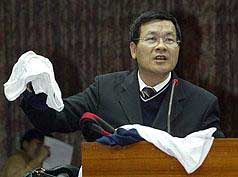
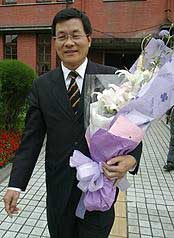
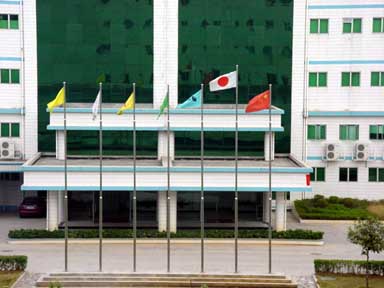
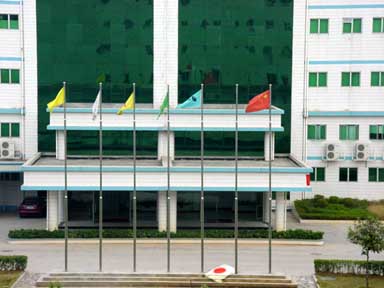


Totally gone missing were the fireworks at that Legislature hearing. Here is China Times' report via Yahoo! News:
[in translation]
... In order to push for the military armament purchases, defense minister Lee Jye tried his very best. When Legislator Wu wanted to propose civilian donations to purchase the arms, Lee Jye deemed it to be inappropriate because national money should be used for such a purpose. Under pressure from Wu, Lee admitted that if he had to donate money himself, he would donate at most one month's salary because "I have to live too!" (我也要過日子嘛!)
Legislator Tsao asked Lee why the Taiwan military did not upgrade their alert status after the recent "termination of unification." Who was going to be responsible if something goes wrong? Lee Jye said calmly, "I will accept the responsibility." Tsai then wondered whether he was qualified to accept responsibility and whether he was saying that in order to keep his job. Lee got mad and retorted: "Do I have to listen to you on military preparedness? You characterize me this way today, so I will never cooperate with you on any of your things in the future!" (我戰備要聽你的嗎?你今天這樣講我,以後你的事我通通不配合!). Tsao also got mad and rebutted "You little man!" (你這個小人!), whereupon Lee countered: "You are acting against your conscience!" (你昧著良心!)
On the issue of unification versus independence, Lee Jye did not want to take a position. Still, Legislator Lee called him: "No conscience!" (沒良心) but this only earned the retort: "My conscience is better than yours!" (我良心比你好!)
Legislator Chao asked him if the linkage of the military arms purchase with politics has caused Lee Jye to have "a head that is twice as big (一個頭兩個大)." Lee Jye replied "My head is still only the size of a regular head, but my mind is getting dizzy!" (一個頭還是一個大,只是腦袋發脹!)
Lee Jye had intended to keep a jovial posture. During the first half of the meeting, Legislator Lin poked fun of him for being a "Zen Buddhist expert" in terms of evasiveness. After the meeting, Lee Jye shook hands with Legislator Lin and used the epithet "XXX!" with a smile.
After the barrage of questions, Lee Jye waited until right before the meeting ended when most of the media have already left. At that point, he released his anger at the last questioner, Legislator Kao: "I spend all my time here. I really don't fucking want to work here anymore! At first, I wanted to count on you on the three military armament purchases. Now I don't care. You can buy it or not. I have said what I needed to say and I have done what I needed to do. History will remember just who opposed the military armament purchases here!" (一天到晚在這裡,真他媽的不想幹!當初是因為三項軍購在這邊拜託,現在隨便。愛買不買反正我該講的該做的都做了,將來歷史會記載是誰在這邊反軍購!)
At this point, this blogger is beginning to like Lee Jye, for being a person with very human qualities and placed in an impossible political situation. Lee has been to N hearings (where N is a large number) without getting anywhere on the military armament purchases. Who wouldn't be frustrated?
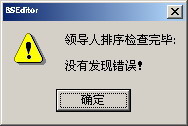
...if one combines the growing online space for private civic discourse provided by blogs with a functionally effective system of censorship and filtering, the result appears to be a recipe for very gradual, slow evolution - not democratic revolution. Outside observers of Internet and politics in China would do well to focus on the impact of blogs beyond the narrow scope of overt political protest and obvious political change. Most Western media attention focuses on those instances where bloggers clash with government censors or the web hosting companies who act as proxies for government censors. But to look only at these instances of conflict is to miss a great deal of what is really happening, much more quietly, under the surface. Powerful socio-political change can be expected to emerge as a result of the millions of online conversations taking place daily on the Chinese Internet: conversations that manage to stay comfortably within the confines of censorship. With each passing day, these conversations do their quiet part to move the collective Chinese mind yet another step further from government control.
For the temporal aspects, one asks: How did things look like 20 years ago or 10 years ago compared against today? Usually, that is too abstract. So I will make it very very concrete for you right here with one case study.
The case study is: The Huananxincheng Story. If you haven't read it before, just go and read it first. It is 'easy' (as in "straightforward" and "linear") reading.
Twenty years ago, there is no way you would hear about this case. The newspapers wouldn't report it and the civilian sector had no means of bringing in front of the public eye.
Ten years ago, there was still no real way of bringing it out into the open, because the BBS forums were only in rudimentary form.
Today, there is the Internet with 111 million users and 700,000 websites (plus tens of millions of blogs). The Guangzhou media (namely, Southern Metropolis Daily and Guangzhou Daily) will not carry this story, because the case supposedly involves a former Guangdong provincial government official. As indicated in the blog post above, the BBS forums and blogs will not give up until even the national media (CCTV) had to take notice. Now for the part that was overwhelmingly powerful (in the sense that you will probably run into the bathroom to throw up) that I previously omitted in my blog post -- there is an Internet video (wmv format) in which the doctor came out of the emergency room to show the family of the victim the spleen that he had to remove in order to save the life of the victim. How many people have seen this video? Give or take a few hundred thousand (if not millions) (for example, this Tianya post, has 75,000+ views and 2,000+ comments already in three weeks' time). What is the cumulative impact? What do these readers think about the local media ban? or government-business collusion? ...
Blog incidents blindsided Western media
Chinanews, Beijing, Mar.13 (By Sun Yuting) - On March 8, two highly popular Chinese media blog sites -- the "massaged breasts" by Sanlian Life Week magazine reporter Wang Xiaofeng and the "milk pigs" by media reporter Yuan Lei, famous amongst Chinese bloggers -- suddenly became blank pages with only one line shown, "Due to irresistible reason known to all, this blog site is temporarily closed."
What is referred to as "reason known to all" is in fact "International Women's Day on March 8th"; the two male bloggers wanted to use this special means of closing down their blog sites to "celebrate" this special occasion.
What a surprise when a Reuters reporter "tightly" linked up this rather humorous incident and the "Two Conferences" being held in earnest currently in China. After learning of the blog incident, this reporter announced to the whole world the following: Two of China's most daring bloggers' websites, "massaged breasts" and "milk pigs", have been shut down on government orders. This represents one of a series of actions in China to tightly control and censor the internet, especially during the period of the two key conferences.
Thereafter, various major Western media, such as BBC and Voice of America, all followed up with similar reporting like a hive of bees.
Not long after, these two media persons' blog sites returned to normalcy and both apologized online to netizens and explained that they, not the Chinese government, closed down their own blog sites.
Verifying news, sometimes from multiple sources, is the necessary means of making sure what is reported is factual and true and is the basic code of conduct for any media worker. But in this matter, certain Western media, due to their "pride and prejudice" towards China, jumped to conclusions based on personal projections and skipped the fact checking part.Now you may find this very strange. The cited article has the title of "Blog incidents blindsided Western media" but my comment has the title of "Blog incidents blindsided Chinese media." Why was "Western" swapped out by "Chinese"?
"Milk Pig" is Yuan Lei (袁蕾). Yuan is a family name and therefore gender-neutral. But the given name "Lei" 蕾 means "flower petal" and therefore indicative that this is a woman. Yes, Yuan Lei is a famous female entertainment reporter with Southern Weekend (see, for example, my translation of a Yuan Lei report at How the Sichuan Dialect Saved A Radio Station). The ChinaNews/Xinhua article refers to "male bloggers." That is WRONG!
So I shall reproduce the first sentence from the final paragraph of the cited article above: "Verifying news, sometimes from multiple sources, is the necessary means of making sure what is reported is factual and true and is the basic code of conduct for any media worker." If this Xinhua reporter so much as picked up the telephone and contacted Yuan Lei at Southern Weekend, he/she would have found out that this is a woman!!! At the greatest moment of gloating, the Chinese media fell down a flight of stairs and ended up with a broken nose! Or something like that ...

[in translation]
What did Wang Xiaofeng do on March 8? "For reasons that everybody knows are unavoidable, this blog is temporarily closed." On March 8, the Massage Milk and Milk Cow blogs showed a white page with only this message.
On that day, Reuters reported that "two outspoken Chinese blogs Massage Milk and Milk Cow were ordered to close by the government. This is another round of actions by China to clean up the Internet, especially during the period between the two Congresses." The English-language Reuters report appeared in the news database used by reporters all over the world. Reporters Without Border, which has the mission of protecting freedom of speech by reporters, issued a worldwide press release about the shutdown of these Chinese bloggers. Major news media such as BBC and Newsweek reported on the case. The news spread everywhere, from Turkey to Australia, from South Africa to India.
Wang Xiaogeng and Yuan Lei did not imagine how much impact a grassroots Chinese blogger can have.
On March 8, Wang Xiaofeng and Yuan Lei had treated Woman's Day as April Fool's day. The Massage Milk and Milk Cow blogs were not blocked. It was just an international joke by the two of them. On the afternoon of that day, the two blogs returned to normal operations.
Wang Xiaofeng told the Deutsche Welle reporter: "Reuters did not check with me about this matter." "For reasons that everybody knows are unavoidable" was naturally taken to mean government action. Without any further investigation, the western media initiated a chain reaction and the whole world was fooled by Wang Xiaofeng.
Behind Wang Xiaofeng's actions is the dissatisfaction by a group of Chinese people against western media's style and attitude in reporting about China. Wang Xiaofeng and others believe that some western reporters habitually politicize their reporting of incidents without understanding the circumstances. Today's China simply cannot be characterized in black-and-white terms.
Furthermore, when the reporters all over the globe compile their reports in front of their computers, they necessarily rely greatly on the news agencies. It is up to the journalists to ask themselves just what the truth of the matter is.
Wang Xiaogeng played a game that entailed no danger. The unlucky people were the foreign correspondents and western media. But the development of Chinese blogging is still fraught with risks. Under the tight supervision and monitoring, it is undeniable that blogs and websites are being shut down in their quest for speech rights. They will still need the attention of international media and the support of international opinion.
But when news come about the shutdown of another blog, will people begin to doubt?
From Geoffrey A. Fowler and Juying Qin, Chinese Bloggers Stage Hoax Aimed at Censorship Debate, The Wall Street Journal, March 14, 2006:
Some well-known bloggers in China used an unlikely tool last week to make a point that Western news media and politicians misunderstand Chinese censorship. They shut themselves down.
Notices posted on the Chinese-language blogs Massage Milk and Milk Pig announced that "Due to unavoidable reasons with which everyone is familiar, this blog is temporarily closed."
Within hours, English-language bloggers and Western news media spread the word that the Chinese government had closed the sites. The BBC news service reported that Massage Milk was "closed down by the authorities," adding that the act had coincided with the annual session of the Chinese legislature. Picking up on that report and others from news services, French free-press group Reporters Without Borders issued a statement condemning the closure of the blogs.
China has recently stepped up its censorship of dissent and monitoring of the Internet, late last year asking Microsoft Corp. to take down the blog of journalist Michael Anti, among other acts. After the topic hit the front pages of U.S. newspapers and magazines, Congress held hearings in February about the ways in which U.S. Internet companies cooperate with Chinese censorship.
But in this case, it appears the Chinese government wasn't involved. By Thursday, a day after the shut-downs, the blogs were back up and running.
In an interview, Beijing-based journalist Wang Xiaofeng of Massage Milk says he shut his blog down to make a point about freedom of speech -- just one directed at the West instead of at Beijing. He calls the Western press "irresponsible" and says that the hoax was designed "to give foreign media a lesson that Chinese affairs are not always the way you think."
"They are not just supposed to report based on their own perceptions, without understanding the circumstances in China," he says, noting that the BBC's report was exactly what he expected. The BBC didn't call him to discuss the issue before publishing its stories, he says.London-based BBC reporter Sebastian Usher, who wrote the original BBC report, says he did try to contact Mr. Wang but wasn't able to reach him. "There is a knee-jerk reaction amongst journalists -- including myself -- to stories that seem to show the Chinese cracking down on freedom of expression on the Internet," he wrote in an email. The BBC later corrected its story citing a government role in the shutdowns.
Reporters Without Borders issued a correction to its statement on March 9, calling the incident a "joke." But Julien Pain, who runs the organization's Internet Freedom Desk, says he doesn't think Mr. Wang understands the consequences of the incident. "If some bloggers start crying wolf this way," Mr. Pain says, "nobody will listen to us when we try to support those who really need help. Censorship exists, as well as repression against Internet writers."
Mr. Wang says he and Milk Pig acted jointly. Milk Pig couldn't be reached for comment.From Raymond Zhou, Reports of blogs' death exaggerated, China Daily, March 14, 2006:
March 8 was International Women's Day, but for Wang Xiaofeng it might as well have been April Fool's Day. On that day, the senior writer for Beijing-based Sanlian Life Weekly shut down his popular blog, as did Yuan Lei, an entertainment reporter for Guangzhou-based Southern Weekend. The duo had planned the practical joke some two weeks earlier.
On that day, both blogs displayed this message: "Because of unavoidable reasons known to all, this blog is now temporarily closed."
That evening, a Reuters report said: "Two of China's most adventurous web logs closed on Wednesday under government orders, the latest in a wave of shutdowns as Chinese censors tighten controls in cyberspace." The report was used by at least 200 international media organizations.
"We tried the prank to test how foreign media would react. And this is exactly what we anticipated," explained Wang Xiaofeng in an interview with China Daily.
Wang's blog, named "Massage Milk," is among the most popular in China. His acerbic writings on culture and entertainment have won him a best Chinese-language blog award from Deutsche Welle as well as a legion of loyal fans. Yuan's blog, named "Milk Pig," is mostly short comments on the nation's entertainment scene.
A source close to Reuters' Beijing office, who spoke on the condition of anonymity, told China Daily that they failed to reach Wang for confirmation and did not check with the relevant government agency.
Wang Xiaofeng had been annoyed that he was constantly misquoted by foreign media. "Every time they interviewed me, they tried to steer the questions towards political topics, in which I have no interest. Even if I made no mention of anything political, the articles would come out as if I were an activist," he said. "Most of the foreign reporters are not readers of my blog, and the few snippets they read in translation are usually out of context so they appear to be political," he added.
Once he told a Western reporter that out of the millions of blogs in China, maybe only five are purely political. "Why can't you look beyond that?" he asked.
The source close to Reuters insisted that some of Wang's postings as well as his amateur feature film, which Reuters also reported on, are political observations. "He would have made straightforward criticism if he had the choice."
Wang disagreed. What he writes and how he writes it are his natural way of expression, he said.
The most common words used by Reuters and other international media to describe Wang's and Yuan's blogs are "outspoken" and "adventurous." Asked how accurate these terms are, Wang said: "Nonsense."
A quick poll by China Daily of Chinese readers familiar with their blogs came up with these adjectives: "sarcastic," "humorous," and "funny." None of them associated the blogs with "outspoken" or "adventurous."
Wang's act was criticized by some commentators for being "politically naive." One blogger accused him of "worsening an already bad situation." Wang responded that some Chinese intellectuals tend to see everything in a strongly political light. "It's sad that they can see only black and white."
A person close to Wang said that what he writes and does, including the gag, are typical of him as a "quan ru" (cynic) even though Wang himself hates the label. There were also suggestions that Wang and Yuan staged the hoax to test how influential they were. Wang denied this was one of their motivations. "We intended to keep our blogs down for 4-5 days. But the rush of biased judgment came swifter than I expected," Wang said.
Both blogs were up and running a day later.
In an email interview with Interfax, Wang Xiaofeng wrote: "I just wanted to make fun of Western journalists? [Content] doesn't need to be serious on the Internet. I don't like it that Western media take a distorted view of China, though China does have problems. I thought that if I closed my blog, it would stir their imagination and then they would begin blah blah. It really is as expected. So let's say they have an April Fool's day in advance."
For a different perspective from a Chinese blogger, please see Non-violent Resistance's I Hate Punk Journalist-Bloggers. The key paragraph: "... respect your fellow journalists although you wanna get at their throats all the time. If you wanna mess with them, do so professionally, not unprofessionally."
So how do you professionally challenge the significant number of foreign correspondents who persist in that kind of behavior? For example, the BBC follow-up article on the hoax ends with this paragraph: "The authorities exert even tighter control than usual on how Chinese citizens express themselves during the parliament's session, particularly on the blogs that many of the country's more than 100 million internet users have set up." Where is the investigative evidence?
While the Great Massage Milk hoax was going on, my sole contribution was Comment 200603#020. I referred to a detailed report elsewhere and I only provided links to three translated Massage Milk posts here at EastSouthWestNorth. There was no editorial opinion from me. While I could not believe that Massage Milk and (especially) Milk Pig were 'persons of interest,' I had nothing more to go with. So I asked people to read these sample contents, which are mild compared to what routinely appears even at the People's Daily forums and blogs (see the Comment 200603#025 on those propagandistic blogs set up by the Chinese government). Implied in my silence is my confidence that you will agree with me that there is nothing that would lead to a shutdown. The full story would require additional information.
P.S. I have just been asked to address the DW question: "But when news come about the shutdown of another blog, will people begin to doubt?" Ahem ... I am quite angry to be asked that. What do you mean? Do you mean that prior to this incident, you just automatically accepted anyone's and everyone's claim without checking the evidence? Were you just a propaganda mouthpiece of a different kind? If so, then it is good thing that this happened here and you have to do your job (you know, the one that you claim to do) from now on.
[in translation]
The Difference Between the Corrupt Elements of the Mao Zedong Era and Today (a post for the representatives at the two Congresses to read)
[... there are ten points of comparisons and only the three points are translated here for a flavor; the rest of the points are no less pointed and unsparing.]
1. Corrupt elements are seldom seen among the cadres during the Mao Zedong era. No matter how they hid themselves, it was impossible not to be found out. Once found out, they were pursued by everybody like a rat crossing the street. Basically, they were afraid of the party discipline and government laws, which they dared not violate. Once their evil deeds were exposed, their careers were finished. But today, the corrupt elements can hide themselves for decades without being discovered. Alternately, they are brazen and open, they hold a sense of privilege, they ignore party discipline and government laws and they disregard the organizations. Even when their deeds come to be known by everyone, they only try to get the superiors not to investigate them. They can continue to appear in the public as "good leaders," delivering reports at meetings, speaking about the "Three Represents" and talking about party progressiveness. Even when the matter breaks out into the open, they can either gets a transfer to be an official at another place, or keep the identical pay while idling at home, or start their own private enterprises. (There are many corrupt elements who earned both "fame and fortune.")
2. Previously, the corrupt elements were easy to satisfy. If they could grab some money, they would; if they would grab some material goods, they would. But they had some clear goals, and they would stop with one or two million RMB. Today, the greed of corrupt elements have no bounds. They use their duty privileges to take whatever they can and they collude with businesses. They will take in tens or hundreds or millions of RMB, and the more the better.
3. During the Mao Zedong era, the corrupt elements did not dare to be too aggressive in accepting bribes. If they brought some food home, they wouldn't dare eat it during daylight. Instead, they wake their wives and children up at midnight to eat in secret. When they brought some meat home, they might hide it for a long time and sometimes never even got to eat it because the meat had rotted. They tried everything they could to look poor. They mixed themselves with the people. It was impossible to tell from the way they lived; if anything, they looked poorer than most people.
Nowadays, the corrupt elements are not afraid of showing off their wealth. Some of them even have the courage to become the representatives of "those who became wealthy first" and show off their wealth in the form of private automobiles, villas, high-end apartments and houses. They enter into business deals with listed companies, they send their children overseas to study, they go on sight-seeing tours and they even purchase large amounts of real estate overseas. They try their best to be different from ordinary people.
...
What is the difference between such a blog post and that which appears in a blocked overseas Chinese-language forum? Not much perhaps, but the following footnote would not need to appear at an overseas website.
The "Two Congresses" are meeting now to discuss issues of national importance. I was worried and I did not want to create more chaos. But after thinking about this back and forth, I decided to bring this out. I ask the forum master to publish this. I would be immensely grateful if this gets published.

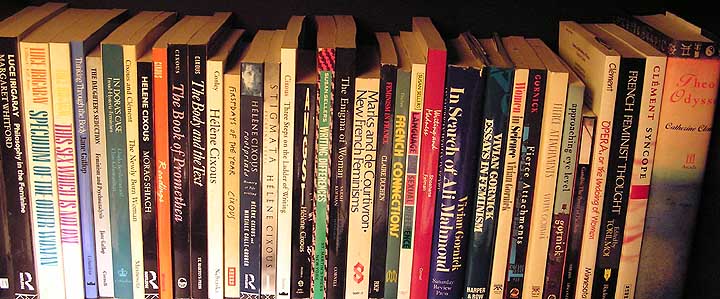
Suddenly, time falters.
First, the head spins, overcome with a slight vertigo. It is nothing; but then the spinning goes wild, the ears start to ring, the earth gives way and disappears, one sinks back, goes away .. Where does one go?
The subject, says the doctor, is inert, pale, without consciousness. Sensitivity is obliterated. There is no respiration, no pulse can be felt ... after a necessarily short time, the pulse reappears, as does the respiration; the skin regains color; the sick person regains consciousness. Otherwise, the ending is fatal; syncope leads to death.
Syncope: an absense of the self. A cerebral "eclipse.," so similar to death taht it is also called "apparent death"; it resembles its model so closely that there is a risk of never recovering from it. The romantic and clinical scenario has usually, in our society, been allotted to woman: it is she who sinks down, dress spreaking out like a flower, fainting, before a public that hurries forward; arms reach out, carry the unresisting body ... People slap her, make her sniff salts. When she comes to, her first words will be, "Where am I?" And because she has come to, "come back," no one thinks to ask where she has been. The real question would be, rather: "Where was I?" But no, when one returns, from syncope, it is the real world that suddenly looks strange.
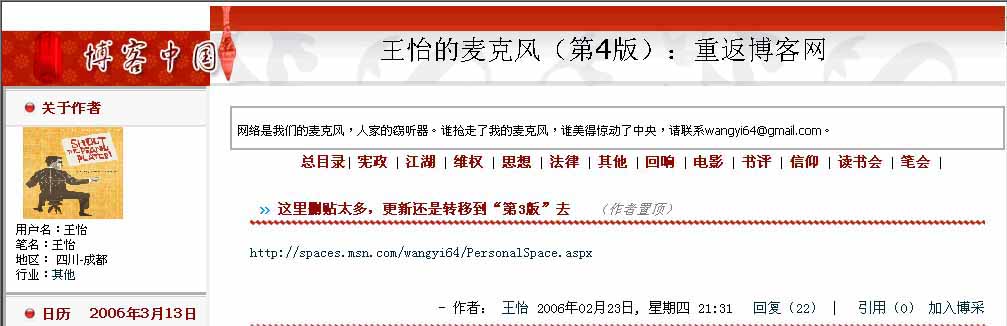
... it appears that the Chinese blog-hosting company Bokee has restored the blog of Wang Yi (Chinese). They shut his blog down at the end of December for posting a petition protesting a police shooting of protesting villagers in Southern China last month. (See a story here about his blog and the incident that came out shortly before he was shut down.) Now he is back up. In his first blog post upon restoration (Chinese), Wang says he hired a lawyer took some kind of legal action which caused Bokee to restore his blog. The details of what happened are not clear.
Earlier today, I was in the office and I was reading Wang Yi's blog at Bokee.com. The latest post consisted of one short paragraph, to the effect: "There is too much deleting around here, so this particular item will appear at my other blog."
When I returned home in the evening and got ready to write about this, Wang Yi's Bokee blog was not responding any more. Perhaps Bokee.com took exception to the tone of that last post or perhaps there was a temporary technological failure or perhaps there are other "well-known" reasons that are "unavoidable." We will be able to sort this aspect out eventually.
Here, I will identify Wang Yi's other blog is at MSN Spaces. The latest post was the text of a speech about Mao Zedong and the Cultural Revolution. This is a long speech, and it includes recommendations such as changing the Gang of Four to the Gang of Five because Mao Zedong was clearly the unindicted leader of the gang. This is clearly 'sensitive' material.
Meanwhile, I asked readers in China to tell me if they can read that WangYi64 blog. If yes, then MSN Spaces is offering some space to Wang Yi that the indigenous blog service providers will not. Out of four responses so far, the first two were 'no' and the last two were 'yes'; you are reminded that even if the MSN Spaces blog is not blocked, the particular page may be blocked by the the Great Internet Firewall for having too many 'sensitive words.' There have been more responses but I have left being somewhat confused. One Beijing responder said that he could not access from work, but there was no problem from home. One Shenzhen responder said that he could not access himself, but he was sure that his friend at a certain Guangdong-based newspaper group could read anything at will at the office.
At least one critic, and undoubtedly anyone in the Chinese politburo who read the draft, could certainly see some risky overreaching: One section requires hosting services to check with the U.S. Department of Justice before turning over any records to foreign officials. “The Internet user in China says this is insane,” notes Hong Kong blogger Roland Soong, who sees authorities shutting off access to Google completely with a law like that on anyone’s books. “You’re doing this for freedom and democracy, but now I’ve just lost a useful resource.”
One of China's most outspoken and widely read blogs has been closed down by the authorities. Massage Milk has recently featured extensively in international coverage of China's vibrant blogger scene and its conflict with the government.
The site belongs to a journalist based in Beijing, Wang Xiaofeng. His irreverence about all aspects of daily life in the Chinese capital has won him considerable popularity. It has also earned him a prestigious international bloggers' award. The site formed the centrepiece of an article on blogging in China in last month's edition of the US current affairs magazine, Newsweek.
Now, Mr Wang's high profile seems to have attracted the disapproval of the Chinese government, which administers the most sophisticated system of internet censorship and control anywhere in the world.
A note on his site reads simply but pointedly: "Because of unavoidable reasons, this blog is now temporarily closed."
Also from Reuters:
Two of China's most adventurous Web logs closed on Wednesday under government orders, the latest in a wave of shutdowns as Chinese censors tighten controls in cyberspace, especially while the national parliament meets.
"Because of unavoidable reasons known to all, this blog is now temporarily closed," said a message on the site of Beijing-based journalist Wang Xiaofeng. The message from domestic host Yculblog.com was probably phrased to show quiet opposition to its closure.
Wang blogs under the name "Dai San Ge Biao" -- a play on former leader
Jiang Zemin's Three Represents, or "San Ge Dai Biao," political slogan. His satirical blog covered everything from the state of Chinese media to a defense of Beijing's cruder slang. Wang's site was visited more than 10 million times, drawn to his shaded ridicule of Communist political posturing in a country where the state-run media sticks to the party line."Milk Pig," the blog of Yuan Lei, an entertainment reporter at Guangzhou's Southern Metropolis News, was also shut down. Wang and Yuan could not be immediately reached for comment, but another outspoken blogger decried expanding censorship.
"I lament the demise of the blogs of these two political cynics," said Michael Anti, whose own blog on Chinese politics was shut down under government orders.
Today, the Massage Milk blog is accessible again and there is this message:
我喜欢开玩笑,但是这次并没有想跟大家开玩笑,更不想愚弄你们。
所以,不像你们想象的那样,也不像外国媒体想象的那样。
谢谢大家关心,在此向你们表示歉意。
[in translation]
I like to play pranks, but this time I did not want to play a prank on everybody, and I did not want to fool you.
Therefore, it was not like you imagined, and it was not like what the foreign media imagined.
I thank you for your concern, and I express my apologies to you here.This led to the following diatribe by an unknown commentator that was relayed by Chinese blogger 连岳的第八大洲.
[in translation]
Grandma! I just got the inside news. The shutdown of the Massage Milk and Milk Pig blogs were staged by Wang and Yuan themselves! They wanted to use the opportunity to test how big their influence is!
I despise these two people who played a cruel political joke on decent people! You fucking attach too much importance to yourselves! You have totally forgotten who you are! And there was that fucking "unavoidable reason that everybody knows about"! You are pieces of messy dog turd! Do you know that your stupid joke can cause certain decent and simple people to get hurt!
You are no better than those filthy politicians. You are fucking even more deceptive and filthy! I used to respect you for your writings, but now I spit on you! Perhaps you are still quite elated today and with a victorious smile, you read the memorial articles written by those people that were fooled. But I am telling you that it would be best that you never ever write on your blog again. If you have the courage, you should continue this prank all the way and fool tens of thousands of people. I hope that you have a nightmare tonight and for the rest of your lives!
Related Link: Massage Milk's disappearance an April Fool's joke by Jeremy Goldkorn, Danwei


Just to let you know, the US Marines have blocked access to “Wonkette” along with numerous other sites such as personal email (i.e. Yahoo, AT&T, Hotmail, etc), blogs that don't agree with the government point of view, personal websites, and some news organizatons. This has taken effect as of the beginning of February. I have no problem with them blocking porn sites (after all it is a government network), but cutting off access to our email and possibly-not-toeing-the-government-line websites is a bit much.
Initially all web blocking was done locally at the hub sites in Iraq. If you wanted a site “unblocked” you just had to email the local administrator with a reason (like, “I'd like to read my email, please.”), and if it wasn't porn or offensive, they'd allow it. Now, all blocking is done by desk-weenies at the USMC Network Operations Center in Quantico, VA, who really don't care if we get our email (or gossip) out here, as they get to go to happy hour after working 9 to 5 and go home to a nice clean, warm home with a real bed! (Sorry, I'm a little peeved.)The situation is spelled out more explicitly in a follow-up email by the same soldier (see Wonkette):
Unfortunately anonomizers don't work out here (never have). Anyway, I had a few minutes today and thought I'd look and see what else was banned on the Marine web here. I think the results speak for themselves:
* Wonkette – “Forbidden, this page (http://www.wonkette.com/) is categorized as: Forum/Bulletin Boards, Politics/Opinion.”
* Bill O’Reilly (www.billoreilly.com) – OK
* Air America (www.airamericaradio.com) – “Forbidden, this page (http://www.airamericaradio.com/) is categorized as: Internet Radio/TV, Politics/Opinion.”
* Rush Limbaugh (www.rushlimbaugh.com) – OK
* ABC News “The Note” – OK
* Website of the Al Franken Show (www.alfrankenshow.com) – “Forbidden, this page (http://www.airamericaradio.com/) is categorized as: Internet Radio/TV, Politics/Opinion.”
* G. Gordon Liddy Show (www.liddyshow.us) – OK
* Don & Mike Show (www.donandmikewebsite.com) – “Forbidden, this page (http://www.donandmikewebsite.com/) is categorized as: Profanity, Entertainment/Recreation/Hobbies.”So this is what Wonkette had to say:
Apparently, when you try to view, say, Condi Rice doing crunches from Iraq, you get this error message: “Forbidden, this page (http://www.wonkette.com/) is categorized as: Profanity, Personal Pages.”
Profanity? Fuck yeah. Personal? It is now. What is this, Red China? What are we fighting for if not the right of all men and women, Iraqi or American, Insurgent or Marine, Sunni, Kurd, or the other one, to hear minute-by-minute updates of Anna Nicole Smith's appearance before the Supreme Court or read birthday cards to disgraced lobbyists?And in the comments:
Speaking of China, what about taking a lesson from the democracy supporters there?
Okay, I can't remember all the details, but... I remember hearing recently of a program being used in China to access blocked sites.
The way it was described, it enabled net surfers in China to surf overseas computers that in turn surfed forbidden sites. Net result = happy Chinese net user esentially surfing forbidden sites, but with no ability for evil overlords to block it. Does this ring a bell with anyone else? NPR report I think?
If something like this could be set up for the troops, enabling them to see reasonable sites, it would not only give them a means of overcoming the unreasonable censorship -- it would very likely create enough of a PR pain in the ass to roll back at least some of it. I mean, picture this headline:
"US Troops Take Tech Lesson from Chinese Democracy Supporters to Overcome Censorship"Here is even more news from Wonkette:
Alas, a Marine tells us that the situation is even worse than we could've imagined:
They also block The Onion, Comedy Central, and all computer gaming sites. We were told it is done to save bandwidth and to prevent people from loafing off at work. […] I also think it might be based on what people are reading. If a site gets a lot of traffic and it's not considered necessary for Marine Corps business it gets shut down. Well, except for ESPN and other sports sites. They'd have bloody riots on their hands if they did that.
He also added that these rules apply only to official work computers, and Wonkette is still available on computers in the charmingly named Morale, Welfare, and Recreation facilities. But if you don't want to wait in that lengthy line (and those computers still block the porno), another operative gives the simplest workaround yet:
Tell the soldiers to go to http://www.google.com/language_tools?hl=en, go to the section labeled “Translate a Web Page”, type in wonkette.com, and select “translate from: portugese to english”. Google will try to translate your site, but since it probably won't find any portugese words, it'll spit the site back out in English. But hosted on the non-blocked Google server.
So we can write anything we want! Assfucking quagmire!

[in translation] According to rumors, certain overseas media want to denigrate our province. So I was called to attend an early morning meeting and asked to file reports during the Fifteenth National People's Congress about our accomplishments here. I was asked to use certain designated materials, and the emphasis will be about the accomplishments during the current provincial party committee.
To make it clear, this is about writing some paean-like essays for Colleague Zhang. Come to think of it, this is kinda funny. If the work has been good all along, why would there be any fear of deprecation by others? We have been denigrating the American imperialists for fifty years (and now Comrade Little Kim has taken over the job), it did not appear that the Americans are any worse; if anything, they are thriving. I am not sure that I concur with Colleague Kaizi's (note: a member of Guangdong Political Consultative Committee) high praises of Colleague Zhang. When the people below want to say things to please the superiors, the moral models above should stop them; but if they not only failed to stop them but in fact ordered or hinted at their subordinates to do just that, then this is unbecoming.
If you happen to find that the subjects within our provincial news websites to be nearly universally high praises, please do not be surprised. This is only too normal. To tell a joke: why not just give the editorial power to the senior masters themselves: they can put in whatever they want, and people below don't have to work overtime?
Translated comments: "I never read that stuff"; "In this world, it is not always up to you"; "Forget it, we're used to it! Besides, we're not the ones who are worried"; "This is normal and we'll just laugh about it! But, is this really normal?"; "As for the senior masters, nothing more needs to be said except for one thing: 'no class' ('贱')."
By itself, this blog post is no different from any number of online diary entries from bloggers complaining about their job, except this person happens to be a reporter. Thirty years ago, such a comment might be considered a crime (economic sabotage, leaking state secrets, etc). Today, it'll draw a yawn. Maybe this blog post itself won't change the world in one day, but this is about the collective corrosiveness of the thousands of similar blog posts and comments over the long-term stripping away the legitimacy of the propaganda/publicity machinery.

(MOP Comment #950) 最近网上疯传一女子踩死小猫的变态行为就这件事. 和日本的一位同学聊天的时候 令人不可思议的得知, 原来这名女子叫仓木加奈子以拍变态广告闻明踩猫踩狗其实是为日本某名牌高根凉鞋的广告, 在日本因为民众抗议被 禁播!!!!不知道 为什么中国人拿几张照片来硬说是杭州女子所为? 实在令人费解` 发自内心的感谢那位朋友帮我找出了元凶, 日本人!!!!!!!她不会好死的
我真的感到很悲哀.为什么大家偏偏认为中国人还说是 杭州人干出这种事情.一个日本拍广告的 就这样欺骗了 所有的中国人.让那些亲日的中国人 利用几张图片让我 们中国人相互攻击.中国人请觉醒吧 请大家转帖, 让真相让所有的人知道,不要让这个臭日本女人忽悠
[in translation] Recently, the Internet has gone crazy over a woman sadistically crushing a little cat with her feet. In speaking to a Japanese classmate, I learned something incredible. This is a Japanese named 仓木加奈子 and she specializes in making "crushing" photographs for a certain well-known Japanese shoe brand. Those ads were banned in Japan after citizen protests!!! I don't know why some Chinese people would take some of these photographs and said that it was done by some woman in Hangzhou? This is incomprehensible. I thank my friend from inside my heart to help me find the true criminal. That Japanese! She will not die a good death.I am truly saddened about why the Chinese people are still saying that a Hangzhou person did something like this. A Japan-made advertisement fooled all the Chinese and let those pro-Japan Chinese to use these photographs to let the Chinese attack each other. Wake up, Chinese people! Please forward this post and let the truth be known to everybody. We must not that this stinking Japanese woman get away with it.
(MOP Comment #1171) 她是日本人!!!她是日本人!!!她是日本人!!!她是日本人!!!她是日本人!!!她是日本人!!!她是日本人!!!她是日本人!!!她是日本人!!! 她是日本人!!!她是日本人!!!她是日本人!!!她是日本人!!!她是日本人!!!她是日本人!!!她是日本人!!!她是日本人!!!她是日本人!!! 她是日本人!!!她是日本人!!!她是日本人!!!她是日本人!!!她是日本人!!!她是日本人!!!她是日本人!!!她是日本人!!!她是日本人!!! 她是日本人!!!她是日本人!!!她是日本人!!!她是日本人!!!她是日本人!!!她是日本人!!!她是日本人!!!她是日本人!!!她是日本人!!! 她是日本人!!!她是日本人!!!她是日本人!!!她是日本人!!!她是日本人!!!她是日本人!!!她是日本人!!!她是日本人!!!她是日本人!!! 她是日本人!!!她是日本人!!!她是日本人!!!
[in translation: This is "She is a Japanese!" repeated N times](MOP Comment #186)
[Explanation: See Wikipedia entry for Cosplay]Unfortunately, when one goes through the thread on some BBS forum topic, these types of things invariably appear. Something goes wrong, and someone blames the Japanese without proof. This is not without consequences, including wasting people's times, fanning anti-Japanese feelings (or, in my case, immunizing me against that), etc. Yes, I get better and quicker at filtering this out, but it still drains some of my valuable time.
[in translation] The Chinese thought police are the best friends of the Taiwan independence folks. They destroy the image of openness and reform in mainland China and they allow the forces of Taiwan independence to become bigger.
Does political power affect thinking, or does thinking influence political power? That is a tricky debate, and a challenge that China faces right now.
The intellectuals and media in China today have actually gone past the control of the official news organizations. Following the rapid development of economic and social forces and communication technologies, Chinese society has developed it own communication network. SMS, email, blogs, MSN and Skype (free from eavesdropping and firewall-penetrating), the traditional Leninist "Thought Police" is no longer in control ...
These "Thought Police" are the best friends of the Taiwan independence. The more media organizations are shut down in China, the stronger the Taiwan independence movement grows. They can justifiably claim that the freedom of expression is so backwards that Taiwan society cannot possibly consider unification with China as an option.
The connection of "Thought Police" and "Media Public Safety" puts an end to the openness and reform image of China, and it puts an end to the openmindedness of the Hu-Wen system. This has caused some party elders to react. They realized that these dated ideological straitjackets not only damage the right of the Chinese people to be informed, they also damaged cross-strait relationships and made the people of Taiwan question the openness and progress of China as well as caused embarrassment and disappointment among the Chinese people around the world.
This is what I mean when I wrote that there appears to be a concerted (and one might even say coordinated) campaign directed at the Central Publicity Department. If this case is compared to the Beijing News incident, the stakes and the scope have obviously jumped up by an order of magnitude. Whereas the Beijing News protests came from the media workers, the Chinese Internet and some overseas voices, the Freezing Point protests came from every which way: the Chinese Internet and overseas voices were there of course, Lung Yingtai entered and bundled the incident with unification/independence, senior party elders published an unpredecented open letter and the two editors (Li Datong and Lu Yuegang) were giving interviews to just about every western media organization.
Of course, Freezing Point was just a symptom and not the root disease. It means nothing even if Freezing Point is restored in full. Today it is Freezing Point, tomorrow it is someone else and it will never ever end. And that was why there is such an apparent campaign out there. Maybe this particular incident is not sufficient to turn things around. But you can bet that when the next incident occurs, people will trot out everything that is written here all over again. At some point, a rational decision-maker must have to evaluate whether the Critical Reading group is a huge negative asset.
It seemed that I did not do anything else tonight other than catching the 'bugs.'
It began like this: When I tried to view my own blog, it was alright at first. Later, I just could not open it. My first reaction was that I have been banned again. But my subsequent analysis was that I must be using certain sensitive keywords that were blocked by the Internet firewall.
So I began to find the files for the posts and examine them one by one: I found the "bugs" and I surgically removed them. But the key was that I have to find them first. This was a dumb approach. Although I have been here for less than a month and I don't have a lot of posts, I would still need to modify each post, upload it and then test it. I also have to guess which is a sensitive term. This was blind guessing and very inefficient. This was not going to work.
Then I thought up a more efficient (relatively speaking) method. From each post, I copied the suspected "bug" and tested it on Google/Baidu. This would cut down on the wasted effort without butchering the innocent. But this was not necessarily very fast.
So I was able to catch a lot of bugs: "Li Datong" was alright, but "Lu Yuegang" was not. Then there were "Taishi," "1989", "riot", and so on. There were quite a few of them. The strangest one was that it was impossible to use "Liu" and "Xiao" next to each other on Google. In Baidu, one can use "Liu Xiao" but there better not be a third word behind them (and it does not matter whether that third word is "Bo" or not!).
My conclusions:
(1) If I refuse to reform and continue to emit disharmonious sounds, I will probably wear myself out or go out of my mind;
(2) Or else I can write everything in secret code, but then nobody would understand it; I would have to give out instructions to decode. So I will still be worn out;
(3) If I have the determination, patience and interest, I should be able to compile the Book of Internet Sensitive Terms; but I don't have what it takes to do that. Besides, that list is being changed continuously.
(4) Let it be and hope for the best.No. I did not think this was what Baidu or Google intend to serve ...


The photographer: Name, gender, company, department, office location, job title, CCP membership, citizen ID number, line phone number, mobile phone number, email address, QQ ID's.
The Internet CD seller at crushworld.net: Name, address, citizen ID number, mobile phone number, car license number, car registration address, online purchase records of high-heel shoes and a copy of Pedro Almodóvar's movie High Heels.
The female: A cashier named Wang for the Luobei People's Hospital, Luobei county, Heilongjiang province.This is collected by civilian netizens and there is no guarantee that this is correct. But the information has been laid out for the rest of the world to see.

With respect to the series of cat killing photos, a follow-up story was published in the print edition of Sing Tao today. This was the top China story of the day in Sing Tao, and it was also covered in the CCTV morning news. P.S. The story is also in Southern Weekend.
[Sing Tao; in translation]
This "cat killing" series consists of more than a dozen photographs. The basic sequence is this: it begins with a female wearing a low-cut bare-back short skirt smiling and hugging a small cat and this was followed by a sequence of horrible cat killing: she used her high-heeled shoe to step on the body of the cat, she put her sharp heel into the cat's mouth and eyes and then she squashed the cat's head as blood is splattered underneath the shoe. The last photograph shows the female looking into the distance contemplatively.
The reporter found out that the photograph was first posted at the pcop.website. A netizen has made a wanted poster out of the female's photograph and urged everybody to identify her. First, netizens deduced from the background in the photograph that the place was in Hangzhou. Over the past two days, many amateur computer sleuths have join in the hunt. From the registration information of the poster, they deduced that the person goes by the name of "gainmas," the place of registration is Hangzhou, the computer from which the photograph was uploaded was also in Hangzhou and the registered email is info@winfox.com, where winfox is a technology company.
The civilian investigators also discovered that apart from the photographs, there is also a video clip which recorded the sound as well. The same videoclip also contains the killing (note: the English word "crush" was added on the video image) of a frog, a rabbit and a dog. There were multiple participants, including the photographer plus many females in their 20's and 30's playing the roles of perverted killers.
Is it illegal to disseminate these types of photographs on the Internet? A Beijing lawyer said that when someone insults and slanders others on the Internet or distribute pornographic material, the public security organizations may hand out administrative penalties. But China does not have any laws to protect small animals, and therefore killing a cat is not illegal, and these photographs are not pornography either.
More civilian sleuthing (via Tianya):
- The video contains a reference to a website: www.crushworld.net. The website is registered to "gainmas" with mailbox info@winfox.com, an address on Academy Road in Hangzhou and telephone number 0571-8886XXX.
- A Google search on the telephone phone found three listings, one being at Silver Fox Technology at the same Hangzhou address.
- According to a search on ebay.com.cn, the individual by the name of "gainmas" purchased a pair of 12cm-high-heeled shoes on January 3, 2005.
- "Gainmas" has a Zhejiang car registration for a silver-grey Mazda automobile license number Zhejiang A/2F7XX and there is even a link to a photo of the automobile
- A netizen has found the QQ number (3167793XX) for the 37-year-old female from Hubei. The QQ self-description is "I angrily trample to death everything that belongs to you and me."(Southern Weekend)
- The reporter contacted Silver Fox Technology and spoke to a Ms. Li who had been answering the telephone all day. She admitted that the domain was registered by Silver Fox Technology for a client. For convenience, when individuals apply, the company phone number is used instead. She has not been able to contact the registrant and there is no telephone number for the individual.
- Civilian sleuths have searched crushnet.com and found out that this is the China branch of an international CRUSH organization. When the reporter entered the website, there were 60 members online and 779 surfers. The IDs of the members are things like "Special Stomping Station Chief," "SC Assassin," etc. When the reporter attempted to enter again at 4pm, March 1, the page was no longer viewable.(6Park) But when "crushworld.net" was sought, the website demands an authorized login and directs all inquiries to crushmovie@yahoo.com. Yes! I could have predicted that it will all lead back to the evil empire known as Yahoo! (just kidding, of course!).
According to an informed source telling this newspaper, the cause of the latest developments began when Li Datong sent a letter of complaint about the suspension of Freezing Point to the Chinese Communist central. Through a certain path, it managed to reach the eyes of Hu Jintao. He read it and he wrote the instructions: "Please handle properly (請妥善處理)." Thus the salvaging of Freezing Point began in earnest.
In the chain reaction, Li Datong and Lu Yuegang were invited for a dinner, a talk and consolation. The end result was that the re-assignment of Li Datong and Lu Yuegang guaranteed that the entire original team would stay. The newly appointed director and deputy chief editor Du Yongtao was a member of the troika at Freezing Point along with Li Datong and Lu Yuegang. Another deputy chief editor is Jiang Fei, and she is the wife of Li Datong. The person with overall responsibility is Chen Xiaochuan, who is a deputy editor-in-chief at the newspaper.
There were also some compromises in the March 1 edition of the resumed publication. Instead of a critical article of Yuan Weishi, it will be an exploratory article. Yuan Weishi will also be given space to reply.
Li Datong was interviewed by Hong Kong television yesterday and he said that Freezing Point was able to resume publication so quickly as a result of the concern showed by the central senior officials. This was an open-minded act and deserved praise. Li believes that Freezing Point will continue the tradition of reporting the facts.[Sing Tao] The assertion about Jiang Fei has just been acknowledged as false.
[001]
The Photo That You Are Not Supposed To See (03/01/2006)
In the inquest into Annie Pang's death, the coroner Colin Mackintosh
declared that it was pointed out to him that page A32 of Oriental
Daily contained a photograph that showed part of the interior of
Annie Pang's apartment. The state of the apartment is an important
aspect of the inquest, since it was asserted that the place was so messy
that her body was not seen.

The coroner stated that he does not wish to conduct an inquiry about this
particular photograph which must have come from an inside source.
However, he warns the media against any future leaks. Should this
photograph have appeared here? Well, let me put it this way, Oriental
Daily has a daily circulation of 450,000 copies; at two readers per copy,
900,000 people have seen it. How can it be undone?
For full coverage of the Annie Pang case, the best work is being done at The
Standard. Here are the links so far. Just look at those
headlines: you must be intrigued, right!?
(2/21/2006) Inquest
into model's death finally opens
(2/22/2006) Things
linking dead model to lover 'not returned by police'
(2/23/2006) Annie
Pang 'died from taking drugs'
(2/24/2006) Questions
over Pang inquiry evidence
(2/25/2006) Guard
tells of nasty smell at dead model's apartment
(2/28/2006) Questions
hang over model's pals
(3/01/2006) Truck driver the mystery man of Pang
(3/02/2006) Boyfriend tells Pang inquest of breakup
(3/03/2006) Model's ex-lover faces court warrant
(3/04/2006) Fang: I did not see girl's bones
(3/06/2006) Fang accused of fixing Pang's death
(3/08/2006) Fang tells of Annie's real estate deals
(3/09/2006) Confusion
over Pang crime scene
(3/11/2006) Pang body showed no indications of violence
(3/14/2006) Mystery of the missing condom
(3/15/2006) Setbacks for both sides in Pang case
(3/16/2006) Pang hearing told of $2.5m debt
(3/17/2006) Fee denial over Pang's skeleton find
(3/18/2006) Pang inquest poised to enter verdict stage
(3/21/2006) Jury set to decide on Pang's death
(3/22/2006) Annie Pang, the energetic and cute sister I knew
(3/22/2006) 'Maybe I'm a sucker ... I help everybody'
(3/22/2006) Pang mystery remains after inquest verdict
(3/23/2006) Pang's sisters call for ICAC probe over evidence
(3/28/2006) Writ accuses Fang of libel as Pang's former lover cries blackmail
Also from the Shenzhen Zen blog:
(2/19/2006) Headless model found in topless bar (or the Lonesome Death of Annie Pang)
(2/21/2006) 'Dem Bones
(2/22/2006) Annie the Headless Ack-ack Gunner
(2/24/2006) That Smell
(2/28/2006) Annie's
Song
(3/02/2006) Johnny B Bad
(3/08/2006) A Legal Matter
(3/10/2006) Head
and Shoulder
(3/10/2006) Big Bad John
(3/15/2006) Handyman
(3/20/2006) Blinded by Science
(3/21/2006) The
End
Every day, it is something new and completely unexpected ...
Archives