A good deal of my life has been devoted to trying to demystify ways of thinking that polarize and oppose. Translated into politics, this means favoring what is pluralistic and secular. Like some Americans and many Europeans, I would far prefer to live in a multilateral world – a world not dominated by any one country (including my own). I could express my support, in a century that already promises to be another century of extremes, of horrors, for a whole panoply of meliorist principles – in particular, for what Virginia Woolf calls "the melancholy virtue of tolerance."
(Kyodo via TMCnet) About 2,000 reporters and others began a walkout Thursday in a move to express their discontent with the recent dismissal of the editor-in-chief of the Beijing News, sources familiar with the matter said.
(Reuters by Chris Buckley) About 100 Beijing News reporters walked out in protest at this week's dismissal of the top editor, the latest victim of China's strict press controls, industry sources said on Friday. Disgruntled journalists also displayed their anger through a photograph in the paper showing a flock of birds flying through dark skies above the newspaper's office, with one bird leading. "The sky may not be very clear, but they will still fly into the distance with their mission close to their hearts," said a note with the picture.
(Associated Press by Joe MacDonald) Reporters at a Beijing newspaper known for covering sensitive topics walked off the job after an editor was removed this week amid efforts to tighten press controls, employees said Friday. ... Reporters stopped filing stories Thursday after the removal of editor Yang Bin, said employees contacted by phone. On Friday, the tabloid was 32 pages, compared with more than 80 on a normal day. "Most of the 400 reporters and editors are unhappy about Yang Bin leaving," said a reporter who asked not to be identified. "We don't know how many high-level officials might leave their post." Employees said they didn't know why Yang was removed. It wasn't clear how many reporters took part in the protest or how long it might last. A spokesman for the Beijing News denied there was any protest. "Everything here is normal," said the spokesman, who would give only his surname, Luo.
(Interfax China by John Liu) Several dozen editors and reporters at The Beijing News went on strike Thursday night to protest the firing of the newspaper's Editor-in-Chief and two senior-editors, who were dismissed for publishing politically sensitive articles, several sources close to the situation said. "The editors were fired because The Beijing News published stories that were too true," a source close to the situation told Interfax. ... After the firing of the editors was announced, a large number of employees at the newspaper threatened to go on strike in protest, a source at the newspaper said. However, the newspaper's management called a meeting Thursday afternoon in which they threatened to fire any person that participated in the strike. As a result, a number of employees who had originally threatened to go on strike did not, while several dozen others did, the source at The Beijing News said. Friday's edition of The Beijing News was noticeably affected by the strike, with most of the stories culled from Xinhua News, China's official state news agency. However, on Friday, the newspaper's management decided against firing employees who participated in the Thursday night strike. Nonetheless, a number of mid-level editors and reporters resigned from The Beijing News, while others said they would, the source at the newspaper said. It was not immediately clear how many employees participating in the Thursday strike had also chosen to resign.
(AsiaNews.it) An unprecedented strike is under way in Beijing: around one-third of the 300 journalists on the staff of “Beijing News” – one of the most popular monthlies – have gone on strike because of the removal of three of their editors. The decision to remove the three, said the journalists on strike, was their too “daring” attitude and some features dedicated to “sensitive” topics of a social nature. The move to stop work followed the decision to remove the chief-editor Yang Bin and his two deputies Sun Xuedong and Li Duoyu; the decision was taken at the end of a meeting on Wednesday with managers of the newspaper’s parent publication, the Guangming Ribao, a daily newspaper considered to be conservative. The Guangming Ribao supplied replacements for the three. The situation seems to be somewhat confused: some journalists who asked to remain anonymous said Sun Xuedong had said he had no intention of leaving in the near future and he had even tried to convince staff to return to work last night. Meanwhile, Li Duoyu, who was editor of the paper’s business section, resigned to take up an offer from an internet company Tencent. As for Yang Bin, he apparently wants to return to his previous job in the Southern Metropolis News in Guangzhou. An official of the Guangming Ribao insisted that Yang Bin “was not dismissed, he received a normal transfer to the Southern within the group.” The latter newspaper, meanwhile, had nothing to say. Concern for the newspaper’s future is running high among strikers as well as those who are not striking. "We knew that such a good quality newspaper may be killed at any time, but we didn't expect it to come so soon and so suddenly," a reporter said. Even if it is still called the Beijing News after Guangming takes over, it is no longer the real Beijing News,” said another.
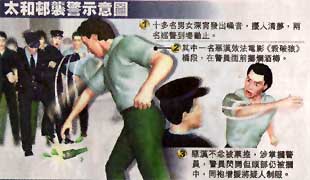


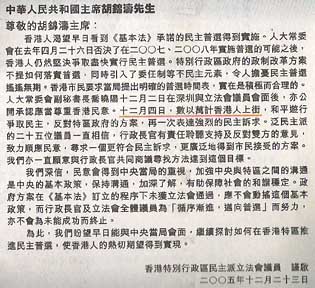
A Chinese human rights activist held by police for more than three months after helping a village protest in southern China was released without charges on Tuesday, in an unusual official concession to protestors. Guo Feixiong, a writer and advocate of democratic change, told Reuters he was released after being in police detention since mid-September and holding a month-long hunger-strike. Police had charged him with "disturbing social order", he said, but prosecutors told him on Tuesday he would not be indicted. However, they accused him of being a "ring-leader" of anti-government protests in Taishi Village, near Guangzhou, the capital of Guangdong province, Guo said by telephone. "They said I'd personally commanded villagers on how to depose the village leaders and organized them to surround the village committee offices," he said. "The charges were absurd."
...
In recent days, Guangzhou police have also released four or five villagers involved in the protests, said Zhao Xin, a human rights campaigner. Altogether, about 20 villagers were detained and later released.




Mr. Fok, there is no need to go to Beijing just to check out any mural. This is the Internet age. All you have to do is monitor the status of Furong Jiejie (Sister Hibiscus) for policy changes. As long as she gets to do her thing, there is no radical change.
That same Saturday night, violence erupted in Hong Kong and Curbside was put to the test. Our team members were in various locations close to the action. With SMS, we were able to stay in close contact, using the newsroom to keep everyone updated. As a result, we had a story about the situation up on the site at 8.29pm, while it was still happening. Being an online publication, we could update the site as necessary. Photographers using digital cameras uploaded photos quickly. Our readers could see some of the first still images of the unrest. Hours later, Curbside was publishing personal accounts of the events and galleries of photos. Not limited by word count and pages, we could publish as many and as much as we wanted.
...
Vivian Kwok, the co-executive editor of the site, worked as a business journalist for Next magazine before joining the masters degree program at HKU's Journalism and Media Studies Centre. For her, it was a wake-up call for those in traditional media. "News Web sites' speed is particularly threatening," she said. "We don't have to wait or meet deadlines. Just click the 'publish' button. The entry barrier for a Web site is much lower than a newspaper, too."
(March 1, 2004) The Streets of Caracas - Part 1
(March 2, 2004) The Streets of Caracas - Part 2
(March 3, 2004) The Streets of Caracas - Part 3Just remember this -- these are the global standards, but the South Koreans never took them here. I would therefore be reluctant about calling the South Koreans in Hong Kong mobsters, rioters, terrorists and all that, because they had the choice to be just that but did not.
Even by Hong Kong standards, the worst in my memory is not being mentioned. So I will remind everyone about this:
October 1st is the national day of the People's Republic of China (PRC), capital Beijing, commemorating its founding on that day in 1949. October 10th is the national day of the Republic of China (ROC), capital Taipei, commemorating its founding on that day in 1911. Each republic has its ceremonies for the its national day.
But for the people of Hong Kong, the day of October 10th does not have the best of memories. Being a capitalistic British colony situated next to an avowedly communist country, it had a great deal of political ambiguity. On one hand, the United Kingdom is a part of the free world that is trying to repel the red menace. On the other hand, this little colonial outpost can be easily overrun by the People's Liberation Army and there are ample nationalistic reasons for a strong China to take back its own territory that was forcibly ceded to the British during the Opium Wars. Thus, the British colonial administration preferred to take a low-keyed approach to political affairs.
On October 10th, 1956, a minor dispute related to the hanging of a large ROC flag in the a public housing settlement in Kowloon led to a mini-riot. At 10 o'clock that evening, an armed mob appeared and systematically began to block traffic on the streets as well as assaulting pro-PRC factories, schools and unions. The police was nowhere to be seen, either because they were unprepared to deal with urban riots or because they did not mind assaults on pro-PRC people. The riots went on until October 13th and was stopped with a massive display of force with order to shoot to kill from the local police and the British army after the wife of the Swiss consul was killed by a mob which stopped her car by stoning and torching it. The British was also forced to take action because Chinese Premier Zhou En-Lai asked the British representative if China was going to have to send the People's Liberation Army in to restore order, since the British obviously could not. The total bill for damages related to the riots was almost HK$5 million, which was a tremendous sum at that time. A total of 60 people died, 45 being shot by the police and 15 at the hands of rioters.
An official government report attributed the riots to underworld triad members, but did not spell out what these people had hoped to gain from their actions. The report declined to address the common knowledge that the triads (such as the 14K) were intimately connected with the Republic of China government, and that the rioters were acting like military troops directed by leader elements.
Given the political constraints that the British colonial government was acting under, it did not want another repeat performance in the future. What it did was not necessarily democratic or legal, but it was effective. In 1957, in the latter part of September, the Hong Kong police arrested 1,527 triad members, of which 119 were expelled and 785 were sent to jail, for the crime of being a triad member. In 1958, 1,075 triad members were arrested in September and another 100 more in the first week of October on similar grounds. Thereafter, similar campaigns took place in September each year. It then became a seasonal pattern in September/October that the top triad leaders would have vacations in Southeast Asia, the middle-level triad members would spend vacaztion time in neighboring Macau while the lower-level triad members would go into hiding. The differences in 'vacation plans' were obviously due to what each individual can afford to do. The alternative was to spend a few days at the Chatham Road detention camp at government expense.
This is an ignored episode in Hong Kong history, as if people cannot deal with the fact that the KMT controlled Hong Kong for a few days and committed acts of horrible violence while the British colonial government went missing in action. Where were you on October 10th, 1956? Most of you weren't born yet, but you can ask your elders about it.
(translation of news report)
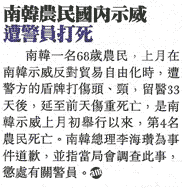
South Korean farmer demonstrated in his own country; he was beaten to death
While demonstrating last month against trade liberalisation in South Korea month, a 68-year-old South Korean farmer was injured in the head and neck by police shields. After being treated for 33 days in a hospital, he finally died from his injuries on the day before yesterday. This is the fourth death of a farmer since the demonstrations began last month in South Korea. The South Korean premier has apologised and said that the authorities will investigate this incident and discipline/punish the police officers who were involved.
The Duke then wrote:Anti-WTO people can use this to say that the Korean farmers are "rebels with a cause"; those who are compulsive about "peaceful and rational expression of opinions" can use this to oppose excessively violent behavior; the Hong Kong police can be proud of themselves; the anarchists can use this as anti-system material.
Please proceed to your own seats and take what you need. We hate the color gray. We like the world as either black or white. You are either with me or against me (better yet, you are either good or evil).
I am the most ungenerous and cold because I use someone else's death as a topic of conversation.
The Qingdong government mobilized more than 270 police officers who made 21 operations to inspect 32 suspected places of ill repute, 3 hotels, 3 hostels, 21 rental houses; demolished 6 illegal businesses, 55 beds, 36 partitions, 18 massage beds; closed down 4 unlicensed hair/beauty salons; arrested 23 suspects. The police announced that they achieved a major breakthrough.
Nine young girls were rescued from Qingdong village, thanks to the kindheartedness of a patron. Here is what the girls said:
- "There were thirty to forty prostitutes at our place, a number of them being kidnapped here. We were rendered unconscious and sold here ... to work as prostitutes here."
- "There are about 70 or 80 similiar places in Qingdong town."
- "Raids? Of course there were raids, but it was useless. Each time that the police come, the boss would receive a phone call. Then we all stay in. It may be chaotic out there, but nothing happens inside."Okay, now do the mathematics.
There were 70 to 80 places, but the police inspected 32 + 3 + 3 + 21 = 59 places, and closed down 4 unlicensed hair/beauty salons.
70 to 80 similiar places with 30 to 40 girls per place means 75 x 35 = 2,625 prostitutes in this town, of which a number were kidnapped and forced to work. How many girls were rescued in the announced police raids? None.
In order to kidnap the girls, watch over them and escort them back and forth to their work, there should be at least several hundred workers. How many were arrested? "23 suspects", some of whom may be released later.
As for the major breakthrough, it would be one if only the Qingdong town could figure who the corrupt moles within their police department were.
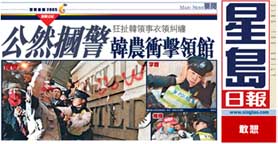
The site, Curbside at the WTO (http://curbside.jmsc.org), was the brainchild of students studying under New Media Professor Andrew Lih at HKU's Journalism and Media Studies Centre. Their goal is to bring "live" coverage of the WTO protests, activities and assorted matters to the community in real time, using blogs, photo galleries and stories from students and, in some cases, Standard reporters.
In the virtual newsroom, participants chat with each other from morning to very late about developments, story angles and schedules; online editors share gossip, give assignments and field queries. Information is posted all day long via an open-source software called Joomla and the result is an online digest of breaking news, analysis and commentary by a wide variety of contributors including others in the online Hong Kong blog community, principally Roland Soong, who operates the popular EastSouthWestNorth blog.
One example: while much of the Hong Kong media was overhyping the pushing and shoving prompted by Korean protests early in the week, Curbside staff Andrew Lih ran a photo for Soong of a TVB reporter wearing a crash helmet on camera when there was no violence anywhere in sight. It was an Emperor's New Clothes moment that caught the spirit of the blogsphere. Now those of us in "old" media have a whole crew watching over our shoulders, reporting faster than we can and critiquing our work as we go along.
For the HKU bloggers, it has been a satisfying week. "It didn't seem possible that it would all come together into something real, and work," said student editor Susan Rossi in an online interview.It is unfair that the outsider should get the detailed description. I urge you to visit the Curbside @ WTO and look at all the other wonderful stuff.
[Lucas] The development package is currently being discussed in "green room" meetings (ie selective – and undemocratic - negotiating meetings among the key players) ...
[Kinnock] Another day of endless speeches before the late night convening of the "big boys on the block" in the green room, where they continue with their haggling and horse trading. This shadowy world excludes dozens of those countries who stand to lose or gain.
We need an anonymous blogger from inside that green room.

三个代表". It is also entirely possible to translate "三个代表" as the "Three Representatives." I was therefore struck by the number of times that the "Three Representatives" appeared in this post The Shanwei (Dongzhou) Incident (e.g. Reuters AlertNet: " Police detained three representatives from Dongzhou on Tuesday, which prompted thousands more to come and demand their release ..."). This is just unreal ... Of course, I intend no sarcasm, irony or disrespect here."Reviewing the course of struggle and the basic experience over the past 80 years and looking ahead to the arduous tasks and bright future in the new century, our Party should continue to stand in the forefront of the times and lead the people in marching toward victory. In a word, the Party must always represent the requirements of the development of China's advanced productive forces, the orientation of the development of China's advanced culture, and the fundamental interests of the overwhelming majority of the people in China." (from Jiang Zemin's speech at the 16th CPC Congress)
In Chinese, the "Three Represents" is written as "


So when I mentioned the 1967 riots in Hong Kong, it meant the following -- personally, I remembered that I walked down the street to go to school one morning. Along the way, I saw a brown paper bag with the words "Compatriots, do not approach. This is reserved for white-skinned pigs and yellow-skinned dogs." What did I do? I walked around it and went straight to school. I didn't call the police or anything, because someone else can do that. I just cannot afford to be late for school, because they would never accept the excuse that I had to call in a bomb! Most bombs were duds, and the live ones were triggered instead of timed. So I had no fear. Most of my blog readers are much younger and will have no empathy with how people like us felt back then.
Also, I was visited by an old friend of my parents today. She recalled: "There was a day in 1967 when they imposed total curfew in all of Hong Kong and Kowloon. This was the only day in the entire history of Hong Kong when all that happened. Your mother and sister were trapped on the Hong Kong side. Meanwhile, your dad was bleeding from his chronic problem in Kowloon. You were too young to know or do anything. I and my doctor husband drove down to your place, put your dad in our car (which has MD plates) and took him to the hospital. We had to take the risk at a time when nobody was allowed to be in the streets. I will never forget the sight of the completely deserted streets as we drove towards Queen Elizabeth hospital." That was why that item made the list.
On my list of events, some email correspondents pointed out that I did not list the date of June 4, 1989. During that period, I had two full-time jobs, I worked 20 hours per day 24/7, and I preferred to sleep under my office cubicle because it was a waste of time to go back and forth to my home. If China had been annhilated by a meteor from outer space, I would not have known or even cared. What I know about June 4, 1989 is learned through reading years later. To me, it is like the Nanjing massacre. I wasn't there, but I appreciate that it meant a lot to those who watched it happen.
As another example of personal experience, let me tell you about 9/11. I remembered that it was a beautiful Indian summer day in New York City. At 830am, I stepped out of my apartment building and I saw a beautiful blue sky. I went down to take the subway train at Union Square to get to Grand Central Station. Then I got out at 43rd Street, I crossed Vanderbilt Avenue (which runs from 42nd Street) and then Madison Avenue (which runs from 23rd Street). When I reached Fifth Avenue, I turned uptown (and northwards) to reach my 45th Street office. But I sensed that something was very wrong here. The pedestrian traffic had completely stopped. I was facing north and I saw that everyone had stopped and looked southward. People appeared to be in total shock. So I stopped too and I turned around. Fifth Avenue is a long and straight street, and when one looked southward, one used to be able to see the tall World Trade Centers all the way downtown. The sight that had shocked everybody was the twin towers in flames. A lot would happen later on that day. But I prefer not to write about it here, because it will bring in other people who may prefer not to reminded of what happened on that particular day. That was why 9/11 was on my list.
Let us accept this -- as individuals, we have lived through various experiences through personal circumstances. Some things will have greater immediacy than others, so let us not challenge each other for political correctness in terms of those personal experiences. I have other experiences too, like the one week that I spent in a general ward in Queen Mary Hospital for a general checkup as a 10-year-old, and all I did was to watch fishermen die from throat cancer presumably because they ate too many salted fish. Yes, I had to watch the person in the next bed slowly expire.
So please give each other some personal space ... I respect yours, so don't push into mine ...
I do this by becoming the single most hated blog in Hong Kong. When I write about something like the number of marchers on 12/4, the democrats are howling that I am a Communist Party shill. When I write about something like the new rules on avian flu reporting in China, the other boot falls. So I am hated by all sides.
Why is my political position so ambivalent? Because I have none. As an American citizen, my greatest sorrow is to watch how political partisanship has destroyed all sense of objectivity among the citizens. Take an event such as Hurricane Katrina and run a public opinion poll on satisfaction with the administration's performance? Approval rates are 10% from Democrats, 15% from Independents and 90% from Republicans. People don't look at the objective situation anymore -- everything is about partisanship calculations. I do not talk politics to anyone in the United States anymore, because nobody is listening. I am either talking to the converted or the enemy. It is pointless.
But when I write about something on my blog, I do not look at the party behind it. If something is wrong, then it is wrong. It is wrong to exaggerate the number of marchers just as it is wrong to order people to hide information about an epidemic outbreak. If there is a pro-Beijing rally in which their organizers claim 750,000, you can bet that I will review the evidence and condemn them for lying. If the Hong Kong government has the same orders about reporting avian flu, I would publish that information too. After living through Free China, Richard Nixon, the Cultural Revolution, Monica Lewinsky, the War in Iraq and all that, I am now insisting on a world of truth.
There is a second part about how I draw visitors from both sides -- I am always interesting. You may hate me for one particular post because it damages your side, but you will come back tomorrow because you don't know what other surprises I will lay out for you and you may just really like it. In the process, I hope to slowly wean people of that political partisanship, which is a grave threat to democracy and governance."
BIGGEST DISGRACE TO HONG KONG BLOGGING : No blog lets the Hong Kong blogging community down like EASTSOUTHWESTNORTH, who among other things translates Hong Kong Chinese newspaper articles into English and provides critical and illuminating commentary. What's more, he actually knows what he's writing about. Several of the NTSCMP judges have become regular readers. What is happening in the world when someone produces a worthwhile blog?
With enemies like that, who needs friends? But I am Aussie and therefore supposed to be able to take a joke or two. I would have been amused if only the NTSCMP guy had even a minute trace of humor anywhere. But alas, that would be demanding too much of him. However, he can make it up by updating that dreadful website much more frequently . P.S. Please add a RSS feed because I am tired of checking every hour and finding no updates!
This year, I have just been named the English language Model Worker by Danwei:
Roland Soong, who writes ESWN, is a one man media machine. His blog is updated almost every day with translations and commentary from Chinese langauge sources in the Mainland, Hong Kong and Taiwan. The blog provides coverage of the Chinese world that you cannot find anywhere else on the Internet or in print. Aside from the amount and variety of information provided, the blogger's personal idiosyncracies are part of the reading pleasure.
With due respect, I prefer a cash bonus. Model worker citations went out of fashion with Hua Guofeng (who?) and we now live in a cash-based post-capitalistic market economy. The unit just never gets it, though. By definition, of course. Alternately, the unit totally gets it and continues to try to get away with it ... after all, it exists to maximize cash flow and shareholder values too ...
大佬) and another triad member to a night shop. They met the person nicknamed White Haired Guy. The captain went up and respectfully said hello, and introduced the two: "Hey, you two listen up. This is Big Brother White Hair, the 'boss' (坐館) in the previous term (note: As noted in the movie Election, the 'boss' is elected by a council of captains to serve for a regular term)." When White Haired Guy heard that, he nodded and smiled. Then he lectured the two of them a bit before leaving.An Organized Crime squad undercover police officer with codename Edgeglass had penetrated the Wo Shing Wo triad, which claims a membership of 120,000 in Hong Kong. On October 8, 2004, Edgeglass accompanied his captain (
In April 2005, the undercover operation was completed and the Organized Crime squad made mass arrests of Wo Shing Wo members including White Haired Guy. Based upon the testimony of Edgeglass, the police charged him with the crime of "claiming to be a triad officer."
However, the trial did not progress smoothly. The defendant's lawyer suggested that when Edgeglass met with White Haired Guy, he had found out that White Haired Guy was already no longer the 'boss.' Therefore, there was no basis to charge the defendant with "claiming to be a triad officer" at the time of the meeting. "Claiming to be a triad officer in the past" is qualitatively different from "claiming to be a triad officer at present." However, do you believe that "smiling and nodding to the statement about being a former 'boss' means that you are presently still a member? Is there reasonable doubt?
The judge agreed with this contention, and advised the prosecutor that the case would be dismissed in the absence of any other evidence. As a result, the prosecutor amended the charge to "claiming to be a member of a triad society." White Haired Guy was convicted of this charge and sentenced to 12 months in jail. Ordinarily, this kind of charge results in 3 to 6 months. The heavier sentence here was imposed in consideration that White Haired Guy was a veteran gang member even though he may not have been the 'boss' at the time. (Note: This is the reason why triad gang members are advised to admit to this crime as early in their careers as possible. This is known as 'cleansing the bottom' (
洗底). The sentence jail is shorter (especially for a juvenile), and they can no longer be charged again for the same crime under the principle of 'double jeopardy').What did White Haired Guy think? He was not happy with being charged on the sole basis of what Edgeglass heard. As quoted by Eastweek, "F*ck! I am not the 'boss' now. I was just bullsh*ting (
吹水) with the guys and I get prosecuted? Are they kidding?" One can imagine that there are many other types of crimes for which pure hearsay will not result in conviction. But in Hong Kong, nobody loves the triads (except for the triads).White Haired Guy will also be facing more than 20 charges related to specific crimes. According to the organizational chart in Eastweek, his team members were engaged in drug sales, illlegal betting (horse racing and football), loan sharking, protection racket, black market petroleum, counterfeit CDs and the mini-bus business between Taipo and Tsuen Wan.
实际上,这两个就在隔壁的论坛聚拢的人差不多,但两边的气氛是完全不同的。在色情文学这边,大家温良恭俭让,满口的恭维。即使有某人作品实在臭不可闻,大家也一样在鼓励,或者提供很专业的写作意见,甚至提供参考文献。当然,所提供的肯定不是《通往奴役之路》。没有漫骂、嘲讽,或以老大自居的自大狂。
反之,在正经论坛上,各类板砖飞舞,破口大骂有之,问候女性亲属有之,蔚为大观。还真是让我到现在都不明白,为什么笔下文字诲淫诲盗的时候人倒是比较谦恭,一旦认为真理在手,就开始大打出手呢?
[translation] In practice, these two neighboring forums had more or less the same group of participants but the atmosphere was completely different. On the erotic literature side, people were kind, nice and respectful with many words of compliment. Even if someone's writing really stunk, everybody still gave encouragement and even provided professional-class writing advice and reading references. Of course, they were not exactly going to recommend "The Road To Serfdom" for reading. But there were no inveighing, harangues, sarcasms or self-aggrandizing egotism.
In contrast, at the serious forum on current affairs, verbal missiles of all types were flying everywhere. Some people let out torrents of abuse, including asking about the female relatives of others. It was quite a sight. To this day, I still cannot understand when people write about sex, violence and criminal activities, they are relatively humble and respectful, but when they think that they have the truth in hand, they come to blows.
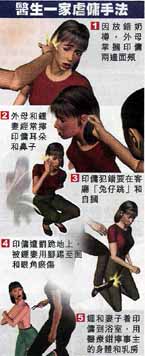
(SCMP) An Indonesian domestic helper who accused her employers of assaulting her for being drowsy at work had been caught on tape falling asleep standing up and in other peculiar positions, a court heard yesterday.Eighteen video clips showed Suliyah falling asleep while washing up, ironing, mopping the floor and bending over to clean furniture and the toilet. On a few occasions, she was seen curled up, crouched and in bizarre positions in the living room and kitchen.
Psychiatrist Chow Lok-yee said she had displayed symptoms of schizophrenia, which could lead to self-mutilation and false memories. He said the strange postures, known as catatonic posturing, were a symptom of the mental illness. Affected patients would have no recollection or reasonable explanation of this behaviour and the posturing could lead to self-mutilation. The condition could lead the maid to believe her injuries were inflicted by the three defendants.
- Attended St. Paul's Convent School in Causeway Bay (Hong Kong). After our family moved to Kowloon, I was interviewed but turned down by Maryknoll Convent School. Yes, they allowed boys in girls' schools back then.
- The Free China propaganda (my father was an executive producer at Cathay Films, then the major production company for mandarin films).
- The waves of mainland Chinese refugees hitting Hong Kong to escape the famine due to The Great Leap Forward.
- Standing for hours in a Hong Kong street to wave our Union Jack flags when Her Majesty The Queen breezed by in her Rolls Royce in under 10 seconds
- Scheduled water stoppages in Hong Kong (like water coming on for four hours on every seventh day)
- The 1967 riots in Hong Kong ("yay! no school today because there are too many bombs in the streets again")
- How to survive on your own with A$8 per week in Sydney (Australia)
- The 1970's movement in the USA to protect the Diaoyutai islets
- The Great Proletarian Cultural Revolution
- The Nixon-Kissinger peace initiative for Vietnam (=secret bombing of Laos and Cambodia)
- Watching the 1973 Watergate hearings while work/study at Harvard University
- Hearing Richard Nixon say "Your President is not a crook."
- The Gang of Four, Lin Biao, "With you in charge, I'm at ease," etc.
- Jimmy Carter's 'malaise' speech by the fireside
- Iran/Contra hearings
- How to run a Chinese brothel in America (if you must)
- Chinese gangs in America (Bamboo Union, Ghost Shadows, Flying Dragons, Fujian Youth, Tung On, etc)
- Watching World Trade Center twin towers burn in New York City on 9/11
Therefore, you should not be shocked to find that our values, attitudes and opinions are quite different.
Many people are setting up their own blogs on the Internet. I have seen the blogs of eight or ten of my friends, and I visited the blogs that they recommended. I discovered that most bloggers are teenagers or under 30, and these are also the people who spend the most time on the Internet. For now, I have not discovered any blogs written by middle-aged housewifes or senior citizen uncles. I have this strange idea: if these people have blogs, what would they look like?
Wongchukhang senior Mrs. Wong's blog: "I heard that they are giving away toilet paper with the newspaper today. So I hurried out early in the morning to buy a newspaper and then I got on the line at the supermarket. When my turn came, they were out of stock! I was so mad! So the whole group of us cursed the supermarket out. Later, I will call the newspaper up and curse them ..."
Ngautaukok Sister Shun's blog: "Last night, I was playing mahjong with Third Aunt, Sixth Aunt and Eight Uncle while watching 'Ah Wong'. It was especially 'Wong' (=lucky). There was one time when I was looking for one particular piece and I knew that the others were not going to play it to me. Nevertheless, I was to find it for myself! It was really 'Wong' (=lucky). I must play a few more mahjong games before the series 'Ah Wong' is over."
Tianshuiwai senior Mr. Chan's blog: "Today, I was in the park and old Cheung said that someone wanted to organize the neighbors to go to demonstrate on Sunday. There will be free buses back and forth, plus a free lunch. I don't have anything to do on Sunday anyway and they are giving a free meal. So I am thinking about going. Is anyone else interested? If so, please post a comment."
This is speculative. I will offer you a real-life alternative blog -- the blog that you are reading now is written by a senior citizen uncle. And this is not your typical teenage diary, is it? According to some, there is no match to this blog as a "serious China blog" at the moment.
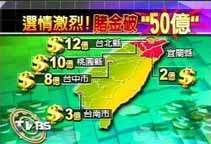
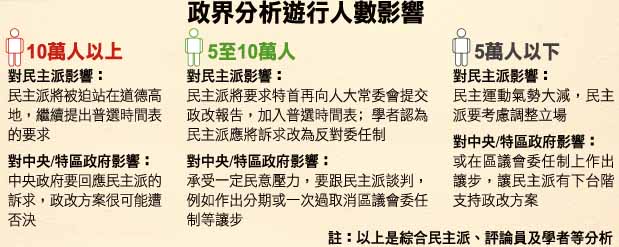
The newspaper has always included a table about the implications of various outcomes consolidated from "various democrats, commentators and scholars":
- more than 100,000: for the democrats, they are forced to stand on the moral high ground and continue to demand a timeline for universal suffrage; for the goverment, the central government must respond to the demands of the democrats and the reform package may not pass.
- 50,000 to 100,000: the democrats will ask the chief executive to submit a political reform proposal to the National People's Congress' Standing Committee with a timetime for universal suffrage; the scholars believe the democrats should change their demand to opposition to the appointment system for district councilors
- under 50,000: for the democrats, the wind will be take out of their sail and they must consider revising their position; for the government, they may concede something on the appointment system for district councilors so that the democrats can back down and support the political reform proposal.As for this blogger, I will revive something from three weeks ago (see comment):
One, do not set up a target to define success/failure. Already the government has put up an estimate between 50,000 and 100,000. Do not take the bait. In a previous comment, I argued for using public opinion polls instead because it has the highest support level (consistently around 60% for direct elections). The demonstration is just a reminder of that level of support, not the quantitative proof.
Two, do not fool around with the number of demonstrators as they did on July 1, 2004 and 2005 (see comment again). If you fool around with the number again, the entire project gets kidnapped and you have to fight the academic researchers and you will lose once again.
Unfortunately, as shown in the Ming Pao table, all sorts of people are already setting up these threshold zones as the metric of success/failure. Perhaps why I should tell you what an outsider (such as someone sitting in Beijing, London or Washington DC) might think. Let us say the number is 100,000. There are 3.2 million registered voters in Hong Kong. 100,000 out of 3.2 million is about 3%. That person in Beijing is going to think: "Three percent of the people went into the streets and they are saying that their wishes must be satisfied?" Those numbers in the Ming Pao table represent a storm in a teacup, but to the outside observer, these arguments are absurd from the viewpoint of the numbers in the absolute sense. As I said, the real important number is the 60% from just about every poll to date. The more this number (100,000) or whatever is talked up, the more absurd it will seem to the outside observer. Somehow, Stanley Ho has managed to kidnap the whole discourse into some absurd diversion. No, the real number is sitting behind there -- 60%! Don't get your attention turned away!
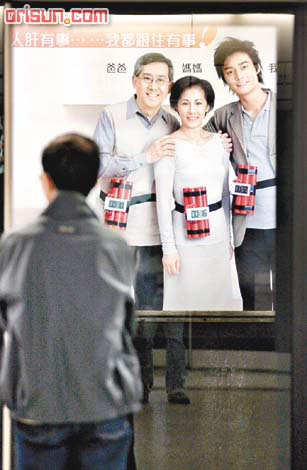
Drugs giant GlaxoSmithKline has expressed regret after being accused of insensitivity towards victims of terrorism by running an advertising campaign in MTR stations featuring pictures of people with explosives and timers strapped to their waists.
Posters advertising the prescription drug Zeffix for Hepatitis B sufferers feature images aimed at highlighting the hidden "time bomb" of Hong Kong parents passing Hepatitis B on to their children.
A spokeswoman for the UK-based firm said: "We are sorry to learn that the ad has created unrest and upset to some commuters. We appreciate their comments and will take serious review with regard to our future communication materials."
An MTR Corporation spokeswoman said: "The MTR is concerned with the incident and aware of the sensitive social issues the adverts are associated with. It has confirmed with [GlaxoSmithKline] that none of those adverts will be posted on MTR stations for the WTO."
The campaign comes five months after suicide bombers with explosives strapped to their bodies caused carnage on buses and the London underground network.
It was drawn up by GlaxoSmithKline's Hong Kong marketing department.
There should have been an advertising agency involved here too.
But this comment is titled Soft Power for a reason. I quote another Lung Ying-tai statement from Unpolitical Political Statements:
In my writing, I knew that I could not directly attack the system. That would be something that the opposition publications do. I could discuss and criticize the environment, security, education and other social problems. Yet, under that authoritarian system, any thinking person will figure out that all social problems ultimately and unavoidably must be rooted in politics. But I could not write about that.
And I did not feel that I need to write about that. If a person has the ability to think independently, he will be able to see the crux of the problem and find his own answer. I believed that the unjust system existed because individuals allowed it to exist; the more basic problem about the system is the individuals.
And that is why every single essay in Wildfire attributes the ultimate responsibility on the individual, and that is the citizen himself.
What is that soft power? You can go back and re-read A Chairman Bowed Formally Three Times and then ask, "Which time, place and event is she talking about?" Are there similar events for which her analyses apply? You can find your own answers. This is soft power at its best. I bow myself in adimiration of the master of the art.
Related Link: Introducing an essay from a Taiwan writer: "Three bows by one chairman" Sun Bin
According to Apple Daily, for the Taiwan County Commissioner election contested between Chou Hsi-wei (KMT) and Luo Wen-chia (DPP), the total amount of bets is NT$1.2 billion. The last-but-one scandal was the Yungchou case directed at Chou, and the last scandal was the videotape of rally attendees allegedly being paid by the Luo campaign (note: this may be an old film from years ago!).
Here are the odds coming from the bookmakers in several districts in Taipei county, before and after the video tape:
- Sanchung: before, Chou by 30,000-50,000; after, Chou by 50,000-60,000
- Banciao: before, Chou by 80,000; after, Chou by 80,000-100,000
- Yungho: before, Chou by 100,000; after, Chou by 150,000This is addictive. You can talk issues and your numbers won't move an inch. You unveil a scandal (true or false), your opponent is down on his knees and crying in front of the television cameras and your numbers rocket up. What should you do?
Postscript: The final margin of victory was about 190,000. The virtual market was imperfect.
Post-Postscript: What a shocker! The video was faked! We are shocked!!!
白樺) was being denounced for liberal tendencies over his novel/movie (苦戀, <<The Bitter Love>>). On December 29, 1985, the Chinese Writers Association held a meeting in Beijing. After the opening ceremony, Hu Yaobang and other central government leaders had their photographs taken with the writers. Then Hu Yaobang walked straight up to Bai Hua, stuck out his hand for a handshake and asked what Bai was writing these days. This was his pose, and once that photograph got published, people everywhere began to congratulate Bai. It was a small gesture, but it was imbued with deep meaning by everybody.The first item has to do with the common woe of the "China hands" who have to cover China from afar. What is really going on? There are no "senior administration officials" to leak state secrets, so you have to read as much meaning from the public record. At one time, Bai Hua (
The second item has to do with a meeting between Hu Yaobang and the recently deceased Ba Jin at Zhongnanhai. Hu began by asking, "Elder Bai! Have you read my essay?" Ba Jin said, "No." Hu said, "In my essay, I wanted to state up front that the criticisms of <<The Bitter Love>> ought to stop, but certain senior comrades did not agree. So I had to put in the back. You are an esteemed figure in the literary field, and you should give the younger writers some proper guidance ..." But Ba Jin did not follow on Hu's suggestion at the time. Instead, he directly offered his own thoughts: "Chinese literary artists have suffered many so years already. They should be encouraged more and criticized less, especially the younger ones. An example is that which is being directed against Bai Hua and <<The Bitter Love>>."
At this time, the news reporter Qi Ming (
祁鳴) was recording the session with a movie camera and he found that his view was suddenly blurred. He checked and then realized that tears were coming out of his eyes when he heard what Ba Jin said. Later Qi Ming told Bai Hua: "According to the practice over the years, it does not matter how famous you are as a literary artist, when you listen to a senior Communist Party leader talk, you are supposed to agree and you don't express a different viewpoint. But in the midst of the wave of criticism against <<The Bitter Love>>, Mr. Ba Jin could selflessly cry out on behalf of the writers." Ba Hua noted: "To this date, when Mr. Qi Ming mentions this incident, he is still teary. Through this story, I learned that Mr. Ba Jin spoke truthfully like this. Yet today, there are still so many intellectuals who bow themselves disgustingly like slaves before power and wealth!"傻逼 ) that they are.Although the two had a valuable lesson, but the fact that they think different from mainland student caused them to feel a little bit embarrassed. "The Shanghai students cared about how the Chinese peasants are being exploited, how China can grow strong and compete internationally, but the Hong Kong students proceed from emotions and analyze the concept of fair trade from the viewpoint of public justice in see how unfair trade can be eliminated. The Shanghai students have strong rich patriotic thought and regard the Hong Kong students as 'impractical/unrealistic.' We may be missing a certain degree of patriotism."
That is a straightforward enough observation. Unfortunately, most Hong Kong people still don't get it at all. There are still those who think that the major issues for China are the revindication of June 4 or the freedom of belief for a certain religious cult. They say that to their mainland compatriots, who look at them incredulously as if they are just the pack of SB (
Xu Xiaonian: I agree with Ding Xueliang's assessent to a certain degree. It is a fact that the level of quality of certain Chinese scholars do not even match up to graduate students overseas. When I was in a class in central Europe, a student asked me what I thought of this assertion. My response was, "I'm trying very hard to become the sixth one."
Shi Jinchuan: Ding Xueliang's fields are sociology and politics. His assessment of economists is like an amateur rating the chef. At a minimum, it is not rigorous.
Xie Minggan: This is totally absurd. Before we discuss who is a qualified economist, we must at least define what makes a qualified economist. The older generation respects the title of economist. As for me, I don't admit to being an economist; I am just a lover of economics. Ding is not from the field of economics, so how can he give out opinions so casually? Every breakthrough in China's reform was undeniably due to the labor of the economists.
Liang Xiaomin: If we use the number of Nobel Prize winners as the standard for being qualified economists, then there is none from China so far. Whether it is one or five, this is clearly not verifiable since there are no standards. But the fact is that society is restless at this time and it is the difficult for great scholars to emerge. This is the imperfection of this era, as with any era of social transformation -- during the British Industrial Revolution or the United States before the 1930's, they did not have any great scholars either.
Xiao Geng: I am not shocked by what Ding Xueliang said, as this is his style but the assessment does not match reality. A senior scholar said, without a large group of brilliant physicists, Shenzhou VI could not have went up into the sky; without a large group of excellent biologists, we might as well as forget about genetic engineering. Yet, without qualified economists, the economic development of China during the previous more than 20 years broke human historical records. This is unimaginable! I have worked at the World Bank. There are more than 8,000 economists (or analysts) at the World Bank, and their research skills are obviously good. But they admire and respect the economic policies drawn up by China.
Archives