The Shanwei (Dongzhou) Incident
The following is an illustration of the level of details in coverage by English- and Chinese-language media of the same event. The listing is done in order of increasing details within the English-language reports, and then the translated Chinese-reports appear below. I have listed only the sections pertaining to the incident itself and omitted background information. There is a set of photographs from the scene earlier in October.
This is not intended as criticism of any of the media. Rather, the point is used to show how the media operate with different levels of space, access to information and journalistic standards for reportability.
Please note how almost everybody else had to rely on the Radio Free Asia report. The Shanwei incident has been going on for more than five months and Radio Free Asia was covering it while nobody else paid much attention. Then when the violence broke out, Radio Free Asia already had the background information as well as sources on the ground. It was a lot harder for others to catch up. You can see that they tried (e.g. calling up the police and being given no information). Please also note that some services felt that it necessary to qualify Radio Free Asia as "US-government supported" or at least as "U.S. broadcaster."
The Epoch Times item at the bottom stands out from the rest. If everyone else refers to several hundred or more than 1,000 police officers, they say 2,000 to 3,000. If everybody else refers to three dead with names given, they say more than ten dead instead. If everybody else refers to tear gas canisters fired at close quarters as the cause of death, they say that the armed police sprayed the villagers with submachine gunfire instead.
(BBC News) December 7, 2005.
Chinese armed police are reported to have opened fire on protesters in the southern province of Guangdong, shooting dead at least two people. Witnesses told US broadcaster Radio Free Asia the incident happened after hundreds of police tried to disperse up to 1,000 demonstrators near Shanwei.
(Kyodo News) December 7, 2005.
At least two people have died in China's southern province of Guangdong after police fired on villagers protesting inadequate compensation for land taken away for wind-power plant construction, Radio Free Asia reported Wednesday. By Tuesday evening, two men had died in a Donghua village hospital near the port city of Shanwei after being shot the previous day by riot police, the U.S.-based radio service said, quoting a hospital official. But the report also quoted a Donghua villager as saying a total of four villagers have been killed in the incident, with many others suffering gunshot wounds.
(Reuters AlertNet) December 7, 2005.
Chinese police opened fire on villagers protesting against the lack of compensation for land lost to a new wind farm in the southern province of Guangdong, local officials and residents said on Wednesday. U.S. broadcaster Radio Free Asia and residents said at least two villagers were killed in the assault after riot police moved into the area on Monday to quell the unrest in the Guangdong village of Dongzhou.
"In the beginning, there were about 100 to 200 villagers protesting and gradually the number got bigger as more and more people came to watch," said an official surnamed Chen in the nearby city of Shanwei. "The police didn't bring guns at first, but some villagers used pipe bombs to attack the police, so the police station sent more police with guns to the scene," he said.
Police detained three representatives from Dongzhou on Tuesday, which prompted thousands more to come and demand their release, the Radio Free Asia report said, putting the number involved in the demonstration at 10,000.
(Associated Press via The Standard) December 7, 2005.
Police opened fire on villagers protesting the construction of a wind-power plant in Guangdong, leaving at least two people dead, a news report said Wednesday. Local police and other officials contacted by telephone in Dongzhou, a village in the southern coastal city of Shanwei, refused to comment. "That's something between the villagers and local government. We are just doing our project and we're not clear about what's going on there," said a spokeswoman for Guangdong Red Bay Generation, a company building a coal-fired power plant nearby. She gave only her surname, Wang.
US-government supported Radio Free Asia, citing witnesses and hospital staff, said at least two people died and an unknown number of others were injured when police began shooting late Tuesday on a crowd of "thousands" of villagers....
Local police and government officials declined to provide details and either denied or refused to say whether police opened fire. "The masses caused some obstruction yesterday. We are dealing with it and trying to resolve it," said an official at the neighborhood Red Bay district police station, refusing to say whether police opened fire.
(AFX via Forbes) December 7, 2005.
Soldiers in southern China's Guangdong province killed four people when they opened fire on more than 1,000 villagers protesting the construction of a power plant, residents said.
The clash happened yesterday evening in Dongzhou village in Shanwei city when hundreds of officers from the People's Armed Police -- a unit of the People's Liberation Army -- were sent in to disperse the villagers, residents told Agence France-Presse.
'The People's Armed Police entered the village, they opened fire and shot to death four people,' said a villager by telephone. 'Two died in a local hospital and two were taken to a hospital in Shanwei's urban center, but they died too,' he said before his phone appeared to be cut off.
A teacher at the Dongzhou Middle School said he did not see the incident because he lived outside the village but learned about it when he arrived at work today. 'It's mainly because of land dispute. Compensation was one of the problems,' said the teacher, who declined to be named.
When contacted by Agence France-Presse, Shanwei city police and city government officials said they did not have any knowledge of the incident and declined to comment further.
(South China Morning Post) December 7, 2005.
Eight villagers were reportedly shot dead by Guangdong police on Tuesday when officers were sent in to break up a protest connected to a land requisition dispute.
Police and government officials in Shanwei - which oversees Dongzhou village - refused to comment yesterday despite repeated attempts for confirmation. "It's not a simple case, because in such a harmonious society, our armed police won't presume to open fire on villagers," a spokesman for Shanwei city government said. Officials from the Shanwei Public Security Bureau said they were "not clear" about the incident.
But a villager contacted yesterday said his brother, Lin Yutui , 26, was among the victims and was shot by police when he went to join the protesters. "He died at the scene immediately because one bullet hit his heart and another his pelvis," said the villager, who declined to give his full name. The villager claimed that eight protesters were killed, but this could not be independently confirmed. According to the man, some of the villagers were still being treated in hospital. He claimed some of the police officers who had taken part in the crackdown had come from neighbouring cities of Lufeng and Luhe.
(AFP via Aljazeera.net) December 7, 2005.
Soldiers in southern China's Guangdong province have killed four people after firing on more than 1000 villagers protesting against the construction of a power plant. The clash happened on Tuesday evening in Dongzhou village in Shanwei city when hundreds of officers from the People's Armed Police - a unit of the People's Liberation Army - were sent in to disperse the villagers, residents said on Wednesday.
"The People's Armed Police entered the village, they opened fire and shot to death four people," said a villager by telephone. "Two died in a local hospital and two were taken to a hospital in Shanwei's urban centre, but they died, too," he said before his phone appeared to be cut off.
A teacher at the Dongzhou Middle School said he did not see the incident because he lived outside the village, but learned about it when he arrived at work earlier in the day. "It's mainly because of land dispute. Compensation was one of the problems," said the teacher, who declined to be named.According to locals interviewed by the US-based Radio Free Asia, the villagers had been demanding that the government should compensate them fairly for building the power plant, but their requests were denied. Tensions have escalated for many months and came to a climax on Tuesday, according to villagers and protesters quoted by Radio Free Asia.
"They were firing shots. But they were afraid to move in. We had blocked the roads with water pipes, gasoline and detonators," a villager who called RFA late on Tuesday said. Another villager Radio Free Asia quoted said "many" villagers had suffered shotgun wounds. "I don't know what kind of guns. I just know they were using real bullets on us. No policemen were wounded," the villager added.
The radio station said it had confirmed that two people had been killed, and quoted villagers as saying four had died....
Shanwei city police and city government officials said they did not have any knowledge of the incident and declined to comment.
(Radio Free Asia) December 7, 2005.
At least two villagers in China's southern province of Guangdong have died after police fired on a crowd protesting the construction of a wind power plant, Radio Free Asia (RFA) reports. Witnesses told RFA's Mandarin service that by 9:30 p.m. Tuesday, villagers Jiang Hu and Jiang Guanji had died in the local hospital while a third, identified as Tang Daxiang, was receiving emergency treatment. Dongzhou Hospital authorities near the city of Shanwei confirmed two deaths and one wounded undergoing treatment, but they declined to give names.
"At least four villagers have died," another villager said at approximately 11:30 p.m. "There is a dead body on the street yet to be retrieved. Many are wounded by gunshots. I don't know what kind of guns. I just know they were using real bullets on us. No policemen were wounded."
"The hospital has become a virtual funeral hall with family members of the dead crying," one villager told reporter Ding Xiao. "They were bleeding. One was hit in the head, one in the foot, and one in the torso. They have been rushed to Dongzhou Hospital. We have prepared detonators. We're ready to fight," another said.
According to several eyewitness accounts, hundreds of riot police moved into the site of the wind power plant Monday after a long-simmering dispute over how much villagers should be paid for land slated to become a wind-power plant. Around midday Tuesday, three representatives from Dongzhou village went to the site to see what was happening. The three villagers were immediately detained, witnesses said.
Shortly after 5 p.m., thousands of villagers showed up at the site of the plant and demanded the release of the three representatives, they said. Police stationed inside the power plant fired tear gas at the crowd but caused no serious injuries. Later Tuesday, authorities dispatched several hundred more riot police to the site of the plant but they were stopped outside Dongzhou village by villagers.
"We are really scared. We need your help. The riot police are at the entrance of our village. There are several hundred of them, between 400 and 500," one villager said in an interview that was cut off several times. "They were firing shots. But they were afraid to move in. We had blocked the roads with water pipes, gasoline and detonators," another villager said. "And there were about 10,000 villagers there. We tried calling the central government several times for help. But all we got was answering machines."
Riot police have now crashed through roadblocks set up by villagers and dismantled their tents near the power plant. Villagers have retreated back to Dongzhou village, they said. Li Min, deputy mayor of Shanwei and chief of public security, asked to comment by phone, said only, "I don't know" and hung up. Guangdong provincial public security offices and the Guangdong provincial government went unanswered. A duty officer at the Dongzhou police station said, "I am not familiar with the situation." Asked to confirm that two villagers had died, he said, "There is no such thing," and hung up.
(Wen Wei Po) December 7, 2005.
[in translation]
Our reporter called up the Shanwei City propaganda department to ask for confirmation on the clash between police and citizens in Honghaiwan. The relevant person said that the nature of the incident is still undetermined . The Shanwei City has prepared a report and will forward the information to the provincial govenment. All release of information concerning that incident will be made by the Guangdong provincial propaganda department.
(Ming Pao) December 7, 2005.
[in translation]
A serious clash between police and citizens occurred in Shanwei City (Guangdong province). Several thousand villagers in the Honghaiwan district of Shanwei protested the loss of the compensation money for building a local electricity plant. On the evening before yesterday (December 6), they gathered in front of the power plant to prevent work. At the time, the authorities sent in more than a thousand police to clear the scene. The sides clashed and the police fired tear gas canisters to disperse the villagers. As of now, the police is still sealing off the village to prevent people from entering or leaving. When one newspaper called up the Shanwei police, they said that they have not heard of this incident.
According to a villager named Chen, the government had requisitioned a large plot of land area including hills, farmland and the White Sand Lake for the purpose of building a large power plant The villagers did not receive reasonable compensation, and the villagers who depend on the sea to earn their living have nowhere to do. So the villagers took turns to protest outside the Shanwei power plant. This affair has been going on for more than 5 months.
According to the villagers, on the evening before yesterday, the government sent more than one thousand anti-riot armed police officers to clear the scene. Several thousand villagers from the nearby Zhongxiuwei village and Shigu village heard the news and came over to help. The police and the citizens faced off against each other. The demonstrators used water pipes and other material to block the road. They also prepared gasoline and home-made fire bombs, so tht the armed police cannot advance.
At about 7pm in the evening, the police took action. They used tear gas to disperse the demonstrators. Three villagers were injured seriously in the head with tear gas canisters and died after being brought to the hospital. Several dozens more people were injured and had to go to the hospital. By yesterday night, the local villagers said that 5 persons died from injuries and more than a dozen disappeared.
Eyewitnesses said that the armed police charged many times into the crowd and used their truncheons to hint the villagers. The villagers used shoulder poles, farm implements and home-made fire bombs to fight with the armed police. Some armed police fired the tear gas canisters right at the demonstrators in close range, thus causing the injuries and deaths.
(Epoch Times via Boxun) December 7, 2005.
[in translation]
According to the latest news from Epoch Times, the Guangdong Shanwei government sent out 2,000-3,000 armed police and anti-riot police into Dongzhou village in Honghaiwan. They used submachine guns to rake the villagers and released tear gas to disperse the villagers. According to local villagers, the police killed more than 10 villagers and arrested two village representatives.
According to information provided by the villagers, "At the time, we know that more than 10 villagers are dead and 40-50 are wounded The wounded have been sent to neighboring hospitals. The more serious injured persons have been sent to Shantou Hospital. According to reports, some of the wounded are in criticial condition. The villagers were allowed to take only two bodies back home. The other bodies have been removed by car. At the time, it was very chaotic at the scene. The villagers on duty left quickly, or else the casualties would be higher. Most of the dead are between 20 to 30 years old ... !
The following is an earlier report:
According to Epoch Times' Xu Poheng, about 3,000 armed police and anti-riot police entered Honghaiwan in Guangdong's Shanwei City at 5pm on December 6. They clashed with villagers trying to defend their land. The armed police and the anti-riot police even shot at the villagers. Three persons who instantly shot to death and another 6 to 7 were wounded. The dead people are between 20 to more than 30 years old. The wounded have been sent for treatment at Shantou's Yihui Hospital. The armed police and anti-riot police fired at the villagers, and also released tear gas to drive the villagers away. The reporter is from Dongzhouhang village, where the people have been forced to retreat back into their own village.
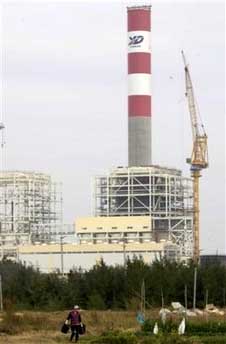
(Associated Press)
(Boxun) October 9, 2005.
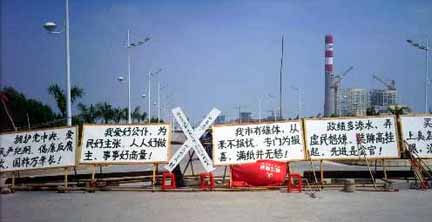
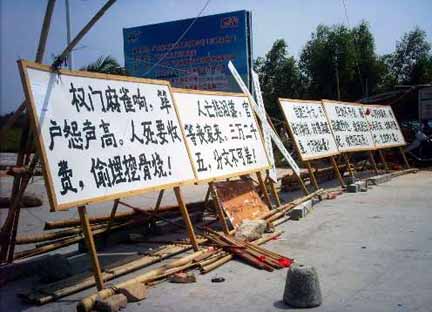
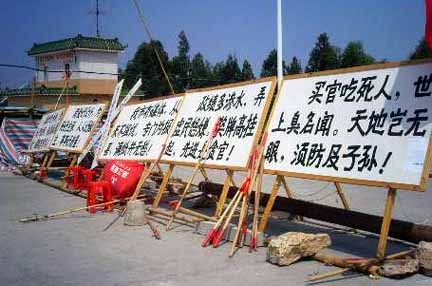
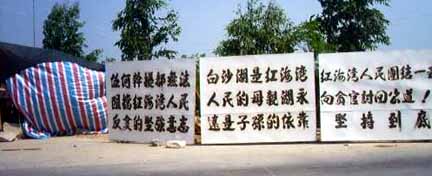
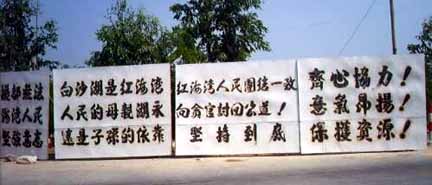
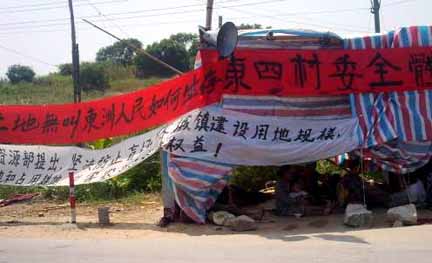
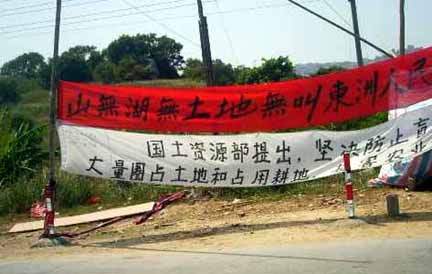
Follow-up reports (in chronological order). The usual warning applies -- DO NOT BELIEVE EVERYTHING THAT YOU READ. There is a simple test -- these reports cannot be ALL true (that is, the number dead cannot be three and "more than 70" at the same time.
(Washington Post) Police Open Fire on Rioting Farmers, Fishermen in China. By Edward Cody. December 8, 2005.
Paramilitary police and anti-riot units here have opened fire with pistols and automatic rifles for the past two nights on rioting farmers and fishermen who have attacked them with gasoline bombs and explosive charges, according to residents of this small coastal village.
The sustained volleys of gunfire, unprecedented in a wave of peasant uprisings over the past two years in China, have killed between 10 and 20 villagers and injured more, residents said. The count was uncertain, they said, because a number of villagers have disappeared and it is not known for sure whether they were killed, wounded or driven into hiding.
The tough response by black-clad riot troops and People's Armed Police in camouflage fatigues deviated sharply from previous government tactics against the spreading unrest in Chinese villages and industrial suburbs. As far as is known, previous riots have all been put down with heavy use of truncheons and teargas, but without firearms.
This time, according to a villager who heard and saw what happened, police responded to the launching of explosives by firing repeatedly "very rapid bursts of gunfire" over a period of several hours Tuesday and Wednesday nights. Some villagers reported seeing the People's Armed Police carrying AK-47 assault rifles, one of the Chinese military's standard-issue weapons. There were no reports of violence Thursday night.
The villagers who rose up against land confiscations in Dongzhou, a community of 10,000 residents 14 miles southeast of Shanwei city, in Guangdong province near Hong Kong, also opened a new chapter -- the use of the homemade bottle bombs and explosive charges that local fishermen normally use to stun fish in the adjacent South China Sea. In previous riots, attacks against police were limited to pelting them with stones and bricks or setting fire to official vehicles.
The Communist Party and city administration of Shanwei, which has jurisdiction over Dongzhou, held all-day meetings Thursday on the violence, officials said. The city spokesman, however, refused to discuss what happened in the village and also declined to give his name. He said only that local authorities were taking the crisis seriously.
There likewise was no public response from the Guangdong provincial Communist Party and government, which have been hit by several long-running and violent confrontations over land confiscations during the past year. As was the case in most previous unrest, the government-censored press and television has not reported on the violence in Dongzhou.
Police set up a roadblock at the edge of the village, blocking most vehicles from entering or leaving, and white Public Security vehicles patrolled the main road linking Dongzhou with Shanwei. Pedestrians and motorcycles were allowed to pass in and out of the village, however, and buses waited for passengers just outside the checkpoint.
About 700 yards down the main street, about 100 villagers glared Thursday afternoon at a force of approximately 300 riot police, wearing helmets and carrying shields and batons, while an officer using an electric loudspeaker urged residents repeatedly to stay in their homes.
"This has nothing to do with you," he blared. "Return to your houses."
The long-simmering conflict in Dongzhou arose over disputed confiscations and what farmers here said were inadequate compensation payments. Authorities exercising the equivalent of eminent domain seized farmers' fields to build a wind-driven electric generating plant on a hillside overlooking the village. The plant would be part of a $700 million electricity development project to supply the growing power needs of Shanwei and surrounding towns and villages.
Villagers, contacted by telephone, complained that the compensation was inadequate. Moreover, they charged, the power plant would spoil fishing in Baisha Lake, a tidal inlet just below the hill on which villagers rely for seafood.
The confrontation was typical of the tension across China between economic development, which runs about 9 percent a year, and farmers' desire to retain the land that they regard as security for their families. The tension is particularly acute here in Guangdong province and the Pearl River Delta, where during the past two decades of economic liberalization, factories and dormitories have steadily eaten away at the rice paddies, corn fields and fruit orchards that used to flourish in the warm, wet climate.
For most of this year, Dongzhou villagers have been protesting on and off against the power plant project, originally scheduled to be finished in 2007 but now delayed. One protest leader, surnamed Huang, was arrested in July.
"It is illegal to impede the progress of a key infrastructure project," a Shanwei spokesman, Li Min, told Radio Free Asia then. "As for whether the compensation is reasonable, it was in line with the usual standards."
The villagers, who asked not to be named for fear of retribution, said the current round of violence was set off when authorities arrested three village leaders who had gone to the hillside plant site Tuesday afternoon to lodge a complaint. Before long, they said, several thousand villagers gathered on the hilltop to demand their release.
Those villagers were dispersed by volleys of teargas fired by police, residents said. But shortly afterward, authorities dispatched between 400 and 500 more riot police into the village as reinforcements, the residents said. That contingent was met by several thousand angry villagers, they added, and police again resorted to teargas about dusk. This time, however, some villagers reacted by pelting police with the explosives, according to witnesses, and the police responded with sustained pistol and automatic weapons fire over the following three hours.
A similar confrontation occurred Wednesday evening on the main village road, leading to more attacks with gasoline bombs and several more hours of shooting, the villagers said. "The police kept on shooting until they drove away all the villagers," said a witness.
In the absence of official information from the government or Dongzhou hospital, reports flew from family to family of villagers killed, bodies burned and relatives unable to retrieve their slain loved ones left lying in the street. Some said 20 villagers were killed each night; others said the total was 14.
"I saw the bodies lying there," said one witness to Tuesday night's violence. "The family members were afraid to go and get them."
One villager, Liu Yujing, 31, said his younger brother, Liu Yudui, 26, was hit by two rounds, one in the heart and one in the bladder, immediately after he stepped outside the family home to see what was going on in the street Tuesday evening. "He died before we could get him to the hospital," Liu said.
(Epoch Times via Boxun) December 8, 2005.
[in translation]
In an 11:30pm interview with our reporter, a villager said: "Yesterday, people were busy taking care of things. We were trying to count the number of dead and missing. We have now found six bodies and they are at the Dongzhou Hospital. A severely injured villager has died in the hospital. There are 30 to 40 people missing. It is not known whether they died or fled. We don't know. We heard that there are more bodies on the hill, but no one can go in there. The main representatives of the village are in great peril. Right now, it is no longer about arresting you and sending you to jail. It is shoot on sight. Yesterday afternoon, a village was shot dead right at the scene."
Some villager offered an exact count by claiming to know that 33 villagers have been shot to death, and more than 20 missing. Most of them are young men in the 20's. There was a young man who works in another province but came back to Dongzhou village to get married. On December 6, he went to check out what was happening in front of the power plant and he was killed right at the scene.
The villager also said that the government is trying to destroy the evidence. On the night of the shooting, some corpses were cremated. They took the bodies to the seaside. When the villagers wanted to retrieve the bodies, they were sopped. The scene in front of the power plant at which the armed police and the anti-riot police raked the villagers with gunfire, the villagers were only able to retrieve some empty bullet shells. A villager told the reporter that the authorities used 30 boxes of bullets on that day.
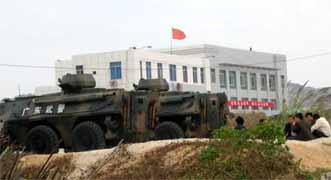
There are still several thousand armed police and police officers in front of the village. The authorities also sent out a tank and the tank gun is aimed at the village. According to the villagers, after the shooting on December 6, fully armed policemen came on both December 7 and 8 to arrest people. The unarmed villagers are very frightened.
A young male villager cried to the reporter over the telephone. He was afraid of being killed and wanted to get out of Dongzhou town. But the armed police officers have blocked the village entrance. The police checked people's ID's and all Dongzhou residents are turned back and cannot leave. He also said that a Hong Kong resident who came back to attend a wedding banquet was also stuck in the village.
On the day of the shooting, the police falsely claimed that they were entering the village to investigate a white powder (heroin) case. They wanted to arrest the three rights representatives of the village. At the moment, there are posters for the arrest of the three village representatives for "smoking white powder (吸白粉)."
During an interview just after 5pm on December 8, a female villager cried out in fear: "They have just come in again" and "Four armed police officers just entered the village to arrest people." And then the telephone was cut off.
The Shanwei television news program reported that the villagers started shooting first. A villager angrily said: "Which citizen has a gun? The guns are all in their hands!"
...
(The Guardian) Chinese militia open fire on demonstrators opposing coal plant. By Jonathan Watts. December 9, 2005.
In one of the most violent confrontations in a wave of recent rural unrest, Chinese paramilitary forces have shot and killed at least one man and injured more than a dozen others during protests against a power plant in Guangdong, local residents said yesterday.
Police reportedly used tear gas on a crowd of several thousand demonstrators, some of whom were said to have been throwing Molotov cocktails and pipe bombs. The death toll from the riot, in Dongzhou village on Tuesday evening, could rise. Local authorities refused to provide details of casualties but reports in the Hong Kong and overseas media suggest up to 15 people may have been killed.
A witness, who only gave her surname, Huang, told the Guardian that a former schoolmate, Lin Yutui, was among the dead. "We didn't expect the police would hurt us so when they fired warning shots in the air, nobody dispersed. Even when they used tear gas, people wouldn't withdraw. So then they used real bullets. I saw people get shot."
After her father was hit in the face by a tear-gas canister, Huang took him to a clinic where she described scenes of grief and chaos. She said the head of the clinic was imploring the biggest nearby hospital, in Shanwei, to send help. A member of staff at the Shanwei municipal hospital confirmed that wounded people had been brought in on Tuesday.
Several Hong Kong media groups said the deaths and wounds were caused by tear-gas canisters being fired at close range. But Mr Lin's family was quoted as telling the South China Morning Post that he had been killed instantly by two bullets, one to the heart and one to the pelvis.
Another witness, Liu, said: "I guess there were about 10-20,000 locals and more than 1,000 police, including militia. The police used rubber bullets first, then villagers threw petrol bombs and pipe bombs at them, so the police used some kind of machine gun ... I heard from others that three people were killed."
Branches of the public security bureau were not answering phones, and the mainland media were ordered not to report the incident.
The level of the violence this week had been unusual, but protests are becoming common. According to central government, 3.6 million people took part in 74,000 "mass incidents" last year, an increase of more than 20% on 2003. As in Dongzhou, most of these demonstrations were about property and pollution.
Dongzhou's villagers oppose the construction of a coal-fired power plant partly on land reclaimed from the nearby Baisha saltwater lake. Although construction of the 6.2bn yuan (£440m) development began in 2003, residents say they have not been compensated for lost income and land or the likely deterioration in the air and water quality. For the past two months, they have blocked the road into the construction site.
Tuesday's violent escalation was sparked by the arrest of the campaign's leaders. According to the AFP news agency, hundreds of officers from the People's Armed Police, a unit of the People's Liberation Army, attended the scene. The developer denied any involvement.
(New York Times) 20 Reported Killed as Chinese Unrest Escalates. By Howard French. December 9, 2005.
Residents of a fishing village near Hong Kong said that as many as 20 people had been killed by paramilitary police in an unusually violent clash that marked an escalation in the widespread social protests that have roiled the Chinese countryside. Villagers said that as many as 50 other residents remain unaccounted for since the shooting. It is the largest known use of force by security forces against ordinary citizens since the killings around Tiananmen Square in 1989. That death toll remains unknown, but is estimated to be in the hundreds.
The violence began after dark in the town of Dongzhou on Tuesday evening. Terrified residents said their hamlet has remained occupied by thousands of security forces, who have blocked off all access roads and are reportedly arresting residents who attempt to leave the area in the wake of the heavily armed assault.
"From about 7 p.m. the police started firing tear gas into the crowd, but this failed to scare people," said a resident who gave his name only as Li and claimed to have been at the scene, where a relative of his was killed. "Later, we heard more than 10 explosions, and thought they were just detonators, so nobody was scared. At about 8 p.m. they started using guns, shooting bullets into the ground, but not really targeting anybody.
"Finally, at about 10 p.m. they started killing people."
The use of live ammunition to put down a protest is almost unheard of in China, where the authorities have come to rely on rapid deployment of huge numbers of security forces, tear gas, water cannons and other non-lethal measures. But Chinese authorities have become increasingly nervous in recent months over the proliferation of demonstrations across the countryside, particularly in heavily industrialized eastern provinces like Guangdong, Zhejiang and Jiansu. By the government's tally there were 74,000 riots or other significant public disturbances in 2004, a big jump from previous years.
The villagers in Dongzhou said their dispute with the authorities had begun with a conflict over plans by a power company to build a coal-fired generator in their area, which they feared would cause heavy pollution. Farmers said they had not been compensated for the use of the land for the plant. Others said plans to reclaim land by filling in a local bay as part of the power plant project were unacceptable because people have made their livelihoods there as fishermen for generations. Already, villagers complained, work crews have been blasting a nearby mountainside for rubble for the landfill.
A small group of villagers was delegated to complain to the authorities about the plant in July, but they were arrested, infuriating other residents and encouraging others to join the protest movement. On Dec. 6, while villagers were mounting a sit-in demonstration, police made a number of arrests, bringing lots of people out into the streets, where they managed to detain several officers. In response, hundreds of law enforcement agents were rushed to the scene. Everybody, young and old, "went out to watch," said one man who claimed his cousin had been killed by a police officer's bullet in the forehead. "We didn't expect they were so evil. The farmers had no means to resist them."
Early reports from the village said the police opened fire only after villagers began throwing homemade bombs and other missiles, but villagers reached by telephone today denied this, saying that a few farmers had launched ordinary fireworks at the police as part of their protest. "Those were not bombs, they were fireworks, the kind that fly up into the sky," said one witness reached by telephone. "The organizers didn't have any money, so someone bought fireworks and placed them there. At the moment the trouble started many of the demonstrators were holding them, and of those who held fireworks, almost everyone was killed."
Other witnesses estimated that 10 people were killed immediately in the first volley of automatic gunfire. "I live not far from the scene, and I was running as fast as I could," said one witness, who declined to give his name. "I dragged one of the people they killed, a man in his 30's who was shot in his chest. Initially I thought he might survive, because he was still breathing, but he was panting heavily, and as soon as I pulled him aside, he died."
The witness said that he, too, had come under fire when the police saw him coming to the aid of the dying man. The Chinese government has yet to issue a statement about the incident, nor has it been reported in the state media. Reached by telephone, an official in the city of Shanwei, which has jurisdiction over the village, said, "Yes, there was an incident, but we don't know the details." The official said an official announcement would be made on Saturday.
Villagers said that in addition to the regular security forces, the authorities had enlisted thugs from local organized crime groups to help put down the demonstration. "They had knives and sticks in their hands, and they were two or three layers thick, lining the road," one man said. "They stood in front of the armed police, and when the tear gas was launched, the thugs were all ducking."
Like the Dongzhou incident itself, most of the thousands of riots and public disturbances recorded in China this year have involved environmental, property rights and land use issues. Among other problems, in trying to come to grips with the growing rural unrest, the Chinese government is wrestling with a yawning gap in incomes between farmers and urban dwellers, and rampant corruption in local government, where unaccountable officials deal away communal property rights, often for their own profit.
Finally, mobile telephone technology has made it easier for people in rural China to organize, communicating news to one another by short messages, and increasingly allowing them to stay in touch with members of non-governmental organizations in big cities who are eager to advise them or provide legal help.
Over the last three days, residents of the village say that other than people looking for their missing relatives, few people have dared go outside. Meanwhile, the police and other security forces have reportedly combed the village house by house, looking for leaders of the demonstration and making arrests.
Residents said that after the villagers' demonstration was suppressed a senior Communist Party official came to the hamlet from the nearby city of Shanwei and addressed residents with a megaphone. "Shanwei and Dongzhou are still good friends," the party official said. "We're not here against you. We are here to make the construction of the Red Sea Bay better. Later, the official reportedly told visitors, "all of the families who have people who died must send a representative to the police for a solution."
Today, a group of 100 or so bereaved villagers gathered at a bridge leading into the town, briefly blocking access to security forces hoisting a white banner whose black-ink characters read: "The dead suffered a wrong. Uphold justice."
(Associated Press) Chinese Village Surrounded After Shootings. By Audra Ang. December 9, 2005.
Hundreds of riot police armed with guns and shields have surrounded and sealed off a southern Chinese village where authorities fatally shot demonstrators this week, villagers said Friday. Although riot police often use tear gas and truncheons to disperse demonstrators, it is extremely rare for security forces to fire into a crowd — as they did in putting down pro-democracy demonstrations in 1989 near Tiananmen Square. Hundreds, if not thousands, were killed.
During the demonstration Tuesday in Dongzhou, a village in Guangdong province, thousands of people gathered to protest the amount of money offered by the government as compensation for land to be used in the construction of a wind power plant. Police started firing into the crowd and killed several people, mostly men, villagers reached by telephone said Friday. The death toll ranged from two to 10, they said, and many remained missing.
State media have not mentioned the incident and both provincial and local governments have repeatedly refused to comment. This is typical in China, where the ruling Communist Party controls the media and lower-level authorities are leery of releasing information without permission from the central government.
All the villagers said they were nervous and scared, and most did not want to be identified for fear of retribution. One man said the situation was still "tumultuous."
A 14-year-old girl said a local official visited the village Friday and called the shootings "a misunderstanding." "He said he hoped it wouldn't become a big issue," the girl said by telephone. "This is not a misunderstanding. I am afraid. I haven't been to school in days." She added: "Come save us."
Another villager said there were at least 10 deaths. "The riot police are gathered outside our village. We've been surrounded," she said, sobbing. "Most of the police are armed. We dare not go out of our home." "We are not allowed to buy food outside the village. They asked the nearby villagers not to sell us goods," the woman said. "The government did not give us proper compensation for using our land to build the development zone and plants. Now they come and shoot us. I don't know what to say."
One woman said an additional 20 people were wounded. "They gathered because their land was taken away and they were not given compensation," she said. "The police thought they wanted to make trouble and started shooting." She said there were several hundred police with guns in the roads outside the village Friday. "I'm afraid of dying. People have already died."
The number of protests in China's vast, poverty-stricken countryside has risen in recent months as anger comes to a head over corruption, land seizures and a yawning wealth gap that experts say now threatens social stability. The government says about 70,000 such conflicts occurred last year, although many more are believed to go unreported.
...Authorities in Dongzhou were trying to find the leaders of Tuesday's demonstration, a villager said. The man said the bodies of some of the shooting victims "are just lying there." "Why did they shoot our villagers?" he asked. "They are crazy!"
(Reuters AlertNet) Chaos in south China village after clashes. By Lindsay Beck and Ben Blanchard. December 9, 2005.
Armed police have sealed off a village in southern China after violent clashes with residents that rights group Amnesty International said marked the first time Chinese police had fired on protesters since 1989. Residents said riot police had opened fire on Tuesday on protesters in the village of Dongzhou in Guangdong province after they moved in to quell demonstrations over lack of compensation for land lost to a wind power plant. Estimates from residents and rights groups put the number of dead between two and 20.
"Now the authorities are coming to the village to detain people," said one villager, adding his brother was among those shot dead during the demonstrations. "My parents and my sister-in-law are kneeling in front of the house to ask the government officials to explain the killing," he said in a telephone interview. He put the number of dead at more than 10.
...The resident said police were chasing away family members who tried to claim the bodies of those who were killed, describing the scene as "chaos" and pleading for help. "Please send somebody to help us," he said. Noise in the background was so loud it was difficult to hear.
...
Residents said there were thousands of armed police in the area, blocking roads and detaining those suspected of involvement in the protests. "A lot of families have moved away from the village. We are all very scared. At night, nobody dares go out," said another villager. U.S. broadcaster Radio Free Asia said armed police had sealed roads into the area and that people were not allowed to enter or leave.
(New York Times) 20 Reported Killed as Chinese Unrest Escalates. By Howard French. December 9, 2005.
Residents of a fishing village near Hong Kong said that as many as 20 people had been killed by paramilitary police in an unusually violent clash that marked an escalation in the widespread social protests that have roiled the Chinese countryside. Villagers said that as many as 50 other residents remain unaccounted for since the shooting. It is the largest known use of force by security forces against ordinary citizens since the killings around Tiananmen Square in 1989. That death toll remains unknown, but is estimated to be in the hundreds.
The violence began after dark in the town of Dongzhou on Tuesday evening. Terrified residents said their hamlet has remained occupied by thousands of security forces, who have blocked off all access roads and are reportedly arresting residents who attempt to leave the area in the wake of the heavily armed assault.
"From about 7 p.m. the police started firing tear gas into the crowd, but this failed to scare people," said a resident who gave his name only as Li and claimed to have been at the scene, where a relative of his was killed. "Later, we heard more than 10 explosions, and thought they were just detonators, so nobody was scared. At about 8 p.m. they started using guns, shooting bullets into the ground, but not really targeting anybody.
"Finally, at about 10 p.m. they started killing people."
The use of live ammunition to put down a protest is almost unheard of in China, where the authorities have come to rely on rapid deployment of huge numbers of security forces, tear gas, water cannons and other non-lethal measures. But Chinese authorities have become increasingly nervous in recent months over the proliferation of demonstrations across the countryside, particularly in heavily industrialized eastern provinces like Guangdong, Zhejiang and Jiansu. By the government's tally there were 74,000 riots or other significant public disturbances in 2004, a big jump from previous years.
The villagers in Dongzhou said their dispute with the authorities had begun with a conflict over plans by a power company to build a coal-fired generator in their area, which they feared would cause heavy pollution. Farmers said they had not been compensated for the use of the land for the plant. Others said plans to reclaim land by filling in a local bay as part of the power plant project were unacceptable because people have made their livelihoods there as fishermen for generations. Already, villagers complained, work crews have been blasting a nearby mountainside for rubble for the landfill.
A small group of villagers was delegated to complain to the authorities about the plant in July, but they were arrested, infuriating other residents and encouraging others to join the protest movement. On Dec. 6, while villagers were mounting a sit-in demonstration, police made a number of arrests, bringing lots of people out into the streets, where they managed to detain several officers. In response, hundreds of law enforcement agents were rushed to the scene. Everybody, young and old, "went out to watch," said one man who claimed his cousin had been killed by a police officer's bullet in the forehead. "We didn't expect they were so evil. The farmers had no means to resist them."
Early reports from the village said the police opened fire only after villagers began throwing homemade bombs and other missiles, but villagers reached by telephone today denied this, saying that a few farmers had launched ordinary fireworks at the police as part of their protest. "Those were not bombs, they were fireworks, the kind that fly up into the sky," said one witness reached by telephone. "The organizers didn't have any money, so someone bought fireworks and placed them there. At the moment the trouble started many of the demonstrators were holding them, and of those who held fireworks, almost everyone was killed."
Other witnesses estimated that 10 people were killed immediately in the first volley of automatic gunfire. "I live not far from the scene, and I was running as fast as I could," said one witness, who declined to give his name. "I dragged one of the people they killed, a man in his 30's who was shot in his chest. Initially I thought he might survive, because he was still breathing, but he was panting heavily, and as soon as I pulled him aside, he died."
The witness said that he, too, had come under fire when the police saw him coming to the aid of the dying man. The Chinese government has yet to issue a statement about the incident, nor has it been reported in the state media. Reached by telephone, an official in the city of Shanwei, which has jurisdiction over the village, said, "Yes, there was an incident, but we don't know the details." The official said an official announcement would be made on Saturday.
Villagers said that in addition to the regular security forces, the authorities had enlisted thugs from local organized crime groups to help put down the demonstration. "They had knives and sticks in their hands, and they were two or three layers thick, lining the road," one man said. "They stood in front of the armed police, and when the tear gas was launched, the thugs were all ducking."
Like the Dongzhou incident itself, most of the thousands of riots and public disturbances recorded in China this year have involved environmental, property rights and land use issues. Among other problems, in trying to come to grips with the growing rural unrest, the Chinese government is wrestling with a yawning gap in incomes between farmers and urban dwellers, and rampant corruption in local government, where unaccountable officials deal away communal property rights, often for their own profit.
Finally, mobile telephone technology has made it easier for people in rural China to organize, communicating news to one another by short messages, and increasingly allowing them to stay in touch with members of non-governmental organizations in big cities who are eager to advise them or provide legal help.
Over the last three days, residents of the village say that other than people looking for their missing relatives, few people have dared go outside. Meanwhile, the police and other security forces have reportedly combed the village house by house, looking for leaders of the demonstration and making arrests.
Residents said that after the villagers' demonstration was suppressed a senior Communist Party official came to the hamlet from the nearby city of Shanwei and addressed residents with a megaphone. "Shanwei and Dongzhou are still good friends," the party official said. "We're not here against you. We are here to make the construction of the Red Sea Bay better. Later, the official reportedly told visitors, "all of the families who have people who died must send a representative to the police for a solution."
Today, a group of 100 or so bereaved villagers gathered at a bridge leading into the town, briefly blocking access to security forces hoisting a white banner whose black-ink characters read: "The dead suffered a wrong. Uphold justice."
(The Standard) Killer cops in 24-hour watch at village. December 10, 2005.
A village in southern China where paramilitary troops fired on demonstrators, killing several, has been placed under 24-hour watch as authorities try to find protest organizers, villagers said Friday. The shootings happened Tuesday during a clash between hundreds of officers in the People's Armed Police - a unit of the military - and more than 1,000 villagers protesting against the construction of a power plant in Dongzhou district of Shanwei city, Guangdong province. The special police unit opened fire after villagers set up a blockade to prevent them from entering and threw small-scale explosives used in fishing, residents and an international human rights group have said.
Villagers said Friday there were still hundreds of troops guarding the village entrance and patrolling the streets. "There are still a lot of People's Armed Police around. They brought in tanks, six of them," said a man surnamed Chen. "They are patrolling everywhere on the roads and the hill. There could be 1,000 to 2,000 of them."
Local authorities have posted notices on the streets, vowing to arrest and punish organizers, residents said. "They are trying to find the villagers' representatives ... it's very tense. We are afraid to go out except to buy food," said a woman, also surnamed Chen.
Some 50 people are missing and are feared dead or arrested, villagers said, while other residents were in hiding.
There was still no official announcement of the incident on China's state- controlled media.
Some residents said four people had died under paramilitary gunfire but Amnesty International issued a report late Wednesday saying some sources said six people had been killed. Other villagers said the death toll may be as high as 30. "There are probably 30 people who died. There were people who saw the bodies being loaded onto trucks," said the man Chen. Hospitals where the bodies have been taken, as well as the police and local and provincial governments, refused to comment.
Villagers said the clash stemmed from a long dispute over compensation they wanted from the government for taking their land to build the big coal- fired power plant. The project, sponsored by a company run by the provincial government, would also prevent villagers from using a nearby lake to earn income from fishing. Villagers said none of the police were injured as the explosives they used were weak.
With the news blackout, villagers said they feared no one would know what happened and lived in a state of fear. "Nowadays, troops kill ordinary people and blame everything on the people. Please help us ask Premier Wen Jiabao for justice for the people," Chen said.
(Xinhua) Shanwei reveals investigation report on villagers' violence in power plant. December 10, 2005.
Hundreds of villagers incited by a few instigators violently attacked a wind power plant on Dec. 6, and assaulted the police, the Information Office of the city government of Shanwei in south China's Guangdong Province said here Saturday. In an investigation report of the incident, the office called the armed assault a serious violation of law.
According to the official recount, the instigators led by Huang Xijun engineered and organized some villagers in Dongzhoukeng and Shigongzhai to illegally besiege and attack a local wind power plant at noon on Dec. 5 and Dec. 6.
The first assault on Dec. 5 caused a seven-hour suspension of the plant's power generation. In the second onslaught, over 170 armed villagers led by instigators Huang Xijun, Lin Hanru and Huang Xirang used in the attack knives, steel spears, sticks, dynamite powder, bottles filled with petroleum, and fishing detonators.
Police moving in to maintain order were forced to throw tear shells to break up the armed besiege, and arrested two insurgents. However, Huang Xijun mobilized over 300 armed villagers to form a blockade on the road to Shigongzhai Village to obstruct the return passage of the police, in attempt to threaten the police to release the arrested insurgents. For a moment, many besiegers intended to quit following the persuasion shouted by the police. However, they were forced to stay in protest under the threat reinforced by the instigators, according to the report. Instigator Lin Hanru shouted through a loudspeaker that they would throw detonators to the police and blow the wind power plant, if the police refused to retreat.
It became dark when the chaotic mob began to throw explosives at the police. Police were forced to open fire in alarm. In the chaos, three villagers died, eight were injured with three of them fatally injured. Concerned government departments are still investigating in the exact cause of the death.
The Information Office said that the instigators with Huang Xijun at the core had incited villagers to join in armed protests since June, using villagers' discontents over a land requisition of a coal-fired power plant in Dongzhoukeng Village as the excuse. They frequently formed armed protests in the construction ground of the coal-fired power plant, blocked public traffic, attacked government offices and even illegally detained people and vehicles passing through the village to threat the local government to approve more compensation fund in land requisition.
In order to magnify the effect of their protests, the instigators hatched the assault of the wind power plant in Shigongzhai Village, which had no relations with their former request for fund concerning the land requisition in Dongzhoukeng Village. The provincial government of Guangdong pays great attention to the Dec. 6 Incident. A special work group has been established to investigate in the incident, according to the Information Office.
(Ta Kung Pao) Shanwei Announced the Truth About the Honghaiwan Conflict. December 11, 2005.
[in translation]
According to Xinhua (Shanwei, Guangdong), Huang Xijun and others have been organizing Dongzhoukeng village to create incidents over the compensation for land requisitioned to bild the coal power plant. In order to create a new incident, they stirred up some villagers in nearby Shigongliao on the grounds that the wind power plant destroyed the fengshui of that village. These people surrounded and attacked the wind power plant and forced the plant to cease supplying electricity for seven hours beginning at 430pm.
After the local authorities stopped the incident and resumed the electricity supply, at 3pm on December 6, Dongzhoukeng village troublemakers Huang Xijun, Lin Hanru, Huang Xirang and others gathered more than 170 villagers armed with attack knives, steel pitchforks, wooden poles, dynamite, petroleum-filled bottles, fishing bombs (which contains dynamite and detonator and are used illegally by local fishermen to fish). They surrounded and then attacked the main control building at the wind power plant. They tossed large numbers of fishing bombs and lit petroleum-filled bottles, starting many fires inside the plants and destroying one transformer. As repeated advice was ignored, the militia policemen on duty used tear gas to disperse the crowd in order to protect public facilities. They arrested two Dongzhoukeng village troublemakers at the scene.
At around 4pm on December 6, Huang Xijun stirred up more than 300 people in Dongzhoukeng village. Armed with fishing bombs and petroleum-filled bottles, they barricaded the only road leading to Shigongliao to prevent the policemen who were carrying out their public duties there from leaving. They further demanded the public security office to release the arrested troublemakers.
In this situation, the police ordered the villagers to depart. At the time, more and more spectators were gathering, more than 500 at the peak. Certain members of the crowd wanted to leave, but the monitors set up Huang Xijun forced them to say. In order to control the situation, more police were sent by Shanwei City to maintain order.
The troublemakers led by Huang Xijun did not listen to advice, and continued to block the road and attacked the police there with rocks, fishing bombs and petroleum-filled bottles. When verbal warnings had no effect, the police fired tear gas. Due to wind direction, the effect was limited.
The scene then called increasingly out of control and Huang Xijun and leaders of the troublemakers were emboldened. Lin Hanru used a loudspeaker to 'order' the police to leave within 15 minutes or else "the entire police squad would be bombed to the ground." They also declared that they will destroy the power plant with bombs.
In the very tense situation, the police were forced to fire warning shots. As it was already dark and the conditions were very chaotic, there were misfires that led to deaths and injuries. In the entire incident, three died and eight were wounded (including 3 serious injnuries). The casualties were all from Dongzhoukeng village. When the police found the injured, they sent them to the hospital. The causes of the deaths and injuries are still being investigated. By around 9pm that evening, the crowds have dispersed and the incident was basically under control. The police dismantled the roadblocks set up by Huang Jixun and others.
(New York Times) Villagers Tell of Lethal Attack by Chinese Forces on Protesters. December 10, 2005.
Four days after a lethal assault on protesters by paramilitary forces, a village in southern China remained under heavy police lockdown on Saturday.
Residents of the village, Dongzhou, interviewed by telephone from this nearby city, said the police continued to make arrests and bar outsiders from their hamlet.
The authorities have still not commented in any detail on the incident, in which villagers said as many as 20 residents of Dongzhou were shot and killed by security forces on Tuesday night as they protested plans for a power plant, in the deadliest use of force by Chinese authorities against ordinary citizens since the Tiananmen massacre in 1989. Residents of Dongzhou said at least 42 people were missing.
Reached by telephone, the deputy propaganda chief of Shanwei, which is 15 miles to the north and has jurisdiction over the village, said the national government would issue its first statement about the incident no later than Sunday. “We will soon have a response to this, very soon — no later than tomorrow,” said the official, Liu Jingmao. “By then, this thing will be made public in the mainstream media and within the province.” Asked what he meant by “this thing,” the official cut short the conversation, saying: “I can’t say now. Anyway, it will be very soon, no later than tomorrow. That’s it.”
Later, a local television bulletin here said that three people had been killed in Dongzhou, and eight injured, describing them as “criminals” and giving no other details. This was the first known mention of the violence in China’s state-controlled media, and Beijing’s silence on the events underscored the vulnerability of a system that still practices heavy censorship in an age when sources of information beyond the government’s control are readily available.
In recent months, the Chinese government has been increasingly preoccupied with stemming thousands of demonstrations against corrupt local governments and pollution and over land-use issues. Most have taken place in rural areas and villages, far from the public eye. Dongzhou, however, is close to Hong Kong, whose television signals reach here easily, and news of the killings has spread rapidly, despite the officially imposed silence in Chinese media. In the last 24 hours, Chinese language Web sites have carried abundant reports on the killings, often picked up from foreign news outlets, and commented upon them endlessly and often angrily.
Dongzhou’s villagers, with little hesitation and much outrage, recounted more details of the events in numerous telephone calls on Saturday. Still, most asked not to be identified. Many said the authorities’ brutality against the demonstrators warranted comparison to the Japanese occupiers of the last century, and to Chinese Nationalist Army of Chiang Kai-shek.
Their accounts suggested a range of possible casualties. They identified four dead villagers, three of whom they said were taken to a local clinic, and said the fourth body was taken to a hospital in Shanwei. But they also spoke with conviction about other casualties, though often with sketchier details. Some insisted they had seen other bodies, and others spoke of large numbers of people unaccounted for.
“I was not at the scene that night, but after I heard some people were shot dead, I went to the clinic and saw three dead bodies there,” said a man who gave his name only as Chang. “The next day, I heard there were several bodies lying by the road, where tragedy took place. I went there and saw seven or eight bodies lying there in a row, surrounded by many policemen, who were denying the families’ attempts to claiming for the bodies.”
Numerous accounts said that the authorities had thrown corpses into the sea and burned bodies after the killings. Villagers said they had counted 13 bodies floating on the sea. Villagers also said that several times over the last few days, female residents had approached the police, who are still present in Dongzhou in large numbers, to beg that the bodies of relatives be released. Others said that people had quickly buried the bodies of their relatives so they could not be destroyed by the police to cover up evidence of the killings.
“I heard that they police had sent dead bodies to Haifeng to be cremated there,” said a man who gave his name as Li, and said he had been at the scene of the shootings. “Some corpses were just burned in the crossroads of the village, but not allowing people to get close to see.”In another reported episode, six unarmed men from the village fled the violence, climbing a nearby hilltop, where they were pursued by the police and shot, leaving only one survivor, whose account was repeated by villagers on Saturday. Some of the dead, the account said, were wounded from afar and then killed by the police at close range.
“That person saw with his own eyes that five people were killed,” said a man who said he had heard the account firsthand from the survivor, who was wounded in the leg. This was one of several accounts in which villagers said security forces had shot and wounded people.
The confrontation on Tuesday was the culmination of months of tension over the construction of a coal-fired power plant. Villagers said they had not been adequately compensated for the use of their land — less than $3 per family, one said — and feared pollution from the plant would destroy their livelihood as fishermen. The plans called for the village’s bay to be reclaimed with landfill. “Shanwei’s deputy party secretary said that he wanted to trample Dongzhou into a flat land,” said a village resident who gave her name as Jiang, and spoke with anger at the heavy-handed manner of the authorities before the outbreak of violence. “He said we’re just like a small hole in the ground.”
Municipal officials here have been circulating the area, blaming the villagers for initiating the violence. They said that the villagers used fireworks, blasting caps and other small explosives, and that they had rejected a generous settlement for the use of the land.
“I’m a good friend of Dongzhou people,” one party official said by megaphone as he toured the village on Saturday. “Nobody wants to see anything like what happened here on the night of Dec. 6, but the people of this village are too barbaric. We were forced to open fire.”
A 16-year-old boy who said he was in the crowd when the police began to fire said: “We didn’t use explosives, because we were too far away. Someone may have tried, but there’s no way we could have reached them. These were homemade weapons, and when they started shooting, we didn’t have a chance.’’
(Washington Post) Chinese police tighten control on rebellious town. By Edward Cody. December 10, 2005.
Armed police tightened their lockdown of a rebellious Chinese village Friday and went from house to house seeking leaders of violent clashes earlier in the week that villagers said had resulted in the deaths of more than a dozen people.
Residents reached by telephone said Dongzhou, a farming and fishing village 14 miles southeast of Shanwei city in Guangdong province near Hong Kong, was quiet Friday for the second night in a row. But checkpoints were reinforced on roads leading in and out of the village, leaving its 10,000 residents blocked in unless they traveled by sea or walked circuitous routes.
Some families were still trying to recover the bodies of those killed by pistol and automatic-weapons fire from People's Armed Police during confrontations Tuesday and Wednesday nights, the residents reported. Villagers said 14 to 20 people were shot and killed. Their estimates were impossible to confirm; government and hospital officials maintained a strict silence and prevented Chinese news media from reporting on the violence.
Over the last three days, residents of the village said by telephone, few people dared to go outside, other than to look for missing relatives. The police and other security forces, meanwhile, searched the village from house to house, residents said, looking for leaders of the demonstration and making arrests.
...
In Dongzhou, standard riot police were joined by People's Armed Police wearing camouflage fatigues and carrying automatic rifles. They opened fire, villagers said, after rioters pelted them with gasoline bombs and explosive charges that local fishermen ordinarily toss into the adjacent South China Sea to stun fish and increase their catch.
Dongzhou's residents have been engaged in a long-simmering protest against confiscations of their farmland for a wind-powered electricity plant. Compensation for the land was too low, they complained, and the project also seemed likely to ruin fishing in a tidal inlet.
A small group of villagers was chosen to complain to the authorities about the plant in July, but the members were arrested, infuriating residents and leading others to join the protests. The police made more arrests on Tuesday while villagers were mounting a sit-in, bringing many people out into the streets, where they obstructed several officers. In response, hundreds of law enforcement officers were rushed in. "Everybody, young and old, went out to watch," said one man who claimed his cousin was shot dead in the forehead by the police during the protest. "We didn't expect they were so evil. The farmers had no means to resist them."Residents said their village has been occupied since then by thousands of security officers, who have blocked off all access roads and were arresting residents who have tried to leave the area in the wake of the heavily armed assault. On Friday, about 100 bereaved villagers gathered at a bridge leading into the town, briefly blocking access to security forces. The villagers hoisted a white banner whose black-ink characters read: "The dead suffered a wrong. Uphold justice."
(SCMP) Riot village sealed off in hunt for protesters. December 10, 2005.
Hundreds of paramilitary police continued to guard a Guangdong village yesterday as evidence emerged of the deaths of villagers in the violent suppression of a riot. While police hunted for those involved in Tuesday's riot in Dongzhou village, Shanwei city , families of some victims hid the bodies of their loved ones, fearing the authorities would take them in a bid to cover up the deaths.
Villagers say dozens of people were killed or injured when police opened fire on protesters. One villager gave the South China Morning Post a photograph of one victim, Lin Yutui, a bullet hole clearly showing in his chest.
Shanwei and provincial officials, meanwhile, have either denied the shooting happened or declined to comment.
The massive police presence yesterday suggested that tensions are still running high in the village. Several hundred police - carrying shields but apparently not armed - guarded the main entries to the village and patrolled the streets. Officers carrying photos of villagers involved in the riots were on the lookout for suspects trying to leave the village and checked the identity of anyone entering. All outsiders were barred from entry. Half-a-dozen armoured personnel carriers and vehicles with water cannon were deployed across the village and near the site of Tuesday's clash.
Villagers had been protesting against the construction of a power plant in the village, complaining that their land was taken away without adequate compensation. In a showdown on Tuesday, hundreds of armed police battled with the protesting villagers, who fought back with crudely made Molotov cocktails. Villagers said police then opened fire on the crowd.
Liu Jingmao , a vice-director of the Shanwei Propaganda Department, said yesterday the city government would give a public account of what happened but refused to confirm that villagers had been shot dead by police. But villagers are afraid of a cover-up. "We fear they are attempting to destroy all the evidence because they insist so far that no one has been killed," one said.
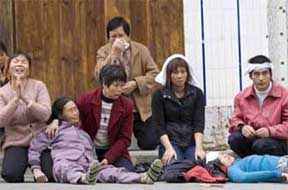
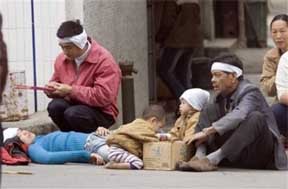
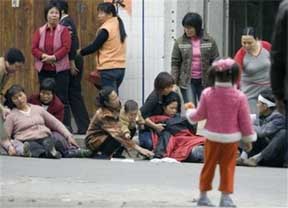
Another villager whose relative, 31-year-old Wei Jin, was killed in the shooting, said local officials had offered the family hush money if they surrended Wei's body. "They offered us a sum but said we would have to give up the body," the villager said. "We are not going to agree." Other villagers remain unaccounted for and families fear they are victims of Tuesday's confrontation. Dozens of women yesterday knelt in front of policemen at the clash site, begging for the bodies of their husbands or sons.
The clash in Dongzhou was not reported in any mainland media and local hospitals refused to say if they had received any injured.
Rumours circulated in the village yesterday that a vice-director of the local public security bureau had been suspended and that senior provincial leaders had arrived to investigate.
(SCMP) Villagers fear reprisals against rioters. December 11, 2005.
Dongzhou villagers in Guangdong yesterday said they fear authorities will soon take action against people involved in a riot that was violently suppressed last week. The clash in the village of Shanwei city resulted in the death of three civilians, according to authorities, who added it was now classified as a case of "serious violence against the people's police by several hundred villagers that was instigated by a small number of people".
One villager whose relative was wounded in the crackdown said yesterday he had been told the police would lock up those they could prove had taken part in the protests.
"We just spent 20,000 yuan on surgery to save him [the relative] after he was shot in the chest," the villager said. "But he is now under effective police custody at Shanwei People's Hospital after he was interviewed by television reporters from Hong Kong last Wednesday."
The villager said that at least four officers were guarding his relative and family who came to visit were not allowed to return home. "Other family members cannot visit him at the hospital now," he said.
Local sources said a senior Shanwei city official visited the widow of Wei Jin late on Friday and offered the family 2,000 yuan in condolence money. Wei, 31, was killed in the clash. He is survived by a wife and two sons.
A woman whose husband suffered minor injuries believed all the injured villagers were now under police control. "Actually, no injured villagers are not allowed to meet outsiders, especially reporters from Hong Kong," she said.
A 57-year-old man, who did not protest but was hit in the head by a tear gas canister, said he saw the police shooting. "I went [to the riot site] to have a look because I was curious," said the man who declined to give his full name, but was willing to be photographed. "But there [police fired] tear gas and I heard gunshots after flashes of bright light. "I went to the Dongzhou health station and heard the doctor saying two men were confirmed dead."
In earlier reports, villagers claimed that they took to the streets because they opposed the construction of a power plant and inadequate compensation for their land.Several village women and victims' relatives yesterday continued to sit outside the Dongzhou police station, which is only metres from the scene of the riot. The site - at an intersection that is a key entry point into the village - was still being guarded by about 100 policemen, but the barricades had been moved back about 30 metres since Friday. On Friday, dozens of women knelt in front of policemen, begging them to return the bodies of their husbands or sons. Yesterday, local officials put up banners reminding villagers that they should not believe in rumours and report suspects to the authorities. Political slogans such as "People's Armed Police are for the people" were also posted in the village.
(Los Angeles Times) China Defends Police Shooting of Villagers. By Mark Magnier. December 11, 2005.
The Chinese government broke its silence Saturday on a deadly clash in southern China last week, insisting that police used deadly force only after a "few instigators" threatened them with explosives.
In the first official response since the incident late Tuesday, the state-run New China News Agency said three villagers were killed and eight wounded in the clash in the village of Dongzhou, in Guangdong province near Hong Kong.
In telephone interviews, locals said police killed as many as 20 farmers who were demanding compensation for land seized to build a wind power plant.
The official news agency, quoting authorities from the neighboring city of Shanwei, said police used tear gas to break up a mob of about 170 villagers armed with sticks, knives, steel spears and explosives in the hours before the fatal clash. The villagers' actions were "a serious violation of the law," the authorities said, promising an investigation.
Riot squads armed with machine guns and shields have ringed Dongzhou, blocking outsiders from entering, and villagers charged that authorities were mounting a cover-up. But in telephone interviews today, residents gave their version of events.
"It happened at night, so it's very hard to tell exactly how many died," said a woman who gave her last name as Liu. Like most villagers, she declined to give her full name out of fear of retribution. "But at least 10 were shot and many are still missing."
Both sides say the catalyst was a police decision to arrest local protest leaders.
A farmer named Zhang, 50, said officials detained one of the leaders about noon Tuesday. That evening, he said, police headed toward a construction site, and villagers, believing they were going to detain more people, blocked their way. Police fired tear gas and shot their guns into the air, he said.
As tension built, villagers told police they had homemade explosives and would detonate them if the officers didn't turn around. "Protesters did detonate explosives," Zhang said. "But it was only a threat, and no official or police were hurt." At that point, officers opened fire on the protesters.
Villagers, several of whom said they believed their phones were tapped, said at least eight protesters were arrested Saturday. Most were impoverished farmers with families to support.
"The military is right outside our door," said one woman, 24, who declined to give her name. "People are crying all the time. We knelt down in front of the military yesterday and begged them not to come into our village and arrest people. But they wouldn't listen."
Villagers said there had been cases of police offering money to families of the dead, possibly in an effort to keep them quiet. One resident said villagers had hidden two bodies to prevent police from taking them and denying that they were killed. As with much of the account, this could not be independently confirmed.
(Apple Daily via ChineseNewsNet) December 11, 2005.
[in translation]
According to Apple Daily, concerning the bloody suppression at Dongzhou village in Shanwei, Guangdong, a 16-year-old youth named Chen was still emotional on December 10 concerning what his father (who was a demonstrator) told him on three occasions. "It was too cruel. A villager was shot in the leg and got down on his knees to beg for mercy. But they dragged this man behind the grass and fired two more shots ..." The first time, the father said that he deeply believes that the corrupt officials will be brought down. The second time, he returned home to say his final farewell. The third time, he saw the military police murder the villagers and he broke down and cried.
On the evening of December 6, the gongs and drums started to beat in Dongzhou to warn that more than a thousand military policemen have arrived to disperse the demonstrators in front of the power plant. Father Chen disregarded his own persons safety to join the movement. Before he stepped out of the front door, he said with great fighting spirit to his 16-year-old son: "We will win! We will bring down those corrupt officials!"
But the police officers and military policemen were as cold and cruel like the bone-chilling winds that evening. Father Chen suddenly came back to fetch his helmet. He said that the military police were cruel and told his son: "They are very cruel! Son, you must take care of yourself."
When the clock reached 10 o'clock, the guns sounded. Father Chen was fortunate to escape and he ran back home and hugged his son, shouting: "It was too cruel. A villager was shot in the leg and got down on his knees to beg for mercy. But they dragged this man behind the grass and fired to more shots ..."
The report said that the the Chen youth was still quite emotional when he recalled his three conversations with his father. He said that he is very sad and solemn right now and he does not know why what his teachers taught in school should be so different from reality.
Another 14-year-old girl was interviewed by telephone and said that she was anxious: "Please come and save us!"
More than 1,000 police officers and armed police opened fire to suppress 6,000 demonstrating villagers. The villagers said that about 30 villagers were killed. "There were eleven bodies floating on the sea. By the grass, by the foot of the hill, under the tree, underneath the bridges ... there are bodies." The number of missing is rising, from the more than 50 on the day before yesterday to almost 100. The villagers said that the police opened ifre again on the evening of December 7. On the morning of December 9, the surrounding forces attempted to enter the village and clashed again with the villagers.
The villagers said that the officials entered the village on the evening of December 9 claiming to comfort the families which have casualties. Actually, they were asking the families not to accuse the military police of shooting and killing villagers to the outside world. Instead, they were supposed to say that "the villagers killed themselves with bombs." The officials even said: "I'll give you as much money as you want." The pained villagers cried angrily: "Can a life be bought with money?"
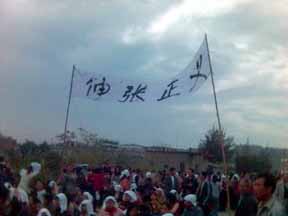
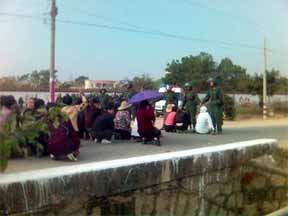
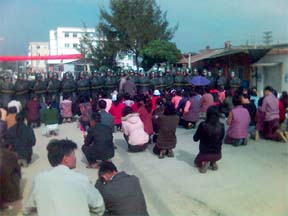
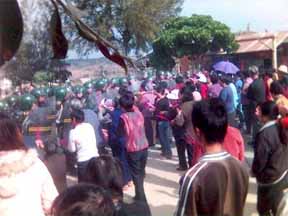
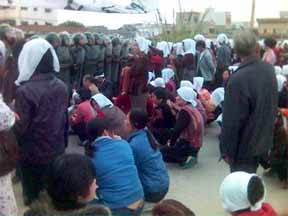
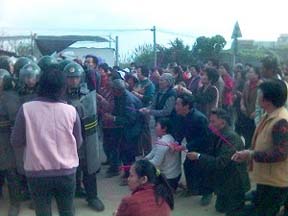
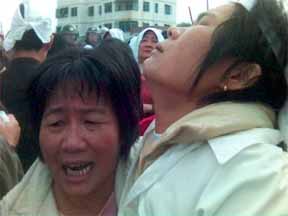
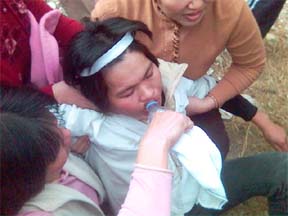
(SCMP) Commanding officer detained over order to shoot protesting villagers. By Minnie Chan. December 12, 2005.
The commanding officer who gave the order for police to open fire on demonstrators in a Guangdong village last week, killing at least three people, has been taken into custody, official media said yesterday.
The official Guangzhou Daily did not give the name or title of the officer or specify when he had been detained but said he was being held over his decision to open fire on the villagers' demonstration.
"The commanding officer on the scene mishandled the situation, causing accidental deaths and injuries. The Shanwei prosecutor decided to arrest him under the penal code," the paper said.
The report differed from a statement issued on Saturday by the Shanwei city government, which said only that city authorities were investigating the incident in Dongzhou village. Neither national newspapers nor Guangdong television reported the violence.
Mainland police have strict rules governing the use of firearms and it was not clear if the officer had clearance from his superiors to open fire on protesting villagers.
When contacted yesterday, Liu Jingmao , a vice-director of Shanwei Propaganda Department, declined to provide further details, including the name of the officer. Sources in Dongzhou said the commanding officer was a vice-director of Shanwei Public Security Bureau but that could not be confirmed independently.
The detention of the officer did little to assuage the anger of villagers, who said they had lost faith in the local government. They urged the central government to investigate but feared that even Beijing's intervention might be too late.
"We do not trust any officials in Guangdong, even the provincial government," said one villager who sat with fellow villagers near last Tuesday's clash site. "They share the same interests and they would only cover for one another." When a representative of Shanwei government approached villagers yesterday he was jeered by the crowd, who yelled: "Get out of here and go home."
(The Guardian) Chinese paramilitary chief held after village killings. By Jonathan Watts. December 12, 2005.
Chinese authorities admitted yesterday that paramilitary forces had shot dead protesting villagers last week, and said the commander involved had been arrested. The arrest came five days after a riot in Dongzhou, a coastal village in southern China, that was put down with the most lethal force known to have been used by officials since the 1989 Beijing massacre.
Witnesses said up to 20 people had died in Dongzhou, while officials put the death toll in single figures. The Guangdong provincial government said the paramilitary commander had committed fatal errors. "His wrong actions caused deaths and injuries," it said in a statement. "Investigative organs have taken the step of detaining him according to law."The name and rank of the officer were not disclosed, nor were there any details of charges. But the public admission that a senior official used excessive force to restore order is a politically significant step towards accountability.
It may also indicate a clash between different levels of government. The Guangdong announcement contradicted an earlier statement by the authorities in nearby Shanwei town, who blamed the riot and its consequences on protest leaders.
Local villages have been protesting for weeks against the construction of a coal-fired power plant, which they say is being built on communal land for which they have not been adequately compensated. In the first official acknowledgement of the incident, the Shanwei authority said police had been forced to shoot because the demonstrators had attacked them.
"Over 170 armed villagers attacked with knives, steel spears, sticks, dynamite powder, bottles filled with petrol and fishing detonators," it said. "Police were forced to open fire in alarm. In the chaos, three villagers died, eight were injured with three of them fatally injured." It was unclear whether this meant three or six people had died. [Blogger's note: the correct translation was "seriously" and not "fatally."]
A statement by the local government said the killings would be investigated, but rather than blame the officers who pulled the trigger or gave the order to fire, it accused three local men of stirring up unrest, adding: "They must shoulder the legal responsibility for what happened."
(New York Times) Military Officer Tied to Killings Is Held by China. By Joseph Kahn. December 12, 2005.
The commander of paramilitary forces who opened fire on villagers protesting land seizures has been detained by the authorities in connection with the shootings, an extraordinary response that suggested high-level concern over whether the crackdown was justified.
The official New China News Agency said in a dispatch Saturday evening that three people had been killed and eight others injured after security forces shot protesters in the village of Dongzhou in Guangdong Province on Tuesday. Villagers have given varying estimates of the death toll, including some who said as many as 20 people had been killed.
Guangdong's provincial government issued a statement Sunday saying that the "wrong actions" of the commander, who was not identified by unit or rank, were to blame for the deaths. The statement said he had been detained by civilian authorities in the area.
An earlier official account quoting local authorities laid blame for the violence exclusively on villagers. It said local residents, led by three men, first attacked a power plant at the center of a land dispute and then turned on the police, using weapons including spears, knives and dynamite, compelling security forces to put down the insurrection forcibly.
The conflicting accounts suggest continued uncertainty about what happened and may also reflect differing responses by local, provincial and national political leaders.
The decision to detain any commander so soon after a shooting incident is rare in China.
Police and paramilitary commanders have limited autonomy to decide on the use of force against civilians and would generally need high-level approval before opening fire. Even if the commander acted on his own or gave inaccurate information to higher authorities before getting approval, however, security forces would generally be expected to close ranks and defend one of their own leaders rather than accept responsibility for mistaken killings.
It would be especially notable if the detained commander worked for the People's Armed Police, which was reported by villagers to have deployed troops in the area. Civilian government officials generally have no power to detain or bring charges against military officers. In many such cases, President Hu Jintao, who has the top civilian, military and Communist Party titles, might be expected to be consulted before conflicts between civilian and military officials could be resolved....
Murray Scot Tanner, an expert on China's security forces at the Rand Corporation, said Monday that the detention of a commander could signal fears that Chinese press reports about the incident may not be treated as credible. He said the authorities are highly reluctant to assign blame to police or paramilitary troops and almost never do so.
(Washington Post) Police Commander Held After Shooting in China. By Philip P. Pan. December 12, 2005.
The Chinese government announced Sunday it had detained the commander whose forces opened fire on residents protesting land seizures in a town near Hong Kong, making a rare admission of police misconduct in what could be the deadliest attempt to suppress demonstrations in China since the 1989 Tiananmen Square massacre. The announcement came a day after local authorities first acknowledged the violence last week in Dongzhou, about 125 miles northeast of Hong Kong in Guangdong province. State media said three people were killed and eight wounded in the clash. Witnesses have put the death toll as high as 20.
...
The main official newspapers in the provincial capital of Guangzhou said that "the commander at the scene dealt with the situation improperly and brought about mistaken deaths and accidental injuries," and that he has been detained by local prosecutors as part of a criminal investigation. The report asserted that the commander's actions were made "under particularly urgent circumstances," and said legal responsibility should be borne by "a tiny minority of troublemakers" who led the protests over compensation for farmland confiscated to build a wind-powered electricity plant. The report did not identify the commander or his unit, nor did it specify how he mishandled the protests. Residents have said that anti-riot police and members of the People's Armed Police, which is under Chinese military command, participated in the incident, firing handguns and automatic rifles at farmers and fishermen who attacked them with gasoline bombs and explosive charges.
The commander was placed under a form of detention that falls short of formal arrest and allows prosecutors to question suspects to determine whether criminal charges are appropriate. If the commander is punished, it would represent an almost unprecedented concession by China's ruling Communist Party, signaling a desire to calm angry residents and warn police officials across the country to refrain from the unnecessary use of lethal force.
...
The commander's detention came as villagers complained that local authorities were trying to cover up the scale of the violence by refusing to allow relatives to retrieve the bodies of the dead and instead hiding them by cremating them or dumping them in the ocean. "They say three villagers were killed and eight were injured, but I don't believe their numbers," said one resident, who spoke on condition of anonymity. "We still have so many villagers who have been missing for several days, and one no knows whether they are dead or alive. . . . What we need from the government is justice!"
He and other residents reached by telephone dismissed the detention of the commander as an empty gesture. "They can't solve the problem this way. They just can't detain a commander. It's not that simple," said one villager. "More people should be held responsible and punished." Residents said the village was calm but tense, with police patrolling the streets and everyone staying indoors. The government has sealed off the village, barring people from entering or leaving and cutting off some phone calls with outsiders. Internet access has also been limited to local Web sites, residents said.
(SCMP via AsiaMedia) Media muted on Shanwei incident. By Jane Cai. December 12, 2005.
Reports on the detention of the police commander who led the crackdown on protesters in Dong-zhou village, Shanwei, were carried in only three Guangdong newspapers yesterday. The Guangzhou Daily, the Nanfang Daily and the Yangcheng Evening News all carried the same report -- apparently directly issued by provincial authorities -- on the alleged accident that officials said left three villagers dead and eight injured.
The report, headlined "Serious anti-law incident takes place in Red Sea Bay Development Zone of Shanwei city" said residents of Dongzhou urged villagers from nearby Shigongliao to join them in a protest for increased compensation for their seized land.
Xinhua's report, headlined "The truth of the December 6 Incident of Red Sea Bay in Shanwei", said villagers believed their fung shui would be affected by a wind-power farm being built on the land. "The incident is a serious crime instigated by a small number of people," the report said. "A very small number of instigators are the main culprits. They must shoulder the legal responsibility of the serious consequence of what has happened."
Newspapers elsewhere -- including those based in Beijing -- did not mention the incident, suggesting that central authorities wanted to play down the story and minimise its negative impact.The three newspapers are generally less popular than tabloids such as Guangzhou's Southern Metropolis News, which has not reported on the police crackdown. Although the report was basically identical to a statement released by the Shanwei government on Saturday and carried by Xinhua the same day, it contained the only admission so far that the commander "mishandled the situation", resulting in casualties.
The statement made no mention of any police officers being detained over the confrontation, saying only that an investigation was continuing. Internet discussions on the incident were also censored. On the popular chat room KDNET's Mao Yan Kan Ren forum, one netizen posted a message yesterday afternoon containing a link to the Guangzhou Daily report, adding a note urging the chat room administrator not to delete it. But the message soon disappeared. Other popular portals such as Sohu and Sina did not carry reports on the incident yesterday.
(Observe China) The Bloody Case of Dongzhou Got Murdered One More Time by the Black Box. By Liu Xiaobo. December 12, 2005.
[in translation]
On December 10, five days after the bloody murders in Dongzhou, Shanwei, Guangdong, Xinhua confirmed to the outside for the first time that there was a police-civilian clash and that the armed police use firepower to suppress the incident. On December 11, Nanfang Daily which belongs to the Guangdong Provincial Party Committee published a report titled "The Major Illegal Incident in the Honghaiwan Development Zone." On the same day, Xinhua released a short report that the official who ordered the police to shoot has been detained.
... [omitted here is a summary of the Xinhua report shown earlier in this document]
When the official Chinese media report came out, the foreign media quickly reported and commented. On December 11, BBC said that there is a big difference between the numbers provided by Xinhua and those from the Dongzhou villagers who were interviewed by foreign press. For example, AFP quoted several local villagers who did not want to disclose their names that 30 people were killed; the New York Times quoted local residents as saying that as many as 20 were killed. At the same time, all those local residents who were interviewed by foreign media said that the officials were lying. They all uniformly said: the villagers did not employ any violence and the armed police opened fire on the villagers on their own initiative.
The more ironic fact is that as of 21:30 on the evening of December 11, after the official Xinhua confirmation of the bloody Dongzhou incident, I checked the major official websites and portals in China and I cannot find the Xinhua and Nanfang Daily reports. Even on Phoenix TV's website, which is supposed to be more dynamic and agile than mainland media on current affairs, there was nothing about the bloody Dongzhou incident. Among all the overseas media websites not blocked in China, only Singapore's Zaobao had a short report titled: "Shanwei police-civilian conflict, officials admit that the police shot three people dead." Although the report also cited AFP, South China Morning Post and other overseas websites, they only used the official casualty figures and did not use those cited by overseas websites.
It would seem that the Chinese government is using the same differential approach of releasing information inside and outside of China. They have not changed at all. Given the state of hunger and thirst for information by the Chinese people, even if the Chinese government gave them the special information for the foreigners, it would not be the food that would satisfy them. The foreigners are also living in a state of semi-starvation and the information that they receive is false and inferior.
Among mainland civilian websites, highly trafficked Century China, Cat Eyes and Open-air Teahouse have no information whatsoever about the bloody Dongzhou incident. Only the lightly trafficked Promoting Democracy and the usually inaccessible Free China Forum carried the foreign news reports on the bloody Dongzhou incident.
At this point, I must salute those two courageous civilian websites.
Just when World Human Rights Day is about to arrive, the media around the world are very much concerned about the bloody Dongzhou incident. Meanwihle, the Chinese media are doing the exact opposite. On one hand, they are shutting down information about the bloody Dongzhou incident. On ther other hand, the major Chinese media are prominently featuring the December 12 People's Daily overseas edition self-congratulatory report: "Everybody can see how China protects human rights; the Internet has become the platform for people to express their views." On December 11, Xinhua published the statement from spokesperson Qing Gang condemning the United States: "China resolutely opposes the United Staes using the so-called human rights issue to attack China."
...
(SCMP) Nine arrested over Shanwei riots. By Minnie Chan. December 13, 2005.
At least nine villagers from Dongzhou village, Shanwei , are believed to have been arrested for their part in riots last Tuesday in which police opened fire and killed at least three protesters, according to local television reports and villagers.
The arrested villagers were all in their 30s and 40s and included the three alleged instigators - Huang Xijun , Huang Xirang and Lin Hanru - who were described as "wanted criminals" by police. Five others were identified as Huang Xiping , Huang Xiran , Chen Jinsong , Zhang Jinwang and Zhuo Nianfu. Villagers were yesterday unable to confirm the identity of the ninth person arrested.
Villagers said the announcement was broadcast on television, but did not show the faces of the nine. "In the past, they would show the faces of arrested suspects to show what a good job the police were doing in arresting criminals," one villager said. "This time, they did not."
Other villagers said police had stepped up their search for demonstrators who joined last Tuesday's riots by posting photographs of protesters on the street. They claimed more than 100 photographs had been posted by police.
"We have lived in fear since the bloody crackdown," one villager said. "Tension has increased every day since the People's Armed Police came. "Local government officials and police are looking for suspected protesters door-to-door. But I am not sure if they have arrested anyone because all those who took part in the protests have fled or are hiding elsewhere."
A report by Guangdong provincial newspapers on Sunday said a commanding officer had been detained for mishandling the riots, resulting in "deaths and injuries by accident". The Hong Kong-based pro-Beijing Ta Kung Pao confirmed a report by the South China Morning Post that the commanding officer was a vice-director of the Shanwei Public Security Bureau and identified him by his family name, Wu.
Yesterday marked the seventh day since the shooting of the villagers. Following Chinese tradition, family members prayed for the spirits of the dead, expecting them to return home to visit the family for the last time. Near the clash site yesterday, family members continued to gather to mourn for the dead. They burned incense sticks and prayed.
Relatives of one of the victims, Wei Jin , said they would not agree to the compensation offered by the government, and could not accept the terms offered for the return of his body. They said Shanwei deputy party secretary Wu Gongqiang had told them on Sunday that they would be paid 50,000 yuan compensation and be given Wei's body on the condition that they buried him immediately under the supervision of the authorities.
"They must have tampered with the body," one relative said. "How would we know for sure that it was Wei Jin? If the body had been tampered with and the evidence [of shooting] destroyed, what's the point of having the body?" The family said Mr Wu was "very angry" when his offer was rejected. "He was shouting and banging his fist on the wall," the relative said.
Relatives of victim Wei Jin (AP)
(Ta Kung Po) December 13, 2005.
[in translation]
On account of the 12/6 incident at Honghaiwan (Shanwei city), city public security bureau deputy director Wu Sheng (吳聲) who was at the scene has been detained on the grounds of "improper commanding at the scene" by the city procurator.
Wu Sheng is about 50 years from and comes from Lufeng. He was transferred from the military to the public security bureau in Shanwei. Last year, he was promoted from director of the disciplinary division to deputy director of the public security bureau.
(International Herald Tribune) China's tight lid on village shootings. By Howard French. December 13, 2005.
One week after the violent police suppression of a demonstration against the construction of a power plant in China that left as many as 20 people dead, the overwhelming majority of the Chinese public still knows nothing of the event.
Following the biggest use of armed force against civilians since the massacre around Tiananmen Square in 1989, Chinese officials have used a blend of techniques, from barring most newspapers outside of the immediate region of the incident to report on it, to banning place names and other keywords associated with the event from major Internet search engines, such as Google, to prevent news of the deaths from spreading.
Beijing's handling of the news, which was widely reported by international media, provides an unusually revealing picture of the government's ambitions to control the flow of information to its citizens, and of the increasingly sophisticated techniques - a combination of old-fashioned authoritarian methods and the latest Internet technologies - used to do so.
The government's first response to the news of an unusually violent confrontation between the police and protesters in the southern village of Dongzhou was to impose a blanket silence, in which Chinese media of all types were apparently banned from reporting the incident. Four days after the Dec. 6 incident, with foreign news reports of the violence both proliferating and growing in detail, the official Xinhua press agency published the first Chinese media account of the confrontation.
According to that report, more than 300 armed villagers "assaulted the police." Only two-thirds of the way into the press agency story was it mentioned that three villagers were killed and eight were wounded, with the report adding that "the police were forced to open fire in alarm." But even this account, highly at odds with the stories told by villagers - who in several days of often detailed interviews insisted that 20 or more people had been killed by automatic weapons fire, and at least 40 were still missing - was not widely circulated.
Like a report the following day, last Sunday, in which the authorities announced the arrest of a commander in charge of the police crackdown at Dongzhou, this news was largely restricted to newspapers in Guangdong Province, and was not broadcast outside of province.
"The Central Propaganda Department must have instructed the media who can report this news and who cannot," said Yu Guoming, a professor at the school of Journalism and Communication at Renmin University in Beijing. "It's all been centrally arranged," Yu said. Referring to Xinhua, he added, "Certainly the New China News Agency Web site only posted the story after receiving instructions from the propaganda department."
The government's handling of information about the violence has drawn sharp criticism from a group of prominent intellectuals, more than 50 of whom have signed a statement condemning what they called the crude censorship by the mainland media of any reporting of the Dongzhou incident." Word of the petition has circulated online, but has not been published anywhere within China.
Not one among several of China's leading editors interviewed on this subject acknowledged receiving instructions from the government on how or whether to report on the death of protesters, but in each case their answers hinted at constraints and unease.
"We don't have this news on our Web site," said Fang Sanwen, news director of Netease.com, one of China's three major Internet portals and news providers. "I can't speak. I hope you can understand."
"I'm not the right person to answer this question," said Li Shanyou, editor in chief of Sohu.com, another of the leading portals. "It's not very convenient to comment on this."
Meanwhile, a link to news from Dongzhou on Sina.com, the third of the leading portals and the only one to even carry a headline about the incident, was a dead end, leading to a story about employment among college graduates.
Even Caijing, a magazine with a strong reputation for enterprising reporting on delicate topics demurred. "We just had an annual meeting, and I haven't considered this subject yet," said Hu Xuli, the magazine's editor, speaking through an assistant.
Further obscuring news of the events at Dongzhou, online reports about the village incident carried by Xinhua were confined to the Guangdong provincial news page, and were not listed as national news stories, or highlighted among the day's headlines. The result of this placement is that few who did not already know of the news, or were searching determinedly for information about it, would have been likely to stumble across it on China's leading official news Web site.
The government arranged more technologically impressive measures to frustrate those who did seek more news on the confrontation. Until Tuesday, Web users who turned to search engines like Google, typing in the word Shanwei, the city with jurisdiction over the village where the demonstration was put down, would find links to a handful of pages on the city but nothing about protests against power plant construction there, or about the violent crackdown.
After a few screens of information unrelated to the incident, the browsers of users who persisted froze. On Tuesday, links to foreign news sources appeared after several screens of Google searches, but the links were invariably inoperative.
(Ta Kung Pao) December 14, 2005.
[in translation]
The Guangdong police increased their security arrangments on the outskirts of Dongzhou village in Shanwei city. They also placed some road blocks in certain towns.
After the civilian-police clash in Dongzhou village that resulted in many casualties on December 6, the police have set up a roadblock on December 12 at about 4 kilometers outside of Dongzhou village. They stopped all vehicles heading towards Dongzhou and they check the identities of all drivers and passengers. Foreign reports attempting to enter Dongzhou village have been turn back.
(SCMP) Village shooting 'no Tiananmen'. By Kristine Kwok. December 14, 2005.
Beijing yesterday rejected any attempt at associating the police shooting of villagers in Guangdong last week with the 1989 Tiananmen Square crackdown on pro-democracy students. The rejection came as activists, intellectuals and the international media drew parallels between the use of force to quell the riot, triggered by land seizures in the village of Dongzhou, Shanwei , and the violent suppression of pro-democracy protesters 16 years ago in central Beijing.
The local government has put the death toll from last week's riot at three, but villagers fear the real figure could be as high as 20 because many villagers are still missing. If the latter figure is confirmed, the Dongzhou riot would be the deadliest assault by mainland security forces on civilians since the 1989 crackdown, in which hundreds or thousands are believed to have been killed.
In a regular briefing in Beijing yesterday, Foreign Ministry spokesman Qin Gang said the two incidents were not comparable as no conclusion had been reached about the Dongzhou violence. "Conclusions have been reached on the 1989 incidents, but no conclusion has been drawn on this event. How can we know if they are the same type of incident?" he asked.
(TIME.com) Village Killings Highlight Beijing's Dilemma. By Hannah Beech. December 14, 2005.
When local riot police backed by armed security forces drove tanks into the southern China village of Dongzhou on Dec. 6 and began shooting at demonstrators, there were no journalists present. Still, in this age of the Internet and cell phones, news soon began to filter out that at least six villagers had been killed. And by the end of the week the authorities admitted something had gone terribly wrong, announcing that a top police commander had been detained.
For Lin Yudui, it started out as a relatively peaceful protest of 1,000 villagers against a plan by local officials to seize land to build a power plant. The 26-year-old air conditioner salesman had returned to his home town of Dongzhou to get married, but instead his family this week buried him after a secret funeral. Hundreds of riot police and soldiers, plus several tanks, were called in to disperse the protesters with tear gas—not that unusual in a country where the number of demonstrations over everything from environmental degradation to land seizures are increasing every year. Such unrest has spooked the ruling Communist Party, which perceives any social instability as a potential threat to its own authority. In 2004, China was rocked by 74,000 "mass incidents," according to Beijing's own estimate. "Villagers are emboldened when they hear of other protests," says Joseph Cheng, a political-science professor at the City University of Hong Kong. "That has to worry the central government when all it wants is for GDP rates to go up and for people to keep quiet about the unfortunate byproducts of Chinese economic growth."
What happened next in Dongzhou, though, was far from an ordinary protest. Just after 7 p.m., say two locals reached by TIME by phone, riot police opened fire on the villagers, who responded by throwing homemade explosives normally used by local fishermen to stun fish. By the time the smoke had cleared several hours later, Lin and at least five others were dead, according to the two eyewitnesses, making the Dongzhou riot one of the deadliest incidents in recent years. "We never imagined that they would shoot people," says a Dongzhou housewife surnamed Huang, whose father was injured in the fight. On Saturday, a city-level government report acknowledged the incident and said three villagers had been killed but insisted that the police had been forced to shoot in self-defense. Three locals, however, say the death toll was higher, citing six bodies that remained in Donghzou and alleging that several others were dragged away by police and have not been seen since. "It's more than three dead," insists one villager who wishes to remain anonymous. "They are lying."
Guangdong provincial officials did, however, announce on Sunday that a local police commander had been detained for “wrongful actions” in connection with the deaths. News of potential disciplinary action against a top official contrasted with Saturday's city-level report, which blamed villagers for instigating the violence. Some villagers now hope that justice is on its way. "I have heard that the central government will send some representatives to investigate," says the villager. "Maybe they will tell the truth about what happened."
But others aren't convinced. Although some of the victims' relatives were being pressured to hand over the bodies to the police, Lin's family kept his bullet-scarred corpse on ice at home for several days before burying it in a secret location. "If we had let the police take the body, they might have pretended that nothing illegal happened," Lin's brother told TIME on Tuesday after the clandestine burial. "We took pictures of the bullet holes and have the body to prove what really took place." Still, he says, there's not much else he and his family can do. "We cannot take any more suffering," he says, noting that most villagers are hiding at home because they are frightened by the heavy riot-police presence outside. "We know that if we try to fight, it will just end in more tragedy." Meanwhile Lin's fiancee, who had been filling out paperwork for her marriage just days before the clash, doesn't quite understand why she must sequester herself from the police: "Why are they treating us like enemies when all we want is justice?"
Although no amount of government redress will bring back Lin Yudui, the public disciplining of a top police commander—unheard-of in previous confrontations between police and protestors—suggests that China’s authorities have realized that in an era of high-speed communication, killings in a remote village can’t be swept under the rug. Still, the state-run media has published only official accounts of the tragedy, and multiple roadblocks near Dongzhou ensure that journalists don’t investigate too closely. China’s future may depend on which aspect of the Dongzhou tragedy dominates its political system: Brute force by local police, or increasing accountability from higher-level authorities.
(Next Magazine) December 15, 2005.
[in translation]
... In order to seek the truth, our reporters arrived in Shanwei on Monday. It was very tense. The authorities said that the scene of the incident has been re-opened, but it was not consistent with the facts. The various roads into Dongzhou village were still blocked by many public security officers and armed police.
So the reporters went to the local hospitals in the hope of interviewing the wounded people. But there were public security officers and plainclothesmen outside the hospital. As soon as the reporters came near, they were watching them.
On the way back to the hotel, the citizens that the reporter encountered all said that they saw a large group of public security officers and armed policemen entering Dongzhou village.
"This affair has been going for a long time. After someone was killed by gunfire, the outside world found out. Last Tuesday night, I heard the gunshots too. But I have never any tanks. Anyway, there are lots of rumors around ... It is not convenient for me to say more. They are still arresting people right now." So said Shanwei citizen Mr. Chen, who was looking around as he spoke and then left quickly after just a few sentences.
Shortly after the reporters returned to the hotel, a dozen plainclothesmen wearing identification badges and claiming to be public security came to knock on the door. The person who spoke claimed to a cadre from the city government propaganda department and the others were plainclothes public security personnel.
"I know that you are reporters. This is a sensitive time and you cannot gather news. Please leave tomorrow morning, or you will be responsible for all consequences." Before he left, he added: "We have been guarding downstairs. You should not go around."
On Tuesday morning, our reporters left Shanwei city under the watch of the public security people.
(Yazhou Zhoukan via ChineseNewsNet) December 25 issue, 2005.
[in translation]
According to a villager named Li, since 2004, Dongzhou village has sent village representatives to complain to the local government and the upper-level departments, but they have never received any responsible responses or solutions. As of June 2005, the villagers set up bamboo sheds on the power plant grounds. They post people there each day to prevent work on the power plant.
On September 21, the villagers blocked the road to the power plant. At the same time, they were hoping to obtain the services of Guangdong province lawyers to resolve the matter through legal means. But the lawyers at several law offices in Guangdong were warned by the authorities not to accept the case. According to a reporter with Nanfang Daily, they received a notice in July this year from the Guangdong province propaganda department not to gather news or report on Dongzhou village.
According to a source in the Shanwei government who does not want his name disclosed, he understood that the situation was extremely chaotic at the scene. At around 2pm on December 6, about 500 police and armed police entered into the main control building in the power plant and began to take down the bamboo sheds erected byt he villagers and also arrested the three villagers Huang Xijun, Lin Hanru and Huang Xirang who were leading the villagers blockading the construction site. They also beat up a dozen villagers, including a 70-something-year-old man. This action aroused several thousand Dongzhou villagers to siege the building and demand the release of the arrestees. They also placed many obstacles on the road into the power plant.
At some time past 4pm, about 1,000 more armed police arrived under the leadership of the armed police director and the city public security deputy director. They attempted to enter the power plant grounds to join the other armed police who went in earlier and then they faced the villagers.
The armed police could not persuade the villagers. At around 7pm in the evening, the armed police reinforcement on the outside of the power plant grounds began to fire off tear gas canisters. But due to the wind directions, the tear gas did not disperse the villagers. According to a villager who was at the scene, the villagers had anticipated the police action and so many of them carried towels.
The local villagers immediately attacked the armed police with the prepared fire bombs and rocks. They said that unless their substantive issues were resolved, they would not leave the power plant grounds. Someone in the crowd yelled that they were going to destroy the power plant site.
According to a local media reporter, there were fires everywhere in the plant area. The transformer was destroyed and there was no electricity. The villagers threw explosives and fire bombs at the police inside the control building. The police suspected that the villagers had dynamite and fishing detonators, and they would take extreme action after dark to destroy the control building and harm the besieged police inside.
According to the villager named Li, when the police used a loudspeaker to address the people, the people also responded with a loudspeaker and demanded the police to leave forthwith. "The reason that we blocked the road was that we hoped that they would send someone to negotiate with us. But nobody imagined that they would shoot at us. When we heard the sound of the gunfire, we thought that they were the sounds of tear gas being fired."
At around 8pm at night, the armed police inside the power plant suddenly fired shots into the sky. Then, they lowered their guns and shot at the ground in hope of forcing the crowd to retreat. With all the noises, many people were not aware of the gunfire. At past 10pm, the armed police besieged inside the control building began to shoot at the people blocking the road.
Over the course of approximately three hours, the police used their pistons and automatic rifles to fire. Based upon the information supplied by the villagers, there were at least 14 deaths in this shooting incident, and at least 50 wounded. According to the villagers at the scene, after the shooting, the surrounding villagers knelt down in front of the armed police and begged them to leave but the armed police was unmoved. When the guns sounded, the unarmed villagers scattered. Many villagers saw dead people in the streets. One of them was Liu Yudui, who took two bullets on his body. The bodies of the dead villagers were take to Dongzhou village for the relatives to reclaim. Many villagers said that they were afraid to proceed because of they were afraid of being arrested.
Afterwards, the police continued to block the roads near the power plant and Dongzhou village. As of December 10, the Shanwei city send out some officials to Dongzhou village and ask the villagers to stay calm together with an offer of 500,000 yuan per deceased person. As for the wounded who were sent to hospital that night, they were all transferred to Shanwei City Hospital and kept under police watch.
(New York Times) Chinese Pressing to Keep Village Silent on Clash. By Howard French. December 17, 2005.
Ten days ago, the sleepy fishing village of Dongzhou was the scene of a deadly face-off, with protesters hurling homemade bombs and the police gunning them down in the streets.
Now, a stilted calm prevails, a cover-up so carefully planned that the small town looks like a relic from the Cultural Revolution, as if the government had decided to re-educate the entire population. Banners hang everywhere, with slogans in big red characters proclaiming things like, "Stability is paramount" and "Don't trust instigators."
Many facts remain unclear about the police crackdown on a Dongzhou demonstration on Dec. 6, which residents say ended in the deaths of 20 or more people, but one thing is certain: The government is doing everything possible to prevent witnesses' accounts of what happened from emerging.
Residents of Dongzhou, a small town now cordoned off by heavy police roadblocks and patrols, said in scores of interviews on the telephone and with visitors that they had endured beatings, bribes and threats at the hands of security forces in the week and a half after their protest against the construction of a power plant was violently put down. Others said that the corpses of the dead had been withheld, apparently because they were so riddled with bullets that they would contradict the government's version of events. And residents have been warned that if they must explain the deaths of loved ones - many of whom were shot dead during a tense standoff with the police in which fireworks, blasting caps and crude gasoline bombs were thrown by the villagers - they should simply say their relatives were blown up by their own explosives.
"Local officials are talking to families that had relatives killed in the incident, telling them that if they tell higher officials and outsiders that they died by accident, by explosives, while confronting the police, they must make it sound convincing," said one resident of the besieged town in an interview. "If the family members speak this way they are being promised 50,000 yuan ($6,193), and if not, they will be beaten and get nothing out of it."
Another villager, who, like other residents, spoke on condition of anonymity for fear or reprisals, said families of the dead who agreed to invoke accidental explosion as the cause of death had been offered $15,000 each.
"The story is being spread around the village that people were not killed by bullets, but by bombs," said one man interviewed Friday by telephone. "That's rubbish. Everybody knows they were killed by gunfire."
The bomb story was also being spread at a hospital in the nearby city of Shanwei, where villagers injured in the protest are being treated. Plainclothes police surrounded a Chinese man who entered the hospital seeking to see the wounded, denying him access to a tightly guarded ward even when he said his relative was among the injured. Later, hospital staff members told the man that the injured had all been warned to stick to the same story, of being injured by their own explosives.
The attempt to enforce a concocted story may help explain why residents have reported difficulty in recovering the bodies of their loved ones.
The official New China News Agency has said that only three people were killed and eight others injured when security forces shot at protesters, so the existence of more bodies riddled with bullets could destroy the official version of events and provide proof of tremendous force against a lightly armed, if restive, crowd.
"The relatives went in tears to the county offices to search for the dead and missing, and they were beaten by electric truncheon, wounded and dispersed," one resident said.
"They offered 50,000 yuan, and told us we could only get back the body at night and bury it on the mountain immediately, without any mourning ceremony or fireworks, without anyone knowing about this," a relative of Wei Jin, a man killed during the demonstration, said in an account of an attempted bribe involving his relative's corpse.
"And if someone from outside asks about the issue, we must say he died by his own bomb. We turned down the offer, and they doubled the money, but we still would not accept it." The man said his relative had been shot twice, once from afar and again from close range.
Other residents of Dongzhou took the precaution of burying their relatives in secret so that the government would not confiscate the bodies. "We buried the body on the seventh by ourselves, and would not let them know where it is," said a relative of Lin Yidui, one of the dead. "You should let the dead lie in peace."
The man said the authorities dared not try the bomb story on him, saying, "We have the evidence." When authorities have come to comfort his family, saying it was an accidental shooting, the man said he replied, "How could my brother be shot in the heart if you were firing a warning?" Interviews with villagers, both in person and by telephone, made clear that security forces had already imposed a high price on others deemed uncooperative. "They arrested one ordinary villager and beat him very brutally," said one resident in the town. "His hands were twisted this way, and his whole body is full of wounds. They said he assisted one of the three leaders to escape the village, so they tried to force him to tell them their hiding place."
Another man told of a woman who had been overheard by the police complaining about harsh repression meted out in the village. "She had said something a bit angry and was beaten by the police," the man said. "She had just scolded them for being so cruel as to shoot villagers, and she was beaten right there, kneeling and crying in front of many people."
More than half of the scores of people reached by telephone in recent days said they were too frightened to share their experiences, and many of them hung up hastily. "I'm afraid of their threats, of being caught and beaten," one man said. "It has happened. The police and the army are here, and if our conversation is known to them, I will suffer a lot."
Another resident reported that telephones in the area had been blocked from making calls to Hong Kong, which is less than 125 miles to the south, shares a similar dialect and has news media that can freely report on the incident, unlike the mainland Chinese media, which have been all but silent about it.
(The Globe and Mail) Even if they did, how many people actually read this kind of stuff? By Geoffrey York. December 17, 2005.
Darkness had fallen on the fishing town of Dongzhou when the riot police marched into town. There were hundreds of them, carrying shields and wearing helmets and body armour.
It was the night of Dec. 6, a little more than a week ago. Just a few hours earlier, police had clashed with hundreds of villagers fighting the seizure of their land for a power plant. Now the paramilitary troops were back in full force — and with assault rifles. The police had been ordered to arrest the protest leaders in this town of 10,000 people in southern China. A throng of villagers gathered to confront them.
At first, it seemed to be nothing out of the ordinary, just another of the rising number of street protests that erupt in China every year. But what happened in the next few minutes was a shocking sign of the mounting violence of those clashes, a violence that China's leaders and some students of the regime believe could one day threaten the stability of the Chinese government. The ruthless suppression of the villagers of Dongzhou was a troubling reminder that China has not yet abandoned the brutal tactics that led to the slaughter of hundreds of students at Tiananmen Square in 1989.Fearful of retribution, most villagers refused to discuss the clash, but dozens did provide a detailed account of the terrifying moments when the police opened fire. Standing in the darkness with the crowd of villagers that evening was a 30-year-old factory worker whose surname is Chen. He and his 26-year-old brother-in-law, Lin Yidui, had left their home separately to search for his mother and bring her back from the dangerous confrontation. Now they were both caught up in the crowd, transfixed by the menacing line of police.
The mood was turning ugly. The hundreds of protesters stood about 200 metres away from the heavily armed police. Some were threatening the police with Molotov cocktails and fishing detonators. About 7 p.m., the police stood aside to make room for a large vehicle with two bright spotlights on the top. The darkness was so thick that the villagers couldn't make out the purpose of the vehicle.
Mr. Chen assumed it was a water cannon. On television, he had sometimes seen the police using them to disperse a crowd. A few minutes later, he heard a noise that astonished him. It was a burst of gunfire from an automatic weapon. In the glare of the lights from the police vehicle, he could see flashes of flame from the guns. It looked like firecrackers exploding in the darkness. Within moments, there was chaos in the crowd. “Run for your lives,” somebody shouted. “They are shooting.”
Fresh bursts of gunfire kept coming. Wherever the spotlights landed, the bullets followed. The police were moving forward. “Charge!” some of the police yelled. A minute later, Mr. Chen heard a cry from a man on a motorcycle near him. “I'm shot, I'm shot,” he moaned as he fell. He and another man grabbed the injured man. They put him on the motorcycle and raced to the nearest hospital, about a kilometre away. When they reached the hospital, where there was enough light to see properly, he was shocked to discover that the injured man was his brother-in-law, Lin Yidui.
Mr. Chen couldn't believe it. His brother-in-law was not a protest leader. He was running a business in Shanghai and was planning to be married soon. He had returned to his hometown just a few days earlier to gather documents for a marriage certificate. The doctors rushed to help the injured man. He didn't seem badly wounded — there was no visible injury, no blood on his face or clothes. But when they tore open his clothes, they discovered a small bullet hole over his heart. When they pressed his chest, blood came gushing up from the wound. He was dead.
Back at the scene of the confrontation, others were dying, too. An elderly man was among those at the front of the crowd of villagers. He, too, was shot. With a gunshot wound to his leg, he fell to the ground, unable to move. And then, according to the accounts of several villagers, he was shot again and killed. According to those same accounts, the police chased other villagers, up a hill or into the sea, and shot them, too. The gunfire continued sporadically all night. Some villagers heard shots as late as 3 a.m. The next morning, Mr. Chen went back to the hospital and took home the body of his brother-in-law. According to traditional Chinese custom, the body had to be buried right away. So, that afternoon, the family put him in a coffin and buried him quietly in a rough plot near their home, with only his family present.
In the following days, the blood stains at the site of the confrontation were washed away by a police vehicle. But the villagers gathered their own evidence: hundreds of spent bullet shells. Five days after the shooting, the police commander who ordered it was detained for “mishandling” the conflict. Officially, the authorities have acknowledged that three villagers were killed and eight injured in the shooting. The villagers insist that many more — perhaps as many as 20 —were killed by the police gunshots, and dozens more were injured. Dozens of protesters have disappeared, and nobody knows if they are in police custody or dead.The Dongzhou confrontation was a dramatic example of a trend that deeply worries China's Communist rulers. In 1993, there were about 8,700 protests and other “mass incidents” in China. By last year, that number had skyrocketed to 74,000. And the number of protests is soaring despite China's rapid economic growth, which was supposed to defuse the discontent and maintain the regime's stability.
If the social unrest continues to worsen, it could eventually threaten the Communist regime and trigger a political tsunami. Authorities are under heavy pressure to control the unrest, yet the protesters are becoming tougher and more confrontational. Despite orders to avoid bloodshed, the Chinese police are increasingly likely to resort to violence as they struggle to control the demonstrations.
“There is increasing consensus that the form of protests is changing in ways that Beijing will find harder to control,” said Murray Scot Tanner, senior political scientist at the RAND Corporation in the United States. He has extensively studied the trends in Chinese protest activity. “Police officials note that protests are growing larger in size and that ‘repetitive' or long-lasting protests are on the rise,” Dr. Tanner concluded in a report this year. “Demonstrators are increasingly reaching across the old boundaries of workplace and office unit, and their levels of organization, use of communications technology and tactical cleverness is increasing. While police insist that most protests are peaceful, they also report that ‘confrontativeness' and violence are on the rise.”
Eight years ago, the typical incident in China had 10 or fewer protesters; by 2003, the average had topped 50 and an increasing number of protests involved hundreds or thousands of people. In the city of Guangzhou, in the same province as Dongzhou, one out of every seven incidents involved more than 100 protesters.
While the protests are becoming bigger, they are also becoming more violent and more intense. A survey of 87 recent conflicts between farmers and police showed that more than 160 people were arrested in the confrontations, while hundreds were injured and three killed. In a dozen of those conflicts, riot police or special forces were involved. In seven cases, armed police were deployed. Some of the protesting farmers were even tied up and paraded through the streets.
“Local governments frequently resort to police force to deal with farmers who have lost their land and are fighting for their rights,” wrote Yu Jianrong, a researcher at Hebei University in China who conducted the survey. “Enormous stakes are involved. . . . Once the farmer struggle enters the stage of demanding rights for governance, it may become a large-scale social political movement.”
Behind all of this is a fundamental shift in China's political culture, a shift with worrying consequences for the Communist authorities. Scholars are debating whether the rising unrest could some day trigger a “tipping point” in China's social stability.
“China's rapid economic growth, rising access to education and information, and increasing exposure to notions of ‘contracts' and ‘rights' are apparently producing an increasingly assertive society,” Dr. Tanner wrote. “After 25 years of economic and political reforms, many average Chinese citizens are simply more willing to take their demands into the streets. . . . Many appear to have forgotten the bloody ‘lesson' that Deng Xiaoping administered in the 1989 Tiananmen massacre.”
In a sign of the government's growing alarm, Beijing announced in August that it was creating special police units in 36 cities to suppress “riots.” One of the bloodiest clashes in recent years was a confrontation in Hebei province between hundreds of protesting farmers and about 300 heavily armed thugs who were hired by local officials and land developers. Six farmers were killed by the thugs armed with shotguns, clubs, metal pipes and knives. The farmers fought back with pitchforks and poles. Yesterday, the government announced that a local Communist official and 26 others would be put on trial for organizing the attack.
In a clash in April, sparked by pollution from a chemical factory in Zhejiang province, thousands of villagers fought back against more than 1,000 riot police, smashing their vehicles and putting 30 policemen in hospital. And in Sichuan last year, as many as 100,000 farmers fought against thousands of police in a dispute over farmland seized for a hydro plant. Several people were killed and scores injured.
Much of the bloodshed is due to a corrupt alliance between local officials and business interests — a “power-money coalition,” in the words of Wu Guoguang, a former Chinese government adviser who is now a political scientist at the University of Victoria. “They certainly arouse more and more discontent,” he said in an interview. “When they find such protests unbearable, they use their guns. This means that the increasing trend of protests will continue, and the frequency of bloody crackdowns will also increase.”
Hou Wenzhuo, a Chinese activist who heads the Empowerment and Rights Institute, a human rights organization inside China, says the growing protests are a result of rising economic inequality and a lack of political rights. “Because of the lack of protection of their rights, farmers are more willing to resort to desperate means,” she said in an interview. “Chinese society has evolved into something like Karl Marx's society, where some of the powerful and wealthy class are depriving the poor of the opportunity for justice or equality. This leads to a violent confrontation or a sudden burst of people's anger,” she said.
In the aftermath of the brutal killings in Dongzhou, the town remains in a state of fear, sealed off from the outside world. Police are still conducting raids and searches from house to house, seeking to arrest the surviving protesters.
At 10 p.m. on Tuesday night, a week after the shootings, there was a knock on the door of one village home. Eight policemen, including two with guns, entered the home and grabbed the father of the family, leading him away. The next day, dozens of police returned to the home. They searched every corner, confiscating a shovel and other farming tools. “We have no way of fighting them,” said the daughter of the arrested man. She broke into sobs over the telephone. “Please help us get justice,” she begged.
Mr. Chen worries that the officials will dig up the coffin of his brother-in-law and burn the body to destroy the evidence. “The town is in a panic,” he says. “We don't know what will happen next. Some villagers depend on fishing, but they don't dare to go out because of the police checks and roadblocks.” He remains at his family's home, trying to comfort his grieving mother-in-law, who has fallen sick. Local officials have visited the house, trying to placate the mourning family with vague words of sympathy. “These words just make us more angry and sad,” he says. “Only a proper solution can comfort us, not these useless words.”
(Washington Post) Chinese Evade Censors To Discuss Police Assault. By Philip P. Pan. December 17, 2005.
At first glance, it looked like a spirited online discussion about an essay written nearly 80 years ago by modern China's greatest author. But then again, the exchange on a popular Chinese bulletin board site seemed a bit emotional, given the subject.
"In Memory of Ms. Liu Hezhen," which Lu Xun wrote in 1926 after warlord forces opened fire on protesters in Beijing and killed one of his students, is a classic of Chinese literature. But why did thousands of people read or post notes in an online forum devoted to the essay last week?A close look suggests an answer that China's governing Communist Party might find disturbing: They were using Lu's essay about the 1926 massacre as a pretext to discuss a more current and politically sensitive event -- the Dec. 6 police shooting of rural protesters in the southern town of Dongzhou in Guangdong province.
In the 10 days since the shooting, which witnesses said resulted in the deaths of as many as 20 farmers protesting land seizures, the Chinese government has tried to maintain a blackout on the news, barring almost all newspapers and broadcasters from reporting it and ordering major Internet sites to censor any mention of it. Most Chinese still know nothing of the incident.
But it is also clear that many Chinese have already learned about the violence and are finding ways to spread and discuss the news on the Internet, circumventing state controls with e-mail and instant messaging, blogs and bulletin board forums.
The government maintains enough control over the flow of information to prevent an event like the Dongzhou shooting from causing a major public backlash or triggering more demonstrations. But the Internet appears to be weakening a key pillar of the party's rule -- its ability to control news and public opinion.
"I learned about it on the 7th," one bulletin board user wrote Monday of the Dongzhou shooting. "Some day, I believe, this incident will be exposed and condemned. Let us pay tribute to the villagers . . . and silently mourn the dead."
At Kdnet, a large bulletin board site based in Hainan province, users flooded forums with more than 30,000 messages of protest and sorrow in the days after the shooting. The site deleted almost all of the messages Sunday night, but a top editor felt compelled to post a note pleading for forgiveness.
"Please understand, what other Web sites cannot do, Kdnet also cannot do," he wrote to the site's users, promising to convey their anger over the shooting to "the authorities in charge."
The party relies on private Internet firms to monitor and censor their own sites, and can shut down those that don't. But officials at these companies often look the other way or drag their feet when they think they can get away with it, because they know customers are drawn to Web sites with less censorship.
Even after the purge of messages on Kdnet, people continued expressing their views on the site by disguising their comments. More than 140 notes and poems were posted in one forum on Lu Xun's essay, for example, almost all of them without any explicit reference to the shooting in Dongzhou, a coastal town about 125 miles northeast of Hong Kong.
"I heard about it a few days ago, but I wasn't surprised. I think it's because I'm already numb," wrote one Internet user. "But now that so many other Internet friends know about it, I am able to feel grief and indignation together with everyone."Another Kdnet forum set up as a "silent memorial" to the victims of the shooting drew nearly 30,000 visits. And in a third forum, users from across the country posted a series of short messages containing variations of a simple protest against censorship: "I know."
"They don't want me to know, but I know.""It's useless that I know, but I still know."
"Though I pretend not to know, I know."
"We express ourselves this way not because we're trying to hide from the authorities, but because we don't want them to delete what we're saying," said one of the participants, who spoke on condition of anonymity. "In fact, they probably know what we're doing, but they can't do anything about it. It's not a crime to talk about Lu Xun. But it's a form of protest."
Elsewhere in Chinese cyberspace, people have evaded censors by writing on smaller bulletin board sites that often escape official scrutiny or by creating blogs on overseas services with weaker filtering methods than mainland blog companies use.
Wang Yi, a well-known blogger in Sichuan province, was among eight prominent dissidents who issued an open letter condemning the Dongzhou shooting as the deadliest use of force against ordinary Chinese since the 1989 Tiananmen Square massacre. China's largest blogging site, Bokee, deleted the letter from his blog less than 12 hours after he posted it, he said.
But then Wang posted just the title of the letter -- "A Statement Regarding the Murder Case in Dongzhou, Shanwei city, Guangdong" -- and a list of all the people who had signed it. Bokee officials, who have been wary of alienating users and losing market share to competitors, decided to leave it alone.
"Although I couldn't post the whole letter, people can see that the text is missing and go find it somewhere else," Wang said. "And if they haven't heard about the shooting, they'll go look for information about that, too."
Those who turn to China's main Web portals and search engines for news about the shooting will get mixed results, because the companies that run them generally comply with orders from the government to filter out what censors call "harmful information."
On Friday in Beijing, for example, a search on the popular Sina site using the name of the city that sent police to confront the protesters returned no results at all. Basic searches on other major sites, including China's top search engine, Baidu, also produced few relevant results, although some returned links to the government's official account of the clash, which said three protesters were killed. It was published only in newspapers in Guangdong.
People who added words like "shooting" and "clash" to their searches, though, or used Google, were directed to sites containing more complete reports by overseas media.Among the results were several smaller bulletin boards openly hosting discussions of the shooting, including Zhongguancun Online, a popular site targeting the Chinese high-tech industry; Bai-xing, a site established by an obscure magazine owned by the Agriculture Ministry, and Yijian Rugu, a forum set up after the government closed a popular student-run site at Beijing University.
One thread on the high-tech industry site, for example, began with an abbreviated version of Wang's open letter. It was followed by a series of messages in which users first expressed shock and disbelief -- "It can't be!" -- then pleaded for more information -- "If you have photos, please post them!" -- and then expressed anger, both about the shooting and the efforts to censor the news."I've posted on several Web sites that have been shut down," one user said. "Will this Web site be shut down now, too!?"
Industry officials say the government focuses its resources on monitoring China's largest Web sites and often ignores these smaller sites, which have multiplied rapidly because they are relatively inexpensive to open and maintain. But if the authorities notice a lot of traffic going to a site with sensitive content, they will often close it down.
By Thursday night, for example, hundreds had posted comments about the shooting on Yunhu, a small discussion board leased from an online gaming firm in Hubei province. On Friday night, the site was no longer accessible.
The main source of information for all these Web sites are overseas news services that publish in Chinese, including media in Hong Kong and Taiwan, government-funded services such as Radio Free Asia and the BBC, and a variety of sites run by exiled dissidents or the banned Falun Gong spiritual movement.
The authorities try to block these sites, and mainland users who attempt to visit them usually get an error message. But free software becoming widely available helps tens of thousands of Chinese Web surfers get around the blocking every day, according to the firms that run these "proxy" services.
The government is directing ever more financial, technical and human resources toward controlling the Internet, including hiring agents to post messages defending the party and undermining its critics, according to Xiao Qiang, director of the China Internet Project at the University of California at Berkeley.
"But the cost of control is getting higher and higher, and the pressure is building on the other side, as more and more people get online," he said. "The question is, when does the pressure become too great and the cost become too high?"
"I don't think they can keep this up indefinitely," he added. "Things are not looking good for the censors."
(Xinhua via Shanghai Daily) Police chief detained after 3 men gunned down. December 19, 2005.
LIFE is returning to normal in a village in Shanwei, southern Guangdong Province, after police opened fire, leaving three men dead and eight others injured amid violent attacks by villagers on a local power plant earlier this month, according to the local government. A government official said police were forced to open fire at a group of protesters who tried to blow up a wind power generating plant on December 5 and 6.
All eight of the injured, including three seriously-wounded, were out of danger yesterday, a spokesman for the Shanwei City government said in an interview with the Nanfang Daily, leading newspaper in Guangdong Province. He said schools and other public services have resumed normal operations and construction on the Shanwei wind power plant has restarted.
The spokesman also released the names of those killed in the incident. They are Lin Yidui, 26, Jiang Guangge, 35 and Wei Jin, 31, all male residents of Dongzhoukeng Village.
Police have detained Huang Xijun, Huang Xirang and Lin Hanru, on suspicion of inciting villagers to launch the violent attacks on a wind power plant in Dongzhouken, "seriously endangering the safety of people and public property." Prosecutors have also detained the commander of the police force that was maintaining order at the construction site of the power plant when police opened fire on attackers to stop explosives assault by the attackers.
"An investigation is still underway. The case will be dealt with fairly and all the results will be made known to public in time," said the spokesman. The spokesman, who the newspaper did not name, said Huang Xijun organized hundreds of villagers from Dongzhoukeng and Shigongliao to illegally attack a power plant at noon on December 5 and 6. Shortly afterwards, the government of Shanwei set up a special task force to handle the incidents.
The government has dispatched work teams to tell villagers the truth of the incidents, and local public security departments are confiscating explosives and knives from residents. While many villagers were outraged by the shootings at first, they now support the government measures after learning what happened, the spokesman said.
"Most of the villagers showed understanding and support to the measures taken by the government. Though few of them were resentful at first, they calmed down after getting to know the truth about the incident."
Officials say Huang Xijun wasn't upset about the government not paying villagers for using their land to build a power plant, as he claimed. He was simply upset about not winning a spot on the village committee during an election in June and tried to escape from the due legal punishment for disrupting the village election. When he realized that he might lose the election, Huang blew up the ballot box in public with firecrackers, halting the vote, officials said. He and two accomplices, Huang Xirang and Lin Hanru set up many armed protests since June, using villagers' anger about the compensation funds for the land being used to build a power plant to incite them, the spokesman said. In order to magnify the effects of their protests, the instigators decided to attack the wind power plant in Shigongliao Village, which had no relationship with their request for funds over the land requisition in Dongzhoukeng Village, the spokesman said.
(Washington Post) Chinese Police Bring Villagers To Heel After Latest Uprising. By Edward Cody. December 19, 2005.
Two weeks after a protest that culminated in gunfire and bloodshed, the rebellious farmers and fishermen of Dongzhou have been reduced to submission. Authorities have sealed off the seaside village and flooded its streets and lanes with police patrols, residents said, and an unknown number of men have been summoned by a knock on the door and hauled away for interrogation.
As a result, the spirit of defiance that pushed several thousand villagers to clash with riot troops and People's Armed Police on Dec. 6 has been replaced by fear, foreboding and resentment, according to conversations with a number of residents. Normal life has been suspended inside the community, they said, and outsiders who approached Monday were halted by police at a barrier with a sign that read: "Entry Not Allowed.""We seldom go outside our houses anymore," said one villager contacted by telephone. "We seldom talk to other villagers. People are afraid to, because the police are patrolling all around the village. We are afraid that if we get together, they might arrest us for some reason or another."
Dongzhou, on the southeast edge of Shanwei city about 125 miles northeast of Hong Kong, has come under a wave of repression. Shanwei officials, in their announcements, have focused attention on three men they qualified as "instigators" who they said used "threats and superstition" to rouse their neighbors to rebellion. All three have been in custody since Dec. 9.
The crackdown by officials in Dongzhou was similar to the response by authorities to riots that have erupted with increasingly frequency across China over the past two years, according to accounts by witnesses and participants.
After setting up an investigation, police typically pay rewards to those willing to denounce their neighbors. Protesters have described being taken into custody and suffering excruciating pain at the hands of interrogators who try to force them to admit criminal actions during the rioting.
The Shanwei government, which administers Dongzhou and surrounding areas, has promised to improve social services for villagers but has not offered any concessions on the dispute that led to the riot: land confiscations to make way for a new power plant. Instead, villagers said local officials repeatedly have broadcast messages over street-corner loudspeakers urging residents to rally to the police, trust the government and stop being led astray by protest leaders.
Police in white vehicles have set up checkpoints, preventing residents from leaving the town and others from entering. The streets were patrolled by small groups of unarmed policemen. Their mission was evident: a giant red banner strung across a government building just across the road from Dongzhou's main entrance reads: "Severely punish the criminal elements and return to normal social order."
For years, the relentless pursuit of those who challenge the state's authority has impeded the development of anti-government movements. But loyalty toward the state, particularly among peasants, has diminished in recent years, and repressive tactics have become less effective. Still, the government's harsh methods have so far confined the challenge to uncoordinated local outbursts, like those in Dongzhou, led by people who feel they have little to loseThe Public Security Ministry has acknowledged that the number of riots has risen sharply in China, reaching more than 70,000 in 2004 and developing into a major concern for the government. But the violence in Dongzhou stood out because police used their guns. Most of the recent uprisings have been suppressed by riot police armed with tear gas and truncheons. Members of the People's Armed Police, who carry automatic weapons, rarely have been deployed.
Witnesses reached by telephone estimated the number killed was between 10 and 20 in Dongzhou. The city government at first denied that police opened fire on Dec. 6. Then city officials issued a statement on Dec. 10 saying police fired warning shots that, in the chaos, accidentally killed three villagers. That account was repeated and elaborated on in a lengthy statement published Sunday in Guangdong province's main official newspapers.
Chinese dissidents, who preferred to believe the villagers, compared Dongzhou to the June 1989 crackdown in Tiananmen Square in Beijing, when People's Liberation Army troops killed pro-democracy demonstrators in an act that for many people still marks the Communist Party.The differences, however, were large: People's Armed Police, under joint military and civilian command, can be deployed without a momentous national leadership decision such as the one that led soldiers to spill blood in Tiananmen Square. Hundreds, perhaps thousands were killed in 1989. Moreover, the protesters at Dongzhou were not students rallying around a statue of liberty at the center of Chinese political life; they were peasants hurling gasoline bombs at police in a village of no more than 40,000 people.
Nonetheless, there were similarities: The official versions of each incident blamed anti-government troublemakers and averted mention of how party and government leaders made crucial decisions that led to the violence, and the careers of senior Communist Party officials were affected.A Chinese source with access to information from senior Shanwei officials said the municipal government was in close coordination with provincial leaders from the first moment of the crisis. After the shootings Dec. 6 and a smaller clash the next day, Zhang Dejiang, the Communist Party secretary of prosperous Guangdong province, who also sits on the party's national Politburo, traveled to Shanwei and took charge on Dec. 8, the source said.
Two days later, on Dec. 10, Shanwei authorities published a statement saying a local deputy commander of the Public Security Bureau, identified by Hong Kong newspapers as Wu Sheng, had been detained for questioning in connection with the shootings. There was no mention of higher-ranking officials.Dongzhou's villagers had been complaining for more than a year about confiscation of their lands. Shanwei officials sold off village rice paddies for a large-scale electricity-generating project, they said, and then offered what they considered to be inadequate compensation for the land.
The peasants also suspected corrupt Shanwei officials were pocketing some of the compensation funds. The widespread conviction that local officials are corrupt has become a leading cause of rural unrest across China.
But Dongzhou's unhappy peasants and fishermen had still another reason for their anger. The village accountant, Huang Jinhe, was found dead in September. Without proof, many Dongzhou residents said they considered his death a murder because he was backing demands that the village accounts be opened for an explanation of how the compensation money was spent.
In addition, the electricity-generating project brought construction crews who filled in most of Baisha Lake, a small South China Sea inlet on the Zhelang Peninsula. The lake has been largely covered over for a thermal plant rising on Dongzhou's shore and, on the other shore, for the construction of a broad avenue leading to a wind-driven power plant installed at nearby Shigongliao village. During a visit Monday, a few fishermen were seen standing in brackish water pulling in empty nets, 10 feet from the raised avenue and under the shadow of a red-and-white smokestack.
For the villagers of Dongzhou, the inlet was not only a source of fish. It was a source of good fortune. They said legendary creatures rose from its waters in ancient times. In more recent times, villagers said -- famine during the Japanese occupation in World War II and the chaos during the Cultural Revolution -- algae at the bottom saved the village from starvation. Filling it in, they complained, ruined Dongzhou's feng shui , the harmony of its environment.
Shanwei officials, in their statement published Sunday, said such superstitions were promoted among Dongzhou residents, in particular by Huang Xijun, one of the three men accused as instigators of the uprising. They said that his influence spread through an illegal broadcast station he set up to incite protest and that he was also director general of the Dongzhou Buddha Council, which the statement described as "a superstitious organization in charge of divine activities in Dongzhou."From the beginning of the year, villagers said they lodged complaints with authorities in Shanwei and Guangzhou, the provincial capital. In response, city and provincial task forces dispatched officials to visit Dongzhou households one by one, to explain the benefits of the power plant.
The city proposed several formulas for compensation, all of which were rejected by villagers. To force the city's hand, villagers set up a roadblock at the entrance to the power plant construction site, bringing a delay of nearly three months and losses estimated by city officials at millions of dollars.
By July, the standoff hardened. Three village leaders -- Huang and two others, Lin Hanru and Huang Xianyu -- were taken into custody. Outraged villagers swiftly blocked the main road outside their community, an artery that leads to a popular beach resort farther down the peninsula. Their tactic appeared to work; the men were released without being formally arrested.
The death of the village accountant in September spurred the protest movement on, villagers said, and increased their resolve not to give in. They sought advice from leaders of Shigongliao, who also had fought to win more compensation for land taken to build the nearby wind farm.
In addition, villagers said they humiliated several city officials by kidnapping them as they swam at a nearby beach and held them for hours in the trunks of their cars.
The tactics drew the police, who came to Dongzhou on Dec. 5 and arrested Li Zelong, another protest leader. Although police said Li was apprehended for drug trafficking, villagers said they assumed he was detained over his role in the protests, and they expected Huang and others to be arrested soon.
With that in mind, they joined forces with a number of Shigongliao residents and moved the next day to take control of the wind-driven power plant on the lake's eastern shore. When they heard that a large number of policemen were moving on Dongzhou late that afternoon, villagers said they rushed to confront them, armed with staves and explosive charges commonly used to stun fish.
For the first time, they said, they confronted not the black-clad riot police they had faced in the past, but members of the People's Armed Police, who wore camouflage fatigues and carried pistols and automatic rifles. Soon after nightfall, after an exchange of police tear gas and the villagers' explosive charges, they said the first volleys of automatic rifle fire crackled in the darkness.
The GMRQ Investigative Report of the Shanwei (Dongzhou) Incident Translation of an investigative report by GMRQ (公民维权网).
(RFA) Shanwei Crackdown Widow Says Her Husband Was Innocent. January 16, 2006.
The widow of a man shot dead by police in the southern Chinese province of Guangdong says her husband was unarmed when police opened fire on a crowd of protesters last month, killing her husband first. "He went out, but didn't take anything with him. He followed the others. That was eight o’clock," Jiang Guangge's widow said in a telephone interview from her home in Dongzhou township, where police opened fire on protesters on the night of Dec. 6, 2005. My children asked me why their father hasn't come home for so long, and I had to tell them he wouldn't ever come home again."
Jiang's widow denied official versions of events, which laid the blame for the first attacks with home-made weapons on the villagers."Today, I heard an official [in the village] alleging that Jiang Guangge took home-made explosives to the scene of the clashes. This is completely untrue. He was innocent," she told RFA Mandarin service reporter Ding Xiao.
"He went out on the streets because it had to do with the interests of the whole village," she said.
"Dec. 6 happened to be Guangge's birthday," she said. "I forgot his birthday. If I could have remembered it, I would have never let him [go] out. Whenever I look at his clothes I cry. He was innocent. He was truly innocent."
Asked how many bullets struck her husband, she said she didn't know. "When I saw him his head was covered with blood and I could not see very clearly," she said.
Jiang Guangge's body was released to his wife the same night. His widow was awarded 500,000 yuan (U.S.$62,500) in compensation, she said. "In the hospital I saw another man who had died with Guangge. As far as I know, the family of the third victim, Wei Jin, received the same amount of compensation [that we did]."
Asked if she would petition authorities to pursue those responsible for her husband's death, Mrs. Jiang, who was unable to convey her given name due to illiteracy said: "I am illiterate and have no ability to do this. They gave me some money, so I have no right to pursue justice. Our children are too small."
Authorities accused her husband of criminal conduct while handing her the compensation money, she said. "No one cares about me, and I cannot visit others because I am newly widowed," she said. With the lunar new year approaching, she said, "I feel even more sorrowful."
(TIME Asia) Powerless In the Paddy Fields . By Hannah Beech. January 30, 2006.
Lin Yudui was considered the lucky brother. Like more than 100 million Chinese peasants, he left his rural roots behind for a job in the big city. His younger sibling stayed in the family's hometown, the hamlet of Dongzhou in southern China's Guangdong province. In early December, when Lin returned for a visit, the brothers joined a protest against a nearby power-station project. Locals claim the plant is being built on village rice paddies sold by municipal officials to the power company without proper compensation to the villagers. Moreover, the project involved filling in most of a lake that had supported generations of Dongzhou fishermen. The protest ended violently, with at least three people killed by security forces. Lin was one of them. "We thought he escaped to a better life in the city," says his brother, who refuses to give his name for fear of official retribution. "But he died a farmer."
Although his fate was worse than most, Lin was one of millions of Chinese peasants losing faith in the ability of local governments to improve their lives. Over the past two decades, vast swathes of Chinese farmland have been converted into the factories, highways and power plants that are fueling the country's economic growth. But many farmers complain that they have not been adequately compensated for losing land, sometimes because corrupt local officials have pocketed the money. In Guangdong alone, two million farmers have been displaced by development, according to provincial statistics. These land seizures were one of the top causes for the 84,000 "disturbances to public order" that Beijing says broke out nationwide in 2005. "We farmers depend on our mountain and our lake to make a living," says Lin's brother. "Now that they've taken them away, how can we continue our lives?"
Local officials aren't providing much guidance. Only one police official has been detained in connection with the Dongzhou killings. A month after the shootings, police continue to arrest villagers and block outsiders from entering Dongzhou to investigate whether the official body count of three is too low, as villagers claim. Power-plant construction, residents have been informed, will proceed. Nevertheless, some locals hold out hope that Beijing, which earlier this month targeted rural graft as one of its biggest priorities for 2006, will clean up the mess. "If only the central government knew the truth, they would help us," says Lin's brother. "Because if they don't help, then there's nowhere we can go to seek justice."
(SCMP) Prison terms for Dongzhou rioters. By Leu Siew-ying. May 25, 2006.
Twelve residents of Guangdong's Dongzhou village were yesterday jailed for up to seven years for their roles in a bloody demonstration last December. The sentences contrast with penalties handed to the police whose actions left at least three villagers dead - the chief who ordered officers to open fire was sacked and three other senior law-enforcement officials reprimanded.
Seven of the 19 villagers who stood trial on Monday in Haifeng - which like Dongzhou also falls under the jurisdiction of Shanwei - were acquitted, said a villager who attended the trial. The villagers were convicted of illegally manufacturing explosives, illegal assembly and disturbing public order, their relatives said.
Villagers Huang Xirang , Lin Hanru and Huang Xijun, previously described as the riots' ringleaders, were jailed for seven, six and five years respectively. Others received three- to four-year terms, and some were given suspended sentences, said the villager, whose husband was given four years.
A Haifeng court worker said she was not aware of the sentences and hung up. The verdicts were handed down as media reports announced the punishments handed to the law enforcement officials held responsible for the shootings. A former vice-director of the Shanwei Public Security Bureau, Wu Sheng , was given a "stern internal warning" and fired after an investigation into the incident, the Guangzhou Daily reported. Mr Wu was previously identified by official media as the senior officer who mishandled the riot and gave orders to open fire on the villagers. Shanwei vice-party secretary Liu Jinsheng , in charge of law and order in the city, was reprimanded, while police chief and Vice-Mayor Li Min and Construction Bureau director Chen Huinan were warned.
Dongzhou villagers and activist Li Jian , who helped villagers with legal matters, criticised the punishment handed to the officials and alleged there was a cover-up. Mr Li said he could not accept the results of the investigation because it was conducted by local authorities, not the central government. "The findings of the investigation kill Dongzhou villagers a second time," he said.
The comparatively light punishment for officials and heavy penalties for villagers showed "utter disregard for human lives" and "treated people's lives like weeds", Mr Li said, adding that he weak penalties would not stop officials committing further crimes and trampling on people's rights. He also accused local authorities of preventing the defendants' relatives from hiring lawyers.
The riots and subsequent violent suppression came when villagers protested against the seizure of their land and a lake for a coal-fired power plant. On December 6, police opened fire, leaving three villagers dead and eight injured.
(New York Times) China Covers Up Violent Suppression of Village Protest. By Howard W. French. June 27, 2006.
When the police raked a crowd of demonstrators with gunfire last December in the seaside village of Dongzhou, a few miles from this city, Chinese human rights advocates denounced the action as the bloodiest in the country since the killings at Tiananmen Square in Beijing, in 1989.
Villagers said at the time that as many as 30 people had been killed, and that many others were missing. The authorities have said little or nothing about the episode, concentrating instead on preventing any accounts of it from circulating widely in the country. In the limited coverage that was allowed, officials blamed the unrest on the villagers.
Six months later, there has been no public investigation of the shootings. Instead, the government has quietly moved to close the matter, prosecuting 19 villagers earlier this month in a little-publicized trial. Seven were given long sentences after being convicted of disturbing the public order and of using explosives to attack the police. Nowhere in the verdict is there any mention of the loss of life.
Outside court, villagers say, the authorities have privately acknowledged the death of three residents during the protest. Many say they suspect that more were killed, citing a witness account of a pile of bodies, and details about people who remain missing, but they say they have been warned not to cite a higher figure.
Indeed, residents of the village, in Guangdong Province near Hong Kong, say they have been warned not to talk to outsiders at all. Given the fact that journalists, lawyers, human rights workers and other independent observers have been kept away from Dongzhou, a definitive death toll may never be established.
Whatever the lingering uncertainty, the handling of the protest and its aftermath stand out as a prominent example of how China deals with localized unrest, which has been rising in the countryside.
The protest erupted over plans for a wind-power plant that used village lands and required significant landfill in a bay where the people have for generations made a living fishing. Before that, nearby village land had been used for the construction of a coal-fired power plant.
But that is not the story that Beijing, which has a long tradition of establishing official histories, wants the world to hear. Dongzhou, it seems, has been consigned to the annals of forgettable minor incidents rather than the milestone it undoubtedly is in the wave of unrest over land issues that has swept the Chinese countryside.
Even six months after the deaths, pressure to deny the truth of the matter remains intense. In dozens of telephone conversations and in interviews with the handful of villagers who were willing to slip away from home and risk speaking with a foreign reporter here, residents of Dongzhou say their telephones are tapped and entry and exit from their village tightly controlled. One phrase, "We are scared to death," was repeated over and over.
"My phone is tapped, and our conversation is being monitored," one man said hastily before hanging up. "The police may arrive even while we're still talking. I can say I don't think the villagers are guilty at all. What we did is try to regain our lawful rights over the land."
Villagers said relatives of those who had been tried were monitored especially closely. The police promptly pay visits to those who make phone calls outside the village, warning them of trouble if they speak about the December shootings. A $200 reward has been offered to informers, many said. Travel permits to Hong Kong — where many here have relatives and where there is a free press — have been barred for the entire village.
Despite their fears, and whether or not their relatives were accused of a crime, many villagers talked. They described the recent two-and-a-half-day trial as a farce that offered no real opportunity for most to defend themselves.
All but one villager were too poor to hire their own counsel, and lawyers provided by the state asked few questions, called no witnesses and presented no evidence on behalf of the accused. Sometimes, villagers said, the lawyers urged the defendants to admit their "guilt."
One man, refusing to admit guilt, said that an oral confession cited by the judge had been beaten out of him in detention, but that he had refused to sign it, according to a villager who attended the trial. The court ignored his protest.
"Even a child can understand this trial was unfair" said one woman, who would not give her name for fear of reprisals. "We don't think they are guilty, because everyone knows what happened on Dec. 6. There were killings when the government opened fire. I'm afraid I can't say anything more to you, because every telephone in Dongzhou is tapped."
The authorities have made equally strenuous efforts to keep outsiders from offering help to the villagers.
In the last few years, China has seen the emergence of public-spirited lawyers who seek out civil rights cases in the countryside and volunteer their services to peasants in disputes over land or other matters.
In a growing number of such cases, including Dongzhou, the government has threatened the lawyers with hardball tactics, including the threat of suspending their law licenses, arrests and the implicit threat of violence.
"Local governments are very determined to prevent the involvement of outside lawyers, especially those from Beijing, because if they can control the local lawyers, keep them under their will, the trial will remain completely under their control," said one civil rights lawyer from Beijing, who was turned away from Dongzhou in December.
"The authorities publicly told the villagers they could hear all of their conversations and warned if you talk to outsiders you will be arrested," the lawyer said. "It was an open threat. The villagers were really scared, and the authorities controlled the entrance from the expressways and beat people who tried to enter."
While the convicted villagers have the right to appeal, most said they saw little point and spoke of being exhausted and demoralized. Villagers said that work on the wind plant resumed the day after the protest and was racing toward completion.
"This village has been pacified as if nothing ever happened here," said one man. "The government hasn't given us a single cent for the land it took, let alone for the sea they filled in and the mountains they blasted for rocks. We dare not ask for more, because they've made it clear: if you oppose the government, they'll show their true colors."