- [106] Marketing
Ideas If according to Zhang
Ziyi's Butt and the Face of the Chinese People, there was a wave of
anger directed at Chinese actress Zhang Ziyi writhing and moaning under the thrusts of a
Japanese actor in the movie Memoirs of a Geisha, one must surely
guess that there is probably a huge demand for a Japanese woman writhing and
moaning
under the thrusts of a Chinese macho man. According to Beijing
Entertainment News via Yahoo!
News, the police came across a SMS message advertising prostitute
services stating "Japanese foreign student asking price 1,500
yuan." When the Dongcheng public security bureau personnel burst
into a residential apartment with a Japanese-speaking interpreter, they
found the so-called "Japanese foreign student" to be a 32-year-old
Chinese woman from Shandong who acts like a Japanese and can speak a few
Japanese phrases fluently. The police found five mobile phones, each
carrying responses to "Japanese foreign students," "Korean
girls," "Chinese war beauty," "dance academy" and
"youth model" advertisements for prostitution services. The
female admitted to begin using SMS to advertise prostitution services since
September at 1,500 yuan per trip. Minimally, she could be charged with
false advertising.
- [105] The
Most Expensive Death (6Park)
This particular case has been circulating in Chinese forums, but it does not
seemed to have shown up in English yet. Here is a summary. At
issue is the hospital/medical bill for a 74-year-old who stayed in a Harbin
hospital for 66 days and was billed a total of 5.5 million yuan (1.397
million yuan for hospital fees at more than 20,000 yuan per day, plus more
than 4 million yuan for medicine).
Through the media publicity, a number of statistics have emerged through the
itemized list and an audit report:
- there were 3,253 bills for tests on the patients over 66 days, but only
3,025 lab reports were produced.
- of the 2,119 reports of tests performed in the patient's room (as opposed
to the lab), only 35 reports were determined to be up to standard
- there were 588 blood sugar analyses, 379 blood sample analyses and 299
kidney function analyses
- there were 1,692 sucrose transfusions and 968 blood transfusions
- on July 25, the patient received fluid transfusions of 78,064 ml, or
786.04 kilograms.
- on August 1, the patient received fluid transfusions totalling 69,307 ml,
or 693.07 kilograms.
- the old man died on August 6, but there was a saliva culture test
performed on August 8
- the hospital room charges were for 88 days instead of the actual 66 days.
The media hype has resulted in the central government sending in an
investigating team to Harbin for this case.
- [104] Compensating
for the Heilongjiang Miners At this time, there are 148 dead
and some more missing at the mine explosion in Qitaihe (Heilongjiang,
China). I am trying to interpret some numbers. First, China
News indicated that the family of each deceased miner will receive
between 200,000 yuan to 220,000 yuan in compensation. Who gets 200,000
as opposed to 220,000? There is no explanation.
According to the next paragraph, the body identification will began to
day. The commanders said that they want to reach an agreement with the
families over compensation, and they want to cremate the bodies as quickly
as possible.
So it goes without say that a little incentive would expedite the
agreement. In a separate China
News item, the post-emergency management team has set down an
incentive plan: an additional 10,000 yuan if the funeral service is held the
same day; 7,000 yuan if held in two days; 5,000 yuan if held in three days;
zero incentive thereafter.
That's half of the mystery. What about the other missing 10,000 yuan?
- [103] Hong
Kong By The Numbers - Part 1 Here are some annoying media
presentations of statistics. The survey was conducted by the Hong Kong Institute of Asia-Pacific Studies
at the Chinese University of Hong Kong, and involved 930 persons in Hong
Kong age 18 or over conducted November 21-23, 2005.
According to the statistical chart in Sing Tao (print edition), the opinion
towards the government's political reform proposal falls this way: 45.8%
accept; 24.7% don't accept; 10.7% accept parts/don't accept parts; 18.8% no
opinion/don't know.
This compares to a similar survey conducted October 25-29 of 1,006 adults
with these results: 58.8% accept; 23.6% don't accept; 9.7% accept
parts/don't accept parts; 7.8% no opinion/don't know.
Here are two media reports:
(Sing Tao, print edition) (in translation) "45.8% accept the government
political reform proposal, which is 13% lower than last month. But the
percent of citizens who do not accept the political reform package rose only
by 1% point." [Blogger's comment:
After reading this, I have no idea what is the percentage of people who
don't accept the proposal.]
(Apple
Daily) The percent who accept the proposal fell from the 58%
last month down to 45%. The percent who do not accept the proposal
rose up 1 percent to 24.7%. [Blogger's comment:
I just marvel at how numbers get rounded -- 45.8% becomes 45% and 24.7%
stays at 24.7%. Somewhere they've gained 1% point in support. It
really makes no difference to the substance, but it creates a bad taste for
the newspaper.]
- [102] Hong
Kong By The Numbers - Part 2 This is continuing with the same
survey.
Those who don't accept the political reform proposal were asked if they
intend to march on 12/4. The responses were: 3.3% definitely will;
5.8% probably will; 6.1% probably won't; 5.6% definitely won't; 3.9% don't
know/undecided; 75.4% all other interviewees.
So how many marchers do the survey data translate to? Well, this is a
notoriously difficult question because stated intent does not equal to the
actual behavior. If you ask how many people are going to buy a Rolex
watch in the next 12 months and then plan the production accordingly, you
will need a huge warehouse to store the unsold inventory. What is
needed is some way of scaling past survey data to past attendance figures.
According to Sing Tao (print edition), (in translation) "Research
Associate Professor Timothy Wong said that a similar survey conducted last
year before the July 1 march found 12% saying that they would go but the
actual number of marchers was 180,000; by inference, the actual number of
marchers this time should be about 50,000." The Sing Tao headline
said: "Expect only 50,000 to march on Sunday."
According to Apple
Daily, Research Associate Professor Timothy Wong estimated that
between 30,000 and 70,000 people will march (他 估 計 約 有 三 萬 人 至 七 萬 人 參 加 遊 行).
[Blogger's comment: All of this is straight
reporting. So why does the Apple Daily headline say: "Public
opinion poll: 70,000 expected to march on 12/4"? No, a confidence
interval was provided for a point estimate -- 50,000 plus or minus 20,000;
it does not give you a license to pick the larger number. There are
two possible explanations: either the headline writer is illiterate in
statistics, or he/she was intentionally misleading.]
- [101] Managing
Media Relationship This is yet another episode in boorishness
that will guarantee to backfire in crisis management. From The
Sun (Hong Kong): "In Jiujiang City at the center of the Jiangxi
earthquake scene, the local government held its first press conference to
report on disaster relief efforts. At the meeting, the Jiujiang
government was repeatedly questioned by the media about whether they had
done their utmost. Jiujiang deputy mayor Zhang Hua then said; 'I thank
the media for your concerns. I have just received a notice from the
Central Propaganda Department. Other than the national- and
provincial-class media, all the other media are finished with their duties
as of now. You can leave.' He then requested all unqualified
media to leave. His order caused dozens of local-level media reporters
to roar and surround him for explanation. Zhang Hua refused to explain
and left with the government workers making way for him."
The problem with this sort of tactic is that it inevitably leads to
speculations such as this one at the end of the same article: "A
reporter pointed out that in order to improve aid to disaster victims, the
State Council's Civil Affairs Bureau has earlier declared the number of
casualties in natural disasters is no longer secret. The fact that
they are attempting to block media coverage is clearly contrary to national
policies, and therefore one must wonder if they are covering up the
inadequate relief efforts."
- [099] Poison
Is A Red Prince Xu Shiyou (許世友)
is legendary for being a Shaolin Temple student who joined the Communist
Party and became a general of the Red Army as well as a member of the
Politburo. When Xu died in 1985, Deng Xiaoping personally made an
exception to allow for an earth burial, with the annotation ("no more
exceptions in the future). As such, Xu must be considered an elite
member of the Communist Party and his descendants are therefore Red Princes
and Princesses. Xu's grandson has an MSN SPACES blog titled Poison
(毒药).
Do you think that there is a cultural sea change happening?
- [098] After
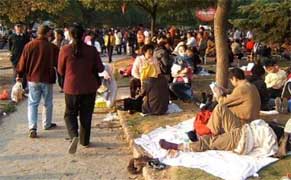
the Earthquake in Jiangxi There is an earthquake and there are
aftershocks. What do you do? The photos come from Jiujiang (via Boxun).


- [097] Public
Service Examinations in China Here is an interesting bit of
information from Southern
Metropolis Daily: Recently, the examinations for entry into the
national public service were held across the country for 10,282
openings. In Guangdong province, there were 34,000 examinees. In
the morning, the examination was about testing administrative profesional
skills in which the examinees must answer 135 questions in 120
minutes. As in past years, the examinees found the mathematical
questions to be difficult and most people were about 10 to 20 questions
short.
More interestingly, in the afternoon, the examination involves writing an
essay on "unexpected public happening." The examinees were
required to write an essay titled: "How does our government raise its
ability to respond to suddenly happening public events." For
reference, there were eight pages of information including a description of
the Sun Zhigang incident. The reporter gathered that many examinees
incorporated the Harbin water stoppage incident to recommend the government
to be more timely and transparent in giving out information.
These days, the public service candidates can use the Harbin crisis as the
counter-example. In 1977, their parents wouldn't worry about anything
like that as they listened to Hua Guofeng tell them about the "two
whatevers": "We firmly uphold whatever policy decisions Chairman
Mao made and we unswervingly adhere to whatever instructions Chairman Mao
gave."
- [096] Super
Girl Grows Moustache A Beijing Times reporter (via Yahoo!
News) found a poster with Super Girl Li Yuchun defaced.
Moustache were drawn on her face and the nose was then round; the words
"handsome (帅)"
and "win (赢)"
were replaced by "ugly (丑)"
and "lose (败)."
There were only some indecent words written in the open space. Some
people tried to wipe the graffiti off, but there were drawn onto the paper
and cannot be erased by wet cloth or tissue.
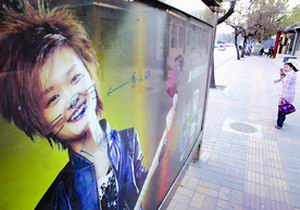
The reporter called up the advertiser, who said that the maintenance company
will be contacted immediately. Graffiti is a unversal problem and some
places have resorted to technological solutions (such as covering the
posters with plexiglass which can be wiped clean easily). More
generally, the outdoor advertising company should have regular graffiti
patrols to deal with these kinds of problems. The problem above had
apparently been there for several days already.
- [095] The
Transcendence of the Media Bloggers in China In this previous
post The Self-Description by Massage Cream,
Michael Anti pointed to how the media workers have become the most
influential and significant bloggers by virtue of their training and
experience. Via CDT,
here is the a Chinese journalist's English-language Non-Violent Resistence (非暴力不合作)
blog. Here are the Jilin-related blog posts: Home
Sweet Home (1) and Home
Sweet Home (2).
From Philip P. Pan in Washington
Post: "On Friday night, reporters received orders from the party's central propaganda department to stop asking questions and go home. All state media were told to use the reports only of the official New China News Agency, the journalists said."
Does that mean media coverage has been totally shut down? Well, the
blogs such as the one above are actually more interesting.
- [093] Media
Coverage in Taiwan Nothing captures the vibrancy and
competitiveness of electronic media in Taiwan than this photo from Apple
Daily.
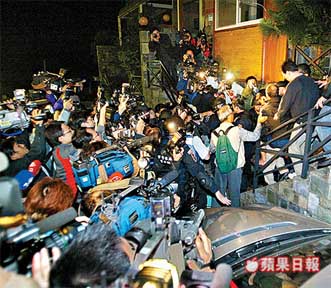
The subject of interest was a kidnapping gang under a police siege.
The police were negotiating for their surrender while insuring that the
kidnap victim remains safe. Around noon, SETTV used a relayed series
of report and was actually going to go live when the police requested that
they stop. They also asked all the media not to report the news as
other gang members were still at large. However, United Evening News
published the item in the afternoon. At 9pm, the police were ready to
assault the location to retrieve the hostage. A television station was
going to send an SNG (Satellite News Gathering) vehicle to the scene, but
the police stopped it immediately. By 10pm, all the cable television
stations were showing the confrontation between the police and the
gang. TVBS and SETTV even used relays to claim that the kidnap victim
has been rescued and sent to the hospital for treatment, while the two
suspects were still inside. The police said: "These are basically
nonsense reports! (根本亂報一通!)"
While the negotiation was still going on, the police found out that the
suspects were watching cable television and the police official asked the stations:
"Please don't report inaccurately. I am getting down on my knees to
beg you, please! (不要再亂報,我跪下來求你們好不好!)"
Still, the suspects did catch the broadcast and at one point waved the gun
and shouted: "Stop the inaccurate reporting, or else I am going to start
spraying bullets at the media! (再繼續亂報,我要掃射媒體!)"
Finally, when everything was settled, the police said: "If lives had
been lost, the media really cannot escape culpability! (要是出了人命,媒體實在難辭其咎!)"
- [092] Universal
Suffrage as Panacea In the print edition of Sing Tao, the
following comment was made in Hong Kong yesterday by an unidentified woman
at a meeting: "Is universal suffrage going to bring many benefits to
Hong Kong? Will it solve the labor problem? Will the inequality of
wealth problem be solved immediately. The United States is a
democratic society, but such problems are still too many to
enumerate." This was greeted by loud coughs and boos.
How does the United States deal with those
problems? Here is a Harris Poll via WSJ.com:
Q: Do you think that the Bush administration generally provides accurate information regarding current issues or do you think they generally mislead the public on current issues to achieve its own end?
| |
Total |
Republican |
Democrat |
Independent |
| Generallly accurate |
32% |
68% |
7% |
25% |
| Generally misleading |
64% |
28% |
91% |
73% |
| Not sure/refused |
4% |
4% |
2% |
2% |
Does anyone get into trouble for being
"generally misleading? Here is the latest amazing adventure by
former FEMA director Michael Brown (The
Guardian):
As director of the Federal Emergency Management Agency,
[Michael Brown] became a national joke soon after Katrina made landfall. As stories emerged of hellish conditions at evacuee shelters, and images of poor, mostly black citizens of New Orleans begging for food hit television screens, Mr Brown seemed eerily detached.
In television interviews the Fema director said he was unaware that hundreds of people were marooned at the New Orleans convention centre. "Don't you guys watch television?" the exasperated anchor asked.
... He was relieved of his managerial duties on September 9 and resigned three days later, barely a week after Mr Bush publicly praised him for doing a "heck of a job".
Mr Brown's reputation since has not been improved by the release of personal email by a congressional committee assessing the government's response to the hurricane. On August 26, as the hurricane bore down on the Louisiana coast, he emailed his press secretary, asking: "Tie or not for tonight? Button-down blue shirt?" The requests for wardrobe advice continued after Katrina hit the coast.
Michael Brown, the bureaucrat who headed America's response to Hurricane Katrina and himself became a symbol of man-made calamity, is going into the disaster management business. He is setting up as a consultant, marketing his expertise on coping with catastrophe - natural and self-made.
"Look, Hurricane Katrina showed how bad disasters can be, and there's an incredible need for individuals and businesses to understand how important preparedness is," Mr Brown told the Rocky Mountain News.
- [091] Male
Virgin Certificate Well, not really. No doctor can
actually certify that in the medical sense. Rather this is a cigarette
case being sold in Beijing (see Legal Mirror via Yahoo!
News). The reporter found this in a Sidan shop. He saw a
row of red metallic cigarette cases. There is a five-cornered star in
a circle and three large words for "Male Virgin
Certificate." The words underneath it are: "The smoking
comrade who holds this certificate is a full virgin who acts properly and
has no disease; may the masses of comrade women use without fear.
Effective period: 1314 years. Issued by the International Pretty Women
Association."
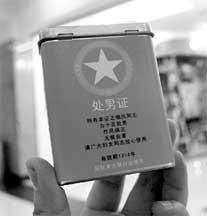
The shopowner said: "How cool! I am the only one in Bejing who
carries this. It is an out-of-print edition and is a collector's
item." When the reporter called the 12315 complaint hotline, the
operator said: "This is a three 'Nothing' product; if the national
symbol is on it, it is an insult that carries criminal liability. We
will send someone over as soon as possible to investigate."
- [090] The
Masato Tashiro Statement The New
Scientist blast out with this headline: Expert says bird flu has
killed 300 people in China.
A respected Japanese scientist, who works with the World Health Organization, says 300 people have died of H5N1 bird flu in China, including seven cases caused by human-to-human transmission.
He says he was given the information in confidence by Chinese colleagues who have been threatened with arrest if they disclosed the extent of the problem.
Masato Tashiro, head of virology at Tokyo’s National Institute of Infectious Disease – a WHO-collaborating centre for bird flu – told the meeting of virologists in Marburg, Germany, on 19 November that “we have been systematically deceived”. His comments were reported in the German newspaper
Frankfurter Allgemeine Zeitung. He told the stunned meeting, called to mark the retirement of a senior German virologist, that there have been “several dozen” outbreaks in people, 300 confirmed deaths and 3000 people placed in isolation with suspected cases.
In Frankfurter Allgemeine Zeitung via ProMED-mail,
the quote was:
Dr. Masato Tashiro, a Japanese WHO consultant, believes that China
has had 300 human deaths from avian influenza and is hiding the true extent of the disease from the rest of the world. Dr. Masato Tashiro,
Director of the WHO Collaborating Center on Influenza at the National Institute of Infectious Diseases, Tokyo, and head of the Department
of Virology of the National Institute of Infectious Disease (Japan), astonished colleagues with this information.
In turn, Masato Tashiro posted a response at ProMED-mail:
I am surprised to read the report in ProMED-mail, Avian influenza,human - East
Asia (180): China, RFI [part 1] {archive number 20051123.3399).
First of all, it is not correct. Therefore, I would ask you to correct it.
In my presentation at the meeting in Marburg, I stated that WHO's official numbers of H5N1 human cases are only based on laboratory
confirmed cases. It should be therefore an iceberg phenomenon. Due to poorly organized surveillance and information sharing systems in
many affected countries including China, it is reasonable to consider that more cases have occurred actually. We have heard many 'rumors'
or unauthorized information which we cannot confirm. In this context, I talked about a few examples of non-authorized information and rumors
about Asian countries which I received through private channels. I clarified that I do not know the original sources and I cannot confirm
whether they are true, how these numbers were derived and what laboratory tests and epidemiological investigation were done.
What 300 hundred deaths? You have
already read all about it here at EastSouthWestNorth on November 15, 2005 at The
'True' Statistics About Avian Flu In China. If you tally up the
number of deaths in the statistical table, the total is 310. Those were
the '300 hundred deaths.' As I pointed out in that post, this is totally
unverified and unconfirmed, and I suggest that any reader can fake any set of
numbers, send it to the same channel and it will be published.
Here the chain of custody: Unverified Chinese
web posting (at Boxun) of a statistical table that did not even look good; an
off-hand mention by a scientist as an example of unverified data; report by a
mainstream newspaper; magnification by a popular scientific journal; prominent
publicity from Boxun as proof that an experts support the 300 deaths figure
(see Boxun);
an angry denial from the scientist. The only remaining question is
whether Boxun will publish the denial and identify the data source (namely,
itself) and explain why scientists would find it inadequate.
- [089] MetaFiltered
in China Last night, I wrote: " My blog
service provider does not record referrers in the log file, so I don't know
who is directing a massive number of visitors to this blog. I thank
whoever it is." A reader wrote in to identify this MetaFilter
post.
EastSouthWestNorth
is a breath of fresh air. Looking for Chinese news in English is pretty frustrating. There is
Xinhua, the CPC mouthpiece, and it's outlets like the
China Daily. The fluffy
Beijing Today isn't much better, geared more towards vapid expats. For an interesting take on China from a Chinese perspective, EastSouthNorthWest translates news from independent Chinese sources to give a picture of China inaccessible to the foreign ear. Everything from
religious and press freedom to
magical man tubers is covered.
- [088] One
Mystery Solved In The Harbin Water Crisis Here is the mystery:
what happened to all the other cities between Jilin and Harbin? Did
their residents continue to drink from the river? In The
Water Crisis in Harbin, from a footnote to the photograph at Nanfang
Daily --- According to China News, Songyuan City (which is located
between Jilin and Harbin) in Jilin resumed the supply of water on November
23 around 1pm after a stoppage of seven days.
So the auxiliary mystery is just what explanation was given to the residents
of Songyuan? Maintenance? Or benzene pollution? In either
case, if the Songyuan news got out, it would have changed the whole
perception of the Harbin situation. First, if they said maintenance,
then what is the likelihood of every city along the river having maintenance
issues one after another? Second, if they said benzene, then everyone
living by the river will be affected in time. Why was the news from
Songyuan shut off?
- [087] Burn
Your Financial Ledger I missed the following Chinese-language
item at Wen
Wei Po but Syaoran at InMediaHK
caught it. What's the big deal? A dozen or so taxi drivers were
unhappy with how Democratic Party legislator James To got away with his office
rental scandal. So they took personal time off from their jobs
in order to protest.
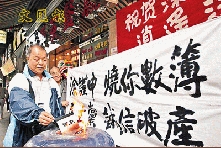
Who cares? Nobody, really. But when one reads the words on the
banner: "James To, we burn your financial ledger; the Democratic Party,
your trust is bankrupt," one has to burst out in laughter. Why
burn the financial ledgers? This is not about any complaint about
faulty book-keeping (although it should be). The phrase turns out to
be the homonym for the well-known Cantonese phrase "Delay No More"
(see previous post).
Such phrases never occur by accident. All locals understand the real
deal.
P.S. There exists a more elaborate Cantonese phrase: 調理農務化系
(Agricultural Affairs Management Chemistry Department). I cannot
translate this, because it would mean the loss of the family-friendly rating
of this blog.
- [086] Running
Dog Hits Venezuela The EastSouthWestNorth blogger has another
life in which he is the Latin American website ZonaLatina.com. During
the process of providing a news service, he found one of his favorite
China-themed websites Running Dog
being prominently mentioned at Venezualanalysis.com.
“How sad,” [Venezuela president Hugo
Chávez] told the viewers of his weekly chat with Venezuela’s popular classes, Alo Presidente, “that the president of a people like the people of Mexico [a nod to Villa’s virility] lets himself become the
cachorro of the empire.” Fox demanded an immediate apology, Chávez refused, ambassadors were pulled and here we are.
I leave the word cachorro in Spanish because it is subject to competing translations. The English-language press, firmly backed by all the Spanish-English dictionaries, goes with “puppy.” Nothing wrong with that except that it loses the fine sense of insider irony and political association that Chávez’s remark contains. I’ll go with “running dog.”
Those of you who remember the late Chinese leader Mao Tse Tung only for his brutal sweeping of all suffering humanity into his version of the ineluctable logic of history may not remember that Chairman Mao also had a way with words, one of which was
zougou, “running dog.” My online English dictionary defines running dog thus: “noun: A servile follower; lackey; from Chinese
zougou, from zou (running) + gou (dog), apparently as an allusion to a dog running to follow his or her master's commands.”
Back in the days of the Chairman’s outsized global influence, the term
zougou was used to characterize his enemies, as well as the enemies of the Revolution. It was always translated as “running dog” in English but simply
cachorro in Spanish. Over time, it was so widely and indiscriminately used that it became subject to a certain nuanced style of mockery and inverted meaning.
There is a delightfully sardonic oppositional (English-language) Chinese Website by that name whose commentaries suggest that Running Dogs who call themselves Running Dogs acknowledge both an unwillingness and an inability to carry out their prescribed roles in a set of authoritarian
relationships ...
Yes, we live in a globalized world in which
some comment on Mexico-Venezuela politics could refer to a blogger in China
...
- [085] Covering
The Water Crisis in Harbin Why have I been getting so many
requests for media interviews lately? Because there is the recognition
that there are some stories that a blog can cover better than western
mainstream media. A case in point is the water crisis in Harbin.
Here are some links found through Google for November 23, 2005.
- Chinese city in chaos as water to be cut off.
David Fickling and agencies, The Guardian. November 23, 2005.
- China city waits for toxic deluge
BBC News. November 23, 2005.
- Residents Flee Chinese City as Taps Go Dry Over Water Poisoning Scare
Luis Ramirez, VOA News. November 23, 2005.
- Toxic spill is to blame for water panic, China admits
Jane MacCartney, The Times. November 23, 2005.
- China city braces for wave of river pollution
Chris Buckley, Reuters. November 23, 2005.
- Harbin residents wait and worry
BBC New, November 23, 2005.
For comparison, there is one and only post at
The Water
Crisis in Harbin. It is a collection of government announcements,
overseas website reports, local BBS posts and email from local observers
coming in English or translated from Chinese. This is precisely the type
of event that western media find it difficult to cover: a complicated sequence
of events with twists and turns over many days. Any report must
summarize the preceding events, and therefore the depth of coverage is
shallower overall. As time goes by, the summaries get more
brief.
By comparison, the ESWN blog post has no spatio-temporal limitations and
continues to accumulate the information. There is also no attempt to
impose a single thesis about what happened; instead, disparate and
contradictory factoids are presented from different sides for the readers to
draw their own conclusions. And this is what attracts the people who
want to know more. You can click through everything above, and I think
that you will decide that a blog is better at it. You can really get
that sense of confusion, panic, betrayal and disappointment.
- [084] The
Taoyuan Edition of the Special CD Apple
Daily: The Taoyuan edition of the special CD made its public debut
to an audience that included media reporters and police officers collecting
evidence.
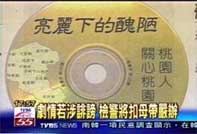
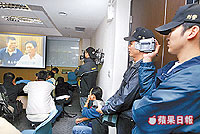
The video clip lasted for about 18 minutes and the music and sound effects
have not been included yet. The contents concern the Taoyuan County
Commissioner Chu Li-lun and his family business in sandrocks, the tree that
blocked the road and his cousin's job at the labor planning
association. Media reporters were disappointed in that there was no
sex scandal about Chu Li-lun and a female television broadcast hostess as
rumored. Since the sandrock business and the tree are historical
issues and the cousin's job is subject to debate, there is probably no cause
for judicial action.
What is the net impact? According to the Apple Daily touchtone
telephone survey of 495 respondents, 46% had seen part of the video on
television; 40% think that Chu will get more votes as a result of sympathy,
whereas 21% think Chu will lose votes.
The matter of the tree is interesting, because it led to a different
sideshow. According to ET
Today, Chu's uncle (=mother's brother) planted this tree forty years
ago on land owned by the family. Later on, the land was sold and the
roadway was expanded here. However, the tree has stood there even
though it impeded the passage of fire engines. Supposedly, the tree
was untouchable because its planter (=Chu's uncle) was the town's mayor and
therefore this was an abuse of authority to the detriment of public
interest.
(TVBS)
So on this day, Chu Li-lun's rival Cheng Pao-ching in the upcoming election
showed up at this famous tree that stands about four stories tall.
Symbolically, Cheng took a saw and made a hack at the tree to pose
for the media. Immediately, there was jostling between the supporters
of Chu and Cheng. The police then had to issue warnings and try to
keep peace.
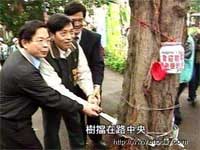
- [083] Human-shaped
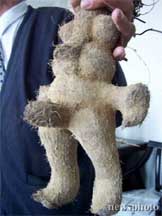
Tubers Polygoni Multiflori Radix (何首烏)
is a tuber with medical properties, supposedly beneficial for the liver and
kidney, and can even reverse premature white hair. The tubers come in
different shapes, and they are especially precious when they assume near
human shape. According to China Daily via Boxun,
a rare human-shaped tuber was recently discovered in Zhejiang: it has a head
with two eyes and a nose and a clearly delineated face; its two arms were
spread horizontally palms down; and its two legs are split. And it is
a very virile male.
- [082] Water
Rationing in Hong Kong For those who grew up in the 1960's in
Hong Kong, what is happening in Harbin might seem completely trivial.
How bad was it? At the worst, the water was turned on for four hours
on every seventh day. Just contemplate that for a moment. How do
you take baths, brush teeth, do laundry, cook rice, wash dishes, flush
toilets, water plants, and all that? However, the entire process
was gradual. We were told about the water shortage and put on four
hours each day. Then it moved to every other day. Then it moved
to every four days. All the while, we could go to Pok Fu Lam reservoir
on Hong Kong Island or Shing Mun reservoir on the peninsula and check the
water level. Today, things are quite different with the construction
of the huge Plover Cove and Shek Pik reservoirs. Besides, there is
also the water pumped in from the Dongjiang river on mainland China.
- [081] If Policemen Are Posted Outside My Door ...
In this previous post of September 2,
2005 when US Secretary of State Condeleeza Rice visited China, Indpendent
Chinese PEN president Liu Xiaobo stated: "If there are policemen posted outside
my door, then some international bigwig must be in town." This week,
Rice's boss is in Beijing, so what is the evidence?
(ObserveChina)
At 830pm on November 21, Liu Xiaobo was invited by the police to have a
chat. This took place at a teahouse and lasted about an hour.
The main purpose is for the police to offer a certain explanation as to the
procedures that were put into place while Bush was in town. For the
past two days, telecommunications with Liu has been erratic, and he has told
people that the police are "downstairs watching him."
- [080] Supermen:
No Girls Over Two Nights You can go read about the
KRTC-related indictments at Taipei
Times. I would instead like to update a media report which
once again causes me to pause and ask: Can anything in the media be
trusted? The original story Supermen: Four Girls
Over Two Nights was reported in China Times Weekly on former deputy
secretary-general to the the Presidential Office Chen Che-nan ordering four
girls over two nights, according to a Korean mamasan in Chejou. When
the article first appeared, it was criticised as being too light in having
only one witness. Apple
Daily sent its own reporter to Korea, probably hoping to dig up even
more dirt on Chen Che-nan. Instead, the original story is being cast
into doubt.
The Apple Daily reporter re-interviewed the mamasan. The reporter
began by reading the CTW story to her. She was astonished! She
said that she had no idea that she was being interviewed. When asked
"Have these two people been here?" she had replied "I might
have seen them. I don't know why they should seem
familiar." She definitely did not say "I know him. He
has been here several times" as reported. She then signed a
statement to the Apple Daily reporter, emphasizing "I am
perplexed."

Apple Daily also produced a table to list the other discrepancies:
- CTW said that she has worked in two other night clubs; she said that she
has always worked at this one.
- CTW said that she claimed that Chen Che-nan liked sexy girls with good
figures and big breasts; she said that this was a statement of what Taiwan
men generally prefer.
- CTW said that she said that Chen Che-nan did not pay, but the bill was
settled by Alen on the final occasion before they left; she said that they
don't accept unsettled accounts.
- CTW said that she has seen Chen Min-yin at the hotel and the night club;
she said that Chen Min-yin has never been to the club.
- CTW said that she provided salacious details about how Chen's escapade
(e.g. 3P); she said that she had no idea that she was talking to a reporter
and the other party never explained the reason for the visit.
When contacted, the CTW editor-in-chief stood behind the story, which was
backed up by a video recording, witnesses and even the tour guide who took
Chen Che-nan there. He believes that she is being subjected to
pressures.
- [079] What
Is Going On In Harbin? (Dongbei
Net) What is known is that the water supply system will be
shut down for approximately four days as of noon, November 22. This
has caused panic buying of bottled water at supermarkets. What
happened here?
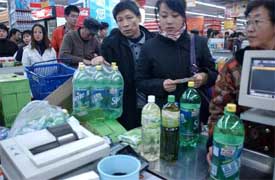
(1) The official explanation was that it was routine maintenance
(2) (Dongbei Net)
Previous to this, beginning around noon, November 20, there was a rumor that
an earthquake has been predicted for Harbin. This has caused people to
start hoarding up on food and water and pitching tents outside to sleep at
night. But what has this got to do with the water supply system?
(3) (First
Financial Daily) Previous to this, there was an explosion at a
petroleum plant in Jilin, and since Harbin is downstream from Jilin, its
water has been contaminated. But what about all the other people who
lives along the river but outside of Harbin?
(4) (Boxun)
An unidentified person from the water works department said that a water
quality inspector found out that there was a large-scale, systematic attempt
to poison the water. But how are they going to get the poison out of
the system in four days?
Any other theories out there?
- [078] The
Sunshine Oath of the Chinese Websites (Beijing Daily Messenger
via MediaChina)
At a November 19 conference, more than ten Chinese literature websites
signed a joint "Sunshine Oath for Chinese Internet
Literature." The conference was initiated by Tencent's Reading
Channel and was attended by the major literary portals such as Xici Hutong,
etc. The oath claims: "We will resolutely oppose the
proliteration of pornographic, violent and reactionary literature on the
Internet. We will eliminate the pollution of our youth by harmful
Internet literature. We will give all our efforts to build a healthy,
uplifting and sunny environment for Internet literature to grow."
Ever since the first Chinese literature website appeared in 1994, there are
now almost 4,000 Chinese literature websites around the world. Within
China, about 300 websites include the world "literature" in their
names. For example, the website Hongxiutianxiang (红袖添香)
was founded in 1999, and now contains 1,600,000 original works. The
daily visitor count is 2 million. However, the webmaster Sun Peng told
our reporter that about one-third of the Internet literature is taken over
by low-brow literary works with pornographic content.
According to the conference organizer Hu Dazhi from the Tencent Reading
Channel, the percent of unhealthy content is over 20%. Next month,
Tencent Reading Channel will introduce a "reader's complaint
system." Any reader who finds any pornographic or violent works
can complain to the website editor, and the website committee will convene
immediately to pronounce sentence.
Blogger's comment: It is hard to say if this is good or
bad. On one hand, something like Serve The People - Chapter 6
will probably be rejected. On the other hand, some of that other stuff
is truly bad (in the sense of being repetitious, formulaic and worthless). If 20% or 30% of the literary output goes here, then it is
an appalling waste of energy on the part of writers and readers. I may
have to translate one or two of those just to make the point.
- [077] Hong
Kong Poll on Political Reform (Ming
Pao) This is a touchtone telephone sample of 629 respondents
conducted between November 18 and 20.
Do you support or oppose the political reform package? Support: 40.2%;
oppose: 31.5%; don't know/not sure: 28.3%.
The opposing legislators say that they will vote against the package if
there is no time schedule, so that the 2007/2008 elections will be the same
as before. Do you agree? Agree: 32.9%; oppose 38.2%.
Will you be attending the December 4 march to oppose the political reform
package? Yes: 21.1%; no: 60%; undecided: 19%.
According to CUHK Political and Administrative Science Senior Lecture Choi
Tse-keung: if too many marchers show up (e.g. 200,000), the democrats will
stand firm and there will be no compromise; if too few marchers show up, the
SAR government and the central government will not feel the need to
concede. So a compromise is possible only if the number of marchers is
neither too few or many.
- [076] Indigestion
(Guangzhou Daily via Yahoo!
News) At the Guangzhou Contemporary Arts Exhibit, a piece of
work titled "Indigestion" was constructed from metallic pieces and
waste spare parts to reflect the bad consequences that the waste products
from modern industrialization have on the natural environment. It is
said that some of the audience did not understand this method of expression.
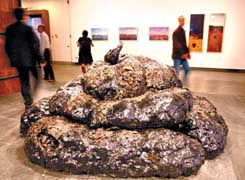
- [075] Chinese
Reporter Attends Church Service To Meet President George W. Bush
Here is my translation from the Chinese version of blogger Buzhesiliu
meeting President George W. Bush,.
I never thought that I would be able to
sneak into the church.
Although my alarm was set for 6am, I woke
up at 5am. I only slept for three hours. I thought that it would
be better if I get there earlier. I ate some congee, I took my camera
and I headed for a Sunday mass with Comrade Bush.
On the way, I saw the police cars heading
towrds that direction. It was truly first-class police action.
When I arrived at the church, there was a bunch of believers lining up to
enter. I joined the queue. An old man behind me was a f*cking
nuisance because he called out, "This man does not have a bible in his
hand." F*ck! What does it matter if I didn't have a f*cking
bible! So I switched to a different line and I started to talk to the
other believers with my limited knowlege of Christianity.
I entered successfully and I went up to the
security. They said, "No cameras." I had to find a
place to leave my belongings. I went over to the command center of the
Americans and I wanted to leave my stuff there. The American siad,
"NO!" I said, "I am a reporter. I want to leave
my stuff here for a while." I showed my reporter's identification
card. But suddenly, a Chinese traitor (汉奸)
showed up and said that no Chinese reporters shall be allowed to
enter. F*ck! It was all screwed up by this Chinese
traitor! "You must leave!" So I went out of the
door. I found a place, I left my stuff there and I told the attendant,
"I'll come back later for this." F*ck! I left more
than 20,000 yuan of equipment there. I am f*cking gutsy!
Then I got back to the end of the
queue. I entered the church. I sat in the middle. I have
not sang with so many other people for a while. Ever since junior high
school, I have not had music training. I am not so lucky as these
Beijing children. I sat next to a 12-year-old, who was baptised at
10. His mother works in the church and so this was a family gig.
At 730am, Bush arrived. Very much on
time. He was nicely dressed. He is a sleazy person, but he looks
nice and clean when well-dressed. His wife was dressed in light-brown
colors, her ears were shining and quite impressive. When Bush entered,
he said, "Morning everyone!" An American politician!
Everybody paid him respect and replied. Rice was also there. She
was not as ugly as seen on television. She even looked good, and that
is not bad for a black person.
Then we sat down and sang. I must be
talented because I could sing without having learned the songs. These
are the same old hymns with some new verses. It was easy. My
voice was especially loud and moving and I looked sincere, and that
convinced the believers around me that I must have been around for years.
That little boy was naughty, as he played
my PALM all the time and did not sing. But I used his bible for
disguise. When Bush sang, his head bobbed and weaved and he was really
into it.
When Bush left, he shook hands with the
believers on both sides. The people kept clapping. I have seen
this type of scene often enough. When Lian Chen came and when Li Ao
came, the Chinese people who have been devoid of political experiences and
whose desire to express themselves have been suppressed too long therefore
felt excited when they see political figures show off.
I was sitting in the middle, so I felt too
embarrassed to rush forward. So I shoved the little boy to move
forward to shake Bush's hand. When Bush saw the little boy, he was
delighted. He went up, grabbed the boy and spoke the very officious
"Thank you." Although he had the sincere look, he said
nothing more. So my plan failed.
"His hand was very hairy," the
little boy yelled out to me in delight!
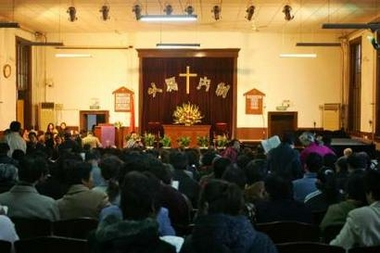
Reuters Photo: Where are the reporter and the little boy?
- [074] The
Pan-Blue EastSouthWestNorth Blogger I'm sorry if newcomers
read this blog and think the blogger is a pan-blue supporter insofar as
Taiwan politics is concerned. The chance of that happening is exactly
ZERO. For example, try this old blog post How
Taiwan Robbed My Childhood. Is there any chance of me ever
lapping up that pan-blue sweet-talk?
Here is the essence of my growing-up experience. In terms of age, I am
older than most bloggers. As a result, I have lived through the
ROC/pan-blue version of Free China of the 1950s/1960s, the Great Proletarian
Cultural Revolution of the 1960s/1970s, the Diaoyutai movement of the 1970s,
the Watergate hearings, the Iran/Contra hearings, my personal involvement in
the Jiang Nan assassination investigation, the War in Iraq I and II,
and all the other stuff. From those experience, I have learned: I will
never ever trust anyone on account of their credentials. I won't give
you my unconditional support because you say that you are Free China, or a
Freedom Fighter, or a Hong Kong Democratic Party member, or a member of the
Democratic Party in the United States of America, or a Chinese Communist
Party member, or a human rights advocate, or whatever. I have been
betrayed too often already. You will have to earn my trust. You
can do that by telling me what is specifically involved in an issue (and I
will check up on that too) and what your position is. Then, and only
then, you will have my support.
I believe that a lot of the ills in
the United States, mainland China, Taiwan and even Hong Kong are due to
people automatically lining up according to party positions irrespective of
the actual circumstances. You can check all the public opinion results
by party affiliation. The sooner that people can get rid of party
lines and look at the issues themselves, the better off we are. It is
not what people say, it is what they actually do. Why are all votes
automatically along party lines? Why are these elected
representatives totally incapable of making their own decisions on specific
issues? Meanwhile, stop assigning people to party position on the basis of their
opinons!
I am sorry if this comment has degenerated into a rant. In a recent
media interview, the reporter said, "Oh, but you don't rant like the
others." Indeed, most of the time.
- [073] Suicide
Blogs (Apple
Daily) In Taiwan, three men checked themselves into a motel
and committed suicide by carbon monoxide poisoning through burning
charcoal. The three had brought along all the equipment: barbeque
racks, charcoal, tape (to seal the air-conditioning vents), whiskey and
sleeping pills. Of the three, one left a farewell letter: "The
21st of this month will be the anniversary when my wife left me. My heart
has ached over time. When I am alone, I often break out in
tears. My heart hurts so much so much ..."
According to another man's relative, he had been browsing the blogs "唐亮哲與五箇寫手"
and "桃子的美麗與哀愁"
where there are comments from netizens about suicide, including "Please
teach me how to die. Which is the best method to die?" and even
"Does anyone want to kill themselves through burning charcoal?
Let's do it together."
According to a lawyer, if a blog's main theme is suicide and it indirectly
led a netizen to commit suicide, the blogger may be guilty of aiding and
abetting suicide under the criminal law code with a maximum jail sentence of
under seven years. However, neither of the two named blogs are
suicide-themed. The first blog is mostly literary, with a review of
the banned Japanese suicide manual in June drawing several hundred
comments. The second blog has only several entries, and the last one dated February 23
is about schoolgirl suicides with a few dozen
comments. However, these blogs may be scapegoats at this point.
- [072] That
Village in Guangzhou You did not think that it would all stop
just like that? Scroll down to the bottom of the chronology file and
read the latest happenings ...
- [071] The
Great K113 Bus Robbery (Nanfang Daily via MediaChina.net)
Recently, a post with the title "On the morning of November 15, an
entire Shenzhen K113 bus was robbed" caused a sensation at Shenzhen
Hotline, Tianya Club and other forums. As this came just after Shenzhen
was rated as the most civilized city in China, this created a negative
image. The Shenzhen Municipal Public Security Bureau's Internet
Monitoring Department began to investigate the source of the problem (note:
there was no such incident as reported). Here is the chronology:
- On the morning of November 15, Mrs. Huang
got on a K113 bus to go to work at Shekou. She heard the woman next
to her tell her about how a whole K113 bus got stolen some time ago.
- Mrs. Huang had not been happy about having
to commute so far every day. She had tried to get Mr. Huang to buy a
car many times, but he would not. So Mrs. Huang embellished the
story and told Mr. Huang that everybody on the bus was "robbed."
- Mr. Huang thought it was true, and sent
the news to others on the company email system.
- A co-worker Mr. Tan saw the news and
posted it onto the Internet under the belief that he may get some
recognition for a breaking story.
- That night, the Shenzhen Internet
Monitoring Department checked all the websites in Shenzhen in which the
information was present and traced the origin. At 730am, the police
appeared at a certain information technology company in Shenzhen and
located Mr. Huang and Mr. Tan. These two people may be facing legal
problems.
How was Mr. Tan located? Probably
either through the real-name registration system or information provided by
Shenzhen Hotline on the IP number which was traced through the Internet
service provider. I'll leave you to decide whether Mr. Tan (and Mr.
Huang)'s rights to
privacy were violated. Do you really defend their inalienable right to
spread unfounded rumors to cause public panic? And should Shenzhen
Hotline and the ISP have refused to cooperate with the police?
Premier Frank Hsieh (謝長廷) and independent Legislator Chiu Yi (邱毅) yesterday continued bickering over whether Hsieh had mentioned "the
empress (皇帝娘)" -- referring to first lady Wu Shu-jen (吳淑珍) -- during a phone conversation with Chiu.
"I swear. If Hsieh never said so, as he claimed, I will immediately resign. Also, if I'm lying, I will be struck and killed by a car once I step out of this door. However, if he is lying, I think the premier should step down," Chiu
said.
Chiu was not hit by a car yesterday.
There were quite a few more of those in this
duel. (ET
News) Chiu Yi swore that if he lied, then may the whole family
perish. When told by reporters, Frank Hsieh laughed and said, "I've
seen an Internet joke about this. The whole family refers to the
reporter's family. His own family is going to live until they are a
hundred years old. He is taking advantage of the reporter."
Frank Hsieh goes on to question the definition of Chiu's family: does that
include his two divorced wives? And Chiu also does not have the right to
ask other people to die. "If Chiu Yi wants to swear, he should
swear that he will lose every election, lose all his assets and die a horrible
death."
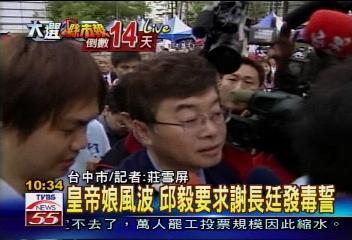
(BCC)
Here is what Chiu Yi said: "如果謝長廷沒有說『皇帝娘』,而我冤枉他的話,我出去馬上被車撞死,橫屍街頭!說謊的人就給車撞死,謝先生你聽到了嗎?"
(translation: If Frank Hsieh did not say 'the empress' and I misspoke, let me
run over by a car as soon as I step outside and let my body lie in the
street! Let the liar be killed by a car. Can you hear me, Mr.
Hsieh?") So it should be noted as well that Frank Hsieh was not hit by a car yesterday.
(TVBS)
This matter yet go the path of a lawsuit. History showed that Frank
Hsieh had sued Chiu Yi six times before and lost each time. But Hsieh's
legal bill was paid by the city of Kaohsiung where he was mayor, whereas Chiu
spent NT$400,000 of his own money for those cases.
- [069] Judicial
Overreach As snooty as this statement may sound, I say
"Statistics is for statisticians." In particular, I ask
judges to butt out. From a soon-to-expire link Judge Denies Nielsen Motion, Allows Antitrust Suit To Proceed
by Joe Mandese at Media
Post, "The judge noted that erinMedia plans to collect data from cable systems representing about 60 percent of the U.S. TV population, while Nielsen's "national" sample collects data from only about 8,000 households."
This is total ignorance about the trade-offs between bias and reliability.
On one hand, someone promises: I can give you a sample of 500,000 cable
households (which obviously get to watch the cable channels). On the
other hand, someone else promises: I can give you a representative sample of
8,000 houseolds (cable as well as non-cable). What is the
trade-off? Having 500,000 cable households simply means that I can get
you the wrong and biased result from cable households only more reliably. That is, I have more
confidence that the result will be wrong and consistently so! Why
should you be happy in any way, shape or form?
- [068] Supermen:
Four Girls Over Two Nights Will the assault of the
executive/judicial branches of Taiwan on TVBS stop the media from covering the
Chen Che-nan case (see, for example, Comment
#70, October 2005)? Apparently not.

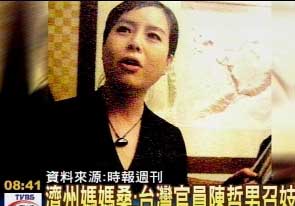
The China Times Weekly Magazine (via Wenxue
City) reports that Chen Che-nan, a former deputy secretary-general to President Chen Shui-bian,
and Chen Min-hsien, who is under investigation for involvement in the snow-balling Kaohsiung Metro
scandal got four call-girls from a night club near their hotel.
According to the mamasan, she recognized Chen Che-nan from a photograph:
"I know him. He has been here several times." Then she
became perplexed: "What is the big deal? It is commonplace for
our customers to take two or three girls out. A Japanese customer once
took five girls out for a 6P game!"

- [067] Otras
perspectivas Shanghai
Express: "Para mí, la principal labor de un blogger es una bien humilde: facilitar la difusión de cuantas ideas se van generando en un mundo cada vez más interconectado para que puedan ser valoradas y examinadas por cuanta más gente mejor."
Now, if we can all do that ...
- [066] The
BBC World Service Interview The telephone rings and it is a
Hong Kong friend of my mother. She said, "Last night, I turned on
the radio to listen to BBC, as is my habit. Some blogger person was
being interviewed by Carrie Gracie. I listened and I thought that I
must know this person. However, this is BBC and I have not been to the
United Kingdom for some time. Who could it be? Then when the
program ended, Carrie gave the name of the person and it was
you!" I told her that it was an interview with Carrie in a London
BBC studio while I speaking talking from a Radio Television Hong Kong
studio. "Yet the two of you sounded as if you have such a good
personal rapport," she said.
I have actually not yet listened to the interview. The session lasted almost one hour, even though I felt that there were many
more uncovered subjects. The broadcast program was scheduled for 25
minutes, so some editing was done. I actually dread listening to this,
because most people don't know what they sound like. My accent is
probably a mess. It cannot be said to be Shanghai, or Hong Kong
Cantonese, or British, or Australian, or Irish, or New York, or Nuyorican,
or Long Island, or Boston, or Los Angeles, or Memphis, or whatever. It
is the sum total of all of these because I had lived in all those
places. I would probably make a lousy liar, because my switching
accents will probably give away my feelings, moods and thoughts.
- [065] Professional
Journalism Presently, the favorite person for bloggers to bash
is someone named Amy Alexander, for saying (NPR via Atrios):
Some friends recently asked me why I hadn't set up a blog, you know, a personal Web site that a lot of folks these days use as a diary or to advocate a political viewpoint. I admit that I've entertained the thought of setting up a blog, usually when I'm ranting at TV newscasts or shouting about something I've seen in the day's newspaper. And as I get older, I realize that my opinions have gotten stronger, even if my journalistic experiences have become less varied.
Before I had children, I was the kind of run-and-gun journalist who lived for adventure--riots, earthquakes, forest fires, you name it. If it was jumping off within a thousand miles of me, I was there. But one of the biggest lessons I took away from the many years I've spent in newsrooms is this: Without editors, you are dead, specifically without a copy desk. You might as well be standing in your living room, ranting away, facts be damned.
That brings me back to my point about blogs. Not all blog readers know the difference between pure unfiltered, unedited opinion and good old-fashioned solidly reported news. Yes, I know that bloggers lately have been credited with everything from drumming up mainstream media interest in the overlooked plight of missing black and Latino women to exposing any number of government hacks and mischief-makers. But much of what appears on many blogs is speculation, however well-informed.
At Huffington Post, Marty Kaplan wrote on Journalism:
R.I.P.:
Mainstream journalism has cancer. The diagnosis – stage three, terminal – was made this week, by anyone with eyes to
see ...
If the Judy Miller saga left anyone wondering what high-church journalism’s standards are about sourcing, confidentiality, and citizen responsibility, the Bob Woodward tale now makes it clear: They make the rules up as they go along. Guidelines and handbooks are for rookies and chumps. If you’re a diva, if you’re working on a book, if you don’t feel like being served with a subpoena, if you think you know better, if don’t want to piss off a source – well, then, you do what you damn well please. It turns out that investigative reporters have the same right to clam up or spin when journalists ask them questions as do White House press secretaries, oil barons or starlets.
We also know now that the MSM is largely useless for adjudicating between conflicting claims and establishing what the facts are. The Bush/Cheney onslaught against its critics is being covered lavishly – but only as theater. Look at the Democrats cry “manipulation”! Look at the Republicans cry “treason”! A war is at stake. The nation’s reputation around the world is at stake. Lives hang in the balance. And all the media can do is cover tactics, politics, the melodrama of thrust-and-parry. The rare reporters who have attempted to create a useful scorecard are battling their weasel-minded editors’ insistence on a bizarre postmodern notion of balance. You know the CYA drill: if you say a good word about Darwin, ya gotta juxtapose it with some intelligent design whackball’s counterquote; if you say Cheney lied about the Saddam connection to 9/11, you’ve still got to dredge up every nutjob’s assertion that the Atta meeting in Prague can’t be disproved.
... What does it say about the news profession when most of the voices determined to ensure accuracy are onliners working without benefit of staffs below them, editors above them, or brand-name seals of approval from the priesthood?
- [064] Global
Reach From a receptionist in Prague (where I just was):
"I just heard you on BBC World Service a moment ago. I send you
my best regards from Prague (Czech Republic)." That was
nice. Really nice. If the BBC interview had occurred earlier,
this person might have shown me the real Prague instead of the tourist
version. Here are a couple of photographs that I took on my tourist
trip.


During my walk through central Prague, all I saw was hordes of
tourists. This cannot possibly be the real Prague, can it? There
are more than 1 million residents in Prague. Who are they? What
do they do? What do they think? I have no idea, because I was
stuck in the Prague Marriott most of the time.
- [Administrative Note] If you
google "EastSouthWestNorth" now, you will get more than 200,000
results. Wow! What does that mean? It means diddly.
Chalk this one as a victory for the splogs (=spam blogs). Here is an
example:

If you are a blogger too, how many splogs link to you? Just remember:
they wouldn't invoke your blog name if it were not important. So there
is the new concept of your splot rating!
- [063] Co-Branding
At the Third Convention of New Products and Services for Family Planning,
Reproduction and Health, plenty of attention was given to the Super Girl and
the 12 Girls Band condoms.
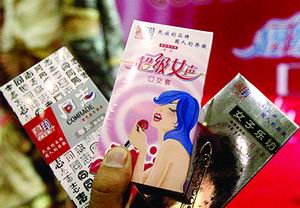
The problem is that the original brand creators had no knowledge of these
brand extensions. The Super Girl brand's manager admitted that when
they first registered the Super Girl trademark, they did not include family
planning tools within their scope. "Who would have thought of
that?," he explained. The 12 Girls Band's manager said
"That's disgusting!" Legally, the condom manufacturers have
applied only for the trademarks for their fields, and they just may get away with
it.
By the way, the third condom shown in the photo is Comrade, which is made
especially for gay men.
- [062] The
2008 Beijing Mascots Were Plagiarized (NOT!) The Chinese
government announced the following five mascots:
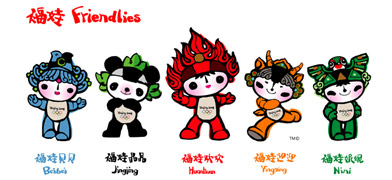
The secrecy behind the selection of the mascots led to this speculation:
those mascots were plagiarized from this particular Manga author Little IroN
from Guangzhou (see Wenxue
City):

The only damned problem here is that Little IroN created these images AFTER
he saw the official mascots. Of course, that would not stop the
Internet rumor mongers ...
- [061] Transborder
Friendships At the beginning of November, I posted a brief
Administrative Note that recommended Chinese-language MSN SPACES websites
that link to the EastSouthWestNorth blog (scroll to the very bottom of this page).
On November 1, the count was 13. Today, it is 24. But the latest and most pleasing is
天方乱谭,
a title which is difficult to translate into English. In any case,
here is a blog post there on November 4 titled The
English version of the Chen Yi affair. The blogger wrote: "A Hong Kong friend has even translated my entire article into
English" and then reproduced my English translation inside a
frame. Yes, this is Tan Renwei, the author of The
Girl Who Sold Herself To Save Her Mother who traveled thousands of miles
across the country to cover that story. I hope that the
reporter/blogger took my effort as an affirmation of his work and it is a
moment such as this that makes me think that my own translation work might be
worthwhile, notwithstanding all the hate messages directed at me.
Above all, I want to communicate to the media workers in China that when they do good
work, the rest of the world has a chance to appreciate it, thanks to the
Internet.
- [060] The
Mild 7 Survey According to SCMP:
"The government is trying to amend the law to ban adjectives on cigarette packets that imply a brand is less harmful to health than others.
Japan Tobacco has been selling its Mild Seven cigarettes in Hong Kong for 20 years
...
The company commissioned a survey of 1,026 people, both smokers and non-smokers. It said 98 per cent of respondents to the question "What does the English brand name
'Mild Seven' mean to you about the cigarettes?" said the words were unrelated to health.
Ronald Hinckley, president of Research/Strategy/Management, a US-based research company, said: "These results clearly show the brand name Mild Seven does not create the impression that the cigarettes are less harmful than others."
But medical sector legislator Kwok Ka-ki dismissed the survey. "This is a study carried out or paid for by the company. It cannot prove to us that it is unbiased," he said.
How different will the survey answers be if
the question was just slightly different, as in "What comes to your mind
immediately when you hear/see the English cigarette brand name 'Mild
Seven'?"
I know that Japan Tobacco wants to save a
brand name whose equity was carefully built up over many decades. But the
brand was probably named 'Mild Seven' for
precisely the reasons behind the proposed government law amendment (i.e. to
imply a brand is less harmful than others, as in a 'milder' version of 'Lucky
Strike' (='Lucky Seven')). There should not be a grandfather clause to
protect that.
- [059] Sex
and the June 4 Hero Splattered across the front page of Apple
Daily is June 4 hero Shen Tong naked in bed with someone else's
wife. Shen was a student leader along with Wu'er Kaixi and Chai
Ling. After 1989, he left for the United States before getting into
business in Taiwan.

This particular story is just the lurid material ripe for the Apple Daily
front page. The female Lai probably loved Shen, who was married to
someone else, but
then she decided to marry Peng instead. When the married couple left
for their honeymoon, Shen got on the same plane and asked Lai to sit
with him in the business class section. When they landed in the United
States, Shen took Lai to stay at his own hotel and left Peng in the room
alone by himself for the honeymoon. Then Shen and Lai approached Peng
to propose a "three-person living arrangement" which Peng
rejected. Last January, Peng found a photograph of the naked couple on
Lai's mobile phone and then attempted suicide. The couple are now
divorced. Shen is facing adultery charges, which has a maximum
jail term of one year under Taiwan law.
What sells? Sex, scandal and politics.
- [058] Sexual
Behaviors: Chinese vs. Non-Chinese Ming
Pao covered an article published in the journal AIDS Care.
Rather than trust Ming Pao's summary, here is the original abstract in AIDS
Care:
This study compared patterns of sexual behaviour and determinants of unsafe sexual behaviours amongst the Chinese and non-Chinese residents of Hong Kong. Of the 2,060 respondents (2060/4157; 50% response rate), 73% identified themselves as being ethnic
Chinese.
Overall, having a non-regular partner was more common amongst the non-Chinese (36%) than the Chinese (17%) respondents.
Chinese people who were at increased risk of having had sex with a non-regular partner included social hygiene clinic attendees and airport travellers, males and ever smokers. For non-Chinese this was inconsistent condom use and being aged 18–45.
Predictors of inconsistent condom use for Chinese included being aged 18–45, never having been married, and having had sex with non-regular partners; for non-Chinese the predictors were being aged 18–45, having had sex with non-regular partners and being unafraid of AIDS.
We conclude that there are similarities and differences in sexual risk-taking behaviours between Chinese and non-Chinese residents in Hong Kong.
Ming Pao also quoted that AIDS Care has
targeted these groups: male homosexuals, truck drivers who go between
Hong Kong and China, youth and patrons of prostitutes. On a technical
note, it is hard to see how a 50% response rate from a representative sample
could result in only 73% ethnic Chinese. There must be something special
about how the sample was selected.
- [057] Remarkable
Advertisement for Popular Enjoyment On one hand, there is
simple but powerful print ad shown at T-Salon.
The words read: "Tell me, will I see the day of universal suffrage?"
and comes from "One who has been waiting from 1984 to 2005, presently a seventy-five year old Hong Konger."
On the other hand, there is this ad
that I read in Monday's Sing Tao. It falls into the category of 奇文共賞
("Remarkable Story for Popular Enjoyment"). It is a
long-winded story, but the gist of is this: If Bishop Joseph Zen, DP
legislator Martin Lee and other Catholic democrats are so interested in
democracy, then they could start by calling on all the Catholics of the
world to unite and march for the popular direct election of the Pope instead
of that small circle election by just more than a hundred people while the
rest of the world watches for the black or white smoke on television.
What can I say? Some people have money to burn and that is their
prerogative. After all, a Hong Kong woman just spent HK$950,000 to buy
a 1.5 kilogram wild fungus in Italy and it will be served at a charity
dinner at the Ritz-Carlton (see Ming
Pao). The money is hers and she can do anything that she
wants. But this particular newspaper advertisement deserves greater
publicity because it is guaranteed to galvanize attendance at the 12/4
march.
- [056] Yielding
the IP Addresses According to Ming Pao (via Yahoo! News),
seven record companies have filed suit in court to demand Internet service
providers (including Hong Kong broadband, i-cable, PCCW and Hutchinson
Broadband) to provide user information on 22 IP addresses (which were used
on the specific dates of November 3rd, 7th and 10th). Why do you
think?
If the requestor is the Chinese government concerning the possible leaking
of state secrets, then the apparently accepted wisdom is that you tell them to
drop dead and refuse to comply at all costs. If the requestors are
record companies with whom you have possible interconnected business
relationships, then you ... do what? If these ISP's yield the
information, will there be a massive consumer boycott?
- [055] Collaborative
Blogging As an addendum to the SimonWorld
post, let me describe two paths towards starting your own blog.
In the first scenario, you go the conventional route. You get a
blogger/typepad/wordpad account and you start your own blog. You build
your traffic from zero. Is it important to grow? I guess so,
because you don't want to write for only five people. How quickly can
you grow? That depends on two things: one, you have to have good
content consistently over time (and that is hard); two, you have to grovel a
bit to get others to link to you.
The second scenario is the Daily Kos model. You join an established
group blog for now. The traffic is built in already. All you
have to do is produce good content, and you don't even have to be compulsive
about writing every day. In time, you may feel ready and you can go
out to start your own blog. You are already well-known and your
traffic is guaranteed from day one.
Which group blog should you join? That is up to you -- it is the one
that meshes with your views, tone and style.
- [054] More
CD stories These can be added to CDs as Cultural Indicators,
but there may be some dispute about jurisdiction.
(Associated
Press) The first story occurred in Los Angeles, when two
Chinese couples were arrested on charges of stealing sensitive documents on U.S. Navy warship technology and trying to smuggle them to
China on a CD (which is encrypted in Chinese). So the place is Los
Angeles (USA), the subjects are Chinese and the topic is banned at Yahoo!
News (China).
(Apple
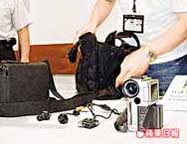
Daily) In Macau, a self-confessed voyeur was arrested for
using a pinhole videocamera hidden in a bag to take 'upskirt' photos of
pretty girls and then selling CD's of those films on a website registered in
eastern Europe. He was uncovered when the friend of one of the girls visited
the website and recognized the girl. His total sales revenue to date: 9 CDs at about HK$60
apiece. Crime does not pay.

- [053] The
Mysterious Workings of the Politburo Joseph Kahn writes in the New
York Times about the memorial rite to Hu Yaobang:
President Hu persisted in his decision about Hu Yaobang's birthday even though four of the nine members of the party Politburo's standing committee, the top ruling body, expressed concern that the move could threaten stability, said people who had been told about the debate.
The four, one of whom was Prime Minister Wen Jiabao, were said to have different reasons for their opposition. But all were said to have argued that the move could risk giving people the idea that the circumstances surrounding the 1989 demonstrations, which the party has condemned as an antigovernment plot, might be open for discussion.
Opposition to the commemoration was first reported earlier this month by Open, a political magazine based in Hong Kong, and was confirmed by people close to the late leader's family.
President Hu is said to have overruled the objections and ordered the commemoration to proceed, arguing that while students may have invoked the late Mr. Hu's name when their protests began, the former leader had no responsibility for the demonstrations.
True or not, here is what was reported in
Yazhou Zhoukan (November 20, 2005 issue) in a very different reporting style.
This alternative version is interesting because you can learn a lot about
management effectiveness by a careful reading.
When the subject was brought up at the
meeting of the Poliburo Standing Committee, Huang Ju, Li CHangchun and Luo
Gan brought up: "We can commemorate Hu Yaobang. What about June
4th then?" Wen Jiabao brought up: "What about Zhao
Ziyang?"
Hu Jintao said: "Let us not talk about
June 4th for the moment. Please give us your individual opinions on
Comrade Hu Yaobang first."
Huang Ju and others: "We did not have
dealings with Comrade Hu Yaogang. We have no opinion."
Hu Jintao said: "Since there are no
opinions, then we should do it." With respect to Wen's issue
about Zhao Ziyang, Hu Jintao said: "Comrade Hu Yaobang passed away 16
years ago. Zhao Ziyang just passed away. We can let it go for
now and talk about it later."
The nine members of the Poliburo Standing
Committee signed their names on the document to indicate their agreement
about the memorial rite.
Wasn't that deftly done by Hu Jintao?
He brought up the subject of Hu Yaobang and asked for opinion. People
mentioned June 4th and Zhao Ziyang. He refused to be sidetracked and
forced everyone to state their positions with respect to Hu Yaobang.
When no one had anything bad to say, it was a done deal by itself. Then
he looped back and deferred debate on the other issues. Very slick,
indeed. It should go right into the Harvard MBA management case studies.
I use "true or not" because the
proceedings would have to be leaked by one or more of the attendees or perhaps
a record-taker. These people are not known to be in the habit of leaking
information, and it would have to be really 'leaking state secrets.'
- [052] What
is the Internet Good for in China? Who am I to tell you?
But here is a translation at Tianya
Club:
There is a 'petition village' near South
Station in Beijing, and it is no secret. No matter what the reasons
why the people there want to seek justice via petitioning, there is no doubt
that they are the most socially vulnerable group. From the first day
that they decided to petition, they have lost their source of livelihood,
even their families, houses and all basic necessities. The implication
of petitioning is that they have lost all legal protection.
The winter in Beijing is bitterly cold, and
it is even colder for those people who have no suitable shelter, no adequate
source of warmth, no food and no basic medicine. I recall that the
temperature in Beijing reached record lows in 2003. When the first
winter snows came, seven corpses were found in this spontaneously formed
village. Those people did not obtain the justice that they hoped for,
and I don't know if they found peace in the other world.
Between the end of December in 2003 through
January of 2004, some ordinary netizens such as ourselves pleaded for help
from everybody to give those people some human warmth in the severely cold
season. The result was astonishing: netizens from around the country
sent through the mail: clothing, medicine and food and we had to get a
vehicle from a moving company to get everything down to the petition
village. On Lunar New Year's Eve, the Beijing netizens donated enough
materiel that it required two bread vans to cart everything away.
According to what I know, some petition village people relied on these
donations to survive that winter.
Winter will be arriving in Beijing
soon. Although the national government has tried to improve the
conditions for petitioning, there are still a lot of people staying
there. As individuals, we do not want to discuss the pros and cons of
the policies, and we do not want to discuss the reasons why people have to
petition. We only want to invoke the most basic humanitarian spirit to
ask our Internet friends: give them piece of clothing that you don't wear
anymore, give them a common medicine or food item, and let them feel some
warmth during this Beijing winter.
We know that we quarrel with each other
unceasingly on the Internet, but in our hearts we care about this
worlds. A friend said: act and bring about change. So be
it. At this moment, let us put aside our quarrels and clashes: act and
bring a little bit of change to his world.
[Details of donation follow]
This post appeared on November 13 11:16:00.
By November 15 23:56, it had been seen by 14,765 netizens with 551 comments.
- [051] How
The Hong Kong Press Reported On The Bird Flu In China In an
article titled Why Must Chinese Press Take a Detour for Virus Info?
in Caijing
via Danwei,
News about the virus often takes a detour to reach domestic audiences: it is first covered by foreign media, and then picked up by domestic press. Journalists sent to infected areas also say that local officials have not been cooperative
enough.
For example, the government briefed the OIE on October 24 about infections in Anhui and Hunan, yet the news first ran exclusively in the Farmers’ Daily, on pages 2 and 4, over the next two days. On the newspaper’s Web site, the items were not even posted. Only after the Foreign Ministry spokesman and the Hong Kong Special Administrative Region government Web site confirmed the infections, and foreign media had widely reported on them, did the official Xinhua News Agency get the word out on a broad scale domestically.
The mysterious death of a 12-year-old girl in Xiangtan, Hunan, also appeared first in the overseas press. Official domestic media did not run the news until after Beijing notified the WHO of her death, and sent a taskforce to Hunan to investigate. When other domestic press, including Caijing, sent journalists to Xiangtan, they met many obstacles in gaining access to the case.
So how did Ming
Pao come up with something like this on October 27: "An anonymous
Hunan province health official said that the girl and boy both tested negative
for the avian flu virus ..." What is so special about Ming Pao that
a health official would talk to them and not Chinese media?
The long translation of Chu Hoi-dick's Criticizing the Hong Kong Media
from InMediaHK offers a clever (but also pathetically sad) possibility about
Hong Kong reporters on the China beat:
There are several admirable China section
colleagues. There are only a few of them, and they have to gather
information from Hong Kong. So they have to resort to lying a lot of
times. They may call up a certain government office and speak with a
Beijing accent. When the other party asks who they are, they may claim
to be from Beijing Youth Daily, Guangzhou Daily or Southern Metropolis
Daily. Their fluent language can fool a lot of people. Sometimes a
major incident breaks out somewhere and they know enough to call up people
randomly in the vicinity for information. One time, a reporter was arrested by the
public security bureau, but he talked his way out with the director and they
even became friends.
That does not mean that the foreign media
always get it right. This methodology is premised on lying to get what
you want and you should not be surprised that people lie to you as a result
and you cannot verify what you were told. For example, the business about the pigs with avian
flu virus appears to have vanished, but it need not have occurred at all if
the transparency was there to begin with.
- [050] Between
East and West Justin Mitchell reported on the
EastSouthWestNorth blogger in Monday's The
Standard. Over the past 10 days, I have done print as well as
overseas electronic media interviews. These interviews are useful to
me personally, not in the sense of bringing in the money (note: the blog is
pointedly non-revenue generating and one never ever gets paid for those
media interviews). Rather, there are important
questions thrown at me that I have never thought about. Here I don't
mean the sudden question about freedom of the press in Hong Kong just after
the bomb went off at Ming Pao. It is not fair for me to discuss those
questions at the moment, as the media have the right to air them
first. Meanwhile, you can read Justin Mitchell's account.
The last section quotes me: "Maybe the time has come for Version 2.0 to go to Version
3.0. To find some like-minded people to do a group blog. For instance, I don't like global politics such as `Will China invade Taiwan in the next six months?' I don't have a clue.
But if I have a group blog someone else can do that. If it becomes big enough maybe it can make a real difference."
Is anybody out there? Do you have time on hand too?
- [049] Hong
Kong by the Numbers Chris Patten appeared on Hong Kong cable
television and commented on the 12/4 demonstration.
(SCMP) The strength of the case for universal suffrage in Hong Kong should not be judged by the turnout for next month's pro-democracy march, former governor Chris Patten said as he bade farewell to the city yesterday.
"Certainly it is very unlikely the turnout will be the same as for the marches over Article 23," Lord Patten said, referring to the shelved national security law.
Half a million people took to the streets in Hong Kong two years ago, forcing the government to drop the proposed legislation.
"[It will be] unwise, either for Beijing advisers to think that you can judge the case for democracy on numbers, or for those who actually organise the demonstration," he said.
(The
Standard) The democratic aspirations of Hong Kong should not be judged by the numbers who turn out at the planned December 4 rally, former governor Chris Patten has said.
While predicting that next month's rally is "very unlikely" to have a similar turnout as the historic July 1 protest where an estimated 500,000 took to the streets in 2003, Patten said in an interview with Cable TV Sunday it will be "unwise for Beijing advisers to think that you can judge the case of democracy on the number of supporters."
There are two things that the demonstration
organizers should do. One, do not set up a target to define
success/failure. Already the government has put up an estimate between
50,000 and 100,000. Do not take the bait. In a
previous comment, I argued for using public
opinion polls instead because it has the highest support level (consistently
around 60% for direct elections). The demonstration is just a reminder
of that level of support, not the quantitative proof.
Two, do not fool around with the number of
demonstrators as they did on July 1, 2004 and 2005 (see comment
again). If you fool around with the number again, the entire project
gets kidnapped and you have to fight the academic researchers and you will
lose once again.
- [048] Reconciling
the Statistics (Tai
Kung Pao) The subject is domestic violence.
- According to a survey of females at the emergency room of Kwun Tong United
Hospital, 10% of them said that they had been abused by their spouses during
the past year;
- According to the Social Welfare Department, there were 3,300 cases of
spousal abuses in Hong Kong last year.
- According to the Hong Kong Census, the number of currently married persons
in Hong Kong was 2.6 million in 2001.
There is no way that 2.6 million can be reconciled with 3,300 reported cases
to come to a 10% incidence, even assuming under-reporting and all
that. The problem with that 10% is that it is not a representative
sample -- it is a self-selected sample of females who show up at a hospital
emergency room to seek medical help. While that should be obvious, why
does the headline say "港一成女性被配偶虐待"
(translation: 10% of Hong Kong women abused by their spouses)? Let me
guess: because that headline attracts eyeballs?
- [047] Advertisement
for Ban on Minor Alcohol Drinking (6Park)
In conjunction with the new "Regulations to Control Alcohol
Distribution Laws" to prevent sales of alcoholic drinks to minors, the
following photographs of a 14-15 year old female student who drank 4-5
bottles of beer within an hour in Guangzhou were shown:

Let those who object to this law raise their hands ...
- [046] The
Jilin Explosions (Xinhuanet)
A witness said that a series of blasts took place at a workshop in No. 101 Chemical Plant under the Jilin Petroleum and Chemical Company from 2:00 p.m. to 3:00 p.m. Sunday. The blasts shatters window glasses of buildings 100 to 200 meters away from the plant.
More than 10,000 residents have evacuated for fear of further explosions and pollution by chemical
materials. Photos are from China
News:
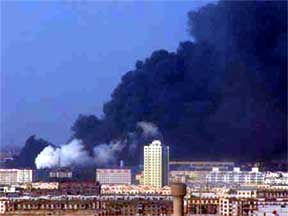
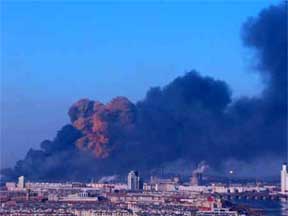
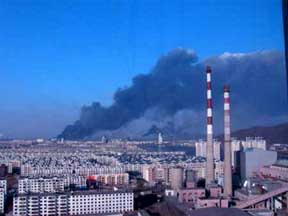
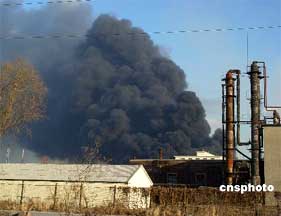
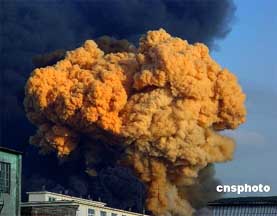
- [045] CCTV
Shuts Out Super Girls (Tinya
Club) It is well-known that CCTV is jealous of Hunan Satellite
Television's Super Girls. At the ceremony to introduce the five 2008
Beijing Olympics mascots, the show was broadcast by CCTV and the Super Girls
were invited to sing. So the audience switched on to CCTV 3, and watched
the mascots being presented. As they scanned for the Super Girls, they
suddenly heard Super Girl champion Li Yuchun's singing voice. Then
they saw the silhouettes of five girls, whom they imagined to be the five
Super Girls. Unfortunately, the audience got plenty of shots of the
dancers but never the singers themselves. But for the fact that the
singing of the Super Girls were so recognizable by now, no one would have
known that they were even present. Not a class act on the part of
CCTV! Here is the deadliest attack: "We are trying to build a
harmonious soceity. In terms of television programming, we do not want
CCTV and the local channels to exclude and reject each other. We want
a harmonious television platform."
What is this such an interesting question? Another Tinya
Club commentator thought that if CCTV can cut off the Super Girls,
then they can cut off anyone else in the future. Indeed, the next
question is: what has CCTV be doing during its entire history other than
deciding who to put on or cut out? And on what basis? And
this isn't even about CCTV, for the same applies to BBC, CBS, Fox News and
others which may have some other bases for their editorial decisions.
- [044] The
Tamiflu Panic Whereas the South China Morning Post calmly
pronounces the good news: "Alternative to Tamiflu ready, official claims,"
the local Chinese-language media are collectively going beserk over two cases
in Japan in which Tamiflu may have resulted in deaths. In one case,
17-year-old went onto the expressway and was killed by a truck; in the other
case, a 14-year-old jumped out of a 9th floor apartment. There were
also five cases in which young children died in their sleep.
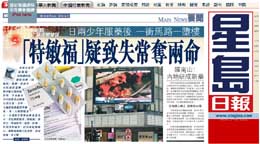

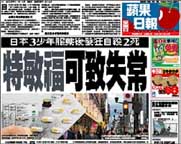


It is known that Tamiflu has some side-effects, just as many other kinds of
prescription and non-prescription drugs. The fact that these
newspapers collectively and independently decided that this report deserves
the front page is indicative less of the seriousness of the situation and
more of the importance of the fear factor in selling copies. But it
doesn't do anyone any good if everybody used the same story on the front
page. The real game is about who has the exclusive scare story of the
day.
- [043] Advertising
Ineffectiveness as Legal Defense (SCMP) In the case of
the two Internet Pimps in Hong
Kong who ran the website sex141.com to advertise prostitute service,
their lawyer claimed: "The success of the ads was not relevant to the
case. The defendants are just like newspaper or magazine proprietors - they frankly don't care about the effectiveness of the advertisements because they already have their money."
Ouch! Newspaper and magazine proprietors actually care a lot about the
effectiveness of the advertisements and they spend an immense amount of
money trying to establish the return on investment. At the Worldwide
Readership Research Symposium in Prague that I just went to, the cleanest
case study was a Norwegian mustard that had never been advertised in its
century-long history and therefore the growth in sales once it started to
advertise in newspapers can be attributed to advertising
effectiveness. In the case of sex141.com, all the prostitutes have to
do is ask their customers, "How did you find this place?" and then
they will know if they are getting their money's worth. You can't
usually do that with most other products or services. I believe that
the two defendants (and everybody else) must know that their ads are
effective, or else they would not have a business.
-
[042]
Not All Sperms Are Equal (Shenghuobao via Yahoo!
News) In the city of Harbin in China, a reporter received a
tip and found this ad posted on a lamppost: "Sperm for sale: Have you
ever been frustrated by not having children? Have you felt helpless
because you don't have a source of sperms? Our company can provide you
with excellent sperm to solve your problems and worries. We offer
sperm over the long term at great prices. Our company has twenty
strong and healthy men of different ages for you to choose from, including
university students, graduate students and married men who have had children
already. Our sperm sources are in excellent health and we have
certified physical exam reports. We guarantee quality and
quantity. If interested, please call Mr. Wang at 8969XXXX."
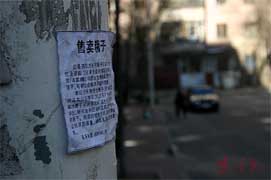
When the reporter contacted Mr. Wang, he found out that the rate card was
tiered:
- 400 yuan (three times): married men around the 30's with children
- 600 yuan (three times): university undergraduate students
- 800 yuan (three times): university graduate student (who is a relative of
Mr. Wang)
The rationale had to do with present physical condition as well as
intelligence which is inherited by the offspring. And you have just
seen what the valuation is in precise quantitavtive terms.
How will the sperm be delivered? Mr. Wang explained: "There is no
need to visit a hospital. You select the person that you want (note:
there is a photo album with the biographies) and you find a quiet place
where he can be alone to masturbate to get the sperm." When Mr.
Wang saw that the reporter was dubious, he said, "It is alright.
As long as the place is clean and the sperm donor sterilizes his hands
beforehand. We will provide the test tub. But you will have to
find your own hospital to conduct the artificial insemination."
According to the Heilongjiang Provincial Department of Health, all that is
illegal and unsafe.
- [041] How
Much Jail Space Is There For Hong Kong Men? This case in
Southern Metropolis Daily via Ming Pao (via Yahoo!
News) sets a precedent in which probably tens of thousands of Hong
Kong men may be jailed on the mainland for bigamy. In this case, the
man is a married 75-year-old Hong Kong resident named Wen. In June
1995, he got acquainted in Zhuhai with a minor (under 18) girl named
Li. Although Li knew that Wen was married, she agreed to move in with
him. On December 9, 1996, Li gave birth to a daughter. Early
2003, Li separated from Wen and received a signficant sum of money.
However, Wen's wife found out about what happened and filed a complaint with
the Zhuhai public security bureau. On August 18, 2005, Li was
arrested. On August 20, 2005, Wen surrendered himself to the police.
According to the court decision, Wen and Li had committed bigamy. In
consideration that Wen is elderly and requires medical treatment, on top of
the fact that he surrendered himself, the sentence was 6 months suspended
for one year.
In consideration that Li was a naïve 17-year-old when she moved in with
Wen, that she has to take care of her daughter and that she is currently
being treated for a tumor, the sentence was 1 year suspended for one year.
The bigger point about this case was that the legal wife of a Hong Kong man
or anyone else can complain to the mainland authorities about his bigamy.
But what happens when a man commits adultery (or bigamy) in Hong Kong?
Here is today's story from Sing
Pao: The 36-year-old wife of a 44-year-old named Wu announced
that she was traveling to the mainland. That night, the mistress of
the man came to sleep over. But the wife showed up early yesterday
morning and entered the apartment with her own keys. Upon seeing the
two naked persons in bed, the wife grabbed a kitchen knife, yanked up the
blankets and took a swipe at the husband's manhood. She missed and
only created a two-inch bloody gash on his inner thigh. Then the wife
turned her attention to the mistress and swung the knife at her head.
Again she missed and only caused a cut on the forehead. The wife then
fled. The two injured individuals were taken to the hospital for
treatment.

- [040] The
2008 Beijing Olympics Mascots
Via Apple
Daily, here are some choice Internet comments:
- "They chose five deformed babies. This must the reflecting the
facts of air pollution and genetic mutation!"
- "Ha ha, five mice creating chaos in Tokyo!" (playing on the
title of a popular novel)
but the meanest is this one: "It reminds me of the babies with bloated
heads because they had need fed useless baby formula made by immoral
business people in Fuyang, Anhui province."
Facetious remarks are made not only by Chinese netizens exercising their
freedom of speech. MSNBC.com
aiding and abetting Americans to exercise their freedom of speech with this
"not a scientific valid study."
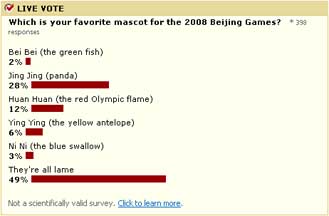
Indeed, lame is the word for these comments.
- [039] Traffic
Jams Are Good For Business In the print edition of Sing Tao
(11/11/2005), the China-column opinion writer wrote about his visit to
Beijing Radio. In 2001, the organization earned 180 million yuan in
advertising revenue; 239 million in 2002; 290 million in 2003; 380 million
in 2004; more than 400 million in 2005. Beijing Radio operates a
number of channels in the city. It turns out that the Beijing Traffic
Station accounts for half of the total advertising revenue.
The popularity of Beijing Traffic Station is due to a simple cause: the
world-renowned traffic jams of Beijing. Too many people are stuck in
traffic, or are afraid to be stuck in traffic, and therefore they listen to
Beijing Traffic Station for the latest advisories.
Where does Beijing Traffic Station get its information? This is an
expansive city with so many roads. There can only be that many remote
cameras installed at major intersections. Instead, the station has 500
traffic informants who report developments to the station and can also
respond instantaneously to queries from the station. Who are these
people? They are retired senior citziens who happened to be able to
watch the traffic conditions from their apartments. As 'traffic
informants', they receive a pay of 500 yuan per month. These are
highly motivated workers who believe that they are performing a public
service. In addition, Beijing Traffic Station also has a mobile squad
of several hundred volunteer taxi drivers.
- [038] The
Masturbation VCD Case See September Comment #117
and #119 for some of the sordid
history. (Apple
Daily) The prosecutor has wrapped up the investigation and
filed charges against four individuals, including the actress Lu Ching and
her gangster uncle, for defrauding Peng Chia-chia. It is believed that
Peng paid a total of NT$44 million to various individuals.
During the investigation, the prosecution searched Peng's home and found a
VHS tape and a VCD. What was on the tape? Here is the
description by an investigator: the tape begins with Lu Ching turning on the
pinhole camera hidden in a flower vase. The camera is aimed at the
sofa in the living room. Soon, Peng entered the apartment and sat down
on the sofa with Lu. Occasionally, the two made body contact, but they
did not appear to be very intimate. Peng had something to drink, along
with a white pill (alleged to be FM2). Then Peng got up and went to
the back of the room (set up with a Japanese tatami bed), took off his
clothes and began to masturbate. Lu did not run away, but just sat
aside and watched him. After about 30 minutes, Peng ejaculated on the
floor, used tissue paper to wipe the floor and then went back to chat with
Lu in the living room. Then Peng left and Lu turned off the
camera. The tape lasts about 3 hours.
For your edification, Apple Daily has provided an illustration.
You are warned that it is graphic in two meanings of the word.
- [037] Hong
Kong Poll Results (Ming
Pao) This is a poll of 822 individuals from the Institute of
Asia-Pacific Studies at the Chinese University of Hong Kong conducted
October 28-31. The subject is how Hong Kong citizens feel towards the
Chinese government.
- 48.5% said that they trust the Chinese central government; 5.4% don't
trust.
- 66.3% are satisfied with Chinese president Hu Jintao
- 73.5% are satisfied with Chinese premier Wen Jiabao
- 44.6% are satisfied with how the central government handled Hong Kong
affairs; 15.8% are dissatisfied
- 33.0% believe that One County Two Systems is being carried out; 22.1%
don't think so
- [035] 屈機
Alright, I admit that I find this term impossible to translate directly into
English. The word comes from this post by Sevenine at InMediaHK.
The post is about certain disturbing events at an elite secondary school in
Hong Kong.
For example, the prefects of the school exercise arbitrary powers over
fellow students. If a student breaks rules (such as not following the
school dress code to the letter), he may be punished by writing hundreds of
lines of "I will not do such-and-such again." There is no
appeal (even to the teachers), and the students are just cowed into
obedience to avoid more trouble.
And then the post cites the slogans that the school uses when they go into
competition: "XX (name of school) empire!" and "XX 屈機."
So what in the world is 屈機?
It turns out that there is no explanation in English! According to Wikipedia
(in Chinese), the term originated from the Hong Kong electronic game centers
in which some players deliberately exploit the flaws in the games (such as Street
Fighter) to
accomplish the goal (e.g. backing the opponent into a corner by repeatedly
using the same moves, so that the opponent is unable to respond to
attacks). Eventually, the term seeped into general Hong Kong culture
to refer to any method by which one exploits the flaws in the system to
accomplish one's goals. Of course, this is so Hong Kong! We
all believe in the rule of law, and if the law is flawed, I'll be damned if
I don't exploit it for maximum benefit! And it's all legal (that is,
in accordance with the law)!
- [034] The
Avian Flu Reports I was just asked this week whether
the whole avian flu thing has been overblown. I had to say that I
don't know. The danger to humans will come when the avian flu mutates
so that it can be transmitted among people. For a statistician, this
is a matter of chance with some small but greater than zero
probability. Who can say? Meanwhile, there is nothing to do but
watch developments carefully and look for the signs. My first
observation is that the attention is turned mostly to China, instead of
Indonesia or Vietnam where there are also some outbreaks. The concern
must surely be about the size of the country and the abysmal performance of
the government during the SARS outbreak. But what do we watch
for? The previous experience has cast some doubt on government
reports. So all I can do for you is to translate two newspaper
reports: The
Three Possible Avian Flu Cases in Hunan Province (China) and Culling
the Chickens of Heishan. These were filed by reporters who
wandered around two scenes, one is a suspected outbreak of avian flu with three
human cases of abnormal pneumonia (including one death) and the other is the culling
of poultry at a site where the H5N1 virus has been confirmed to be present. There
is little or no government official presence in these stories, except for the
part about the Heishan party secretary breaking into tears on the spot when he heard that H5N1 has been confirmed. Instead, these are
heartbreaking stories about how the grassroots are trying to cope.
Here is why I spend so much time on these translations: I don't care whether
the western world feel threatened about whether the Chinese outbreak might
spread outwards; I don't care whether the Chinese government loses face once
again; I am only hurt by the father in Xiangtan (Hunan) losing his
daughter or the people of Heishan county losing their entire economic
foundation.
- [033] Why
Blog? (Dongfang Morning News via MediaChina)
Here are some results of a survey of 2,020 Chinese bloggers; the sampling
methodology is unspecified, so please hold that grain of salt.
- 26.2% started between 6 months to one year ago; 34.6% started between 3
months to 6 months ago; 28.7% started within the last 3 months.
- 58.8% only only one blog; 41.2% own two or more blogs.
- 83.3% hope to increase their Internet fame by blogging
- 85.9% hope to gain economic benefits by blogging
The business model of blog service providers includes: subscription fees,
content publishing, advertising, moblog, enterprise applications, etc.
- 63.4% of bloggers are willing to pay the BSP for better service (note:
most BSPs provide free blogs at present)
- 72.7% accept the economic benefits from the blogs
- 37.1% are willing to accept commercial ads
- 32.8% are willing to accept public service ads
- 24.0% are willing to accept any ads from anyone
- Of those who are willing to accept ads, 61.9% are willing to
split the income with the BSP
- 6.1% refuse to accept any ads
- 30% said that their blogs have already brought them economic benefits
- [032] The
Art Thieves In a hotel in the city of Hankou (China), the
security guard in the lobby stepped out to drink some water. When he
returned, he was astonished to find that an 8' landscape painting on the
lobby wall had disappeared. A review of the surveillance videotape
showed the following, which took fewer than 5 minutes to accomplish.
The police are looking for the art thieves, who still have that painting
that is estimated to worth several tens of thousands of yuan.


- [031] Spinning
Polls This is usually my beat, but I was out of town today and SimonWorld
scooped it.
A poll has seen the Hong Kong public give Legco a "satisfaction" rating of 28%, as opposed to 23% dissatisfied with Legco. Chief Executive Donald Tsang's satisfaction rating is 58%. What headline would you come up with on those stats? The SCMP came up with this:
A record-high 1 in 4 happy with Legco
Completely factual, completely besides the point.
A record-high? The complete HKU-POP
survey results are here.
As noted by HKU-POP director Robert Chung, "People's satisfaction with Legco members in general has increased to a record high for this session, but at a much slower pace than that of the SAR government as a whole. The government led by Donald Tsang is now about 30 percentage points more popular than Legco members. Since the popularity base of the legislature is lagging far behind than that of the entire government, which comprises the executive, the legislature and judiciary, its ability to check and balance the executive arm may be handicapped."
But that page also contained the identical
results for the First and Second HKSAR Legislative Councils. In April
1999, the all-time-high "satisfaction" rating was 29.8%. From
July 1998 up to now, the HKSAR Legco has never achieved a
"satisfaction" rating better than 30%. Maybe an organization
that has never achieved a 30% rating from 1998 up to now should be scraped
altogether? Again, Robert Chung explains: "It should, however, be noted that the overall performance of Legco members includes those returned by geographical as well as functional constituencies, and it is not a direct measurement of individual Legco members' performance."
But then overall performance of the government includes the executive, the
legislature and judiciary too, including some current liabilities such as the
Environment and Food Bureau. Perhaps that is because the executive and
judiciary arms are cooperative, where the legislative arm is famously divided
and combative, and the difference in ratings is the inevitable outcome.
- [030] Red
Star MM Here is the latest Internet star in China, in the
footsteps of Tianxian MM
and Sister Hibiscus.
(Sichuan News Net via Yahoo!
News) A few days ago, someone posted a comment at the Hot
& Spicy Community area of the Sichuan News Net in praise of the
beautiful and dutiful traffic police woman working under the Red Star Bridge
in Chengdu. Within a few days, tens of thousands of people have read
the post of Red Star MM (红星妹妹).
The reporters smelled a story and converged to the scene. Citizens
even drove to to the location just to gawk at her. However, the
traffic department has so far turned down all requests for interviews with the
officer. Of course, that will only serve to increase the mystique of
Red Star MM.
Somewhere in there is the material for a thesis in sociology. It is
speculated that the appeal of Tianxian MM is the combination of beauty with
minority/poverty whereas the appeal of Red Star MM is the combination of beauty with
public service. So the trick is to link beauty to another concept that
the public has great empathy for. Great, you can now go and apply this
theory to explain Sister Hibiscus ...
- [029] More
TVBS Flap You will recall that Taiwan President Chen Shui-bian
had publicly promised that no TV channels shall be closed down during his
term. That was very reassuring. But today, the world found out
what he really meant. (Apple
Daily) Pasuya Yao, director-general of the Government information Office, said yesterday TVBS cable would be fined NT$1 million for failure to clarify its ownership.
TVBS has until December 20 to rectify its problems, or else more fines will
be imposed. Obviously, if TVBS goes bankrupt as a result of these
fines, then they are doing so by their own choice as opposed to be being
closed down by the government. Get it? Here is the Apple
Daily instant poll result:
The GIO has determined TVBS is 100% foreign capital, imposed NT$1 million in
fines and set a date for corrections, or else the license will be
removed. What do you think?
- 51.3%: Excessive
- 31.6%: Appropriate
- 17.1%: No opinon
- [028] It's
The Ratings Company's Fault I love this story because I have
been at the receiving end enough times already. (Taiwan Daily via Yahoo!
News) The subject of the story is Wang Beng-hu (汪笨湖),
a television host whose program The Voice of Taiwan will be
terminated. Wang's program began in November 2002 and became popular
because he was able to broadcast live on the scene for the 3/19 shooting
incident during the presidential election campaign. In that sense, his
support has always come from the pan-green camp. More recently, in the
aftermath of the KRTC Thai laborers scandal, Wang has turned his attention
to pursuing the truth in competition against TVBS and the one-per-day
exposés from certain legislators. As a result, the program ratings
have plummeted. As a result, his program is going to be terminated.
Who does Wang blame? It must be the television ratings company.
After all, the company is financed by Hong Kong capital and therefore it
overweights northern Taiwan compared to southern Taiwan, and this explains
why his ratings were plummeting.
Sorry, the reality is that the pan-green camp does not want to watch any
program (whether it is TVBS or Wang Beng-hu) following up on the KRTC
scandal. If Wang's core audience is the within the pan-green camp, it
is no wonder that his ratings should plummet. Wang really should have
realized who his audience is, and stuck to those issues that appealed to
them. This was an elementary error.
- [027] A
Fake Fake Chinese Blog (Xinwenchenbao via Ynet)
Bloggers are a dime a dozen these days. If you hit sina.com these
days, you will find any number of famous celebrities running their own
blogs. However, you may be stunned by the fact that the novelist Jia
Pingao (贾平凹)
runs a blog there too. After all, this man has proclaimed that he does
not know how to use a computer and has no intention of having a blog.
But if you read the said blog carefully, you will find a line of text:
"This is the blog that I run on behalf of Jia Pingao." Hmmm
... some netizens followed up some questions to the man and Jia Pingao has
come out and publicly stated that this was not his blog. But that did
not kill the blog.
Soon, that Sina.com blog came into another controversy. A netizen
alerted the blogger that many of the published essays violated the
copyrights of this netizen. So the blogger replied by proclaiming
innnocence: "Did I steal your stuff? I only re-published
them. I said so in the public notice at the bottom." Yeah,
like what is wrong with that? Especially when it is done under the
name of famous novelist Jia Pingao!
Blogs form an open platform where people can freely publish opinons and
exchange ideas. But who is going to ensure that this is an orderly
process? The writer Chen Cun believes that people who start blogs
under the names of celebrities are bad influences, and the victims ought to
prosecute them to the full extent of the law. Otherwise, this is
misleading the population of all netizens!
For further reading, I recommend the Gawker
post on the spoof blog for the New York Times political reporter Adam
Nagourney.
- [026] More
Textual Comparisons Musing Under the Tenement Palm steps up
once again to compare ESWN's The
Girl Who Sold Herself To Save Her Mother with China Daily's Girl sold herself for mom: Dilemma of Internet charity
(credited to Southern Metropolis Daily/zonaeu). The MUTP post is
titled: ESWN: Give Me an R-O-P-A! with
the conclusion: "Everything matches 100% except for a few specific paragraphs that were cut out, similar to a previous example. I thought the first time it was censorship, but on second glance I’m not so sure. This one I won’t say because I haven’t really read either. I’m too tired from all the cutting and pasting. Roland, please tell China Daily not to stretch your translations over 14 pages, will you?"
Let me put it this way: If I were running an advertising-supported website,
I would have chopped up my post into 14 pages! It would have meant 14
hits instead of 1!
- [024] Medium
vs. Message In a blog
post about DW BOB, Chinese blogger Anti referred to the Chinese
Blogger Conference held at the same time in Shanghai: 我觉得上海会议主要讨论的还是web 2.0的概念,更多的像一个IT人的聚会。在世界上普遍把博客当成新的媒体的时候,上海年会竟然缺乏媒体专家来讨论真正重要的趋势。难道中国真的分成了偏媒体的博客派和偏IT的网志派吗?
(Translation: I feel that the Shanghai meeting was mainly discussing about
the concept of Web 2.0, so this is more like a meeting of IT people.
At a time when the world is treating bloggers as the new media, the Shanghai
meeting is actually missing media specialists to discuss the significant
trends. Could China be really splitting into those who favor
media-like bloggers and those who favor IT-like blogs?)
As for me, let me state firmly that I fall on the content-side and not on
the technology-side. Once upon a time more than two decades ago, I was
the supreme technologist. I knew most of the programming languages:
IBM Assembly Language, FORTRAN, PL/I, Algol, Pascal, SNOBOL, LISP, C, C++,
and you name it. In time, I abandoned the technology as I focused on
'getting the job done' by whatever means and not by some fancy means.
Today, the EastSouthWestNorth is incredibly done with Microsoft FrontPage
98. My tradeoff is this: if I have one hour to spare, would I spend it
on building content or some tricky programming? I have made my
choice. All that other stuff is cute, but so what? I could do it
a lot better than you ever will, but why should I? That won't and
shouldn't be the reason that you come here for.
- [025] Speculations
on Ming Pao Reports That Triggered the Bomb Attack The letter
that accompanied the bomb stated that the letter writer was unhappy with something
that Ming Pao had done in October. What thing(s)?
Sing Pao
offered three candidates: (1) Retirement homes squeezed senior citizens dry
and then collected debts, pointint out that the government already pays HK$1
billion to let 20,000 senior citizens stay in private retirement homes, but
out of 26 investigated by Ming Pao, 7 violate government directions and
demand its residents to turn over their bank savings passbooks and sign
IOU's. (2) Hospital workers do not wash their hands after using the
bathroom, according to observations by Ming Pao reporters at Kwong Wah,
Prince of Wales and Eastern District hospitals, including the photo of a
police officer stationed at Kwong Wah. (3) The Department of Health
street cleaning teams had been sneaking time off on the job even though they
have been continuously criticised since 2001.
Apple
Daily listed the following that might have upset individuals: (1) On
October 9, a report on how a Department of Health street cleaning crew was
sneaking time off on the job; (2) On October 12, a report about how a
Shenzhen woman was assaulted by her Hong Kong live-in boyfriend; (3) On
October 14, a report of gangster students. All these reports included
blurred photographs of the principals. Also (4) A report on the blind spots of
mobile phone coverage along hiking trails. (5) Report on the new
Secretary of Justice. (6) The lack of caution at a Yuen Long chicken
farm.
The Hong Kong police have taken copies of every issue of Ming Pao during
October for further study.
- [023] The Ming Pao Mail Bomb (Ming
Pao, Ming Pao) At 2:50pm, a secretary in the editorial room of Ming Pao
newspaper opened a package addressed to the editor-in-chief along with a
threatening letter. The items had been hand-delivered by a man in his
50's, who was later identified as the delivery person for a flower
shop. Earlier, a middle-aged man of medium built, 5'8" in height
and wearing a motorcycle helmet had entered the flower shop, paid for the roses and
asked the shopowner to have the gift box and flowers delivered to Ming Pao.
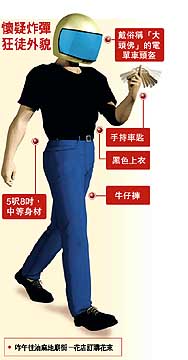
The letter stated that the writer was unhappy with
the "good things done in October" by Ming Pao and demanded Ming
Pao to donate HK$30 million to the Community Chest charity, or else Ming Pao
would be responsible for all consequences. The secretary paid the
letter no mind and opened the small box. There was a small explosion
with sparks, thick smoke and the smell of firepowder. The secretary
was burnt mildly on the chin and another secretary fell ill through
breathing in the smoke. Both have been sent to the hospital. The
police is investigating. Ming Pao condemned this violent incident, and
repeated that protecting the freedom of press is the duty and obligation of
all news workers and that they will never back down.
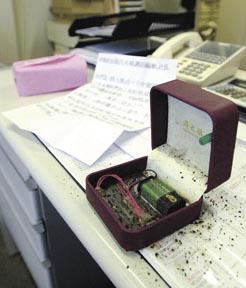
Here is the complete letter from Yahoo!
News: 姓金、張氏夫婦、總副編輯、社長﹕
你們這一群人渣,在十月中做的好事,不用多講你們也心知肚明,現送你們一份小禮物及給你三天時間,用明報之身份捐三千萬進公益金之戶口及在報張上刊登收據,你亦可當作一封開玩笑的信,但你記得所有後果及員工之安全由你這班人渣自負。三天﹗三千萬,請以後你們也不要做這些事情,否則下次罰得更加利害﹗ 好自為之。(in
translation: The Jin person, the Zhang couple, the deputy editor-in-chief
and the publisher: Your bunch of human waste have done 'good' things during
the month of October and I don't have to tell you because you know it.
I am sending you a small present for now. I am giving you three days'
time to donate HK$30 million in the name of Ming Pao into the account of
Community Chest and you need to publish the receipt in your newspaper.
You can treate this letter as a joke, but you must remember your bunch of
human waste will be responsible for all the consequences as well as the
safety of your workers. Three days! Thirty million. Please
don't do these things anymore, or else the penalty would be even more severe
next time! Behave yourself!)
Question: Was this an attempt to intimidate freedom of press in Hong
Kong? Well, my response was that Ming Pao would not have been the most
obvious target since it is centrist ... unless this is the start of a
campaign against many.
- [022] The
Pressure On Hong Kong Democrats With respect to the government
reform package, six democratic legislators would need to vote the package to
pass. Therefore, the pressure is on them from all sides. In the
last elections, I voted for Lau Chin-shek. The following are two stories about
what happened to him.
(Apple
Daily) At a meeting between the religious sector and the
pan-democratic camp, a retired Methodist elder declared that if Lau
Chin-shek supported the government proposal, he would kick him out and not
let him return. This elder seemed to be very worked up. If Lau
insisted on the package, he is going to disappoint his church.
(Ming Pao)
Yesterday, Lau Chin-shek went to his church to worship as usual. The
honored guest was Professor Leung Yin-shing, who spoke about his own
experiences helping the poor in mainland China. Leung then turned to
Lau and said that he supported Lau's efforts to communicate with the
mainland; he said that reconciliation and communication must begin first
before one can attempt to spur on the mainland to progress.
Afterwards, Lau reflected on the dais: "At this time, for something to
say this in support of me is like sending me charcoal when it is snowing
outside." Afterwards, the two hugged each other.
I sympathize with Lau. But I won't tell him what he must do -- I voted
for him not because he would represent all my preferences during this entire
term; rather, I voted
for him because I believe in his integrity over the years. I
will live with whichever way that he votes in this instance. [P.S.
There will be people who will write hate notes about me for saying
this. This is known as freedom of speech.]
- [021] Alternate
Form of Kidnapping for Ransom (Sing
Tao) At the Tseung Kwan O Chinese Eternal Cemetery in Hong
Kong, three ash urns and their tombstones were stolen with a note written in
simplified Chinese: (translation): "Will the family of the deceased
persons write HK$50,000 within three days to the Chinese Construction Bank
in Shenzhen for account number XXXXX. After I receive the money, I
will call my colleague to return the ash urns. Do not call the
police. You will not be able to catch me."
- [020] Yahoo!
Groups for Gangsters This is a sensationalistic report, and
yet it is a logical development. (Apple
Daily) A legislator has charged that Bamboo Union, Freemasons
and other gangs have established websites to introduce their histories and
regulations, and they have even set up Yahoo! Groups to recruit new
members. According to a member of the Tiandaomeng gang, they used to
hang around their headquarters on their turf and wait for action; these
days, the younger members tend to be Internet users, so it is easier to use
the Internet to communicate (about meetings, ceremonies and actions) and
recruit, while staying out of police surveillance. Here is an example
(in Chinese): 3821.com.tw (or
it could easily be a parody ...).
- [019] Original
Chinese Texts A large portion of this blog consists of
translations from Chinese into English, plus some commentary. I would
usually keep the link to the original source (e.g. Southern Metropolis
Daily, Tianya Club, etc). This meant that my increasing number of
readers in China can consult the original rather than my English
translations. However, it has come to my attention that I was
forgetting one critical difference. I happen to live in Hong Kong,
where I can access anything that I want (e.g. Boxun, New Century Media,
blogspot.com, typepad.com, etc), but the same cannot be said for those
readers in China. For example, a reader in China recently went to my
post How To Profit In China,
could not access the original article (in blogspot.com), but liked it enough
to translate the whole thing back from English into Chinese. This is
admirable but it breaks my heart to see him/her waste time in this
manner. Therefore, I promise hereafter to attach a copy of the
original Chinese text if I suspect that it may not be available in
China. For example, there is now a How
to Profit in China (in Chinese).
This is also an unanticipated development in the evolution of the ESWN
blog. I had construed ESWN v.2.0 to be a small window for the
English-only reading world to look into what the Chinese are really reading,
seeing and thinking without being filtered by western mainstream
media. As such, I supposed that it holds no interest for readers in
China. Already, they can read everything. Upon questioning some
of my correspondents from China, I now realize that I have been
mistaken. There are several reasons why they are interested in ESWN
v.2.0.
(1) In spite of my assumption that they can read everything that I
translate, they actually don't. I am lucky in that my present work
arrangements give me a great deal of free time to read broadly for many
hours a day. Thus, some readers in China appreciate my selection of
material which they don't always have the time to screen for themselves.
(2) It is also true that some of my selections come from Hong Kong and
Taiwan (e.g. Apple Daily, Next Magazine, etc) and cannot be accessed easily
inside China. So this is a window to see something that was recognized
as important but otherwise inaccessible, even if only in English.
(3) When Chinese blogger Anti announced Anti's
English blog, he wrote: 没有用英文表达的事情也许在世界上没有真实存在过
(translation: "Anything that has not been described in English has not
really existed in this world"). So at a minimum, what I have done
is to affirm that which I have translated had existed in that narrow sense,
to the point where I am willing to spend hours and hours of my life to
translate it for many more others to read.
ESWN is limited. It is only one person. There are thousands of
points of light in China, and ESWN can only cover so many (or so few).
Many more are needed. Where are you ...?
- [018] Chinese
Blogger Conference The inaugural Chinese
Blogger Conference is taking place in Shanghai. I am not
there, and I have not checked via webcast or IRC channel. What are
they talking about? Here is a photo that I saw at the 横戈
(Hengge) blog:
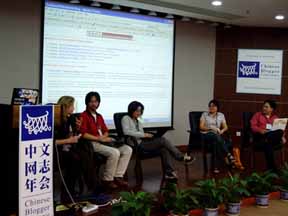
In this photo, I can recognize Rebecca MacKinnon and Lam Oiwan
(InMediaHK). Can I guess what they are talking about? This is a
snapshot, so lipreading is out of the question. Ah, I recognize what was being projected
onto the presentation screen: it is the home page of
the EastSouthWestNorth blog. No wonder my ears were itching ...
- [017] The
Price of Senegal Recently, Senegal re-established diplomatic
relations with China instead of Taiwan. The BBC
News report ends with this: Taiwan has suggested in the past that China has been offering millions of dollars worth of aid to
impoverished countries to make them switch allegiances to Beijing.
But the Taiwanese government itself has regularly used aid pledges as leverage to win diplomatic recognition.
So what was the price of Senegal? Under normal circumstances, the
amount of aid (or "bribe") would be top secret, otherwise there
would be an escalating bidding war. However, President Chen Shui-bian
has just told the world how much Senegal cost (see China
Times). During an election campaign trip, Chen revealed that
Taiwan had spent NT$5 billion on Senegal over the past ten years.
Officials from the Ministry of Foreign Affairs would not comment on that
revelation. This means that the members from the 25 countries which
still have diplomatic relations with the Republic of China (see wikipedia)
will be comparing their aid amounts against that figure and see if they were being
ripped off. The other implication is that the People's Republic of
China is now providing aid to Senegal in significantly larger amounts.
- [016] My
Most Viewed Post Ever Actually, it is nothing that my regular
visitors would have ever imagined, because those posts came into being long
before on another website before the concept "weblog" ever came into
existence. My most viewed 'blog post' ever was written in 1996 and it
has been able to generate several tens of thousands of page views
consistently over the years, but someday I will deal with it in much greater
detail. The subject here is another post that was written in 2000 and
has also been able to generate several tens of thousands of page views per
month: El Chapulín
Colorado, El Chavo & Chespirito.
This has come into view again right now on account of a Slate
article by Brendan I. Koerner:
The appeal of El Chavo del Ocho, the most popular sitcom in the history of Mexican television, might seem mystifying. The show, which first aired in the 1970s, follows the allegedly humorous exploits of a street urchin who lives inside a barrel, played by then-fortysomething comic Roberto Gómez Bolaños. His pals, including the spoiled Quico and the crafty La Chilindrina, are similarly played by adults, who shriek inane catchphrases while bouncing around a set befitting a community theater production of You're a Good Man, Charlie Brown. The gags usually involve someone getting bonked in the head with a hammer or brick.
But 27 years after the last of its 1,300 episodes taped, El Chavo is a cable hit in the United States. Currently airing on Univision-owned Galavision, it's consistently the No. 1-rated Spanish-language cable program, often taking eight of the top 10 Nielsen slots. And in one amazing quarter last year, 48 of the top 50 Spanish-language cable shows were El Chavo repeats. ¿Por qué?
Largely because the people who watch Spanish-language TV are often looking for a hit of nostalgia. According to a Pew Hispanic Center survey, about 75 percent of Hispanics in the United States are at least very proficient in English; for those born on American soil, the figure is over 90 percent. When watching English-language TV, these viewers favor shows like CSI, Desperate Housewives, and Lost—that is, the same fare as non-Hispanics.
So when they switch over to broadcast stations like Univision or Telemundo, or cable alternatives like Galavision, Hispanics crave the sort of programming they can't see on ABC or Fox—shows that provide a cultural fix, or at least a sweet reminder of bygone days. And that means lots of telenovelas, or melodramatic soap operas, and vintage Bolaños comedies like El Chavo and El Chapulín Colorado. (Bolaños' performance in the latter show inspired the Bumble Bee Man character on The Simpsons.) Television viewers generally look to cable for comfort programming—TNT's incessant Law & Order reruns always do well—but not nearly to the extent that Spanish-language viewers do; sports aside, the cable ratings are usually dominated by wrestling, Lifetime Original movies, and mature fare like Nip/Tuck.
But why El Chavo, rather than another 1970s sitcom? The show has the advantage of having been a hit throughout Latin America, not just in Mexico. About 60 percent of Hispanics in the United States are of Mexican descent; that means millions of viewers with roots in Puerto Rico, the Dominican Republic, Peru, or Colombia crave televised nostalgia, too. Fortunately for Galavision, 1970s households in Lima or Santo Domingo were likely to be tuned into El Chavo's first run. (Dubbed reruns of the show remain such a hit in Portuguese-speaking Brazil that when the network SBT threatened in June to quit airing them after 21 years, hundreds of fans marched in protest; SBT relented.)
Strong cross-generational appeal works in El Chavo's favor, too. Because it depicts the hijinks of child characters—albeit played by adults—the show does well among grade-schoolers; it is, in fact, the No. 1-rated Spanish-language show among American viewers ages 6 to 11. Their parents, meanwhile, have no qualms about plopping Junior in front of the television for back-to-back episodes from 6 p.m. to 7 p.m., familiar as they are with El Chavo's G-rated content. (At 7 p.m. sharp, however, the TV is likely switched over to Univision's flagship broadcast station, where telenovelas such as Inocente de ti dominate the prime-time Nielsens.
I am willing to bet that Brendan Koerner must
have come across my post in researching for that article.
- [015] Remarkable Writings for Popular Enjoyment It has been
said that the strength of a blog such as this one is the dogged
determination to follow through a specific event through collating multiple
sources written in Chinese. On the matter of TVBS in Taiwan, I admit defeat as far too
much is happening. On just today, the Taiwan media dumped dozens more
new leads, most of which were probably spin or outright lies. As
illustration, I will list some translated headlines from Yahoo! News and
Apple Daily for the day of November 5:
- CNA:
GIO MInister Pasuya Yao forgives senior citizen for threatening phone call
- CNA:
Former President's Secretary Chen Che-nan's nephew-in-law denies that he
is "Deep Throat" nor has he separated from his wife
- TVBS:
Who is "Deep Throat"? A gangster named Huang named four
people
- TVBS:
President complains that there are too many "Deep throats"
- ETToday:
Independent legislator communicates with "Deep throat" via code
and/or fax about KRTC scandal
- UDN:
Huang says "Deep throat" is a military school graduate and not a
gangster
- TVBS:
Individual named Liu denies having provided casino photo
- China
Times: DPP legislator said "Liu showed me the photo"
- ETToday:
Government audit department says NT$10 billion missing in KRTC
- ETToday:
Vice-President Annette Lu asks the corrupt people to turn themselves in so
as not to damage the Democratic Progressive Party and Taiwan
- FTV:
President: Unificationists and media combined to debase Taiwan
- FTV:
Chen Che-nan promises to mail his medals back to the President's Office
- UDN:
GIO Minister Pasuya Yao is certain that TVBS broke the law
- Taiwan
Daily: GIO Minister Pasuya Yao denies making call to ET Today
about coverage
- ETToday:
Shut up TVBS! Don't bring up freedom of speech every time!
- Apple
Daily: Chen Che-nan's assets grew by NT$10 million per year
- UDN:
What did Chen Che-nan do under the watch of Chen Shui-bian?
- UDN:
Chen Che-nan used the President's accountant to play the stock market
- Apple
Daily: Insider trading from the President's Office; accountant was
in tears when interrogated by the prosecutor
I hope that you see why I feel that I have
neither the need nor competence to wrap all these things up for you. Without
doing too much work, I will provide a couple of English-language links which I would call 奇文共賞
(translation: Remarkable writings for popular enjoyment).
- Editorial: Who has the guts to stay seated?
Taipei Times, November 3, 2005. Favorite quote: American civil-rights vanguard Rosa Parks, who passed away aged 92 last Monday, was the first woman to lie in honor in the US Capitol Rotunda -- a tribute formerly reserved for presidents, soldiers and prominent politicians. She was no shrewd legislator, charismatic politician nor an articulate talkshow host. She was but an ordinary woman who simply had the guts to say, "I'm tired of giving up my seat."
The majority of the Taiwanese public could learn from her example and end their mute reaction to pro-China media manipulation.
We need more people like Parks -- people who can dare to stand up and defend the dignity and pride of the Taiwanese and refuse to be bullied.
- Freedom of the press? Or to make lots of cash?
Taipei Times, November 5, 2005. Favorite quote: But is freedom of the press really under attack?
Before answering this, maybe we should ask what freedom of the press really is. Although countries around the world stress the importance of freedom of the press, no one -- including the International Press Organization and Reporters Without Borders -- has proposed a definition of "freedom of the press."
... As Taiwan has joined the WTO, the state should guarantee that domestic media outlets are not taken over by international forces to avoid losing a platform for expressing local public opinion and disseminating cultural values. At the same time, the state must finance research into the freedoms of speech and the press to let humanism replace raw capitalism and initiate the reconstruction of media order so that everyone can enjoy these rights.
These are examples of what you do if you were
ordered to make up reasons to squash the freedom of press.
- [014] A
Reporter Strikes Back The follow post has been circulated
around Chinese forums (e.g. Xici
Hutong). The author is supposed to be Hu Zhenjie, who has
published a book titled "Conscience and Truth: The True China in the
Eyes of a Reporter."
According to a certain bookstore manager
Guo in Zhengzhou, a shipment of 100 copies of "Conscience and
Truth" was received in early October. At first, only single
copies were sold. Then on October 18, a man who came by car showed up
and ask if the bookstore carries that title. Guo told the man to find
it on the shelf. But the man said, "I'm asking you how many
copies you have in total." Guo said, "83 copies."
The man bought the whole lot. Guo reflected upon this and thought is
strange enough to call up the author Hu Zhenjie. Hu said that he had
just heard that a bookstore in Sanmenxia had ordered 500 copies and after
selling more than 100 single copies, someone had gone there and purchased
all the remaining copies for unknown reasons.
Hu Zhenjie had reasoned the book collected
a number of major exposés in China (note: the list is omitted here) and a
number of important and influential people were named ... Hu Zhenjie said
that everyone who has any conscience or sense of justice should be able to
read the truth contained in the book.
At this point, a cynical person might decide
this was an author's (or his promotional specialist's) publicity stunt to get
people to rush out and buy any copies still left in the bookstores. Not
so easy, though, because the author encourages anyone (whether they want to
buy the book or not) to visit the website Zhenjie
to read the book for free. That is correct -- for free.
If true, then this is sweet revenge.
Someone has paid money to buy more copies than the book was probably expected
to sell (e.g. the 500 copies in the Sanmenxia bookstore would be a phenomenal
number). Meanwhile, more people will have read the book as a result of
the Internet publicity. In fact, this may be a new business model.
- [013] A
Hong Kong Poll About WTO From Ming
Pao, here are the results from a Synovate poll in August of 500 Hong
Kong citizens age 15-64 conducted by telephone.
Q: Do you know that there will be a WTO
conference in Hong Kong from December 13 to 18?
A: Yes: 70%; No: 30%
Q: Do you think Hong Kong is prepared to
deal with the anticipated demonstrations during the WTO conference period?
A: Yes: 78%; No: 22%
Q: Do you agree with the statement:
"Free trade benefits most countries and peoples in the long run"?
A: Agree a lot/Agree: 49%; No opinion: 36%; Disagree a lot/disagree: 15%
Q: Do you agree with the statement:
"Free trade causes rich countries to benefit but small and poor
countries become even poorer"?
A: Agree a lot: 16%; Agree: 20%: No opinion: 38%; Disagree: 19%; Disagree a
lot: 6%
The response to the second question has no
doubt been pumped by the endless pronouncements from the Hong Kong government
about preparedness. Of course, this is setting themselves up for a
potential big fall. If there were truly a large number of professional
demonstrators out there, they would have studied all those pronouncements and
do the unexpected.
The last question shows that the Hong Kong
government's WTO ads with the mobile
phones and oranges
may not have worked well. This assertion is unproven since the Synovate
survey is one moment in time. Had the same survey been done six months
ago, we would have been able to detect shifts.
- [012] How
Much Is 'Art' Worth? According to 6Park,
the oil painting of Chairman Mao Zedong inspecting a Guangdong peasant
village fetched 1.012 million RMB at an auction in Beijing. How much
would you offer for it?
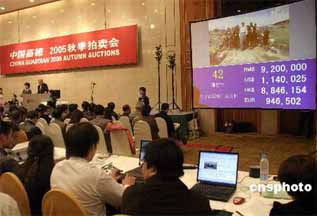
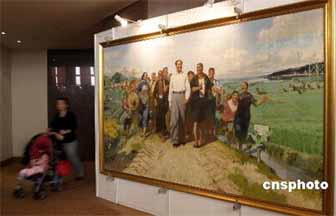
- [011] Strippers
or Singers? (Wenxue
City) The following four photos were taken during recent
concerts by Joey Yung, Jay Chou, Andy Hui and the Grasshoppers (草蜢).
Who are these people? Are they singers? Or strippers?




- [010] Yahoo!
in Taiwan According to Apple
Daily, in October, the police asked Yahoo! to provide the IP address
as well as the user information for the webmaster of a certain Yahoo!
group. The police then proceeded to make an arrest at the
location. The crime was for setting up a Yahoo! group with
pornographic photographs. There were almost 200 users registered in
that group.
However, this crime was unusual on account of the arrestee. When the
police went to the location, they found a male householder and two
elementary school children. The police interrogated the persons within
the household and was astonished to find that the culprit was not the
householder but his 11-year-old daughter who is still in fifth
grade.
The daughter was brought back to the police station for interrogation.
At first, she had no idea that she had broken any law. She told the
police that she set up the website in order to show off. Whereas her
classmates were still posting Hello Kitty pictures, she was running an adult
side and not childish like them. When the daughter found out that she
had broken the law, she began to shake and cry. She was then sent to
juvenile court.
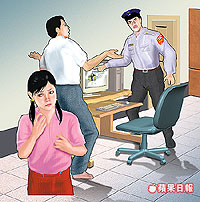
- [009] Headlines
for a Hong Kong Poll Here are the poll results as summarized
in The Standard:
The Chinese University poll, conducted by the institute between October 25 and last Friday, took in 1,006 people.
Of these, 69 percent wanted to see the introduction of universal suffrage
either in 2007/08 or 2012 while 65 percent said a timetable for universal
suffrage should be set now. Only 26 percent felt a timetable was not
necessary.
On the question of universal suffrage, 34.2 percent said it should be introduced in 2007/08 despite the decision of the National People's Congress Standing Committee to rule it out, while 34.8 percent said full democracy should be granted by 2012.
Only 18.1 percent of the respondents thought it should come after 2012 while just 6.1 percent said no timetable should be set.
On the government's reform package, 58.8 percent said yes and 23.6 percent said no. Of the yes votes, 32.8 percent said they accepted the package readily, 27.7 percent did so reluctantly and 36.8 percent said there was no other choice.
Wong said that of those who did not accept the package, 33.9 percent, or 8 percent of all respondents, said they will join the December 4 protest rally.
"According to our experience, that 8 percent could represent tens of thousands of people," he said.
Please note that there were in fact two major
questions within this poll -- one about the introduction of universal suffrage
(and the time table) and the other about the government's proposed reform
package. Now I will walk you through the headlines in the Hong Kong
newspapers. What headline would you have written?
Like many Chinese twenty-somethings, Lu Ruchao loves to surf the Internet. He often visits a local chat room to sample the neighborhood buzz. One day, Lu noticed that Netizens were complaining that local police often drove down the main street of Suquian with sirens blaring, disturbing half the city. Lu, himself a policeman, jumped into the e-fray. He tapped out a defense of the police, arguing that a cop car sounding its siren is responding to an emergency and shouldn't be criticized. But Lu isn't just any cop. He's one of China's estimated 30,000 to 40,000 e-police who collectively serve as an Orwellian Big Brother for the country's nearly 100 million Internet users. "We have to face knives and guns while on duty every day," Lu explained later to the Chinese publication Southern Weekend. "How can they criticize us?"
...
Southern Weekend reported Lu's story, saying the Jiangsu city of Suqian hired him and 25 other e-cops last April to form its "Internet commentator team." (The Southern Weekend later censored itself by removing the article from its Web site.)
Actually, you can find the full translation
of the Southern Weekend article here at ESWN
on May 21, 2005. This is very old news indeed. But anyway, that is
not the true issue of this post. What Lu Ruchao said about the police
sirens may actually be truthful as well as constructive. But this is not
what it is all about. There are other instances in which I would really
start worrying about Big Brother.
I will give you one instance in which a forum
commentator was surely an Internet police agent. This goes back to the
case of Lu Banglie and what happened to him in a certain village in Guangzhou
province. If you refer to The Chronology,
you can find the official statement of the Panyu district government circa
October 15:
On the morning of October 10, the [ Zhijiang City people's congress
standing committee] brought Lu
Banglie to the Zhijiang City People's Hospital for further examination while
asking the legal medical expert of the Zhijiang City Public Security Bureau to
be in attendance. After repeated examination, except for the legal
medical expert identifying the light scratches on his arm (believed to have
been caused during the pushing and shoving with the villagers when Lu insisted
on entering), Lu was deemed to be normal otherwise. Afterwards, Lu
Banglie signed his name on the town and city hospital examination
results. Therefore, the "bloody incident" in which Lu Banglie
was beaten or killed was fabricated.
So now I find an attack on Lu Banglie's
account at this forum
posting, and it is accompanied by this:
So what kind of Internet commentator has
access to a scanned copy of the medical examination record from the Zhijiang
City Public Security Bureau? Need we say more? More interestingly,
do you think that they win because they control all the information?
Well, actually, the more information that they provide to bolster the case,
the less capable they seem. Certainly, I don't see any space to which Lu
Banglie attached his signature in this document!
- [007] The
Girl Who Sold Her Mother to Save her Mother I have just posted
a full translation of a Southern Metropolis Daily article.
The most obvious question is how soon before it appears on China Daily? The second thing of note is that there was a translation of a
commentary about this case at Democrat Yang Zhizhu: A More Effective Donation System Needed
on Anti's English Blog.
The two articles should be read in parallel, as the newspaper report is
stronger on factual details whereas Yang Zhizhu is stronger on the
implications.
I want to take this opportunity to welcome the appearance of AEB; if we can get a few dozen more of similar
blogs, this may actually change international perceptions and relations.
- [006] Super
Girl Sings Zombie (Entertainment Tidbits via Wenxue
city) [Originally dictated in English; translated into
Chinese; back-translated here into English again]
Dear Chinese friends:
The Chinese are a great people. To my
mind, the Chinese are hardworking and wise; that is until I accidentally
came across what angered me the most since arriving here: in that Super Girl
program, a singer named Li Yuchun held the microphone and jumped around
singing the song Zombie with a big smile. I was stunned! Then I
got angry!
Li Yuchun covered this song. She used
a light beat to describe how the butchers massacred children and abused
their mothers. She used her bright voice to sing: "Another
mother's breakin'. (又一位母亲被强暴)
(translated into English as: Another mother's being raped)." Dear kind Chinese people, she was having
fun!!
This is an insult to the Irish. It
blasphemes music which is supposed to represent humanistic culture as well
as universal conscience and spirit.
A soulless woman brought us an increasingly
pointless visual display.
"Li Yuchun, you are making fun of the
pains of a people!! Do you realize the creative background and political
situation behind Zombie? If someone sings about the 9/18 incident or
the Nanjing massacre with a smile, how would a Chinese person feel??
This is an insult to an entire people!! The Irish people had lived
under the high pressures of war for the longest time with their lives always
at risk!"
As an Irish person who has lived in China
for a long time, I am deeply appalled by this type of ignorant
entertainment!
This item must be classified as 'suspect'
because of the phrase that was shown in translation above. According to
the lyrics of the song, the sentence is this:
Another mother's breakin',
Heart is taking over.
Thus, "breakin'" is an adjective
for the noun 'heart' referring to the broken-hearted mothers of the murdered
children. An Irish person should not have mistaken this to mean 'being
raped.'
- [005] October
Website Statistics. For the month of October, here are my combined
website statistics:
- Number of hits (including htm, pdf, jpg, gif, wmv, xml files) = 1,872,782
- Number of page views (htm files only) = 327,516
- Number of user sessions (IP numbers within 30 minutes) = 260,383
- Average time spent per user session = 9 minutes 13 seconds
- Bandwidth consumption = 30,413,156 kilobytes
Basically, these were about the same numbers as last month, but I had been
away for two weeks in October.
- [004] Snowly
of The World of Warcraft (Xinhua)
A young girl nicknamed "Snowly" died last month after playing the online game "World of Warcraft" for several continuous days during the national day holiday.
Several days before Snowly's death, the girl was said to be preparing for a relatively difficult part of the game
(namely, to kill the Black Dragon Prince) and had very little rest. She told her friends that she felt very tired. A big online funeral was held for Snowly one week after her
death (see photo from The
First).
- [003] Life
In The UK (Telegraph)
The 'Life in the UK' examination, which from tomorrow becomes compulsory for people applying for naturalisation, aims to give newcomers a taste of what it means to be British.
To become British, applicants will have to pay £34 to sit the 45-minute exam, which includes 24 multiple choice questions.
The exam-takers need to answer 75 per cent of the questions correctly to pass, but those not up to scratch on their Scouse accents and union rights can take the test as many times as they like until they pass.
Here are sample questions (see Times
for answers):
- Where are the Geordie, Cockney, and Scouse dialects spoken?
- What are MPs?
- What is the Church of England and who is its head?
- What is the Queen's official role and what ceremonial duties does she have?
- Do many children live in single parent families or step-families?
- Which two telephone numbers can be used to dial the emergency services?
112, 123, 555, 999.
- Which of these courts uses a jury system? Magistrates’ Court, Crown Court, Youth Court or County Court.
- Your employer can dismiss you for joining a trade union. True or false?
- Which of these statements is correct? A television licence is required for each television in a home
OR A single television licence covers all televisions in a home.
I am presently a dual citizen. In Hong Kong SAR, there is no
citizenship test. It would have been quite difficult too, given the
heterogeneity of the population there (e.g. English-only speakers,
Cantonese-only speakers, putonghua-only speakers, etc). What
will they ask? Where is the Hakka dialect spoken? What is the
name of your district councilor? How many families receive
social welfare aid in Hong Kong? What is the name of the Secretary of
Justice? Can you describe Article 45 of the Basic Law? This is
hopeless. Not even the Chief Executive knows the answers.
In the
United States, there is a citizenship test but it appears to be a lot easier than
the "Life in the UK" examination. When I took the US citizen test, I was asked to name the three branches of
the federal government and name the two Senators from New York State.
There was also an English-language examination. First, I was shown a hand-drawn
picture. The Immigration Officer pointed to one object and asked,
"What is this?" I said, "This is a house."
She pointed to another object and asked, "What is this?" I
said, "This is a man." Then she pointed to a third object
and asked, "What is this?" I said, "This is a
dog." Then came the writing test. She asked me, "What
do you do?" I said, "I am a statistician." She
then asked me to write down that sentence inside a box on the form. After all
this, she swept aside the paperwork and said, "I see that you are
sponsored by your sister and she is married to a Chinese person with an
unusual name that is the same as that of a famous watercolor painter.
Is she related to the painter?" I said, "Yes, as a matter of
fact, the painter is her father-in-law." And then the minutes
flew by as we chatted about watercolors, the Chinese experience in America,
etc.
America is an extraordinary country in which one can encounter surprises
everywhere. But the surprises are not always good. I watched the
movie Crash on the airplane from New York City to Hong Kong. I know that this is just a movie,
but those kinds of problems continue to exist without any obvious solution
in sight. I am immensely saddened.
- [002] Is
TVBS safe? That was purportedly a blanket statement from
President Chen Shui-bian that no TV station will be shuttered as long as he
is president. Do you believe him? First from Taiwan
Times: "No TV networks will be shut down, the president said in response to the latest developments in the TVBS controversy."
Shouldn't that be good enough? Read on:
President Chen Shui-bian yesterday said that all illegalities involving companies, such as unacceptable capital structures or activities to evade taxation, have to be investigated according to the law.
However, Chen said that the government has to follow the principle of proportionality, which is embedded in almost every legal system when taking disciplinary action against companies that commit unlawful actions.
"However, we have to be careful when considering closing a television network. During my presidency, I will never let it happen," Chen said.
He said the government would never close any TV station or newspaper, because Taiwan is a democratic country ruled by law.
The freedom of the press is especially important for Taiwan -- a country just transformed from an authoritarian system into a democratic one, he said.
"I urge all media agencies to disseminate information, in the form of either news or commentary, based on factual events," Chen said.
Are the people of Taiwan reassured? Did
they think that this is doubletalk? Apple
Daily interviewed 422 persons 20 years or older via computer-assisted
telephone dialing on November 1.
Q1: President Chen Shui-bian said that no
television station will be closed during his term. Is this statement
sincere with respect to protecting freedom of press?
- Yes: 30.8%
- No: 50.2%
- Don't know/no opinion: 19.0%
Q2: Do you believe that President Chen
Shui-bian's statement can calm down the controversy brought up by the debate over
TVBS's license?
- Yes: 28.0%
- No: 54.5%
- Don't know/no opinion: 17.5%
Meanwhile, here are the latest television
ratings from the night before.

(Apple
Daily) On one side, the program "2100 Speak To The
People" on TVBS achieved a 2.36 rating which projects to 504,700 viewers
on the average. Meanwhile, FTV's program "Challenging the Policies" featured Premier Frank Hsieh could only garner 36,400 viewers
on the average. That program on FTV is sponsored by the Democratic
Progressive Party with a budget of NT$1 million, of which NT$700,000 will be
paid by the DPP party central as well as donations from supporters and
NT$300,000 will be paid by Frank Hsieh himself.
(China
Times) In a poll of 511 persons 20 years or older, China Times
found that 42% opposed the GIO's actions against TVBS, 12% supported it and
35% had no opinion. By political affiliation, more than 80% of pan-blues
supported TVBS, 40% of the pan-greens supported the GIO. Among
independents, 40% supported TVBS and 10% supported the GIO. Do the
respondents trust the president's guarantee? 24% (3% definitely believe
and 21% believe) trusted the president, while 47% either did not believe or
definitely did not believe the president. Will this an impact on the
upcoming election? 51% said that it will have negative impact on the
pan-greens, 6% said
it will have positive impact, 13% said no impact and 30% had no opinion.
- [001] Taiwan
By The Numbers Here are three sets of numbers about the TVBS
flap (see October Comments #070
and #073).
(TVBS via Yahoo!
News) On October 31, a group of protestors gathered outside
the TVBS office building. This was an ad hoc group formed just last
week under the name of Taiwan People's Reading, Listening and Monitoring
Action Alliance. Their spokesperson said: "The spectre of China
is appearing in the streets of Taipei. The Five Star Flag should be
torn to shreds. We don't want a megaphone for China."
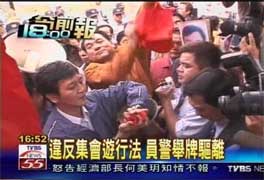
The numbers: the Alliance expected about 200 attendees, but got fewer than
20. However, there were more than 200 police officers and media
reporters present at the scene. The protestors asked the police,
"Shouldn't the media obey the law too?" In response, the
police said, "We only know that you are breaking the law by assembling
without a permit!" Then the police dispersed the demonstrators.
(Apple
Daily) According to a survey of 955 persons via computerized
telephone dial:
Q1. The Chen Shui-bian administration accuses TVBS of having problems
with its source of capital so that it have lose its licence. Do you
believe that this is intended to attack TVBS and freedom of press.
Yes: 69.5% (continued to Q2)
No: 21.1%
Don't know/no opinion: (9.3%)
Q2. If the Chen Shui-bian eliminates the license for TVBS, which would you
rather have: TVBS/freedom of press or the Chen Shui-bian administration?
TVBS: 95.6%
The Chen Shui-bian administration: 1.7%
Don't know/no opinion: 2.7%
(TVBS via Yahoo!
News) The cable/satellite television channel TVBS ran a
telephone call-in campaign to show support. Previously, on March 21
after the presidential vote, TVBS ran a telephone call-in campaign to ask
the question: "Did you feel that this election was fair?"
Between 3pm and 11pm, more than 170,000 calls were collected over 8
hours. This time, the call-in campaign ran from 9pm to 2am. Over
the course of the five hours, there were 278,869 calls from unique numbers,
and 369,680 calls including multiple calls from the same number.
Between 11pm to midnight, there were 1,870 calls per minutes. This
sets a historical high for all telephone call-in campaigns in
Taiwan.
- [Administrative Note] I am traveling
from New York City back to Hong Kong. In the meantime, let me
introduce you to some of the Chinese-language MSN SPACES blogs that link to ESWN:
I know that they are all in Chinese, but
sometimes you don't need to read Chinese to have fun. Take, for example,
this Anti
post: there are two photographs of the control room inside a North Korea
factory which was supposedly built with Chinese aid. What is wrong
here? For starters, why would you put an air-conditioning unit on the
floor inside the room? Why do people wear helmets inside the
control room? Would you configure your computer this way (e.g. the
keyboard is at arm's length; the CPU is all the way around on the other side
(so try inserting a CD!); why are there windows without shades to let the sun
rays heat up the equipment?)? And so on. (Postscript: I regret to
say that you can no longer find the Anti post because MSN Spaces had deleted
the entire blog at the request of the Chinese government)
Archives