[in translation]
On the pedestrian bridge outside the subway station in Yangjiaping (Chongqing), many citizens gathered to look at the "nail house." The worksite is surrounded by a bamboo fence, which has drawn a throng of spectators. They kindly made room for me near the gate and waved for me to approach. A young man even strip away a few of the bamboo sticks so that I can poke my camera in to take a better photograph.
From the outside, I can see that the home owner Yang Wu was hanging up a white banner that read: "The nation respects the people's rights." A young father by my side told the daughter in his arms: "Uncle Yang is very brave. Someday, if anyone wants to demolish my house, I will fight them to the death." There are several women who are holding stacks of documents and looking for reporters to plead their cases. It seemed that land requisition with low prices and forced evictions are rather commonplace, except the people had no place to release their emotions.
Yang Wu's wife Wu Ping appeared and this caused a stir in the crowd. The waiting media surrounded her to interview her. Due to communication problems with the worksite security guards, Wu Ping could not enter. The dissatisfied crowd began to push at the gate. Within thirty seconds, everybody entered into the worksite. The crowd was well-disciplined. As soon as the media went in, they withdrew back to outside the worksite and continued to watch.
The next day, I went to the worksite again. The bamboo gate has been replaced by a strong wooden gate with a blue warning sign "No trespassers allowed." The security guards stood in front of the gate and the atmosphere was tense. But as long as the reporters display their press cards, they were allowed to come and go freely. The land developer even arranged for representatives to be interviewed. They are trying to use public relations methods to balance the one-sided media coverage for the rights defenders.
During my three days covering the case of the nail house, I did not see the police intercede. Everything was left to the land developer. This is a degree of freedom rarely seen in reporting rights defense in China. By comparison, this was heaven-versus-earth compared to my coverage of land requisitions in Sanzhou village (Shunde city, Guangdong province) in November 2006. At the time, as soon as I entered the village in a rented car, I was followed an undercover police officer dressed as a motorcycle driver. As soon as I approached the scene of the incident, I was immediately taken to a hostel by undercover police officers for interrogation. I signed papers that I voluntarily turn over my materials and I let them erase the related photographs in my digital camera. Then I was escorted out.
The head of Taiwan's Examination Yuan has called on the United Nations to support Taiwan's bid to join the World Health Organization (WHO). Yao Chia-wen was speaking in Geneva at the fourth meeting of the UN Human Rights Council on Thursday. This is the first time a top-ranking Taiwanese official has been able to put Taiwan's case directly to a high-level UN meeting.
Taiwan has not been able to join the UN or the WHO due to pressure from China, which considers Taiwan part of its territory. Yao addressed the meeting as a representative of the non-governmental organization Liberal International.
Yao said that Taiwan's exclusion from the WHO could cause serious repercussions not only for the people of Taiwan but for the whole world. He also said that the people of Taiwan have shown their willingness when it comes to issues of public health. He gave as examples the SARS outbreak of 2003 and Taiwan's efforts in offering international humanitarian aid.
It is one thing to give a speech, but something happens afterwards. Here is Xinhua's report (via 6Park):
[in translation]
UN Human Rights Council president Luis Alfonso de Alba apologized to China about the appearance of Taiwan "officials" at the meeting and promised that similar mistakes will not occur again. He promised to delete all video recordings and minutes of the incident. He also promised that he will prevent Taiwan "officials" from getting meeting passes like they received this time via a technical error. ... Meanwhile the Chinese and Cuban representatives asked the UN headquarters in New York City to sanction Liberal International for violating the regulations.
[in translation]
There was a conflict between Renmin University School of International Studies professor Zhang Ming and Dean Li Jingzhi. This "very serious clash" occurred at a professorial review/evaluation meeting about Xiao Yanzhong. Zhang believed that Xiao "already had a great academic reputation in the 1980's and it was inexplicable for him not to have been promoted to professorship already." According to Zhang, Li tried to interrupt his speech twice and later located other people connected to Zhang to get them to "break relationships" with Zhang and thus force Zhang to quit out of humiliation. "Anger filled Zhang's heart," and he wrote about this and other doubts about the review/evaluation process on his blog. This caused quite a public stir. In Li Jingzhi's open letter to the faculty and students of the school, he wrote: "This is an internal affair of the school, and there was no need to go to the media to hype it up."
Here I don't want to discuss who is right or wrong. I just want to share my views about whether "internal affairs" ought to be discussed in the public.
I believe that if the internal office affairs are state secrets, business secrets or something involving the privacy of a citizen, then it should not be disclosed; in fact, it would be wrong to disclose them. But even if your unit involves state secrets or you are an organization that spends public funds, your ordinary internal affairs should be transparent because you should not have any internal affairs that the public cannot see.
For example, consider the "minor matters" that affect "the personal interests of a particular individual." The leader should deal with it in accordance with state law and policy or else he is violating discipline. If this individual cannot get justice, then it is his right to petition, complain and go to the media. Can you use the name of "internal affairs" to shut him up? Your internal affairs are the affairs of society, not affairs in a true vacuum. A fight between a married couple may be a family affair, but when it becomes criminal assault, it may show up in court with the media following up.
In the past (and including now), many people were taken advantage of by "internal affairs" and there was nothing that they can do (or they did not even think about what to do). For example, a friend of mine has written dozens of books and he has been writing a weekly feature article for his newspaper. The people at the newspaper say that it is hard to distinguish who is good or bad, because "anyone can look at a newspaper with a cup of tea and a cigarette for a long time" without ever being able to tell. So while my friend was respected greatly by his colleagues and readers, his job rating was always the lowest and his pay too. If he went to the media to complain, it would have been "hype" or even "malevolent hype"? According to the logic of "internal affairs," he is doomed to suffer forever.
Several years ago, it would be wrong to even think about publicizing "internal affairs." This was mainly because there was no "public notice bulletin board." Most workers can only let "anger filled their hearts" when they encounter unfair "internal affairs."
But things are different nowadays. For example, professor Zhang Ming published the unfair treatment of him in his blog. He may have accused XXX falsely, but XXX can refute him. If he maligned YYY, YYY can sue him in court. The heavens will not fall down on account of these actions. Actually, when many things show up in the public media, the truth becomes clearer; when something is debated publicly, the rights and wrongs become clearer. These are the benefits that the Internet bring to the citizens. Some people are scared of that, but more and more people welcome it. For example, there is now the group of "sun bathers 晒客" who publish the wages in various occupations and industries. This is known as "exposing the wages" under the sunshine. Someone showed that the retirement pay for professor-class workers was 800 RMB per month whereas that for retired janitors was 200 RMB per month. Shouldn't this vast wage gap draw public attention and give the "relevant departments" some enlightenment? Can you say that this is purely the "internal affairs" of certain companies or units? I am thinking that even the anti-corruption organizations may be able to get some valuable tips from this "internal affairs" information.
Education chief Arthur Li Kwok-cheung had warned the Hong Kong Institute of Education it would be "raped" if it refused to merge with the Chinese University of Hong Kong, the institute's president Paul Morris testified Thursday at a Commission of Inquiry probing alleged government meddling in the institute's affairs and academic freedom.Morris, the only witness to be questioned Thursday by his lawyer, Martin Lee Chu-ming SC, said he heard in 2003 that the institute would be "raped" from Simon Ip Sik-on, a former chairman of the institute's council, after Li had had lunch with Ip and two other senior institute officials on July 19, 2002.
According to Morris, Ip explained to him in 2003 what the secretary for education and manpower meant by his remarks. Morris said he understood the word "raped" meant the institute would be rendered "not viable."
As noted in Apple Daily, there were problems with how to cover the 'r'-word on television:
... yesterday it was revealed that Education and Manpower Bureau's King Arthur had threated to "rape" the Institute of Education. "Rape" means "the crime of forcing another person to submit to sex acts" and the dictionary specifies its pronounciation as /relp/. Cable TV reporter Ho Wing-hong was perfect in his pronunciation. However, not everybody was as good. On ATV, female reporter Vienna Cheuk reported that Arthur Li threatened to "rap" someone. While Li is known for doling out tongue-lashing, he is not known to have sung "rap" songs. Meanwhile, the TVB newscast completely avoided the 'r'-word and used the word 蹂躪 (='trample') instead.
According to CUHK Department of Translation director Gilbert Fong (方 梓 勳), it is wrong to pronounce 'rape' as 'rap.' However, the expert Koo Tak-king (古 德 明) said that the dictionary lists two pronunciations: /relp/ and /rep/. /rep/ is close to 'rap,' but very few people pronounce it this way.Did Arthur Li say that? Not according to evidence, which isn't even hearsay because there is no assertion that the word 'rape' came out of his mouth. So while this is a sensationalistic headline, should it be in there?
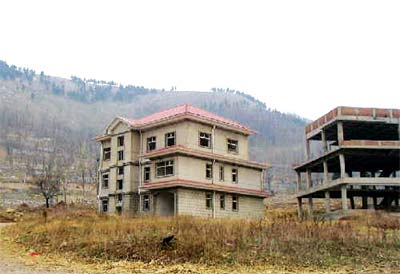
(Beijing News) 记者调查发现,半数以上毁林新建的别墅均有土地证。“绝大多数都有土地证!”铜山县林业局的苏局长称。他同时表示,该局始终没有审批一家。
[in translation] The reporter investigated and found out that more than half of the villas built after clearing forests owned land permit. "The majority of them have land permits!" said Tongshan county forestry department chief Su. At the same time, he said that the department had not reviewed or approved a single building.
(CCTV) 记者调查发现,半数以上毁林新建的别墅均有土地证。"75%都是徐州市级机关工作人员的,且绝大多数都有土地证!"铜山县林业局苏局长称,该局始终没有审批一家。
[in translation] The reporter investigated and found out that more than half of the vaillas built after clearning forests owned land permit. "75% of them belong to Xuzhou city-level government office officials, and the majority of them have land permits!" Tongshan county forestry department chief Su said that the department had not reviewed or approved a single building.
So Beijing News pleaded ignorance while CCTV had no fear about saying 75% of the villas belonged to city government offcials. The difference is that each media organization exercises its own editorial license in the name of social harmony.

... in recent years, I am beginning to believe that in the face of Beijing, the business community and the many conservative forces, it is a bad idea to use an oppositional approach to advance democracy in Hong Kong. Instead, I believe in 'engagement' (循循善誘). To put this in simple terms, Beijing is undoubtedly a non-democratic government, but it is not the tyrant that used to resort to armed suppression without notice. Instead, in order to join the new globalized society, it must lear to become "civilized." During that process, it definitely has doubts and misgivings. Therefore, the most significant meaning of this CE election is to give a rehearsal of a direct election, which make Beijing understand that the sky did not collapse and it was no big deal.
During this "quasi-direct-election," the pan-democratic camp did not propose Hong Kong independence or any such, and it did not bring up topics sensitive to Beijing. In fact, Alan Leong even characterized the central government as "pragmatic and rational" during the television debate.
As for the business community, they also saw that as long as there is the determination, willingness to learn and sufficient preparation, even a 60-year-old government official who has been working in an air-conditioned room for the last 40 years, can have a respectable performance on television debates and not be humiliated by the more articulate barrister. Thus, universal suffrage will not be won only by barristers and street warriors.
What are you afraid of then?
Therefore, I want to ask Beijing and the Hong Kong business community, what are afraid of about universal suffrage?
... The historical verdict may be: in the 2007 Chief Executive election, Donald Tsang took a half step forward. This half step might have been extremely awkward, but it was a half step forward and set an example for everyone around him. That is 'engagement.'
Whether Alan Leong got 132 votes or 123 votes, nobody will remember in a few weeks' time. History will only remember: in the spring of 2007, there were no personal attacks, there were no smearing and there was no incitment of class antagonisms and ethnic group contradictions. Alan Leong and Donald Tsang gave a warm-up/rehearsal for universal suffrage.
Sen. Ted Stevens (R-Alaska) said last year that his wife had been delayed repeatedly while airlines queried whether Catherine Stevens was the watch-listed Cat Stevens. The listing referred to the Britain-based pop singer who converted to Islam and changed his name to Yusuf Islam. The reason Islam is not allowed to fly to the United States is secret.
Anyway, this is a bizarre news story.

... What kind of medicine is so expensive (note: 22,538.21 RMB per dose)? It turns out to be an import drug and the recommended price is lower than the cost of the importer. The seller could not say what the actual cost charged by the manufaturer was ("Sorry, we did not have the data with us so we cannot tell"). Since this is the age of globalization, the sellers of Chinese medicine also tried the same. A certain pharmaceutical company had a Vitamin C-Yingqiao tablet which they asked for 99,999 RMB. However, the buyers' experts knocked the price back down to 0.053 RMB. Ha ha ha, it is easier to bully your own people, who are recommended to register overseas and then come back into China.
After reading this piece of sunshine news, my heart was clouded. Who is to blame for the sky-high price for medicine?
The pharmaceutical companies? But didn't a pharmaceutical company executive said that "medicine must not be sold like steamed buns" and "the prices are low enough, and there can be no lowering"?
The hospitals? But they complain that the government only covers 7% of public hospital expenses and the rest would have to be raised by themselves. What can they do?
The medical sales representatives? One medical sales representatives even exposed the situation (there is a certain medicine that the pharmaceutical company is charging 3.8 RMB but the hospital is selling it for 98 RMB. So it would see that these are the culprits? But the same whistleblower said: "I have figured out that the medicine goes through ten intermediaries before getting to the patient. Each of these intermediaries demand a cut." Who are these intermediaries? Who is charging money? I have once read a joke: At the big anti-corruption rally, the big corrupt ones were delivering the report, the medium corruption ones were listening to the report and the small corruption ones were the defendants (反腐败大会上,大腐败作报告,中腐败听报告,小腐败当被告). It fits this situation to a tee.
A while ago, I was feeling very listless and unenergetic, so I went to the hospital. The doctor quickly scribbed a medical scrip for me which cost more than 300 RMB. The doctor instructed me: "You must take this medicine every hour during the day. Each time, you take three pills. There is enough medicine for two weeks. You must remember to drink a lot of water when you take the pills. Frankly, I have never heard of this regime. So I asked: "Doctor, why is my illness? What is this medicine for?" The doctor told me quite honestly: "Actually, the medicine does not do anything. Right now, what you need most is to drink a lot of water." Bwwwwaaaaa
Chen Litian is the deputy mayor of Jiang County. Last year, more than 100 migrant laborers came to demand their 130,000 RMB back wages. The laborers tried all the legal methods, including going to the Labor Mediation Committee but they got nothing. None of the relevant Jiang county departments paid any attention to them. So the laborers were forced to go to the Yuncheng city party committee to present their problem. They probably received some attention, because the Jiang county government dispatched deputy mayor Chen Litian to Yuncheng to meet with the laborers. After negotiations, Chen Litian turned over a signed document to the laborers to guarantee that the problem will be resolved within three days (beginning tomorrow), or else the county treasury will foot the bill. But when the laborers got back to Jiang county, the promise of the deputy mayor was not kept.
Well, this is a common enough story and there is nothing new except that Chen Litian told the reporters that his only objective on this trip to Yuncheng was to get the laborers to return to Jiang county. Besides, how can anyone take a promise seriously? (March 14, Shanxi Evening News) Right, how can anyone take it seriously? Chen Litian deceived people and then he blamed his victims for being gullible. That is enough to make you sick inside.
In the March 14 report in Shanxi Evening News, the closing sentence was: During the interview with our reporter, Chen Litian said, How can a promise be taken seriously? (陈力田在接受记者采访时说,写承诺的事怎么能当真?). This story was carried by other newspapers across China and made Chen Litian a target of criticisms.
yWeekend has followed through with an interview of Chen Litian as well as the Shanxi Evening News reporter.
On March 16, Chen Litian told the yWeekend reporter: "No. I definitely did not say that a promise cannot be taken seriously." According to his recollection, at around noon on March 8, he was meeting with the procuratorate director when Shanxi Evening News reporter Hu Zengchun knocked on the door to enter. Hu place a tape record on Chen's desk and produced a press card. Chen then demanded to see the letter of introduction. When Hu showed him a letter, Chen did not think that it qualified. Chen asked Hu: "What is your matter?" Hu produced a piece of paper and put it in front of Chen: "Did you write this?" Chen recognized this to be a photocopy of the letter that he wrote on January 10, 2006 to promise the migrant laborers that the problem "will be solved in three days, or else the treasury will advance the paypment." Chen said: "Yes. What about it?" "How were you going to deal with it?" asked Hu. "In accordance with the law," said Chen. The conversation lasted for more than 20 minutes and Chen said that he never said anything like "how can a promise be taken seriously?"
On March 20, the yWeekend reporter made contact with reporter Hu Zengchun of Shanxi Evening News. Hu said that he was busy but he would ask a colleague who was also at that interview to review the tape. Half an hour later, the colleague called back and confirmed that Chen Litian did not say that. Later on, Hu explained that their original report did not contain a direct quotation. Instead, Chen Litian was explaining to Hu that this matter cannot be solved on his personal say-so alone. Accordingly, Hu Zengchun wrote that Chen implied that the promise cannot be taken seriously.
Later on, the yWeekend reporter use Baidu to search for this story. On March 14, Beijing News had a report titled: <<The deputy county mayor reneged on his promise to pay back wages while saying 'how can it be taken seriously?'>>. The report identified the source to be Shanxi Evening News and then quotation marks were placed around "How can a promise be taken seriously?" to make it an actual quotation from Chen Litian.
The yWeekend reporter contacted the Beijing News editor, who said that he found the original Shanxi Evening News article and another Shanxi report from NetEase/Sohu. Due to the deadline, he used mainly the other newspaper's report, which has the double quotation marks. The Beijing News editor does not remember the name of the other Shanxi newspaper.
Chen Litian intends to sue Hu Zhengchen of Shanxi Evening News. "I'll definitely sue him. How can he write it that way? All the negative things about me on the websites were caused by his report. Therefore, I want to hold him responsible."
By the way, Chen Litian met the migrant laborers in January 10, 2006 and the case foundered in the court system. On March 14, the report on <The Deputy County Mayor's Promise Was Not Kept> appeared in Shanxi Evening News. The next day, the county made the decision to pay the migrant laborers out of the treasury first (80,124.99 RMB was allocated and almost 70,000 RMB has already been paid out while some remaining laborers have to be located).
When asked why he seldom gets interviewed by Hong Kong media, JImmy Lai said: "First, many Hong Kong media will not interview me. Second, I feel that since I am a media person, I should not get too much exposure. But the lack of exposure over the long-term meant that the sense of mystery becomes misunderstood. When the media person has a bad image, the entire organizatiom suffers. Therefore, I have decided to show up more often so that the public can see me more often. They can judge for themselves. I won't hide and let people trash me."
...
EasyFinder is a relatively sensitive issue for Next Media. A netizen asked Jimmy Lai, who is a Catholic, why he wanted to run a magazine like EasyFinder? The netizen suggested that EasyFinder's problem is with the management and wondered if Jimmy Lai realizes that. Another netizen said that Next Media has few ads and are often sued, so did Jimmy Lai consider replacing the management completely, or even transform his entire media empire. Jimmy Lai said: "Even Catholics have to do conduct business! When an organization publishes different publications, mistakes will happen. They are already changing and the readers should be able to see it. No matter what occurred in the pst, the important thing is what you do in the future. We accept responsibilty for what we did previously. The readers should see what we are doing now." "Actually, there is has been some changes in the management of EasyFinder. I know that. I spent quite a bit of time on EasyFinder." "The media cannot avoid offending people. Ultimately, bad news is good news. It is impossible for us not to expose the scandals for some people! Some people feel that it is bad news, but we have to report it. We put it on the front page and we make a big deal out of the story. So we offend people. I realize that. But we should avoid overblowing something, we should act responsibly and we should treat it in a nice way."
...
Next Weekly and Apple Daily became phenomena in Hong Kong media, and Next Media's impact in Taiwan is possibly even greater. This time, Jimmy Lai wants to get into Internet media. His opponents are not the old media which have not moved forward in decades, but they are the thousands of creative netizens. Why is Jimmy Lai up to? Faced with so many competitiors, what is Apple Daily's most distinguished mark?
"The distinguished mark of Apple Daily is that it is constantly evolving. Society is progressing rapidly through information transmission. Everybody's way of enjoying information is constantly changing. Therefore, a newspaper may keep up with this change. We the media must be the ones who change the fastest."
But when netizens asked Jimmy Lai whether he helt that his media company is not forward-looking and somewhat tired-looking, the answer was unreservedly "Yes." BHe felt that the newspaper should work hard to cope with the impact from the Internet. "I think that the impact is causing us a lot of worries and damge, but these worries and damages are opportunities for us to re-invigorate ourselves."
When asked about how he intends to use the Internet to improve the competitiveness of Next Media, he said that there are definitely many things to do and the company is thinking about working with Internet media and use new media more. Thus, this particular netchat with the readers is one such new experiement. The newspaper will have more conatct with the Internet. This is an experiment. The Internet has a great deal of impact on society and readers, and so the newspaper ought to evolve in that direction. If we do not put the relevant information into the newspaper, it will hard for us to know how to evolve. I believe that this change will have ingredients of the Internet, because the influence of hte Internet is getting bigger and bigger.
YouTube videos:
黎智英 網上訪問 07-03-21 part1
黎智英 網上訪問 07-03-21 part2
黎智英 網上訪問 07-03-21 part3
黎智英 網上訪問 07-03-21 part4
Another question in the latest poll is when should universal suffrage for the Chief Executive be implemented: 58% said 2012, 13% in 2017, 11% in 2022 and 5% said that there should not be universal suffrage.
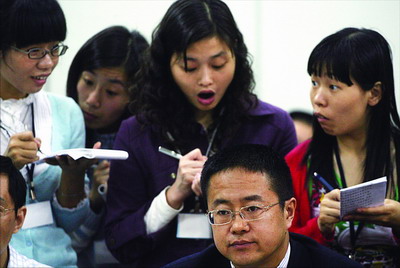
[in translation]
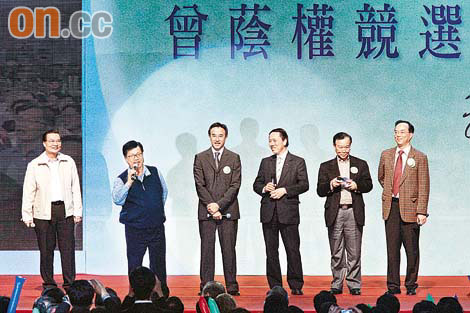
There are no permanent friends or enemies in politics! This is an eternally constant rule, which showed itself last night at the rally for the re-election of Donald Tsang. It is an open secret that the traditional lefties do not like Bowtie Tsang and often file complaints to Beijing. But for the sake of political interests, the pro-China political groups shouted their voices hoarse as cheerleaders for Tsang and praised him for becoming "much more friendly." Their show was even better than the one given by movie star Stephen Chow at the rally last night.
As Bowtie is about to be re-elected, the pro-China political groups realize their future political spoils will depend on their performance last night. So on this final show, they all did their very best. This is the one performance that will determine whether they get to eat rice or congee next.
The six pro-China political groups not only supported Tsang by showing up in large numbers. The leftie leaders also did their very best. Federation of Trade Union president Cheng Yiu-tong led off to say that Bowtie has become more approachable; he used to be stubborn, but now he cares about labor workers and listens to public opinion. He praised Bowtie to the heavens, and he even figured out a job for Bowtie's wife -- she could make some soup for her husband to relieve the job pressure. This repulsive monologue was enough to make many attendees break out in goose pimples. No wonder some of the attendees said that they saw Bowtie moved to tears at Brother Tong's words. In show business, this is known as mutual acting support.
DAB vice-chairman Tam Yiu-chung observed that Brother Tong had gone for broke so he did not dare to slack up. He praised that Bowtie shares the same goals with the DAB, and that is to build an even more prosperous Hong Kong and an even more harmonious society.
The Alliance's Ho Chong-tai saw that Brother Tang and Tam Sir has used up all the goose-pimple-making words of praise, so he used his quick wit to coin a new (and difficult enough to make one puke) descriptive term for Bowtie -- he said that Bowtie had both "talent and morality才德兼備."
It was only Liberal Party's James Tien (who had gotten into a habit of clashing with Bowtie) who was more direct without using those four-word terms of praise. He said that he realized the Liberal party disagrees with the SAR government on certain issues. However, Bowtie's policy platform was better than Alan Leong's and that is they are supporting Bowtie. The FTU, DAB and the Alliance were all shining Bowtie's shoes, but James Tien was stingy with his shoe polish. He had better expect that when Bowtie starts appointing Executive Council members, Secretaries, deputy Secretaries, assistants to secretaries and the chairman of the Tourism Board, the Liberal Party may get fewer posts.
In which newspaper was this review published? Not in Apple Daily. The newspaper's website is listed in the top-left corner of the photograph.
[in translation]
From the record of the live press conference given by Chinese Premier Wen Jiabao, 162 words concerning democracy were censored. This showed that Hu-Wen do not have totally control of the propaganda department.
It is common for Chinese and overseas media to encounter censorship by having essays or sections being censored. But if the state leader of China gets censored, then this is big deal. A few days ago, a global television audience saw Premier Wen Jiabao held a press conference at the end of the National People's Congress and they were impressed by his frankness and sincerity. His words were printed in black-and-white everywhere, but they could not escape review and excision by the Chinese Communists' publicity department. A total of 162 words related to democracy were deleted.
... According to the recording of the Premier's press conference, the reporter from France's Le Monde asked Wen Jiabao:
﹕“最近您在《人民日報》發表了一篇文章﹐我想引述其中的一些話﹐您提到社會主義制度和社會主義民主並不是相互排斥的﹐您同時還說社會主義的初級階段還要建設一百年。請問您是否意味著說中國在未來的一百年都不需要民主﹖另外﹐談到民主﹐我還想問一個問題﹐是有關最近中國的前總理和共產黨總書記趙紫陽在香港出版了一本書﹐他在書中提到﹐中國如果要實現現代化﹐就需要像東邊的臺灣那樣實現民主的政策﹐過去臺灣也是處于獨裁的統治下﹐現在實現了民主和多黨制﹐您對這位前總書記的話有何評論﹖”
Recently, you published an essay in People's Daily. I would like to quote some words from it. You said that the socialist system is not mutually exclusive with socialist democracy. At the same time, you said that it will take another 100 years to complete the first phase of socialism. I ask you whether you imply that China will not need democracy for the next 100 years? Also, when it comes to democracy, I would like to ask another question. This is about former Premier and Communist Party Secretary-General Zhao Ziyang publishing a book in Hong Kong. In the book, he mentioned that if China wants to modernize, then they must implement democracy as in Eastern Europe and Taiwan. Taiwan used to be under a dictatorship but it has realized democracy and a multi-party system. Do you have any comments on what the former Secretary-General said?"
In his response, Wen Jiabao re-emphasized that his People's Daily essay mentioned that democracy, legal system, freedom, human rights, equality and fraternity are universal values that mankind pursues. When it comes to "socialist democracy" needing "to guarantee democratic election by the people, democratic policy making, democratic governance and the right to democratic monitoring," he said that "it is necessary to create a set of conditions to let the people supervise and criticize the government" "in an equal, fair and free environment so that every individual can develop fully; that is, to realize their creative spirit and independent thinking. Concerning the Zhao Ziyang book, he said: "Concerning the book published in Hong Kong and the points that I have discussed, I don't see any connection. I have not read the book."
The book that the French reporter referred to was "The Sayings of Zhao Ziyang under House Arrest." But Zhao Ziyang did not publish it. It was his old friend Zhong Fengming who recorded and edited it and then got it published in Hong Kong. Wen Jiabao has been involved in politics for decades and he obviously understood the significance of the question. He wanted to speak out, but he held back. But this unsubstantial conversation (including the last part of the question from the Le Monde reporter) was reviewed by the Publicity Department of Li Changchun and disappeared from the official print and televised versions, as if nothing ever happened.
Thou hast committed --Fornication: but that was in another country,And besides, the wench is dead.(The Jew of Malta, Christopher Marlowe)(Wenwei Po via ChineseNewsNet) In the list of corrupt government officials, National Bureau of Statistics director Qiu Xiaohua was the first provincial-level official to be charge with bigamy ... According to Wenwei Po, Qiu Xiaohua seriously violated three areas. First, Qiu Xiaohua received a total of 220,000 RMB in gifts since 2003; secondly, Qiu Xiaohua was suspected of polygamy; thirdly, Qiu Xiaohua committed adultery with multiple females, including some who reside outside of mainland China.
... According to article 258 of the Criminal Law Code, "anyone who gets married to someone else while still married can be subjected to two years or less in imprisonment."
Explanation: Why was the Chrisotpher Marlowe play invoked here? Once upon a time, the ESWN blogger was forced to study T.S. Eliot's poems as an Australian high schooler. As such, he had to reseach the Marlowe epigraph. In this instance, there is no further meaning beyond the fact that this evoked certain ancient memories ...
(World Politics Watch) Universal Suffrage Headlines Hong Kong Elections. By Luke Hunt. March 22, 2007.
Hong Kong 's elections are shaping up with all the pomp and ceremony of a Canto-pop star singing numbers from a Looney Tunes cartoon. And the result is about as forgone as Bugs Bunny surviving a bullet from Elmer Fudd. ...
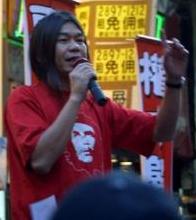
... Long Hair [Leung Kwok-hung], a working class Marxist who likens himself to South American revolutionary Che Guevara, is often dragged kicking and screaming by police from street protests and has been jailed four times.
A few years ago he was dismissed as an unimportant clown who protested for the sake of protesting, but in the lead-up to the current poll he is increasingly being seen as the point man for the growing frustrations of those wanting to elect their own leader....
Photo: Legislator Leung Kwok-hung, known as "Longhair" because of his waist-length tresses, has stunned the Hong Kong political establishment with his popularity and demands for universal suffrage. By Luke Hunt.(Hong Kong Research Association) (Survey of 1,386 Hong Kong citizens on March 14-20 with respect to their ratings (1-6 scale) of the 30 directly elected Legistive Council representatives)
#1. Rita Fan: 3.93 points
#2. Audrey Eu: 3.47 points
...
#28. Albert Cheng: 2.51 points
#29. Lee Kwok-ying: 2.46 points
#30. Leung Kwok-hung: 2.39 points ["stunned the Hong Kong political establishment with his popularity ..."](HKU POP) (Survey of 1,020 persons on January 22-26, 2007 about their ratings of the top ten (based upon unprompted mentions by respondents) Legislative Councilors to get their ratings (0-100))
#1. Rita Fan (63.8%)
#2. Audrey Eu (59.0%)
#3. Selina Chow (57.2%)
#4. James Tien (54.3%)
#5. Albert Ho (52.7%)
#6. Lee Cheuk-yan (51.1%)
#7. Jasper Tsang (50.9%)
#8. Martin Lee (48.6%)
#9. Emily Lau (48.1%)
#10. Leung Kwok-hung (34.0%)
... those who know the process by which Hong Kong was returned to China know that the Communist Chinese leadership ultimately decided to adopt the principles of "one country, two systems," "Hong Kong people rule Hong Kong" and "a high degree of automony" in order to solve the problems of the return of Hong Kong and the governance thereafter, as well as to use the successful implementation of "one country, two system" and the ensuing prosperity, stability and greatness of Hong Kong in politics, economy and society as a model example for Taiwan. The Taiwan people may then ultimately accept the "one country, two systems" model to resolve the unification issue between the two sides of the Taiwan strait.
After the return of Hong Kong, there may still be many problems in the economy and society but the place can basically be described as stable. The relationship between mainland and Hong Kong showed that the two economies are fused together and certain special mainland policies were helpful in the economic transition of Hong Kong during hard times. The principle of "Hong Kong people ruling Hong Kong" and "a high degree of autonomy" appear superficially to be working. Yet, insofar as political democracy is concerned, there is little progress in Hong Kong and there is a great deal of social division. On the surface, there is nothing to boast about in Hong Kong to Taiwan.
But Taiwan's Mainland Affairs Council believes that Hong Kong is ripe for universal suffrage and, if implemented, the effects would be just as good as (if not better than) Taiwan. But precisely because the ruling party in Taiwan (Democratic Progressive Party) is pushing the Taiwan independence route which is causing longlasting tension across the strait, the various elections in Taiwan have created a negative impression to the Hong Kong people. The chaos has worried certain Hong Kong people. If Hong Kong were to realize the same political democracy in Taiwan, there would be chaos and instability.
Representing the pan-democratic camp in Hong Kong, Alan Leong is presently challenging the current Chief Executive Donald Tsang in the election. His speech at the second debate was accused by certain Hong Kong persons as advocating "Hong Kong independence." To a large degree, in the minds of certain Hong Kong people, democratic politics in Taiwan has been kidnapped by the Taiwan independence path chosen by the Democratic Progressive Party.
[in translation]
Concerning the sale of "oil fish" by the ParknShop supermarket, Hutchinson Whampoa chairman Li Ka-sjomg was still angry yesterday. Once again, he urged the people of Hong Kong to use their brains and think: "You won't about the 85% of the other shops that are selling it ... media reports must be balanced. Many things were not true. Why won't you investigate the other 85%. ParknShop has always acted responsibly."
Li Ka-shing pointed out that ParknShop was only a small majority in the oil fish affair. On the market, 85% of the oil fish had nothing to do with ParknShop. So why did the media only gave broad coverage to ParknShop. He pointed out that certain "victimized" companies were not victims; rather, their public relations work was god.
Li Ka-shing was getting excited. By chance, an Apple Daily reporter asked him about he felt when he began the media target on account of his status as celebrity. Li Ka-shing answered immediatel y: "Without Apple Daily and Next Weekly, the rest of them do thing! You are asked a good question today. I appreciate it." Then he emphasized that he is not denouncing the Apple Daily reporter. Rather, he knew that "it was the person who is causing trouble."
(The First Hong Kong Chief Executive Election Debate) (March 2, 2007)
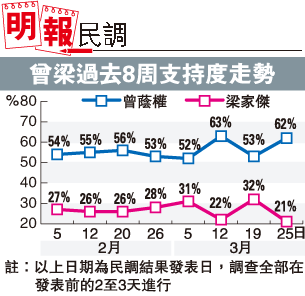
(HKU POP) 46.3% said Tsang was better and 33.7% said Leong was better. If election were held today, 65.6% said Tsang and 21% favored Leong.
(The Second Hong Kong Chief Executive Election Debate) (March 16, 2007)
(HKU POP) 38.5% said Tsang was better and 38.8% said Leong was better. If election were held today, 64.8% said Tsang and 21.9% favored Leong.
There are also any number of other polls by Lingan Universty's Public Governance program, the Research Association of Hong Kong, etc. The overall impression is this: while Alan Leong is supposed to have improved in performance from the second debate compared to the first one, the public support for Leong as CE has held still or dropped. Why should debate performance not run in the same direction as the overall support?
This is a subject that I have not found anyone willing to explore. The only indirect suggestion is that Alan Leong might have seemingly won the second debate through a number of facetious and flippant remarks that he has subsequently regretted (e.g. the mention of Milton Friedman), but this only erodes the public confidence in his governance as CE (i.e. all talk and no substance). But the survey/polling data do not tap into this directly. So I don't have any data and therefore I cannot tell you that this is the case. However, it cannot be denied that there is a problem when there is a divergence between evaluation of debate performance versus overall support. If there is a problem (and this may be structurally tied in with being in the 'opposition' with no record of governance), then one had better be prepared to analyze the problems and come up with solutions instead of shooting the messenger (namely, yours truly here).
Anyway, I posed this question to my readers (that is, those who are interested in Hong Kong): Is there a problem, given the survey/poll data (and I can tell you that everybody knows that there is a problem based upon those survey/polling data when the loser of the televised debate leads the public poll by 40% or so)? What is the problem? And what is the solution? Discuss among yourselves ...(Explanation: Maybe the survey/polling data are confusing here. The two HKU POP polls were conducted immediately during and after the debates and the respondents are restricted to those to have watched some portion of the televised program. As such, the total 'universe' is about 2 million persons or so. Other surveys and polls were conducted afterwards and cover the general population (more than 4 million adults including those who did not follow the debates) and Donald Tsang leads by an even bigger margin).
Relevant Link: The Horse Race Daisann McLane, Learning Cantonese
I believe that it has to do with the disempowerment of participants in the democratic movement. I still remembered a couple of months ago, a teenage girl asked me why we still kept on protecting the star ferry pier even though it was useless. I asked her, how did she know that it was useless, she answered half a million people came out in 2003 and 2004 and still nothing had changed in the political system.
We caught in a deadlock. Some people believe that such deadlock was created by central government's control over Hong Kong's political development; but I think the problem is actually come from within. To use central government's phrasing, there are "deep conflicts" (深層矛盾) within Hong Kong, and such conflicts have to be addressed from within.I don't agree with that one. In 2003, 500,000 persons showed up to march against Article 23. Please remember that 500,000 is only just over 10% of the total adult population in Hong Kong. Could it be said that nothing changed? The Article 23 legislation was withdrawn and the Chief Executive Tung Chee-hwa became instant lame duck and eventually resigned for reasons of "ill health." How can one say that "nothing had changed in the political system"? This was a cataclysmic change.
I have no reason to doubt that more than 60% of the Hong Kong people want universal suffrage. Every single survey/poll that I have ever seen has indicated such. I attribute the poor turnout this time to the three reasons that I wrote about. I firmly believe that if a demonstration mechanism can be devised to circumvent those three situations, which is largely due to perceptions about professional political parties, politicians, activists and internecine struggles. I firmly believe that if an event can be organized to ensure that it will absolutely not be an occasion for any political party, politician or activist group to get their share of media hype, then it is possible to surpass that 500,000 figure of 2003 easily. This may be a demonstration march, an assembly or some other means. We just have to eliminate the factors that make people reluctant to reveal their preferences as recorded in surveys/polls. Such an occasion would not go through the usual channels (such as the Civil Human Rights Front or Apple Daily) but through a direct appeal to all persons (inclluding political parties, politicans, media, activist groups, university student associations, movie stars, singers, citizens, etc) and even forcing them to show their hands (Are you for or against universal suffrage? If you care, then just come down for a silent 30-minute assembly and then we all go home. We promise that there will be zero speeches, prayers or whatever. There is only one message: we want universal suffrage. Period. There will be nothing on vindication of June 4th, gay marriage, minimum wage, preservation of cultural heritage sites, government-business collusion (Li+X), environmental pollution, Star Ferry/Queen's Pier, small class sizes, CyberPort/Mody Mall, flat tax, F*L*G/Nine Critiques, whatever).
So how can that happen? The funny thing is that the only way I know is to go through all the channels which I said must be bypassed! Hey, this is where we are ...
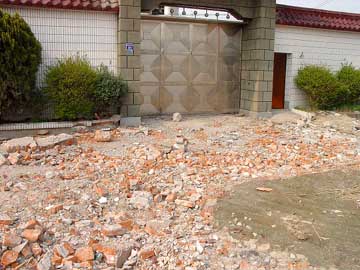
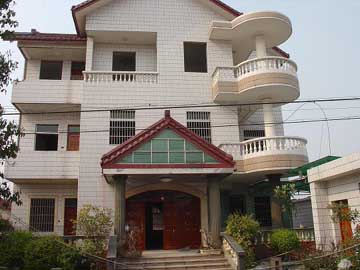



[in translation]
In elections at the Dingmei village, Dongfu town, Xiamen city, there had always been vote buying. Last August, when the village committee election was being held, villagers Hu Feihuang and Hu Jianbiao were vying to become village director (mayor). The Hu family elders arranged for the two candidates to go to the Temple of Lord Guan and swore that they will not buy votes. So this election last year saw no vote buying.
But the absence of vote buying caused unhappiness among some villagers. An elderly villager named Chen said that in previous years, a vote in the village director election was worth three to four hundred RMB, and even as much as 1,000 RMB. "One can make a lot of money by becoming villager mayor. What is so wrong about coughing up some money?" Chen's wife explained further: "One person gets a few hundred; a family can get more than 1,000 RMB. If one vote is worth 1,000 RMB, then the whole family will make several thousand RMB." Among the dozen or so villagers interviewed, half of them approved of vote buying. According to Liu Xiguang, who is a National People's Congress delegate from Hebei province, some wealthy or resource-filled rural village have highly competitive elections in which people spend over a hundred thousand or even several hundred thousand RMB in elections.
According to associate professor Wu Licai of the Huazhong Normal University's Political Science Research Institute, village mayor candidates used to offer "gifts" to town mayors and party secretaries. Therefore, it is "progress" to go from "offering gifts" to your bosses to "bribing" villagers. He believes that the logic why villagers welcome bribery is very simple: the candidates are making an "investment" which they "will re-coup eventually." This logic reflects that the common problem that in the development of democracy in the rural villages, the villagers has the "right of speech" only during the voting but otherwise had no influence in the village public affairs.
The direct election of the village committees is one of the steps for village self-autonomous rule. But in the presently held direct elections, there have been various degrees of vote buying. Furthermore, things have seem to get getting worse. Here are some examples:
- In Guankou town, Jimei district, Xiamen, there was an election for village party branch committee in 2006. Village cadre Chen was campaigning to become a committee member. During the Lunar New Year period, he gave tea leaves and cigarettes to voters under the name of New Year presents and tea-tasting to curry favors. Afterwards, Chen was relieved of his party duties by the relevant department.
- In Yongtai, Intersection town, Lunan county, Shantong province, the Yongtai residents committee director named Wu was campaigning for re-election. He publicly offered 20 RMB to each and every voter in the name of thanking them for their work. For each villager who voted for Wu, he offered 300 RMB for the family.
The Civil Affairs Bureau Base-level Political Power Construction Department Rural Village Division director Wang Jinhua admitted at a Peking University forum that one-third of the petition cases in 2005 were related to voting irregularities.
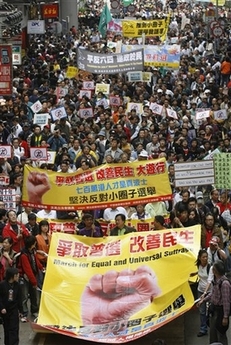
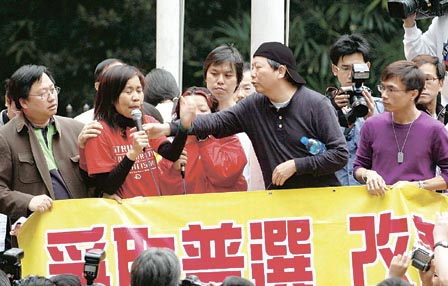
Members of the League of Social Democrats - a group which includes maverick lawmaker "Long Hair" Leung Kwok-hung and controversial former radio talk-show host Raymond Wong Yuk-man - staged a protest after the pan-democrat legislators and rally participants arrived at government headquarters. They yelled slogans denouncing Leong and pan-democrat legislators who have nominated him, calling their act "shameful" because they have endorsed the rationality of a "small- circle" election.
The scene turned hostile when group member and former legislator Michael Mak Kwok-fung tried to grab the microphone from lawmaker Frederick Fung Kin-kee, while two other group members went onto the stage and questioned Leong about what Hong Kong has achieved through a competitive chief executive election.
"It's a simple fact that, with a pan- democrat candidate joining this `small- circle' election, the number of people who turned up at today's rally to strive for full democracy has dropped significantly," Leung said. "The Beijing government could say tomorrow that you have lost your popularity and public support, and eventually you will lose the `small-circle' election next. Thirdly, you'll probably be deserted by the pan-democrat camp."
(Ming Pao: Two League of Social Democrats women seizing the microphone)Those are the reasons that I came up with. There may be others. so maybe these comments will generate the usual criticisms that I hate democracy and freedom. But what is your explanation as to why 5,000 people showed up for the march when public opinion polls showed that 60% of the population are for universal suffrage? If you can solve that puzzle, then you will get 60% of 7 million people = 4.2 million people to march for universal suffrage. How can that sort of people power be stopped?
During the long Lunar New Year holiday last month, Mario Yang (楊士模) and his family found themselves absorbed in a new activity. His parents and grandparents were not playing mahjong this year, but rather were trying their hands at Nintendo Co's new Wii games. "My grandma said now we can move around the house while playing games instead of just sitting in front of the computer," said 27-year-old Yang, who is an editor with an online news portal. He rushed to a game shop on Feb. 15, two days before the holiday started, to purchase a Wii, which sports a motion sensor used to play virtual tennis, golf or baseball. "This is a game console that the whole family can take part in," he said.
... The craze has even made its way into political circles. Premier Su Tseng-chang is an avid Wii player and has called the console a "great invention that offers gamers a good workout."
The much lauded consoles, however, are not yet officially released in Taiwan. Eager gamers have gotten their hands on Wii in advance by buying consoles imported from Japan or the US, where they have been available since November. Yang, for example, shelled out NT$9,700 (US$293) to buy a Wii, the official price tag of which is US$250.
Oh, wait, before you get the idea that you can start bringing in those Wii's into Taiwan for fun or profit, read the other story (via TVBS):
Although the Wii has not yet been formally imported into Taiwan, many people have purchased the machines overseas and carried them back to Taiwan. But the Taoyuan Airport customs officers have been detaining the machines. As of today, 69 machines are under detention. The customs said that people must have a permit from the NCC to do so. A Hsinchu engineer said: "When their X-rays spot a Wii, they detain the machine, controller and the disks."
The Premier endorsed the machine. The Government Information Office said that any quantity fewer than two would be approved. But those promises were not kept. The NCC has entered to offer excuses: "The Wii is an electronic toy which emits electromagnetic radiation." It is emphasized that the machines are not being detained for tax reasons and they are only being in temporary safe-keeping. These machines do not have the stickers which show that they satisfy the criteria for low-level electromagnetic radiation. In order to retrieve the machines, it is necessary to show up at the customs office with one's identification, various documents and NT$500 for a permit; then the Wii must be taken to the NCC service center to be tested at a cost of NT$1,100.
... For those who already have a Wii at home, do they also need to go through testing as well? The NCC does not clarify, but the people will surely pursue this.
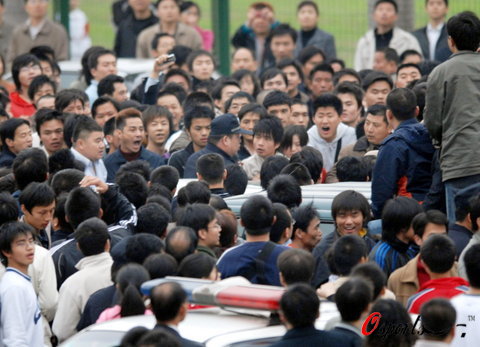
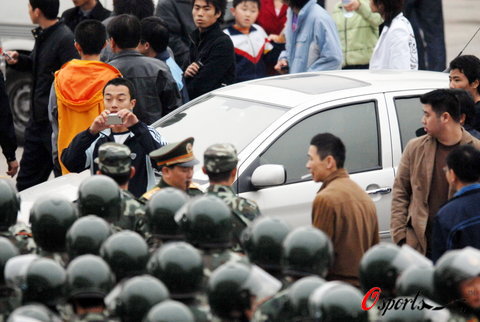
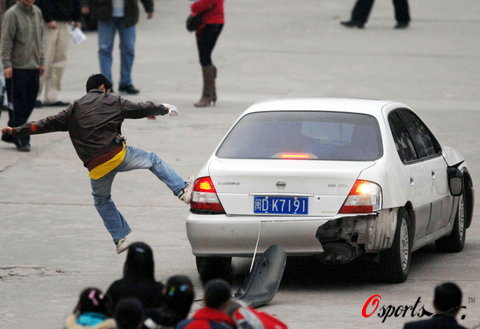
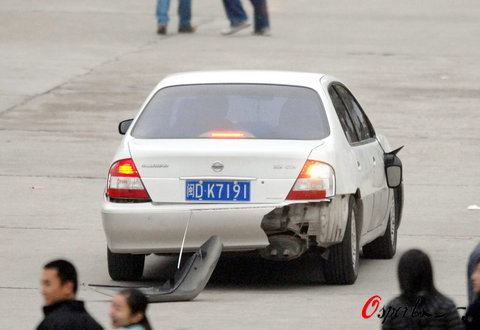
(in translation)
Last week, I received an English-language email from a program host at a television channel known as Al Jazeera English. This person indicated that he would be in Hong Kong that weekend and would like to conduct a short interview with us about the blog.
Ordinary blog visitors here know that I am not ostentatious, so why would I write about a post about a request for an interview? This is not because I feel elevated, but because I thought that ... it was intriguing! Why?
I searched for "Al Jazeera English" on the Internet and it does exist. This was not phishing. According to the email address, it comes from Kuala Lumpur (Malaysia). I thought that it could be a Malaysian channel, and it was not unusual for people in Singapore-Malaysia to read Cantonese, and therefore they could be reading the Diuman Park blog.
But I was really too busy and I did not know how to answer this new and different invitation. Therefore, I turned it down.
Then I received another email from the same program host and this time it was written in simplified Chinese characters. He said that our blog was very interesting and he wanted to interview us about our views on Hong Kong democracy. This was in Chinese and it clearly listed the Chinese name of the television channel.
I was ashamed! I blame myself for not reading English-language newspapers often enough and being deficient in international vista, which was why I did not realize who Al Jazeera is! Perhaps, you already know ...
This is what we call 半島電視台 (Peninsular Television).
Right, that would be the Qatar Peninsular Television (if you don't know, you can click here for the details (note: Wikipedia in Chinese)).
In the end, we did not do the interview. If the inviter should read my blog, I want to thank them for the invitation.
But I think that it is funny that we almost made it into the Arabian world. Ha ha.
Of course, I do not hope that someday you get to see the re-transmission by Hong Kong television of us about to be executed with a bag over our heads!
This is the part where the ESWN blogger has to come up against the decision to insert his personal comments or not. If he does not, then the translation stands; if he does, then it may be confounded with the original author's opinion. But here is what the ESWN blogger says (and it has nothing to do with the Diuman Park blogger has to say): Al Jazeera (English) is a project to provide an alternate global television media source other than BBC and CNN. Upon information and belief, in this particualr instance, Al Jazeera could have filed a news report by interviewing government sources or opposition politicians; instead, it chose to seek out some independent opinions (specifically, independent Hong Kong bloggers). By the way, Al Jazeera was willing to conduct the interview in English, Cantonese or putonghua (and that was why the Diuman Park blogger received multiple-language requests).
[Barbara] Walters also asked Chavez about calling Bush the devil, a donkey and a murderer.
"Yes, I called him a devil in the United Nations. That's true. In another occasion, another time I said that he was a donkey because I think he is very ignorant about things that are actually happening in Latin America, and the world. If that is in excess on my part, I accept. And I might apologize. But who is causing more harm? Do I cause any harm by calling him a devil? He burns people, villages, and he invades nations."
Donkey? What call someone a donkey? That is unusual in English. For an explanation of what Chavez actually said, please refer to the 2004 ESWN post Pendejo.
[in translation]
Italian prime minister Silvio Berlusconi once offended his wife. The famous bigmouth was complimenting another politician whom he described as being so handsome that he wanted to introduce his wife to. Afterwards, he apologized to his wife in an open letter published in the newspapers, saying: "I'm only a politician. How can anyone believe what a politicians says? If people believe what politicians say, what will Italy turn into?" Berlusconi is likeable in the sense that his actions and words show that he loved power and will grab it by any means. He knew the essence of <The Prince> and he made sure that Machiavelli had company.
It is commonly accepted that one should pre-suppose that anyone who pursues power is a bad person whose words cannot be trusted and only their actual deeds count. To a large degree, we must thank those lying politicians because we learn to mistrust only after being fooled a few times. It is not hard to be a hypocrite. Within any system, there is a standard set of iron-clad, water-proof clichés and if you learn to say them well, you will do well. A real crook like Berlusconi provides good political lessons to everybody when he speaks his mind: one must always be skeptical about politicians. If they mutter a few wonderful sentences, they make a righteous pose, they shed a few tears without doing a thing and you are somehow moved by them, then you deserve a terrible fate.
The Shanxi edition of Silvio Berlusconi is named Chen Litian, who is the deputy mayor of Jiang County. Last year, more than 100 migrant laborers came to demand their 130,000 RMB back wages. The laborers tried all the legal methods, including going to the Labor Mediation Committee but they got nothing. None of the relevant Jiang county departments paid any attention to them. So the laborers were forced to go to the Yuncheng city party committee to present their problem. They probably received some attention, because the Jiang county government dispatched deputy mayor Chen Litian to Yuncheng to meet with the laborers. After negotiations, Chen Litian turned over a signed document to the laborers to guarantee that the problem will be resolved within three days (beginning tomorrow), or else the county treasury will foot the bill. But when the laborers got back to Jiang county, the promise of the deputy mayor was not kept.
Well, this is a common enough story and there is nothing new except that Chen Litian told the reporters that his only objective on this trip to Yuncheng was to get the laborers to return to Jiang county. Besides, how can anyone take a promise seriously (March 14, Shanxi Evening News)?
Right, how can anyone take it seriously? Chen Litian deceived people and then he blamed his victims for being gullible. That is enough to make you sick inside. We do not need more discussions about hidden rules and we do not want to talk about trust, responsibility and other vacuous terms. I only hope that there are a few more deputy mayor Chen Litian's who can utter a few more truthful words that rub salt into wounds and let their victims remember well: "Everybody does this anyway. So I just lied to you -- so what? Bite me!" For the one hundred plus laborers, their feelings might have been hurt. But they could have run into some slick-talking officials who offer comforting words ("sorry, uncles and brothers ...") and then they may forget about everything since the Lunar New Year has just past and they don't have urgent need for money anymore.
People will get fooled sooner or later, but it is important not to be fooled again. This particular story will improve the debt collection techniques of laborers -- the money is yours only when it is in your hands and only then is the matter over. More generally, this shows that Berlusconi's words have generality: How can you trust what a politicians says? Please do not be one of those gullible people -- it is one thing to cheat you out of a little money, but it is a lot more if you get fooled for life.
[in translation]
Q: I want to say that we Chinese always wear a fake mask. We say one thing and we do something else. Therefore, we are unable to muster the courage to state our opinion about the Taiwan issue. We just cannot go about saying that everything is correct.
A: Is that meant to be a criticism from you?
Q: If only we have to courage to state our posiition about democracy in Taiwan and about the Taiwan problem ... I object to your saying "I don't know" nine out of ten times.
A: Fine. I understand. You mean to say that one must say whether one supports or does not support self-determination for Taiwan. And if you don't say it, you are wearing a fake mask. This is how I understand what you say. Thanks. Here is how I look at this problem: no matter whether we are talking about independence or unification for Taiwan, or about our attitudes towards the Chinese Communist Party or the Chinese authorities -- no matter what we are talking about -- we must be able to state our positions. If we won't, then we are hypocrites. Concerning this requirement (which is not very important no matter what the actual issue is), my personal view is: "I have no right to demand others to state their positions."
How come? Suppose there is a subject, which ten thousand people say is condemnable. This appears to be a very obvious subject. But at a time when ten thousand people say this is condemnable, I feel that we should tolerate and respect some people for not stating that this is condemnable or just refusing to state their positions. I think that you ought to respect them too, because of all the core values that we have, I think the most core of the values is: we respect dissenting opinions.
If this is a true core value as opposed to a fake mask, then you need to respect anyone else not using your approach to solve a problem; you need to respect someone else using a different method to undertake the same resistance. That is to say, waving the flag and shouting aloud is one approach, maintaining silence is another approach and evasion is yet another approach. I do not think that the person who goes to the public square to pour gaosline on himself should condemn those who do not follow suit as 'cowards'; alternately, how do you know that a person who chooses to maintain silence feels less pain and hate than you do? how do you know that a person who chose evasion would not eventually achieve much better effects than your direct approach? You cannot actually judge.
If our ultimate goals are democracy and freedom, then you must pass the test for everything that you do now. That test is: you are talking about a society with democracy and freedom, but during the process, you demand everybody else to follow you by doing things the same way, and anyone who fails to do so is a fake, then you have just destroyed the thing that you claim to be pursuing and you are wearing a fake mask. I believe that if you want to practice it, you must do so one bit at a time in your real life. Then you can prove whether you are someone who is genuinely seeking the goal. This is a test that many people cannot pass.
The female news reporter from Cable News asked: Mister Leong, you proposed that the ministers be directly appointed by the Chief Executive without going through the central government. When this policy was brought forth, many people began to question whether this is working towards Hong Kong independence and challenging the central government. When you came up with the idea for this policy, did you ever think that these questions would arise? Is your political intelligence quotient too low? Or do you know that it will never happen and therefore you just throw it out there without a thought? (applause)
Leong responded: Thank you for your question. I want to ask the audience presence here if anyone of you believe that anyone in Hong Kong is working for Hong Kong independence? If there are any, please applaud. (applause). A minority. That is, two or three.You can check the video if it really was 'two or three.' While Leong might have thought that it is objectively true that no one is working for Hong Kong independence, he has set up a situation in which the Tsang supporters may applaud to embarrass him. He could have simply made the point by saying: "I'm not aware of anyone in Hong Kong is working for independence ..." instead of letting the audience members vote.
I have nothing else to add, except to re-list my previous posts which covers most of what I want to say:
The Case of Shi Tao 05/01/2005
Yahoo! and the case of Shi Tao 09/08/2005
Yahoo! Sends Another Man To Jail 09/22/2005
Comparing Yahoo and MSN Spaces 01/06/2006
The Case of Li Zhi 02/08/2006
The Third Way For Yahoo 02/11/2006
Taiwan independence:
Opposition rate: 80%
Support rate: 13%Cross-strait reunification:
Confidence: 53%
No confidence: 36%Taiwan rejoining the United Nations:
Opposition rate: 55%
Support rate: 27%Believed "One Country, Two Systems" was applicable to Taiwan:
Yes: 59%
No: 29%
[in translation]
... According to research by the Taiwan Think Tank, the percent of people who think that the ethnic group problem is serious has risen sharply over the 12 years survey period between 1995 and 2007: the numbers for 1995, 2003, 2004 and 2007 are 17%, 31.9%, 55.9% and 57.3%; those who do not think that this is serious went from 63.3% to 36.1% over those 12 years.
... Generally speaking, society looks at the political map of the ethnic divide as follows: South -- pro-green, pro-independence; north -- pro-blue, pro-unification; people whose origins are outside of Taiwan are pro-unification; Fu-lao people are one-sidedly pro-independence; DPP and TSU supporters are one-sidedly pro-independence; New Party supporters are totally pro-unification, followed by the PFP; the KMT crowd is positioned between the DPP and PFP.
The above impressions are partially true, but the recent public opinion poll by the Taiwan Think Tank has surprisingly found that more than half of this is false.
The parts that are correct are: the south is pro-green; the north is pro-blue; the DPP and TSU are one-sidedly pro-independence; the Fu-lao people are pro-independence.
But if Taiwan independence is defined as regarding the sovereignty of the Republic of China belongs solely to the 23 million people in Taiwan and not to the 1.4 billion people on mainland China, then there are some unexpected results.
First, the percentage of people who believe ROC sovereignty belongs only to the 23 million people is 76.1%, which is far larger than the 15% who thinks that the mainland Chinese should be included. 85% of young people between the ages of 20 to 30 and 80% of those with university education thinks so too, and that is unsurprising.
Surprisingly, among those with origins in other provinces, 24.7% are pro-unification and 70% believe that sovereignty belongs to the 23 million people. This is bound to surprise everyone. As for the aborigines, 27% are pro-unification and 45.7% are pro-independence. This may be due to the aborigines have the poorest access to information and the KMT was successful in indoctrinating them.
Previously, people have regarded Keelung-Taipei as the home base for people from outside provinces due to their pro-blue voting and therefore they must be pro-unification. The opposite is true. 80.4% of people in Taipei-Keelung believes that sovereignty belongs to the 23 million people, and this is the highest number among all areas. Even the Yun-Chia-Nan area which is regarded as most pro-independence only has 76.9%. This is probably because the capital people has better education and access to information, and therefore they tend to be more pro-independence in spite of their ethnic identities.
As for the political parties, the results are equally surprising. The party who members are most against independence are not the New Party or PFP but the KMT. Only 69.6% of them think that sovereignty belongs to the 23 million people, compared to 74.7% for PFP and over 80% for the New party. As for the pro-unification, the KMT also led with 24.0%.
These numbers showed that as far as the party leaders go, the New Party may be the most pro-unification. But the New Party and PFP supporters did not offer their support solely on the basis of unificationist ideology, for some of them are anti-black-gold middle-class people.
This piece of significant research showed that there are differences in terms of north/south geography, Taiwan/outside province-origin, Taiwan/mainland China identification, but there is also a huge gap with the rigid impression conveyed by the politicians. This is enough to make one worry and celebrate.
One worries because the politicians do not recognize this and just rigidly shout and scream to create chaos. One celebrates because geography/ethnicity/unification-independence are not pre-destined linkages. Through information and education, there is still space for rational choices.
(RedNet (Changsha) via CCTV) March 13, 2007.
On the morning of March 9, certain citizens of Zhushan town, Lingling district, Yongzhou city, Hunan province gathered at the Anda Transport Company's bus depot due to their dissatisfaction with the price hikes. The local government learned about the situation and immediately ordered the Anda Transport Company to rectify its unapproved price hike. On March 11 and 12, the Anda Transport Company re-instated its former prices but some citizens still regarded the prices as being unreasonable and blocked the vehicular flow. A very small number of criminal elements took advantage of the situation to vandalize and set fire to the buses as well as the vehicles belonging to the local public security personnel in charge of maintaining public order. To prevent further escalation, the local government organized its cadres to stop the masses. When the persuasion failed, the public security organizations arrested the leaders who directed the vandalism and arson in accordance with the law. The spectators then gradually dissipated and the matter was stabilized.
After the incident, the Hunan provincial and Yongzhou city government gave a high degree of attention. Provincial and city department leaders quickly rushed to the scene, obtained feedback from the masses and analyzed the cause of the incident. They have ordered the Anda Transport Company to cease operation pending investigation and re-organization; they have bruoght in over ten buses to provide service on the bus line to meet the needs and security of the citizens and students. At the same time, the Yongzhou city, district and town cadres have entered deep among the masses to patiently explain the situation and maintain social oder.
As for now, the masses are emotionally stable and production activities are normal. During the incident, there were not fatalities.
Ignoring the more important issue about the veracity of the official version, there is a sideshow here. This report did not come from Xinhua, CCTV, People's Daily or a Hunan newspaper. Instead, it was published at the website RedNet (as in Red).
Meanwhile, if you check The Yongzhou Mass Incident, then all the western media as well as Hong Kong media reports refer to Zhang Zhilin, who is the Hunan province representative of the Chinese Pan-Blue Coalition. Upon hearing that a mass incident had occurred in Yongzhou, Zhang had hurried over and provided some first-hand photographs and eyewitness accounts. In the various reports, there was a sense of nervousness on the part of Zhang. A flash message at Boxun.com then that Zhang Zilin's mobile telephone (1387XXXXXXX) had suddenly been shut off as of 5pm on March 14. The Chinese Pan-Blue Coalition then reported (at Boxun.com) that Zhang Zilin is now under the control of the Hunan province public security bureau. The Coalition announced that its Guangdong province representative Ding Yi has been urgently dispatched to Yongzhou.
It is over-reading to suggest that this is a Red versus Pan-Blue battle, because such that would be very asymmetric warfare because the Red side has the entire weight of the government and the party on its side.
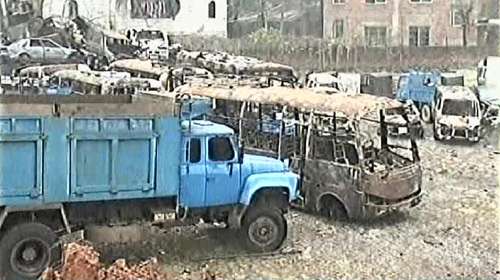
ESWN: The Yongzhou Mass Incident(湖南永州抗议运费涨价引发骚乱的报道,不是我懒或是喜欢英文,而是相关中文报道都在被屏蔽的网站上,google、百度全搜不到,连香港新闻这部分也被遮蔽,只有TVB网上新闻可见。)
(translation) Report on how a protest in Yongzhou (Hunan) against transport fees triggered off disturbance. It is not that I am lazy or that I prefer English, but all corresponding Chinese-language reports are on blocked websites. It cannot be found on Google and Baidu. Even the Hong Kong news websites are blocked, with only the TVB news report being viewable.
The case in Yongzhou (Hunan) was basically a commercial dispute in which the customers were unhappy about the businessman increasing prices during the Spring travel period. Supposedly, the businessman has powerful background and used violent means to intimidate the customers. This led to an escalation in which the government was forced to use the police to control the situation and the whole matter has therefore become politicized. Many people thought that the fact that the local government banned media reports and refused to sanction the business meant that the government officials had an involved interest. While this is speculation, it is convincing enough for the citizens and it makes them angry. How can a tiny incident lead to such an incident while bringing up a host of other problems?
First of all, how dare the business employ violence? Does it have a backer? Next, why are the people so skeptical about the local government? Is there real corruption there? Thirdly, why are the media not reporting? This is just a local affair and it is understandable why the local media were silent. But why are the national media not reporting?
Isn't this strange? The reporting on the Yongzhou Mass Incident has been completely obliterated inside China. Where did the Rose Garden blogger find out the details, given that she is on sabbitical from Phoenix TV to east coast USA presently? That is enough for a separate discussion altogether. In a way, this is not different from the ESWN blogger, who is presently also situated on east coast USA. The answer is this -- if you want to know, you'll know irregardless of the mystical Great Firewall of China.
1. The Definition of the Democracy Movement
The precise definition of "a person in the democracy movement" -- someone who is mentioned in the overseas media as fighting for the realization of democracy, freedom, human rights and rule of law in mainland China.
The precise definition of the "democracy movement" -- the sum total of the organizations and actions of the aforementioned "persons in the democracy movement."
2. The Problems with the "Democracy Movement"
Based upon the above definitions, there are serious problems with the "democracy movement." In fact, it has a terminal disease.
First of all, the "democracy movement" lacks independence and self-determination -- because the structure of their members, leaders and organizations as well as the nature and scope of events are basically not determined by themselves. Instead, they rely on an outisde proxy server -- the media (including new media) -- to operate. This is like as if the American president and congressional representatives being elected by Russians, or the American government being accountable to Sierra Leone citizens instead of Americans. How could this not be a mess?
Secondly, the "democracy movement" has is like a tree without roots and water without a source -- this is about the relationship between the so-called "overseas democracy movement" and "mainland democracy movement." There are some who insist that the "mainland democracy movement" should be the priority and the issue is only about how the "overseas democracy movement" can support the "mainland democracy movement." But the "mainland democracy movement" does not exist in reality. The so-called "mainland democracy movement" described by outsiders is only an extension of the "overseas democracy movement." The "democracy movement" exists only on the "overseas media, and therefore this is an "overseas democracy movement."
Thirdly, the biggest problem is that the media are under the control of the Chinese Communists -- this is not only totally true inisde China, but many of the overseas Chinese media (most of them) and even western media (in terms of the focus of attention and structural control of the "leaders"). In conclusion, the "leaders" (not every one of them, but in terms of voice) and "structure" (basically) of the "democracy movement" appears to be opposing the Chinese Communist but they are ultimately structurally controlled by the Chinese Communists (both in hardware and software).
These problems existed in 1989, or even earlier. The more that you probe about the truth of June 4, the more you will find these kinds of problems and ones that existed before and afterawards.
3. The Future Direction of the "Democracy Movement"
Now that we know everything has been inverted, isn't the future direction quite clear? To quote Li Peng (1989, May 18): "As a Chinese Communist Party, I do not disguise my viewpoints. But I won't say anything today ... actually, I've already said it."
- On February 2, Pikawang International Group chairman Jia Yun was placed under the "double regulations" by the party disciplinary committee. This meant that he was required to make a full account of his problems "at a given time and a given place." He spent three weeks at a vacation village in the company of two minders who were with him day and night. On the evening of February 27, Jia Yun got one of the men to go out and order some midnight snacks. Then he knocked the other man unconscious and fled. He is now a wanted man.
-The official reason given by the Dongyang party disciplinary committee for placing Jia Yun under "double regulations" was that Jia Yun is a Communist Party member who has one daughter already and now his wife is pregnant again. Therefore, he is being charged with exceeding the family planning quota.
- The official reason given by the police was that Jia Yun rigged the public auction of the Nanshan Cultural Park land use together with the other four bidders.
- The real reason for the "double regulations" was election bribery. Jia Yun is already a People's Congress representative for both Jianhua city and Dongyang county city, and he wants to become a member of the Dongyang city party standing committee. He attempted to bribe certain People's Congress representatives but was reported to the party disciplinary committee.
- Pikawang International Group is engaged in audio-visual cultural products, real estate development, construction, logistics and industry. Once upon a time, Jia Yun ran a leather furniture company in Dongyang and when the company failed, he left for Guangdong. Several years later, he returned as a movie company boss.
- Jia Yun's blog at Sina.com is titled "The Boss of Stars -- Jia Yun." This reflects his reputation as the "sugar daddy" of a certain well-known female movie star and his status as an "audio-visual mogul." At this blog, there is a special section titled "Fan Binging and me." There is no entry as yet in that section.
- On March 5, the reporter obtained some promotional materials from the Pikawang International Group's real estate division. There were many photographs of Jia Yun shaking hands with government and party leaders. "One time at a Hangzhou movie festival, industry insiders looked at the photographs and pronounced them to be computer-made composite because the hands don't even look to be in the right positions." Those photographs used to be posted on Jia Yun's blog, but they have been scrubbed as soon as he became a wanted fugitive.
Wall photo of Fan Bingbing and Jia Yun
Part 1:
(SCMP) Police cordon scuttles march against poll. By Klaudia Lee and Joshua But.
A march protesting against the chief executive election was called off last night after more than 100 protesters who had defied a police ban were surrounded by officers at Victoria Park and prevented from marching to Central. Protesters led by members of the League of Social Democrats, including "Long Hair" Leung Kwok-hung, Raymond Wong Yuk-man and Albert Chan Wai-yip, and The Frontier's Emily Lau Wai-hing, earlier threatened to break through the iron gates where they were trapped, but the organisers decided to disband after two hours. Mr Leung claimed that more than 300 people had joined the protest, and denounced the government for using a "dishonourable tactic" to prevent them marching. About 100 uniformed officers were deployed to control the crowd. Although they never marched, the legislator said: "It's a peaceful protest and, no matter what, it has been successful. We have delivered a message to the whole world."(Boxun) More than there hundred people were in attendance ... the police sent in more than 100 plainclothes undercover officers to mix in with the crowd ...
Part 2:
(Ming Pao) The world-famous Swedish fashion clothing chain store H&M held the grand opening of its first Asian store in Central district, Hong Kong. About 1,000 fans queued up to sweep up the merchandise.
(Over the Rainbow blog) As a reporter, I was invited to attend the grand opening party on March 8 with a 20% discount on all purchases. The party began at 8pm, and the queue was more than 100 meters long with more than 1,000 guests. I and my colleague L entered after 9pm, and many of the products (such as the Madonna line of Clutch) were sold out already. Everybody in the store had one or two bags in hand. L bought one skirt and the cashier wondered: "You only bought one item?" Actually, L was holding the last skirt in that line.
... In the magazine reoprt, I wrote that "Fast Fashion" depends on having many styles, small quantities and low prices. This is "fast consumption." The consumer no longer waits for the big sale, because they can buy a lot, wear them only a few times but pay only small sums.
[Note: I'm out of Hong Kong and have no access to Apple Daily stories. But what do you think they considered the more significant story?]
Vice President Annette Lu accepted an apology the Associated Press offered yesterday for quoting Chinese media as calling her "insane" and characterizing her as a "crazy separatist" and the "scum of the nation." Showing a letter of apology from the American news agency, Lu told a meeting at the Office of the President in celebration of Women's Day she also accepted an AP offer of an exclusive interview.
Lu announced her candidacy for president at a news conference on Tuesday. Min Lee, an AP correspondent in Hong Kong, covered the press meeting. In a story filed from Taipei, Min Lee cited China's state-run media calling the vice president names. She considered the report "maliciously" embraced a "China angle" to "insult" her.
On the other hand, the CNN posted the AP story on its Web site on Tuesday but used what the vice president deemed an insulting headline. It read: "Taiwan's scum of the nation runs for president." The vice president at once sent the letter of protest, demanding that the popular American cable network apologize and give her an exclusive interview.
Cheng Wen-tsan, director-general of the Government Information Office, told Democratic Progressive Party lawmakers the spat between the vice president and the American media is over. DPP lawmakers demanded that Min Lee be deported within 24 hours for insulting the vice president and the people of Taiwan. The Hong Kong-based correspondent is currently taking part in a GIO press tour of southern Taiwan. "There is going to be a satisfactory result," Cheng told angry legislators, who wanted Min Lee to "get out." He referred to the apology offered by the AP. The CNN is likely to follow suit.
Earlier, however, a Ministry of Foreign Affairs official promised the lawmakers to revoke Min Lee's entry visa as soon as GIO has informed him that the correspondent was "filing reports without permission." A GIO official also promised to send the information. Both officials reversed themselves after they had been told the vice president was satisfied with the AP response.
The background for the "other" story is contained in this Taipei Times editorial:
For AP and CNN to be accused of being "proud and prejudicial" -- as Lu has said -- and pro-China in general is preposterous. Only weeks ago CNN's Anjali Rao interviewed President Chen Shui-bian (
陳水扁 ) at length on the Talk Asia program, which was notable for the fact that Chen had to be translated throughout -- unusual for the network. We also see no shortage of reports in CNN depicting Beijing's incompetence and malice in domestic affairs, including terrible footage of police mistreatment of ordinary people, content no doubt that has led the network to be censored in China. As for AP, Taiwan has been quite professionally covered by the agency's correspondents. We might occasionally quibble with AP's treatment of stories and its interpretation of political developments, but for DPP caucus whip Wang Sing-nan (
王幸男 ) to call for Cabinet resignations if the AP reporter at issue is not hounded out of the country is a contemptible over-reaction and reminiscent of Chinese Nationalist Party (KMT) thuggery in the Martial Law era. It's one thing to keep a select group of reporters from China's state-run media on a short leash. It's another altogether to threaten real journalists with visa cancelations. If freedom of speech is to be respected, then reporters must not be threatened, and that includes threats over material that is offensive to the government of the day.
So this other story is premised upon the following elements: (1) Annette Lu made a public complaint and demanded apologies from AP and CNN; (2) DPP legislators demanded the expulsion of the AP reporter Li Min (or Min Lee), who was not even responsible for the "insane" and "scum of the nation" words; (3) MOFA and GIO officials were more than eager to expedit the expulsion; (4) at some point, cooler adult heads interceded and pointed out that an expulsion would be devastating for Taiwan's international reptutation; (5) Annette Lu met the press and waved a piece of paper that is said to represent an apology from AP, and the case was considered close with future AP/CNN interviews to come.
But there is more to the other story (from 6Park; TVBS):
[in translation]
The Associated Press office in New York made an official statement in response to Annette Lu's protest. The statement said that AP CEO Tom Curley received the protest letter from Annette Lu and wrote a reply that was delivered to the Taipei Economic and Cultural Representative Office in New York City to explain the position of AP.
In his letter, Curley pointed out that it was proper for AP to cite the description of Annette Lu by mainland Chinese officials because this was clearly identified as the view of Beijing. AP had not been propagandizing in quoting the severe criticisms and unique language from mainland China.
Curley also pointed out that Taiwan plays an important role in world affairs, and AP has no hidden agenda or intent to be disrespectful.
As for Annette Lu's claim about the special AP inteview, the AP public relations representative that this was an unrelated matter. Based upon what he knew, the news department had discussed this matter for future purposes and the list of interviewees contains more than just Annette Lu.
Wouldn't you want to know what is in the piece of paper in Annette Lu's hand?
[CNN.com] Abe: No new apology for war brothels. March 4, 2007.
Japan will not apologize again for its World War II military brothels, even if the U.S. Congress passes a resolution demanding it, Prime Minister Shinzo Abe told parliament Monday. Abe, elaborating on his denial last week that women were forced to serve as frontline prostitutes, said none of the testimony in hearings last month by the U.S. House of Representatives offered any solid proof of abuse.
...
Abe last week sided with the critics, saying that there was no proof that the women were coerced into prostitution, igniting a storm of criticism and protests in South Korea and other countries where the women came from.
In conjunction with this news report, CNN.com offered an online poll with the caveat : "This QuickVote is not scientific and reflects the opinions of only those Internet users who have chosen to participate. The results cannot be assumed to represent the opinions of Internet users in general, nor the public as a whole." Scientific or not, it is the national honor at stake.
The polling question was: "Should Japan apologize again for its World War II military brothels?" Here is the battle report from New Express (via Wenxue City). The poll was started on late March 4. At first, opinions were running 50%/50%. By March 6, there were more than 500,000 votes with 90% against. The Korean netizens pubilshed the news link on their portals and blogs: "It is the time to show the strength of Korea now!" and encouraged netizens to vote. In turn, the Japanese netizens organized their own get-the-vote-out campaign. By the afternoon of March 8, more than 2 million people have voted with 25% for and 75% against. Here is the latest score: 5.6 million votes and 82% against.
While the Chinese press kept tab of this battle, the Chinese netizens appear to be missing in action. This has led to the usual comment that the Koreans are more active patriotic than the Chinese. Alternately, the other usual comment is that the Chinese are only good at ferreting traitors out among their own people (see, for example, the blog statistics in Finding A Husband For "Chinese Traitor" He Zhili).
Albert Cheng repeatedly brought up the issue that his departure as Commercial Radio program host has meant that the space for free speech had become smaller even as the total audience size decreased (he repeatedly pointed out that the number of radio listeners has decreased ever since he left Commercial Radio). Kevin Lau suggested that the Internet may be "an outlet for free speech," inasmuch as Hong Kong stock exchange board member David Webb became famous through Internet commentary. But Cheng responded that he is pessimistic about the Internet: he recalled that when he participated in Internet radio programs, the largest audiece was 3,000 persons and so this can only be called 'narrowcast.'
Albert Cheng's 'narrowcast' can be understood to be the result of the limitations on technology and resources. But it seems to overstate the case to say that if the new media have fewer audience members than the traditional broadcast media, then this negates the potential and possibilities of the former. That view seems a bit extreme. After all, since the young people today seek information from the Internet and that is a much less restrictive medium, then the correct approach is to reach out and develop the youth because the payouts will be much greater in the long run. But from the panel discussion, it seems that traditional and new media are "mutually antagonistic" entities.
Kevin Lau had something more to say about the eternal question of traditional versus new media. He said that during the Bus Uncle episode, Ming Pao held internal discussions about whether "the Internet will replace traditional media." They even asked people to do quantitative analyses and found out that there had been a vast increase in the number of citations of Internet news within newspapers. But he said that even if the traditional media were to draw in the "civilian journalists," the "news information" provided by them do not necessarily have news value (for example, they may favor "fun" or "gossip" stuff). So even if they become increasingly important, they cannot replace the "core values" of the professional journalists.
Thus, two questions were raised. "What is news value?" and "What is core value?" My understanding is that Kevin Lau's so-called "news value" is determined by the "gatekeeper" at the news organization and the basis of that determination involves the theories taught at journalisim school, the accumulated personal experience, the corporate culture and even the will of the superiors. As for the "core values," it is like what Albert Cheng brought up when he spoke about narrowcasts. That is, what the audience sees and hears depends on the "expert" (or at least "experienced veteran") at the news organization. This contains a hint of "elitism." In recent years, people who advocate grassroots media and civilian journalism oppose precisely that attitude -- they want to break down the monopoly of traditional media, they don't want the media to tell them what to watch (information, viewpoints, etc) because they want to decide on their own.
I know what Kevin Lau meant. But in yesterday's forum, I could see that the university students in the audience are obviously already relying more on the Internet than traditional media. Apart from lifestyle changes, I guess that they find what is on the Internet to be more satisfying than in traditional media.



En un antiguo Buenos Aires donde habíamos vivido y escrito en la incertidumbre, abiertos a todo por falta -- o desconocimiento -- de asideros reales, las mitologías abarcaban no sólo a los dioses y a los bestiarios fabulosos sino a poetas que invadían como dioses o unicornios nuestras vidas porosas, para bien y para mala, las rágafas numinosas en el pampero de los años treinta/cuarenta/cincuetna. García Lorca, Eliot, Neruda, Rilke, Hölderlin,
y esta enumeración sorprendería a un europeo incapaz de aprehender una disponsipilidad que maleaba lenguas y tiempos en un misma operación de maravilla, Lubicz-Milosz, Vallejo, Cocteau, Huidobro, Valéry, Cernuda, Michaux, Ungaretti, Alberti, Wallace Stevens, todo al azar de originales, traducciones, amigos viajeros, periódicos, cursos, téléfonos árabes, estéticas efímeras. Las huellas de todo eso son tan reconcibles en cualquier antología de esos años, y por supuesto aquí.
[in translation]
In an old Buenos Aires where we had lived and written in uncertainty, open to everything for lack of -- or ignorace -- of anything real t ohold onto, our mythologies encompassed not only the gods and the fabulous bestiaries but poets who, for better and for worse, invaded our porous lives like gods and unicorns, the numinous lightning-flashes on the pampa-dweller of the thirties/forties/fifties: García Lorca, Eliot, Neruda, Rilke, Hölderlin,
and this list might surprise a European incapable of understanding a disposition given to bending pure languages and times into a single act of wonder, Lubicz-Milosz, Vallejo, Cocteau, Huidobro, Valéry, Cernuda, Michaux, Ungaretti, Alberti, Wallace Stevens, all by way of originals, trnslations, traveling friends, newspapers, courses, grapevines, ephemeral esthetics. Traces of all these are easily identifiable in any anthology of those years, and of course here.
The Center for Strategic and International Studies veteran writer and expert on China fused in his new book <Rise of the Vulcans: The History of Bush's War Cabinet> the biography and theory on Dick Cheney, Donald Rumsfeld, Condeleeza Rice, Colin Powell, Paul Wolfowitz and Richard Armitage over thirty years. Unless you understand the experiences and thoughts of these illustrious people, you cannot understand the origins of the foreign policy of the Bush administration. If you don't understand the basic values and beliefs of these helmsmen of American policy, you will not understand how policies are decided at the White House, Congress, the Pentagon and State Department.
....
Gerald Ford was a weak president. He had no clear concept of ruling and foreign policy, and so Henry Kissinger had unchallenged influence. In the later stages of the Ford administration, Rumsfeld and Cheney worked together to force Kissinger to fade from the scene. James Mann wrote: "Cheney ultimately failed, because Alexander Solzhenitsyn did not get to meet the president. This eventually meant that Ford and Kissinger paid high political prices." When Ronald Reagan entered the White House, the influence of Kissinger was finally terminated. Reagan employed strong tactics against the Communist countries in Russia and China and realized the hopes of Solzhenitsyn about the American role in international affairs. This was the correct foreign policy. Within the internal developments of Soviet Russia and eastern Europe, this ultimately swept the Communist Parties in these countries into the dustbin of history.
On May 11, 2006, President Bush received myself, Wang Yi and Li Baiguang (three Christians and human rights activists from mainland China). According to the senior officials from the USA National Security Administrator, China's Religious Affairs Bureau director Ye Xiaowen publicly acknowledged that the Chinese Communist government attempted to go through diplomatic channels to stop this meeting from happening. Within the US State Department, certain senior officials recommended that the White House should cancel this meeting so as not to irk the Chinese Communists. But vice-president Cheney resolutely turned down this recommendation and made sure that the meeting took place. In the end, President Bush personally ordered this meeting to take place according to the original plan.
Thirty-one years ago, deputy director Dick Cheney of the White House office was unable to persuade President Gerald Ford to meet with Alexander Solzhenitsyn; thirty-one years later, vice-president Dick Cheney was able to ensure that President Bush would meet with three Chinese intellectuals. During the meeting, I noticed that Cheney was listening with a smile on his face on the side; meanwhile, the American media reported that when Hu Jintao visited the White House, Cheney was napping on the side. The different attitudes of Cheney on the two occasions provided an obvious contrast. As I read James Mann's story about Dick Cheney and Alexander Solzhenitsyn, I have a deeper understanding of the taciturn Dick Cheney.
It is standard practice to say the "the enemy of my enemy must be my friend." As such, Chinese dissidents must not be criticized. However, this particular essay from Yu Jie occurred at a particular inopportune moment in history -- American vice-president Dick Cheney's aide Libby had just been convicted by a US court on a number of charges. While American politics may be too complicated for Chinese citizens to follow, you can try this cartoon-illustrated narrative from Juan Cole. The case extends much more than a perjury trial, because this was also about mispresenting intelligence in order to start an unnecessary war in which hundreds of thousands of lives have perished already. This is arguably about a crime against humanity. To put in bluntly, would you like a Dick Cheney-like person to take charge in China? If not, you better say so instead of talking about how he was a good guy because he did not fall asleep during a meeting ...

Previously, the Hong Kong Broadcasting Authority had issued a strong advisory against TVB for showing the movie <An Autumn Story> which included some strong language. HK BA chairman Patrick Fung dodged the public outcry against the decision until he finally came out with a proclamation that the decision was consistent with public opinion.
According to the news report, the Broadcasting Authority claimed to have received many responses. Of these, 1948 supported the decisions (note: there were two decisions, one on <An Autumn Story> and the other about a gay segment on a RTHK program) and only 812 opposed. Among these responses, 18 opposed the decision against <An Autumn Story> and 5 supported it; 166 supported both decisions and only 13 opposed. The rest of the responses pertain only to the other decisions.
How could the outcome turn out in these kinds of numbers? According to a report in Ming Pao on February 25:Recently, I received several email which will help to explain the mystery behind these numbers. One email began this way: "Urgent call! The 'One letter per person to support the Broadcasting Authority's decision on <Comrade, Lover>' action. Hurry up! Or else, the Broadcasting Authority may issue a public apology due to lack of public opinion support and then it will be too late!"
The email provided the reasons and wording in great detail, while emphasizing: "The following are just some suggestions for your reference. If you want to use it, please make some amendments and add your personal thought, because the government may treat identical letters as a single item. There is no length requirement, and a few dozens words suffice."
The letter came from the Hong Kong Sexual Culture Society. This organization understands the rules of the game and is terrific at crafting public opinion. So why were there so few responses with respect to <An Autumn Story>? Because nobody started a campaign.
When Patrick Fung spoke about public opinion, this is the kind of thing he means. As for all the published essays by named individuals as well as the media criticisms, he sees nothing.
TVB has decided to strike back. On midnight on next Sunday (that is, early morning on Monday March 12), TVB will show the uncut, original version of <An Autumn Story>. Viewers will be able to listen to Chow Yun-fat say the objectionable words again. The blogger Yip Yatchi urges all civilized persons to stay up and break the ratings record for the midnight period; parents are also urged to watch with their children and discuss this general knowledge lesson with them.
Postscript: (Ming Pao) Apparently, TVB has backed from its threat to have the whole film shown as is. Instead, TVB will edit out the words "F**k" and "XX鏟." Not to fear, because you can watch the episode on YouTube at 秋天的童話. By the way, the phrase "Eat banan" can be heard distinctly and nobody has commented on this obvious reference to fellatio so far.
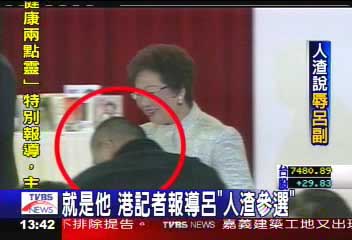
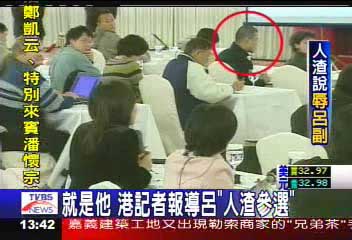
Annette Lu's chances of a victory in next year's vote are slim, and many doubt she will even win her party's primary _ which already includes three other solid candidates. But the unpredictable, outspoken Lu will likely spice up the race.
She has repeatedly angered Beijing with her support for Taiwanese independence, and China's state-run media have called her "insane'' for favoring a formal split from the mainland, and the "scum of the nation.'' Tensions with China would likely rise if she were elected.
While announcing her candidacy Tuesday, she again challenged Beijing's sacred view that Taiwan is an inseparable part of China. "Taiwan is a Pacific country, not an affiliate of China,'' said Lu, whose campaign slogan is, "Rebuild a beautiful island, Taiwan go go go.''
Taiwan has been ruled separately from China since the Communists won a civil war and took over the mainland in 1949. Beijing insists Taiwan must unify eventually or face a devastating war.
Lu, 62, proposed a China policy of "constructive engagement'' that promotes "coexistence, co-operation, co-prosperity.'' She said, "Taiwan and China are distant relatives and neighbors. There isn't any hatred between them. There shouldn't be a war.'' But she added that she would continue the work of President Chen Shui-bian, who is also reviled by Beijing for his refusal to endorse eventual unification.
The AP story was then cited by CNN.com (see screen captures)
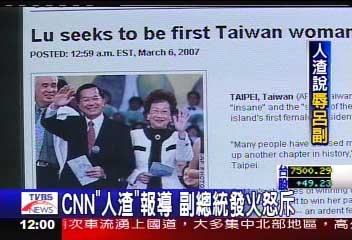
(TVBS) Thanks to the Internet, within one day after the story appeared, searches on the word 人渣 (scum of the earth) ends with the top news story result being this negative report. Lu filed a protest with CNN and also demanded an explanation from AP: "I'm going to send a very stern letter to Associated Press. Many of the international media were sent over from mainland China or Hong Kong temporarily, and their ideas and views are totally those of the Beijing authorities. Their reprots are very damaging to our national image." "This is not just my personal problem. I am a two-term vice-president and it is an extremely serious affair to use those words from Beijing to insult us. I think that the Ministry of Foreign Affairs and the Government Information Office need to pay attention."
(TVBS) Based upon the TVBS investigation, the AP journalist was named Li Ming. He was one of the foreign correspondents who got to shake hands with Annette Lu. During the press conference, he sat in the front row. Li Ming is his 30's and he is inexperienced insofar as the AP ranks ago. This is his third visit to Taiwan since the presidential election in 2004, usually coming over from Hong Kong to support the team. On this occasion, Li Ming followed Annette Lu's tour and then went back to the office to write about the press conference as well as some general background. The quotations of "insane" and "scum of the earth" were in fact written by senior AP staff members. AP does not believe that the quotations were inappropriate. Nevertheless, Li Ming has cancelled his assignments today because he has become the focus of the story now.
Vote of confidence in CE Donald Tsang
65% (Feb 1-6)
69% (Feb 22-26)
74% (Feb 28)Vote of no confidence in CE Donald Tsang
18% (Feb 1-6)
16% (Feb 22-26)
17% (Feb 28)Satisfied with SAR government performance
38% (Feb 1-6)
42% (Feb 22-26)
51% (Feb 28)Dissatisfied with SAR government performance
17% (Feb 1-6)
14% (Feb 22-26)
12% (Feb 28)
Q1. Satisfaction with President Chen Shui-bian
16% satisfied
58% dissatisfied
26% no opinion
Q2. Yesterday, President Chen Shui-bian proposed the "four yeses and one without" -- that is, Taiwan should be independent, it should have a normalized name, it should have a new constitution and it should develop; there is no issue about left versus right, just unification versus independence. Do you agree with the President's proposal?
24% agree
54% disagree
22% no opinion
Q3. President Chen proposed that Taiwan should have its normalized name. Do you agree with this proposal?
29% agree
49% disagree
22% no opinionQ4. President Chen proposed that Taiwan should have a new constitution. Do you agree with this proposal?
30% yes
45% no
25% no opinionQ5. President Chen proposed "four yeses and one without." Are you concerned that this would heighten cross-strait tensions?
56% concerned
32% not concerned
12% no opinionQ6. President Chen proposed "four yeses and one without." Are you concerned that this would affect the relationship between Taiwan and the United States?
52% concerned
33% not concerned
16% no opinionQ7. Which of the following three positions for Taiwan do you support?
15% independence
62% maintain status quo
9% unificationQ8. Which of the following three options would you choose for Taiwan?
46% independence
21% unification with mainland China
8% a state in the United States of America
25% no opinionQ9. Which of the following two options would you choose for Taiwan?
55% independence
25% unification with mainland China
20% no opinion
凌坡).[in translation]
In the 2000 American presidential election, then vice-president Al Gore was facing off against challenger George W. Bush. On October 3, the first televised debate was held. Al Gore was considered the favorite, right? Everybody knew that he was a terrific debater whereas his opponent was just a "Texas cowboy."
On that night, Al Gore did everything that he could and showed off his great debating skills in a technical knockout of his opponent. The next day, the media called it a "big night" for Gore. The political commentators and debate experts gave him high marks and proclaimed him the winner. President Clinton called Gore to congratulate him for his outstanding performance. The instant public opinion poll also favored him.
Gore's "success" was not accidental. It was the result of careful planning. Gore spent a lot of time perfecting his body language and speech act. When Bush spoke, Gore gave him looks of contempt and shakes of the head. Gore attempted to use subtle body language to influence the audience's perception of his opponent and to knock down the confidence and sharpness of his opponent (when Bush spoke, the camera may not have been pointed at Gore's face but the slight sighs and sneers were still audible over the microphone).
But a strange thing happened. Over the next week, the public opinion polls showed a "huge turnaround" towards the Bush side. The various political commentators and speech tutors were surprised.
What happened was that there was a huge discrepancy in judgments between the media elite and ordinary citizens. So what happened?
Last Thursday night, Donald Tsang and Alan Leong held the first televised debate for the Chief Executive election. Leong was articulate and sharp and his body language was powerful. He had the punch lines and suond bites and he overwhelmed his opponent.
As expected, on the next day, most of the poiltical commentators (including myself) gave Leong high marks and proclaimed him the winner. Most people in politics, including the pro-Beijing people, agreed with this assessment.
Then a strange thing happened. In the instant public opinion poll conducted by Hong Kong University's Robert Chung, 46.3% chose Donald Tsang and 33.7% chose Alan Leong when asked: "Who performed better in the debate?" This result was completely opposite to the marks given by the political commentators and expert scholars. How to explain this strange phenomenon?
Getting back to the strange phenomenon of Gore, his aides and the American political circle concluded afterwards that while Gore's debating skills, enunciation, body language and speech act were parts of the report card for the elite and expert panels, they were considered as "exceesive" and "showboating" to the general public. Finally, on the second televised debate of October 3, Gore returned to the basics and said in his own words: "I put all my sighs in a lock box tonight."
I have often been asked to serve as a judge at debate competitions. I know that each report card consists of content, choice of words, debating skills, style, organization and other items. To win a competition, you have to try to get the maximum number of points in each of the categories. Speaking like an "ordinary person" will not win you any more points, so you just "go over the top." This time, the media used the same report card for the Chief Executive debate and wanted the commentators to give them marks in the same way ...
Yesterday, my buddy Eva Chan worte in her Ming Pao column:
The whole family watched the debate between Donald Tsang and Alan Leong. When it began, my mom called to say how Alan Leong is beating Donald Tsang and therefore she wanted to call all children to get them to watch it on television. At the same time, my mother-in-law uttered four words of disgust in her rural dialect, which basically meant that Alan Leong glared and sneered; however, he only knows how to talk but can't do anything.
At dinner, my other friend (a famous financial analyst Mr. T) said that his mother reacted like the latter person.
I think that the public opinion poll conducted by Lingnan University's Li Pang-kwong should be revelatory. The polled showed that 36.5% thought better of Alan Leong after the debate and 20.9% thought worse of him; the comparable numbers for Donald Tsang were 26.7% and 13.1%. Either way, Alan Leong caused more changes.
When I was young, I entered debates with the same style as Alan Leong. Later I discovered that I usually do better when the judges were younger and worse when they are older. I think people will have different reactions to debates based upon their age, educational level and elite/commoner status. The political commentators are just a very small group of people, and they are often the most atypical people in society.
Three years ago, I wrote Book 1 of <The New Prince>. There was a chapter titled <Politics is not a debate contest> in which the following appeared:
Politics is not a debate contest. The people will not give you marks on account of the choice of words or debating skills. The final victory will not be the result of simply adding up the points in these categories. Politics often depend on a certain feeling."
A friend went to Harbin on business. I gave her the list of eight books named by Mr. Wu Shulin and asked to check the bookstores for them. My friend did not disappoint, as she found three books including Wu Fayun's <Ruyan>. The store salesperson told my friend that Zhang Yihe's <Past Histories of Peking Opera Stars> had just sold out. I believe that the copy of <Ruyan> that she brought back was a pirated copy because of the following reasons:
There are page numbers after page 256; on pages 257-260 only the top half of the pages were printed; page 261-268 were blank pages; page 269-272 also only had the top half of the pages.
Honestly, apart from the missing material described above, the quality of the paper, the typesetting and clarity of the printed words were quite good.
I have to thank three people for letting me get a copy of <Ruyan>. The first person is the writer Wu Fayun. Without his creative work, I would not know that there are still excellent writers in the intellectual circle which is now dominated by cynicism. The second person is General Administration Press and Publications deputy directory Wu Shulin. Without his ban order, I would have missed out on these books with new and different viewpoints . The third person is my friend who went to Harbin. If she had not checked at every bookstore, I would not have this book in front of me.
This blog hasn't changed all that much since it started, aside from my various writing tics evolving and changing. I've always basically written about politics-as-covered-by-the-media primarily, with a secondary focus on how the Bush administration sucks and the media too often fails to notice (with special emphasis on Our Excellent Adventure in Iraq), and then occasionally dipping into coverage of specific policy/legislation and strategic advice for Democrats. And the occasional blogfight when I get bored. That's what I do. That's what people come here to read. I'm not sure how I could change that.
But there is certainly plenty of space for people to do other things. To establish new directions for commentary or activism or whatever. I know lots of people think that established bloggers have some sort of lock on the traffic and there's no room for new entrants. I don't deny that there is a degree of habitual readership, and that someone who started writing a blog identical to and as awesome (or sucky) as this one wouldn't have an audience overnight, but neither did I.
And you don't even have to start your own goddamn blog and slowly build an audience. You can go to the Great Orange Satan's place and post a diary, potentially having tens of thousands of readers right away, or try at any of the "smaller" community blogs. I'm not claiming that there's some perfect meritocracy in blogworld, but if you can make a compelling case for whatever you feel the need to make a compelling case for, people will respond.
But leading requires leadership skills. Yelling at people for not doing what you think they should be doing isn't leadership, it's a tantrum. Persuade, don't hector. Inspire, don't try to tear everyone else down. And if people aren't responding the way you think they should, maybe you should rethink your approach.
There are missing pieces in the blogosphere, places for people to stake out a territory. Blogging is harder than most people think, however, and if you think you want a large audience then you might consider being careful what you wish for. Most of all, building an audience requires regular and consistent posting. It's very time-consuming. "I'm smart and I have things to say that people should hear" isn't enough.
[008]
The Adelaide Diaries
(03/04/2007) This was a
full travel day for the 12+hours to get from Adelaide to Hong Kong.
Airplane food was atrocious, so I went out for a late dinner upon arrival.
(03/03/2007) On my last
full day in Adelaide, we went for a German dinner in a place called
Hahndorf. What is a German dinner? One huge pork hock plus a
wide variety of sausages. Just in case, we had a rack of pork ribs for
diversion. Not a single vegetable was in sight (unless you include the
mashed potatoes). Afterwards, it was back into the Adelaide city
center to have a cup of coffee and then I went back to the hotel to pack for
the return trip to Hong Kong. Was this a fun trip? Well, since
when is any funeral 'fun'? I was tasked with delivering the eulogy and
I faltered at the end because my carefully and clinically prepared script
managed to overwhelm me emotionally all the same. I am just
unqualified to be a political commissar ...
Even at the funeral, I am coming across the Internet effect. I met
someone who read the Next Magazine interview with me (天外有天:宋以朗
in Chinese) and then he used my personal history to write a newspaper
article to reflect on the general phenomenon about how so many Chinese
students have been ranked at the top of South Australia and other Australian
states. Then there was another person whom I did not get to talk to
but I really wished that I had -- he came from the Ocean University of
Qingdao, he showed up at the funeral precisely because of his interest in my
grandfather's connections to the predecessor of Ocean University and he
could have really illuminated me about the family history as I presented at Roots
- Part 1.
(03/02/2007) What do I
miss when away from Hong Kong? No Apple Daily, because it is a
subscription-only service outside of Hong Kong. It makes no sense for
me to get such a subscription because I spend the preponderance of my time
in Hong Kong. Ummmppphhh!
There is a picture that is missing here, as the group went out to the
seaside by Glengelg to watch an approaching thunderstorm. Mobile phone
cameras are pretty much useless to take pictures of the lightning bolts,
because the requirement is for the quick reaction + long exposure. But
it was an interesting sight.
(03/01/2007) A lesser
known subject about the Internet 广州日报, websites and blogs is the existence of
hidden social networks. These social networks are hidden (i.e. unknown
to the blogger) and only get revealed at the right moment. A case in
point is this current trip to Adelaide. As far as I know, I only have
some relatives there and they have a social network there; in other words, I
do not have any social network on my own. So I come here and then I
find email coming in -- a Beijing-based foreign correspondent makes a
recommendation for a a restaurant; a Flinders University student offered a
guided tour and also recommended the Deng Hao restaurant at Gouger
Street. So I took the last piece of information to my relatives and
they shrieked in delight: "Oh, that was the restaurant that we took you
to last night. See! We take you to nice places!"
Previously, I was in Prague in 2005 for the readership research
symposium. While there, I received an email from a hotel clerk:
"Hey, I was just listening to BBC World and you were being interviewed
by Carrie Gracie. I went to your blog and I saw that you are in
Prague! Would you like me to show you around?"
There is also the opposite story, as when other bloggers come to Hong Kong
and ask to meet.
(02/28/2007) What do
insomniacs do? They watch sunrise ...

(02/27/2007) In between
errands during the day, I stayed in my hotel room most of the time.
Why not see the town then? By nature, I have little or no interest in
the typical tourist 'thing.' For example, I lived in New York City for
more than three decades and I have never been to the Statue of Liberty,
Ellis Island, Empire State Building (correction: I once went to a
tenth-floor office to see my aunt), Metropolitan Museum, etc. In any
case, there are some additional drawbacks about being in the streets of
Adelaide. One, the skies are cloudlessly blue. That is great but
you will get a sunburn in about five minutes outside. Two, it gets a
little bit hot outside (as in, 40 degrees centigrade).
So I stayed in my hotel room. I am writing some proposals for
conference papers, and then I am still left with quite a bit of time for
translating here. Due to the present circumstances and the nature of
this trip, I am in no mood to go through all the sources to find the new and
different things in the brief comments section. So I relied on the
recommendations at Chinese
Content. I went through the article on 你可能不知道的龍應台,
finished the translation, hit save and it promptly disappeared (nothing was
in the cache!). At this point, I don't know if I can work up the
energy to do it one more time.
(02/26/2007)
In purchasing the roundtrip airplane ticket between Hong Kong and Adelaide,
I was struck by the the fact that the duration from Hong Kong to Adelaide
was 8:40 hours while that from Adelaide to Hong Kong was 12:05 hours.
Wow! I thought, "That must be some kind of head/tail
wind!" Once I got here, the travel agency person straightened me
out: "It's about the length of the runway at Adelaide." Say
what?
The fact is that the airplane takes off with a full load of fuel from the
long Hong Kong International Airport runway. Almost 9 hours later, it
arrives with a much smaller fuel load and lands at the shorter Adelaide
runway. If this airplane were to take on a full load of fuel, it could
not take off on the Adelaide runway. So, for the return trip, this
airplane will take off almost immediately (without a full fuel reload) for
Melbourne, another Australian city less than two hours away. At
Melbourne, the airplane takes on a full load of fuel. Since Melbourne
has a longer runway, the airplane can now take off. But the airplane
does not use the most direct route to go from Melbourne to Hong Kong.
Instead, it takes off towards Adelaide in a west north-west direction.
When it reaches Adelaide airspace, it then veers towards Hong Kong in a
northerly direction in order to satisfy the paper requirement that this is a
flight from Adelaide.
Every day, I learn something new ...

The view from the hotel room of the river and the cricket ground.
(02/25/2007) I arrived in Adelaide safe, sound and sleepless after the
overnight direct flight. There is nothing much to see in Adelaide on
Sundays; to be more precise, if you are interested in churches, then there
is plenty to see in the place known as "the City of
Churches." After checking into this extremely expensive hotel
(I'm here because there are events going on one after another and this hotel
is the only one with rooms available precisely because of the high price), I had
a mild fright when the laptop computer would not start correctly (note:
distorted screen). This computer is five years old and probably due to
crash soon. Fortunately, the problem was fixed after detaching the
movable mouse altogether and using the built-in mousepad exclusively.
If I do not update the website for the rest of the week, you will know why.
(02/24/2007) I will be leaving for Adelaide (South Australia) for a
few days. So this blogging thing may drop off as a result.
[007] The Swallow Comes South (03/02/2007) (Boxun) AIDS activist Hu Jia and his wife Zeng Jinyan visited Hong Kong and went to the famous local bookstore known as People's Commune (人民公社):
[in translation]
Then some friends took us to a small bookstore known as "People's Commune." As much as I don't like the feeling of pain brought on by the head portrait of Mao Zedong on the logo, I must admit that the bookstore was decorated in a relaxed, refined manner for us to sit and chat on the sofa. We could also use the bookstore's computer to access the Internet. We were able to pick any book and read it. Although the bookstore does not have many books, the selections were excellent. The bookstore staff had soothing smiles and they let us take photographs at will. The beverage list came in the form of a little red book from Chairman Mao. I ordered a mango drink known as "Red Guard Ice" (红卫冰).
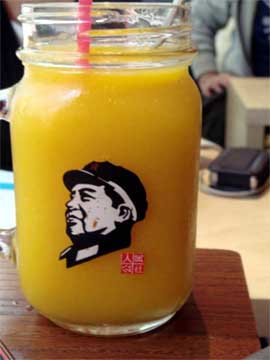
But Mao's head portrait still makes people uneasy.
We bought a few good books. Based upon our spending level, this was expensive, but there books are simply not available in Beijing. As I was leaving, I noted a copy of <The Empire of Lies> on the bookstore with the word "Fire" (火) noted on it. I asked the young man in the bookstore what that means. He smiled and said that it means that the book is selling well. My husband was blushing like a child as he picked up the book and said, "This book mentions us." He flipped to the section about AIDS in China and showed the young man, who was laughing like sunshine: "What don't you make an annotation that you were here. You are someone not liked by the Chinese authorities, and we are a bookstore that they don't like."
As they chatted in a low voice, there were a few relaxed readers in the store and the air had the feel of the mild dampness of see breeze. I did not have to turn around to see if someone was tailing us, I had no fear, I had no embarrassment and I had no particular joy. I was just relaxed and I bid farewell to the young man. At the moment when the door closed behind me, I wanted to freeze time in this instant.
[006]
The Number of Bird Species (03/02/2007) In researching The
Hong Kong Chief Executive Election Debate, it was frustrating. I
did not watch the televised debate (note: I'm presently in Adelaide,
Australia) and there is no transcript or even a detailed summary. The
candidates throw out numbers (such as the reserve funds of Hong Kong) and
challenge each other; one would think that the media would follow up but it
was hard to find a clear account. Instead, there is plenty of opinions
from image consultants and the like.
One number was noted at Over
The Rainbow. "Alan Leong noted that there are more than
500 species of birds in Hong Kong, even more than in China. The
colleague working on the China section of our newspaper immediately started
to search on the Internet and found that China has 1,500 species of
birds." Without the transcript, I must say that I'm totally
confused. I'm not even talking about the fact that Hong Kong is part
of China and therefore any Hong Kong bird species is automatically a Chinese
bird species. I just cannot imagine that there is some bird species
that knows that it must always stay on the Hong Kong side of the border and
never cross over into Shenzhen. I must be missing something here ...
Relevant data:
WWF:
"With a land area of only 1,095 square kilometres, Hong Kong is home to over 420 species of birds – roughly a third of the total number of bird species in the whole of China."
Wikipedia:
"Hong Kong is a major stopover point of Asia’s migration routes for birds. The wide varieties of local habitats including wetlands, grasslands, woodlands, seashores and farmlands contribute to the diversity of the birds. There are over 450 species of wild birds including residents, winter visitors, passage migrants, and summer visitors recorded in Hong Kong."
WWF:
"Hong Kong is a stopping ground or part-time home to more than 200
species of migratory brids when they travfel along the East Asian
flyway. Migratory birds actually make up the bulk of species recorded
in Hong Kong."
ChinaBirding:
"For example, De Schauensee(1984) recorded 1,1195 species of Chinese birds, Cheng Tso Hsin(1994) recorded 1,244, later Cheng Tso Hsin reported 1,253, moreover, 1,329 bird species were recorded by Mackinon in 2000."
P.S. There is always the audio and/or visual recordings at RTHK.
[005]
Anti-Japanese War Memorial Site (03/02/2007) (Chongqing
Evening News via Ming
Pao) In June 1951, the Japanese air force bombed the city of
Chongqing intensely and more than 2,500 peole died at a certain air raid
shelter. Afterwards, the site was preserved as a memorial place.
Recently, the site has been subjected to a barrage of urine and feces.
Every morning, the workers found piles of feces and pools of urine.
Although they remove the material every day, the smell persisted. The
media made a stake-out, and counted ten people urinating at the site in just
30 minutes.
So who is not respecting the memory of the war of resistance against Japan?
Why do the angry young people have to say?
[004]
Five Golden Flowers (03/02/2007) (Ming
Pao) On February 28, the Shenzhen Public Security BUreau
announced the "Five Golden Flowers" in which citizens can cilp out
the forms in local newspapers to vote for their favorite police women.
What happened was that the local police went out to buy up all the copies of
local newspapers in order to vote for their co-workers in the same police
station.
At Baoan Road, a police man came to a newspaper kiosk on a motorcycle and
bought all the several dozen copies of local newspaper. The two
storage cases on the motorcycle were stuffed with newspapers but the
policeman continued down the road to buy more newspapers.
Once this was revealed on the Internet, mass denunciations came in: "I
thought that this was for the people to vote, not for the police to vote for
themselves"; "The police sisters should probably be doing
something for the people instead of themselves"; "It is shameless
to be driving a motorcycle and buying up newspapers while on duty!";
"If the passion for electing the police 'golden flowers' were used for
solving crimes, the crime rate would be reduced by at least 50%."
When Ming Pao called up the Shenzhen public security bureau, they received
no reply.
[003]
Hong Kong By The Numbers (03/01/2007) (HKU
POP) (1,014 respondents surveyed on Feburary 22-26, 2007)
Results of a hypothetical voting between Donald Tsang and Alan Leong among
all persons:
74% voted for Donald Tsang
14% voted for Alan Leong
13% were uncertain
Of the demographic breakdowns, the most relevant one is political
inclination (self-selected from pro-democracy (61%), pro-China (6%),
moderate (37%), no preference (23%)):
Donald Tsang:
74% all persons
64% pro-democracy
97% pro-China
77% moderate
75% no preference
Alan Leong:
14% all persons
25% pro-democracy
2% pro-China
10% moderate
8% no preference
[002] Transfers and Promotions (03/01/2007) (Southern Metropolis Daily)
On February 26, two Chongqing important leaders replied to the public skepticism about the transfer of the Penshui SMS poem incident's principal Lan Qinghua to become deputy director of the Chongqing city Statistical Bureau. The key points were: first, Lan should not go without work given his work capability; two, Lan Qinghua was transferred horizontally but his new job has lesser power than his original job as county party secretary and this implies punishment.
From the raging Internet reaction, these statements did not placate the netizens but they only provoked a new round of criticisms ... the explanation laid open a piece of common knowledge in officialdom: every official would rather be a country party secretary than be at the Statistical Bureau. It is just so much more powerful and attractive. If you don't understand this hidden rule, then you won't understand the meaning of the "implied punishment."
So why do positions at the same level have different power? You can listen to what the fallen Wang Zhaoyao had to say. Wang had spent many years as a county and town party secretary (or 'number one'). In his confession, Wang explained "power" this way: "On job appointments, it was just a matter of my say-so, a wave of my hand, a telephone call or have a meeting with the relevant persons and telling them what to do. That was it."
"Just a single sentence" and "a wave of my hand" represent the power of the "number one." That is why so many officials want to have that "power." "Absolute power creates absolute corruption" is an immutable truth. If the officials really care about the people, if they are thinking about "the three represents" and if they are thinking about the "honors" and the "shames," they would not care about where or how they serve the people. Every department would be a place to contribute to the nation. Then how could a job transfer at the same level be a "punishment"?
[001] 36 People Decide Which Movies 1.3 Billion Chinese People Shall Watch (02/28/2007) (Singtao Net) (see also commentary at 一个和三十六个)
[in translation]
Who decides which movies the 1.3 billion Chinese people shall watch? The answer is: the motion picture review committee of the State Broadcasting and Motion Picture Administration. According to a person from the Broadcasting and Motion Picture Administration, the committee consists of 36 persons from various walks of life. They review and decide which movies may be exhibited mostly on the basis of the harmony between the ideological content and the current official policies, and they take their gate-keeping duties seriously. Of the eleven standards for motion picture review, only one pertains to the technique and quality of the movie while the other ten are about the ideology and substance of the movie.
<Legal Evening News> reported that the 36-person committee of the Motion Picture Review Committee controlled the life and death of Chinese movies. The thirty-six people are not all members of the Broadcasting and Motion Picture Administration. According to an insider, the committee members come from all walks of life. The known committee members include Beijing Cinematic Academy Department of Directing professor Zheng Dongtian, veteran director Yu Yang, National Women's Association Publicity Department director Zhu Xiaozheng, State Religious Affairs Bureau Joint Information Office director Xiao Hong, etc.
It is necessary to keep the gate in a serious manner in order to make sure that the ideology in the movies are consistent with government policies. The standards of review were based upon the <Motion Picture Administration Regulations> published in December 2001. Of the eleven standards for review, only one refers to the technical quality (e.g. color hue, sound recording, etc) of movies while the other ten are about reviewing the thoughts and ideological contents of the movies.
The review of the thoughts include: no leaking of state secrets, no putting state security in peril or damaging the national honor and interests; no incitement of ethnic hatred; no promotion of pornography, gambling and violence; no instigation to commit crime; no propaganda for superstitution and evil cults. For example, the movie <The Ghouls Are Coming> directed by Chinese director Jian Wen was banned because it portray Chinese citizens as being ignorant, numb and slavish during the war of resistance against Japan.
As for the method of review, the production unit must first begin its own "self review" and it shall make an application for review at the Motion Picture Administration. Then the review committee shall watch the film. This how the review process begins formally. As to whether the movie can pass, it will depend on the number of opinions from the committee members. If they have no opinion, then it will be passed immediately. The more opinions that they have, the bigger the problem. The production unit must respond within thirty days to the "advice for revision" from the Motion Picture Committee and re-submit the revised movie. If the motion picture passes the second review, it will be issued the <Permit to Publicly Exhibit the Motion Picture> from the Motion Picture Administration. If the motion picture fails the second review, it will have to be revised again (unless the production unit decides to abandon the effort). The motion picture review committee controls the power of life and death. When they review a movie, not all members need be present; only a committee majority is required to be present.
Generally speaking, revised movies will receive the permit to exhibit. There are occasional surprises. Chinese director Huang Jianxin's <Silver Ornament> passed the review at first. At the premiere, the original version containing nudity was accidentally shown instead. Under pressure, the movie was pulled after the premiere and has never been seen by a general audience.
Many movies that did not receive the permit may decide to take another path. Since the review of audio-visual recorded materials comes under the Ministry of Culture, many movies that could not procure exhibition permits may opt to apply directly for a DVD edition, or sell the rights to overseas distributors and then bring the movie back into mainland China in pirated form.
The major reasons why movies are banned are because they involve pornography, superstition, violence and criminal gangs which are deemed to be unsuitable for the general public, underage audiences or family viewing. A movie may also be banned for having too narrow a subject. The movie "Xiao Wu" showed the harsh life of a thief and was banned because the market was too small and the story lacked warmth.
These banned movies end up being preserved as "historical materials." Controversial movies such as <The Ghouls Are Coming>, <To Live>, <Blue Kite>, <Papa>, <Blind Shaft> and so on became historical material immediately after the review. Chinese audiences can only watch the pirated versions or else wait until the day when freedom of speech arrives and these films become available as "nostalgic movies."
Archives