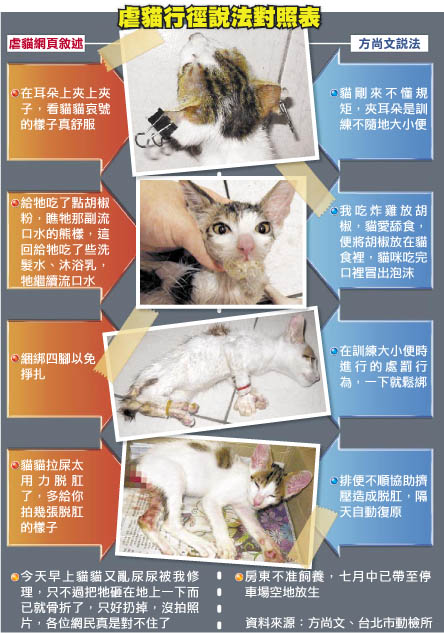
王世堅)
is famous for his exposés and harsh crticisms. In the August 31 issue
of Next Weekly, Wang was seen entering a hourly-rate motor inn with his young
female ex-assistant. They were in there for three hours.
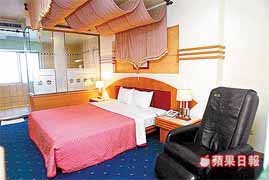
Afterwards, the reporter checked the room (VIP room 215) and found ruffled
bedsheets and pillows. The photo below is the cleaned room.
So what does Wang have to say?
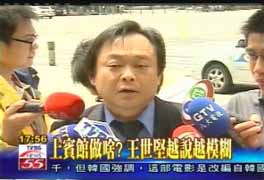
Yesterday, Wang held a press conference which was rated by reporters as quite
bizarre. Wang was not his usual eloquent self, but was tongue-tied and
confusing. He did not deny going to the motel with his assistant.
But he said that he was meeting a source, so there were three people in the
room. Then he said that there was another person, so there were four
people in the room. Then he said that there was the source, plus her two
children, so that were five people in the room. Wang played an audio
tape of the interview, but it was long, windy and unfocussed and it was
uncertain that the tape was made at this motel at this time. According
to Wang, the source (a Ms. Chang) wanted to donate a sum of about NT$300,000
to him for his August 26th activities but he returned the money to her the
next day. He also showed the SMS on his mobile phone from Ms. Chang, but
the SMS was dated August 29, after the motel date. Why meet in a
motel? Because Ms. Chang was staying there. Besides, bothi Ms.
Chang and his ex-assistant have gone there before ...

Related links: Pro-Chen legislator denies report of romantic liaison
By Shih Hsiu-chuan, Taipei Times; 《壹周刊》替天行道 踢爆王世堅帶前女助理(朋友的女兒)上賓館爆.......
.
- [117] YouTube as
Detective (08/31/2006) (Apple
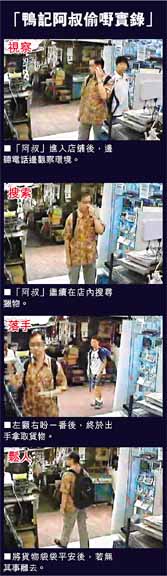
Daily) On August 19 at 3:50pm, a middle-aged man entered an
electronics store on Apliu Street, Sham Shui Po district, Hong Kong and
appeared to have stolen a micro-video camera. The man got away without
being detected at the time. The process was recorded by closed-circuit
television and the videoclip was posted at YouTube. The videoclip was
circulated around the forums and BBS. On August 26, the individual was
identified as a senior police officer in the Sham Shui Po precinct. He
was detained and risks losing his 30-year pension of more than HK$1 million
if convicted of theft. The video has now been removed by the poster,
but here are some screen shots.
Meanwhile, Oriental
Daily put this story on the front page and describes the
defense. The suspect admits to the individual in the film. When
he found out that the video was on the Internet, he went back to the shop
and begged for mercy while offering to pay for the item. The shop
refused. Then he claimed that he was just visiting the shop which
belongs to a friend and he was helping out to adjusting the proper camera
position. Unfortunately, someone created a joke and posted the
videoclip on the Internet. Hmmm ...
- [116] That Other Woman
(08/31/2006) Consider that issue of EasyFinder with the Gillian Chung
photos. Here is the front cover:

Who is the bared-back woman on the right hand side of the page?
Objectively, if we have to classify the magazine by the level of obscenity,
we bascially see much of Gillian Chung on the left and far too much of the
woman on the right.

Here is a better shot of Chen Zihan (
陈紫函),
who was in the television martial arts series The Return of Condor Heroes.
According to Wenxue
City, Chen has said: "I'm in a situation in which I cannot defend
myself. This affair has destroyed my image completely."
According to information, Chen was invited to go to the EasyFinder office to
take some photographs for promotional purposes. She was tricked into
changing her clothes in the presence of an all-female working crew. For
this particular photograph, Chen said: "They were testing for the
lighting effect and they called out to me suddenly. I turned around and
that was when they took the photograph." When she was told that the
photos were published in EasyFinder accompanied by some "unhealthy"
language, she was concerned but she was unable to contact the EasyFinder
editor anymore. When she finally received a copy of the magazine, she
was shocked.
- [115] Hypocrite Lecteur
(08/31/2006) From the poem Au
Lecteur from Charles Baudelaire's Fleurs du Mal
Tu le connais, lecteur, ce monstre délicat,
— Hypocrite lecteur, — mon semblable, — mon frère!
Presentation #1: Why am I unenthusiastic about the
outcry over the Gillian Chung photos in EasyFinder magazine?
Fact#1: Gillian Chung is contracted to the Emperor Entertainment Group.
Fact#2: The owner of the Emperor Entertainment Group is Albert Yeung.
Fact#3: Albert Yeung also owns the weekly magazine Oriental Sunday.
Fact#4: Oriental Sunday is a competitior of EasyFinder and its sister Next
Media Group publications such as Next Weekly
Fact#5: Oriental Sunday once ran this front cover of long-range snoop photos
of actor/singer Leon Lai being "swallowed/sucked/stripped" by a
girlfriend (note: an extra print run was made in response to consumer demand)

Where were these protestors when this happened?
Presentation #2. Why am I unenthusiastic about the outcry over
Shanghai sex blogger Chinabounder?
Fact: The following screen capture was taken of the copy of Professor Zhang
Jiehai's post at the Tiexue BBS.
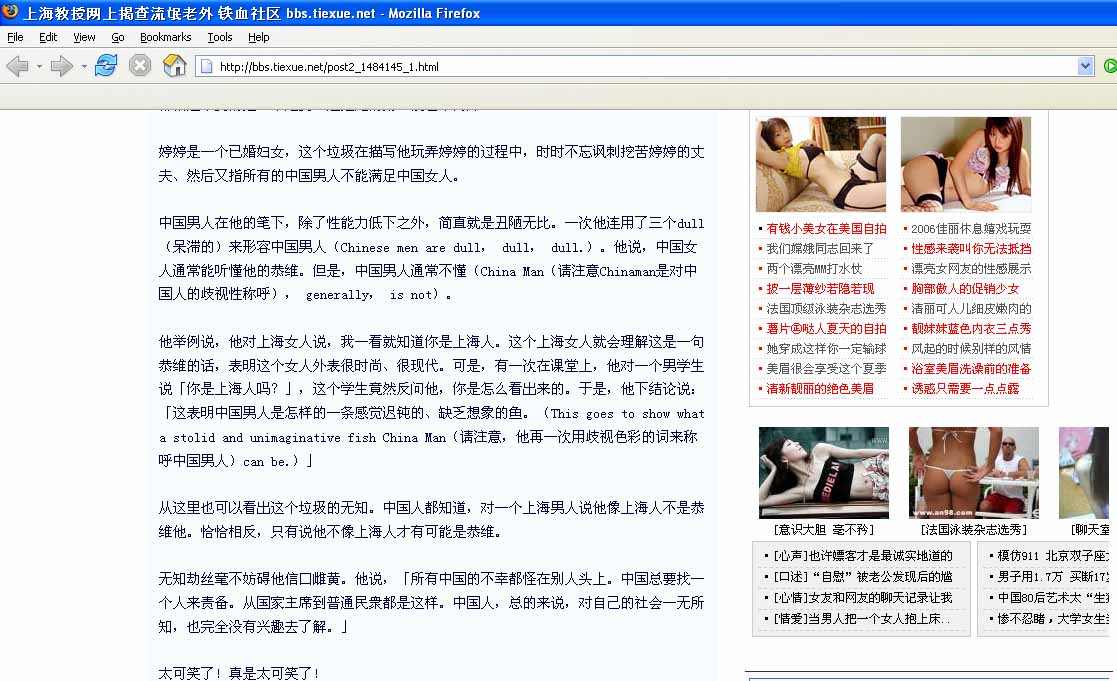
With due respect, the stuff on the right-hand-side is not about treating women (Chinese and foreign) with
respect. But why then is no one outraged? Instead, this is accepted as
commonplace.
I am a simple person who only wants moral consistency.
- [114] Andy Lau Is Dead
Again (08/31/2006) How many times must the man die for the
profits of others? How many times must his manager answer queries and
say that he is alive?
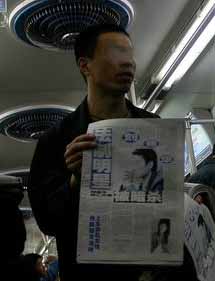
(Aside)
May 9, 2006: "Special news: Andy Lau was assassinated yesterday in Hong
Kong by the triads." At around 11am today, on the Beijing number
2 subway line, a man was selling the newspapers known as Legal Star.
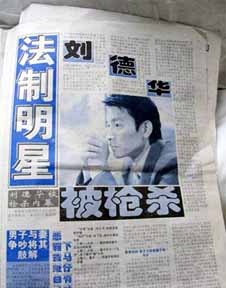
(Noon News via 6Park)
August 29, 2006: "Superstar Any Lau shot to death" according to
the newspaper Legal Star distributed in the Beijing subway systems.
According to the newspaper, Andy Lau received a phone call at this birthday
party and left in his car. The car was intercepted by a truck from
which six gun-wielding men emerged and shot Lau and his bodyguard.
Look at the front pages --They did not even bother to change the
photograph. More background at Illegal Legal News in China.
[in translation]
People are different. Whether it is the Chinese
people or foreigners, men or women, there are noble as well as vulgar people
and there are honest as well as conniving people. Gender and
nationality do not account for all that. If northern Chinese can form
happy families with southern Chinese, then why should a Chinese woman going
with a foreign man be held in contempt? Several million Chinese have
gone overseas to pursue their dreams, so why is a foreigner working or
studying in China a loser who couldn't make it back home?
Chinabound wrote about this personal experiences and
views. Right or wrong, we should not turn this into a battle among
Chinese men, foreign men, Chinese women and foreign women. Why do we
have to start a war with all of China against one foreigner who dislikes
China and disrespects Chinese people? He is just a passerby in the
long history of China. I don't believe that he is happy and satisfied
inside, so why not let him be? We have enough important things to do
such as enjoying our work and lives and loving ourselves and others ...
First, we respect this values of this hooligan
foreigner. At the same time, we ask that this
freedom/democracy/rights-advocating foreigner also respect the values and
morality of the Chinese. Equality means mutual respect.
Next, the promiscuity of the foreigner is his own
freedom. But to publish openly the details of his dalliances with
Chinese women, to attack Chinese men verbally and to advocate separatism of
Chinese territory on the Internet offends all Chinese people.
Finally, the westerners' human rights values are derived
from Kantian ethics. The second rule is: "Do not treat people as
the tool to achieve your objective" because that is an unethical
violation of human rights. The foreigner dallied with Chinese girls to
satisfy his animal lust. I think that you violated the rights of the
Chinese and your actions were unethical.
- [112] Apple Daily
Slams EasyFinder (08/30/2006) (SCMP; no link) Here is a
translation of the Apple Daily editorial on the Gillian Chung photos.
This is a huge story in Hong Kong and it was expected that Apple Daily would
have to eventually say something. So here it is.
"We consider it a mistaken and highly inappropriate act to take photos of people changing clothes. Easy Finder was wrong to publish such photos.
"It compounded the wrongdoing further with its decision to order a reprint in an effort to boost circulation.
"The fact that Gillian Chung Yan-tung was changing her costumes while performing in Malaysia is not major news, nor does it have any major public interest implications. What is the justification for taking pictures using such highly intrusive and clandestine means? What is the justification for Easy Finder to publish such photos and ask for a reprint?
"The people who took the photos are no different from those who secretly take photographs up women's skirts in the street. How can such an act not be a wrongdoing? And how can Easy Finder not be committing a wrongdoing by printing and reprinting such photos? However, we consider it dangerous to introduce legislation on the way journalists gather news. It will seriously undermine the power of the media in monitoring the government and its officials."
- [111] Second
Anniversary (08/30/2006) Oh, my God! My brain must have
been friend because I missed the second anniversary. Here is the first
anniversary message (Comment
200508#133) reproduced here:
With due respect, August 27 is the anniversary of the four-day trial
of the libel suit against Chen Guidi/Wu Chuntao without a verdict (see previous
post). What can the court be waiting for? This is a civil suit and the verdict should be delivered within one week normally. Do they think that if they wait long enough, this whole thing will go away by itself? That won't happen if people like me keep bringing it up. If you are a blogger too, I would ask you to post a happy anniversary note as well.
- [110] Hong Kong Police
raid Citizen Radio (08/30/2006) (The
Standard) Police raid Citizens' Radio. By Jonathan
Cheng. August 30, 2006.
Police and government officers raided Hong Kong's only unlicensed radio station Tuesday evening, arresting one man and issuing verbal warnings to two others in a long-anticipated sting against Citizens' Radio which is operated by activist Tsang Kin-shing.
The raid occurred just as the underground radio broadcasters were preparing to go on the air for their 7pm show on FM 102.8 in Chai Wan.
Police, who launched the operation with the Office of the Telecommunications Authority in tow, also seized computers and equipment.
Police simultaneously launched three other raids on hillslope locations in Kowloon. Altogether, they confiscated seven pieces of equipment and three sets of radio transmitters.
...
The authority issued a statement late Tuesday night, calling it a matter of "duty to clamp down on unlicensed use of radio-transmitter equipment."
"After months of investigation and close surveillance, we decided to take action this evening. In this operation, other than the radio transmitter equipment, we also targeted the radio equipment at the Citizens' Radio's studio which was used for relaying the content," the statement read. It described the three hillslope locations as transmitting stations, while the Chai Wan operation was used as a studio.
"Unlicensed use of radio transmitters would cause harmful interference to other legitimate spectrum users," the statement said, adding that the authority "would not tolerate such illegal activities."
The maximum penalty for a conviction under the law is a HK$100,000 fine and five years' imprisonment.
You can read the rest of the article with statements from
the usual list of democratic activists. With due respect, this is the
same old issue from before: Citizens' Radio in Hong Kong.
This Citizens' Radio (FM 102.4) is squatting on the frequency band of
Metro Finance radio (FM 102.8), which legally obtained a government license to
operate at that frequency band. The government's position is that the
frequency band was legitimately assigned to Metro Finance and therefore any form
of squatting by anybody is illegal. Citizens' Radio does not address this
issue. This question is not about public radio space, citizen media
participation or freedom of speech/press. It is about the rule of
law. Booting Metro Finance out to make way for
Citizens' Radio for expediency or turning a blind eye towards squatting with
pirate equipment = giving up the rule of law. It is as stark as
that. You decide.
- [109] Western Media
Begins FoxConn Coverage (08/29/2006)
- China paper vows to support staff in defamation case
Reuters
- China court freezes journalists' personal assets over iPod story
AFX
- Foxconn sues Chinese media over sweatshop report
Interfax (subscription)
But the prize for the best mainstream report so far goes to ... People's
Daily Online!
Here is the next reseach question: Does Apple's Supplier Code of Conduct
have anything to say about their suppliers intimidating reporters through
ruinous litigation in order to prevent reporting? If not, then ask
Apple why not? That is, does Apple (or Dell, or Sony, or Nokia, or HP) condone this kind of
behavior?
[Update] I went out to dinner and when I came back, this is
what I found through Google News and Technorati. The tide is coming in ...
- Ipod subcontractor is suing over article on employees
Agence France Presse
- Chinese Court Targets 'iPod City' Reporters
Deutsche Presse-Agentur
- IPod maker freezes reporters' assets
vnunet.com
- Foxconn Sues Journalists For Reporting Tech Labor Issue
China CSR
- Chinese court freezes assets of iPod plant journalists
PC Pro
- Foxconn sues reporters over iPod story
MacNN
- Foxconn sues journalists over 'iPod factory' claims
Macworld UK
- China Court Freezes Journalists' Personal Assets Over Apple iPod Story
SDA India
- Foxconn shoots itself and Apple in the foot
Will Moss, CNET Asia
- Foxconn sues two Chinese journalists over iPod city story
Ryan Block, Engadget
- Apple Computer urged to intercede for two reporters who exposed bad conditions at supplier’s plants
Reporters Without Borders
- Picking on the weak
Tim Johnson, China Rises blog
- Lawsuits and sweated i-pods
Blood & Treasure blog
- Foxconn and the fourth estate
Shanghaiist
- China: chain effect on ipod maker’s legal action against journalists
Oi Wan Lam, Global Voices Online
- La Red : Foxconn demanda al periodista que publicó la historia de las "fábricas del iPod"
www.faq-mac.com
- Foxconn will Journalisten mundtot machen
Mac Essentials
- Chinese journalists in trouble for iPod story
San Francisco Chronicle
- Foxconn Sues Journalists For Reporting Tech Labor Issue
China Tech News
[Update] I went to sleep and this is what I found when I woke up.
- Chinese court freezes assets of journalists in iPod exposé
The Guardian
- China IPod Journos Speak
Wired News
- Apple asked to intercede on behalf of Chinese reporters
CNETnews.com
- Foxconn Sues Two Journalists Over "Sweat Shop Labor" Stories
DailyTech
- iPod Labor Fiasco Update: Apple Contractor Suing Reporters for Uncovering Oppressive Practices
Podcasting News
- iPod sweatshop hits back at reporters
Silicon Valley Sleuth
- iPod Factory Makes Even Apple's Treatment Of Bloggers Look Good
Techdirt
- China IPod Maker, Journalists in Dispute
Associated Press
- Chinese media protest Hon Hai suit
Financial Times
- Apple trying to resolve dispute at Chinese iPod factory
Associated Press
- Hon Hai explains accusations against Chinese journalists
DigiTimes
- iPod City : Foxconn attaque les journalistes
Clubic.com
- What makes news?
Richard Spencer, Telegraph blogs
- Save us from court action, Chinese ask Steve Jobs
IDG News Service
- [108] FoxConn Coverage
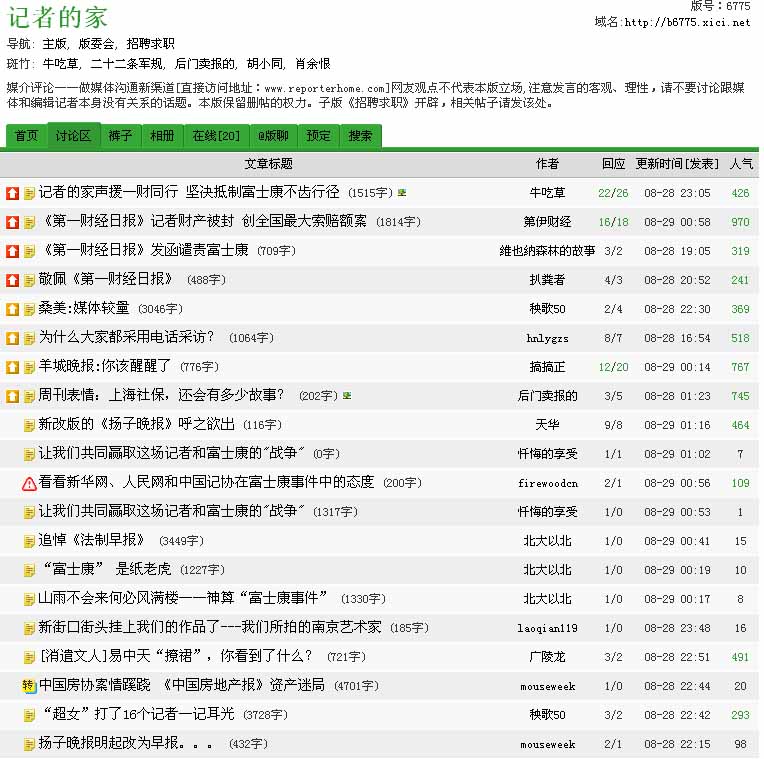
Update (08/29/2006) Here is a comparison of interest. On
one side, there is ReporterHome.com
(
记者的家),
regarded as the Internet forum of choice for serious Chinese
journalists. By my count, nine of the twenty listings from the top are
about the FoxConn case with words like boycott," "disgust,"
"condemnation," "paper tiger" for FoxConn and words like
"admiration" and "victory" for the First Financial Daily
reporters.
Meanwhile, at Google News at this very
moment, the top 20 search results for the keyword "FoxConn" are:
- Nasty Results Rear BenQ in Two (August 28, 2006)
- FoxConn boxes make the eyes boggle (August 25, 2006)
- Apple clears FoxConn iPod China plant mostly (August 22, 2006)
- Foxconn handset keypad development may affect Siltitech orders (August 23,
2006)
- Apple Releases Report on Foxconn's China Labor Issues
- Journalists
sued over iPod story (Shanghai Daily) (August 29, 2006)
- How does Foxconn do it? (August 24, 2006)
- Taiwan market: Acer offering SFF desktop manufactured by Foxconn (August 22,
2006)
- Sunarrow technical team reportedly joins Foxconn (August 22, 2006)
- Apple releases results of Foxconn probe on employee treatment (August 18,
2006)
- BenQ stock surges on Foxconn investment rumors (August 15, 2006)
- Gemtek and Foxconn finalists for Sony PS3 WLAN ordres (August 16, 2006)
- Apple readying to give Foxconn another contract?
- Flextronics to challenge Foxconn in motherboards (August 15, 2006)
- Foxconn seeking to become Apple notebook manufacturer (August 16, 2006)
- Foxconn International gets Motorola assemly orders (August 13, 2006)
- More Foxconn merger rumors, this time with Quanta as the bride (August 15,
2006)
- Foxconn International likely to assemble Motofone handsets for ... (August
14, 2006)
- Apple: Foxconn violated code of conduct (August 17, 2006)
- ICFTU criticizes Apple Foxconn report (August 18, 2006)
This is the day when an
English-only reader will have to depend on state-owned Shanghai Daily to get
this story. Oy vay!!!
If I can make this case very simple. This is not a question of whether
the First Financial Daily reporter was right or wrong in his reports. Either
way, FoxConn is entitled to file a civil libel suit against the newspaper,
which employs that reporter and her editor. But since when does a civil
libel suit involve freezing the assets of the reporter and the editor,
including their bank savings accounts, stock holdings, homes and automobiles,
to the tune of 10 million RMB for the editor and 20 million RMB for the
reporter? As the reporter noted, this amount is many more times than
that which she can ever expect to make in her lifetime. By comparison,
how would the western media react if a prominent American newscaster such as
Katie Couric is sued by a large corporation such as Exxon-Mobile or MicroSoft and have all her personal assets
frozen for the duration of the legal proceedings? The Chinese media workers are of
the opinion that if this case were allowed to go through, it will be the end
of any coverage of the doings of large corporations.
So why are the western media and press freedom organizations silent on this
affair? Why is Shanghai Daily the lone voice in the wilderness?
The lesson from FoxConn's similiar attempt in Taiwan in 2004 was that the
pressure from international media organizations made them back off. Where
are those voices now?
Related link FoxConn is not dumb, but downright vicious
Non-violent Resistance, 08/28/2006.
- [107] Contesting
Sergeant Keroro (08/29/2006) (Apple
Daily) Sergeant Keroro is a Japanese anime/manga series, but
his likeness has been expropriated in the pro-/con-Chen Shui-bian fight in
Taiwan. There is a YouTube
video in which a Sergeant Keroro has been re-edited and re-dubbed.


In this clip, the green alien frog Sergeant Keroro is seen to be going after
the blue alien Private Second Class Tamama with Chen Shui-bian's speech in
the Legislature against the pan-blues after the recall motion: "Could
A-Bian be wrong? Could A-Bian be wrong? Could it be that A-Bian
is wrong?"
For this clip, both camps were able to spin to their advantage. For
the Bian supporters, this is a way of bringing up the speech and watching
the cowed blue soldier back away in fear. For the Bian opponents,
Keroro is exactly A-Bian -- just a frog who likes green, shoot his mouth
off, talk about invading the blue planet (=earth), buy armaments that sit at
home and do nothing, and afraid of women.
- [106] The Price for
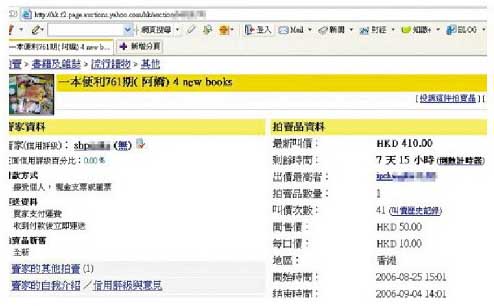
EasyFinder #761 (08/28/2006) The following screen capture from
Yahoo! auction site was shown in Hong Kong newspaper am730 (no link).
The auction object was issue #761 of EasyFinder magazine with the snoop
photos on Gillian Chung. The list price of the magazine was HK$20, and
the seller opens with HK$50. Forty-one bids later, the latest offer
was HK$410. It is noted that the magazine has been classified as Category II
Obscene Material. This means that to be sold legally, it must be
wrapped under transparent plastic wrapping matter with the appropriate
Category II warning messages printed and it must not be sold to a minor.
- [105] The
FoxConn-First Financial Daily Case Goes National/Global
(08/28/2006) Globally speaking, this went from DoNews
(China; in Chinese) to InMediaHK
(Hong Kong; in Chinese) to EastSouthWestNorth
(Hong Kong/USA; in English) to Slashdot
(USA; in English). No global mainstream media have picked this story
up yet, but it will not be too long because the Chinese mainstream media has
exploded (see the following).
Nationally inside China, the Non-Violent
Resistance blogger wrote:
Not many people have noticed this, it seems; but I have just called my colleague the legal editor of my publication, and asked him to see if we can get a hand on this story next week: FoxConn, the Taiwanese company and manufacturer of iPod, has taken two Shanghai journalists to court and frozen their assets for writing stories about its the sweatshop labor conditions in the company's iPod factories in Shanghai.
I was simply shocked and confused when I first read this on Saturday's Beijing Times; but now that I've read from ESWN about what the same company did to a Taiwanese journalist for the same "offence", it all starts to come together. Terry Guo (Guo Taiming), Taiwans' richest man and the boss of Hon Hai Precision Industrial who is in turn the parent company of FoxConn, has been very good and consistent at this: you run negative coverage of my sweatshops in China, I sue you for an amount of money you cannot wish to make in your entire life, whether you are a British, Taiwanese or Chinese journalist. In the case of the two Shanghai journalist defendants, editor Weng Bao and reporter Wang You of the China Business Times, the damages asked for were 10 million yuan (US$ 1.25 mil) and 20 million yuan (US$ 2.5 mil) respectively.
The reason that I am so angry about this is not only that FoxConn and Guo chose to list the journalists themselves as defendants, but that a Chinese court would be stupid enough to consent to this and proceed to freeze the journalists' personal assets. As the Beijing News story quoted a Renmin University law professor as saying, Chinese law doesn't even support such a claim: according to a judicial interpretation issued by the Supreme Court in 1993 on libel cases, if the literary work at dispute is written by full-time journalists while fulfilling their work duties -- reporting and writing for their newspaper, in this case -- then only the employer i.e. the newspaper, should be listed as the defendant. The journalists are entitled to petitioning the court and lift the freeze on their personal assets and they have done so. The court has yet to respond. The Beijing News story didn't say which STUPID, STUPID court in Shanghai did this; but come to think about it, it's not that much of a surprise -- Shanghai has always been ultra-friendly to Taiwanese businesses and businessmen, and Hon Hai is probably the biggest overseas investor in the mainland. So what we have here, barring too rash a conclusion, is PROBABLY a case of the local judiciary bowing to a powerful investor and taxpayer.
Update: OK, my premise was not exactly true: by Monday, everybody has noticed this latest controversy and Sina News has even set up a special section dedicated to
this. The China Business Times in a quasi-editorial openly condemns FoxConn's intimidation tactics and calls for help from the Chinese press circles. They certainly have my sympathy this time. Time to flex our muscles and kick some blood-sucker ass, brothers!
Indeed, in today's Southern Metropolis Daily, there is one
full-length article and one opinion column on FoxConn. In the short opinion
column by Li Kanli
李甘林,
it was noted: "It is the professional duty for news reporters to expose
conditions in sweat factories. FoxConn does not sue the newspaper, but it sues the
reporter instead, including asking the court to freeze the personal assets of
the reporter. It is incredible that the court should accept the
petition. Even if the total assets of the two individuals are frozen,
that would be far short of the astronomical demands of 10 and 20 million RMB
respectively. What is the point of the court freezing the assets of the
two reporters?"
In the long feature article,
the entire affair is recounted in detail, together with FoxConn's previous
anti-media case in Taiwan (see Comment 200608#098).
Then Peking University law professor He Weifang was interviewed (and this
time, it is likely that an actual interview took place with Professor He! see Comment
200608#094!).
[in translation]
Peking University Law School professor He Weifang thinks
that this case is absurd: "Large enterprises should be subject to
rigorous monitoring by the people and the media. The most absurd thing
is that the target of the lawsuit was not the newspaper but the
reporter. It is the professional duty of the newspaper to publish in
the newspaper, because this is what the newspaper asked him to do.
Therefore, the wrong entity has been sued. Furthermore, the court has
not even done even the most basic investigation before freezing all assets
of the individuals. This creates an impression to people that every
stage of the process is seriously flawed."
He Weifang said that the rule of law is just beginning in
China and sometimes people get the impression that they can use the law to
get whatever they want. "Since they have plenty of resources and
money, their judgment has been correct so far."
"This is a form of intimidating abuse of power,"
said He Weifang. "They wanted to use this method in order to intimidate
all the other media. I think that this is an serious issue that must
be considered by the judicial authorities when handling the case.
Isn't it frightening when the media won't dare to say anything about what
corporation and governments do?" "No matter what the outcome
of the case may be, it is worrisome at this point."
Related link (in Chinese): 《第一财经日报》发函谴责富士康
Beijing News, 08/28/2006; FoxConn is not dumb, but downright vicious
Non-violent Resistance, 08/28/2006; All
the news that's unfit to print in China Andrew Leonard,
Salon.com
- [104] Thai Duck
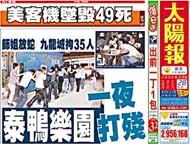
Paradise Lost (08/28/2006) (The
Sun) Finally, we have a day in which Gillian Chung is not on
the front page! So what do we have here? "A night raid lays
waste to the Thai duck paradise"!
Due the large number of restaurants and bars run by Thais, the Kowloon City
district of Hong Kong is known as Little Thailand. A side industry has
developed in which there are handsome young Thai men available for
'friendship' with women and gay men. In Cantonese, the term for male
prostitutes is 'duck.'
Since these duck shops cater only to regular customers or Thai nationals,
the Hong Kong police had difficulty in collecting evidence. So they
found a dark-skinned Hong Kong police woman to cruise the bars as if she
were a southeast Asian woman.
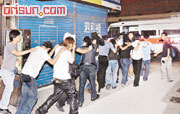
Yesterday, the police worked with the Immigration Department to raid four
bars in Kowloon city and took away 30 Thai male nationals who are here on tourist visas.
Presumably, they will be charged with violating the terms of their visas by
working. Another five Hong Kong residents were arrested.
Presumably, they will be charged with hiring illegal laborers. Please
note: there is no mention of prostitution charges anywhere, for such is the
uniqueness of Hong Kong law.
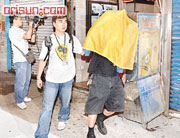

- [103] More Gillian
Chung Photos (08/28/2006) (MOP)
If The Sun won't feature Gillian Chung on the front page today, a Japanese brothel had no qualms
about using her photograph to advertise the presence of Hong Kong girls in
their goldfish bowl. Please proceed to the fourth floor to get
serviced!!


- [102] Taiwan By The
Numbers (08/27/2006) (China
Times, China
Times) (1,023 adults interviewed by telephone on August 23-24 using
a random sample from the telephone directory with the last two digits of the
selected numbers being randomized again)
For the anti-Bian movement led by Shih Ming-teh, 42% of
all respondents are supportive, 30% opposed and 29% gave no opinion.
When the movement began on August 17, the support level was 47%; after more
than NT$100 million have been donated, the support level has dropped to
42%. On August 17, 32% opposed.
Concerning the recent criticisms of Shih Ming-teh by the
Democratic Progressive Party, 55% of all respondents said that Shih's past
is unrelated to this movement, and only 19% think Shih's personal morals
disqualify him from leading the movement. Most pan-blues and
independents think it is unrelated, and 38% of pan-greens think it is
unrelated.
61% said that the Democratic Progressive Party is ruining
its own image by criticizing Shih Ming-teh, and 10% said that it enhances
the party's image. Most pan-blues and independents think it has been
damaging and 49% of pan-greens think so too (and only 18% of them think that
it helps).
Will A-Bian stay as president? 60% believe that
there is little likelihood that the movement to oust him will succeed and
only 8% believes that it could succeed (compared to 12% on August 17).
As to the impact on social harmony, 53% are worried that
it may be disrupt social harmony while 38% believe that it won't.
Among the pan-blues, 36% are worried; independents 58%; pan-greens 74%.
(Apple
Daily) 427 more adults interviewed by automatic dial-tone
telephone on August 26.
-Support bringing down Ah-Bian, and will join silent sit-in
36% August 9
22% August 19
15% August 26
- Support bringing down Ah-Bian, but will not join silent sit-in
44% August 9
57% August 19
48% August 26
- Support Ah-Bian and oppose Shih Ming-teh
16% August 9
17% August 19
24% August 26
- Don't know/no opinion
3% August 9
3% August 19
13% August 26
- [101] Cyber Terrorist
Threats in Taiwan (08/27/2006) (UDN)
In a chat room on Yahoo! (Taiwan), an open letter was posted about a planned
bomb attack on the Taipei main train station at 11pm yesterday from the
"National Salvation Brigade" (救國團).
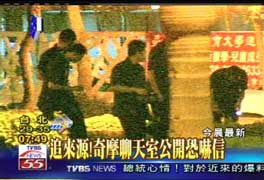
At 3pm, the Railroad Police Department searched through all corners of the
station that may have explosives. At 9pm, the Railroad Police even
brought in two bomb-sniffing dogs to go through all the storage lockers,
garbage receptables and restrooms.

(TVBS)
Another open letter in a Yahoo! (Taiwan) chat room also from 'National
Salvation Brigade' claimed that at 11pm, there will be a full attack on the
President's residence at 11pm, August 26. The letter also contained
detailed descriptions on how to manufacture gasoline bombs (and reminded
the participants to bring lighters!).
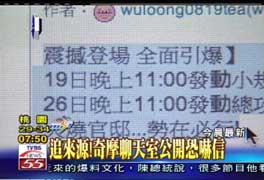
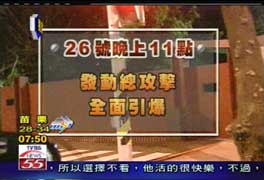
What about any police investigation into the person who posted these
letters? Well, the user account was set up in the United States and so
the police will have to figure out to get the information from Yahoo! (USA).
- [100] An Internet Trap
(08/27/2006) At the HKGolden forum, a recent forum
post by member "Peace and Love" was titled "The
unpublished Gillian Chung snoop photographs have come out" and asked
people to leave their email addresses to receive those secret photos.
Within a short time there were more than 100 email addresses already.
There were also other netizens who said that "Peace and Love" was
setting up a prankish trap using those non-existent photos (and therefore
email addresses such as youasshole0n79@hotmail.com, whofukingcares@yahoo.com.hk,
diu_lee_lo_mo@on9.com (meaning "fuck your mother, you fucking
idiot"). Unfortunately, a 13-year-old boy studying in England
from Hong Kong left his email, with which someone else was able to look up
his particulars (including full name, Hong Kong and UK addresses, telephone
numbers, ICQ number, birth date, photos, website, etc). Alternately,
that email address was left by others to make it appear that this boy sent
it. Anyway, this is not good ...
- [099] The Case of Ding
Wan-ling (08/27/2006) (Taiwan
News) Journalist loses job for anti-Chen outburst.
August 25, 2006.

A reporter with the Chinese-language United Daily News was removed from his post yesterday after he shouted at President Chen Shui-bian (
陳水扁), demanding he step down from the presidency while covering an award presentation ceremony in Taipei.
In front of dozens of TV cameras, the reporter, identified as Ting Wan-ming
(丁萬鳴), shouted "President Chen step down!" at the president while waving a placard saying "Depose Chen" after Chen delivered a speech at a ceremony marking the presentation of awards to producers of "products very well made in Taiwan" for the year.
Ting was immediately subdued by three security guards and his poster and folder was also removed and checked. Chen was escorted by other guards as he swiftly left the scene without looking back or saying a word about the melee.
Ting told other reporters later that he was speaking for "more than 60 percent of the Taiwanese people" who think Chen should be removed from office as he has lost the trust and respect of the people.
Ting said he shouted at President Chen on impulse as he wished to remind President Chen what people think about him.
"President Chen does not seem to able to hear what people say about him these days as he is always surrounded by guards wherever he goes," Ting said. "Only on these kind of occasions can we tell him what we think about him and his leadership."
Ting was released after he was questioned by police and officials from the National Security Bureau (
國安局).
In response to Ting's outburst, the United Daily News authorities issued a statement later in the day saying that Ting had severely violated the journalism principles and work ethics. As a journalist, the statement said, Ting should know how to separate his personal political affiliation from his job.
The United Daily News respects its staff members' personal political affiliations but also strictly requires all staff to observe journalistic ethics while on duty, the statement said.
The statement said Ting would be removed from his post as a journalist and transferred to another post at the daily.
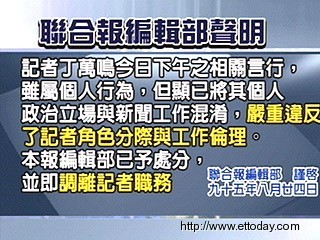
Please note that Ting Wan-ming was removed/re-assigned forthwith without anyone
really attempting to defend his right. Government spokesperson Cheng Wen-tsan (
鄭文燦)
said: "Ting had gone past the boundary for news gathering. Although
a news reporter is a citizen, the reporter plays a different role. A
citizen can express his opinion anywhere; but a reporter has the right to
gather information and he can therefore come and go at various places on
account of that right. The rights of reporters should be defended.
The reporters can write special essays to express their opinions, but when a
reporter becomes an actual participant, protestor and activist, then there is
a confusion of identity and a role conflict."
But here is the mystery (or maybe it is no mystery):
Whatever happened to all the people who were up at arms to defend the right of
Epoch Times reporter Wang Wenyi to disrupt Hu Jintao's speech on the White
House lawn and to tell him that his days are numbered (see Hu Jintao At The White House)? Why are they not
defending Ting Wan-ming? Unless such cases are
permitted selectively, depending on whether your speech is deemed noble or
ignoble by them.
- [098] FoxConn Sued
Newspaper in Taiwan (08/27/2006) In FoxConn
Sues Newspaper, the Taiwan-capital technology manufacturer FoxConn sued
Shanghai-based First Financial Daily for mis-reporting on its factory
operations in China. Taiwan-capital, eh? So is there a precedent
of FoxConn in Taiwan? If so, what lessons can be learned from its
ultimate resolution?
(Association
of Taiwan Journalists) Terry Guo (
郭台銘), Chairman of Hon Hai Precision Industrial (鴻海科技)
(parent company of FoxConn) and the richest man in Taiwan, objected to
Commercial Times reporter Kuang Wen-chi (曠文琪)'s
article of April 29, 2004 and filed a lawsuit against her personally.
Kuo's company put down NT$10 million in a Taiwan court to ask that Kuang's
assets (to the maximum value of NT$30 million) be frozen in the event that
such an amount should be awarded to Hon Hai. This obviously set a bad
example of how big business can afford to use its huge legal and financial
resources to quash the livelihood of an individual reporter. Apart from
this case, it also set a bad precedent for all future media reporting on big
corporations.
The Association of Taiwan Journalists therefore took it up with the
international media organizations to make this case a center of attention; the
association also approached the major clients of Hon Hai such as Dell, Sony,
Nokia, HP, etc to remind these companies that this supplier is knowingly
overlooking basic human rights. Eventually, Hon Hai abandoned the
lawsuit in the name of "sparing society of the trouble caused by the
lawsuit."
What is the lesson for the First Financial Daily, its editor and its
reporter? They need their media associations to work on their
behalf. Ah, but of course, there is no such working entity in China like
the International Federation of Journalists or the Assocation of Taiwan
Journalists. They also need international attention. For example,
Apple needs to be informed that while they have just finished the audit of
FoxConn with respect to factory working conditions but FoxConn is also
presently engaged in the intimidation of the press to insure that no further
bad news ever gets reported.
Related Link: Technology journalist's assets seized by angered company
Custom PC, December 17, 2004.
- [097] Gillian+Chung+Easyfinder
(08/26/2006) Website traffic here soared to five times the normal
average from Google/Yahoo searches for the keywords "Gillian Chung
Easyfinder." There was only a brief comment here (Comment
200611#083), but the high Google rank of this site shoots it to the
top of the results. Here is today's developments in the case via SCMP
(reported by Vivienne Chow):
The Easy Finder magazine edition containing pictures of Canto-pop idol Gillian Chung Yan-tung changing her clothes has been classified as Class II indecent by the Obscene Articles Tribunal.
The interim Class II classification, which means the issue cannot be sold to anyone under 18, came as complaints about the publication doubled in a day to 1,726. Publisher Next Media has five days after receiving notice of the classification to seek a full hearing.
This is a post facto classification announced on
Saturday for a weekly magazine that appeared on Monday. What is that
going to do for the newsstand sales? The additional 15,000-copy printing
is sold out already. By the way, the magazine was being offered at HK$50
on the Internet (versus cover price of HK$20).
The number of complaints leapt from 812 on Wednesday, surpassing the 1,656 and 1,650 lodged against two articles in Yes! magazine in 2004, and the 1,149 against Eastweek for featuring a nude actress on its cover.
The Hong Kong Performing Artistes' Guild condemned the magazine and said existing laws were outdated. The organisation urged the government to protect the interests of artists and the public.
The case continued to draw public protests. Twins' fans petitioned Tela to take action, and the Hong Kong Women Development Association marched to the Tseung Kwan O headquarters of Next Media demanding an apology.
The Equal Opportunities Commission denounced the photographs of Chung as "an affront to women". It said the publication was clearly invasive and offensive.
Missing from that list is Catholic Archbishop Joseph Zen,
who was quoted in Oriental
Daily: "
日 日 有 咁 多 雜 誌 咁 做 , 咁 理 所 當 然 係 錯 事 , 我 有 冇 需 要 次 次 都 發 表 意 見 呢 ?
(So many magazines come out every day and so something goes
wrong. Do I need to express my opinion every time?)"
What does Apple Daily have to say about this, given that it
was their sister publication that published the photos? There is an Apple
Daily opinion column by a free-lancer
田 昊.
This is a comparison of the government's monitoring and surveillance law which
enables the police to 'snoop' in the course of criminal investigation
alongside the media's snooping on celebrities in order to hype up sales.
All snooping is alike, so any legislation over media snooping logically
implies that police snooping has no basis. To be logicall consistent,
either all snooping (by media and police) is banned or all snooping is allowed
(by media and police). P.S. There is also the usual comments about the
complete dismantling of the Basic Law in Hong Kong, etc.
There is a different line of thought on the Hong Kong
forums. Protect the children from indecent content? Sure, we
should start with looking at what goes on at the concerts. The following four photos were taken
at the recent
concerts by Joey Yung, Jay Chou, Andy Hui and the Grasshoppers (
草蜢)
(see Comment 200511#011). Is
this indecent or just entertaining?



 曹林).
曹林).
Fact: In Beijing's Forbidden Palace, there are two shops with the signs
"Foreign Guests Only, Chinese Nationals Forbidden." Wow!
Is this a re-run of "No Chinese or Dogs Allowed" in today's
China! Well, the truth of the matter is that this has nothing to do with
idolozing foreigners or prejudicing against the Chinese. Rather, this is
a patriotic expression whereupon foreigners are invited to enter the stores
and pay exorbitant prices while protecting the Chinese against these
rip-offs. Furthermore, admitting the Chinese into the store may result
in them warning the foreigners that the merchandise is very much over-priced!
Here is a piece of old news: In Shenyang, a vendor raised the price of
cherries to 35 yuan per kilogram to a foreigner. But two university
students walking by were disgusted and told the foreigner to reduce the offer
to 15 RMB. The vendor began to mutter: "How could a Chinese person
help a foreigner? Chinese traitor!" Similarly, in the
Forbidden City affair, the reporters are being cursed as "Chinese
traitors" because "the foreigners ought to pay back what the Allied
Armies of the Eight Nations did when they invaded Beijing!" In the
eyes of many netizens, the swindlers are patriots who are punishing the
foreign criminals who invaded China.
Perhaps we should step back to pay attention on how anyone in the food chain
(scenic sites, travel agencies and shop owners) can collude to rip off foreign
and Chinese tourists. The guides bring the tourists (both foreign and
Chinese) to shops at the scenic sites to pay exorbitant prices. At the
Forbidden Palace, there are relatively more foreign visitors; at other Chinese
scenic sights, there are relatively many more visitors from elsewhere in
China. Is that okay to rip off the Chinese visitors because they are
"out-of-towners"? It is certain that many Chinese tourists
have had the experience of being led by their tourist guides into a
memorabilia shop which pays a fee to the guides.
Therefore, exposing the swindlers who are trying to cheat foreigners has
nothing to do with "foreigners" or even maintaining the national
moral character. We are doing this to make sure that we are not swindled
ourselves, and we want to say that the patriotic bases behind these actions
are complete lies!
- [095] Sex, Violence
and Money (08/26/2006) Now that this list pretty much covers
everything in life! Actually, this is a promotional piece for the Beijing Bookworm Mini Literary Festival.
As Danwei's Jeremy Goldkorn points out, the September 4th (Monday) 7:30pm
session shall be:
Internet Publishing in China Panel Discussion
featuring:
Hong Huang (CIMG)
Jeremy Goldkorn (Danwei)
Roland Soong (EWSN)
At this time, the three of us have not really figured out
what we wanted to say. Actually, we don't need a plan because it will be
the bantering among us (and the audience) that will be the key attraction and
all three of us are skillful conversationalists. I know in my mind that
I will bring up the topics of Sex, Violence and Money within the subject of
Internet publishing. Of these three issues, I am probably most qualified
on 'violence', quite unqualified on 'sex' and absolutely hopeless on
'money.' However, my two co-panelists will more than make up for my
deficiencies!
[in translation]
Peking University law professor He Weifang read the forum
posts and told our reporter that the Internet photographs can easily be
determined as pornographic, and therefore those who organized the
dissemination can be held criminally responsible under the laws against
pornographic materials. If they were making money, then they would be
profiting on pornographic materials.
Professor He believes that it is unlikely that the schools
organized it. "If the school organized it, then the school and
the direct leaders will be responsible. The parents can file civil
suits concerning the damage against minors."
He Weifang affirmed the action of the Internet
investigations: "I don't think that there is anything wrong with
that. Any citizen has the right to expose illegal activities.
This is appropriate. In this affair, the netizens should quickly turn
over the clues to the law enforcement organizations."
Unfortunately, Professor He
Weifang has no recollection of speaking to anyone on this affair!
The two reporters could quote an interview with me and I
was shocked that I could speak so readily. No matter how hard I tried
to remember, I have no recollection of being interviewed by this
newspaper. Furthermore, I have no knowledge of criminal law and
tehrefore I refuse all interviews and requests for opinions on crimes and
crime sentencing. Questions of criminal law often involve prison
terms, so one should never speak rashly. I hope The Weekend will
investigate how this occurred and then publish a public apology in the
newspaper so that the rumor will not bring unintended consequences.
P.S. A reader pointed out this item at Youth
Weekend.
China University of Political Science and Law professor Wu
Ming'an read the forum
posts and told our reporter that the Internet photographs can easily be
determined as pornographic, and therefore those who organized the
dissemination can be held criminally responsible under the laws against
pornographic materials. If they were making money, then they would be
profiting on pornographic materials.
Professor Wu believes that it is unlikely that the schools
organized it. "If the school organized it, then the school and
the direct leaders will be responsible. The parents can file civil
suits concerning the damage against minors."
Wu Ming'an affirmed the action of the Internet
investigations: "I don't think that there is anything wrong with
that. Any citizen has the right to expose illegal activities.
This is appropriate. In this affair, the netizens should quickly turn
over the clues to the law enforcement organizations."
Thus, this is an identical text except for the name of the
legal scholar. So The Weekend's reporters must have
copied-and-pasted the whole thing, but changed the name of the professor from
the one in Beijing Weekend to another well-known legal scholar whom they never
spoke to.
Remaining question: Was Professor Wu Ming'an ever interviewed?
- [093] The Case of Zhao
Yan (08/25/2006) (NYT)
New York Times researcher Zhao Yan has been sentenced to three years in
prison. He was found not guilty of the charge of leaking state secrets
(which would have carried a sentence of 10 years or even the death
penalty). Instead, he was found guilty of fraud.
Fraud? What fraud? Here is the only piece of information that I
have found so far. (People's
Daily)
Chinese journalist Zhao Yan, a former reporter with a Beijing newspaper, has been sentenced to three years in prison for fraud, according to sources from the No. 2 Intermediate People's Court of Beijing on Friday.
... The court also ordered him to pay 2,000 yuan (250 U.S. dollars) in fines and to pay back 20,000 yuan (2,500 U.S. dollars) he had gained through fraudulent means.
Xinhua was provided with a document by the court that provided only the following details of the proceedings.
The document says in 2001 Zhao traveled to Jilin to investigate a story for the Beijing newspaper "Baixing Xinbao" involving a man named Feng Shanchen, who had been given a punishment of one and a half years in a labour camp by the local authorities in Songyuan City, northeast China's Jilin Province.
According to the document, Feng believed the penalty to be unjust and turned to Zhao for help. Zhao reportedly lied that he had connections with the "Legislative Affairs Bureau of the State Council" and if Feng paid him 20,000 yuan, he would be able to rescind the punishment. But Zhao is said to have taken the money but did not keep to his promise.
Now here is the interesting part -- this explanation is
available only in English and not in Chinese. So this is strictly for
international consumption.
(Addendum) (SCMP) Fraud count was used 'to justify arrest of journalist'
Josephine Ma. August 26, 2006.
Yesterday's verdict provides interesting details on the fraud charge against Zhao.
He was convicted because he failed to carry out his promise to use money given by village official Feng Shanchen to bribe a state council official to rescind a labour re-education order while he was working for Baixingxinbao and China Reform Magazine in 2001 and 2002.
The court also ruled that Zhao also received a mobile phone and 2,000 yuan from Mr Feng as a transport fee.
Zhao has denied the accusation, according to his sister, Zhao Kun .
Former Peking University journalism professor Jiao Guobiao , said even if Zhao admitted the accusations, the incident described in the verdict was a common practice among mainland journalists and he had not heard of other journalists being arrested for such practices.
"Zhao Yan has covered so many sensitive topics before and some people may hate him," he said. "It is obviously a warning to overseas media to make them reduce the sensitivity of their reports."
That last bit from a journalism professor must be a
groundbreaking statement on professional standards and practices for Chinese
journalists.
- [092] The Simple
Dichotomization (08/25/2006)
(UDN)
About Wang Chien-ming and Lung Ying-tai. By Hu Chi-ming (
胡智銘).
August 25, 2006.
(in translation)
Last week, I wrote "Media
self-discipline should begin with the Wang Chien-ming refusal to be
interviewed." That essay collected many responses from netizens
and readers. Some readers think that I am a media worker, so I
necessarily speak for the media and that I must be fantasizing about public
participation when I should be cleaning up my own act. Another reader
cleverly changed the title to "Refusing Taiwan media should begin with
the Wang Chien-ming refusal to be interviewed." Recently, there
were also the cases of Lee Chi-tung and Lung Ying-tai declining to support
the anti-Bian movement and caused them both to be condemned severely.
This made me want to talk about how the thought process in Taiwan has turned
into a simple dichotomization in recent years.
What is a simple dichotomization? I
will quickly define something and then those who disgree with my ideas are
my enemies and those who agree with ideas are my friends. There is
also a strong sense of ethnic or tribal group identity (
非我族類,其心必異
-- anyone who is
not from my tribe will have the wrong ideas). There is no space for
any ideas or positions outside of local-versus-outside, blue-versus-green,
anti-Bian-versus-pro-Bian.
How did the thinking process in Taiwan
society become so simplistic? I think that during the development of
democratic politics, the two-party system was gradually formed. In
order to consolidate the voting base and intensify the beliefs, the two
camps used slogans to educate ("brainwash", to be blunt) the
masses and that was one important reason. For example: localism is to
love Taiwan and disrespecting localism is not to love Taiwan. Over
time, this phrase even becomes logical. In actuality, that is a curse
around everybody's head.
Democratic politics is valuable because it
respects diversity. Voltaire said: "Although I disagree with your
viewpoints, I will give my life to defend your right to speak."
Voltaire said those words in the 18th century. Several hundreds years
have passed, and Taiwan society seems not only very remote from that stage,
but there does not seem to be anyone who thinks that we should progress
towards that direction.
When Wang Chien-ming refused to be
interviewed, some people wrote to oppose but they were immediately drowned
out by the protests. The protestors said that the opponents were
brain-damaged, but have these people actually read what the essays were
saying or the ideas that were being communicated? I don't know, but I
only saw a collective act in which these people used a simple
dichotomization: Wang Chien-ming is winning glory for the nation, and
therefore it is wrong to oppose Wang Chien-ming. It does not matter
whether the essays have problems in the contents. These are opinions
that deserve to be respsected. Everybody has the right to object, but
this is not the type of insult and smearing that is popular on the Internet.
The affairs of Lung Ying-tai and Lee
Chi-tung are similar. These two scholars clearly stated that they do
not support President Chen Shui-bian, but they only reckon that there are
many more important things that requires attention. But this position
cannot be accepted by the impassioned masses, and therefore another round of
insults and smearing have appeared. ...
- [091] Fight of the
Week (08/25/2006) (UDN)
On FTV News, former DPP legislator Lin Cheng-chieh (
林正杰)
and Contemporary magazine chief editor Chin Heng-wei (金恆煒)
were guests on a political talk show. During the program, Lin objected
to the repeated interruptions by Chin and expressed his dissatisfaction with
a slap to Chin's face followed by a straight right hand that missed (see video).
This was followed by a few more punches and then a kick. Thereafter, Lin
used his shoe as a weapon. Chin sustained cuts on his face from his
broken glasses. He went to the hospital to get five stitches and then
returned to the program to state his intention to charge Lin with assault.

This is alleged to be the first live fight on a television show.
Here are the self-justifications:
Lin: "Chin is not somebody with whom one can communicate
rationally. When I see him get on a television show, I don't want to be
on it. Every time that I say two words, Chin interrupts me. If
Chin does not change his attitude, I'm going to beat him up every time that I
see him again."
Chin: "When a person is incapable of talking reason and uses his fists to
resolve matters, then it is time to be careful. Shih Ming-deh and Ma
Ying-jeou better be careful. When someone like Li Cheng-chieh shows up
at a meeting, will be used his fists to resolve the issue of whether A-Bian
should quit?"
- [090] A Student
Protest in China (08/25/2006) Why do students demonstrate in
China? First of all, please remember that high school student
demonstrations do not happen that frequently and so there must be something
extraordinary.
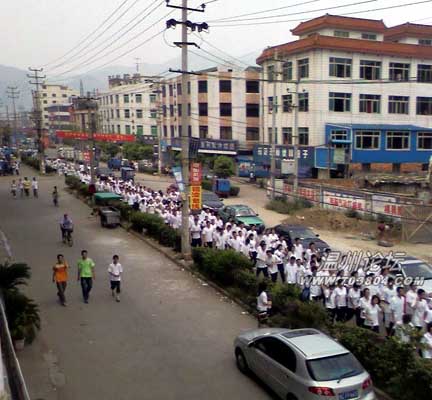
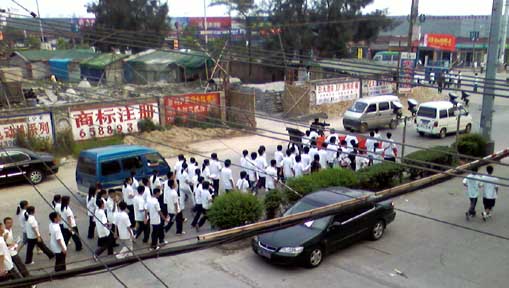
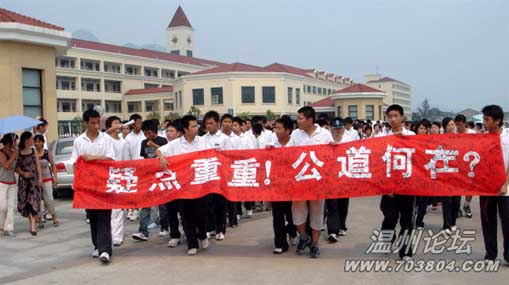
Banner: "So many doubts! Where is justice?"
Here is the translation of the students' open letter to the public (Beijing
News via 6Park)
On August 18, when we heard the bad news that our teacher
has committed suicide, we could not believe that such a bright person would
be so stupid as to kill herself. As a university graduate in English,
how could she be so psychologically feeble? On the day before she
died, she told us that she will be giving us dictation the next day.
She is a reliable person, so why would she lie to us? She told us that
life is like a coin, and we should see the good side instead of being stuck
under the dark skies all the time! ... So how could she have killed
herself? She has a son who is only two or three years old, so how
could she abandon him alone in the world! Does she not know that a
motherless child is lonely and helpless??
The incident took place two days ago. Why has law
enforcement refused to investigate? Why is the legal doctor
late? Why are the people's guide -- the media -- also late? We
don't understand! In a society under the rule of law, something
infuriatingly unjust has happened! Our rights become so pale and
powerless in the face of money!
Here is a summary of our doubts:
1. Before the day of the incident, our teacher asked us to
memorize the nouns because she was going to give us dictation the next
day. She patted the head of one student and smilingly
"warned" him that he better memorize the nouns. How could a
suicidal person tell such a joke so light-heartedly?
2. If she wanted to kill herself, would she be wearing
only her underwear??! Our teacher is a pretty woman who wants to look
well. Would she want to die in such indignity?
3. The teacher's child is so young and she loves him so
much. Would she abandon him?! Besides, a suicidal person should
have made some arrangements beforehand. But our teacher did nothing
...
4. Afterwards, we read the teacher's diary. She
wrote that she will not rely on others. She will only rely on herself
and she write that she will be strong. She wrote that she is a mother
and she is the world to her son. Motherly love is so great!
Would she give up life so easily and abandon her young child?
5. When we saw the body of our teacher, she had bruises
everywhere. Although her limbs were intact, her cranium was burst
open. She died a horrible death.
6. Our teacher told us that the High School Third Year
Class teachers work very hard. She said that she will not be satisfied
if we get into the universities. So why would she choose suicide?
7. The law enforcement department refuses to intervene in
this matter. Justice is so pale and powerless in front of money.
How will the people ever trust the government again?
Therefore, we ask all righteous people to extend your
righteous hands to give justice to our teacher! This is on behalf of
all the teachers under the heavens! May our teacher rest in peace!
The entire class of students of the Third Year Class,
Rui'an Number Three High School, Zhejiang province, China
You may say that this is a ho-hum matter that will not get anywhere. Ah,
but you forgetting the power of the Internet to strike emotionally! How
so? Read the above and see which of the seven points has the most
potential of being emotionally overwhelming? There is nothing more from
the child. So that leaves the manner of death (number 2 and number
5). So here is the famous (WARNING: GORY)
photograph that has been going around the
Internet. While it violates the preference of the teacher (according to
number 2), this may be the most direct way of seeing justice served.
- [089] Big Character
Wall Posters Reappear in Beijing (08/24/2006) The art of
sensationalizing headlines consists of writing something that is literally
true but evokes a conditioned reaction that is vastly different from what
was actually happening. In this case, big character wall posters
reappeared in Beijing but a different kind of Cultural Revolution was
happening.
(Beijing Times via Wenxue
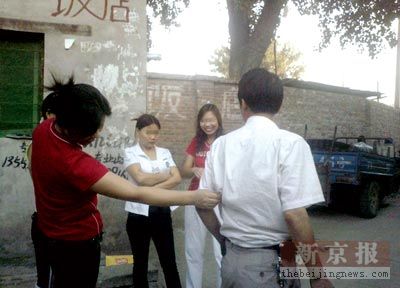
City) In the Haiding district of Beijing, there is a nameless hutong
(=lane) of about 100 meters in length and 2 to 3 meters in
wideth. Yesterday at 4pm, our reporter observed about a dozen or so
women in their 30's wearing tight clothes were leaning against the wall or
standing or sitting; whenever men walked by, they were propositioned with
cries of "50" or "30. When the price was settled, the
man and woman would enter into one of the small houses and conduct the
transaction.
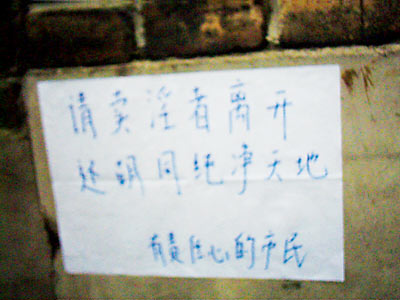
On the morning before, the hutong was plastered with big character
wall posters that said: "Will the prostitutes please leave and return
this hutong to a clean state!" The posters were torn down
shortly afterwards. According to the residents, this business has been
going on for three years. The busiest time of day was around 8pm
at night, when 40 to 50 working girls turn out.
One of the economic factors was that some of the houses in the hutong have
been designated for demolition. Until the demolition happens, those houses
have their water and electricity cut off already. However, the girls
are willing to pay good money to rent those houses, and the landlords really
have no other takers for houses without water and electricity.
- [088] Apple Daily,
Oriental Daily and the Internet (08/24/2006) The following was
found at the Hong
Kong Media Workers Forum. Please remember that these are just
jokes (that have some basis on certain perceptions but there is no factual
truth otherwise). The background is the recent rush by the mainstream
media in Hong Kong to expropriate Internet content (without compensation, of
course!).
Opening salvo: "The Fruit Daily will be holding a job fair for
200 openings. The job responsibility is for every person to work nine
hours per day, and they need only to watch the 200 most frequently visited
Internet forums. Each person will monitor one forum, and they will
turn in enough material to cover all of Apple Daily's print
space." "This Department of Fishermen's Nets will be able to
able to replace 3/4 of workers in the 'Department of Suddenly Breaking
Incidents' at Fruit Daily."
Return shot: "The Directional Daily will be holding a job fair
for 20 openings. The job responsibility is for each person to work
several hours per day, and they need only to visit 20 frequently visited
Internet forums and then make up rumors to post for Apple Daily to fill up
their pages." "This Department of 'White Powder Marketing'
will be able to replace 3/4 of the people who hang around the boss Ma
So-and-So."
Putting the snark aside, you get the idea that there is still a great deal
of skepticism among mainstream media workers that much of the contents at
the Internet forums is just lies that are indistinguishable from the small
number of truths. This may be where the blogs can come in to change
the balance, because blogs are personalized and therefore have a track
record for trustworthiness. Anyway, we have come a long way already and
I can't wait to see what happens ...
- [087] Mainlanders in
Hong Kong (08/23/2006) I read these two stories in Applie
Daily (Hong Kong). I'll save them here and I'll bring them back some
day when Hong Kong people go to visit mainland China and get treated as
criminal suspects.
(Apple
Daily) At a mainland Internet forum, a netizen said that he
and his family relatives were watching the fireworks at the Avenue of Stars
when they were accosted by Hong Kong police officers who told them: "I
take a look at you and I know that you are from the mainland ..."
The netizen wrote: "How do you know that we are from the
mainland? He said that all he has to do is take one look ... that damn
policeman said, 'I am native born.' ... he was disgusting! That
cop! He was the one who came over to talk to us! He was
contemptuous of mainlanders! I despise him ... Ha! This was the
way to be super-hospitable!" The Hong Kong Police Sergeants
Association president said: "We are absolutely not prejudiced against
mainlanders." He added: "When we go out on duty, we get
suspicious when they avoid the look from police officers or they make
special moves to cover themselves up. Most people have nothing to fear
from the police."
(Apple
Daily) Mr. Li runs a furniture business in Shenzhen and he was
visiting Hong Kong on businss this Saturday. At 2pm, he was in the
Shatin district of Hong Kong carrying a briefcase with business document
when he was accosted by three male and one female police officers.
Mr. Li said: "They treated me like a criminal. When they
questioned me, they were very aggressive! They asked, 'Did you come here to
commit burglary or robbery?'" When Mr. Li complained, a police
officer said, "Do you believe that I can put a screwdriver inside your
bag." Mr. Li believed that the police officer was threatening to
frame him.
The police officers then asked Mr. Li to empty the contents of the briefcase
onto the ground for inspection. Afterwards, when nothing suspicious
was found, they refused to help him pick the documents up. When Mr. Li
compalined, two of the police officers took him into a nearby parking lot
and hit his head and stomach. When he felt that one of the police
officers was trying to drag his hand and put in on the pistol holster, he
clenched his fist and wrested. He was finally released. Mr. Li
intends to file a complaint at the police headquarters.
Well, I don't know if any of these stories are true or not. But this
is what keeps showing up in the traditional/new media. You are much
less likely to hear about Hong Kong police officers being polite, courteous
and friendly because that would not be too newsworthy.
- [086] MSN Spaces
Banned! (08/23/2006) All the people in China who are
writing MSN Spaces blogs will probably have a heart attack when they read
this piece of breaking news here!!! I could name them, but that might
bring them to the attention of the authorities. You know who you are
anyway. The important thing to note is that this is not about MSN
Spaces in China. This is about the United States of America, known as
the 'home of the brave and the land of the free.' I was in the New
York City company office and I clicked through every MSN Spaces site on my
blogroll. Each and every single one of them were blocked by the Great
Corporate Firewall for being "Adult Content/Political Content."
- [085] Danwei vs Peking Duck
(08/23/2006) Positive
Solutions made a comparison of Danwei versus Peking Duck in terms of
referrals. By this count, Peking Duck beat Danwei by 400+ versus
250. What all this mean in the context of China, which has a
population of 1.3 billion people? Or the 300 million people in the
United States? You must be kidding!
My advice: If you have a metric of success, it is something other than the
absolute number of visitors. Otherwise, we are all deadmeat.
P.S. Of course, there will be complaints against me for offering a negative
criticism without a positive suggestion. Alright, how about the
following? My metric of success is how often a Chinese-themed,
English-language website leads mainstream/new English-language media
on news stories. This means that that recyclying what the New York
Times, the Washington Post or The Guardian have to say about China is
pointless (because I can read them too) unless you can provide added
value. Or, how much has a website added to my knowledge of China that
I cannot already get from reading what is written in English? That is
my criterion and you don't have to go with it.
- [083] The
EasyFinder Front Page (08/23/2006) Oh my God! All I ever
did was to get on an airplane in New York City and when I landed in Hong Kong, the place has
gone amok. Everything has to do with the front cover of EasyFinder
weekly magazine. I got off the plane, I walked past the news stand, I
stopped when I saw the front cover on EasyFinder magazine and I said,
"Holy crap!" If it were not for the fact that I have a
website subscription, I would have purchased a news stand copy (and it was
amazing that there were still unsold copies on Thursday when the magazine
came out on Monday already).
The Kong-chan
blogger confirmed my instinctive reaction: (in translation) "According
to my neighbor who is a newspaper vendor, this issue of EasyFinder was selling
especially fast. Compared to last week's issue (which has "Bit
Tits" Maggie) on the front cover), this one was selling twice as
quickly. His forty copies were gone by lunch and he had to get more
from the distributor. This society is under so much pressure.
Even Maggie's traditional Japanese-style sexy photos cannot satisfy the
readers. They needed to have stealth photographs of someone changing
clothes. The consequence: in the end, the government will have another
excuse to supervise the media."
Strictly speaking, Kong-chan was incorrect. The current issue (#761)
of EasyFinder has these photographs of Gillian Chung (
鍾欣桐)
aka A-Gill (阿嬌)
of the singing duet Twins in the middle of a clothes-change during a concert
in Malaysia. The accompanying text said that she had taken off her
clothes and then put on a bra; during the process, it was seen that she was
quite stacked (上圍極豐滿)
and not padded up (裝假狗).


In the previous issue (#760), the featured celebrity was Amanda Strang, who had
nowhere near the same draw. The simultaneous presentation of the
19-year-old Hong Kong girl whose self-made photographs were published on the
Internet without her permission did not help sales much either (that is, you
can see all 76 photographs on the forums without blurring).

It was in the next to last issue (#759) that Maggie (33-C) of the Hong Kong
Comic Festival Twins was the featured celebrity. Actually, Maggie was
hitherto unknown until she became one of the two hit photography models at the recent
Hong Kong Comic Festival. As you can see, her photographs follow the
traditional Japanese style of covering up the naughty bits in order to be
sold openly on the news stands without plastic wrapping. Although these photographs have the guys at the Hong Kong
forums drooling, it did not translate to a lot more sales at the news
stands.

Related Link: Jimmy Lai Is A Catholic
(Or So I Was Told) Letters from China
[in translation]
After typhoon Saomai hit Zhejiang and
Fujian provinces, if you read the local mainstream media, you would think
that the people who had the hardest times were the cadres. Isn't that
so? "Various levels of party committees, governments and
grassroots cadres dutifully, patiently and quietly did their best in excess
of their job requirements over long periods of time. The broad cadres
showed a superb conscientiousness and party spirit in the face of the
super-typhoon and its disastrous consequences. This year, our province
has experienced multiple disasters and our cadres are worn out. But
the cadres in Ningde and Fuding firmly stayed in their posts to serve the
people." Furthermore, they were unfairly and unjustly blamed and
they said they "wondered if they can continue to withstand the
interference to accomplish the job for which they are responsible to the
people."
But according to CCTV's "The Economy
in 30 Minutes" on August 20, more than 1,000 ships were damaged in
Shacheng harbor and more than 400 ships sank into the sea. The
official number of deaths was 218, but the actual number is unknown.
The local fishermen said: "They only made a symbolic
announcement. We can only rely on the radio receivers to find
out. How can they claim to have made this clear to us?"
"If we knew that Saomai was hitting the sheltering harbor directly, we
would not have stayed on the ships to wait the storm out." The
fishermen from the outside were even worse off: "No alert.
Nothing whatsoever." The number of dead fishermen from the
outside is not entered into the number of deaths.
When comparing these two news reports,
"The Economy in 30 Minutes" dealt with concrete specific
information, whereas the local media had only clichés and empty talk.
"The Economy in 30 Minutes" cared about the lives of ordinary
citizens, whereas the local media reports is permeated with an arrogance --
nothing was said about the dead and the pains of their families and there
only descriptions of officials "driving more than 300 kilometers in
almost 40-degree high temperature."
This is a "people-based"
era. This is an era for building a civil society. I hope that I
will see less and less of officialese-filled news reports.
- [081] The
Black Hand Behind The Attack on Albert Ho (08/22/2006) (The
Guardian) Hong Kong police are searching for three men who savagely clubbed a pro-democracy politician with batons and baseball bats in a crowded
McDonald's. The assault on Sunday - in a territory with low levels of violent crime - left Albert Ho, vice-chairman of the Democratic party and a member of the legislature, with a broken nose and head wounds.
According to witnesses, the attackers burst into the packed restaurant while Mr Ho and a Democratic party colleague, Howard Lam, were sitting at a table.
"Three muscular men, wearing caps and jeans, sprinted towards us," Mr Lam told the South China Morning Post. "They were very well organised."


So who did it? And for what reason? The whole world wants to
know. The following is a media round-up:
- (The
Guardian) Mr Ho was attacked soon after he took part in a protest march against a proposed sales tax, but his colleagues played down any political connection.
"We don't think that the attack relates to big politics," the Democratic party leader, Lee Wing-tat, said. "It isn't to do with the Beijing government or the Hong Kong government."
- (Ling Feng (凌锋)
at New
Century Net) (in translation) Following lawyer Gao Zhisheng
being snatched by the Communists in Shandong, lawyer Albert Ho was attacked
in Hong Kong and suffered a broken nose. This is how "One
Country, Two Systems" works. The Chinese Communist law
enforcement system can work directonly on Gao Zhisheng, but it was not
convenient to act directly under "One Country, Two Systems" in
Hong Kong. The previous efforts to "interpret the Basic Law"
was too blatant. Therefore, mobilizing criminals is the easiest way.
... Albert Ho knew that this day would come but he was willing to
endure. When lawyer Gao Zhisheng initiated the global hunger strike
and was oppressed by hooligan methods by the Chinese Communist, Albert Ho
supported lawyer Gao and held his own hunger strike. At the time when
Ho was interviewed by the media, he thought that the Chinese Communists
would engage in lowly activities. Ho has been concerned about the
Chinese democratic movements for a long time, and he understands the Chinese
Communists only too well.
- (Epoch
Times) The assault has provoked a lot of conjecture. Ho had earlier announced his intention to join the investigation organized by the Coalition to Investigate the Persecution of Falun Gong in China (CIPFG), which is probing reports of the Chinese Communist Party harvesting organs from living Falun Gong practitioners imprisoned in China. Ho had strongly urged the Hong Kong public to pay attention to these atrocities. Recently, an international investigation group has made a breakthrough in the investigation. Politicians and lawmakers in Australia and Europe have been considering using diplomatic approaches to pressure the CCP and requesting the United Nations and representatives from different countries to form a committee to investigate the allegations of CCP organ harvesting. "I suspect the Chinese Communist Party (CCP) is behind the attack on Mr. Albert Ho," commented Shi Zanshan, a Washington-based China expert.
"The goal was not to hurt Mr. Ho, but to divert the attention of international society. What is the Chinese Communist Party most afraid of at present? …The international society's investigation into reports of the Chinese Communist Party's organ harvesting has reached top-level politicians in the world and some nations are contemplating their responses to the atrocities and using their influence," he said.
- (The
Guardian) Colleagues speculated that the assault may have been carried out by triads. Mr Ho, who works as a lawyer, has a reputation for taking on cases other legal firms have been intimidated out of taking.
(Ming Pao via Yahoo!
News) (in partial summary) These criminals acted
'professionally' and therefore this seems to be the work of a crime
organization. Local crime organizations would not dare to assault a
legislator in public to challenge the system. As soon as the police
even get a hint, they will apply full pressure on all the revenue points of
that organization until they hand over the culprits. So it is more
likely that these are criminals from the outside.
- (Ming Pao via Yahoo!
News, Yahoo!
News) (in partial summary) According to fellow Democratic
Party members who visited Albert Ho at the hospital, he recalled that he had
received a threatening letter after he took on the case of Winnie Ho, who
has been involved in a public struggle with her brother Stanley Ho over the
control of Macau's casino flagship Sociedade de Jogos de Macau.
Previously, Winnie Ho's former lawyer C.K. Mok had been assaulted twice and
another of her non-Chinese lawyer Mark Side also received a threatening
letter ("Stop talking, don't come to Macau, remember C.K. Mok"). (Hong
Kong Media Workers Forum) (in partial summary) "The three
attackers participated in the anti-GST march and the police have videos of
them (including when they took off their caps). Therefore, the police
can arrest them anytime. However, Stanley Ho is the
"kingmaker" for Hong Kong SAR Chief Executive Donald Tsang, and
this will be disastrous for the latter." "That's
funny. If Stanley Ho were a member of the Democratic Party, someone
would be jumping out already to talk about presumption of innocence until
proven guilty!"
... so are you any wiser? Just remember: There is not a shred of
evidence for any of the above.
[in translation]
I believe that quite a few people have
noticed a news item: the child of Faye Wong and Li Yapeng had a hare
lip. I have previously commented on the prejudicial langauge used in
the news reports. But today I want to say that this news has led to a
discovery that almost made my jaw fell off.
On 10:08:19, August 12, 2006, the male
principal Li Yapeng published his thoughts on his sina.com blog: Thanks.
The post describes his current situation and his feelings, and it had some
truly touching language. Even though it is not known if he personally
wrote this, it still constituted a solid response to the concerns of the
outside world. What astonished me was that for the more than two days
since, 1,267,290 persons read the post and 19,242 replies were made over 386
pages -- it was impossible to read them all.
Consider the top blog in Taiwan -- Wanwan's
blog -- there are about 100,000 to 150,000 visitors per day and each post
gets about 200-300 replies. That is an astonishing standard in Taiwan,
but it is nothing compared to Li Yapeng's blog.
Of course, there are many more netizens in
mainland than Taiwan and it is normal to expect that there are more readers
and replies. But I never imagined that it would be so vastly
different! Perhaps this was because the topic was hot in mainland and
Li Yapeng and Faye Wong are famous celebrities, but this is still
formidable. If they can write anything on their blog and have more
than one million readers and 20,000 replies, then isn't this frightening
communication power? If he were not writing to say thanks, but he
wrote certain prejudicial or inflammatory things, then what kind of
destructive power will that be? The sort of Internet scale of usage is
probably not something that we on this small island can comprehend.

Even sina.com's home page is featuring a
headline of "Li Yapeng's single blog post sets sina.com visitor
record." This shows that even the mainland compatriots were
surprised by this explosive power. I wonder if any Taiwan BSP can
sustain the load on their main server machines.
I don't want to discourage ourselves.
But beyond our surprise at this powerful force, we may perhaps begin to
think. We in Taiwan also write in Chinese and we should perhaps become
more concerned about the development of blogging in mainland and attempt to
enter their groups to understand their culture in order to increase the
communication channels. We can push aside all the simplistic and
complex ideological issues and use the strength of Chinese-language netizens
to jump out of our self-imposed confusion. How about that?
[in translation]
In mid August, I went to Chongqing on
business. This happened to be when Chongqing was experiencing a
drought and heat wave that had not occurred in fifty years. At noon,
the temperature in the streets was higher than 43 degrees. In the
busiest heart of Chongqing, the crowd at the Liberation stele did not seem
to mind as they walk around or take breaks. There were foreigners
coming through and the officers in the police cars were keeping alert watch.
But the shocking thing was that right in
the heart of this city underneath the People's Liberation Heroes' stele,
there were people distributing all sorts of erotic business cards to
pedestrians. It is more infuriating that these erotic cards all
referred to female university students as their selling points, including
spelling out the schools of these students -- the Sichuan Foreign Studies
University, Chongqing University, Normal University, Commerce University,
Arts University, etc.
Even more hilarious is that these business
cards promises to give formal receipts and 24-hour-service. These
business cards had high production quality. They were handed out not
just at the Liberation stele, but also in the Chaotianmen plaza with the
persons whispering in Chongqing dialect: "They are all pretty
girls!"
When such activities occur in the heart of
a city, we must consider this city to be chaotic and mismanaged, and
re-organization is necessary!
Here is an example of a business card (and
many more at Sumianguan
blog).

- [078] Taiwan
News Via YouTube (08/20/2006) For people on mainland China,
the Taiwan news websites are blocked. For example, websites such as
TVBS, ETTV, FTV and others cannot be accessed. Along comes YouTube, on
which netizens have posted some of the news videos. However, these
selections are neither random nor representative. Instead, they are
chosen because they are interesting in some amusing or controversial
way. Here is a selection of Taiwan news videos for mainlanders.
Watch them while you still can ...
- Fucking news tv at taiwan
- Shit news report
in Taiwan part 1
- Shit news report in Taiwan
part 2
- [077] An
Eternal Mystery (08/20/2006) In the mystery of the piles of
feces at the Hong Kong International Airport (see Comment
200608#062), the Airport Authority originally hinted that it could
be the narcotic-sniffing dogs.
(Sing Pao via HKGolden)
This allegation caused the Hong Kong Police and the Hong Kong Customs
Service to go into hyperdrive. After checking all the logs of the
police squads at the airport, it can now be declared that no police dogs had
been in the area at the time of the incident. Therefore, the police
dogs have been excluded as suspects. The police reminds the public
that their dog handlers would never let this happen anyway -- they are fully
armed with cleaning equipment and can handle any 'suddenly breaking
incident'!
Who (or what) did it, then? On the day of the incident, the cleaner
came and removed the piles and then discarded them. At this time,
there is nothing left to test whether the source was human or animal.
Thus, this shall remain a mystery forever.
- [076] Central
Park, New York City (08/20/2006) Saturday was the occasion of
the New York Road Runners Club's Club Championship and this was the first
time in a while that I have stepped inside my home turf, Central Park (note:
I am a member of the Central Park Track Club and I used to be its
webmaster). Apart from many race photographs of my teammates, I took a
couple of photographs of Central Park. At one point, some Hong Kong
people believed that they didn't want a West Kowloon Cultural District with
an opera house and an overhead canopy; instead, they want a park. What
would it look like?
Here is the photograph that I took of Manhattan Island while taking the
Staten Island ferry. That was taken when the two twin towers were
still standing.
Here is a photograph that I took of Manhattan Island from an airplane
window:

So it is hard to imagine that in the midst of Manhattan Island, 843 acres
(or 6%) of the land had been set aside for a public park which accommodates
several hundred thousand people on weekends. Here is my photograph
today of the
baseball/softball fields in the north side of the park. The
well-maintained lush green grass and trees are available just a short walk
away.

From the north side of the lake in the middle of the park looking towards
midtown, this is the city skyline on this day. It looks even more beautiful at
night with the bright lights and starry sky.

And Central Park changes color by season. Here are some photographs from
EastSouthWestNorth (v.1.0).
(November 2003)

(December 2003)

Of course, unlike a cultural district with theaters, museums and
transvestite shows, this park does not generate revenue (in the sense that
tourist do not travel across the world to visit this park). Rather,
this is about the quality of life for the citizenry, and this could be a
very difficult concept to communicate in Hong Kong.
- [075] Calmly
Facing The Darkness (08/20/2006) The following is a
translation of the blog
post of Southern Weekend reporter Fu Jianfeng:
[in translation]
From last night through this morning, I
brought two interns to cover a shocking and tragic (to the point of
bone-chilling) story. This was an assignment of a type that I have
rarely ever come across in my career.
The two interns were practically stunned as
they watched how things occurred and developed.
From darkness to dawn, it was finally
over. We dragged our tired bodies back into the streets of
Beijing. I asked the two interns how they felt. They said that
they were shocked, and they even thought that it is only this kind of thing
that really deserves journalists to investigate.
I smiled and I told them that this was not
a good way to put it.
A journalist should face the darkness
calmly and use pity to encompass both anger and despair. He would not
consider himself as the natural person that the weak can trust. Amidst
the pain and sorrow, he must remain neutral and skeptical. He would
not think that he is a hero or a spokesperson for justice. He would
only think that he is a journalist -- he adheres to his professional conduct
and he strives for technical excellence. He is far and away from those
who think that they are morally superior and he understands what his
limitations are.
I told them, for example, an article like
this all-nighter is basically unpubishable.
Wouldn't you want to read about this?
Well, you know, he has a blog ...
- [074] Bus
Auntie (08/19/2006) (HKGolden)
Scene: 715am, August 18, 2006, a KMB bus heading towards Tuen Mun (New
Territories, Hong Kong). At the Wong Tai Sin stop, there adults and
one child boarded the bus, and an elderly woman began to put money into the
collection box. Here is the conversation:
Driver: Hold on, Ma'am. Can I trouble you to put the bills in one
at a time?
Woman: What?
Driver: I suspect that you are not putting enough money in.
Woman :What? Not enough? (She begins to put the money in anyway)
Driver: Ma'am, we have been watching you for some time! This is not
your first time! You always underpay by stuffing a whole pile into the
box! Every driver on this bus line knows about you!
Woman: What? You better watch what you are saying!
Driver: Here! Anyway, I won't press the button to let the money
drop in and I won't start the bus either. I am going to call the
company now to have someone come over and count the money. You better
not leave yet. Dear passegners, I know that this is going to take up
your time. But I am sorry. We have been watching this person for
some time and the company thinks that this has to be taken care of.
This is not the first time for this person! Another bus will be coming
along shortly for you.
Woman: What? You better fucking watch what you saying! I am
going to sue you for defaming my reputation! I fuck your mother!
^&@$#&*&@*^@$#%&^&*...... [about 5-10 minutes of
one-sided verbal assault from the woman to the driver, who was controlled
and professional despite the abuse against himself and his mother.]
Driver: You can say whatever your want! Anyway, the company is
sending someone over to count the money. You stay and the truth
will come out.
[At this moment, the woman appeared ill and sat down slowly on the
ground. Fortunately, a male-female couple came forth.]
Passengers: Wow! This looks serious! Driver, call the police
quickly! She may die!
[The driver actually called the police. Honestly speaking, I would
have called the cops too! She was providing the opportunity to bring
in the police, right? Unfortunately, another bus came along and all
the other passengers including myself left with it. So I never found
out what the outcome was.]
Audio Links (mp3 format): Audio 1 and Audio
2.
- [073] Lung
Ying-tai on the Million Person Sit-in (08/19/2006) (Apple
Daily) At the forum for her new book "Please convince me
with civilization," more than 400 people packed the auditoriusm.
Inevitably, she was asked about Shih Ming-teh's campaign to use street
demonstrations to oust President Chen Shui-bian.

Lung Ying-tai said that if the goal is to have a healthy and complete
democratic system in Taiwn, then one must not resort to the street passions
during the era of authoritarianism or choose street bloodshed or
hroism. If a democratic system and a democratic quality are the core
targets, then one must consider mobilizing the whole country to bring down
Chen Shui-bian, including shedding blood in the street or hiring bodyguards
to defend oneself. "In the era of authoritatianism, the people
did not have a vote. So they have to charge in the President's Office,
or jump on the podium and break the microphone. But that is no longer
necessary, because we each have a vote in our hands today But this
does not mean that I support Chen Shui-bian."
Lung Ying-tai also said that she published Today's
Lesson: Character not as an open letter to A-Bian because "Chen
Shui-bian is not qualified to receive an open letter from me!"
- [072] Website
Traffic Surge (08/19/2006) There was a mild website traffic
surge today, as Media Coverage of Typhoon Saomai.
The sources were a bit surprising: Tianya
Club and Sina.com.
This is surprising because my posts were English-language translations of
original contents available inside China. So it is a mystery as to why
they ought to appear in these large Chinese-language forums.
- [071] Liu
Xiang Loves China ... NOT (08/19/2006) This piece of idiocy
began with a widely circulated forum
post titled: "Liu Xiiang, the Pride of our China."
The centerpiece is this photograph from the Tenth National Games in which
China's world-record-holding hurdler Liu Xiang was spotted as having taped
over the logo on his singlet (see red circle in photograph).
The post pointed out that the official clothing supplier at the games was
the Japanese company Mizuno. Therefore, Liu Xiang was showing his
individual patriotism, in spite of the fact that the official Chinese Sports
Association sold its soul to the Japanese for money. Liu Xiang is
alleged to observe three general princples in product endorsements:
(1) It must be a strong and well-known brand
(2) Between a Chinese and foreign company, the Chinese one will be
considered first.
(3) Overriding the first two principles is this: NO JAPANESE PRODUCTS, NO
MATTER WHAT THE PRICE IS.
Great story, isn't that? ... until some netizen went back and looked
up what happened at the Tenth National Games. According to this report,
the Chinese company 特步
(xtep) won the contract with a bid of 16.2 million RMB, beating the 10
million RMB offered inititally by Mizuno. Thus, the logo underneath
Liu Xiang was that of a Chinese company. Liu is contracted to Nike,
and he had therefore sold his soul to the Americans for money.
Never mind ...
- [070] Chinese
Sexual Acrobatics (08/19/2006) Here is an assertion: the media
often pour oil on fire to inflame passions. When Japanese Prime
Minister Junichiro Kozuimi visited the Yokusuni Shrine recently, the Chinese
media obliged with a bunch of anti-Japanese stories. For example, the
Wenzhou public restroom named the Yokusuni Shrine (see Comment
200608#068).
Here is today's story in Ta
Kung Pao:
In Shenzhen, there has been a rash of
pirated pornographic video disks that showed how the Japanese insulted
Chinese women ... One film was titled "Chinese Acrobatics: Pretty Young
Girls (中国杂技系美少女)."
The filming location was Beijing, with the Forbidden Palace and the Great
Fall making appearances. The principals were several women who speak
putonghua to declare that they are acrobats. Then they take off their
clothes and then do gymnasitics and acrobatics. Another young naked
girl played the Chinese music instrument erhu skillfully.
After the Chinese girls finished
performing, Japanese men then chatting with them while fondling their
breasts. An 18-year-old girl who identified herself as Shasha from
Beijing welcomed the Japanese to make films in China.
Here is the problem with this report -- these
films have been around for quite some time. If you search for the title
"中国杂技系美少女,"
you will reach all sorts of websites and forums, and you can even download
them through BT for free. There was no interest in this story until
now. The timing is therefore suspect for this story to be brought to the
forefront right after the Yasukuni Shrine visit. This is called 'pouring
oil on fire' in an already dangerous situation.
- [069] The
Princess Roared (08/18/2006) (TVBS via Wenxue
City) This is an exclusive report from TVBS which found Taiwan
President Chen Shui-bian's daughter Chen Hsin-yu on a shopping trip at a
furniture.
Q: Who are you shopping for? Yourself or someone else?
A: For your home!
Q: Are you moving back to your home on Minsheng East Road, or are you
staying at the President's Residence?
A: At your home!
Q: ...
A: You people follow me around everyday. How can I not be angry?
How about a little bit of human rights, alright?
Addendum: Here is the TVBS
video clip of the incident.
Comments: My personal sympathy is completely with Chen Hsin-yu.
As a citizen, she should be able to go and shop for furniture without film
crews following her around and people sticking microphones in her
face.
- [068] The
Chinese Pay Tribute At Yasukuni Shrine (08/18/2006) (Wenxue
City) At a public restroom in the city of Wenzhou, China,
there is a sign that reads: Yasukuni Shrine" with the sub-titles:
"Down with little Japan" and "Home of Junichiro
Kozuimi." For the grand sum of 0.20 RMB, you can pay your
respects and take care of your Number 1 and Number 2 problems.

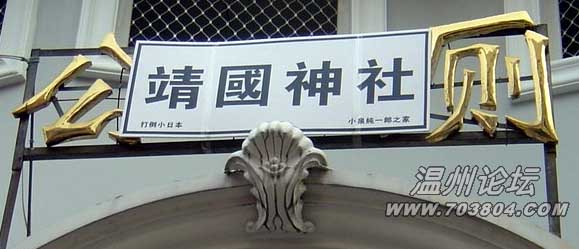
On a more serious note, what do you think should be done about? Option
1: Send in the goon squad, rip down the sign and send the female
attendant to five days of administrative detention? While this may
sooth the hurt feelings of the Japanese people, it will definitely inflamed
the hurt feelings of the "angry young people" on the Chinese
Internet even more. Option 2: Leave things alone because this
sign has no material impact. Besides, this is a training exercise for
free exercise of expression. Of course, these are extreme actions and
are not mutually exhaustive.
- [067] Taiwan
By The Numbers (08/18/2006) (China
Times, China
Times) Public opinion survey conducted August 16-17 of 1,006
adults in Taiwan based upon random selections from telehone directory and
randomzing last two digits.
Satisfaction with President Chen Shui-bian: 18% satisfied; 58%
dissatisfied; 24% no opinion. [note: this is a historical low in the
China Times polls]
Should President Chen Shui-bian complete his term?: 31% yes; 54% no;
15% no opinion.
Satisfaction with Democratic Progressive Party: 18% satisfied; 58%
dissatisfied; 24% no opinion.
Support for Shih Ming-teh's anti-Bian movement: 47% yes; 32% no; 22%
no opinion.
Probable Result of Shih Ming-teh's movement: 12% optimistic; 59%
pessimistic.
- [066] Chickens,
Ducks and Thai Transvestites (08/18/2006) (Apple
Daily (Taiwan)) According to Shenzhen Evening News, a
10-year-old girl in fourth grade in Shenzhen (China) in told her mother that
her 2003 edition of of the New Chinese Dictionary ("updated for
the new century with news terms and words") was a bit 'weird (怪怪的).'
Her mom took a look and found these brand news terms:
"Chicken" (雞):
(1) domestic animal; (2) prostitute. A young prostitute is called a
"small chicklet" and an old prostitutue is called an "old
hen."
If a child does not know what a prostitute is, he/she can look up
"prostitute (妓)."
"Prostitute" (妓):
(1) a female who sang and danced in ancient times; (2) a person who sells
his/her body for money. A female prostitute is also known as a
'chicken (雞)'
and a male prostitute is known as a 'duck (鴨).'
Furthermore, a "Thai transvestite" (泰國人妖)
is also a type of prostitute.
The 10-year-old said that these are not new terms for her because she and her
classmates already knew about them a long time ago. Her mom threw out
this 12 RMB dictionary and bought another one.
- [065] Dialetical
Materialism of YouTube (08/17/2006) According to the
dictionary definition, in dialectical
materialism: "all historical growth, change, and development results from the struggle of opposites. (In philosophical terms, a thesis is opposed by its antithesis, which results in a synthesis.)"
Whatever ...
On one hand, you can read about the state of YouTube in China: SARFT attacks Internet video
and The General Administration of Anxiety about Radio, Film and TV
about how YouTube could be banned inside China and there is a pushback along
the line of the defense of freedom of expression.
On the other hand, you have a total jerk in Hong Kong who wants to
supply the perfect justification to ban/censor YouTube. From The Sun
(via HKGolden):
Several Dragan Air stewardesses have their
upskirt videos posted on YouTube. More than 6,000 persons have viewed
that video already. In that 1:09 video, the focus was on a stewardess
in short skirt and black nylon stockings. Whenever she bent over to
inquire about the needs of a passenger, the camera would sneak in from
behind and underneath. Two more stewardesses were filmed in the same way
when they were opening up the overhead compartment or pushing the food
service cart. The same YouTube user has also posted other upskirt
videos such as young girls going up escalators.
When Dragon Air learned about this video,
they promised to seek legal advice. The YouTube user has removed all
his videos.
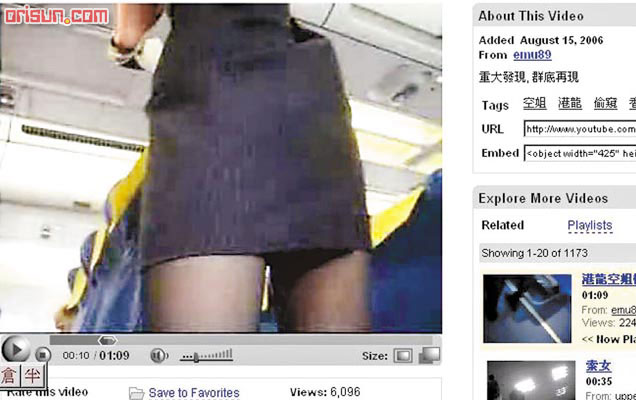 (Oriental
Daily)
(Oriental
Daily)
- [064] Taiwan
By The Numbers (08/17/2006) (TVBS)
Selected excerpts from the public opinion poll related to Shih Ming-teh's
campaign to oust President Chen Shui-bian. The sample consists of 948
Taiwan persons age 20 or older interviewed on August 14-15 by telephone
(drawn from telephone directory with last four digits of the telephone
number being randomized).
Satisfaction with President Chen Shui-bian:
10% satisfied, 73% dissatisfied, 18% no opinion
Following the whole series of scandals
around President Chen and his family (including the national security funds,
SOGO gift vouchers, Taiwan Trading Corporation, etc), do you believe that
President Chen should resign?
Should 62%; should not 21%; no opinion 16%. [editor's note: when you read off
a list of negatives before you ask the question, then it is loaded
question!]
Do you support Shih Ming-teh's "One Million Persons Oust-Bian"
movement?
Total: 58%
and by political affiliation
People's First Party: 88%
Nationalist Party: 85%
Independent: 44%
Democratic Progressive Party: 11%
Taiwan Solidarity Union: 3%
- [063] Speaking
Out On Behalf of Ching Cheong (08/17/2006) (Ming
Pao) By 李先知.
August 17, 2006.
[in translation]
Singapore Strait Times top reporter Ching
Cheong is being charged with espionage. But because the case involves
certain national secrets, the entire investigation and trial process have
been shrouded in mystery and outsiders have no way of knowing the
details. People in political circles know that this case is highly
sensitive, so that even though the case has reached the stage of
"judicial verdict," the family of Ching Cheong, the usual human
rights organizations and even the SAR government have been mute or
low-keyed. But the signals from various political sectors indicate
that the silent backdrop did not mean that no one is working on behalf of
Ching Cheong. It only meant that these people are choosing
"silence is golden."
In the case of the SAR government,
knowledgeable persons said that apart from those public "statements and
responses," all the involved senior officials are working under guiding
principle to "say less and do more." The political gossip
was that the SAR government has continuously worked various levels of the
mainland government for over a year to show their concern. Informed
sources say that the Legislature and the media have never ceased applying
pressure on the SAR government. On each trip that Chief Executive
Donald Tsang made to Beijing to report on work, someone has asked Tsang,
"Did you ask the leaders about the Ching Cheong case?" These
public pressures make it impossible for Tsang to evade.
The political gossip is that Donald Tsang
mentioned the Ching Cheong case on every trip, and the Political Affairs
Department and the Beijing Office have also done some work, including relay
messages to Ching Cheong from his family. In the early stages, the
Hong Kong Security Department had even suggested that Mary Lau (Mrs. Ching
Cheong) can visit him in the company of Hong Kong SAR officials. In
the end, Mary Lau remembered that her husband told her in their last phone
conversation not to go to the mainland, and therefore she declined the
proposal.
But government officials say that even
though outsiders ask them about what is being done to aid Ching Cheong and
how to respond to the case, they know that they cannot publicly disclose
what they know or make criticisms. They know clearly that as soon as
they make a detailed discussion of the Ching Cheong case, it becomes an
assessment of the judicial system on the mainland and it is no longer
"One country, two systems." Someday if the mainland starts
making public comments about the verdicts in the Hong Kong courts, what will
happen?
In addition, according to private
communication from a friend of Ching Cheong, many prominent figures outside
of government have also worked on the Ching Cheong case. This includes
some of the National People's Congress representatives from the Hong Kong
region. He said that the People's Congress representatives, the Ching
Cheong concern group and the SAR government have reached out to their
mainland contacts to state their hope that the mainland authorities will
provide lenient treatment in consideration of the overall situation.
He analyzed that there are many people in
Hong Kong who are concerned about the Ching Cheong case. If Ching
should receive a heavy sentence, there will be repercussions here.
"At the moment, Ching Cheong's family and friends are hoping for their
best case to come true and he can come home soon. But they are also
prepared for the worst case scenario."
Furthermore, even those people in the
pro-Beijing camp who have "clamped up" early on have been
reflecting to the authorities to ask for "lenient
treatment." Even if Ching Cheong is really guilty, he should be
released early for "medical reasons." One veteran leftist
politician said, "After all, we knew each other."
Some organizations have set up "plans
for post-verdict action." For example, the Alliance to Support
Democratic Movements in China has decided that if Ching Cheong is found
guilty or sent to jail, they will go into the streets to demonstrate and
hope to use public opinion to save him. The Civil Human Rights Front
said that they will support any action to save Ching Cheong, and the
decision to organize large-scale marches will depend on the severity of the
sentence.
The pan-democratic camp does not dare to
make any high-keyed moves at this time. They all know that a
high-profiled support of Ching Cheong by the democrats at this time will be
the "kiss of death" in the eyes of the central government.
Rather than being unhelpful that way, they can only wait for the Ching
Cheong family to "issue the orders."
- [062] Hong
Kong International Airport Struck by Terrorists (08/17/2006) (Sing
Pao) Yesterday at 845am a group of 30 students were traveling
to Hangzhou. Inside the restricted zone with the Hong Kong
International Airport right outside the three up-scale shops of Bally, Prada
and Coach, the students spotted a stream of feces in the aisle.
Because they are as big as fists, they were unlikely to have come from
animals or babies. One pile had been squished because someone had
stepped on it. Nobody apparently wanted to deal with the situation, so
one of the students took out tissues to cover them. Finally, someone
at Bally called for assistance.

The Airport Authority spokesperson said that there 81 cleaners on duty at
the time and the area was cleaned within minutes after they received the
first report at 850am. The spokesperson also said that the only
animals allowed in the airport are police dogs and narcotics dogs, so it
cannot be excluded that the piles had been left behind by official
dogs. The Prada spokesperson said that it was inconvenient to respond
to the inquiries. Everybody agreed that it was SHOCKING!
- [Administrative Note]
(08/17/2006) Upon arrival in New York City, everybody wanted there
wanted to know: "How bad were the security searches?" In
truth, this was fairly unremarkable as the additional security arrangements
apply only to flights leaving Hong Kong for the United States and the United
Kingdom. So all the US-bound flights (Cathay Pacific, Continental,
United) were sequestered into the far end of the terminal where passengers
and their luggage have to searched by hand. There was no issue with
ALL passengers being put through the same search process. I will be
curious to see what happens on my return trip from New York City.
By comparison, this experience was no way as intimidating on my first trip
to Bogota, Colombia in 1995. When I left, I went through the usual
X-ray machine stuff and then I came to this long row of white-gloved
security agents (about 50 of them) with tables in front of them. Every
item in the luggage was sifted through by hand while the dog handlers lead
their sniffing dogs up and down the aisle.
- [061] Anti-Japanese
Protests in China (08/16/2006) According to Hong Kong media
reports, the subject cannot be reported in mainland China. So here are
the brief summaries.
(Apple
Daily) In Beijing, about 30 anti-Japanese protestors went to
demonstrate outside the Japanese embassy. They waved Chinese flags and
yelled anti-Kozuimi slogans. The police were on alert but did not
interfere. The demonstrators stayed for about 20 minutes before
leaving.
(Ming Pao)
Police were on alert at the major public centers such as Huaqiangbei, Sino
Plaza, Jusco and other places. The Shenzhen city publicity department
had issued order that the media should not report on anti-Japanese
activities during this sensitive period. Reporters were also told not
to participate in any anti-Japanese activities on their personal time;
violators will be disiciplined. Shenzhen Cable TV also controlled
anti-Japanese information. When Hong Kong television reported on the
Beijing demonstration, ads were inserted immediately.
Yesterday, an action artist named Ai put on a show in Huaqiangbei.
Although the police tried to stop him several times, he persisted with the
support of the several hundred citizens who booed the police and asked:
"Are you Chinese or not?"
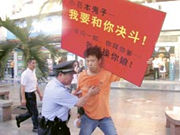
- [060] Political
Talents (08/16/2006) Ming
Pao had a column by DAB legislator and former chairman Jasper
Tsang. This connects to the issue as to why the probable candidates
for Chief Executive are the incument Donald Tsang, the former Chief
Secretary Anson Chan and the former Secretary of Security Regina Ip, all of
whom are current or former administrators. Outsiders need not
apply!
[in translation]
... The following problems need to be
discussed:
1. What is a "political
talent"? What is the relationship between political talent and
the political system in that place?
2. In Hong Kong today and the foreseeable
future, what type of political talent is needed? If the government and
the political parties need political talents, are these one and the same, or
are they different?
3. Does Hong Kong lack political talents,
or does it lack the opportunities for political talents to develop?
If political talents are people who are
"good in politics" or who "do political work," then the
definition of "political talent" presupposes a definition of
"politics." On this issue, the definitions in textbooks or
dictionaries may not be useful, as in the vacuous saying that politics is
about matters that affect the polity. When the Chinese speak about
'politics', they may mean something completely different from what Americans
mean; and when the Chinese speak about 'politics' today, they mean something
completely different from the Cultural Revolution era. Here,
'difference' does not refer solely to society, economy and politics (in a
different sense), and 'political work' has a different social means and
ends. This is about a fundamental difference in understanding.
Under the present "western
democratic" system, election is the biggest piece of
"politics." The so-called "politicians" are the
people who obtain power through elections at a certain level. The most
important quality of a politician is to defeat others in an election and
hence to retain that position afterwards so that no one can replace
them. In other words, the political talent is someone who is good in
the "permanent campaign."
Once a poltiican is elected to a certain
government post, an important factor in keeping that post lies in political
accomplishments. Does his government have the ability to push through
public policies, solve various conflicts and promote economic and social
progress. This is very important 'politics.' Therefore,
political talents must be able to have the additional ability to gain
majority support politically and socially in order to implement potentially
controversial but essential political reforms.
"Western democracy" has not been
implemented totally in Hong Kong, but it is publicly accepted as the
ultimate goal. Do we have enough people with the two aforementioned
types of talents for the political reforms? These two talents can be
broken down into certain skills and requirements, such as communication
techniques, ability to delegate to the right people, decision-making,
charisma, courage, eloquence and even physical looks. There are plenty
of such people in various professions and industries in Hong Kong. But
if we add up all these "elements," it is still not equal to
"political talent." If you want to say that there are many
political talents in Hong Kong but they have no opportunity to show
themselves, then maybe not many people wll believe you.
- [Administrative Note]
(08/16/2006) I am on my way from Hong Kong to New York City on my
fourth and final between-my-two-homes trip for the year. Oh, my year
goes from September-August and four round-trips between my two homes are
required to retain my frequent flyer status with Cathay Pacific. Since
this trip was planned some time ago, I was beginning to wonder if it is such
a good idea given the Homeland Security alert status. From the online
check-in message, it did not seem so bad now -- still no mineral water,
shampoo, skin gel or toothpaste, but at least personal computers are
allowed. Actually, I will not carry a computer because I have notebook
computers in Hong Kong and New York City, so all I have to do is bring a USB
storage device with the necessary files. My only problem is that I
travel so light that the Customs officials get surprised (and therefore
suspicious). But since I carry next to nothing, the search process is
over in less than a minute anyway. And my explantion: "Dual
homes! No need to carry my underwear nine thousand miles!" is
understandable.
Am I scared about the terroristic threat? The answer is NO. As a
statistician, I know that the odds of getting killed by terrorists is a lot
smaller than many other things (like traffic accidents). I am actually
more upset that people are telling me that I ought to be scared!!!
- [059] A
Blog Every Day (08/15/2006) As noted by Sidekick,
Hong Kong's mainstream newspaper Sing
Pao is carrying a daily column titled "每日一blog"
(A Blog Every Day). Every day, the newspaper reprints a blog post
selected by the editor.
What is the business sense? The more cynical among us would recognize
that Sing Pao is financially strapped (as in not being able to meet payroll,
or pay rent and utilities) and therefore this is a source of free
content. The newspaper does not pay the bloggers, who are not like
regular columnists because a different blogger is published every day.
For most bloggers, it is simply not worth the effort to get paid for that
one short blog post. Besides, the newspaper publishes the URL and that
will bring in additional site traffic.
This also leads to the interest issue of what
does an URL look like. For some blogs like this one, it is easy.
For other blogs, it may look something like:
http://hk.myblog.yahoo.com/jw!l7fuAPCVHBaLYk4bwJTMqqJuHBjvUFrY/article?mid=13&prev=-1&next=12解剖與否
Ouch! Are you going to read the
newspaper column and type this URL into your browser one letter at a
time? What is the likelihood of making an error? Well, go blame
the blog service provider for generating this link!
The 占占字起
blogger does not mind, and only hopes that the newspaper can pay back the
entire blogging community by sponsoring activities or doing special features.
You can read his blog post at: http://mrjimtong.mysinablog.com/index.php?op=ViewArticle&articleId=226514
A key figure in the embezzlement allegations surrounding the first family, Ligi Lee (李慧芬), yesterday offered prosecutors documents she said provide proof of wrongdoing at the Presidential Office.
Lee's statements and the documents provided by her are believed crucial to allegations that fake receipts were used to claim reimbursements from a secret Presidential Office slush fund.
...
Lee arrived in Taipei from Australia late on Sunday night and was immediately placed under the protection of the Ministry of Justice's Investigation Bureau (MJIB).
More than 20 MJIB agents were on hand at CKS International Airport to pick Lee up and escort her to a hotel in Taipei. Agents were posted outside her room.
Lee entered the Black Gold Investigation Center of the Taiwan High Court Prosecutors' Office at 9:45am, along with two pieces of luggage she said contained documents relating to the case.
Now I want to look at the other
Chinese-language stories about the weirder aspects of the Ligi story.
First, from Apple
Daily, when Ligi Lee stepped out of the airplane, more than thirty
police officers and investigating agents held hands and formed two rings
around Ligi Lee, who was pushed in a wheel chair. In the past, only
murderers, crime bosses or important case witnesses whose lives are threatened
received such protection. Ligi Lee is the first corruption case witness
who received this level of protection. Here are some photos from the
other media.

At the Far East Hotel, Ligi Lee is staying in
suite 3409. The entire 34th floor has been vacated and closed to all
others. Here is Apple Daily's floor map. Ligi Lee is staying in
the room at the top of the graphic. The red figures are the
investigators, the greens are the bodyguards and the blues are the police
officers. This elaborate setup has caused one DDP legislator to wonder:
"Has Taiwan become Sicily now?"
When Ligi Lee checked in at the airport in
Sydney, she made the airline wrapped two big suitcases in plastic
sheets. Here was supposed to be the previously unknown bills, cancelled
checks for credit card usage and other evidence of interactions with the first
family. Yesterday, it was revealed that the two suitcases contained one
small stack of photocopied bills which the investigtors had seen
already. Ho hum ...
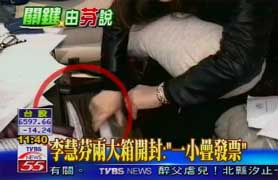
- [057] How
To Attract Eyeballs (08/15/2006) (CNN.com via AMERICAblog)
You make them very scared ...
[in translation] According to the
Municipal Public Security Bureau, more than 3,000 ATM machines in Beijing
will be directly linked to the police by the end of next year. The
system will have facial recognition capabilities, so that the photographs of
users will be sent to the police monitoring office on a real-time
basis.
... According to the project workers, the
facial recognition system uses facial bone structures to identify people, so
that sticking on a moustache and other disguise techniques cannot stop the
system from recognizing the people.
... If the photographs match suspects in
the database, the monitoring department will automatically notify the
police.
Time to bring back the surgical masks
again?

"Challenge to the CCTV monitors: Who am I?"
- [055] The
Poisonous Sword with a Single Blade (08/14/2006) (Boxun)
This is the new book by Liu Xiaobo. The subtitle is "Critique of
Chinese Nationalism." From the foreword, "Except during a
crisis caused by the invasion of the motherland by outside forces, I do not
regard 'nationalism' as a respectable term. On the contrary, during
peacetime, only disgusting politicians and misguided idiots are gathered
under the banner of patriotism."
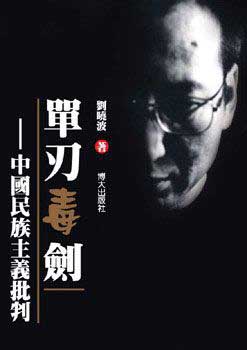
- [054] Bikini
Kungfu (08/14/2006) A couple days ago, MOP
Hunts Pornographers appeared here. Today, this story becomes the
lead China-related story in Ming
Pao. How soon will the English-language media pick this up?
More: Apple
Daily (Taiwan) August 15,2006; Oriental Daily (no
link) August 15, 2006.
- [053] What
Mafalda Actually Said (08/13/2006) In Mafalda
in Chinese, I looked at the sentence " maybe you mistook 'fly-bred' (蠅養)
for 'nutrition (營養)"
and I wondered what Mafalda actually said in the original Spanish. Now
a reader Fernando Martínez Llamosas wrote to say that she actually said:
"¿y no será que confundes alimentación
con alimentaje?" This
is a little tricky because the word alimentaje does not exist
in Spanish. But what would a Spanish-speaker think upon encountering
that sentence?
There is a famous Spanish phrase: "no
confundir libertad
con libertinaje"
that asks people not to confuse 'libertinism' with 'liberty.' Now you
all know that 'liberty' is 'freedom' but you may not know too much about
'libertinism.' Well, 'libertinism' is the state or quality of being a
'libertine' which is defined as 'a dissolute person (remember the
Case of Liu Zhihua?), debauchee, philanderer, swinger, tramp, rake,
adulterer, profligate, fornicator, womanizer.' Without getting into
'libertinism' is morally good or bad, we can agree that it is not a
universal value of the order of 'liberty.'
Because of the familiarity with "no
confundir libertad
con libertinaje,"
the Spanish speaker would know "¿y no será que confundes alimentación
con alimentaje?" is about
the confusion between 'nutrition' and some perverse and misguided notion of
'nutrition' (like eating soup, in Mafalda's mind).
- [052] False
Positives and Negatives in Mexico (08/13/2006) With respect to
the as-yet-unresolved Mexican presidential election, The Wall Street Journal
and its columnist Mary Anastasia O'Grady would prefer the world just move on
with accepting Calderon as the winner and Andres Lopez Obrador as the
"sour grapes" loser. But there is currently a recount of 9%
of the total votes. Please bear in mind that approximately 41 million
votes were counted and Calderon beat Lopez Obrador by 244,000 votes
(=0.58%).
According to Reuters,
here are the preliminary results from a partial examination of the 9% of the
total votes as claimed by Lopez Obrador -- there were 40,000 physical
ballots which did not appear in the tally sheets (=false negatives) and
there were 60,000 votes on the tally sheets for which there were no physical
ballots (=false positives). These are just the partial results from
the 9% that were to be examined.
What is a recount anyway? From each electoral precinct, all ballots
are placed into a box that is sealed. Attached to the outside of each
box is a tally sheet which shows the number of votes for each
candidate/party. The boxes are sent to a central electoral office,
which added up the counts as shown on the tally sheets without opening up
the boxes. A recount means physically opening the boxes, counting the
ballots and comparing the counts against the tally sheets.
Here are the partial results of the recount (as claimed by Lopez Obrador).
The tally sheets show an additional phantom 60,000 cases out of 9% of the
cases, so that there could be as many as 60,000 / 0.009 = 667,000 phantoms
in total. What are these phantoms? The recount could show
whether these were votes for Calderon, or Lopez Obrador. If most of
these phantom votes went to Calderon, then the overall election results are
in doubt given that the margin was only 244,000.
The tally sheets did not list 40,000 ballots that were actually in the
boxes, then there could be as many as 40,00 / 0.09 = 444,000 uncounted votes
in total. What are these uncounted votes? The recount could show
whether these were votes for Calderon on Lopez Obrador. If most of
these votes went to Lopez Obrador, then the overall election results are in
doubt given that the margin was only 244,000.
So should Andres Lopez Obrador just shut up and go away? No way.
- [Administrative Note] A
reader wrote: "I can't believe that what I am reading at your blog
nowadays. This has just become the consolidation of tabloid journalism
from Apple Daily, Oriental Daily, The Sun, etc." Hey, welcome to
the market economy! Tabloid journalism generates traffic and
"freedom of speech" does not. Seriously though, there is
always something serious underneath the "yellow journalism"
stories but I have not drawn out what should be obvious because you don't
need a pedant/preacher.
- [051] The
Case of the Zhuhai Nanny (08/13/2006) (Guangzhou Daily via Wenxue
City) Five years ago, the radiant young girl Cai Minmin from
Henan came to work as a nanny for a single mother Ms. Wei in Zhuhai,
Guangdong province.

Ms. Wei is currently on trial for abusing Minmin in a case that has received
national attention in China. The police evidence consists of the
following:
(1) The employer Ms. Wei is of sound mind and she is not suffering from any
mental defect, as determined by a doctor.
(2) The physical injuries on Minmin came from more than one occasion of
violence. Based upon the damage and recovery characteristics on the
skin and bones, the injuries are consistent with multiple occurrences over
time. Wei had claimed that all the injuries came as a result of one
car accident, for which she paid for treatment. Wei said that she
treats Minmin like a sister.
(3) The police searched the residence of Wei and found eight spots in which
human blood stains (from Minmin, according to the DNA analyses) were found,
including the walls, door frames, ceiling, porch, pillow case and bed
sheets. Wei claimed that the spots on the ceiling were just soy
sauce. She also said that Minmin has a habit of tripping over her own
feet and so she must have wiped some of the blood that came from her spills
onto the walls and door frames.
What about Cai Minmin's testimony? She claimed that Wei beat her
regularly over the past five years. Each time, Wei said that Cai did
something wrong and therefore the beating was administered to help her
become a better person. For example, one time Wei asked Minmin to rub
her back in the bathtub; when Minmin tried to hard, Wei picked up a glass
bottle of fragrance and smashed it on Minmin's head, causing blood to stream
down. Another time, Minmin was peeling an apple and dropped it on the
ground; Wei got mad and used the knife to stab Minmin in the belly several
times. Then Wei put chopsticks in Minmin's mouth, ripping the flesh
out and knocking out all her teeth. All this time, the timid girl from
the countryside was too afraid to complain.
Is this a case of "She said versus she said"?
No, at some point, the evidence become incontrovertible because of
commonsense and because your brain will explode! Here are two photographs of Minmin today (WARNING:
VERY SHOCKING): Photo
1 and Photo 2.
Compare them to the radiant young girl in the photo above and try to imagine
what happened to her since. It is these photographs of Cai Minmin that
are haunting China today.
- [050] Anti-Japanese
Game Spokesperson (08/12/2006) (Apple
Daily) It is axiomatic that there is not such thing as bad
publicity. In mainland China, the rumor was that the first
anti-Japanese-themed online game ever will have as its spokesperson none
other than Vicky Zhao (趙 薇).
Hmm, you will recall that in September 2001, Ms. Zhao was featured in Vogue
magazine wearing what appears to be a Japanese flag and was condemned by
tens of thousands of netizens. When Ms. Zhao subsequently gave a
concert in Changsha, a member of the audience got on stage and dumped feces
on her.

Therefore the news today was received by yet another torret of abuse:
"We would rather have a prostitute than her!" "A hen is
better than her!" "Why get Vicky Zhao as spokesperson?
Why do just get Junichiro Koizumi directly?"
What was the rationale? Vicky Zhao is well known and her grandfather
was a martyr of the New Fourth Army. But the cynics think that the
online game company is pumping the public with this news, but they actually
had no intention of signing Vicky Zhao.
- [049] How
Media Reporting and Public Opinion Mattered - Part 2 (08/11/2006)
Now it will do well to recall How
Media Reporting and Public Opinion Mattered - Part 1. First,
from Taipei Times: "The Presidential Office came under fire again yesterday, this time for the allegedly improper use of taxpayers' money to pay for domestic help for the family of President Chen Shui-bian's (陳水扁) daughter.
The Presidential Office issued a statement yesterday afternoon dismissing the allegation and calling on the media to stop making
'unnecessary interpretations' of the matter."
However, the media reports and the resulting public opinion storm forced the
president's daughter to reimburse the government to the sum of NT$2.4
million for the salary of A-Ching Sao.
Is that the whole story? No. Because the media did not have the
full story at the time.
(China Times via Yahoo!
News) Today, senior officials at the National Security Bureau
confirmed that they have been paying A-Ching Sao a monthy stipend of
NT$20,000 for more than five years. Her status was equivalent to a
"special agent" because she was required to "assist and
coordinate with the protective service agents." The National Security Bureau Director-General Hsueh Shih-min
receives a stipend of NT$29,000, so housekeeper A-Ching Sao's NT$20,000 is equivalent to
that of an army captain. In view of the public controversy over the other
matter, the president daughter's has quietly reimbursed NT$116,750 to the
National Security Bureau. This information was only disclosed today by
the National Security Bureau which has discontinued paying the stipend
effective this month. President Chen Shui-bian obviously knew about
this (note: he signed off on the original dispensation) but decided that he did not need to inform the people directly.
Are there more unknown contributing government agencies out there? Who
is going to believe in any denials by this point?

"007"?
P.S. Taipei
Times has caught up to latest development. Here are the
political responses:
Chinese Nationalist Party (KMT) caucus whip Tsai Chin-lung (蔡錦隆) said that it was "pathetic" to use taxpayers' money to pay Lin, and ridiculed her for being described as a member of the secret service while actually working as a housemaid.
People First Party caucus whip Lu Hsueh-chang (呂學樟) noted that Lin was neither a secret servicewoman, nor a plain clothes policewoman, and so had no right to claim such a subsidy from the NSB.
Taiwan Solidarity Union Legislator Lo Chih-ming (羅志明) said that Lin's claiming of the subsidy was outrageous and that the NSB should make a full review.
Who is missing here? Well, no DPP
person would be caught dead speaking on this affair. Anyone who has ever
tried to defend the President in the cascading series of scandals has been
burned, because they don't have the facts which are constantly running beyond
their control.
You don’t have to be here long to recognise that a large percentage of domestic helpers aren’t well-treated.
Recruitment agencies and employers play games with wages, depriving workers of as much money as possible for as long as possible. Unaware of their rights, helpers stay in the hope they can earn enough to send home, where poverty is so bad even their meager income goes a long way.
Other forms of abuse are rampant. Some helpers are underfed or overworked. Some employers force helpers to work without a day off for months at a stretch, while others put them to work for multiple families.
But this isn’t new; it has been going on for years — and not only in Hong Kong.
The saddest part is that the report will make no difference; the status quo won’t change until the government chooses to take off its blinders.
Now, as I have often said, the
Chinese-language reader deals with another world that the English-language
media have decided that their readers do not need to know. But you
wonder if the Chinese technique is better at BWG's task: "The trick is getting someone to listen."
When you are done reading the last sentence of the story in today's Apple
Daily, you will be cursing! The story would be deeply imprinted
in your mind. What next, though?
(in translation) Forty-something year
old accountant Chan Kwok-keung (陳國強)
was charged with forcing his Indonesian maid to provide fellatio and hand
masturbation during her four month employment. When she was fired
without cause, she left a will and attempted to commit suicide by jumping
into the ocean. That was when the case broke open. Yesterday, at
the district court trial, the maid recalled her traumatic experience and
burst into tears. For services beyond the call of duty, the employer
had rewarded the maid with a bonus of HK$20 (=less than US$3).
- [047] Naughty
Public Displays (08/11/2006) (Apple
Daily) Why did the Taipei city government order this wall
advertisement to be removed within three days (multiple choice question --
pick one or more answers):
(1) It may affect the mentality of the children attending the kindergarten
across the street
(2) It will cause drivers to become distracted and get into traffic
accidents
(3) It will affect social morality
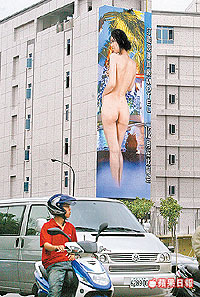
- [046] How
To Say Sorry (When You Must) (08/11/2006) This is the front
page story in Apple
Daily (Taiwan). 32-year-old female named Lee recently filed a
police complaint concerning spousal abuse. The medical examination
showed "large areas of bruises and cuts on her back, shoulders,
forearms, elbor, thighs and legs" (see photo below).

According to Lee, her husband sometimes forced her to eat rotten fruits
while saying "You are just a dog and so you can only eat rotten fruits
(妳是一隻狗,只能吃爛水果!)."
Or he would beat her and dragged her into the bathroom and force her to
swallow toilet issues laced with feces. Last Saturday morning, her
husband began to lashed her with steel wires until she was bleeding in the
face and back.
Now that the police has stepped in and the social welfare department is
getting involved, how do you think the husband will make up to the
wife? Hey, it's 2006 and it's SMS time!
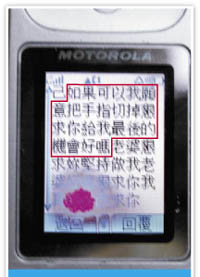
"我問自己為何要動手打自己心愛的老婆,我恨自己,如果可以我願意把手指切掉,懇求你給我最後的機會好嗎?
(I asked myself why I would beat my beloved wife. I hate myself.
If I am willing to cut my finger off, can I beg you to give me one final
chance?)"
P.S. This is really not good co-branding for Motorola!
- [045] The
Heroes of the Flag (08/11/2006) (Qianlong.com)
In Furong Valley, Jinyun county, there is a national-class scenic site with
the large characters 'Iron City' (铁城)
carved into the face of a cliff. Last year, the television drama
series "The Heroes of the Flag" came to the area for outdoor
filming. The film team decided that the characters were too intrusive
and used a spray to cover them up. When the filming was completed,
they asked the National Cultural Preservation Department to clean out the
spray for the 2,000 RMB already paid on deposit. To their shock, the
National Cultural Preservation Department discovered that the spray had
corroded the original paint and now the characters are barely visible.
(See before and after photographs below)
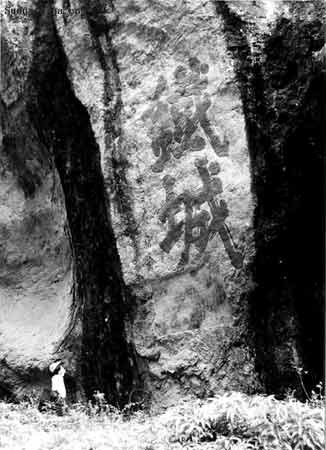
When contacted, the film company person-in-charge said that they had
received permission to film. Furthermore, over the more than two
months of filming, he had spoken to many local government officials but no
one had mentioned that "Iron City" was a national-class preserved
cultural artifact.
- [044] From
Russia With Love (08/10/2006) Let me work this
backwards. I was reading The
Sun online this morning and I saw this brief China item:
[in translation]
The Chinese Communist mouthpiece People's
Daily English-language website was likely attacked by hackers
yesterday. According to an Interfax report, a reader found out that a
section of the website contained more than a dozen links to pornographic
photographs and related contents. If you do not follow the links, the
topic goes back to the normal content. An editor named Wang at
People's Daily Online said: "The website may have been attacked by
hackers. We will publish the relevant information later."
Later, those links were removed from the website.
This motivated to look up the Interfax
release. The Sun omitted one sentence:
The incident was initially posted on popular China-related blog site at
http://www.zonaeuropa.com, which is complete with a screenshot of the bizarre situation."
Ah, Interfax hearts
EastSouthWestNorth!!! For the original story provided by a reader, see The
People's Daily Dose of Porn.
- [043] Using
News To Affect Influence Today (08/10/2006) Here is the book
that was banned sight unseen in China. When Li Datong, the former
editor of the Freezing Point weekly magazine of China Youth Daily, announced
that he was writing a book, you can bet that it would never see the light of
day in China. So the book has now been published in Hong Kong by
Tidetime Publishing and can be bought at various bookstores. Actually,
in my experience, the best places to look for it are the Hong Kong
International Airport bookstores which have sales records to prove that
books like The Chinese Peasant Study and this one are popular among
the travelers to/from mainland China.

The book has the sub-title of "The Chronicles of the Freezing Point
Weekly Magazine." This is not totally true, because Appendix 1 is a
chronicle of the discussions between 1,013 Beijing news workers and the
party central in May 1989. The upshot of those encounters was that the
movement leader Li
Datong was sent off to the News Research Department of China Youth Daily for five years before being
recalled to found Freezing Point.
Today, Li Datong is once again assigned to the News Research Department.
When will he be back for the next great project? Apart from the hopes,
there is also a comparison. In 1989, Li went away into obscurity for
five years because he had no communication channel. In 2006, Li went away to publish a book. Granted
that this book will not be officially published in China, but how soon will
it begin to appear in pirated editions being sold by roadside women holding
babies in their arms?
- [042] No
Comments (08/10/2006) EastSouthWestNorth is not a true blog
because it does not have the 'comment' functionality. Why not?
On the first day that I tried to have comments, the first entry was an offer
for an illegal service (as in, I am willing to offer $XXX for something
illegal). It was not something that could be filtered out by anti-spam
software and I knew that I would have to expend significant amounts of my
life towards spam- and troll-patrol. I decided: "No
way!" I am a lot older than most of my readers and I have other
priorities in my remaining life ...
That does not mean that reader feedback is completely barred. For
example, The
People's Daily Dose of Porn was derived from an email from a
reader. Among the many readings of this reader, she just thought that
this website was a good place to comment on her finding. I appreciate
that. The other moral of that story is obviously that if one is going
to permit comments, then one had better spend time to monitor them!
Here is another interesting piece of reader feedback. For The
Great Xiangyin Massacre, I had written " Welcome to the world of Internet rumors in a time of
untransparent official information. This is proof that the Internet is not
ready to displace mainstream media." A Dutch reader wrote that he was
reading the excellent NRC Handelsblad, which "yesterday
posted fat headlines as what Boxun posted. only in the main article the
different opinion was being posted ... I say that the mainstream media do
look at most stories published on Internet, and sometimes don't research any
further than what they can see directly."
If you have any thoughts or complaints, you can email me. It does not
mean that I will personally answer everything.
- [041] Henry Tang in
Free Fall (08/09/2006) (HKU
POP) Nothing of much note in the popularity Hong Kong
government officials in this latest poll, with one exception. In the
aftermath of proposing the Goods and Service Tax, Secretary of Finance Henry
Tang suffered a free fall in public confidence.
- April: 67%
- May: 64%
- June: 64%
- July: 69%
- August: 50% (19% drop!!!)
- [040] Richard
Li Explains (08/09/2006) The confirmation that Richard Li has
bought into the Hong Kong Economic Journal created another round of
speculations as to what will happen to the last great Chinese newspaper
founded by an intellectual to inform and influence the public. In Ming
Pao, Richard Li was interviewed briefly on telephone.
First, Richard Li started off with saying: "This is not to make money
because the amount is very small (note: US$35 million) ... I am hoping that
Hong Kong can have freedom of press."
Wow! That was definitely not the expected statement from Richard Li
given all the other kinds of talk around!!!
How does Richard Li justify that assertion? He said: "You look at
all the large China-capital companies in the Hangseng Index. How come
none of them will advertise in Apple Daily? Don't you think that it is
weird? The Civic Party's newspaper 'A45' has only one large corporate
advertiser and that happens to be PCCW (note: one of Richard Li's
companies). Don't you think all this is weird? ... I am not saying
that I agree with the extreme approach in Apple Daily. I read Ming Pao
... I hope that by buying the Hong Kong Economic Journal, I can make some
contribution towards freedom of press."
Well, the principal shareholder of the Hong Kong Economic Journal has stated
his desire to sell out and retire. What are his options?
Option #1: Sell to a China-capital company (such as Guangzhou Daily)
and then the Hong Kong Economic Journal may become like the economic-themed
version of Ta Kung Pao or Wen Wei Po.
Option #2: Sell to a financial group with business interests in China
and then the Hong Kong Economic Journal may become like Sing Tao.
Option #3: Sell to a Taiwan-capital media group (such as United
Daily) and the China-capital corporations will starve the Hong Kong Economic
Journal.
Option #4: Sell to Richard Li and hope that he means what he
says. In the Ming Pao interview, Richard Li does not preclude the
possibility of sending someone into the editorial office. But Richard
Li has to be very, very careful because he will under a magnifying glass in
a way that no other buyer would be.
Note: Anyway, it has already been pointed out that among the non-advertisers
at Apple Daily are Park 'n Shop and Watson's (note: within the Li
family). What does Richard Li say to that?
- [039] Scottish
Kilts in Shenyang (08/09/2006) (Boxun)
In Shenyang, a singing bar has this gimmick of having the male service
workers dressed in Scottish kilts.
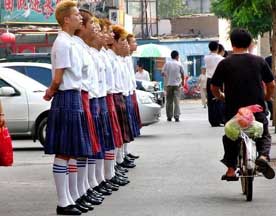

Well, at least, the service workers can change into regular clothes when
they are off-duty, unlike The Bald Restaurant Hostess.
- [038] Bonus
Points (08/09/2006) (Southern
Weekend) The Middle School Exams in Zhangzhou. By Cheng
Gong (成功).
August 3, 2006.
At the middle school exams this year in
Zhangzhou (Fujian), student Wang Quan scored 336 points, but he still
entered the top middle school in the city even though the admission
standards are higher than his score. Meanwhile, student Liang Shifu
had the same score but was only accepted by a third-rate school.
Why? According to policy, the
children of the owners of the top 100 taxpaying corporations in the city
shall receive an additional 20 points. Wang Quan's dad owns a company
that had revenues of 340 million RMB and pays taxes of 10.29 million RMB in
2005. Therefore, Wan Quan got an extra 20 points. Liang Shifu's
dad was not rich.
As you may expect, this story has led to an
Internet storm. Part of the Internet debate has to do with whether bonus
points should be awarded to anyone, bearing in mind that certain types of
students have always received special considerations: ethnic minorities,
overseas returnees, children of revolutionary martyrs, national-level category
2 athletes, winners of scholastic competitions, excellent students who are
economically disadvantaged, etc. But now there is an additional category
that taps into the increasing uneasiness about the rich-poor gap. The
impact on the overall system is minimal -- there were no applicants in 2005
and Wang Quan was the sole applicant in 2006.
In Southern
Metropolis Daily, the commentator Xiao Shu (笑蜀)
dealt with a different aspect of the issue. The question is not whether
20 points (or even 1 point) should be awarded. The question is about how
this policy came about. One would have expected that this type of major
policy to involve wide public consultations first before being approved and
implemented in a
rigorous process. So how could this have been decided unilaterally by a
certain senior official? It was just amazing that the suddenly occurring
idea of one person can change the fates of so many people, or that the fates
of so many people depend solely on what flashed across one individual's
mind. No matter how brilliant that idea may be, the situation is a frightening
one.
- [037] The
Shenzhen Bus Website (08/08/2006) (Southern Metropolis
Daily) Visitors to the Shenzhen website www.szbus.com.cn
yesterday did not find information on bus routes. Instead, they saw a
message from a hacker with the title: "This is a website officially
despised by the Chinese Hackers Alliance." The story was this:
the girlfriend of the hacker took the bus to go to work. It turns out
that she forgot to bring money, and the driver made her get off in front of
the public. The hacker is therefore taking revenge.

According to the law in China, people who damage the function of computer
systems may be subjected to five days or less of detention; in serious
cases, the detention may be for five to ten days.
- [036] The
Fallout from Xiangyin (08/08/2006) In the matter of The
Great Xiangyin Massacre, there will apparently be repercussions.
Recall that this was about a fictitious report about Chinese armed police
killing more than 100 peasant petititioners who were trying to defend their
rights. In Hong Kong's Oriental Daily (sorry; no link), there is this
ominous sentence: 目前當地警方正追 網上造謠者
(The local police are now investigating the Internet rumormongers).
Is is hard to find them? Well, that first entry was written by Zhou
Zhirong (周志荣)
who published his telephone number and he was citing another activiist 洪运周
(Hong Yunzhou). All that information is in the public domain and
distributed across many forum sites.
- [035] Hate
Groups in Xanga (08/08/2006) (Ming Pao via Yahoo!
News) Hong Kong University professor Michael
Chau presented a paper titled "A Framework for Locating and Analyzing Hate Groups in Blogs"
at the Pacific Asia Conference on Information Systems in Kuala Lumpur in
July and won the best conference paper award.
What is a "hate group"?
"This refers to groups that hold prejudices and hatred."
Specifically, Chau was studying prejudices against black people as found in
Xanga. In his work, he found more than 800 white American and European
white persons who directed foul and obscene language against black people:
"Today, I was returning home and a black person stared at me. So I
punched him a few times." Others called black people
"ugly" and "stupid."
Chau studied Xanga carefully and did not find
any Hong Kong person attacking black people. He believes that blogs are
a platform in which one insulting comment will draw others. "Young
people are easily influenced by blog contents. But if you say something
and I say something else, how much of this is real?" Chau's
interest in blogs was inspired by reading about news of terrorists using
websites to recruit people. Thus he began to wonder if the newly popular
blogs could become another destructive platform. "Is the Internet
drawing people together or pulling them apart?"
- [034] Surprising
Development in the Case of Gao Yingying (08/08/2006) Recall
that The
Case of Gao Yingying was about a young female hotel service worker
falling to her death under mysterious circumstances. Her parents
believed that she was raped and killed, but the police did not think
so. The county party/government insisted that her body be cremated as
quickly as possible, thus rousing suspicions. Now that the whole county
leadership has "fallen off the horse" (in Chinese parlance) for
unrelated corruption, her parents are resurrecting the case through the
press and the Internet. The parents claimed to have a key piece of
evidence in Gao Yingying's underpants on which were traces of semen.
The surprising development is this: (Oriental
Outlook) On July 17, the special case squad looking into the
case anew contacted the father Gao Tianfu. On July 18, the underpants
were sent to the public security bureau for analysis. On July 21, Gao
Tianfu vanished from public view along with his wife. Since then, his
sister has been notified that the two are under detention.
Why? According to informed sources, the two are being suspected of
falsifying the evidence because the semen stains on the underpants were
identified to have come from Gao Tianfu, the father of Gao Yingying.
The other family members found this to be absolutely unacceptable.
Monday Sep 4th 7.30pm
Internet Publishing in China: Panel Discussion
Explore the issues and challenges surrounding internet publishing in one of its most exciting and dynamic regions, with three confirmed experts in the field -
Jeremy Goldkorn (danwei.org), Roland Soong (ESWN) and media mogul
Hong Huang.
Free.
When I told a friend about this, he said,
"Oh, about a thousand people will show up ..." I'll be
spending a few days in Beijing around that date, without anything else
planned. After all, it is not right to keep writing about a place
without being there.
- [032] Taiwan
By The Numbers (08/07/2006) (China
Times) Interview of 1,106 persons on August 1-3 using Taiwan
household telephone numbers.
In the case of Taiwan Development Corp,
President Chen Shui-bian's son-in-law Chao Chien-ming was charged with insider
trading but he was not charged with selling government jobs, lobbying,
expropriating political campaign donations, etc.
- 83.3% said the investigation did not meet expectations (93.9% among
pan-blues and 61.8% among pan-greens)
- 12.8% said the investigation met expectations
In the case of the SOGO gift vouchers,
neither President Chen Shui-bian's wife Wu Shu-chen nor her family doctor
Huang Fang-yen were indicted.
- 77.4% said the investigation did not meet expectations (91.8% among
pan-blues and 50.8% among pan-greens)
- 15.6% said the investigation met expectations
In the case of the derailment of the South
Link Line, Lee Tai-an is being charged with the murder of his sister-in-law
for insurance money. Previously, his brother, also a suspect in the
case, had committed suicide
- 29.7% said the investigation did not meet expecations
- 59.2% said the investigation met expectations
- [031] Taiwan
By The Numbers (08/07/2006) (United
Daily News) Interview of 880 adults (with 406 refusals) on
August 6 by telephone by sampling telephone directories and then randomizing
the last two digits.
- Performance of President Chen Shui-bian:
15% satisfied; 70% dissatisfied; 13% no opinion
- Performance of Premier Su Tseng-chang: 39% satisfied; 39%
dissatisfied; 20% no opinion
- Did you know that Chad broke off diplomatic relationships? 76%
yes; 24% no
- Government handling of foreign affairs: 15% satisfied; 62%
dissatisfied; 21% no opinion
- Chinese Communists oppressing Taiwan's international presence: 71%
serious; 12% no serious; 15% no opinon.
- Why did Chad break off? 50% Chinese Communists; 24%
incompetence of Foreign Ministry; 6% neither; 20% no opinion
- Using financial aid to sustain diplomatic relationships: 17% agree;
68% disagree; 14% no opinion
- Using financial aid to rescue breaking diplomatic relationships: 11%
agree; 75% disagree; 12% no opinion
- [030] Who
Marched Against GST in Hong Kong? (08/07/2006) (SCMP)
"Thousands of people from the catering, retail and logistics industries joined a march organised by the Liberal Party to protest against the proposed goods and services tax yesterday.
About 6,000 demonstrators attended the event, the party said, but police put the figure at about 2,900."
Who are those people? SCMP: "Protesters from more than 40 organisations gathered at Chater Garden at 10am before marching to the government offices."
You would have go to the Chinese-language media to find the interesting
stories.
(Ming
Pao) More than 200 employees (or about two-thirds of the entire
staff) of the Tai Lin (泰林)
electronics chain store marched, led by the chairman of the company. As
a result, the stores did not open for business until 1pm. The chairman
claimed that "GST will suppress the consumer desires and the retail
industry will suffer the most. It is estimated that Tai Lin will lose
20% to 30% of its business."
(Apple
Daily) More than six hundred members of the Hong Kong Night Club
Federation marched, led by sleepy-eyed mama-sans wearing heavy
make-up. According to one mama-san, "With the GST, the
customers will all go north of the border. There is no business left for
us."
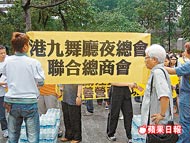
Oh, yes, these guys don't know how to count
either. Apple
Daily noted that the police at the start said that there were about
3,000 people; when the procession arrived at Government Headquarters, the
Liberal Party announced a figure of 6,000; when the event was nearly over,
some Liberal Party person suddenly claimed more than 10,000.
- [029] Mainstream
Media Go Blogging in Hong Kong (08/07/2006) There are
different models by which the newspapers are going about this.
Example 1: (Apple
Daily) This is the emulation of the traditional
man-in-the-street interview. In the coverage over the Number 3 vs.
Number 8 typhoon warning signal, a number of blogs and forums were
quoted. For example, here is the airline stewardess at the 菜鳥手記
blog: "Flying from Los Angeles to Hong Kong ... stopped in Japan for
several hours ... the airpline was reeling when it got over the Hong Kong
airport, so the weather was bad indeed. We were rocking and we were
reeling, like as if we were on a ride at the Six Flags theme park in Los
Angeles. The airplane flew lower and lower ... right before landing, I
was recalling all the emergency escape routines in my mind ... I am very glad
to arrive at my home ..."
Example 2: (Ming
Pao) This is the feature article for a blog in a section known
as Blog Blog趣
("Blog Blog Fun"). On this day, it was Ben Ng's blog 知日部屋.
The blogger is a Chinese University of Hong Kong professor who loves to read
Japanese anime and manga. He advocates "hating and opposing Japan
is not as good as knowing Japan" and his blog posts covers Japanese
culture, leisure, cuisine, fashion and so on as well as Sino-Japanese
politics. Much of the contents also related to Hong Kong culture.
For example, if Hong Kong people like to say "未解決"
("It is not resolved") now, then what do the Japanese say
instead? What is otoko culture? Lolita culture? and so on.
Example 3: (Apple
Daily) This is a traditional supplement column that now carries
the title ("Consumer Blog") and is a regular feature on Mondays. The
so-called blogger is an OL ("Office Lady") and this post is about
the Hungry Ghost Festival discussion at the office. The inclusion of
"blog" in the title is an indication that this is a hot keyword now,
more so than just "column."
- [028] Taiwan
By The Numbers (08/07/2006) (TVBS)
1,302 persons in Taiwan age 20 or over interviewed on July 27-28, 2006 by
telephone (last four digits randomized).
| Person |
%Satisfied |
%Dissatisfied |
%No opinion |
| Chen Shui-bian |
11 |
74 |
15 |
| Annette Lu |
33 |
35 |
32 |
| Su Tseng-chang |
38 |
38 |
23 |
| Yu Shyi-kun |
28 |
52 |
20 |
| Frank Hsieh |
39 |
43 |
18 |
| Lee Teng-hui |
25 |
47 |
28 |
| James Soong |
21 |
58 |
21 |
| Lian Chan |
48 |
27 |
25 |
| Wang Jing-pyng |
56 |
23 |
20 |
| Ma Ying-jeou |
61 |
26 |
13 |
- [027] MySinaBlog
Champion (08/07/2006) Fong Chi-Kwong, webmaster of the Weather
Underground of Hong Kong website, maintains a personal blog with
MySinaBlog. A recent post, "Did
you know that the Weather Observatory lied to you?," has
received more than 100,000 page views and is now supposed to be the record
holder.
If I take a step back, I can say that Weather Underground is the single best
example of concerned citizens providing oversight over a government
agency. The citizens do not have all the resources of the government
agency, such as a supercomputer to simulate the weather. But the
citizens have enough information and expertise to know if the government
agency is actually doing what it is supposed to. Unfortunately, this model is harder to apply to other types of
agencies.
- [026] The
Ladies in Hoods (08/06/2006) (Apple
Daily; Ming
Pao) It is a well-known social phenomenon that mainland
Chinese girls obtain a 30-day visa to visit Hong Kong where they work hard
as prostitutes in order to earn as much money as possible. Some of the
girls work solo, but others are involved with organizations that provide
full-service to the girls and their clients (including lodgings, meals,
advertisements, transportation, protection, etc). Periodically, the
police will raid these establishments. Such is the raid yesterday in
which these two girls were arrested at an apartment on Jordan Road.
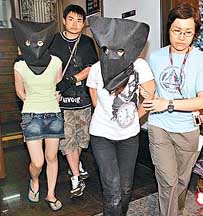

If there should be a police raid, the girls know that they are in trouble --
if arrested, they will have to spend a couple of months in a Hong Kong jail
for violating the terms of their visas, sent back to mainland and be barred
from re-entering Hong Kong for a long period of time. That is why the
girls will sometimes take huge risks to avoid being arrested.
Yesterday, when the police detectives knocked on the door of the 15th-floor
apartment on Jordan road, the people inside refused to open the door.
When the police burst through, they found three men chatting and no
girls. Then one detective noticed an open window and stuck his head
out to take a look. Whooooaaaa!

Three girls had clung on to the water pipes and climbed downwards to the
10th floor, and they were now stuck precariously on a ledge. So the
police went down (using the stairs, of course) to the 10th floor and
eventually persuaded the girls to come in. The police said that these
girls were high-class prostitutes who charged HK$1,000-1,500 per session
arranged at hotels in the Yautsimmong area.
- [025] The
End of <<Popular Cinema>>? (08/06/2006)
<<Popular Cinema>> is a Chinese magazine founded in 1950, and
has a cirulation of 9.6 million at one point. A recent article was
about the revolutionary martry Dong Cunrui (董存瑞)
in which a director described the filming process (YNet.com):
"In real life, Dong Cunrui was not immediately pronounced a
martyr. His family was notified of his death and that was all.
More importantly, nobody saw him personally ignite the dynamite fuse, hoist
it over his head and destroy the bridge. It was just speculations
based on clues. Dong Cunrui did not have a rack and there was no way
to place the dynamite under the bridge. After the battle was over,
they found the socks that his wife made for him. Therefore, the
military experts speculated that Dong Cunrui might have been holding the
dynamite over his head when the explosion occurred."
This essay immediately drew the ire of veteran soldiers. The PLA Daily
published interviews with eyewitnesses and called the <<Popular
Cinema>> essay an insult to the Chinese people. A netizen noted:
"<<Popular Cinema>> is finished (大種(眾)電影要完蛋啦)."
The precedent was obviously the Freezing Point supplement of China Youth
Daily, and that publication was shut down for publishing a piece of
'revisionist' history.
Here is the asymmetric part about Chinese media nowadays. It is
possible to severely punish mainstream media (such as <<Popular
Cinema>> and China Youth Daily) for transgressions such as tarnishing
the image of revolutionary figures (whether they be Dong Cunrui or the
Boxers). But in the civilian sector, there are any number of
disrespectful essays, photos or videos about revolutionary figures and
events. Nothing much seems to be happening to those people.
After all, if people are just posting onto Internet forums, there is no
issue of cancelling their publication licenses, and sending them to jail
will probably generate mass protests.
An example is a proposed movie project about <<Lu Feng's first
girlfriend (雷锋的初恋女友)>>.
While the State Administration of Radio, Film and Television eventually put
a stop to that, the producer Deng Jianguo (邓建国)
is going on with other projects befitting his title as King of Hype (炒作大王).

- [024] What
The Naked Man Said (08/06/2006) (Apple
Daily) In Keelung (Taiwan), a 34-year-old man got drunk, went
to the river side, took off his clothes and jumped into the water. The
police/fire departments were called and set up a ladder for him to climb
back up.
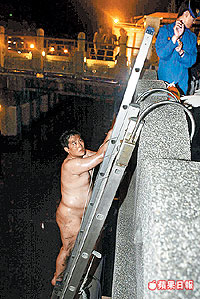
When he got back up, he complained about the rescuers for being so slow.
He yelled: "You would be quicker if I were Chao Chien-ming! (我要是趙建銘你們就會快一點了!)."
- [023] Number
3 or Number 8? (08/06/2006) The debate over whether the Hong
Kong Observatory did right by not hoisting the Number 8 Typhoon Warning
signal this week continued. The initial claim from the Observatory was
that the rules inherited from the 1970's are based solely upon on average
windspeed inside Victoria Harbor. Therefore, all those wind gusts
(which are peaks and not averages) elsewhere are immaterial.
The following table was published in Apple Daily (via InMediaHK).
The data are provided by the Hong Kong Observatory and augmented by the
Apple Daily information library. From left to right: column 1, typhoon
name; column 2, year/month; column 3, highest typhoon warning signal; column
4, windspeed at Kai Tak (East Kowloon); column 5, windspeed at Star Ferry,
Tsimshatsui; column 6, windspeed at Cheung Chau island. The rules have
therefore not been consistently applied over the years. This is
selective science, not science.
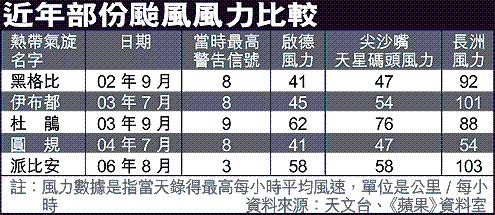
The InMedia essay also noted other known oddities -- the announcement of a
Number 8 Typhoon Warning Signal is usually made before 5:30am, 12:30pm or
after office hours. This is obviously calculated to avoid major
traffic jams as people leave work.
Over the years, there have been been controversies over those signals.
In 2001, the hoisting of number 8 was criticized for costing the Hong Kong
economy HK$4 billion. In 2006, not hoisting number 8 was criticized
for endangering the citizens. The InMedia essay has a simple
prescription: the Observatory shall used the Victoria Harbor windspeed
figures to issue typhoon warning based upon an exact set of rules -- day,
night, holiday, whatever. It will never ever be selectively
enforced. The rules are the rules, and there will never be any more
subjective judgments, political calculations and second-guessing.
There is another interesting phenomenon in the current discussions.
First, the character of all discussants are impugned. If you are a
worker, then you are probably upset that you did not get a free day this
week; if you run a business, then you are probably trying to protect their
business income. However, everybody is united in wanting the head of
the Observatory director on a pike, even though their reasons may be very
different.
- [022] Laicheongsing.com
(08/06/2006) This is quite galling as Lai Cheongsing is the central
character of the greatest corruption case in China in which tens of billions
of RMB and hundreds of officials and business persons were involved.
Lai is presently in Canada awaiting the resolution of his extradition case
back in China. Earlier, he announced that has a team of three writers
working on his autobiography (see Lai
Changxing Writes His Memoirs). Then he has a website www.Laicheongsing.com.
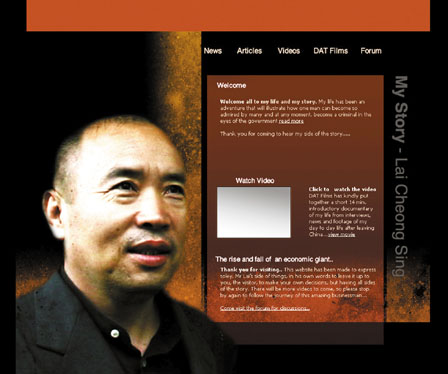
(CReaders.net)
The website contains news, articles, videos, forum and an introduction to
DAT films (which plans to make the Lai Cheongsing movie). In the video
section, there is a 14-minute video about Lai Cheongsing which you can
download for C$1.99 via PayPal. According to Ming Pao (via Wenxue
City), the forum has been shut down temporarily because most of the
comments had been of an abusive nature and Lai did not think it was
appropriate. After all, who wants to read that kind of stuff about
oneself? The forum will come back as a paid website, so people will
have to pay for the privilege of verbally abusing Lai Cheongsing.
The Southern Weekend, in it's typical straight-faced celebrity freak show style, did an interview with Liu Zhongde, a former Minister of Culture and Director of the Central Propaganda Department. Let's again hope that ESWN will pick this up; I'll just present the freakiest parts of it -- namely, how the quirks of one art-minded Party bureaucrat could affect the tastes of a complete country, a complete generation.
Once I read that, I had no choice but to
translate the whole thing at Why
Teresa Teng Could Not Visit Mainland China. Yeah, I've got
pressure ... (see "我有壓力,你有壓力,你做乜挑釁我呀?(I've
got pressure and you've got pressure. So why are you provoking me?)
from Bus Uncle).
- [020] The
Flying Trash Receptacle (08/05/2006) (Apple
Daily) A Hong Kong netizen has posted a video clip of a
television news report on TVB Pearl about typhoon Prapiroon at YouTube: 三號風球下被垃圾筒K.O.的女人
(Hong Kong: blowin' in the wind
on TVB Jade via Mr. Bijou).
Within one day, it garnered 40,000 viewings and made it to number 12
worldwide. The best part of the the clip is when a plastic trash
receptacle knocked over an unsuspecting woman.
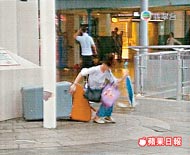
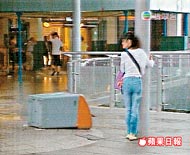
- [019] The
Super Guys (08/05/2006) (Apple Daily; Huzhou
Online) Whereas the female singing contest Hunan Satellite
TV's Super Girl was the top program in China last year, it is being shadowed
by two Shanghai talent shows featuring guys. Those two shows featured
strong personalities.
In "Go! Good Guys! (加 油 ! 好 男 兒)",
the star is Ma Tianyu (馬 天 宇).
He does not have any terrific performance skills, but he is able to draw
sympathy when he narrates his impoverished childhood and the early death of
his mother while the tears well in his eyes. Therefore, he has a huge
contingent of female fans. Recently, the CCTV-Sofres ratings showed
that "Go! Good Guys" has a national rating of 1.4 compared to the
1.0 for "Super Girl."

Meanwhile at "I've got style, I'm handsome (我 型 我 秀)",
the star is Shi Yang (師 洋).
His specialty is his unpredictability. At one moment, he may be
telling about his own impoverished family, and then he switches into a
farcical act wearing boxing gloves. The judges were always at odds
with each other with respect to rating him, and yet he always advances
because he is the one who can guarantee high ratings.

There are two news points coming from these developments. First, there
is now the phenomenon of the "dirty" singer. In the case of
Ma Tianyu, a male Beijing photographer has blogged about a romantic affair
which ended because Ma decided to spend more time with rich people who gives him 300 RMB each time that he sees them. Ma has neither admitted
nor denied those allegations. The organizers are concerned about the
trade-offs between promoting 'harmful' behavior versus losing SMS votes and
TV ratings.
Second, these two stars have two things in common -- they think like
girls. If Super Girl produced a Super "kid brother" in Li
Yuchun last year, then Super Guy is producing a couple of "kid
sisters" this year. Is it because the single child policy lead
people to think that "it does not matter whether it is a boy or girl (生 男 生 女 都 一 樣
)," or the existence of gender
neutrality has become mainstream in society?
- [018] The Lettre Ulysses
Award 2006 (08/05/2006) The Millions blog has the long list for the 2006
Lettre Ulysses Award. In 2004, the first prize, worth 50,000 euro, was
given to the Chinese authors Chen Guidi and Wu Chuntao for The Chinese
Peasants Study. In 2006, there is another entry from China: Li
Datong for The Story of Freezing Point. At The Millions blog,
most of the other entries in the long list were linked to Amazon.com.
However, there is no Freezing Point book in English yet, so the link went to
an EastSouthWestNorth page. In
order to be included in the Lettre Ulysses Award, an English translation
must be submitted to the panel of judges to read, even if this is not the
final version for publication. So there is apparently an
English-language draft out there already.
Everyone knows Al Gore stars in the global warming documentary "An Inconvenient Truth." But who created "Al Gore's Penguin Army," a two-minute video now playing on
YouTube.com?
In the video, Mr. Gore appears as a sinister figure who brainwashes penguins and bores movie audiences by blaming the Mideast crisis and starlet Lindsay Lohan's shrinking waist size on global warming. Like other videos on the popular YouTube site, it has a home-made, humorous quality. The video's maker is listed as "Toutsmith," a 29-year-old who identifies himself as being from Beverly Hills in an Internet profile.
In an email exchange with The Wall Street Journal, Toutsmith didn't answer when asked who he was or why he made the video, which has just over 59,000 views on YouTube. However, computer routing information contained in an email sent from Toutsmith's Yahoo account indicate it didn't come from an amateur working out of his basement.
Instead, the email originated from a computer registered to DCI Group, a Washington, D.C., public relations and lobbying firm whose clients include oil company Exxon Mobil Corp.
- [016] Super
Nanny Dad (08/04/2006) (Yam
News) Internet satirist Bang Bang Fun (砰砰阿峰)
is ready to release his latest work titled Super Nanny Dad (超級奶爸).
The subject will be President Chen Shui-bian's son-in-law Chao Chien-ming's
new role as "super nanny dad." The game starts with the
President's daughter yelling at the pink-dressed Chao to look after the
kids. But being idle at home, he had too much time and caused his wife
to bear twins next. So now he had to deal with five kids. For
protection hereafter, Chao used the condoms for which he is the
spokesperson. Unfortunately, the condoms were defective and his wife
then had quadruplets. So now he had to deal with nine kids.
So the game is about how to sneak out. If you fail, you will be beaten
by the inebriated princess. But even if you succeed, it only means
that you get to fly to Brazil where you have to realize President Chen's
dream about Taiwan soccer. Bang Bang Fun's previous game drew 5.7
million hits within one week, and he is hoping to do even better this time.
Bang Bang Fun said: "Bang Bang Fun must thank the support of the first
family and the Bian administration. If they did not have all these
corruption and stupid things, I could not have so many creative ideas."
Bonus: The
Bang Bang Fun Interview
- [015] The
Typhoon and the Snooping Law Bill (08/04/2006) Even though I
was sitting home yesterday, I can tell by looking out the window that there
seemed to be more than a number three typhoon signal happening. News reports
are that 559 airline flights were delayed or canceled, 672 trees fell down
and two ships ran aground due to typhoon Prapiroon. So why wasn't the
number 8 typhoon signal hoisted? Thus asked Apple
Daily on the wrong page. The correct response is that the Hong
Kong Observatory follows certain conventions (namely, the average windspeed
as measured inside Victoria Harbor) that had to be studiously followed.
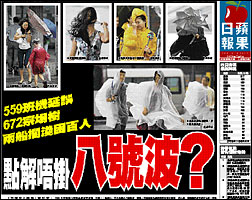
Meanwhile the guys at the editorial and opinion sections of Apple
Daily were having fun. Everybody knows that Donald Tsang is
being tested on his ability to get the snooping law passed on his own
without Beijing leaning on the legislators. The legislators have been
working overtime in order to read through the hundreds of articles in the
bill in time to pass next Tuesday. Obviously, if the typhoon number 8 signal
were hoisted, the legislators would scatter and Donald Tsang may lose face!
Ergo, there was no way that we would ever see a Number Eight even if the
gates of hell opened up!
Bonus video: 三號風球下被垃圾筒K.O.的女人
YouTube
- [014] The
Jon Factor (08/04/2006) In my coverage of the Cosplayer case
(see Comment 200608#011), I had
paid too much attention to the subject instead of the photographer.
Lyn Jeffery (Virtual
China) noted correctly "this event is similar to the Bus Uncle incident in that: A scandal? Quick! Get it on tape!"
In the Bus Uncle case,
the camera person Jon became a third-party celebrity who could swing a
financially rewarding deal on the other video clips on his camera-capable
mobile phone. This inspires everybody else to buy such a piece of
equipment and become constantly vigilant!
- [013] Crime
Stopper in Shanghai (08/03/2006) (MOP)
Shanghai authorities recently invested almost 3 million RMB to set up 25
high-resolution 360-degree monitoring cameras. Here is the photoplay
of some real action to stop a live crime.

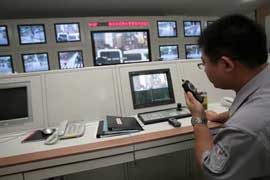


Top left panel: At 10:30am, the captain detected a crime in action on
one of the cameras.
Top right panel: The command center controller immediately notified the enforcement
vehicle about the coordinates of the live crime.
Bottom left panel: Two suspects fled at the sight of the enforcement
vehicle. However, their movements were tracked by camera and relayed
to the field force in hot pursuit.
Bottom right panel: The forces of justice triumph as the municipal
administrators confiscated two bags of vegetables from two unlicensed
vendors.
- [012] Catkiller's
Defense (08/03/2006) Yes, you guessed it, it was all a
misunderstanding. The initial story was in Comment
200608#004 about how Taiwan Internet sleuths tracked down the
sadistic 'Catkiller.'
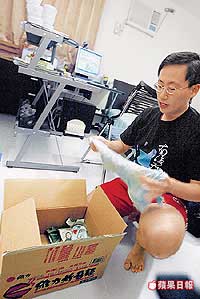
At 4am, Catkiller spoke to Apple
Daily and showed the cans of cat food that he bought -- if he was
feeding the cats, he couldn't be a cat torturer, could he? He had
picked up a stray kitten in June and he asked for advice on the Internet
about how to toilet-train the kitten. The advice that he got was to
flick at the kitten's ears. That was why he tied the kitten's limbs up
and then applied file clips on the ears. He thought the kitten looked
cute that way, took some photos and then he untied the kitten.
When asked why he fed bath gel to the kitten, he explained that he was
eating peppered fried chicken once and the kitten licked it. He
thought the kitten liked pepper and that was why he added pepper into the
catfood. The kitten got constipation and that was why it was foaming
in the mouth. But he swore that he never fed it bath gel. As to
why the kitten was defecating uncontrollably, he said that he squeezed its
belly to relieve the constipation.
Catkiller insisted that he treated the kitten like his own child.
"If you don't train your young child now, you won't be able to do it
anymore later!"
Alright, you have heard the one-sided story above. If you wish, you
can reconcile all that with some pictures that he posted on the
Internet. Mind you -- it can be very upsetting, so you may choose to
skip over this bit. Here are the photos.
- [011] The
Cosplay Incident (08/03/2006) The following is a demonstration
of how YouTube works. At the HKGolden
forum, a poster provided a link to a YouTube
video. The scene is taken from a higher floor at the Hong Kong Comics
Festival held at the Wanchai Convention Centre. Down at the lobby, it was alleged that the following
incident occurred: "A man yelled, 'Fuck your mother. You better
never come down to Wanchai again' and then he charged into a group of girls,
slapped one of them and kicked her in the belly. As he attempted to
leave, he was stopped by onlookers until the security staff came. The
video began after the alleged assault took place. The poster asked,
"I heard that the man is the boyfriend of the runner-up in the Cosplay
competition and that the girl whom he hit was a friend of the winner ... Did
anyone see this?"
In the comments, someone posted another YouTube
video. It was the same incident, but taken from amidst the crowd down
in the lobby. Since the assault happened out of nowhere rather
quickly, there was no video of the act itself. But immediately
afterwards, at least two witnesses used their videocameras and then posted
the films at YouTube.
... Yesterday a number of court police attempted without much success to fend off members of the press at the Taipei District Court, as the reporters chased the president's son-in-law, Chao Chien-ming, (趙建銘) as he exited the court building and got into a taxi.
As the press and police officers pushed one another in the chaos, Sanlih Entertainment Television employee Chu Wen-cheng (朱文正) was grabbed by several police officers and forcefully hauled into the court building, where he was taken into custody.
The court police then brought Chu to the Taipei District Prosecutors' Office and accused him of interfering with a public function (妨害公務罪).
Chu, who suffered minor injuries, told the press as he left the prosecutors' office that he neither swung at court police nor assaulted them.
"They got the wrong person," Chu said, adding that several cameramen had recorded the incident from different angles and could prove his innocence.
The court police said they arrested Chu because he hit them and kicked a court police officer during the fray.
Since then the media have been playing their
videos all day on television to look for Chu assaulting any court police
officer. Nothing has been found yet, but here are photos from the scene
of Chu being taken away by force.
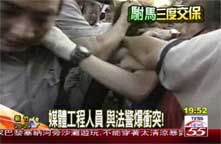
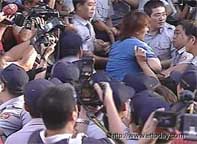
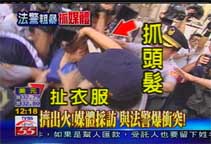

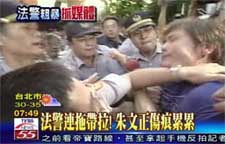
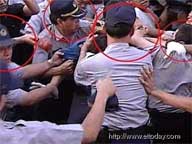
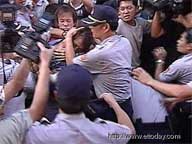
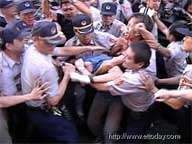
Yesterday afternoon, Chu filed a lawsuit against the Taipei District Court police for offenses against personal liberty, causing bodily harm and malfeasance in office. He
is asking for NT$1 million (US$30,470) in compensation. This is the
photo of Chu pressing the bell button at the courthouse.
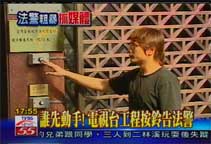
How did this happen? The court police
probably did not figure on the rock-star status of the man with the 45-degree
chin tilt.
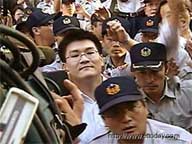
Extra: Here is the TVBS
video.
- [009] July
2006 Website
Statistics (08/03/2006) For the month of July 2006, the total
website statistics were:
- 2,773,634 hits (including htm, jpg, gif, wmv, xml, etc)
- 442,933 page views (htm files only)
- 376,412 unique sessions
- total time spent = 71,850 hours
- bandwidth = 58 gigabytes
On an average daily basis:
- 89,472 hits
- 14,288 page views
- 12,142 unique sessions
- 11:27 per unique session
- [008] The
Degeneracy of Taiwan Media (08/02/2006) (New
Century Net) From Jiao Guobiao's "How the Office of
Taiwan Affairs polluted Taiwan media."
[in translation]
... During my visit to Taiwan, I attended a
forum organized by Taiwan media scholars. After listening for a while,
I learned that the degeneracy of Taiwan media has two aspects: one, they
smear democracy in Taiwan; two, they prettify mainland
totalitarianism. A speaker pointed out that according to exact
information from the Taiwan intelligence service, at least 17 media
organizations in Taiwan are receiving "black money" from mainland
officials who regard democracy and freedom as their enemies.
When I visited Mainland Affairs Council Chairman Joseph Wu,
in front of many Taiwan media, I "accused" the Beijing-based
Taiwan reports of not caring about the fate of the mainland people,
democracy, freedom and human rights. When I criticized the Central
Propaganda Department in 2004, almost of the Beijing-based correspondents
from the democratic nations in Europe, America, Australia, Japan, South
Korea, etc interviewed me to express their care and concern for freedom of
press in mainland China. But I was not interviewed by the
Beijing-based reporters from Taiwan. Which other areas were there
whose reporters did not interview me? The Islamic, African and South
American countries did not. We don't have to elaborate on the
standards of civilization of those countries, but the Taiwan media were as
degenerate as those countries and that puts chills in the hearts of mainland
citizens.
Later on, a Taiwan media friend told me
that the situation with Taiwan media is more complicated. For example,
the two large Taiwan newspapers China Times and United Daily are pliant with
the mainland not because they agree with the media control there.
Their reporters have resisted and got into trouble many times. The
Office of Taiwan Affairs is tough and whenever the Taiwan media slip up,
their reporters are expelled or the bureau gets shut down. It is
different with western media, because their reporters are backed up by their
embassies. In Beijing, the Taiwan reporters are orphans and nobody
cares about them if they get into trouble. Lots of people mess with
them, but nobody loves and cares about them. I said: "So what if
you are closed down or expelled? Apple Daily cannot establish a bureau
in Beijing but it is still red hot. If you have the will, you can
still do good mainland coverage, or even better." This friend
shook his head and said nothing.
Postscript: In response to the
question: "Why are you publishing this nonsense?", I state that the opinions expressed in the translations here are not necessarily the same
as mine. The reason that this excerpt is here is this: Mr. Jiao used to
teach journalism, so you can decide whether it is standard journalistic
practice to make an assertion ("Taiwan media are degenerate") while
providing the following supporting evidence: (1) some person at a forum says
that Taiwan intelligence servcie has exact information that some Taiwan media
organizations are receiving "black money" from mainland officials
who regard democracy and freedom as their enemies; (2) the Taiwan media
organizations did not interview Mr. Jiao when he was the darling of the media
from the western and Asian democracies (with a barb at the lack of
civilization in the Middle East, Africa and South America). I report,
you decide.
- [007] How
Media Reporting and Public Opinion Mattered - Part 1 (08/02/2006) Here
was yesterday in Taipei
Times:
The Presidential Office came under fire again yesterday, this time for the allegedly improper use of taxpayers' money to pay for domestic help for the family of President Chen Shui-bian's (陳水扁) daughter.
The Presidential Office issued a statement yesterday afternoon dismissing the allegation and calling on the media to stop making "unnecessary interpretations" of the matter.
(emphasis added) The statement said the president was still the owner of the apartment on Minsheng E Road, where his daughter Chen Hsing-yu (陳幸妤) and her husband Chao Chien-ming (趙建銘) now reside. The president and first lady Wu Shu-jen (吳淑珍) relocated to the official Yushan Residence on Chongqing S Road in January 2001.
Lin Hsiu-jen (林秀貞) -- better known to the public as A-ching
Sao (阿卿嫂), or "Auntie A-ching" -- had worked as a housekeeper for the Chen family long before Chen was elected president.
After Chen became president in May 2000, the Presidential Office put Lin on its payroll to serve the president and his wife.
The statement said the Presidential Office continued to pay Lin to work for the president's daughter after he and Wu moved out of the Minsheng apartment because Chen Hsing-yu is considered a member of the first family and Wu also makes frequent visits to the Minsheng residence.
... The Presidential Office did not respond to the calls for the government to be reimbursed for Lin's salary for the past six years. Office Spokesman David Lee (李南陽) said the office did not have anything new to add to its original statement.
Yesterday, there was also the Apple
Daily instant poll (July 31, 2006; 511 respondents via automatic
telephone dialing):
- 78%: Disgusting! Using public funds
for private purposes. The first family must cough the money back
quickly.
- 15%: The apartment is an official residence,
so A-Ching Sao's salary is justified
- 7%: no opinion.
More importantly, no major political figure
was willing to come out to support the position of the Presidential Office.
Then comes today's front page story in Apple
Daily: The Presidential Office issued a press release after
office hours that A-Ching Sao has made a verbal resignation which has been
approved and she will now be directly employed by Chen Hsing-yu in a private
capacity instead. Chen Hsing-yu will also pay back the government the
salary amount of NT$1.6 million from October 2001 up to now. There has
been no public apology from the first family. A-Ching Sao said: "I
do whatever other people want me to. I am employed by them and I work
for them (人家要怎樣,我就聽人家意思,我也是呷人頭路(台語,指受僱於人),幫人做事呀!)."
However, she will be losing her government employee benefits.

And there was no mention in the Taipei Times
... they must be taking pains not to make "unnecessary
interpretations" ...
- [006] Pretty
Girls In The Kitchen (08/02/2006) The TVBS hit program
"Pretty Girls in the Kitchen" may seem dumb, but it is actually reflective of social
customs in Hong Kong. The concept is that certain pretty celebrities
who have non-existent cooking skills are invited to prepare food on the
show, and the entertainment is precisely in their incompetence. Why
are they so bad? Because many of their generation have been brought up
in homes served by domestic helpers who take care of all household chores
including cooking.
(Apple Daily via HKGolden)
In last Sunday's episode, the star was Kary Ng (吳雨霏
). Previously, Fiona Sit (薛凱琪)
had established the record low score of -19 when she made lemon duck and
caused one of the judges to throw up. But Kary Ng would proceed to
establish the new record low of -32.
The assigned dish was homestyle fried carp. Kary began by heating the wok while
she chopped up the vegetables and stuff at the same time. But the wok
became overheated. When Kary pour some oil in, the fire shot up as
high as her head and caused her to scream in terror while the judges and
audience roared in laughter. A security guard rushed in and put out the
fire with an extinguisher. Afterwards, Kary continued the cooking and
forgot to clean the fish before cooking. Even though the presented
fish was falling apart, it was still not fully cooked. One judge said:
"If you withdraw now, I'll give you a zero. Otherwise, I'll have
to give you negative points." Kary insisted, and all the judges
threw up, including one who had body shivers.




The show is not completely facetious as the 'winner' of the evening was Ada
Choi, whose 110 points became the third-place all-time highest score.
- [005] More
Religious Crackdown in China (08/02/2006) One of the functions
of the media is to supervise/monitor/watch on behalf of the people.
When a media report actually had an effect, it is time for the media to
gloat. In this issue of Hong Kong's EastWeek (August 2, 2006, issue
153; no link), there is a case of triumphalism. Previously, in issue
144 (May 31, 2006), there was an exposé about how the Buddhist monks at
certain Guangdong temples regularly engaged in eating meat, boozing and even
patronizing prostitutes together. As I recalled it, the reporting was
fairly rigorously, consisting of the diary of the reporter tailing the monks
around, speaking to the restaurant owners and the working girls ("Do
you know those men?" "Yes, they're regular
customers." "Do you know who they are?"
"Yes, you can tell by their hair, couldn't you?").
Reportedly, the Chinese central
government took notice and ordered a rectification campaign among all
Buddhist organizations! Certainly, all those monks involved in the
scandal have been expelled from the organizations, but the various local
leaders also got lectured for months already. At a recent Guangdong
conference, State Administration of Religious Affairs director Ye Xiaowen
lectured the head of the Guangxiao temple (from which some of the monks in
the scandal came): "Master, there should be better management of the
Buddhists in Guangdong. You should use the Buddhist regulations as
your guide." The master was flushed with embarrassment.
The EastWeek headline this week says: "Mainland Buddhist monks subjected to
rectification: no more patronizing prostitutes."
Idle speculation: Could this article be published inside China?
Would it be suppressed for creating a negative image detrimental to social
harmony?
- [004] Another
Internet Manhunt for A Cat Killer (08/01/2006) (Apple
Daily) Recently, about a dozen or so photos were circulated on
mainland Chinese websites showing cats being tied and tortured by dousing
with boiling
water, forced feeding with pepper water, etc. The person with the alias Catkiller
wrote (in simplified Chinese) updates such as: "This morning, the cat
urinated again so I taught her a lesson. I only slammed her into the
ground and she broke some bones. So I had to throw the cat out.
Dear netizens, I am sorry if I did not take any photos. If you like, I
will adopt more cats and have some more fun!"
Outraged citizens began to scrutinize the photos very carefully. There
was a copy of Taiwan's United Daily News and a bottle of Attack concentrated
liquid laundry detergent in the photos, so the location was believed to be in Taiwan rather than mainland
China.

So more than 50 people at Taiwan's Cat forum began a campaign to find
Catkiller. Through the assistance of someone inside a telecom company,
they locked the IP address of the forum poster down to a district in Taipei
City. It so happened that one of the photos showed a building in the
background through a window view. The netizens canvassed this neighborhood, comparing each
and every building against the photo until they found the right one.
Then they determined the exact apartment from the angle.

The netizens called the police and provided the details of their evidence. When
the police spoke to the suspect, they
established that he had a black mole on his wrist just like one of the photos
showed.
Yes, but so what, though? Under Taiwan law for the protection of animals,
this person has been fined NT$50,000 subject to appeal. Meanwhile, Catkiller has gone on the Internet to say that he has four more kittens at
home: "I will process them one after another and show you the
photographs. Afterwards, I will leave the broken-boned bodies at the
local bus stop." There is no legal basis for the police to enter
the apartment to effect a rescue (note: the fire safety law permits an
emergency entry to save human lives only).
- [003] Photo
Ops (08/01/2006) (The
Sun; a more detailed version is at Southern
Metroplis Daily)
(in translation)
"Aren't you Chinese people
beggars? Why won't you pick it up?" A foreign man threw out
many coins onto the streets of Beijing and waited for the passerbys to pick
them up in order to take pictures. This action aroused the anger of
the citizens, who cursed him. Finally, the foreign man had to pick up
the coins himself and leave in a hurry.
According to a report in Beijing Times, a
foreign man wearing an old green Chinese military uniform and wearing an
army cap was taking photographs with two companions. Sudden, the man
threw out thirty to forty coins and then pointed the money to an old man who
scavenging for empty mineral water bottles. The foreign man then
positioned himself five meters away and got read to to film.
The action of the foreign man aroused the
anger of the people waiting for the buses because they thought that this was
an insult to the Chinese people. They demanded that the foreign man to
pick up the coins himself. Some of the citiznes had raised their fists
and were ready to hand out a lesson to the foreign man. When the
foreign man assessed the situation, he quickly bent down to pick up the
coins that he had thrown out and then he left in a hurry.
- [002] The
Color of Your Skin (07/31/2006) A couple of anecdotal stories
here.
First, I was talking to a former foreign correspondent based in China.
She told me about the Beijing demonstrations at the American embassy in the
aftermath of the bombing of the Chinese embassy in Belgrade. As an
American working for an American news service, she thought that it would be
wise to claim to be Canadian instead. Still, she was hit in the head
by a Chinese person until others pulled her away. She then commented
that it was dangerous to be an American under those circumstances. I
commented (with some bitterness) that this was not true -- I am an American
citizen and I could have gotten away with it --- because the color of my
skin was yellow.
Second, here is the translation of a blog post by Hong Kong reporter Susanna
Cheung Chui-yung: "On the first day that I arrived in Managua
(Nicaragua), I became the victim of violence. I thought that it was
around 4pm, the sun was shining brightly and the streets were crowded, and
therefore it must be safe. When the six men came at me armed with
guns, I had a delayed reaction because I thought that they must be
joking. But they took everything that I had on me, almost even taking
my eyeglasses."
Ummppphhh! I can understand that. When I was working and had to
travel in Latin America, the first rule was that I was never allowed to
travel on my own, regardless of my own lack of concern. The company always had people to pick me up and take me
anywhere I had to go. Why? Because I have yellow skin and I am
therefore a prime target for kidnappers (note: blame it on the Japanese
corporations which will pay any amount to free their employees!).
In 2001, I took a trip to Bogota (Colombia) (aka, kidnap capital of the
world) and I had a company chauffeur assigned to me to take me everywhere I went. He took me to the
hills from which I took the following picture of the cityscape.

Moments later after I took this photo, a motorcycle police officer pulled up and spoke to the
chauffeur. The conversation went something like: "Are
you out of your mind? How can you stop at this place and let your
passenger out? Everybody can see that he is Asian. You are
making him an obvious target for robbery and kidnapping. Now get out
of here as quickly as possible!"
Depending on the time, place and context, the color of your skin may be a
problem. I am not telling you anything that you wouldn't know, if you
have ever traveled anywhere away from the 'safe' places..
- [001] The
Hong Kong Blogosphere (08/01/2006) I always want to
regard the progress of freedom of speech in China as 'sea change.'
Rather than focus on this or that incident at this moment as indicative, I
want to step back and look at how things were twenty, or fifteen, or ten, or
five years ago compared to today. From that perspective, the state of
things today is nothing less than astonishing and I cannot wait to see what
happens over the next five years.
Closer to home, let us review what has been happening in the blogosphere in
Hong Kong.
Let me retrieve the following posts from just over a year ago:
- Hong
Kong Blogosphere Up In Arms (May 2, 2005)
- Weblogs
as Online Diaries (May 5, 2005)
- Blog is Blog (July 2,
2005)
One year ago, the Hong Kong bloggers were trying to collect signatures to
protest against the mainstream media for characterizing blogs as teenager
online diaries! We got no respect! They would not take us
seriously!
A lot has happened since! Here is a landmark event: In Hong Kong
Economic Journal columnist 孔少林's
final column before his departure, he made a recommendation of blogs to read
(see Comment 200607#087).
It is as if he was telling his readers: I will no longer be around for you,
but you can read these blogs because they are every bit as interesting and
informative!
I would not call this a tsunami, but it was not a slow sea change on a
geological scale either. Anyway, the bloggers have arrived in Hong
Kong and we are many and diverse. Can you imagine what it will be like
in another year's time? Oh, I can't wait! Of course, dear
reader, much will depend on what you put in your own blog! We need to
be many and we need to be good.
Archives