
- [099] The
Kiddie Porn Story (06/30/2006) Earlier this week, a press
interviewer noted, "When I read your post Kiddie
Porn In Hong Kong, I thought: it will probably show up a few days later
in the South China Morning Post." Yes, this morning Donald Asprey
wrote "Uproar at photos of teenage singer" in SCMP. If you
get the chance to read that article, it may strike you as being light on the
original EasyFinder article with more space for outside commentators.
Perhaps the reporter had not even read the article itself. Here is the
last paragraph: "Next Media Group did not respond to a request for comment. The article has been removed from Easyfinder's website."
This is an error. At the Easyfinder website, they only show the cover
of the latest issue (#753 right now). The Renee Lee article appeared
in issue #752; a subscriber to the Next Media website can access older
issues and that article is still there. Yes, I am a subscriber and I
just checked before I wrote this.
One perverse effect of the hoopla was that by late last week, there were no
copies of EasyFinder #752 to be found on sale anywhere in Hong Kong.
It was sold out everywhere. You can still pay get a copy if you bid
for it on the Internet but at higher than the original cover price (like
HK$60 for the original HK$20).
- [098] Hong
Kong By The Numbers (06/30/2006) The following are Ming
Pao's survey results for intent to particpate in the July 1st
morning parade or the afternoon march.
Survey 1 (June 21-23, 1,200 persons, automated telephone dial survey)
- 61.4% will not participate in either event
- 15.6% undecided
- 13.2% July 1st afternoon march
- 7.4% July 1st morning parade
- 2.4% participate in both events
Survey 2 (June 27-29, 681 persons, automated telephone dial survey)
- 57.6% will not participate in either event
- 13.5% undecided
- 15.7% July 1st afternoon march
- 10.3% July 1st morning march
- 2.9% participate in both events
Among those intend to participate in the July 1st afternoon march, 57.5 said
they do so for "equality, justice, democracry, universal
suffrage"; 18.1% dissatisfied with current economic situation; 11.8%
dissatisfied with HK SAR government; 6.3% because Anson Chan will be there.
Among those who intend to participate in the July 1st morning parade, 47.8%
said that they support "harmony, unity, development"; 26.7%
celebrate the return of Hong Kong to China; 13.3% satisifed with HK SAR
government.
Among those who do not intend to particpate in either event, 42.9% have
something else to do; 20.7% believe marches/parades disrupt social order;
10.5% satisfied with HK SAR government; 7.1% say economic situation has
improved.
As mentioned in Comment 200606#082, "intend
to participate" is usually much higher than "actually
participate."
- [097] "I
Denounce My Daughter!" (06/29/2006) In Comment
200606#054, titled "I Denounce My Daughter", a 19-year-old
female university student publicly denounced her father for keeping a
mistress. Since then, the media blitz (see, for example, My
Dad Is Worse Than Ximen Qing) has turned up a few more facts and we have
a situation in which a significant portion of the public is in fact not
sympathetic to her cause. These translated Tianya
Club comments are examples.
Her mother Yang Xili is a shrew with
absolute control in the household. Her father's peasant parents do not
dare come to visit. So when his uncle needed to see a doctor, he had to
borrow a place for the uncle and the uncle's daughter. He did not dare
to mention it to his wife. When the shrew found out, she thought that
he was in rebellion and went to his office to scream and complain.
This time, the father has had it, asked for a divorce and persisted on that
demand until the court acceded. At the time, Wang Jing was only 15
years old and she only listened to her mother and started the protest
movement. In their view, under public opinion pressure, the father had
only two options: apologize and ask to come home, or go to jail. The
mother was too naive in not knowing that it was her behavior that drove her
husband out and, until that changes, he will never come back.
... Wang Zhihua explained that so-called
'mistress' Li Cuilian was a relative who is a peasant woman with two
kids. He has taken her to the office before. After his wife
began publicly accusing him of keeping this mistress, his office colleagues laughed and said,
"Old Wang, you have really poor taste." Later in the wife's
home, the reporter saw a photograph of Li Culian. This is a fat woman
with a simple and honest smile, like a typical peasant woman. The
reporter cannot imagine how a man would keep such a peasant woman as
mistress. If Wang had really done it, then he must have been really
living a miserable life before so that he was grateful for any kindness and
care irregardless of the looks.
- [096] The
Case of Zhou Xiude (06/29/2006) Zhou Xiude (周秀德)
the former director of the Jiangsu Provincial Supply Cooperative who has
been sentenced to life in prison for corruption. In trying to research
the case, I was struck by the styles of reporting. The same story
could be written in many ways.
(Inner Mongolia
Daily) This is totally fact-based. Section one: name,
gender, year of birth, highest job position, party disciplinary measures,
crime, punishment. Section two: brief biography. Section three:
the prosecution's charges. Section four: the facts presented and
accepted in court. Section five: the court's decision. Section
six: the relevant articles in the criminal law code. Section seven:
important dates in the case.
(East
Day) This is a popular police detective story. Here is
an example -- Zhou was suspected for working with two business persons Hu
and Wang. There was a problem with contacting those two because Hu had
fled at the instruction of Zhou and Wang was based in Hong Kong. So
the prosecutors flew to Hong Kong to interview Wang, who proved to be
evasive. However, Wang was too smart for herself as she sneaked out
and flew to Shanghai for a meeting because she thought the prosecutors were
still stuck in Hong Kong. When her plane landed in Shanghai, the
prosecutors were waiting for her at the gate!
(Qilu Evening News via Sina.com)
This is a tale with sexual tease. It turns out that Zhou Xiude's had
an interesting office, which was one hundred squares meters in size and
decorated as a bedroom. Each floor in the office building was equipped
with surveillance cameras, except there was none on Zhou's 21st floor upon
his orders. Zhou's daily routine consisted of showing up at the office
at 8am, saying hello to the people and then going out immediately to take a
taxi (and not his chauffeured official vehicle) to meet his mistress.
Here is the best bit: "After Zhou was arrested, the prosecutor found
more than 40 diaries about his encounters with more than 100 women,
including lots of unreadable descriptons of debauchery." There
are no more details, though.
(Yangtse Evening News via Boxun)
Now we get the tabloid stuff. During the 12 years between 1989 and
2001, Zhou kept 14 diaries most of which are about his adulterous affairs
with more than 100 women. While Hainan province official Li Qingpu was
famous for collection public hair samples from 236 prostitutes locked in a
steel cabinet, Zhou must be one of the few others who recorded the
evidence. He listed the persons, times, places and responses.
Zhou sometimes had more than one encounter per day, and even the slowest
times were once every three or four days; the locations included his office
and his home, suites in teahouses and coffee houses, or even outdoors in the
park. Zhou also compiled summaries, such as the year-end summary
statistics of the number of people and occasions.
Which is the best style? That depends on the objective. If the
objective is to sell copies, then the answer should be obvious.
- [095] The
Chinese Internet Police (06/29/2006) In Southern
Metropolis Daily today, there is an article about the arrival of the
Internet police Jingjing and Chacha to the Guangzhou-based websites.
The following graphic shows the icon that will appear on the website for
netizens to click and report harmful information such as pornography and
gambling. Four websites (21CN, Southcn, Dayoo and YCWB) are supposed
to have taken the lead already.
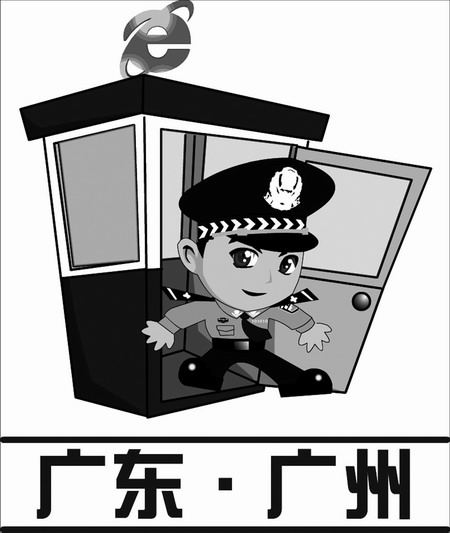
Now I don't expect every web page will have an icon this big, so I decided
to go to 21CN.com and see what it actually looks like. I had to scroll
all the way down to the bottom of the page to find it, and this is a screen
capture. It is difficult to discern what that graphic means unless you
already know what it is.

And here is the one at Dayoo:
And here is one at YCWB, which has a really cluttered page. I had to
wait for a long time for all the graphic elements to download before
reaching that last itme.
I was unable to find the icon at Southcn (unless if was really that small!).
When I click on the icon, it directs me to a government website which
returns this message: "Failure of server APACHE bridge: No backend server available for connection: timed out after 10 seconds."
To put it charitably, this is work in progress.
Here is the translation of the last paragraph of the SMD report:
"Concerning this matter, some netizens say that while it is logical to
stop pornography and gambling on the Internet, but having an icon
representing law enforcement at forums and chat rooms will cause unnecessary
caution among netizens and inhibit their willingness to speak up.
Zhongshan University professen Ren Jiantao believes that this is a
reasonable step to ensure public security, but when citizens discuss public
affairs and criticize others (including leaders), their speech should be
protected. Therefore, this step must not be inappropriately extended
to become a restrictive measure."
- [094] The
Emergency Response Law (06/29/2006) Wow! is what I say.
As an observer, I watch the Chinese Internet grow and I keep wondering at
what point do people recognize the power that is in their hands by virtue of
the fact that they are now more than a hundred million and organize
accordingly to exercise that power. I can see it in apparently mundane cases
such as the Lady Cat Killer and I wonder when they will tackle a more
substantive political issue. The following links is a glimpse of the
future and this is when some media responded vigorously but without figuring
yet how to mobilize the masses (like 1,000 forum posts per hour):
- Suddenly
Breaking Incidents in China EastSouthWestNorth, June 26, 2006.
- Media clause of proposed emergency management law raises hackles at Southern Metropolis Daily
By David Bandurski and Brian Chan, June 26, 2006.
- Media clause of draft emergency management law already under contention
By David Bandurski and Brian Chan, June 27, 2006.
- Chinese media continue their attack on the media clause of the draft emergency management law
By David Bandurski, June 28, 2006.
- Draft bill: Breaking news stories to be illegal
Jeremy Goldkorn, Danwei
- An Audacious Assault on Press Freedom
Non-violent Resistance
- Follow-up on Emergency Response Law
Non-violent Resistance
- Emergency Response Law: Caijing Magazine Kicks Ass!!
Non-violent Resistance
- Chinese journalists say enough is enough
Rebecca MacKinnon, RConversation
- [093] Taiwan
By The Numbers (06/28/2006) Here are some public
opinion surveys after yesterday's presidential recall vote in parliament.
(TVBS via Yahoo!
News) (no description of methodology)
Chen Shui-bian: 16% satisfied; 70%
dissatisfied
Ma Ying-jeou: 45% satisfied; 42% dissatisfied
James Soong: 35% satisfied; 51% dissatisfied
In particular, here is the trend for Ma
Ying-jeou
- elected as KMT chairman: 65% satisfied; 20% dissatisfied
- visited United States: 58% satisfied; 14% dissatisfied
- recall vote process: 51% satisfied; 30% dissatisfied
- the day after the recall vote: 45% satisfied; 42% dissatisfied
What next? 45% push for no confidence vote in
government; 41% let Chen finish his term.
(China
Times) (727 adults interviewed by telephone on the evening of June 27)
- What next? 28% push for no confidence vote in government; 36% disagree; 36%
undecided.
- Should KMT go back to moderate road? 69% yes; 10% no; 21% no opinion.
(United Daily)
(836 persons interviewed on June 27)
1. Chen Shui-bian's performance as president: 19% satisfied; 66%
dissatisfied; 14% no opinion
2. Ma Ying-jeou's performance as KMT chairman: 51% satisfied; 27%
dissatisfied; 20% no opinion
3. James Soong's performance as PFP chairman: 29% satisfied; 48%
dissatisfied; 21% no opinion
4. Democratic Progressive Party's performance: 18% satisfied; 68%
dissatisfied; 13% no opinion
5. Do you accept the result of the recall vote? 52% yes; 32% no; 13% no
opinion
6. Do you support the no confidence vote? 32% yes; 45% no; 21% no
opinion.
7. If the no confidence vote results in new parliamentary elections, which
party will you support? KMT 38%; DPP 11%; PFP 3%; TSU 1%; independent 1%;
no opinion 42%.
8. Your outlook for the remaining 2 years of President Chen's term:
optimistic 19%; pessimistic 63%; no opinion 16%.
(ETTV via Yahoo!
News) (no description of methodology)
- Chen Shui-bian's performance: 26.5% satisfied; 57.0% dissatisfied
(note: prior numbers were 21.9%/68.7%)
- Ma Ying-jeou's performance: 46.2% satisfied; 40.1% dissatisfied
(note: prior numbers were 55.5%/27.0%)
- James Soong's performance: 30.3% satisfied; 53.3% dissatisfied (note:
prior numbers were 39.3%/37.3%)
- Democratic Progressive Party's performance: 68% dissatisfied (note:
prior number was 62%).
- No confidence vote?: 26.5% yes and 'more than half' no.
- [092] George
Clooney and Chang Hui-mei (06/28/2006) (Apple
Daily) Hollywood superstar George Clooney seems like a
humanitarian politician these days. In the United States, he has been
denouncing the racial cleaning in Darfur (Sudan) and he has been calling for
the US government to intervene quickly to put a stop to this African tragedy
that has been going on for three years. Through aid organizations,
Clooney and his father went to Sudan and Chad to visit the refugee camps in
person in order to understand the situation. Maybe Clooney is
interested in publicity, maybe he wants to expiate his sins, or he may even
be aiming for a Nobel Peace Prize. But the fact is that Clooney is
working to bring the Darfur situation to public attention.
Last summer, Taiwan's superstar singer Chang Hui-mei (張惠妹)
also went to the Sudan refugee camps. Just like Clooney, she saw what
happened with the refugees. When she got back to Taiwan, she got on
stage and shed tears to ask the people to Taiwan to show their love to help
the Sudan refugees. But all the media treated A-Mei's Sudan trip as
entertainment news and reported extensively on her personal medical
emergency. A-Mei joined Hunger 30, but not many people know the
connection between Sudan and Hunger 30, and only very few people know where
Sudan is and what is happening over there.

George Clooney and Chang Hui-mei both brought first-hand news about Sudan to
their respective countries, but the responses have been opposite. Is
it because Clooney has broad vision while Chang Hui-mei has narrow
vision? Is it because the United States is internationalized while
Taiwan is too isolated? It does not have to be. Taiwan is not
the United States for it does not have the ability to conduct humanitarian
intervention overseas. But if the people of Taiwan can bring
themselves out of their microcosm and attempt to understand the tragedy that
has led to the deaths of several hundreds of thousands and the destitution
of millions, then it should not be difficult for Taiwan to offer help to the
Darfur refugees and make sure that A-Mei did not shed her sweat and tears in
vain.
- [091] Summer
Recreation in Chengdu (06/28/2006) (Wenxue
City) In the Hongku district of the Chinese city of Chengdu,
they set up a swatch of beach umbrellas that stretch over 10 miles right by
the river during the summer. What are the people doing there?
They certainly do not look to be working on a suntan underneath the beach
umbrellas.
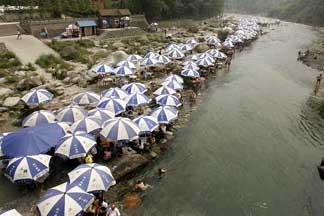
Click on this link to
find out what people do underneath the umbrellas while soaking their feet in
the cool water.
- [090] Striking
Fear (06/28/2006) (Oriental Daily via Yahoo!
News) According to a study conducted by the Hong Kong
University Li Ka-shing Medical School and three other organizations, 65% of
men who suffered from erectile dysfunction had smoked for more than 50
years. According to a urologist, 400,000 Hong Kong men suffered from
erectile dysfunction and he urges men to quite cigarettes in order to retain
normal erectile functioning. The survey sample consists of 498 male
adults with erectile dysfunction.
- [089] Overseas
Reactions to the Chen Shui-bian Recall Vote (06/28/2006) I don't
mean the bare-facts Reuters
report; I don't mean the People's
Daily report; more generally, I don't mean anything that has to do
with political partisanship. Rather, I mean the reflections by
'grown-ups' about what it means for them.
If the indicator is taken to be Lung Ying-tai's essay Today's
Lesson: Character, then the essay is being cited broadly outside of
Taiwan. Here are three instances. The point is less about
whether these commentators are right or wrong. Rather, the point is
that they came away with a tremendous respect for what is happening there
and they are busily trying to figure what the lessons are for themselves.
At InMediaHK,
the essay was posted in full with the commentator 'fred' adding this
preamble: "Another typical powerful punch-packing essay from Lung
Ying-tai. Although this is ostensibly about Ah Bian in Taiwan, it is
possible to have a different reading for the Hong Kong environment on the
eve of July 1st." 'Fred' highlighted the following paragraphs
which can obviously be readily transplanted to Hong Kong.
According to my understanding, the head of
state has four core responsibilities. First , no matter the hardship in which the
country finds itself, he must have the ability to make the people feel proud
of being citizens, so that the citizens will have a healthy sense of pride.
Second, no matter how powerful the opposition
is, he must have the ability to bring together the sense of common identity of
the people to identify with the country, society and especially with each
other. Third, he must have the ability to offer a
long-range ideal for the country. The people identify with this ideal
and they are willing to work together towards this ideal. Fourth, he does not have to be a saint but he
must have a high degree of morality. To the outside, he represents all
the people. To the inside, he symbolizes the consensus values of
society. When an elementary school students writes the standard
"When I Grow Up, I Want To Be ...," he should be the ideal that
children want to become. ...
The rights and wrongs of the matter are
obvious to my eyes. The leader is not just a corporate CEO who only
talks about operational efficiency and legal liabilities. For a leader
of the nation, legal liability is the least and last thing; his first thing is
to assume political responsibility and moral responsibility. Both political
responsibility and moral responsibility are not spelled out in articles of
law. ...
If our families, schools, society and
political parties have never treated character and upbringing as key contents
in education and if our government never treated civilian quality as part of
the grand educational plan of the nation, then even if there is a democratic
system, the people in this system will be a group which is basically
indifferent about character. So why should we be astonished to find that
we have elected an incompetent and ignorant president with no sense of shame.
...
Democracy is not populism; democracy is
not laissez-faire; tolerance is not the abandonment of principles; as people
grow up, it does not mean that they don't want model characters. Through
the recall vote, the people are testing how much they care about rights and
wrongs, how much confidence they have in the progressive forces in society,
whether they decide that the behavior is insufferable and how to keep
struggling towards the worthwhile goals.
In China, Lung Ying-tai's essay was published
at the TECN (天益)
forum. There were plenty of
praises for the essay and its author. The discussion of the issues is
mild, since TECN forum's predecessor was the banned Yannan forum and there is
no point in testing the boundaries so soon. Here is one translated
comment:
We must admit that Taiwan is ahead of
mainland in terms of the development of democracy. But we are learning
here on the mainland too. The one window of instruction (Phoenix TV)
is obviously deliberately set not to be open all of the time, but we can
absorb the lessons and avoid the diversions along the way. The case of
Taiwan democracy shows us a lot about how the rules of the game can be
manipulated and that universal values can be used as covers that by those
disgusting but experienced old-hands.
More extensive coverage is offered at Asia
Times Online (via ChineseNewsNet).
Here is a translated excerpt:
Ever since the cancellation of martial law
in 1987 and the cancellation of press restrictions the next year, the people
of Taiwan no longer have to be afraid of the white terror in the system or
worry about the presence of the secret police spies next to them. But
whether it was because of Baiyang's "Ugly Chinese" collective
mentality or the habits from the days of the shadows, the people of Taiwan
may pay lip service to the democratic notion that "the leader is the
people's servant" but they don't really appreciate the meaning
thoroughly. Conversely, the leadership never really appeared to accept
this notion and truly work to serve the people.
With this confusion or adoration of power
and with the alienation from the legislative and political party system of
the previous generations, the basic concept was that "politics is about
administering" according to the theoretical precepts in
textbooks. Politics in Taiwan was all about money, violence, special
interests, family monopolies and local sectarianism. In recent years,
it was also about the rupture between local and outside groups. In
this political game controlled by the politicians, the people is never the
"master" except on election day. Most of the time, the
people are just the tools for the politicians or political groups to grab
personal benefits.
It is therefore delightful to see that
during the presidential recall process, the will of the people of Taiwan manifested
itself in various ways. There were no mass mobilization before
politicians, political parties or even the government. During this
period, the audience to political commentary programs soared; as soon as a
radio station opens its lines for citizen call-in, all the lines are jammed
immediately; at offices, restaurants, gymnasiums, markets and department
stores, one can hear people discussing the political situation.
The difference with the past is that the
masses do not necessarily go along with the political parties in marching on
the streets, and they do not follow the political parties around. Most
people watched television, reflected, discussed and interacted with each
other. They have internalized the concept that "if the president
does not perform well, I can oust him from his job." Even though
in the middle-class Taiwan society, the people have different values and
attitudes with respect to the cost of recalling a president, this process of
internalization is sufficient to make any future president understand the
true meaning and importance of "humility" and "keeping the
wishes of the people at heart."
- [088] Will
The Boat Sink The Water? (06/27/2006) June 26, 2006 is
the official date on which Chen Guidi and Wu Chuntao's book Will The Boat
Sink The Water? becomes available. The original Chinese titles is 《中國農民調查》;
for a lot more information about the book and its authors, please see The Chinese Peasant Study.
This unusual title is based upon the ancient Chinese saying: “水能載舟,亦能覆舟”
(translated: Water holds up the boat, water can also sink the
boat." The Tang Emperor used this phrase to mark the relationship
between the ruler (=the boat) and the people (=the water), for the people
can support the ruler and they can also overthrow him. The book title
here turns everything upside down -- Will the ruler destroy its people?

(ChineseNewsNet)
The original book was published in China in January 2005 and sold more than
100,000 copies after three printings in the first month. On February
25, 2004, the General Administration of Press and Publication asked the
Chinese media to not report and recommend the book and make it fade away (不報道、不推崇、內部淡化處理).
In March, the publisher took the book down from its website upon
orders. Thereafter, the official edition vanished from the
market. Meanwhile, it was estimated that several millions of pirated
copies had been sold. According to Wikipedia, the Internet ban on the
book was quietly removed in December 2004, and it is widely available for
free downloading.
Related Link: No such thing as The Chinese People
Richard Spencer, Telegraph Blog, April 18, 2006.
- [087] National
Anthem On Television (06/27/2006) A recent Internet post at
Strong Nation, CCTV, Tianya Club and other forum has forced CCTV petitioned
CCTV1 to restore the evening broadcasts of the Chinese national
anthem. The post suggested that CCTV stopped the broadcasts because
there was enough patriotic education already. It is a testimony of the
strength of the Internet that CCTV felt that it was necessary to issue a
response.
(Sina.com)
CCTV stated that no country in the broadcasts its national anthem during
dinner time. Therefore, on September 1, 2004, CCTV followed
international customs and shifted the national anthem broadcast from the
original 7:05pm to 5:55am.
Hmm ... let me see: How much does a 30-second
commercial cost on CCTV? Could that be the true reason?
Meanwhile, in Hong Kong, there was this SCMP
story on October 7, 2004, shortly after CCTV took the national
anthem off prime time. This was a true example of One County, Two
Systems as Hong Kong went in the opposite direction of China.
The government has ordered television stations to run nightly broadcasts of a patriotic propaganda video, sparking worries that communist China is attempting to indoctrinate the free-spirited territory.
The nightly 45-second airing of China’s national anthem played over a montage of patriotic images has sparked more complaints than flag-waving in Hong Kong, where many of the 6.8 million residents remain leery of Beijing’s communist government after the territory was returned from Britain to China in 1997.
...
The video, titled “Our Home, Our Country,” was launched last week as Beijing celebrated the 55th anniversary of the People’s Republic of China. It is now being shown every evening before the news on three Chinese-language TV channels.
While the anthem plays, the film shows images of the first Chinese astronaut, Yang Liwei; Chinese Olympic medallists including diving queen Guo Jingjing; members of the People’s Liberation Army; Hong Kong children singing and some of the territory’s landmarks.
CCTV has now provided the counter-argument --
no nation in the world broadcasts the national anthem during prime time.
Can Hong Kong join the league of nations too?
P.S. If China had a democratic election
system like the United States, there would be fewer worries about stuff such
as national anthem broadcasts and more concern about the really vital
matters. Their elected representatives can concentrate on more important
issues such as the Flag
Amendment.
P.P.S. The Hong Kong Press Workers Website has this comment: 香港政府同公民教育委員會拍馬屁拍中馬撚了.
Sorry, it is untranslatable.
- [086] Reporter
Bloggers (06/27/2006) Recently, I got the opportunity to speak
to some real-life reporters in Hong Kong. On the matter of whether
they should be writing blogs, the answer was NO -- they had discussed this
at a company meeting, but legal considerations barred them from doing
so. That is, they were afraid that if their personal sentiments and
thoughts on the blog diverged from the published accounts on particular
stories, then this becomes proof of malice in a libel suit. So it is a
bit of a shame that the environment in Hong Kong is so unfavorable to
reporter bloggers (or blogging reporters). Here are two rare
specimens: Over The Rainbow
(in Chinese) and Shenzhen Zen.
In China, the species known as reporter bloggers is in fact dominant in
influence due to the environment. On their jobs, the Chinese reporters
are often frustrated by the restrictions on what they can write and publish,
so they often publish it on their blogs or at forums instead. Chinese
reporter bloggers provide much of the information that I translate on this
website. Here are my favorite illustrative examples:
The
Shalan Flash Flood - Part 3 This is a translation of a Nanfang
Weekend report that was written but denied publication. But it found
its way to the Internet anyway. Read this gripping account even as you
figure out why permission was denied.
The
Shalan Flash Flood - Part 4 The journalist who wrote the banned Nanfang
Weekend article also wrote about what else he couldn't write in the article.
Meanwhile, Tim
Johnson and Richard
Spencer are Beijing-based English-language foreign
correspondents who maintain their own blogs on the side with company approval.
What about reporter bloggers in the United
States? Hmmm ... why would reporters do a thing like that? They
get million dollar advances on their books, so why would they give the
information away for free on blogs?
Since the World Cup began on June 9, Hong Kong police have mounted around 50 large-scale operations, arresting more than 100 people and seizing an estimated HK$50 million in betting slips.
The stakes were raised last week as national teams battled it out to go through to the knockout stages.
On Wednesday, police uncovered the biggest bookmaking operation in Hong Kong since the launch of the crackdown, when they arrested two men and found betting slips worth HK$12 million. A computer was found connected to an overseas gambling Web site.
Five Hong Kong residents, including a 15-year-old boy, were arrested in Macau Thursday.
On Saturday, a joint operation seized an estimated HK$100 million in betting slips.
It is by no means clear that this is striking
fear into the hearts of the betting syndicates. What is the outcome
after a police raid, if these people were smart enough to have computer backup
files not seized by the police? It would be a win/no-lose situation for
them. For anyone who placed a bet and lost, the syndicate would collect
the bet; for anyone who placed a bet and won, the syndicate would say that the
police seized all the records. Now isn't that the perfect arrangement
for the Big Boss? You almost have to wonder if he didn't tip the police
off!
None of this may be true. That is just Internet gossip.
- [084] The
Kaohsiung Rally (06/26/2006) Depending on what you read, you
may have completely different impressions.
From AFP:
"Taiwan main opposition Kuomintang (KMT) chairman Ma Ying-jeou (C) shout slogans during an anti-President Chen Shui-bian's rally in Kaohsiung, southern Taiwan. Thousands of protesters have taken to the streets calling for the resignation of Chen over a string of corruption
scandals. (AFP/Sam Yeh)"
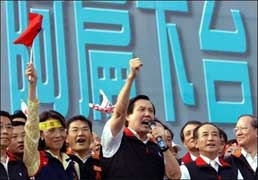
(Apple
Daily) Due to the "assassinate Ma Ying-jeou" talk on
the underground radio stations, the police mobilized 1,500 hundred officers
to prevent that from happening when Ma Ying-jeou appeared at the Kaohsiung
rally. When Ma entered the venue, he wore a bullet-proof vest and
there were five layers of police cordons around him.
From Associated
Press: "A Democratic Progressive Party supporter bleeds as he is carried away by police after a scuffle with opposition Nationalist Party supporters during a rally, Saturday, June 24, 2006, in Kaohsiung, Taiwan. Taiwan's opposition parties launched a final weekend of protests to recall President Chen Shui-bian on Saturday, just days before a legislative vote on whether to hold a referendum to sack Chen over allegations his family is corrupt. (AP Photo/Steve Chen)"
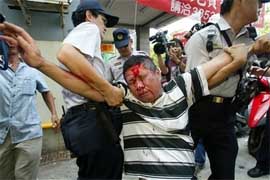
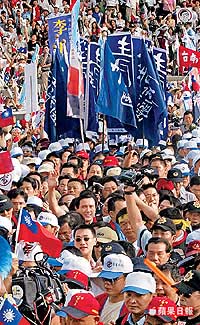
What was really going on? On one hand, I was not there, so I had to
rely on the media. But I know that for the media, "Dog bites man
is not news whereas man bites dog is headline material." So do
you think that these three selected photographs really tells me what
happened? On the other hand, even if I were there personally, I could
have only seen what was happening from where I was standing and I am still
unsure whether that was the whole deal. Each of these pictures
therefore have their own truths, but they do not constitute the whole truth
which may never be presented.
- [083] Football
and Nationalism (06/26/2006) The following is a partial
translation from an essay by Liu Xiaobo published at Boxun:
Compared to the true enthusiasts, I'm just
an amateur football fan. The first reason is that I don't like the
festival joy that football creates, I don't like the mass celebrations and I
rarely feel to urge to watch a live football game. In my view, passion
prevents one from appreciating the art of football as well as the
performances of the stars. When the French team won the 1998 World
Cup, a million people rushed towards the Arc de Triomphe; when the South
Korean team made the final 16 in 2002, the entire country was swamped in a
sea of red. These scenes made me feel very weird when huge masses of
people are cursed with nationalism -- when a crowd goes crazy, its strength
is powerful and scary. A crowd like that may be a historical event,
but it may also lead to human disaster.
But those are my personal
preferences. I don't want to insist on politicizing the passion that
football brings to people and I don't oppose people who like mass
celebrations and emotional outpourings. As long as there are no acts
of violence by football hooligans or nationalistic incitements, these mass
celebrations bring 90 happy minutes to innumerable people. Nobody can
despise the ordinary person for pursuing and enjoying this.
The second reason is that I like football
without borders. I want only to watch high-quality games and brilliant
football artistry. No matter which countries are playing, an awful
game is awful and it is not going to get better on account of
patriotism. As a Chinese person, I don't like Chinese football.
Chinese football is of poor quality, the system is ossified, the players are
lousy and corruption is rampant. It cannot give me any pleasure to
watch them, and the corruption disgusts me. Therefore, I never watch
the league games in China, I rarely watch the Asian Cup and I only keep up
with the World Cup preliminary qualifying matches through news
reports. When China qualified in the round of 32 in 2002, the Chinese
fans were ecstatic and the official media were hyping it up, but I was not
excited. Actually, at the 2002 World Cup, the performance of the
Chinese team was as ugly as always. The Chinese football system is
just as ossified and corrupt as the general system, and incapable of making
systematic protection and incentive to improve football and player
quality. Instead, it became a tool that buried talents and inflamed
narrow-minded nationalists.
Here, Liu Xiaobo is just saying NO to the
non-football-related added-values. There is also the opposite approach
as exemplified by: A Socialist's Guide To The World Cup,
Simon Black, ZNet, June 14, 2006. Instead of refusing to read any
significance, a much greater and critical significance is read into the game.
If you want the details about Chinese football, there is this Chinese-language
article 中国足球困境的宪政透视
by 贺卫方.
- [082] Hong
Kong By The Numbers (06/26/2006) (Apple
Daily) Now that Anson Chan has announced that she will attend
the July 1st march, how will that affect the attendance? Apple Daily
conducted a survey of 419 citizens (note: no methodology given) with these
results:
- 11% will attend because of Anson Chan
- 13% will attend with or without Anson Chan
- 61% will not attend
- 15% undecided
The population of Hong Kong is about 7 million, of which maybe 60% (=4.2
million) are adults. 11% + 13% = 24% of 4.2 million is about 1
million. So there you have it -- 1 million marchers on July 1st this
year.
Of course, I am kidding. No serious business would ever mistake
"intent to purchase" for "actual purchase." Here
are some commercial numbers from the TGI Latina study:
- Number of households that intend to purchase a house in next six months:
3.5 million
- Number of households that actually purchased a house in last six months:
0.8 million
- Number of households that intend to purchase computer in next six months =
2.3 million
- Number of households that actually purchased computer in last six months =
1.2 million
If you plan your revenue forecast, staffing and production according to
"intent to purchase," you won't make it.
- [081] The
Celestial Queen (06/26/2006) (Oriental
Daily via Yahoo! News) You take a look at this poster.
It looks like a movie, right? Who is Mia Wong? You have probably
never heard of her. Is she a new star?

Mia Wong is an established star but of a different variety. She is an
English-language teacher at a tutorial school. She is presently in the
news because she is being sued by her former tutorial school for breach of
contract. For how much? The estimated economic loss is HK$8
million. Is an English-language teacher really worth that much?
Here are the economic data from the case. In 2002-2003, the school
generated revenues of HK$2 million. In 2003-2004, the school invested
more than HK$1 million in advertising that featured some of their teachers
including Mia Wong, and revenues increased to HK$4.5 million. In
2004-2005, a star Chinese-language teacher left and revenues decreased by
HK$1.5 million. In view of this, the school signed Mia Wong to a
contract lasting until 2008 which requires that she cannot unilaterally
terminate her contact and work in a similar capacity elsewhere without the
permission of the school. In May 2006, Mia Wong resigned to take a job
at another school. The plaintiff estimated that (1) the school had
invested HK$1.5 million during 2004-2006 to make Mia Wong famous; (2) the
school estimates that it will lose HK$4 million as a result of her
departure; (3) the school estimates that it will have to invest HK$2.5
million to hire another teacher and create the same image through
advertising. Therefore, the total cost is HK$8 million.
Are there Hong Kong-based English-language teachers among my readers
here? Did you know that you are worth HK$8 million for doing your job?
- [080] The
String Theory Paparazzi (06/25/2006) Very funny stuff from
Joel Martinsen (Danwei) on Science vs. the paparazzi: string theory in Beijing.
Consider that my bookshelf (see You Are What Your Read
- The Living Room) contains books such as:
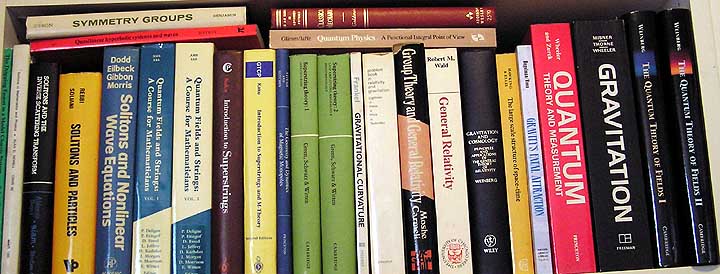
Maybe you would think that I am interested in what Stephen Hawking has to
say on this China trip. Sorry, no. We scientists are inbred
snobs. Any significant research results would have been released as
pre-prints to a small circle years ago. There is nothing new in these
general public speeches for anyone who is familiar with the subject
already. And for anyone who isn't familiar with the subject, there is
not much hope of getting anything within such a short timespan. So
what remains is decorum, which has obviously been missing in action.
P.S. Oh, you say, "But you don't have any Stephen Hawking books
here." But actually they are all there. A Brief History
of Time is a light-weight populist book and it was therefore relegated
to the backrow. Instead, you can find the yellow-covered book by
Hawking and Ellis: The Large Scale Structure of Space-Time which
covers the detailed empirically observed astronomical data to support a
certain theory of space-time (while being consistent with other theories of
space-time too).
- [079] Say
Hello To The Paparazzi (06/25/2006) Yesterday, I had an
appointment near St. George's Building on Kadoorie Avenue. I live
downhill and so it was a short 3 minute walk for me. On the way, I was
mindful of the paparazzi situation (see Comment 200606#019)
and therefore looked for cars parked on the street. There was
none. Afterwards, I walked downhill again and I spotted a car parked
down the road. I walked up to it and looked at the two male
passengers, and they looked back at me. I smiled at them. They
did not smile at all. I did not have my camera, so I just
continued walking. I never found out whom they were staking out: Jimmy
Lai? Kelly Chan? Who knows? Who cares? This is so
commonplace Hong Kong. Have a nice day, guys! I know you have a
tough job!
- [078] China
Media Project (06/25/2006) Although the China Media Project is
also located in Hong Kong, I have never had the honor to have any contact
with that team. But increasingly, I am pleasantly surprised to find an
uncoordinated convergence of interest recently.
Here are some examples:
- State Council Information Office says Western media coverage of China has taken a turn for the better
(CMP; June 24, 2006) and The
Demonization of China (ESWN; June 24, 2006)
- The Liu Zhihua Case: reading power and profit through the Chinese newspaper page
(CMP; June 21, 2006) and The
Case of Liu Zhihua (ESWN; June 13, 2006)
- Chinese media debate information disclosure as reporter sues Shanghai City Planning Bureau
(CMP; June 12, 2006) and Journalist
Sues Government (ESWN; June 8, 2006)
Perhaps this means that I can retire from the business of covering
developments in Chinese media and hence focus on my core audience in the
manner of immensely popular items such as Kiddie
Porn In Hong Kong, The
Yongchuan Government Promotional Photos,
The
Shenzhen Cat Meatball Restaurant, The
Jilin Quintuplets and, of course, Bus
Uncle!
But then all of those so-called 'low brow' stories are about the media
too! The fact is that we get most of our information from the
media. There is just no getting away from them.
- [077] Multiple
Uses (06/24/2006) In The
Demonization of China, I noted that the following photograph was used in
the Ta
Kung Pao article with the caption: "外國媒體常利用負面新聞來吸引受眾。圖為日前北京民眾申訴場面。"
(in translation: Foreign media often use negative news to attract
audiences. The photo is about a group of people petitioning in
Beijing.)
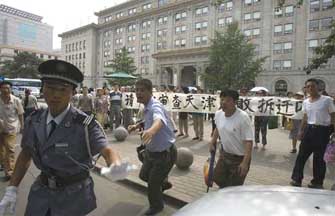
Meanwhile, in the comment directly below this one about Tianjin deputy mayor
Chen Zhifeng, the following photograph was used with the caption: "天津多名官員因房地產問題被查之際,一批被迫遷的天津市民周三到北京,向建設部請願,要求嚴懲拆遷中腐敗官員。 美聯社"
(in translation: At a time when multiple Tianjin officials have been
investigated for land-related issues, a group of displaced Tianjin residents
arrived in Beijing on Wednesday to ask the Department of Construction to
punish corrupt officials. AP)
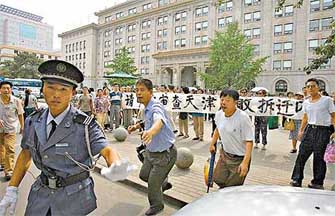
The original AP caption (via Yahoo!
News) is: A Chinese security guard tries to prevent a photographer from taking pictures of Tianjin residents protesting outside the Chinese Construction Ministry in Beijing, China, Wednesday, June 21, 2006. Investigators have questioned three top officials in the northern Chinese port of Tianjin over alleged corruption tied to shady real estate deals, a human rights group said Wednesday. The allegations come amid protests by Tianjin residents over what they say are forced evacuations being directed by officials out for personal profit. The Chinese words read 'Central Government please investigate Tianjin home eviction issue'. (AP Photo/Ng Han Guan)"
This illustrates the final point in the Demonization article -- certain
objective facts gave cause for the western media to write the negative
reports to "demonize" China.
- [076] Where
Is Chen Zhifeng? (06/24/2006) (Apple Daily via ChineseNewsNet) Who is Chen Zhifeng (陳質楓)?
He is/was/is the deputy mayor of Tianjin city.
On June 21, the overseas media were asking the Tianjin spokesperson about
whether Chen was being investigated by the Central Party Disciplinary
Commitee for economic problems. "Hey, our deputy mayor will even
be attending an international conference on Monday!" said the
spokesperson in a strong denial.
On June 22, on the Tianjian city goverment list of leaders on the official
website, the name of Chen Zhifeng was removed without fanfare. When
the media asked the Tianjin spokesperson again, he was unresponsive.
On June 23, on the Tianjian city government list of leaders on the official
website, the name of Chen Zhifeng was restored without fanfare.
Since the authorities will not explain these mysterious happenings, the
citizens' only source of information is the Roadside News Agency -- there is
a major political strugge between Tianjin Party Committee Secretary Zhang
Lichang (張立昌)
and Tianjin Mayor Dai Xianglong (戴相龍).
So there you have it!
- [075] China's
English-Language A-List Bloggers (06/24/2006) There is no such
list, of course. If there is such a thing as an A-list blogger in
China, the person would have learned from Zhuang Zi (莊子)
to not worry about status and to enjoy just doing it instead. This is
particularly true at a time when being a 'blogger' is actually become
restrictive and constraining with respect to other possibilities beyond
traditional blogging. For an interesting discussion, please see Danwei's
comment about "Danwei probably does not count as a blog any more: there are too many contributors, and we are trying very hard indeed to sell out, by accepting advertising."
and then Sinosplice's
follow-up.
More importantly, who wants to be called an A-list blogger anyway?
Here is what Atrios
noted: "Lots of bloggers and blog readers have something against the nebulous club of
'A-List bloggers'." Why? Here is Atrios' explanation:
There are a variety of reasons people seem to like to get their hate on at
us ... and I'll try to spell them out as I understand them without bothering to argue with them.
1) A-list bloggers have shitty blogs that no one should read but people just read them because they've been around for so long.
2) A-list bloggers are supporting the wrong candidates/causes. They are doing X, but they should be doing Y.
3) A-list bloggers suck up all the attention from better bloggers who everyone should be reading.
4) A-list bloggers end up representing the "netroots" but they shouldn't.
5) A-list bloggers aren't generous enough with their links and should be providing more publicity for other bloggers.
6) A-list bloggers are stupid and they're ugly and nobody likes them.
Indeed, who wants to be known as stupid and
ugly?
P.S. In like manner, 韓江雪:
尋找香港的「公共知識份子」
is wondering where the public
intellectuals are. There are two types of public intellectuals -- those
who are busy talking about being public intellectuals and then there are those
who are busy being public intellectuals without bothering to talk about the
process.
- [074] The
Hill of the Waiting Wife (06/24/2006) On page A21 of Apple
Daily (via Diuman
Park), the following paid ad appeared.
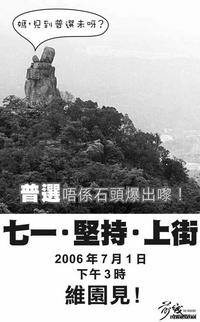
The natural stone figure is known as the Hill of the Waiting Wife and can be
seen when descending from the top of Lion Rock down to Shatin.
Alternately, you can see it from the train window leaving Shatin and heading
into the Lion Rock tunnel. The waiting wife is looking towards the sea
with her child bundled behind her back in the traditional Chinese style and
hoping her seafaring husband would return soon. There is no
explanation for this figure, so the assumption is that the audience is native
Hong Kong people who are familiar with this legendary site.
In this advertisement, the child's caption reads: "Mom, have you seen
universal suffrage yet?" The words underneath read:
"Universal suffrage did not explode out of a rock! July
1st. Persist. Get out in the street. See you in Victoria
Park at 3pm, July 1st." As the Diuman Park blogger noted, the
concept for this ad was developed by private citizens who contributed it for
neither pay nor acknowledgement.
- [073] The
Hong Kong Economy (06/24/2006) Yes, I'm talking about real
estate, because nothing else really matters. This evening, the
apartment owners of my building held a general meeting to discuss our
future. Our building was constructed in 1949 for the grand sum of
HK$50,000. There are four sections (A, B, C, D) at five stories each,
so that there are 20 apartment owners. The original plan included a
section E, but we ran out of money so there was an empty lot. My
family began renting our apartment from a Chinese-capital investment company
in 1959. In the early 1970's (and in the last throes of the Great
Proletarian of Cultural Revolution), an edict came down from Beijing
to the investment company directors: "We are a socialist country and we
cannot conceivably own any capital. Please dump all the holdings
ASAP!" The company then looked for the quickest route: they made
an offer to the tenant (namely, my parents) for this 2,000 sq. ft. apartment
in an exclusive neighborhood at the grand sum of HK$180,000. My
parents went for it and that was how our family became landlords
again. To put the money figures in perspective, the apartment comes
with a parking space. Today, HK$50,000 will buy you half the parking
space and HK$180,000 will buy two parking spaces (ignoring the issues of
inflation, costs of living, etc). [Note: I was informed that I am
seriously undervaluing the price for the parking space!]
Anyway, this is the year 2006 now and this building is obviously heading for
an encounter will the wrecking ball unless it collapses on its own before
that appointment. That was the reason for our meeting today. We
invited a banker and a lawyer to give us a briefing, and what they told us
is related to how the Hong Kong economy works. First, the land title
to the lot had been divided among the apartment owners individually.
To rebuild, we must all sell our individual land titles to a combined entity
(whether this is our own company or a developer or a joint venture), for
which we would have to pay a 3.75% sales levy. After the builiding has
been demolished and rebuilt, the entity will sell the new apartments back to
us, for which we would have to pay a 3.75% sales levy again. The total
sales levy from these two rounds is estimated to be circa HK$40
million. Now you understand why the Hong Kong SAR government imposes
such a low personal income tax.
Of course, the sole decision at the meeting was: "Seek legal/expert
counsel to see how we can get around the sales levy." That is the
more significant part about how the Hong Kong economy works.
- [072] Photo
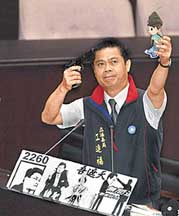
of the Day (06/23/2006) More properly, the title should be
"Idiotic Photo of the Day." (TVBS via Yahoo!
News) During a parliamentary debate, KMT legislator Chiang Lien-fu
(江連福)
took out a toy gun and a Chen Shui-bian doll and declared : "子彈上膛,上膛之後,阿扁總統,你是自己了斷?還是要我代表全民,來幫你了斷?在這邊就幫你了斷好了,(開槍)。"
(in translation: The gun chamber is loaded. Now that the chamber is
loaded, President Ah Bian, are you going to finish it yourself? Or should I
represent the People to help you finish it? I'll help you finish it
here right now. (Pulls the trigger)."
- [071] Interview
with Ang Lee (06/23/2006) The following the section of the
Southern Daily interview related to the new movie <<Lust, Caution 色,戒>>.
Q: I hear that you are in Shanghai for the film festival and also to
prepare for your new film adapted from Eileen Chang's novel <<Lust,
Caution>>.
A: Yes.
Q: Eileen Chang has left us many works. Why the interest in
<<Lust, Caution>>?
A: I adore Eileen Chang's work, but I did not think about turning any of
them into a film. This one is a short novel which leaves a lot for the
imagination and I really like it because it is carefully written in great
depth. Therefore, it has a particularly strong sense of a movie, plus
a stream of consciousness. It touched a certain sense of tragedy of
our Chinese people. I read it and I put it away. Then I thought
about it and I put it away again. So now I really want to make a
film. Of course, I have quite nervous because there are many out there
who adore Eileen Chang and there are many experts. People will have
high expectations. One can say that they must be sharpening their
knives.
Q: Since you made Zhang Ziyi into a star in Crouching Tiger, Hidden
Dragon, many female actresses want to star in your movies. Are the
roles in <<Lust, Caution>> locked up?
A: No, but I am seen some who are more suitable. The genius of
Eileen Chang as a writer is that she tells you what she thinks.
Basically, such a female character does not exist. We can only try to
be as close to what she described. For example, if there are five
requirements and no one meets all of them, we will look for four, three,
two. We will look for the closest person. For me, it is
important to have a passion to act. Talent, passion, involvement, she
must be willing to use her image, emotions and intelligence to interpret the
novel and allow us to capture it. This is one of my selection
criteria.
- [070] Internet
Triumphalism (06/23/2006) Whereas Product
Placement In Mission Impossible 3 appeared on this website on
June 14, Shanghai
Daily and Los
Angeles Times carried the story on June 20 and June 21
respectively. And I don't think that they got it right either. In
the first report, "In trying to sanitize Shanghai's image, the film censors scrutinizing "Mission: Impossible III" missed a phone number for phony documents that China netizens trumpeted.
But by the July 20 release date, that's likely to be wiped out by the censors who want to put Shanghai's best foot forward."
In the second news report, "Chinese censors recently delayed the release of "Mission: Impossible III" because they didn't want to air the city's dirty laundry.
But the sharp-eyed film police apparently missed a more obvious smear, a crude advertisement for one of China's most notorious businesses: producing fake documents.
Now, Internet mavens across the Middle Kingdom are tsk-tsking at the censors' bumble. Some have clipped the fleeting scene from a pirated download of the movie — which won't be released in China until next month — and posted it on the Web, generating guffaws in chat
rooms."
The facts are that the 'censored' version to be released on July 20 has not
been seen in China yet, and all references are to the pirated edition which was
obviously not screened by any Chinese censor to make sure that the roadside
vendors are selling politically correct DVDs at 10 yuan (=US$1.2) apiece.
- [069] Taiwan
Public Opinion Polls (06/22/2006) After President Chen
Shui-bian's speech to all the people (delivered in Minnan dialect and
therefore alienating a significant proportion of the population), the first
poll cited was from Era TV at 92% against Chen. The fact that the poll
result was announced within 30 minutes of the speech and it has a sample
size of more than 60,000 meant that this was a self-selected Internet
poll. So forget it! Similarly for this one: "An opinion poll conducted by the Yahoo Taiwan website showed that only 15 per cent of 23,920 voters were satisfied by the case Mr Chen made, while 84 per cent said they found the speech unconvincing."
On the extreme, Taipei
Times obtained the feedback from three academic types, of which a
majority approved the speech. But with more time, the more traditional public opinion polls done by
telephone are being reported.
Apple
Daily (sample of 934 adults via computerized voice interviewing,
which means quality control is lacking)
- About the speech, 69% thought it was an attempt by Chen to weasel
his way out; 22% believed him and sympathized with his situation; 9% don't
know/not sure
- How did it change your opinion of Chen? 23% better; 64% worse; 12%
don't know/not sure
- Is Chen still suitable to be president? 26% suitable; 66%
unsuitable; 8% don't know/not sure
TVBS (no
description of methodology)
- overall approval of Chen: 18% satisfied; 65% dissatisfied
- approval of speech: 27% satisfied; 65% dissatisfied
- Chen should resign?: 50% agree; 32% disagree
- Chen suitable to be president? 31% suitable; 55% not suitable
- president wife's met with Chen Yu-hou? 14% no (=believe president);
56% yes (=believe other version)
United Daily
(also at Yahoo!
News) (sample of 865 adults (with 414 refusals) using random
telephone numbers in phone book and then randomly changing last two digits)
- overall approval of president: 20% satisfied; 64% dissatisfied; 15%
no opinion
- Chen a trustworthy president: 19% yes; 60% no; 18% no opinion
- Chen spoke truth in televised speech: 13% yes; 50% no; 36% no
opinion
- president's wife met with Chen Yu-hou? 11% no (=believe president);
56% yes (=believe other version); 31% no opinion
- president said wife did not 'directly' receive SOGO gift certificates.
5% thinks she did not receive them at all; 66% thinks she received them
indirectly; 26% no opinion. By political affiliation, pan-greens 20%
thinks did not receive and 48% indirectly received; pan-blues 87% received
indirectly; independents 51% received indirectly.
- president's family involved in fight to control SOGO. 49%
yes; 15% no; 35% no opinion
- recall of president? 47% agree; 38% disagree; 13% no opinion
- if recall fails, no confidence vote in government? 35% agree;
38% disagree; 24% no opinion.
China Times Part
1 Part
2 (sample of 814 adults (response rate of 62%) using random
telephone numbers in phone book and then randomly changing last two digits)
- approval of speech: 23% satisfied; 46% dissatisfied; 31% no
opinion. By political affiliation, pan-greens are 53% satisfied and
25% dissatisfied; pan-blues are 8% satisfied and 71% dissatisfied.
- president's wife cleared? 12% yes; 41% worse than ever; 47% no
opinion
- president's wife met with Chen Yu-hou? 11% no (=believe
president); 42% believe other version; 47% no opinion. By political
afficiliation, 33% pan-greens believe president.
- president's wife in SOGO gift certifcate case clarified? 13% yes;
51% no. By political affiliation, 38% pan-greens think yes.
- recall of president? 43% agree; 34% disagree; 22% no
opinon. By political affiliation, pan-greens 20% agree and 67%
disagree and pan-blues 73% agree and 15% disagree.
- if recall fails, no confidence vote in government? 35% agree,
36% disagree and 29% no opinion.
Summary table: United
Daily
- [068] Fishing
For The Bottom Line (06/22/2006) In China
Digital Times' feature on Nicholas Kristof's essay on the Chinese
Internet, there is a translation of a comment to Kristof's blog:
Ha ha, I saw today's masterpiece from Mr. Kristof on the New York Times, China vs. the Net. Let me say a few words here about it. Please allow me to be direct. This method to detect the bottom line of freedom of expression on China's Internet may not be the best. First of all, your test blog has very low traffic so far so even if the censor's see it, they will not feel threatened.
Secondly, maybe freedom of expression online in China does not have a well-defined bottom line. If you really insist, you may want to be a regular visitor to
this
forum, where you may learn something.
The bottom line might actually be even
deeper. Here is another example: zyzg.org
( 自由中国论坛).
This is not a totally 'free' site because Rule #1 at the discussion forum is:
"#1. No posts allowed about FLG's Nine Criticisms or Party
Resignations or Organ Removals (but information related to democratic political
systems are negotiable)."
The top of the subject list will always be occupied by this message: "Please remember this
alternate URL if this website should be shut down again."
Here is a list of recent subjects at the zyzg.org discussion forum:
- The riot at Shengda College in Zhengzhou University
- The freedom of blind dissident Chen Guangcheng
- New developments at the Chinese Democratic Party
- The Wang Yi-Yu Jie versus Guo Feixiong debate
- The shutdown of the search engines of Sina.com and Sohu.com (via South China
Morning Post)
- Election of the next Chinese Communist Party chairman and the Central
Military Commission chairman
- Cao Changqing's report on the firing of US State Department "pro-China
idiot" (=Robert Zoellick)
- Chen Shui-bian: "My coming or staying will be decided by my
people"
- Gao Zhisheng: "Kidnapping an old woman and a young boy -- more misdeeds
by the Hu-Wen government"
Why is this sort of thing happening? Why aren't the Internet secret
police all over them already? It isn't that easy for an Internet secret
police such as the one described here: A Day
In The Life Of A Chinese Internet Police. I would suggest that the
female police officer and her colleagues in that story have no idea who Chen
Guangcheng, Wang Yi, Yu Jie, Guo Feixiong, Cao Changqing, Robert Zoellick, Gao
Zhisehng or the Chinese Democratic Party are. Dear reader, do you know what the
issues are with all nine stories listed above? Furthermore, the
authorities don't
have the ability to keep the Internet secret police informed on the latest
developing stories, because it will likely destroy faith and morale.
I suggest: stop whining and start paying attention to what the Chinese
netizens are actually
writing and reading on the edge of and underneath the radar screen. They
are probably already too many to be stopped effectively.
- [067] The
Eviction Squad (06/22/2006) I am sure that you have read about
the thugs hired by land developers to evict peasants from the forcibly
requisitioned land (see for example The
Sanzhou Incident, The
Shengyou Reporter's Fieldnotes, The
Huaxi/Huankantou Incident). But I
think the following photograph from Southern Metropolis Daily (June 6, 2006,
page A47 via zyzg.org)
gives you the best idea about what an eviction crew looks like. These
are not hired thugs, but they are civilian patrol members brought in to
evict homes to make way for the 2008 Beijing Olympics. You have to
wonder if this was staged for some movie ...
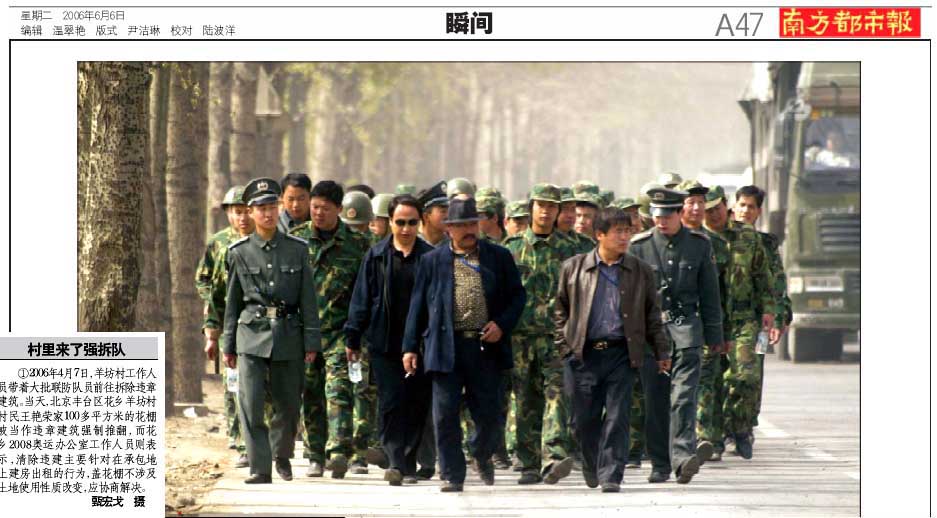
- [066] Lights
Out For Ma Ying-jeou (06/22/2006) (ETTV via Yahoo!
News) KMT chairman Ma Ying-jeou was going to make a television
appearance at 8pm to give his reaction to President Chen Shui-bian's speech
the previous evening. Ma is presently the mayor of Taipei City.
By coincidence, the Taipei City Environmental Protection Department had an
one-hour program starting at 8pm for citizens to turn off their lights and
electricity for one hour.
At the press conference, the Taipei City Environmental Protection Department
director said: "We call upon our citizen friends to tell off your
lights and televisions sets at that hour and step outdoors to enjoy our
natural energy-saving night." The reporter asked: "But the
mayor is speaking tonight at 8pm?" Duhhh! The director was
acutely embarrassed. However, this event was planned and scheduled
some time last year. Here is the compromise: "If you have to
watch television, at least turn the lights out!"
- [065] An
Amazing Essay For Popular Enjoyment (06/21/2006) The essay titled Looking at the recall bid with a foreign eye
by self-described 'longstanding observer of US politics and media' and 'deputy secretary general of the Northern Taiwan Society' Michelle Wang
王美琇
appeared on June 18, 2006 in Taipei Times. Here is the revelant
excerpt:
For a fresh perspective, let's try looking at the situation through US eyes. The US is a mature society that has practiced democracy for more than two hundred years. The preposterous presidential recall bid proposed by the blue-camp would be unlikely to occur in the US, given that country's more mature legislature, media and society.
...
US politicians and citizens did not initiate impeachment proceedings against former US president Bill Clinton over his sex scandal, although the US public definitely disapproved of his behavior. In the end, Clinton remain as president until the end of his second term. The moral is, if the president did not break the law, he cannot be impeached or recalled.
This last paragraph made me wondered if I had
been living on a different planet. So I checked -- on my planet, there
are 4.6 million entries when I googled 'Clinton+impeachment.' For
example, Washington Post has consolidated all their Clinton impeachment
stories at the Clinton
accused page, with even the exact Senate votes on the perjury
and obstruction
charges. If you believe that Washington Post is a pack of liars,
here is the Wikipedia entry on the Impeachment
of Bill Clinton. Fact: Clinton was impeached but he survived the
vote.
Now Wang also had this paragraph:
As a longstanding observer of US politics and media, I have never seen the US media make a big stink of what the first lady is wearing. How she wants to dress herself is a private matter unless the way she dresses is obviously inappropriate or connected with bribe-taking. US media and lawmakers are more interested in whether the president is competent to govern the nation than in how the first lady dresses. They supervise how the president manages foreign, economic and domestic affairs. If the president is clearly involved in any misconduct, the media and Congress will move to impeach him or her based on the evidence. Former US president Richard Nixon's downfall over the Watergate scandal is a classic example.
For the exemplary behavior of the American
press, please consult the entire archive of Bob Somerby's The
Daily Howler from 1998 to 2006. Every day, the man just copies
one or more examples of howlers from the American press. Do you believe
that Gennifer Flowers, Katherine Willey, Monica Lewinsky, the Arkansas state
troopers and the long cast of characters have much to do with the
"foreign, economic and domestic affairs" that US media and lawmakers
supposedly only care about? By the way, it also did not matter what the
US media and lawmakers had to say, because Clinton's approval ratings among
the general public was always around 60% during the the period when the
impeachment trial was in progress (see chart).

Here is today's bonus report in Globe (via Daily
Kos):
Laura Bush stormed out of the White House after a blow-up with the president over whether he was cheating with Condoleezza Rice. [...]
The infuriated first lady spent at least one night in the famed Mayflower Hotel in Washington, D.C., after the bitter row, respected author and national security expert Wayne Madsen tells GLOBE. ... We reported in our Jan. 16 issue that in a recent therapy session, the 59 year-old president confessed he lusts after other women. And now, sources say he's been acting out those fantasies with Rice, 51.
Rumors of the affair have enraged Laura, who has been at odds with her husband for months over their deteriorating 28-year union.
Meanwhile a host of other problems are plaguing the Bush marriage, including reports that the president had been caught drinking whiskey again after quitting for 20 years, and strife between Laura and her meddling mother-in-law Barbara, say sources.
Relevant Link: Unbeknownst to me at the time of writing, Keywords
had the Michelle Wang article covered. I could have spared myself.
But it goes to show that this was so obviously and outrageously wrong.
- [064] The
Internet Censors Failed At Their Jobs (06/21/2006) (Ming
Pao) There are about 7,000 posts per day at this
website. It employs ten web editors who inspect the web contents every
day. In addition, 130 trained students function as "forum
masters" who inspect the web contents on a regular basis. The
website has an automatic filtering system for harmful keywords. In
order to post, one has to become a member so that it is possible to follow
up with the individual about any harmful information. This sounds exactly
like mainland China, doesn't it? This is so bad ...
Hong Kong Education City is a non-profit organization funded by the Hong
Kong Education and Manpower Bureau to the tune of HK$24 million per annum
and is intended to serve young students. The product is the website hkedcity.net,
which is billed as Hong Kong's largest one-stop educational
website.
So what happened here? A Mrs. Wong complained on Commercial Radio that
her 9-year-old daughter told her that the contents on Hong Kong Education
City were "disgusting" (好核突).
Mrs. Wong checked for herself and was appalled, because the joke section
contained many adult jokes including ones about sexual organs when a brother
and sister bathed together, a nun being assaulted by a sex fiend and a
doctor violating a female patient. Mrs. Wong described the jokes as
being "very perverted and very filthy." When Hong Kong
Education City was informed, it removed the offensive contents and published
a reminder about the rules.
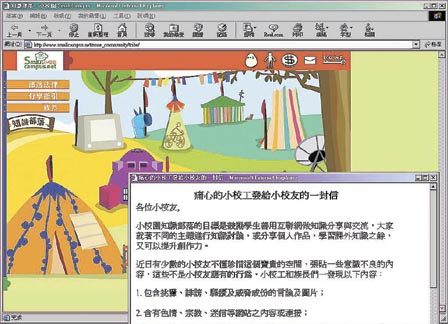
Should Hong Kong Education city have implemented a censorship system with
Chinese characteristics? And how come it wasn't working? Talk
among yourselves ...
- [063] Polo
Weekly (06/21/2006) While Apple Daily may lay claim to be the
most popular newspaper in Taiwan, there is a competitor (see Yam
News) -- Polo Weekly. This is an Internet spoof that
has accumulated more than 1.2 million reads already. Here is the most
recent issue (see this Xiute
blog for the complete high-resolution publication). This
issue's headline is about stock number 2260 (the share price for concept
stock for Chen Shui-bian's son-in-law Chao Chien-ming is soaring, noting
that 2260 is the prisoner ID number for Chao).
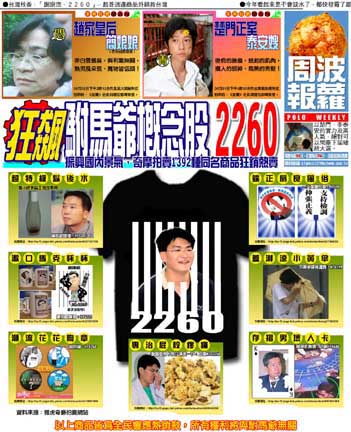
- [062] The
Vindication of Sidekick (06/21/2006) Previously, I left three
links on my recommended reading list. I'm requested to explain
to an English-only reader what the interest in this collection of Hong Kong
blog posts is. I suppose an explanation is in order.
The incident began late last year when a
blogger Martin Oei accused another blogger Sidekick of working in conjunction
with ep21.com. At the time, Sidekick responded with a blanket statement
that she has no connections to ep21.com. In reply, Martin Oei said that
he has proof but he was busy and promised to produce the proof as soon as the
December 4th 2005 march was done. It is now June 2006. In the
first post above, Sidekick says, "I want my
vindication!"
In the second post, Martin Oei replies that anyone who wants him to produce
the proof ought to think instead about why Sidekick took so long to demand a
"vindication" and that should be enough to figure out Sidekick. In
addition, Martin Oei welcomes any email from Sidekick to explain her
relationship with ep21.com. Martin Oei also allows no trackbacks and
comments on his blog post.
In the third post (also reproduced at InMediaHK),
the blogger The Duke of Aberdeen openly questioned whether Martin Oei (who
is newspaper columnist, political commentator, Legislature consultant, Chinese
University of Hong Kong Assessment Committee member and political and
administrative science lecturer) can assign a political label to a blogger
without any evidence.
Now, I am just a blog reader and I don't know the rights and wrongs beyond
what was written. But from my summary, you can tell that I think it is
inadequate (actually, pathetic) for Martin Oei to make the unsubstantiated
assertion, fail to keep a promise to provide the evidence and then turn the burden of proof on the
accused. The preceding is not libel, because I am just telling you what I have
read and concluded. This is therefore free thought and speech.
Martin Oei can change my mind by producing the evidence.
- [061] Yet
Another Chinese University Student Riot (06/20/2006) After The
Zhengzhou University Riot story made it into western media reports,
there is now another reporte of a university student riot involving almost
10,000 students at the Jiang'an campus of Sichuan University (The Sun via Wenxue
City). In early morning of June 12, the students in more than
ten dormitories began to toss water bottles, beer bottles, wooden barrels
and even their washing basins out of the windows. They also set fire
to bicycles, sofa and computers. More than 9,000 people participated
in the riot, and dormitory administrators were injured.
Okay, what was this about? During normal times, the university
supplies electricity only up to midnight. During examination time, the
university usually supplies electricity 24 hours a day for students to
study. This year, the electricity has not gone 24 hours a day yet and
the students are upset because ... they can't watch the World Cup past
midnight! After the rioting, the university has turned on the
electricity all night and opened the cafeteria for the students to watch the
games. Although examinations are scheduled for next week, the students
still stayed up until 5am to watch the games.
- [060] Upgrade
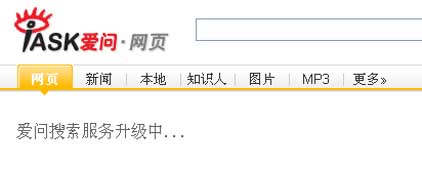
in Progress (06/20/2006) At this moment, if you try to access
Sina.com's iAsk and Sohu.com's Sogou search engines, you will get a
"search service in the process of being upgraded message."
How coincidental for both of them to upgrade at the same time?

In South China Morning Post (Shi Jiangtao in Beijing):
The search engines of two of the most popular Web portals on the mainland have been blocked in a sign of intensified internet censorship, with millions of users expected to be affected.
Sina and Sohu are the latest victims of Beijing's increasing control of the internet for having failed to filter certain keywords deemed politically harmful, industry sources in Beijing said yesterday.
"Chief editors of Web portals were summoned to the State Council Information Office in the morning and Sina and Sohu were ordered to shut down their search engines after they failed an on-the-spot censorship test," one of the sources said. The two portals had been given three days to "rectify their mistakes", the source said.
The Sina and Sohu search engines have been out of service since noon yesterday, with the search pages carrying a message that the sites were undergoing upgrades. Other services of the two portals were unaffected.
The two companies declined to elaborate on the shutdown or provide statistics about their users.
Sohu spokeswoman Zhang Xin insisted that it was normal to have a system upgrade. Her counterpart in Sina, Yan Hongyan , did not offer an explanation. "I don't know yet what has happened and why the search engine is out of service," she said.
Both companies said last night the services would not resume for two or three days.
Now this is a brand new piece of information
-- there exists a test in which the examinees were allowed to observe.
Previously, people might have thought that you were blocked PERIOD without any
further feedback, you are given no clue as to what needs fixing and you have
to go back to guess what they want. But there is actually a test and
they show you the results.
Will someone let the people know what the test is (of course, that person would be leaking
state secrets)?
Relevant Link: Nanny Fails Sina Sohu China.com Search Engines
Letters from China
- [059] Two
Public Interest Ads (06/20/2006) The following two photos appear at
the Flypig
blog. The translated text is: "Due to the gradual erosion of
gender distinctions in China, various businesses and foreign companies have
developed print ads with this as the core value. The following two
photographs came from a transnational 4A advertising agency and is being
circulated privately." In other words, these are not real ads --
or, at least, not yet. If they really did run these ads, there would
be major controversies (with LYC's fans).
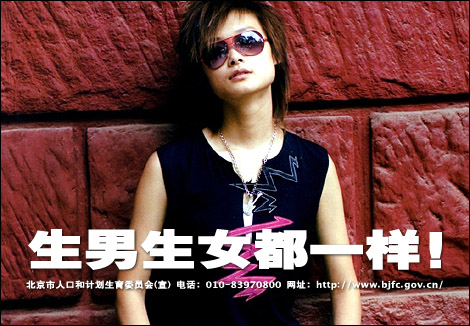
"It is the same having a boy or girl" --
for the Beijing Municipal Commission of Population and Family Planning

"Google: Large or small, it can be found"
- [058] Never
A Dull Moment (06/19/2006) Front page headline news in Sing
Tao: "Regina Ip returns to Hong Kong to push
democracy." Holy crap!
Three years after being chased out of Hong Kong for pushing Article 23
(which led to 500,000 protestors in the streets) and one masters degree from
Stanford Unversity (thesis title: Hong Kong: a case study in democratic development in transitional societies),
she is returning home to lecture us about Hong Kong democracy.
Opening statement (in translation): "One-person-one-vote only meets the
most basic requirement for democracy. Many southeast Asian countries
have one-person-one-vote, but the government is rotated among several
families with the support of the military. This type of
one-person-one-vote system is not democracy in the eyes of western
scholars. Democracy involved truly competitive elections, with rule of
law and basic guarantees of human rights ... In the Hong Kong Legislative
Council, there are six political parties which have very few members.
The most experienced party is the Democratic Party which has fewer than
1,000 members and lacks participation from business and government
administrative elites ... even if a political party assumes control, where
will they find the 50 or 60 departmental secretaries and their
deputies? We cannot rule Hong Kong on the basis of street
demonstrations only."
- [057] The
Secrets of the Huayuan Case (06/19/2006) Is there any fear or
anticipations of secrets being revealed in Lai
Changxing Writes His Memoirs? Well, it will be a tough act to
follow on the previously published The Secrets of the Huayuan Case (「遠華案」黑幕)
by Sheng Xue (盛雪)
from Mirror Books. This author
claimed that three-fifths of the book was based upon personal interviews
with Lai Changxing and the rest on independent research.
Here is a summary from a review quoted in ChineseNewsNet:
I have just read the first ten pages and I
cannot believe what my eyes were seeing! Is this a fantasy tale for a
single person to assume so many identities? A Fujian peasant who never
completed third grade in elementary school; the Huayuan boss with more than
1 billion yuan in personal wealth; a Hong Kong permanent resident; Hong
Kong's outstanding youth of the 20th century; a Fujian People's Congress
representative; third class honorary special agent for the Chinese security
bureau; double spy for China/Taiwan; ... Of course, the Chinese call him
"China's biggest smuggler" and he calls himself "a Canadian
political refugee."
How much confidence do you have in the
following?
-- He knew any number of important people
in the party, government, military and police in China, from members of the
Chinese Commuinst Party Central Politburo Standing Committee down to the
Fujiang provincial party secretary and the Xiamen customs director; by his
estimate he knew 83 persons at the secretary level or above, including Jiang
Zemin, Zhu Rongji, Luo Gan, Zeng Qinghong and Wu Yi.
-- Chinese Politburo member and Deng
Xiaoping's bridge partner Wang Hanbin got him a Zhongnanhai car license
plate so that he can come and go at Diaoyutai and the People's
Congress. When he is not in Beijing, Wang gets to use the car; when he
arrives, Wang assigns him a chauffeur to drive him around in that car.
-- He got cigarettes supplied by actress Gong Li's
husband; he was in partnership with Macau's Stanley Ho on the casino boat
project;
he was friends with Li Peng's son Li Xiaorong, the comedian Jiang Kun, the
actress Liu Xiaoqing, etc. Is there any celebrity in China who is not
connected to him?
Believe it or not, I continued reading
because it was too readable ... This is better than a spy adventure film
from Hollywood!
For mainland Chinese readers, you can
probably pick up this book from your local roadside contraband bookseller.
- [056] The
Root of Chaos in Taiwan (06/18/2006) (China
Times) Yesterday at the pan-green rally to support President
Chen Shui-bian on Ketagalan Boulevard in Taipei, the TVBS live reporter was
surrounded and yelled at. Eventually, the reporter had to interrupt
the live coverage and leave the scene. All other TVBS reporters at the
scene were then ordered to remove the station logo in order to avoid
incidents.
(China
Times) Meanwhile in Tainan, a crowd surrounded the SNG vehicle
and yelled at the reporter. For the sake of safety, TVBS interrupted
its live coverage.
(Apple
Daily) Since TVBS's program "The People Talk At
2100" had been accusing the president's family of corruption, it became
the "public enemy" at yesterday's rally. Photographs of
"The People Talk At 2100" host Lee Tao and frequent guest Chiu Yee
were hung up as target practice and pelted with rocks and water
balloons.
Banners include "Turmoil-causing group Chiu Yee and TVBS get out of
Taiwan," "Media's shame Lee Tao (李掏),
Legislature's rice worm (邱疫)
are detested by people and gods," and "TVBS is source of chaos in
Taiwan." There were far more anti-TVBS banners than those that
support President Chen Shui-bian or oppose the KMT.
(Taipei
Times) Local TV news channel TVBS, which is viewed as a pro-China media outlet by pan-green supporters, became one of the targets at yesterday's rally.
Some protesters shouted at the TV station's reporters and refused to be interviewed.
So once again the time is ripe for another round of politics (via TVBS):
DPP legislator Lai Ching-te: "即便是將TVBS關掉,都應該是在所不惜。"
(Even if it means shutting down TVBS, it should be worthwhile.)
That's right -- if TVBS is shut down and all other media are intimdated into
silence, then there won't be any more corruption in Taiwan.
Taipei
Times, June 22, 2006: "The Cabinet yesterday urged the National Communications Commission (NCC) to investigate and, if necessary, punish TV talk shows for misleading the public with remarks on political scandals that are currently under investigation. Cabinet Spokesman Cheng Wen-tsang (鄭文燦) said that the Government Information Office (GIO) has received a significant number of phone calls from the public about this matter. The complaints mainly requested that the GIO "do something" about the TV talk shows, which continue to report, criticize or analyze scandals which are under investigation. "[The talk shows' criticism of these scandals] obviously violates the Broadcasting and Television Law (廣電法). We urge the NCC to get involved, investigate or even punish those TV talk shows," Cheng said. Cheng said the law stated that the media should not discuss, criticize or analyze any case under investigation because doing so could mislead the public."
- [055] Which
Search Engine? (06/18/2006) In Chinese
Women News, I concluded with: "As an individual, I will use the search engine that serves my
purposes best. If a search engine wants to 'castrate' itself to the
detriment of user satisfaction, it will be punished in the free market."
Brave words! So it serves me right to be therefore asked: So what do
you use most of the time?
For China-related subjects, my principal interest is in tracking down
different versions of a single story. Here are some recent examples
with the past week: The
Jilin Quintuplets, The
Case of Liu Zhihua, Rainie
Yang Goes To China, The
Naked Ladies With The Pink Ribbon. With due respect, Google, MSN
and Yahoo are useless and I am left with Baidu. But that is me with my
very special needs, so please do not generalize.
- [054] "I
Denounce My Daddy" (06/18/2006) (Phoenix TV via 6Park)
Second-year university student Wang Jing thought that she had a perfect
family: her dad was a cadre in the National Land Resources Department and her mom
was a teacher. In October 2003, the illusion was shattered when her
mom found her dad with another woman in an apartment that he rented in an
adjacent building. Wang Jing said: "I understand my dad. He
was a military staff officer and he knew that 'the most dangerous place is
the safest' and therefore he kept his mistress right by us." On
that night, her father removed his bank passbook and his clothes and never
returned to the family home again. Shortly afterwards, he filed for
divorce in family court. Immediately, Wang Jing took action by sending
the family court judge two wooden figures of an old couple -- the judge got
the message and rejected the request. But the father filed an appeal.
In June 2005, as soon as she finished her university exams, Wang Jing
traveled to Beijing Central Party Disciplinary Committee office to denounce
her father. She recalled: "The lady wearing the Number 115 badge
was really nice. She said that I had to provide
documentation." So right in front of the Central Party
Disciplinary Committee office, she wrote down the case of her father and the
mistress word by word. Her denunciation was taken seriously and the
local party organizations were ordered to investigate.
However, Wang Jing's dreams were shattered when the local court ruled for a
divorce due to irreconcilable differences. The heartbroken Wang Jing
then traveled during the 2006 Spring Festival to Beijing again. In the
complaint, she asked the Central Party Disciplinary Committee to oust her
father from the Party on the basis of articles 151, 152 and 154 of the
Chinese Communist Party Disciplinary Regulations. When contacted, her
father had no comment. The case is pending at this time.
- [053] Update
on <<Lust, Caution 色,戒>>
(06/18/2006) (ETTV via Yahoo!
News) For the film adaptation of Eileen Chang's novel <<Lust,
Caution>>, director Ang Lee has settled with Tony Leung (梁朝偉)
as the male lead. In my opinion, he is a little bit too handsome for
that role, but what do I know? The female lead has apparently been
chosen but not announced yet. It is likely to be an unknown.
But for filming to take place in China, there are political issues.
In the original novel, the story is about a young female spy being recruited
by the KMT government to join an assassination plot against a Chinese person
who was collaborating with the Japanese occupation forces during the Eight
Year War of Resistance. Ahem ... on the first proposal, the State
Administration of Radio, Film and Television had a problem with the idea
that the KMT should have a role in fighting the Japanese. So the
revised proposal now refers to an assassination plot by spontaneously
organized patriotic students.
Well, what can I say? It's only fiction, right? At least, it
wasn't changed to a Communist plot ... hehehe ... (And why not? Because the
plot failed and we cannot have failed Communist plots, can we?)
By the way, this falls into the category of entertainment news, which means
that nothing can be taken to be truthful. And that is a universal
characteristic, whether in mainland China, Hong Kong, Taiwan, Italy, UK or
USA.
- [052] The
HMS Tamar Poll (06/18/2006) (Ming
Pao) The Society for the Protection of the Harbour
commissioned the Hong Kong University Public Opinion Programme to interview
about 1,000 citizens by telephone. The subject was the proposed government
headquarters at the HMS Tamar site.
Here are the survey results: 45% supported the allocation of HK$5.2 billion
to build government headquarters at HMS Tamar, while 36% opposed. But
60% believed that the government need to hold more hearings and only 30%
believe that the decision should be made now. The survey also found
out that 40% of the citizens believe that they know "little" or
"very little" about the HMS Tamar project.
HKU POP director Robert Chung said that the reseach showed that citizens do
not adequately understand the HMS Tamar project. In the absence of
knowledge, the citizens will tend to support the popular government; even if
they don't know much, they will cast a vote of confidence. Chung
pointed out that this is not a long-term solution to use popularity to force
through projects because there may be drawbacks later on.
On this type of subject, I have declared myself to be a crypto-fascist a
long time ago. The following two posts are for that other boondoggle
known as the West Kowloon Cultural District:
- Pictures
At An Exhibition
- The West Kowloon Cultural District Poll
Fraud
For the HMS Tamar project, I believe that polls are useless. I am sure
that I can swing the support level wildly just by careful phrasing of the
question. Would you like 80% support? I can deliver. Would
you like 20% support? I can deliver too. Most people are uninformed
and uncommitted, so all I have to do is find the trigger points (e.g.
authoritarianism; fear (of dioxins, for example); etc) and bundle the
project with them to deliver the desired results.
Additional Link: Counting
Games SimonWorld. "A poll of 1,033 people, commissioned by the South China Morning Post, found only 28.1 per cent wanted a government complex to be built at Tamar."
- [051] ESWN
History (06/17/2006) An usual characteristic of the
EastSouthWestNorth blog is that the audience traffic is driven by old
blogposts. Recently, with the switch to a new hosting service, I now
have the ability to look at referrer logs. For example, here are some
page views driven to this site through Shanghai
Expat. I re-read my original blogpost and I was quite pleased
with it. I am glad that this page continued to receive attention a
long time afterwards.
I also noticed today that there was another surge in traffic via desprecopii
forum. If you follow through with the link, you probably will
not understand the comments because they are written in the Romanian
language. But if you follow the recommended link, you will reach the
page that is the bane of EastSouthWestNorth. On the day before
yesterday, I was interviewed by mainstream media and the question arose as
to why I have a minimalist website design. I explained everything in
terms of how EastSouthWestNorth version 1.0 was wrecked because the graphics
elements was creating a financial disaster, to the tune of US$8,000 for
excessive bandwith charges in April 2005. So it was with some
consternation that I watch the latest traffic surge due to that desprecopii
post. But I now have a new web hosting service with a much higher
bandwidth allowance. So maybe I can live with the consequences.
Therefore, I will identify the specific EastSouthWestNorth page: The
Children of Iraq. The page is simple -- there are only
pictures and no text. That is why the page has universal
appeal. You look at the photographs and you can come to your own
conclusions. The page may take a long time to load because there are more
than 300 photos. You are warned that it may not be work-safe, because
people have said that they "broke down in sobs while viewing the page
in the office."
- [050] Bus
Uncle Turns Over A New Leaf (06/16/2006) We left off with Woman
Attempts Suicide Over Bus Uncle, at the end of which Bus Uncle resigned from
his job at Steak Expert. As a sign of his weakening drawing power,
this item appeared only in the print edition of Sing Tao. The good (or
bad, depending on your perspective) news is that Bus Uncle has been hired as a marketing and promotional
person at a company that sells environmentally safe products. The
salary will be HK$9,000 and he received a HK$3,000 advance so that he can
get a new hairdo and other stuff. Among his listed plans is a trip to
the United States as an "environmental protection
ambassador." Already, a Los Angeles Chinese-language radio
station wants him to on air to help people "relieve their
stress." His company is also trying to get him onto the David
Letterman show!
- [049] An
Internet Lawsuit (06/16/2006) (Boxun)
Ms. Fang (see photo) was a recent acting school graduate and submitted her
portfolio to various companies in search of employment. On December
17, 2005 a schoolmate called her and told her to check out a certain
website. She went there and saw her photograph and real name posted on
the website, which included phrases such as "online erotic
dancing" and "my first sexual intercourse." Therefore,
she is suing the website operator for 150,000 yuan in damages.

As witness, a friend Mr. Huang testified that he went to the website on
December 18, 2005. At the time, he saw Ms. Fang's name and four to six
photographs. Afterwards, he forwarded the page to Ms. Fang via email.
Case closed and shut? Not so fast. The website operator said
that they run a legal social chat room and not an erotic site, and they have
never displayed Ms. Fang's photograph. On December 27, the website was
attacked by hackers and went down, and did not come back online until the
morning of December 19. Therefore, the testimony of Fang and Huang are
suspect. The company spokesperson said: "This is case in which
the plaintiff planned a personal attack against the company and hype up the
incident."
Question: If Ms. Fang and friends wanted to make this up, could they be so
dumb as to choose two days on which the website was out of order?
- [048] A"Zero-Mark"
Exam Essay (06/15/2006) From Full marks for fake college essays
(Joel Martinsen, Danwei), "In the days following the exam each year, the national media is filled with analyses of the essay questions.
... Typically, one or two particularly breathtaking "full-mark essays" will make the rounds of the online forums, sparking debates over whether they are genuinely creative or just empty, flowery language."
It is also true that "zero-mark essays" are also published for
discussion (or entertainment). The problem of all these purported
sample essays is that they may be fakes.
Anyway, for entertainment purpose (and only for that purpose because
authenicity cannot be established), here is a
"zero mark" English-language essay from Taiwan (via MOP):
- [047] An
Artist Sketch (06/15/2006) This is the translation of a blog
post by Chinese blogger/reporter/photojournalist 不着四六:
Little Zhang is a tattoo artist. She
studied art in Hunan for two years, and she was working in a small shop in
Sanlitun (Beijing) where she made body tattoos for second-rate singers and
fashionable youth.
One night, a drug addict went into the shop and wanted to rob Little
Zhang. She is a Hunan person, and has the toughness of the people
there. She fought the robber. In the end, the man took her
mobile phone and stabbed her five times. Each stab wound was deep down
to the bone. Her lung was punctured and her elbow was smashed.
She was taken to the hospital.
That night, I followed the news tip and went to the hospital. Little
Zhang's boyfriend was a handsome young man with his long hair tied in a pony
tail. His face was filled with sorrow, and he sat limply on the bench
in front of the operating room. The muscles on his face were twisted
in anger and he was mumbling, "How could anyone do that to a
girl? I'm going to kill that bastard" and so on. That was
understandable.
I comforted him and said that the young woman was physically strong and will
come through. Then I had to remove my humanity and carry on with my
job to ask him to tell me what happened. I said that the Beijing
public security bureau doesn't care about whether outsiders live or die, but
if we report it, they will pay attention. He said that his mind was
blanked out and he was so confused. I recovered my humanity. I
waited with him quietly in front of the operating room. Then he asked
me if I have a cigarette, because he felt like smoking. I don't smoke
and I don't carry cigarettes. So I told him that I would go out and
buy him some. I went out to look for a tobacco shop. It was past
3am at night, and it was not easy to find any place open. In the end,
I took a taxi cab to the nearest convenience store and found
cigarettes. I went back and gave them to him. And then I left.
The next day, he called me. His girlfriend had come to and she drew a
portrait of her attacker. This was a good news report that is rarely
ever encountered.
I thought: if I did not comfort him and bought him cigarettes, he would
surely not remember me ...
Therefore, good people get good rewards. So you should do more good.
This story also tells us that if you want to rob someone, it had better not be a
drawing artist because he/she will draw a portrait of you.
- [046] Cavity
Search (06/15/2006) I read Another night in custody as Lam's fate undecided
(The Standard, Albert Wong, June 14, 2006) and I am looking specifically for
something that was reported in the Chinese-language press. I found
nothing at all. I can appreciate that this may have been done to
protect the sensitive feelings of English-only readers, but you really ought
to know the real deal for the majority of the population of Hong Kong.
The following is translated from page A5 of Sing Tao Daily on June 14, 2006
(and Sing Tao is a sister paper of The Standard).
According to informed sources, Andrew Law
was brought to the Lai Chi Kok Detention Center last evening.
Following standard Corrections Department procedure, he was subjected to a
cavity search (technical note: the Chinese term is 通櫃
which literally means 'clearing out the cabinet drawer'). He felt so horrible
that he cried.
As Andrew Lam was emotionally distressed,
the Detention Center put him in the special hospital room for people with
suicidal tendencies. The room is monitored by workers every hour to
make sure that the patients do not injure themselves. Since Andrew Lam
was crying continuously after being brought back to the detention center
from the courthouse, the Corrections Department arranged Lam to meet with a
psychiatrist last evening.
The largely untranslatable (due to the prison
jargon) description in
Next Magazine is: 林 炳 昌 被 送 入 荔 枝 角 羈 留 所 , 一 到 便 忍 不 住 流 下 男 兒 淚 。 據 懲 教 署 職 員 說 : 「 佢 一 落 車 , 『 爆 骨 』 ( 解 手 銬 ) 入 指 摸房 , 便 『 流 馬 尿 』 。 到 『 通 櫃 桶 』 ( 通 肛 門 , 以 防 藏 毒 ) 時 , 已 欲 哭 無 淚 。 」 由 於他 週 一 、 二 晚 仍 未 有 刑 期 , 故 可 以 從 茶 餐 廳 叫 外 賣 , 不 用 吃 「 皇 家 飯 」 。懲 教 署 職 員 又 說 , 他 情 緒 低 落 , 恐 怕 他 會 「 度 頸 」 ( 吊 頸 ) , 故 此 被 列 作 特 別 照 顧 (
Suicide Watch ) , 每 小 時 最 少 巡 視 一 次 。
- [045] Jimmy
Lai on Television (06/15/2006) From the Cafe
Catcher blog, there is a report of Apple Daily's Jimmy Lai on Taiwan
television. He appeared with Jan Hung-tse of PC Home magazine.
Here is the translated excerpt from that blog:
[in translation]
Jan: Why media? Why Taiwan?
Lai: After the Tiananmen incident, I believe that China must be opened up
and therefore I started a media business. When I saw Chen Shui-bian
elected, I thought that "democracy is for real" and so I started a
media business in Taiwan.
But when Jimmy Lai said "Chen Shui-bian's greatest contribution over
the past six years is that he expanded democracy a lot," many of the
media industry members in the audience were in an uproar. Jimmy Lai
must have sensed that "extraordinary" atmosphere and so he
immediately followed up: "I am looking at this realistically, because
Chen Shui-bian has made great contributions towards democracy over the
past six years in that he has made a lot of prior practices become
transparent now. In the future, nobody would dare to do that kind of
thing again. That is a huge contribution to Taiwan."
There was loud laughter at the scene.
When it came to the free market, Jimmy Lai said that even the free market
must the rules of free market. Many people demand a free market.
When there are problems in the economy, they blame the government for not
interfering ... in mainland China, there is plenty of contraband
merchandise. It is a free market -- a free market without any rules
...
There was one section that I found particularly interesting: "People
are very much equal, because our ignorance is unlimited ... the ignorance of
people is equal ..."
- [044] The
Naked Ladies (06/15/2006) Here is the standard three-point
comparison between ESWN blogposts and mainstream coverage. The ESWN
page is The
Naked Ladies With The Pink Ribbon on June 11 and the western mainstream
report is Reuters: China irked by topless women's health ad
on June 13, 2006.
Point 1: The blog was faster in getting the information out (June 11 versus
June 13).
Point 2: The blog has greater content depth (e.g. Chen Dan's complete personal
statement) because there is no restriction
on length.
Point 3: The blog has the ability to follow up (for example, there is a
public apology from Chen Dan translated on that page).
- [043] Shantou
- The Saga Continues (06/14/2006) (Ming
Pao) This might be the classical situation of the popular discontent
due to government requisitioning land from the peasants by fiat and not
paying adequate compensation. The developers may have paid a fair
price but some corrupt official may have kept the money for
themselves. As a result, there have been reports of mass incidents in
the Shantou area over the past several months. We have all seen this
classicial situation before. But there is an evolution, which is
perhaps inevitable in retrospect.
Based upon what happened to the officials in charge at The
Shanwei (Dongzhou) Incident, the Shantou officials were
initially passive and feeble, because no one wants to be responsible for the
next "Mini-6/4." In Pu Me village, Chenghai district, the
ongoing Hong Kong-based Huijing Phase 3 development was forcibly occupied by
villagers, who erected a banner: "Whoever demolishes will be help
responsible (誰拆誰負責)."
The previously completed and occupied Phase 1 and Phase 2 of the project
were also blockaded by several hundred villagers who assaulted estate
security guards and workers. When the police showed up, a riot
ensured. It is even rumored that one police officer has died from
injuries.
Meanwhile in Batou town, a Hong Kong-financed garment factory was also
attacked by Tuchi villagers. The security office was smashed and there
are banners hung around the factory. Further down the road, a newly
constructed wood processing factory has been taken over by villagers, who
left their elders and handicapped persons to guard the gate in temporary
tents on a 24/7 basis. Production has stopped, while villagers grew
vegetables on the factory grounds.
So the targets for this wave of action are the investors. Some of them
have paid off the villagers. Once the word gets around, armed
occupation becomes the thing to do with proven results. The biggest
losers are the investors, and Ming Pao wrote: "受害者稱現時恍如在白色恐怖下生存。"
(Translation: The victms claimed that they are living now as if they were
under the white terror)
- [042] The
Latin Dance Student (06/14/2006) This is a mind-boggling Hong
Kong news story (in Chinese only, so far). (Oriental Daily via Yahoo!
News) The details have emerged as the result of a civil
lawuit. The plaintiff is HSBC Private Bank Asia Regional Chief
Executive Officer Monica Wong. Apart from managing a corporation, she
was also in love with Latin dancing and paid for private tutoring from a
professional pair, Mirko Saccani and Gaynor Fairweather.

How much do you imagine one can pay for dance lessons? You will be
stunned at the figures. In 2000, Monica Wong began to take lessons
from Gaynor Fairweather. Two years later, she had already paid HK$10
million in two separate payments. In 2002, Monica Wong wanted to take
lessons from Mirko Sacanni as well. They reached a verbal agreement
for a contract that entailed HK$120 million to take effect at the end of
2004. Wong made a prepayment of HK$62 million.
In August 2004, Wong was working with Saccani to prepare for an
international competition to be held in Miami. On that day, the
attention of the audience was drawn to the team of Gayor Fairweather's
ex-husband Donnie Burns. So Saccani got mad and blamed Wong and called
her "lazy cow" and "move your ass" in public. She
was deeply embarrassed. Then he said, "Monica, I don't ever want
to see you again!" He then terminated the verbal agreement and
promised to refund the prepayment. So Wong is suing the pair to get
her prepayment back, while the pair is countersuing her for the balance of
payment (case number HCA 2061/2004).
- [041] The
Xian Petitioners (06/13/2006) (Wenxue
City) Around noon of June 11, 2006, a middle-aged couple is kneeling on a sidewalk holding a placard under the blazing sun in the city
of Xian China. What is their cause? Is this yet another 'legal'
eviction in which they were inadequately compensated? Or is this
another case of municipal maladministration?
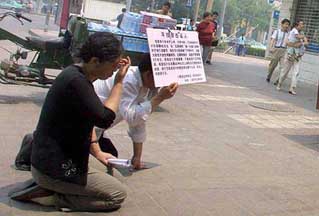
You will be surprised to learn their two causes, one private and one
public. The location is right in front of an Internet bar. On
the night of May 20, the 16-year-old son of the couple went to this bar and
had an argument with a thief. One hour later, the thief came back with
a dozen man and assaulted the boy with poles. The Internet bar paid
the parents only $2,000 for medical expenses, which have totaled almost
$50,000 by now. So the private cause was to demand justice from the
Internet bar. The public cause was to ask the Internet bar not to
admit underage persons as required by law.
- [040] Underground
Radio in Taiwan (06/13/2006)
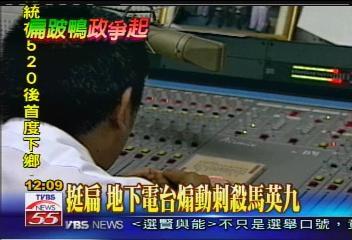
(China
Times)
After the National Communications
Commission (NCC) was established, the original media monitoring duties of
the Government Information Office was transferred over to the NCC.
Here is what the NCC does. All television media monitoring is
outsourced to a civilian company Rainmaker Corporation for full recording
and monitoring. When there is an allegation of violation, the
relevant tape can be retrieved and reviewed. All underground radio
braodcasts are monitored by twenty-two monitoring groups in Taiwan through
sampled recordings and monitoring. There are far too many radio
stations, so that the monitoring is incomplete. The monitors will
look for excessive commercial times, inaccurate advertisements for medical
products, and other violations. When transcribed, the evidence is
used for regulatory actions.
So with respect to whether underground
radio stations issued calls to assassinate the "China
spokesperson" Ma Ying-jeou, the evidence may not be there as the
monitoring is incomplete. The existing recordings only contain terms
like "destroy," which may or may not be sufficient for
"criminal incitement."
P.S.
(China
Times, June 15, 2006)
Two specific instances have been found
after NCC reviewed the tapes that it made. Case one: On June 10, on
a Kaohsiung radio program hosted by 戴榮聖,
a female called in to say that a Tainan city male has prepared a 'hoe' (鋤頭)
to attack Ma Ying-jeou if he visits Tainan. The man's nickname and
address were mentioned. Case two: In the radio program run by 萬宏,
there were many emotional statements against Ma Ying-jeou, but the word
"assassination" does not appear.
- [039] World
Cup Picks (06/13/2006) You could not have guessed that the
World Cup was going on from reading this website. So I'll just quote
from the CPTC website
about their favorite teams:
Group F - Australia, Brazil, Croatia, Japan
Preferred Team: Australia
Why: In honor of Roland Soong, the original webmaster. Also, they're called the Socceroos.
Alternate Team: Brazil
Why: It's nice to root for a perennial winner that isn't evil (cf. New York Yankees, Dallas Cowboys, Los Angeles Lakers). Plus, have you
seen
their
fans?
Once upon a time, I played the role of the
pommie-bashing Aussie with great effectiveness (=irritation factor). And
Australia just defeated Japan 3-1.
- [038] Woman
Attempts Suicide Over Bus Uncle (06/12/2006) No, you cannot
make this stuff up! Previously, in Comment
200606#034, it was noted how miffed Elaine Lee was at her father for
hiring Bus Uncle to work in the Steak Expert restaurant chain. About
Bus Uncle, Elaine said: " If I were there, I would have told him to 'shut
the fuck up.'"
Elaine Lee's mother is Lin Chen-chi (林珍奇 ),
a former movie starlet at Shaw Productions a few decades ago and currently in charge of the
human resources department at the restaurant chain. Here is the
photoplay of what happened yesterday (Apple
Daily and Ming
Pao).
(1) Lin and her husband had a fight over Bus Uncle. She wanted him
fired because she had been under a lot of "pressure" (e.g. the
negative press reports (such as patronizing prostitutes) and friends telling
her that they won't patronize her restaurants), but he did not understand
(and still does not understand) what the big deal is.
(2) Lin went and locked herself in her room, called a company employee and
informed him that she had just taken several dozen sleeping pills.
The company employee immediately called 999 (emergency services).
(3) The Fire Department showed up to smash down the door. In case she attempted to jump out of the
window (and Lin apparently had a prior attempt to leap from a building when
she was still in Taiwan), another fireman was lowered down from the roof to outside the
window to stop her just in case.

Lin was sent to the hospital for stomach pumping. When Lee arrived at
the hospital, she refused to see him at first. Lee said, "I've
got pressure."
Bus Uncle has done the right thing by resigning effective immediately.
- [037] Diminished
Expectations (06/12/2006) Here is the latest management in
expectations with respect to the July 1st march in Hong Kong: (The
Standard) Democratic Party chairman Lee Wing-tat conceded he would not be surprised if the turnout this year was lower than last year's 250,000.
To understand what is happening here, we have to review the history of the
numbers.
In the July 1, 2004 march, the event was
kidnapped by the controversy over the organizers' claim of 530,000 versus an
average of 180,000 as counted by four different academic research teams (see
July
1, 2004 Crowd Size
Estimates).
In the July 1, 2005 march, the organizers decided that they would avoid by
adopting the methodology used by some of the academic teams. Their
number was 21,000, which was close to the counts by the four academic
research teams on that day (see July
1 2005 Afternoon March Estimates).
The 250,000 referred to the December 4, 2005 march (The
Numbers for 12/4 Hong Kong), where once again the
event was kidnapped by the controversy over the organizers' claim of 250,000
using some undisclosed methodology versus an average of 70,000 as counted by four different academic research
teams.
So Lee Wing-tat's statement should be read in
the context of whether the organizers want another round of controversy of
their own stratospheric number versus the academic research teams (which are
usually consistent with each other). So far, the word is that the organizers will not
be counting this year. That is the real reason why the number won't be
250,000.
- [036] Underground
Radio in Taiwan (06/11/2006) (Ming
Pao) The mainstream media in Taiwan are reporting that the
underground radio stations in Southern Taiwan are calling for the formation
of a squad of patriotic Taiwanese to assassinate Ma Ying-jeou, who is the
"spokesperson for China." As a result, Ma's public
appearance yesterday was flooded by the presence of additional police
personnel and this has increased tensions.
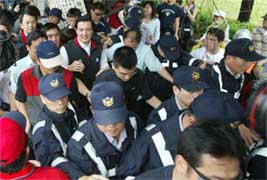
According to Ming
Pao, there are 171 underground radio stations across Taiwan.
The historical development of these radio stations was intimately tied in
with the relationship between the totalitarian regime and the opposition.
Since the regime controlled all mainstream media either financially or
through the censor, the unlicensed hidden radio stations became the voice of
the opposition. Today, mainstream media are open to all political
views, but the underground radio stations are still around. The
underground radio stations are often still politically engaged and the
speeches are possibly further than what the licensed mainstream media are
willing to go.
That was the general background. But what about the specifics of this
case? Nobody has even identified the exact station, locale or time
when those calls were made. The Central News Agency only reports that
the Kaohsiung city police has received reports that many low-power
underground radio stations aligned with Taiwan independence were inciting
its supporters to form "dare-to-die" squads to assassinate Ma
Ying-jeou. That was as specific as it got.
Now that the news is out, people are monitoring those underground radio
stations. Obviously, they would be fools to continue to do so, if they
ever did. Instead, according to Apple
Daily's monitoring, the underground radio stations are saying that
this is just more rubbish from the pan-blue media. The most extreme
statement heard was: "They won't shoot you. They'll just break
your legs."
According to the law about inciting others to commit an criminal or illegal
act, the penalty is less than 2 years of imprisonment and/or less than
NT$1,000 in fines.
- [035] Where
is Huang Ju? - Part 2 (06/11/2006) Part 1 was originally
published as Comment 200602#063. Executive Vice-Premier Huang Ju
is ranked number six on the nine-member Politburo in China. His
whereabouts is a mystery. Under the
prevailing media protocol, all news about the Politburo members is released
only by the Central Publicity Department.
The sage continues:
China Daily. Top leaders attend science summit.
June 4, 2006. Top Chinese leaders, including Chinese President and General Secretary of the Communist Party of China (CPC) Central Committee Hu Jintao, attended on Monday the academician conference of the Chinese Academy of Sciences (CAS) and the Chinese Academy of Engineering (CAE).
Vice Premier Huang Ju, 67, previously reported to be hospitalized, also attended the conference alongside the other eight Standing Committee members, Xinhua news agency said.
Washington Post. Chinese Official Reappears, but Mystery Persists
By Edward Cody. June 8, 2006.
The most believable rumor said Huang, 67, had received a diagnosis of pancreatic cancer and was undergoing therapy. This version received added credibility when a spokesman for the National Committee of the Chinese People's Political Consultative Conference said March 2 that "Comrade Huang Ju was hospitalized for treatment because he was unwell. He is currently recovering."
But other versions circulated as well. One said that Huang's wife, Yu Huiwen, was in police custody being investigated for financial irregularities and that Huang had been asked to step aside pending the investigation. Other reports said that Huang himself was under suspicion and that police were interrogating him as well as Yu.
More recently, a mid-level official said he was told, in great detail, that Huang was indirectly involved in a security leak to Taiwan and was being extensively interrogated by national security officials at a government facility in the Beijing suburbs.
Huang's daughter, the official said, had a long-standing relationship with a Taiwanese businessman whose father has ties to the pro-independence Democratic Progressive Party of Taiwanese President Chen Shui-bian. Suspicions were aroused that the relationship might have become a conduit for state secrets through carelessness or espionage, he said. Hu and his lieutenants were particularly concerned, the official said he was told, because Chinese intelligence learned that the content of a Standing Committee meeting on Taiwan policy was passed to Chen within days of its being held.
Sorting out the reports was impossible, even for relatively well-informed Chinese. Many informed people bought into the cancer theory, particularly after the spokesman's comment in March, but they were far from sure and did not know how authoritative it was.
Now Boxun
offers the proof about the corruption case of Huang Ju's wife. It quotes
a member of the special investigative team in Shanghai: "黄菊老婆掏浆糊,证据理好,拨伊(黄菊)看,告诉伊(黄菊)要判十年以上,要伊离婚.赤那,黄菊作死作活.不配合."
(Translation: Huang Ju's wife was involved in corruption and the evidence has
been gathered and organized, and then shown to Huang. We told him that
she will get ten years or more in prison and he ought to get a divorce.
Fuck! Huang Ju threw a fit and would not go along."
Proof? I too can take any of the above alternate theories and translate
it into Shanghainese, but that would not make it any more or less true.
- [034] Bus
Uncle Gets Dissed (06/10/2006) An openly stated reason (apart
from the need for money) why Bus Uncle took the job at Steak Expert
restaurant was that the boss's daughter is the well-known beauty Elaine Lee (李依琳)
and therefore
he is drooling.

Sing Tao
intercepted the boss's daughter at a party for Locman watch.
Q: What about Bus Uncle?
A: I don't want to talk about him.
Q: Have you met him?
A: Yes.
Q: What do you think about him?
A: I don't.
Q: Did you visit him after he was injured?
A: NO!
Q: Did you ask your dad why he made the hire?
A: I asked him but he did not respond. There are many things that he
doesn't tell me.
Q: Did you read that Bus Uncle is interested in you?
A: I don't know!
Q: Are you worried that he will harrass you?
A: A little bit, but I have many male friends who can protect me.
Q: Would you accept Bus Uncle?
A: NO! He is too rude. Anyone who watched that video clip would
be disgusted with him. If I were there, I would have told him to 'shut
the fuck up.' (original Chinese: 他太無禮貌,任何人看過那段片,都會對他反感,如果我在場的話,一定會叫他Shut
The Fuck Up)
- [033] Permalink]
Da Vinci Code in China (06/10/2006) Joseph Kahn in the
New York Times wrote China Bans 'Code' After Warning From Catholics.
I admit that I don't have a clue why they did this, but I enjoy
unsubstantiated speculations like anyone else. In Hong Kong, a recent
popular issue is whether Szeto Wah falsely accused Donald Tsang of
attending a pro-democracy concert seventeen years ago. The exact term
used was 砌生豬肉
which customarily refers to how the Hong Kong police fabricated
evidence to send people to jail because they refuse to pay for 'protection'
or some such. So is this what is going on here?
Customarily, all we know that Da Vinci Code was pulled ahead of
schedule, and there was no explanation. Any speculation with respect
to motive is therefore just that ... speculation. I would like to
think that this is a case of 砌生豬肉.
Whatever the real reasons are, the authorities intend to leave you with the
impression that the Catholics are intolerant and want to prevent everybody from
seeing a certain movie, and that would make them no different from some
other people. If the Catholics can do it, so can we. The
Catholics may be the doing this in the name of God, Jesus and Church, but we
can surely do this in the name of social harmony. Mission accomplished.
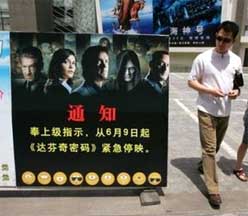
Alternative interpretations:
Plot Thickens: Why China Pulled The Da Vinci Code
China Confidential
After Short-lived Hit Run, Da Vinci Code Banished from Chinese Theaters
Non-violent Resistance
Media sources: national ban on coverage of "The Da Vinci Code" came 10 days before the film was pulled
China Media Project
The strange case of the disappearing blockbuster
Imagethief
The following appeared on a Chinese-language blog and cannot be
verified. This is purportedly a notice from the movie distributor to
all exhibitors to stop screening Da Vinci Code to make way for a
bunch of excellent Chinese movies to commemorate the 85th anniversary of the
Chinese Communist Party.
(金牌打手张小北)
中影和华夏关于[达芬奇密码]下片的紧急通知
紧急通知
各院线公司:
为纪念建党八十五周年,中国电影发行放映协会.中国电影制片人协会.中国城市影院发展协会联合发出倡议,做好优秀国产影片展映,适时推出一批优秀国产影片.
为加大国产影片的宣传和预热,保证国产影片充足的放映时间,中影集团电影发行放映分公司,华夏电影发行有限责任公司决定,自6月9日零时起< <达芬奇密码>>全线下片,不得放映.该片所有拷贝立即运回发行方片库,运单必须为6月9日,逾期未发运,由院线公司承担一切责任后果.
特此通知
中国电影集团公司电影发行放映分公司[公章]
华夏电影发行有限责任公司[公章]
2006年6月7日
- [032] Smiling
Faces (06/10/2006) John Kennedy (Global
Voices) has the goods on the two new announcers (Li Zimeng and Kang
Hui) on the premier television news program, News Broadcast, on CCTV.
At long last, people proclaim that there is finally someone who can actually
smile.
Boomerang!!! According to Huashengbao (via 6Park),
some people are very upset at the Li Zimeng's smile. The newspaper
reported a woman called up its hotline: "When Li Zimeng reported on the
airplane crash, she maintained a smiling expression. I could not bear
it. My son is in the Air Force and works at an airport. I can
truly understand the feelings of the families of those who died in the
crash. As a News Broadcast announcer, she cannot relate this piece of
news with a smile. It will really make the parents whose children have
perished feel extra terrible."
- [031] The
Surprise In Sudden Death (06/10/2006) With respect to The
Sudden Death of a Female Worker in China, Stephen Frost (CSR
Asia) wrote: "I should have known that ESWN would be onto it - as the late Barry Sheene used to say - like a rat up a drainpipe. Thanks, Roland; beautiful work."
That was a funny statement and very true to my heart. I admit that I
was drawn to that article as soon as I read it -- I have little or no
identification with macroscopic statements (such as exchange rate
adjustments or military budgets) and it is always the microscopic stories of
apparently insignificant individuals that move me to action.
I should mention that there was one surprise for me in that report.
The situation was that a female garment factory worker had died from
over-working (or, at least, that was a contributory factor).
Immediately, a newspaper reporter showed up to poke his nose around the
factory. Based upon standard expectations, I expect to see a bunch of
security guards chase after the reporter with knifes and sharpened iron
pipes.
Instead, this reads as if the factory management voluntarily showed the
reporter the time-card records. Why is that? I don't know.
Is such over-time practice so prevalent in Guangdong province that the factory management did not think
that they could get into trouble? The reporter does not get into this
beyond some rather dry statistics. Mind you, those working hours
violate the relevant provincial labor regulations.
- [030] Dinosaurs
Surround Chinese University Dormitory (06/10/2006) (China.com)
Female students at a university outside of Xian were outraged to find when
they woke up in the morning that someone had spraypainted twenty six Jurassic Park
logos on the walls outside their dormitories. The university has
immediately painted them over, but a female student took a photograph of the
evidence before that happened.
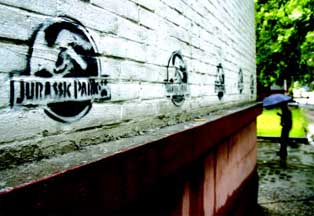
So what? So maybe someone likes that movie. But if you don't
understand the issue, then you are not of the Internet generation in which
guys use the term 'dinosaurs' to refer to well-educated and plain/ugly-looking females. The perpetrator is unknown at this time, which is
just as well as there is a lynch mob of angry women out there.
- [029] Hong
Kong Votes On Sexual Assault (06/09/2006) The question is
whether Commercial Radio talk show hosts Sammy and Shiu Yee should have
been suspended for two months without pay for the transgression for running
a public opinion poll to vote for the top ten most popular female celebrities for
indecent assault.
(Sing Tao)
On one side, the Women's Commission and other organizations have collected
1,714 signatures denouncing Commercial Radio as of noon yesterday. The
Broadcasting Authority has received 137 complaints too.
(The Sun,
Sing Tao print) On the other side, fans of Sammy and Shiu Yee have
organized an Internet counter-demonstration in support of the two.
More than 10,000 Internet signatures have been collected. In the
comments, supporters accused the women's organizations of making "much
ado about nothing." As for the media critics, the supporters
point out that so many of them routinely published sexy
photographs of female celebrities that they do not have any moral grounds to
have a say.
What do you think? What happens if it is all left to a popular vote?
I mean, don't we want a democracy here?
- [028] Impeaching
The President's Photograph (06/09/2006) If the impeachment of
Taiwan president Chen Shiu-bian appears to be a long-term dragged-out
process against formidable odds, then there is always the next best (and
infinitely easier) task of just removing his portrait. (Apple
Daily) In the front page story, at the Taipei City
Legislature, the legislators voted 27-10 along party lines to remove
Chen's portrait.
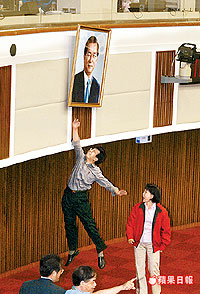
Why is the portrait there? (Central
News Agency) According to the Ministry of Interior's
'keypoints about the national flag, statued of the founding father and
portraitd of the president," various levels of government, public
school halls and other points of assembly should have the presidential
portrait on display. The purpose was to glorify the president
personally but to pay respect to the nation that is represented by the president. Since
this is a national-level regulation, local governments do not have authority
to do otherwise. Furthermore, if a public servant should remove the
president's portrait, then he/she would be breaking the first law of public
servants: "To carry out your duty in accordance with the
law."
But Apple Daily ran a check and found out that some county governments
(including Taipei, Taoyuan and Taichung) have never had the presidential portraits on
display.
I point this item out because this is form substituted for substance.
It may be good for the newspaper front page because of the melodramatic
photograph, but it
means absolutely nothing.
- [027] Media
Crackdown in Hong Kong (06/09/2006) There were two
media-related stories today about Hong Kong radio stations.
(1) Commercial Radio suspends So Fab for two months
The two Commercial Radio talk show hosts (Sammy and Shiu Yee) who came up with
the idea of the top ten most popular female celebrities for sexual assaults
were suspended without pay for two months.

(2) Four held on RTHK script con
Four people were arrested by the Independent Commission Against Corruption
for conspiring to charge RTHK for non-existent work (such as writing
never-used scripts) to the total value of about HK$70,000.
Apple
Daily then cited an unnamed legislator who said that the government
is dealing with the media just like it dealt with dissident organizations
and media during the British colonial era: "The method of using the
ICAC to go after RTHK was employed all the time during the British colonial
era. If you were a private organization, they would get the tax
department to investigate you. Anyway, even if you are not found
guilty of any crime, you would still get a lot of trouble." The
legislator then used the So Fab program as an example. The government
observed the public opinion was popularly against what happened, and so many
senior officials immediately applied pressure. Even the Broadcasting
Authority has publicly identified the seriousness of this incident.
"The government is best at following public opinion. Even if we
know that there may be political considerations behind this, we cannot
support Commercial Radio."
This is the sort of thing that points out to the poisoned atmosphere in
which government oppression is read into everything dealing with the
media. In the So Fab case, the government reacted and therefore it was
interpreted as a crackdown on Commercial Radio. If the government did
not react in the face of the public outcry, will it get any applause for
tolerance? No, it will be condemned for inaction instead.
There are many interesting things that I wish could be dealt with
instead. For example, why did the female DJ Shiu Yee went along with the
topic, and even got herself listed among the choices? What was going
through her mind? What would she do if she was sexually assaulted one
day? That answer might actually be illuminating. And if you want
huge ratings, you can even get some guy to grope her during the interview
without prior warning ...
- [026] A
Trivial Incident (06/08/2006) Or may be not so trivial after
all. The video can be seen as the 蝦碌事件一則
post at the 聞.見.思.錄
blog. The incident refers to a vehicle catching fire in the Hung Hom
Cross-Harbour Tunnel in Hong Kong. As a result, several hundred
persons had to run away from the scene on foot. Cable TV News was on
the spot immediately and there was a live report as archived on
YouTube. Ths clip has an elapsed time of 1:26 (mm:ss). The clip
begins with a citizen boarding an ambulance. Shortly before the
midpoint, we see a jostling match between a tunnel worker and a reporter,
with obscene language being deployed. The video clip then continued
with the sound being cut off because some producer was obviously appalled at
what was being said. (Note: Even if you can't understand Cantonese,
you should still watch the video for the physical confrontation between
reporter and guard)
Why should I care? First, Cable TV News is probably going to catch
some flack for allowing the conversation to be aired. This was live
coverage, and the producers were not quick enough to cut it off in the heat
of the moment. Second, this is a hypocrisy that I do not
understand. As the Bus
Uncle episode illustrates, I am barraged by obscene and
objectionable
language everywhere that I go in daily life in Hong Kong. After
decades of experience, I can no longer be appalled. The astonishing
thing is that society can still think that television stations are supposed
to keep that everyday stuff off the air.
Now I am well-known to be not a member of any mass protest movement.
Once upon a time in America, the Chinese students at my university attempted
to get me to sign on to protest against a housing supervisor for using the
term "M*therf*cker" in their presence. I had to giggle
because they must not have much contact with real black Americans.
Look, the term is so commonplace and it is just bizarre to insist that such
language ought to be kept off the air.
- [025] Chao
Chien-Ming Is Not Guilty! (06/08/2006) Not withstanding
the thousands of articles written about Taiwan President Chen Shui-bian's
son-in-law's alleged crimes against humanity, I am not convinced that he
will be found guilty on many of the charges (which is different from whether
he is actually guilty of something or the other in the moral, ethical or
common sense). The easiest-to-understand case is the NT$17 million fee
for being a spokesperson of an umbilical cord blood bank. The blood
bank has publicly acknowledged that a sum of NT$17 million had been paid in
accordance with Chao Chien-ming's instructions into the bank accounts of
Chao's family members (but not to Chao personally). Retroactively, the
company has sent out a statement of payment to Chao.
The consequence of all that is that Chao Chien-ming is guilty of not paying
income tax. The tax rate is 40% at that income bracket. Failure to pay taxes typically
results in an additional fine of 50% of the overdue payment. Thus,
Chao Chien-ming will have to pay 40% + 20% = 60% or NT$10.2 million in
tax/fine retroactively. The alternative viewpoint is that Chao will walk away with
NT$17 million - NT$10.2 million = NT$6.8 million scott-free. There is
nothing that can be done about that. This is the rule of the law.
Is NT$17 million a fair price for being a spokesperson for an umbilical cord
bank? It is unlikely that superstars such as Lin Chiling (aka
"040"), Jolin Tsai or Faye Wong can command that kind of rate for
a single photograph of father-mother-baby. But there is no crime if a
corporation over-rates the value of its chosen spokesperson. The corporation
is only guilty of stupidity and not some other sinister motive (note: that's
possible too, but where is the proof?).
There will probably be some further repercussions for Chao Chien-ming, since
his wife (=the daughter of the president) was not aware of what was
happening. Chao lets his wife handle his bank saving passbook in which
his monthly salary of NT$200,000+ as an osteopath at Taipei University
Hospital is deposited. His wife has no reason to believe that Chao had
any other source of income and she was not aware that his NT$2 million per
month credit card charges were paid by his brother to whom some of those
extraordinary revenue streams were directed. But that will just be a
family matter. This part of the known case is closed. The
citizens will still have the lingering resentment that nobody would ever pay
them NT$17 million for endorsement on anything. This is a privilege
that came with being related with the President, and there is no law against
that.
Presently, Chao Chien-ming is being held in incommunicado detention for
insider trading on Taiwan Development Corporation stocks. Chao seems to be maintaining the position that he knew nothing about the
trading made through the account of his mother. This was the first
stock trade ever made by his mother and it was for a significant amount of
money raised at short notice. Chao acknowledged that he was present at
two meals with the buyers and sellers of the stocks, and he insisted that
nothing about the stock trade was mentioned in his presence. The two
other principals at the meeting are now cooperating witnesses with the
prosecutor's office, and so this will become a he-said-they-said case.
If Chao loses the case, it is 3+ years of prison time, for himself and
possibly for other members of the Chao family.
Update: (TVBS)
Oops! I speak too soon. It seemed that in the latest
interrogation session, the prosecutor brought up the recently concluded Condor
case and enumerated the consequences. Those individuals who confessed
were given suspended sentence, but the recalcitrant individual who insisted
on his innocence to the bitter end received a ten-year sentence. So
TVBS reports that Chao Chien-ming has now acknowledged that insider
information was discussed in his presence at the meal gatherings. TVBS
offers this calculation: the jail term for insider stock trading is 3 years
to 10 years. If Chao holds out, he may get the maximum of 10
years. If he cooperates, he may get the minimum of 3 years, plus
another 50% deduction for the cooperation. A 1-1/2 years sentence
makes him eligible for a suspended sentence, which means he may not have to
serve any jail time (as long as he behaves during the probation
period). So it will be up to Chao to decide.
- [024] The
Bus Uncle Complaint File (06/08/2006) In the ESWN mail inbox:
"Stop the Bus Uncle stuff. Focus on the serious stuff. You are becoming tabloidy."
Yes!
Okay, so let us proceed to the discussion of the serious issue of
China-Taiwan unification. At ETToday,
they interviewed an expert none other than Bus Uncle (in translation):
"Chen Shui-bian must go, because he was wrong. Why doesn't he
quit, because he can't control his family, right? Ah Bian is being
asked by the people mainly because he does not want a unifiied
China. The important thing is for the Chinese people to unify and
avoid war. There are different opinions and viewpoints in this
world. Some people want Taiwan independence while others want
unification. This is like two groups of monkeys screeching at each
other. There will come a day when we the Chinese people will resolve
all this, right? No more pressure, right?"
Late breaking news at 23:10 on June 7th (Ming Pao via Yahoo!
News): Bus Uncle was assaulted in Mongkok when four people charged
into the restaurant where he works, pointed to him and said: "That's
him!" and then proceeded to beat him up. The four men then fled
afterwards. Bus Uncle was taken to the hospital when he was found to
be injured on the face and back of the head.
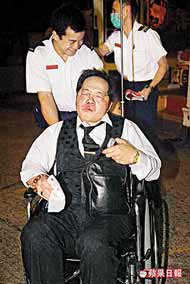
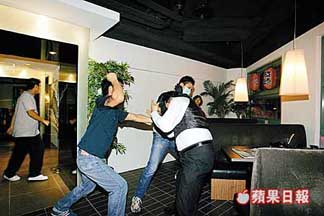
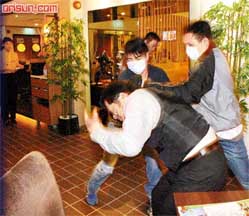
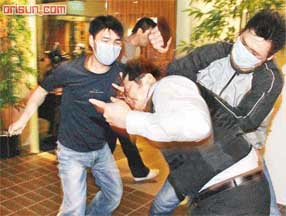
If at first the restaurant owner thought that he was getting a bargain by
paying Bus Uncle HK$9,000 a month to generate additional traffic, it is now
a negative asset because nobody wants to be involved in any risky
situations.
Introspective note: It is true that the brief comments tend to be somewhat
trite, but the blog posts are as dour and glum as ever: examples -- Hong Kong Cultural Sovereignty: Whose Tamar
Is It? and The
Sudden Death of a Female Worker in China.
- [023] Bus
Uncle Goes On A Field Trip (06/07/2006) ... and it becomes
another crisis for trust in the media. Here is the story in Apple
Daily. In the current issue of Oriental Sunday magazine, the
front page headline was "Bus Uncle patronises prostitutes."

When shown the magazine, Bus Uncle explained: "On the afternoon of May
3, this magazine interviewed me. I went and took some photographs with
them. Then the two male reporters took me in their car and we went to
the Huanggang border checkpoint. Once we crossed the border, we drove
to Sha Tsui in Shenzhen. Someone brought three girls around and we
went singing at a karaoke place from 2am to 6am/7am. The total cost
was more than one thousand dollars and I did not pay a cent. Then the
reporters and I went for a massage at a sauna center. We left at
10am. The cost was also more than one thousand dollars and I did not
pay either. After morning tea, he met with reporters from another
newspapers and then they went to sing karaoke." See the YouTube
video: 巴士阿叔 淫賤實錄
(note: Bus Uncle insists that the hand groping the girls was not his).
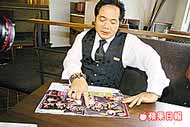
Is Bus Uncle so innocent? There is a taped video interview on the Oriental
Sunday website in which he claimed to have more than 1,000 sex
partners in his life so far and then he explained that when he makes love,
he uses his tongue half of the time, so that "before the train even
enters the tunnel, she has already capsized in Tolo Harbour."
The question: Who is being used here? Bus Uncle or the media?
Postscript: (Apple
Daily) Oriental Sunday issued a "solemn statment" to
state that they were interviewing Bus Uncle when he said that he wanted to get
a massage in mainland China. Since the interview was not completed yet, the
reporters went with him. Bus Uncle took the reporters to a certain
entertainment place in Sha Tsui and he was the one who asked for the girls.
Afterwards, Bus Uncle said that he did not intend to pay and, besides, he
didn't have the money anyway. So the reporters were forced to pay because
they were not going to get out of the place otherwise (note: the place
was said to be 'complicated' in the sense of gangster-affiliated). The reporters
said that Bus Uncle knew exactly what he was doing, and there was never any question of "PhotoShopping" those photographs.
- [022] Yannan
Morphes Into Tecn (06/06/2006) On September 30, 2005, the
famous Yannan forum went offline in China for re-organization (see Comment
200510brief.htm#005). If you punched in www.yannan.cn,
you get the message wishing you a happy national celebration day (October
1st).

Today, if you punch in www.yannan.cn, you
are redirected www.tecn.cn.
- [021] Seventeen
Years Ago (06/06/2006) The most important issue about June 4th
continues with incredible full coverage in Hong Kong today (see Hong
Kong By The Numbers for what happened the day before). The most
critical question for the patriotic democratic movements in China is: Did
Donald Tsang and his then-13-year-old son had dinner at the Royal Jockey
Club or attend a concert on the grounds of the race course in 1989?
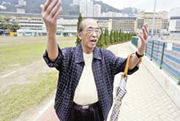
In Ming Pao,
Szeto Wah goes back to the Jockey Club and showed the spot where he
encountered Donald Tsang and son in 1989. Szeto Wah said: "There
is no reason for me to make a false accusation." (我沒什麼理由現在去『砌他生豬肉』)
[technical note: the colloquial phrase was 'cut up raw pork meat' in
Cantonese and customarily refers to how the Hong Kong police fabricated
evidence to send people to jail because they refuse to pay for 'protection'
or some such.]
In Apple
Daily, Democratic Party chairman Lee Wing-tat said that the concert
organizers even borrowed all the suites from the Royal Jockey Club. So
if Donald Tsang wanted to dine, he would have to go to the Clubhouse on Shan
Kwong Road. Several callers to Commercial Radio pointed out the
Clubhouse on Shan Kwong Road had not even built yet, which means that Donald
Tsang could not be at either place to dine.
In Ming Pao,
the Jockey Club spokesperson responded to an inquiry and affirmed that its
restaurants were located inside the Jockey Club headquarters building in
1989 and
did not move to Shan Kwong Road until 1992.
In Apple
Daily, Democratic Party chairman Lee Wing-tat said that the Royal
Jockey Club restaurants were closed that day and therefore Donald Tsang and
his son could not be 'dining' at the Jockey Club.
In Ming Pao,
the Jockey Club spokesperson responded to an inquiry and confirmed that all
the restaurants were operating as usual on that day seventeen years
ago. This information was obtained from operating records, and also from the recollections of veteran restaurant workers. However, Lee Wing-tat said that most of the streets in the area
were sealed off and the police would not let anyone in unless they were
attending the concert. If so, who were the restaurants serving on that
day?
Both Apple
Daily and Ming
Pao also reported on an eyewitness named Ng, who recalled speaking
to Donald Tsang and his son as a marshal for the event. Mr. Ng was a
government worker and therefore knew Donald Tsang, and he took them to sit
down in the front row seats reserved for important guests. The two
allegedly stayed for about one hour. Mr. Ng was originally scheduled
to speak on Commercial Radio, but withdrew after discussion with his family
on account of the pressure.
Due to the large number of famous singers at the concert, there must have
been extensive media coverage. What about the photographs and videos
from the archives? Has anyone found the incriminating evidence yet for
this utmost important issue? Here it is what has been produced so far
...
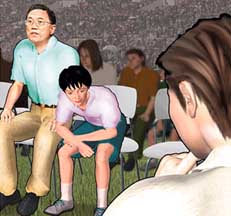
It is an Apple Daily artist's illustration of what Mr. Ng said he saw.
We should be looking out for that PhotoShop job coming out next ...
- [020] The
HK Democratic Party Members List (06/06/2006) Political
parties such as the Democratic Party and the Civic Party are registered in
Hong Kong under the Companies Ordinance. One consequence is that the
party membership list must be published for inspection by the public.
The Democratic Party decided against such disclosure last week on the
grounds that it was inconsistent with the protection of privacy.
Well, if the Democratic Party won't, then somebody else will. At the Hong
Kong Political Digest blog run by someone named 'Luke Loo,' a list
of 311 names of purported Democratic Party members was published on June
2. This may or may not be the complete and accurate list, but so far
no one seems to have objected to being incorrectly included.
This is second time in the last month that Democratic Party internal
information has been disclosed through blogs (see Big
Discovery in Hong Kong for the first case).
- [019] Paparazzi
versus Paparazzi (06/06/2006) From YouTube, here is this
counter-surveillance
video of the paparazzi team from Oriental Daily that was assigned to
hound Apple Daily's Jimmy Lai. I'm going to have to say this -- this
is a fool's task because the environment makes it impossible to conduct
proper surveillance. From a map in Eastweek magazine last year
(see Comment 200508#108), I have
marked the location of Jimmy Lai's house. I know what it is like there
because I live downhill. This street is impossible for the paparazzi
to stake out inconspicuously because nobody parks cars in the
street. They cannot be there without sticking out like sore thumbs.
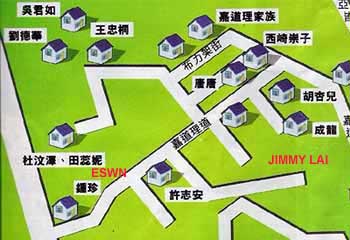
They cannot rent the apartment across the street from Jimmy Lai for any
amount of money, because actress/singer Kelly Chan lives there and she will
never let a tabloid newspaper use her house for that purpose. The
taller apartment building in the background of the video is the St. George's
building and it is even more
exclusive. I mean, you can't offer HK$10,000 to use the apartment of
Lord Kadoorie, principal shareholder of China Lighting and Power Inc. There is a reason why the map shows that people like Andy
Lau and Jackie Chan have houses in this neighborhood.
- [018] New
Forms of New Media Are In Vogue (06/06/2006) From Raymond Zhou and Wang Zhuoqiong
at China
Daily:
The eruption of blogs was a watershed event for 2005. Although the major blog hosting sites were injected with large doses of capital, bloggers and their readers were galvanized by a desire for self-expression, and in a few cases calculated moves of exhibitionism.
It is estimated that the total number of blogs in China will reach 15.2 million this year and almost double to 28.6 million in 2007. But will it drown out traditional media, their trained editors, reporters and all? Many people, including some of the best bloggers, doubt it.
A click through the blogosphere will reveal that the majority of blogs are personal journal types in the style of high school girls' notepads. A typical blog has total clicks in a few hundreds, and if comments are any indication, the readers are young people with nothing better to do but "grab the sofa," an online euphemism for leaving the first comment for a posting.
However, there are a few blogs that have built up reputations to rival that of mainstream media brands. Besides Xu Jinglei, the actress with the most-read blog, Wang Xiaofeng's "Massage Milk" comments on cultural and social news; Hong Bo's Keso deals with what's happening in the technology field; Roland Soong's ESWN aggregates and translates China-related news and offers observations with cross-cultural acumen.
These are some of the best blogs, and they are mostly run by media professionals. However, the bloggers tend to differentiate their day jobs from their blogging hobby. "The information presented on my blog is partial, selective and idiosyncratic," Soong explained. "A blog is the effort of a single individual and may excel in some small niche subject area or in reporting a suddenly breaking incident."
- [017] 'Bus
Uncle' Covers World Cup On TV (06/05/2006) A TVB commercial
used to promote its World Cup coverage will feature its commentator Lam
Sheung-yee spoofing the role of Bus Uncle (see Apple
Daily). Originally, when the clip was first uploaded onto the
Internet, the title identified the person as "X Sheung-yee"
because of the apparent resemblance with the renowned television
commentator.
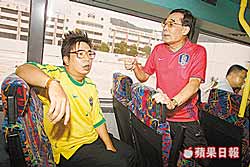
See YouTube
for the TVB ad.
- [016] Joey's
Birthday (06/05/2006) When I saw the headline "Joey生日江門掘金"
in Apple
Daily (Hong Kong), I thought that they must be kidding.
Apparently not.
This item cannot be explained any further because this website would lose its
family-friendly rating.
- [015] Derivative
Products (06/05/2006) (Wenxue
City) The scandal with Taiwan President's son-in-law Chao
Chien-ming has created many commercial opportunities. First and
foremost are the T-shirts with Chao's headshot and his prisoner ID number
2260. Sales has been helped by free promotions on mainstream media
(see, for example, ETToday).
There are also Chao Chien-ming dolls.
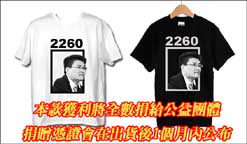
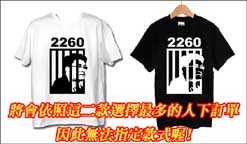
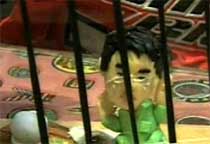
A spin-off product is the t-shirt of President Chen's wife dressed up as an
empress (see Wenxue
City):
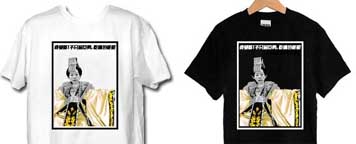
Here is the close-up of the 'empress.'
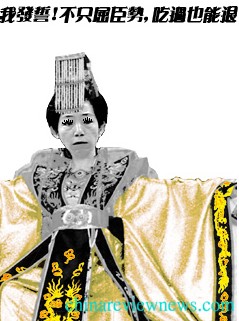
On a more serious note, my opinion is that these kinds of black humor is an
indicator of the existence of a democracy with free speech rights. In
certain other places, the penalties vary from banning to confiscation to
fines to
prison to even worse things.
- [014] Who
Do You Want To Molest? (06/05/2006) (Ming Pao via Yahoo!
News) On the Hong Kong Commercial Radio program So Fab <<架勢堂>>,
the organizers wanted the public to vote for the "sexiest female
artist/performer/entertainer." However, the title was deemed to
be too boring. Instead, this became a vote for "the Hong Kong
female artist that you like most to molest" (最想非禮的香港女藝人).
If they wanted publicity, then they've definitely got a public uproar
(protests, petitions, complaints to the regulatory agencies, etc). Eh
... as a reminder ... it is against the law to molest (or indecently
assault) any person ...
Related link: 'Fun' radio poll sparks outrage
The Standard, June 6, 2006.
Postscript: The radio program will be suspended for two months
for the transgression! Commercial Radio suspends So Fab for two months.
The Standard, June 8, 2006.
- [013] Chu
Yi Was Put Under Anti-Double Regulations (06/04/2006) The term
雙規 (double
regulations) refers to the Chinese Communist Party's request for a Party
member to appear at a stipulated time and place for questioning, and is a
disciplinary measure enforced by the CCP's Disciplinary Inspection
Committee. This is an invitation that cannot be refused and is
equivalent to a police summons. This is usually an indication of big
troubles because the invitation would not be extended unless there are
serious problems.
Chu Yi is a Taiwan legislator who has been prominent recently for his daily
scandal exposés of alleged corruption in Taiwan. What is the connection between Chu Yi and Double
Regulations? On May 28th, Chu Yi was scheduled to speak at Peking
University about the importance and interaction of democracy and freedom of
press. However, the speech was canceled at the last minute. What was
going on?
Here is an article by Situ Beichen (司徒北辰)
republished at Fu
Jianfeng's blog:
[in translation] ... Chu Yi's speech had
become a hot topic around the Peking University campus. The 500-seat
conference hall had more than 1,000 students attempting to sign up.
But things changed quickly. The May
28 speech was canceled on the evening of May 27, and that surprised Chu
Yi. The talk was that a senior CCP official (of rank higher than
bureau director) called at 10pm at night; one hour later, Peking University
called Chu Yi one hour later to apologize. Chu Yi said that the
mainland officials wished that he would change the venue: "Other than
Peking University, any school is acceptable -- Fudan University or Zhongshan
University can be arranged." But Chu Yi said firmly that it was
unacceptable. ...
Before he left, Chu Yi treated the reporters to a meal at a Taiwan
restaurant. I was there. During the meal, everybody continued to
speculate about the real reason why the speech was canceled. Chu Yi
said that the mainland government was worried that his speech will draw
resonance among the mainlanders and lead to a popular campaign at exposing
scandals and corrupton. After I heard everybody spoke, I said,
"What Mr. Chu said may not be the main thing. The very most
important thing is that a certain 'date' is about to arrive and anything
concerning democracy is sensitive at this time, especially at Peking
University." Then Chu understood and agreed. Previously,
nobody had struck this chord. At noon, many of the Taiwan television
broadcasts were missing this major news point.
I told my Taiwan media colleagues that in
ordinary times, Legislator Chu is not really talking about anything
excessive because many Peking University professors are instilling even more
progressive kinds of content and values in their students. I said that I hope Mr.
Chiu can come to Beijing more often, give a few more talks and I hope that I
can do a special interview with him.
So this was a case of Anti-"Double
Regulations." Chu Yi was requested NOT to appear at a
certain time at a certain place to give answers to certain questions.
Another place would be fine, or another time, or another subject, but just not
all of the above.
- [012] Casting
for <<Lust,Caution>> (06/04/2006) (Chengdu
Commercial Daily via Wenxue
City) The central character in Ang Lee's film adaptation of
Eileen Chang's <<Lust, Caution>> is a female university student
age 18-23. Getting this role will be a major career point for
anyone. The initial speculation about Shu Qi has been rejected, for
that actress if over 30 years old and too mature for that role. Zhou
Xun would be too sophisticated too. It is possible for Zhang Ziyi to
play a slightly younger role. But what is this talk about Little S or
Big S? This is really hard to see ...

Filming will begin in September.
- [011] Hong
Kong Attitudes Towards June 4th (06/04/2006) Earlier this
week, the Hong Kong University Public Opinion Programme released the results
of its annual June
Fourth Survey of Hong Kong people.
On the key question: "Should there be a reversion of the official stand
on the situation?" the numbers of the tracking study over the years
are:
2002: 39%
2003: 47%
2004: 54%
2005: 56%
2006: 56%
The condition of human rights in China since 1989:
Improved: 80%
The condition of human rights in China three years from now:
Improved: 69%
Hong Kong people have a responsiblity to instigate in China:
Development of democracy: 76%
Economic development: 83%
Hong Kong people should put more effort on:
Economic development in China: 45%
Development of democracy in China: 27%
China should emphasize more on:
Economic development: 47%
Development of democracy: 28%
- [010] Bus
Uncle Is A Steak Expert (06/03/2006) Here is today's Bus Uncle
update. First from Express Daily (note: no link), Bus Uncle attempts
to reconcile with his ex-girlfriend Shirley with the media in tow on the day
before yesterday. The security guard told him that the instructions
are not to let him in. Bus Uncle says that he needs to get his clothes
back and calls to the police. Shirley tells him that she has thrown
all his stuff out already. Bus Uncle leaves in disappointment.
Yesterday, Bus Uncle calls the reporter up and says that all is well.
He has just reconciled with his former girlfriend named Lily and he already
has a good-paying job offer from a Japanese restaurant within the Hokaido
Group. The reporter calls up all seven restaurants in Hong Kong with
Hokaido in their names but none said that they have hired Bus Uncle.
Next, from Oriental Daily (via Sina.com),
the reporter went with Bus Uncle to interview at the Steak Expert
restaurant. Bus Uncle had claimed to be fluent in French and German
and can cook Hungarian and Yugoslavian dishes. Bus Uncle was hired to
be a host at HK$9,000 per month; his responsibilities include leading
customers to their tables, recommending food and communicating in
general. Bus Uncle was given an immediate downpayment of HK$5,000 to
buy new clothes and get a haircut. He will be working at the Steak
Expert restaurant in Dundas Street, Mongkok district, Kowloon.
Bus Uncle also said that two websites want him to be program host. The
expected income is in eight figures on a shared-revenue basis. Bus
Uncle will make recommendations about stress reduction and give instructions on
fruit sculpture. Another concept is to bring American Idol
competitor William
Hung over in a show in which Bus Uncle will scold William Hung playing the
role of Elvis Ho and then the
two will sing together. Bus Uncle claimed that Miriam Yeung wants him
as a guest at her concert later this year, but Yeung's manager said that she
has no concert plans at all. Another entertainer Sammi Cheng's manager
said: "It is a lot of stress working with Bus Uncle, so we better think
about this!"
- [009] The
Wen-Ho Lee Case (06/03/2006) In the New York Times report News Media Pay in Scientist Suit,
the story seems to be focused on whether the five media organizations ought
to have agreed to contribute US$750,000 towards the settlement. Anyone
who has kept interest in this case is clearly looking for the explanation of
the New York Times towards this case. So here it is:
The Times covered the charges against Dr. Lee aggressively. But in September 2000, it published a lengthy note "from the editors" saying that despite "careful reporting that included extensive cross-checking," there were "some things we wish we had done differently in the course of the coverage to give Dr. Lee the full benefit of the doubt."
The note said The Times should have pushed harder and sooner "to uncover weaknesses in the F.B.I. case against Dr. Lee" and to assess the scientific, technical and investigative assumptions behind the case.
It probably took the full board of senior
editors five hours to write these two short paragraphs to make sure that
everything is prim and proper. If this is the first
time that you read about this case, you will have no idea what really happened
from the above. Even if you already know about the case, you may want to
refresh your memory with some of the
major pieces in this sordid act of journalistic malpractice:
- How the New York Times helped railroad Wen Ho Lee
Eric Boehlert, Salon.com. September 21, 2000 (Quote: "There's nothing wrong with making an error, we all make
mistakes. What's scary is the paper's unwillingness to admit fault. I think the Times is doing a real disservice to its own interest. But it seems they've dug in so deep they can't get out.")
- The Times and Wen Ho Lee
The Editors, The New York Times. September 26, 2000 (Quote: "In those instances where we fell short of our standards in our coverage of this story, the blame lies principally with those who directed the coverage, for not raising questions that occurred to us only later. Nothing in this experience undermines our faith in any of our reporters, who remained persistent and fair-minded in their newsgathering in the face of some fierce attacks.")
- The New York Times apologizes
Eric Boehlert, Salon.com. September 27, 2000 (Quote: "Carefully crafted and qualified like a lawyer-vetted brief, the story, with its front-page teaser and 1,500-word spread, will certainly be remembered as one of the Times' most dramatic explorations of its own shortcomings. At times a laundry list of coulda, shoulda, wouldas, the appraisal is both candid and defensive, admitting both serious, journalistic blemishes while steadfastly maintaining that the paper's work is, essentially, accurate."
- No Defense: How the 'New York Times' Convicted Wen Ho Lee
Robert Scheer, The Nation. October 5, 2000. (Quote: "The torment of Wen Ho Lee
[began] ... when the New York Times, the most respected media outlet in the country, laid out a tale of atomic spying that has been proved wrong on virtually every count, but that launched a witch hunt ending in Lee's incarceration.
There are too many low points in the history of this nation's journalism to permit one easily to employ superlatives about the Times's startling transgression. I don't know if it makes the all-time Top Ten list, but the trial and conviction of Lee in the pages of the Times--both in its news columns and on its editorial page--is certainly right up there."
- Newsroom Lessons From The Wen Ho Lee Fiasco Eric Boehlert, Huffington Post. June
5, 2006. (Quote: "In March 1999, when the Times was poised to break its big Wen Ho Lee scoop on page 1, a story with major national security implications, Clinton's FBI, for various reasons, asked the Times to hold off running the story. The Times complied for just 48 hours and then published the story. But recall that in 2004, when the Times was set to break its big NSA wiretapping story on page 1, a story with major national security implications, the Bush's administration, for various reasons, asked the Time to hold off running the story. The Times complied for nearly a year before finally publishing the story.")
- Media Failed Its Duty in Lee Case
Robert Scheer, CommonDreams.org. June 7, 2006. (Quote: "In a post-settlement statement, the five media outlets — the Los Angeles Times, The Washington Post, ABC, AP and The New York Times — claimed they paid Lee only to protect their sources. But those government sources broke the law, and the news organizations covered for them, rather than covering the important news of “government officials” who, acting on their own political agendas, decided to selectively leak highly classified information to smear a scientist who was innocent of the crimes they claimed. The “bond” of the media with its sources was in fact a bond with government witch hunters willing to destroy a loyal American citizen — a man who had devoted his working life to this nation’s military security — in order to renew the Cold War with China.")
- What we can learn about confidential sources from Wen Ho
Lee. Michael Kinsely, Slate. June 9,
2006. (Quote: "To say with a straight face that "only from confidential sources" could the public have been "informed about the issues" in this "matter of great public interest"—about the Wen Ho Lee case! The matter of great public interest was imaginary. It was part of an organized effort to misinform the public. And the culture and rules of confidential sources are what made this campaign of misinformation possible. The real story was a government plot to destroy a man's reputation and violate his privacy. The culture of leaks was both central to that story and the reason everybody missed it.")
In the recent settlement, the five media
organizations said: "We did so to protect our confidential sources, to protect our journalists from further sanction and possible imprisonment and to protect our news organizations from potential exposure."
To protect your sources who lied to you in order to to push their hidden agenda is ...
how shall one say? ... to do evil.
- [008] Journalist
Sues Government (06/02/2006) (Ming
Pao) Shanghai's Liberation Daily reporter Ma Cheng (馬騁)
has filed suit against the Shanghai City Planning Department for
"non-disclosure of government information." This is being
described as the first case in mainland China in which a journalist has sued
a government department for violating the right to gather news. On
April 18, Ma Cheng faxed a proposed outline for an interview to the Shanghai
City Planning Department and received no response. On April 23, he
sent a written application by registered mail to ask the Department to
follow the "Shanghai City Government Regulations on disclosure of
information" but his request was rejected.
According to those regulations, the government departments should disclose
information related to economy, social administration and public service,
either voluntarily or upon request. In a letter to the Chinese
Journalists Association, Ma Cheng also said that in recent years he had been
frequently turned down by government departments, some of which used illegal
and irregular methods to restrict his news gathering.
A legal scholar pointed out that Ma's case is viable if he sued as a
citizen. If he sued as a journalist, then there is no clear regulation
that says government departments must accept news interviews.
"Government information should be disclosed to the citizens, but this
this does not mean that the government departments has the obligation to
disclose the information to journalists." Ma said that he
emphasized in his lawsuit mainly on the disclosure of information and less
about the right of journalists to gather news. The case has been
accepted by the relevant court for hearing.
Postcript: Liberation Daily reporter unexpectedly drops lawsuit against Shanghai's City Planning Bureau
China Media Project
- [007] Backchat
(06/02/2006) Those of you listening to RTHK 3 this morning in Hong
Kong heard me on the Backchat program. The hosts were Bryan Curtis and
Hugh Chiverton, and the other guests were Michael Wong (Chief Officer
(Education), Mental Health Association HK), Dr. Kenneth Leung (Department of
Journalism CUHK) and renowned columnist Chip Tsao. The subject?
Bus Uncle! Here is the RTHK
website link.
Chip Tsao tied the stress experienced by Hong Kong people to Mao Zedong's
dictatorial rule over the Chinese people, the vindication of June 4th and
the lack of democracy in Hong Kong and China. That might be something
of a stretch insofar as cause-and-effect goes. After all, they have a
democracy in the United States which is the home of the term of 'road rage'
(fun and game: take this Road
Rage test).
As a listener Tricia commented, "There has to be better and more
important things to talk about in this town." Yup! I'm sure
that plenty of people feel that way too. In itself, the incident is a
commonplace occurrence here or anywhere else in the world, almost a
non-event. It was the Internet word-of-mouth reaction that drew the
initial public interest. Within the past couple of days, the second
wave of interest is about the behavior of the mainstream media in becoming
part of the news instead of just reporting it (such as, which one of them
paid Bus Uncle for cooperation?).
You may be sick of this and longing for the next big one to draw away the
public attention. But here is the latest update on Bus Uncle as told
to Oriental Daily:
His girlfriend Shirley has dumped him because she is too embarrassed about him
being the Bus Uncle. He claims to have only HK$100 left on him and one
set of clothing. He says that he owes more than HK$4,000 in
electricity and telephone fees. He had demanded HK$100,000 at first
for an exclusive interview, but was turned down. He lowered the price
to HK$10,000 as "appreciation of the effort" and was still turned
down. He is now just asking: "You make me an offer so that I can
get out of my present predicament."
- [006] Hell
Hath No Fury Than A City Scorned (06/02/2006) First, we have
the US Homeland Security budget allocations (see Huffington
Post):

NY Post: Less than five years after the murder of 2,749 people in the Twin Towers on 9/11, the feds yesterday shockingly slashed anti-terror funds needed to protect New York City against future attacks.
The Homeland Security Department announced it was hacking funds distributed to the city by 40 percent compared with last year, while pouring hundreds of millions into unlikely terror targets like Kentucky and Wyoming.
What was the rationale (that was a rhetorical
question as all you need to do is to pick out a map of historical voting
patterns -- New York City is Democratic territory)? ABC News (via Huffington
Post):
New York has no national monuments or icons, according to the Department of Homeland Security form obtained by ABC News. That was a key factor used to determine that New York City should have its anti-terror funds slashed by 40 percent--from $207.5 million in 2005 to $124.4 million in 2006.
The formula did not consider as landmarks or icons: The Empire State Building, The United Nations, The Statue of Liberty and others found on several terror target hit lists. It also left off notable landmarks, such as the New York Public Library, Times Square, City Hall and at least three of the nation's most renowned museums: The Guggenheim, The Metropolitan and The Museum of Natural History.
So here is the payback from the hometown
paper which was formerly pro-Bush:

- [005] Bad
Behavior (06/02/2006) (Metro via InMediaHK)
The Christian Services conducted a survey of 506 Hong Kong citizens age 12
or over in Kwun Tong and northern New Territories. The survey
respondents were shown the Bus Uncle video and interviewed afterwards.
The survey respondents was shown a list of possible reactions (from which
they can choose two items). The most popular response at 32% was
"nothing can be done."
In another part of the survey, 90% thought social ethics is important, 75%
thought they has good social ethics and 31% believe that Hong Kong people
have good social ethics. It's all about me, isn't it?
Here is the best part -- naming bad behavior:
- spitting in public places
- urinating in public swimming pools
- smoking in non-smoking areas
- picking your nose in public places
- queue jumping
- parents helping children to urinate in washing basins
- using foul language aloud
- littering
- sneezing/coughing without covering up
- making noise inside cinemas
It is known the cameraman Jon in the Bus Uncle
episode has another 160 video clips for sale. Most frequently
mentioned is this clip: Jon was in a bus caught in a huge traffic jam; an
old woman got off the bus to urinate right by the roadside and then got back
on the bus again; all this was caught on film. Hey, that didn't even
make the top ten list of bad behaviors!
- [004] May
2006 Website
Statistics (06/02/2006) For the month of May 2006, the total
website statistics were:
- 2,780,006 hits (including htm, jpg, gif, wmv, xml, etc)
- 516,947 page views (htm files only)
- 369,615 unique sessions
- total time spent = 68,468 hours
- bandwidth = 50 gigabytes
On an average daily basis:
- 89,978 hits
- 16,676 page views
- 11,923 unique sessions
- 11:07 per unique session
For the last week of the month, the page views were over 20,000 per day
courtesy of Bus Uncle.
This is the first full month in which the logs have referrer data. It
looks like almost half of the page views came from various Google sites
(Google.com, Google.com.hk, Google.com.tw, Google.com.sg, Google.com.au,
Google.com.ca, etc).
- [003] The
Extraordinary Real Person (06/01/2006) In China, the rave of
the moment is the series of staged photographs posted under the name of 非常真人
(=extraordinary real people) (see, for example, Tianya
or ChineseNewsNet).
This series of photographs features various young people in some absurd,
ironic or humorous situation which could be communicated intelligently
through captions. Here is an example:
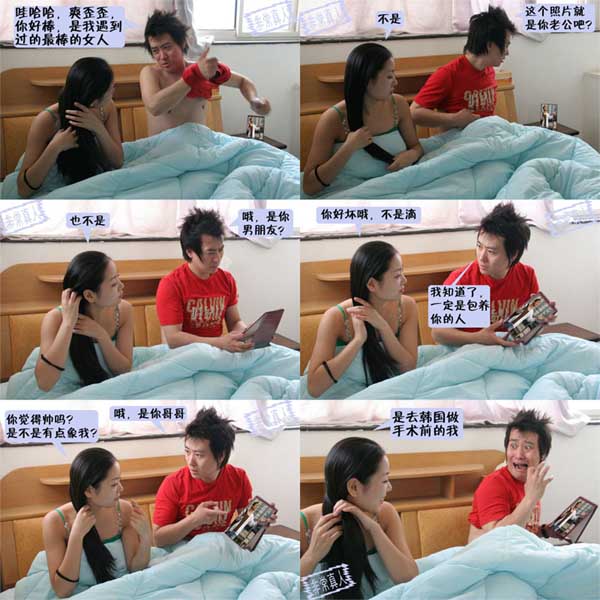
Top left: "Wow! Awesome! You were so wonderful! You are the best
woman that I have ever met."
Top right: "Is this a photo of your husband?"
"No."
Middle left: "Oh, is this your boyfriend?" "No."
Middle right: "I know. This is the man who is paying for you as
his mistress." "You are so bad. It isn't."
Bottom left: "Oh, it is your brother." "Don't you think
he is handsome? Doesn't he look like me?"
Bottom right: "That was me before I went to South Korea and got the
operation."
- [002] The
Chao Chien-ming Phenomenon (06/01/2006) (Apple
Daily) On broadcast television the day before yesterday, TTV
and CTS had 6 minutes and DTV had 9 minutes in their hour-long newscast on
the case of the president's son-in-law. The cable news channels had
much more, with at least 20 minutes per hour on this story.
This leads to the case of a 81-year-old veteran in Hua-lien city. On
the day before yesterday, he was viewing the CTV news program and cursed out
angrily: "All the money in Taiwan have been robbed clean! Get
mainland China to fire a few missiles over to get rid of them!"
His wife noted that he has high blood-pressure and said: "Don't get
angry! If the missiles come over here, they will only hurt plain folks
like us. Just watch some television! There are corrupt officials
on the mainland too. There is corruption everywhere. Just watch
things calmly!" Then she added: "You either take the money
from the Taiwan government or else you go back to mainland China!"
When her husband heard that, he put on a raincoat and walked out of the
house. Yesterday morning, a citizen found the old man had killed
himself by hanging from a tree by the river. More personal and public
acrimony is being passed around.
- [001] The
Bus Uncle Meets Elvis (06/01/2006) From South China Morning
Post:
The young man who was scolded by the infamous Bus Uncle yesterday made an appeal to the media: "Don't bring him to see me."
"I really do not want to see him again. I would like to call on all media workers not to bring him to see me. Don't bring him to see me please," said Elvis "Alvin" Ho, who was the hero of a six-minute video which has been viewed on computers millions of times in Hong Kong and overseas.
...
Mr Ho said: "I do not want to be put under the spotlight so that some people can use me to make more drama. I really hope the whole saga can die down soon."
This is called being one newscycle behind, because
the media-arranged meeting (=debacle) had already taken place.
(Sing
Tao) Last evening at 730pm at Elvis "Alvin" Ho's
real-estate office in Mongkok, he was trying to conduct business with a client
when he saw Bus Uncle enter. Ho immediately started to yell: "I've
got nothing to say. You get out now." Bus Uncle said,
"Don't be nervous. Let's be friends" and offered his
hand. But Ho said: "This is a private space. Why are you
here? You people get out now. Get out quickly!" So Bus
Uncle and the reporters left. Ho then followed out: "All the
reporters leave me your business cards!" Bus Uncle had hoped to
develop some business opportunities with Ho (like doing concerts), but those
hopes have now evaporated.
Archives