[128] The
Life and Times of Mainland Chinese Reporters (10/31/2006) (ReporterHome.com)
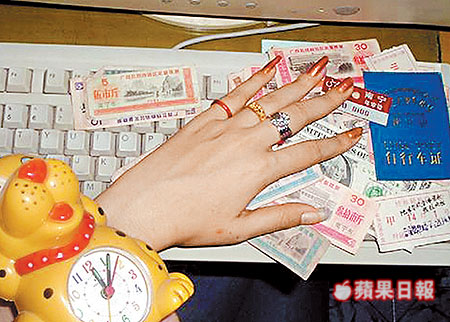
Instead of personal testimonials, this is a list of reporter ID's that have
been canceled (along with the reasons for cancelation)
9/21/2006 Shantou Daily: Reporter ID was robbed
9/14/2006 Changjiang Information News: Wrong gender
9/14/2006 Changjiang Information News: Wrong gender
9/14/2006 Family Life Guide: Wrong name
9/12/2006 Nanjing Morning News: Reporter ID was stolen
8/25/2006 Guangdong Science and Technology News: Wrong gender and incorrect
photo
8/21/2006 Jiangmen Daily: Handbag was stolen with reporter ID
8/14/2006 Guizhou Political News: Robbery
8/03/2006 Datong Evening News: Retired cadre
8/02/2006 Datong Daily News: Retired cadre
8/02/2006 Datong Daily News: Retired cadre
8/02/2006 Datong Daily News: Retired cadre
7/26/2006 Ningde Evening News: Photograph of another person appeared in
Reporter ID
7/21/2006 Xiuzhou People's Radio: Arrested by procuratorate
7/17/2006 China Petroleum News: Work injury; lost capacity to work
7/12/2006 People's Daily (overseas edition): Left job to study overseas
6/30/2006 Jiangxi Daily: Suspected of economic crime
[127] The Public Bus and the Incense Brazier (10/31/2006) In Comment 200610#107, it was noted that in Taiwan, a man cursed his ex-wife as

[126] They
Read Pictures (10/30/2006) (Wenxue
City) On October 30, Taiwan President Chen Shui-bian held an
online meeting from Taipei with Tokyo. The following photograph was
released by the Central News Agency.
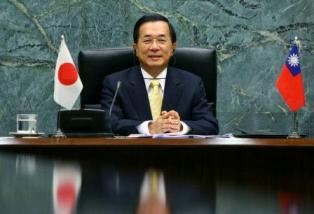
Internet comment: "Look at the positions of the Japanese and Republic of
China flags. Obviously, Chen is closer to Japan than ROC."
This leads to a question: Is the Internet really helping us to build a civic
society of concerned, rational citizens? Well, maybe some of them are
concerned, but not necessarily about the important things.
[125] Another
Chinese Netizen Sent to Jail for Exercising Free Speech
(10/30/2006) (Southern Metropolis Daily)
On September 16, a netizen named Beibingyang wrote at a Huizhou forum that
he had reported police involvement in a gambling operation. However,
the authorities not only refused to take action but actually alerted the
gambling operators. On October 16, Beibingyang wrote that he was
facing retaliation (namely, his wife and child were threatened and insulted,
his windows were broken and the police investigators threatened him)
On October 19, a netizen named Rulaifozu wrote a post in which he identified
himself as police and threatened Beibingyang. Subsequently, these
posts were disseminated across other Chinese forums.
The Huizhou city public security bureau began two investigations. The
first one involved undercover surveillance of the gambling den indicated by
Beibingyang. They found out that the so-called 'police' was just a
security guard named Pu working at a police station. The 'gambling
den' was a citizen center sub-contracted by the local neighborhood committee
to Pu's wife to provide entertainment such as mahjong games with symbolic
bets.
The other investigation concerned Beibingyang himself. Among other
things, Beibingyang was an unemployed single male, so there could be any
possibility of his wife and child being threatened and insulted. On
October 21, the police arrested Beibingyang at a Huizhou Internet
cafe. During the interrogation, citizen Peng admitted that he was
Beibingyang and that the incidents mentioned were fictional. He said
that he was unhappy with being out of work for so long and he needed to
release his emotions somehow. He also admitted that Rulaifozu was his
'sock-puppet' alias and he wrote that threatening post to arouse more
hostility towards the militia police.
Citizen Peng has been sentenced to 10 days of detention plus a fine of 500
RMB.
[124] The
Nanchang Non-Demonstration (10/30/2006) (Ming
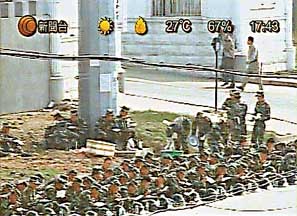
Pao) Under the vigilant watch of the armed police (see photo
below from Hong Kong's Cable TV News), the planned demonstration by the
vocational/technical schools students at 8/1 Plaza, Nancheng, Jiangxi never
took place.
One of the reasons why the provincial leaders were determined to prevent any
public incident was that Philippines president Gloria Arroyo happened to be
giving a speech at Nanchang University. For preventative purposes, 8/1
Plaza was blanketed with undercover policemen.

The last paragraph in this report said: "A worker with Nanchang
Ganjiang Technical School emphasized that the school did nothing wrong and
never deceived the students. The student demonstration had no
cause. According to local sources, the police believe that this
incident was incited by certain people and they have locked down on certain
leaders and will take appropriate action."
[123] Taiwan
By The Numbers (10/30/2006) (China
Times) (1,087 persons interviewed October 25-26 by telephone
with numbers being drawn with the telephone directory as base)
Q: In the matter of the national secret fund in which the presidential
couple may be involved, who do you think is innocent?
71%: both the President and his wife are not innocent
8%: the President is innocent but his wife is not
1%: the President is not innocent but his wife is
18%: the President and his wife are both innocent
By political affiliation:
Both innocent: pan-blue 4%, independent 22%, pan-green 54%
Both not innocent: pan-blue 91%, independent 66%, pan-green 26%
Q: If prosecutor Chen Jui-ien ends up with an indictment of either the
President or his wife, then should the president resign?
Yes: 80%
No: 18%
By political affiliation:
Yes: pan-blue 93%, independent 77%, pan-green 52%
Q: If prosecutor Chen Jui-ien ends up without any indictment against the
President and his wife, do you agree with another mass resistance campaign
led by the anti-Bian headquarters?
Yes: 46.5%
No: 51%
Q: Do you have confidence in the judicial system in Taiwan?
Yes: 26%
No: 72.5%
By political affiliation:
No confidence: pan-blue 85%, independent 71%, pan-green 36%
[122] Tsim
Sha Tsui Suzy (10/30/2006) They send emails. Yes, some
of my readers are shocked at what happens in Taiwan with respect to exercise
of free speech in Comment 200610#107. In the
public record, the Letters
from China blogger was impressed by how a woman was sentenced to ten
days of detention for telling someone else: "You're More Treacherous Than James Soong!"
This was not some crap that Apple Daily made up because you can backtrack to
the original item in Liberty
Times -- In the morning of December 12, 2003, a woman named Wang ran
into a former employer named Hsu in the corridors of the Chiayi court.
Wang was angry that Hsu had sold her stock holdings without her knowledge
and so she said, "You are more treacherous than James
Soong." As a result, Hsu complained to the Chiayi district
prosecutor that he had been defamed. The net outcome was that Wang was
sentenced to ten days of detention (which can be paid off by NT$9,000).
I have no comments on this. This is a question of community
standards. There is no reason why Taiwan or any other place should be
held to some abstract 'universal' standards. It is just too easy to
think of unacceptable speech in any number of locality that is commonplace
elsewhere. This is that whole Danish cartoon thing that you should be
be able to feist on Iran.
For example, if Taiwan standards were applicable in Hong Kong, what would
happen to the infamous Bus Uncle
[121] The
Desperate Mother's Blog (10/29/2006) (Wuhan Morning News via Sohu.com)
Tan Rong was a 33-year-old female judge in Jingzhou. On October 25,
2001, her husband was out of town on business. At 7pm, Tan Rong had
dinner at her in-laws' place and was ready to take her daughter Dudu
home. Since it was raining outside, Dudu did not want to go and so Tan
Rong went home alone. One hour later, her brother Tan Tao brought
Doudou home, where no one answered the door. So her parents came with
the house key and when they opened the door, they found Tan Rong dead in a
pool of blood with her throat slashed. Five years have passed and the
murderer has not yet been found.
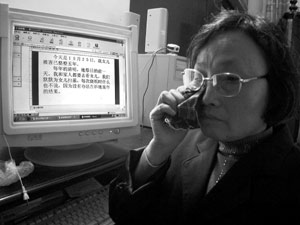
On July 30, 2006, her 61-year-old mother Qian Kezhi opened a Sohu blog
titled Desperate Mother.
She created the blog out of frustration with the police effort and she also
wanted the public to help. Concerning the police investigation, she
wrote: It has been five years and the case is still unsolved. We have
petitioned, wrote letters and visited the public security bureau and city
government offices innumerable times. But the Jingzhou police has not
only failed to provide any explanation, they have also not been nice to the
family of the victim. I have begun this blog in order to find the
truth about the death of my daughter. When I die and see my daughter
in the underworld again, I hope that I will have an explanation for her
about what happened.
As for the public's help to solve the case, this would seem quite
unlikely. The incident appears to be a burglary gone wrong. The
burglar most likely climbed up the drain pipe and entered through the
window. Unexpectedly, Tan Rong came home and the surprised burglar
killed her. The burglar most likely left through the window (and
therefore the door was locked when her brother and daughter came
home). Due to the heavy rainstorm that night, there was not much
evidence outdoors and no eyewitnesses. However, this blog has been
featured in the mainstream media and constitutes a powerful form of public
pressure on the police. The provincial-level public security bureau
will be re-examining the case. Reportedly, the famous Chinese-American
criminologist Henry Lee is getting involved in this case.
Sample Blog Post
(10/26/2006) (in translation) At before 7am on July 25, I and my husband Tan Wenyu went
to the Jingzhou City Political Law Committee office. The door was
opened, and the small reception hall was full of people already. We
registered ourselves and we were number 14. After 9am, the various
department heads began to slowly arrive. By 11am, there were still six
people in front of us. I departed and let my husband continue to
wait. Finally, he was received at noon by a city public security
bureau chief who said: "You don't have to say anything. We know
about your case. I was at the scene. If there are new clues, we
will re-investigate." Tan said: "The case has been unsolved
for so many years. Can you at least give us an
explanation?" The chief said: "What account can I possibly
give you? I can only say: if there are new clues, we will
re-investigate." So that was how Tan returned home at 1pm.
I asked him what happened, and he said angry: "I ran into a ghost
today. Nothing more needs to be said." For the past few
months, we have been in Jingzhou. Nobody gave us any feedback.
We did not get any standard official statement, never mind any progress
reprot. This is our second reception by the public security bureau.
[120] The Meeting Minutes (10/29/2006) (ReporterHome.com) There is a forum post that purports to be the minutes from the weekly meeting of the Shenzhen station of Souther Metropolis Daily. The major issue is the dismissal of reporter Zhou Yu for professional misconduct.
[selected translations]
... What happened? At 8pm on September 21, I received information from another media worker that our reporter Zhou Yu was extorting a clinic which felt that the asking price was too high and therefore they were ready to call the police or the other media. So I asked him to give us an opportunity to investigate ourselves. He told me that I could come along to witness the transaction and I did. I saw what happened and I was very shocked.
... How do I look at this? This is the shame of the Shenzhen station, this is my personal shame, this is the shame of Southern Metropolis Daily? Fortunately, the matter was handled in a timely manner. If the principal did not come to us and went to the police and other media, what would have happened? The two biggest news item of the year would have been the FoxConn case and our scandal ...
What do we do? First of all, this is an individual case. Overall, the station is in good shape. I have made a detailed investigation and I believe that my judgment is accurate. I have told the newspaper committee that this was the act of one individual.
... Zhou Yu explained that Nanfang Daily wanted to run an undercover story and got one of our reporters to do the story. Afterwards, the clinic wanted Zhou Yu to mediate. When the asking price was too high, the complaint came to us. Of course, Zhou Yu said that he was innocent and I am sure that this is a reasonable position from his perspective. But I think that Zhou made two fatal mistakes. First, he was pimping for others. Even though this was not as bad as trading his own article in for money, he was trying to get another reporter to do just that. Secondly, he failed to consider that this was detrimental to the image of Southern Metropolis Daily. So I told Zhou that this affair has not been unfair to him.
... Afterwards, I went down to the advertising sales department and I used a pleading/warning tone to ask them not to drag our reporters into these kinds of things. ... In Zhou's case, someone in the ad sales department was involved. Had Zhou refused, the ad sales person would have tried it. ... it was important that the editorial and business departments be separated. The authority to publish any article should rest solely with the managing editorial committee.
... The people who face the most temptation are not the frontline reporters; it is the managers such as myself. If I wanted to get rich that way, I wouldn't still be here.
[119] Requirements
for Promotions (10/29/2006) (ReporterHome.com)
In China, reporter/editor jobs are classified into four levels: senior
reporter/editor; managing reporter/editor; reporter/editor; assistant
reporter/editor. Job promotions are effected by the individual
applying for promotion while supplying a list of accomplishments in
accordance with the requirements.
According to Southern Weekend, the Anhui Bureau of Human Resources has added
the additional requirements for senior reporters/editors to "publish at
least three positive propmotional articles about Anhui in the major national
media." For print media, the articles must have at least 500
words; in broadcast media, the segment must be at least 20 seconds long.
Apart from the accentuating the positive, there is also punishing the
negative: "If the applicant should commit major mistakes in direction
in the reporting, he/she will be disqualified from applying for promotion
this particular year as well as the next two years."
[118] Obscene Article (10/29/2006) (The Sun) The Hong Kong Obscene Articles Tribunal has declared that an article on pages 26-30 of Issue #859 of Next Weekly has been tentatively classified as 'indecent (

 ,正煩×!"
(in translation: "X! Is there an X mistake. So X
annoying. Very annoying X!"). Can you use "X" nowadays?
If not, you better let me know before I get into trouble ...
,正煩×!"
(in translation: "X! Is there an X mistake. So X
annoying. Very annoying X!"). Can you use "X" nowadays?
If not, you better let me know before I get into trouble ...




[117] Plot Twists (10/29/2006) In The Jiangxi Student Demonstrations
[in translation]
According to information, after the media "exposed" how the school deceived the students, someone deliberately incited a riot and thereby created the excuse to suppress the students. Some students are complained that the school campus had been vandalized and torched by "unknown persons." Meanwhile, more armed police officers have been sent there.
Yesterday, a student said that there more than 2,000 anti-riot and armed police officers are on campus. The entire school has been sealed. The students faced off against the police and have been gassed. Another said that the riots at the school have gone on for several days, but there is no reporting in the local media. The private entrepreneurs must therefore colluding with the local government officials to pressure the media.
According to overseas website reports, the campus riots were deliberately incdited. Some students said that CCTV reported on Monday that the school was deceiving its students. On the same night, someone vandalized the campus, breaking the windows, looting the computers and setting fire to the offices. The more than 10,000 students were terrorized. On Tuesday morning, large numbers of armed policemen entered the campus. But on the evening, there were still peasants and hooligans looting in the school and molesting female students.
Students from ten Jiangxi vocational schools plan to demonstrate on Sunday at the 81 Plaza in Nancheng city.
P.S. Never mind that I have not even touched on this piece from Taipei Times; "The paramilitary People's Armed Police was deployed to contain the protests and at least five people were detained, the report said. It said the protesters were from ethnic minorities, including some 2,000 Uighurs from China's Muslim northwest." Isn't that another mystery? Why are there 2,000 Uighurs at the Jiangxi Clothing Vocational School out of a student body of 18,000?
[116] A
Hukou Registration Update (10/28/2006) (Sanxiang Metropolis Daily
via Wenxue
City) In Jiangnan town, Anhua county, Yiyang city, Hunan
province, 30-year-old Li Guohua went to correct information in his hukou
registration booklet. At the registration office, the workers brought
up the relevant information on the computer system, and changed gender from
"male" to "female." Li was the first sex-change
case in Shenzhen. Afterwards, his 60-something-year-old dad Li Tieniu
was in tears. He said: "I hope that she can find a good partner
who treats her nicely."

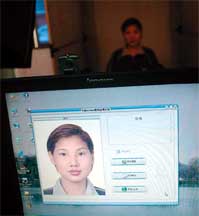

[115] Taiwan By The Numbers (10/28/2006) (China Times) (707 adults interviewed on October 27 by telephone. Sample was based drawn from the Taiwan telephone directory with the last two digits randomized).
General attitude towards United States
Favorable: 45% (this is a historical low compared to 68% when US invaded Iraq in March 2003; 48% in September 2004)
Unfavorable: 25%
Do you think Taiwan should procure those arms from the United States?
Yes: 30%
No: 41%
[generally, pan-blues oppose purchase while pan-greens support it; among those with university education, 57% oppose and 30% support]American officials have demanded the Legislature to pass the arms procurement bill quickly. Do you agree?
Yes: 25%
No: 46%
The strongly worded statements from American officials such as AIT director Stephen Young on arms procurement were ...
Inappropriate: 66%
Appropriate: 12%
Will United States abandon Taiwan (i.e. place Taiwan outside its protective umbrella) if arms procurement failed to pass?
Yes: 22%
No: 68%
Will United States come to Taiwan's aid if Chinese Communists invades?
Yes: 40%
No: 44%Related Link: Fringe v. mainstream views Glenn Greenwald, Unclaimed Territory
[114] Wilful Ignorance (10/28/2006) (Digging through a stupid war Matthew Ways, Montreal Mirror) Inteview with Seymour Hersh.
M: Why does so much of the American public often seem wilfully ignorant? Much of the populace seems intent on not knowing what is going on in terms of political and foreign affairs.
SH: This is the strangest interview I’ve ever had.
M: Why?
SH: Because you’re so fucking opinionated. I don’t disagree with you, but we’re just rolling through your thoughts on things. It is sort of silly. No, it’s not silly, but we’re just rolling from whatever obsession you have to the next. You’re pretty obsessional.
M: Isn’t that a fair question?
SH: The ignorance may not be wilful. The problem with this is, in order to answer your questions, I have to buy into what it is you’re saying. I have no fucking way of knowing whether they’re ignorant. I mean, Americans are pretty fucking ignorant. What we don’t know is pretty huge. You could never accuse Americans of learning from history or learning from past mistakes. You’re talking about a country that went to war in Vietnam with the theory that we had to bomb North Vietnam in order to keep the hordes of Red China from coming, right? Not knowing that Vietnam and China had fought wars for 2,000 years and would fight one four years after the war was over, in ’79. What we don’t know is just breathtaking in my country. To call this ignorance wilful as opposed to general ignorance, I don’t know. On any issue, Americans can display an incredible lack of information. I doubt if there’s a society which has paid less attention to the facts than any else.
[113] A Focus Group on Politics in Hong Kong (10/28/2006) (Miss Lee in Summer)
[in translation]
I went to shoot the breeze in a small discussion group that provided cakes, beverages and even a fee. We discussed the Hong Kong SAR Chief Executive election involving Donald Tsang and Alan Leong. As ordinary citizens who attended this discussion group, it seemed that even though we read the newspapers and we have opinions about the celebrity politicans, we seem to be influenced by the media and our opinions are incomplete and partial. In the end, it seemed as if we had not been reading the news at all.
For example, what about Donald Tsang? Donald Tsang is an ill-tempered and lousy-looking Catholic chief executive who has many years of government administrative experience, knows how to whistle and can handle public relations. Alan Leong is a dandy-looking, principled but extremist barrister who is anti-government, carries a pocket handkerchief and sings English-language songs. These are impressions derived from certain news reports, even if they are not connected to each other.
The moderator asked everybody whom they want elected as Chief Executive. Everybody assumed that the undeclared Donald Tsang would win with certainty. The majority even believed that Alan Leong would not be a better CE than Donald Tsang, because he has not been involved in politics long enough and he has no experience in government administration. With respect to any hopes from the entry of Alan Leong in this "election," the ordinary citizens only mentioned the policy platforms and Donald Tsang's debating points in the sense that Donald Tsang will have to offer new ideas and promises to let the citizens understand his viewpoints. Actually, we didn't have any fresh ideas.
The discussion was actually very partial. This was obviously deeply connected to the purpose of obtaining "your impressions about Tsang/Leong/the next Hong Kong Chief Executive" (I am just guessing, since I don't know what the ultimate purpose of this meeting was. I was just asked to attend by a friend at the last minute).
From the ordinary citizens' idea that the anti-smoking regulations came from the policy report and that the anti-smoking was related to the blue-sky movement, that their descriptions of Tsang/Leong were very "impressionistic," and then the moderator eventually asking about opinions of the styles of Tsang/Leong, I felt that the policies or even details of the events ultimately do not matter to ordinary citizens. When a politician steps up to say something -- as long as it is not shocking -- the content is unimportant. To become famous, you have to make frequent appearances to create the appropriate impression by saying the appropriate things. You will then be able to leave an impression in the citizens' minds.
Why do the ordinary citizens feel that it is important for a candidate to have been in the government and worked as the Chief Executive previously? Why was Alan Leong typed as an extreme oppositionist by the ordinary citizens? How should we usually read the news reports? How to manufacture the image? Where does public opinion spin stop? The attendance fee for this day was worth my while.
[112] Reporter
Assaulted in People's Congress Great Hall (10/27/2006) (Oriental
Daily via Yahoo!
News) At around 3:50pm yesterday, Oriental Daily reporter Weng
Huo went to Beijing People's Congress Great Hall with his photography
equipment to cover the 46th Miss International Contest. Weng joined
several other similarly credentialed reporters to film the Miss
International contestants rehearsing on stage. Suddenly, several men
dressed in black came and ordered the reporters to leave. The men said
that the reporters were too close to the contestants and they began to push
the reporters back with their hands. The experienced Weng back-pedaled
up and told the men in black that he needed to retrieve his camera lens by
the stage. But the men refused and began to curse him. As Weng
tried to plead with them, someone yanked his column from behind and he went
down on the floor as his eyeglasses flew off. The men dragged him into
a corner away from the other reporters and pummeled his head, temples and
face. The beating stopped only after someone yelled: "Stop the
beating. The guests will be arriving soon!" Afterwards,
Weng stumbled out into the streets where his colleagues found him and took
him to the hospital.

If Weng's attackers were security guards at the People's Congress Great
Hall, then the conduct was shocking and deplorable. If they were not
security guards, then where were the real security guards during the
assault? In any case, the fact that a credentialed reporter was
physically assaulted inside the People's Congress Great Hall is chilling!
(The
Sun) In the Dongcheng district court of Beijing, a defendant
was sentenced to a month in detention for "deliberate
assault." Although the victim Weng Huo said that seven or eight
people assaulted him, only one of them has been punished. Weng Huo and
the Oriental Daily group expressed their displeasure with the outcome.
They believed that this was a major incident on a reporter credentialed to
gather news in one of the most important public buildings in China.
[111] Hong Kong By The Numbers (10/27/2006) (Apple Daily) (Chinese University School of Journalism and Communications) (500 adults interviewed in February 2006, with 56% response rate. Respondents were asked to rate various media outets in Hong Kong, with a maximum score of 10). Herea are the average scores.
1. South China Morning Post (7.36)
2. Ming Pao (7.24)
3. Hong Kong Economic Journal (7.09)
4. Hong Kong Economic Times (7.08)
5. The Standard (6.97)
6. Sing Tao (6.84)
7. SIng Pao (6.43)
8. Metro Daily (6.15)
9. Orient Daily (6.12)
10. Hong Kong Daily news (6.09)
11. Headline Daily (5.99)
12. AM730 (5.88)
13. Hong Kong Commercial Daily (5.78)
14. Apple Daily (5.51)
15. The Sun (5.42)
16. Wen Wei Po (5.26)
17. Ta Kung Pao (5.25)Technical Note: Although the newspaper article does not indicate, the base of each rating is not the total adult population of Hong Kong. For example, not every adult knows South China Morning Post (i.e. they don't read English); as another example, a non-Chinese-reading adult doesn't know the Chinese-language newspapers. One option is to allow a "Don't Know/No opinion" response and then compute the average rating solely from those who provided a rating. Another option is to ask a screen question ("Have you read or look into any issue of South China Morning Post in the past 3 months (or 6 months)?") and then getting a rating only from those who answer affirmatively. In any case, the respondent bases of the average ratings will differ across newspapers. South China Morning Post (100,000 circulation) will have a smaller and different base than Oriental Daily (400,000 circulation). But if the base is self-selected (that is, those people who read the newspaper), then the results may be biased.
The best illustration of self-selection bias that I can remember is for mainframe computers. At the time, the market was dominated by IBM with some clones (such as Amdahl). However, an end-user survey showed that the highest satisfaction score was for Xerox, which was no longer even in the business. Why? There were just two Xerox users left. Their needs were very simple, they did not require any state-of-the-art technology and as long as Xerox continued to satisfy their minimalist needs, they could not be happier. By contrast, the people who are using the latest state-of-the-art IBM computers are always wishing for even more functionalities.
[110] Taiwan
By The Numbers (10/27/2006) (China
Times) (more than 700 qualified Taipei City voters were
interviewed by telephone on October 26, 2006; the numbers in the parentheses
represent the change from the previous poll in mid-October)
Support for Taipei City mayoral candidates:
Hau Lung-kin (KMT): 42% (+6%)
Frank Hsieh (DPP): 20% (+2%)
James Soong (IND): 7% (-3%)
Li Ao (IND): 3% (no change)
Clara Chou (TSU): 2% (no change)
[109] Website
Traffic Driver (10/27/2006) ESWN is somewhat different from
most websites in terms of traffic patten. First, there is the idea of
a Brief Comments section. Since this
section is cumulative over a month, bandwidth usage increases towards the
end of the month. If you click on the page today, you will receive
more than 100 comments so far with all the texts and photographs.
Secondly, most of the traffic to this site is driven by search engine
results. In October 2006, Colombian artist Fernando Botero is
exhibiting his Abu Ghraib paintings in New York City and therefore The
Art of Abu Ghraib is suddenly by far the most
popular page on this site. Such occurrences are entirely due to
external circumstances and beyond the blogger's control. This
experience is probably shared by many bloggers who find their most popular
blog posts to be unintended and unexpected.
[108] The New Renmin University (10/27/2006) (Southern Metropolis Daily) The Anonymous Internet is the Citizens' University. By Lian Yue.
[in translation]
It is said that on the Chinese Internet, the ratio of current affairs among all topics is among the world leaders. Every Chinese person is a political commentator. And the degree of volatility of their speeches (and the number of times that every netizen's ancestors have been cursed) is also among the world leaders. The Internet watchdogs conclude that it was the anonymity of the Internet which caused this explosion of evil human nature. Aided by a bunch of VIP's who were abused on the Internet, the real-name registration in every Internet area is gaining ground.
The current proposal for real-name blogger registration is one part of the process. Actually, Internet mob violence is something that the watchdogs ought to consider for another reason. On the mainland Internet many inappropriate websites have already been shut down, leaving only innocence and harmony behind. So why is our Internet still more barbaric than elsewhere? That is because this virtual world is the only place to speak out for many people whose rage have no other venue for release.
The emotions of people need to be released somehow, especially anger. If we see so much rage on the Internet, it means that the rage have been brewing inside the speakers. They throw curses on the Internet and they leave their words behind, and then they become more relaxed in real life. Which system is more efficient? more effective? Many people like to invoke the case of the schizophrenic person. They say that this gentle and well-mannered person in real life becomes foul-mouthed on the Internet. If real-name registration is implemented, then he will be a gentleman all the time. But what about another possibility? The only reason that he could maintain his "civility" in real life was because of his "vulgarity" on the Internet. If this final exit is closed, then he could become a foul-mouthed person all the time. The smart watchdog should be grateful towards the rage on the Internet. People who hit others with 'bricks' from a keyboard will not hit people with bricks in real life.
People often need to learn how to express their opinions. The Internet serves the function of self-determined progress. Although rough language can express one's position, it usually cannot persuade others. When someone becomes aware that this mode of expression is ineffective, he will gradually abandon it and seek more logical methods of persuasion. A child begins by using crying to express his viewpoints. If he wants milk, he cries; if he wants to defecate, he cries; it is hard to communicate with him and you cannot just shut him up by telling him: "You are illiterate. You don't now how to talk. What is the point of crying?" But after crying a lot, he eventually learns to talk clearly to articulate his needs.
... The anonymous nature of the Internet is not only beneficial towards social harmony, it is also a university for civic speech. This is the free lunch offered by the Internet. If we get rid of it, then we are too ignorant. It is so hard to gauge public opinion when speech is slanted, but anonymous Internet speech serves the irreplaceable function of polling that will help people to understand this society better.
[107] Watch Your Mouth! (10/27/2006) (Apple Daily) At around 7pm on March 9, 2006, a man named Wu went to Taichung to collect unpaid money for construction work that he had already performed. He had an argument with the debtor's daughter named Zhu, who tried to chase him away with a stick. So he told her
[106] White
Rabbit Candy (10/26/2006) (Apple
Daily; see also Sidekick)
At the HKGolden forum, a netizen going by the alias White Rabbit Candy
complained that she is financially distressed and therefore had to sell her
body to make some quick money. In the real world, there will be fellow
citizens who would try to understand her and otherwise help her.
But that is the real world and we are in the virtual world.
Immediately, some netizens ran a search on her, found out that she was only
17 years old and published her photographs as well. Surprised and
hurt, White Rabbit Candy wrote: "I have actually never had any
clients. I was only thinking about doing it because of the influence
of friends. But now I am afraid to go into the streets because I may
be recognized. I hope that you will have mercy on me."
[105] Update
on the Pengshui SMS (10/26/2006) In Satiric SMS or libel? Writing political poetry in Chongqing
(Joel Martinsen, Danwei) Pengshui resident Qin Zhongfei was detained after
sending out a satiric SMS about local politics. Here is the update
from Southern Metropolis Daily via Sohu.com.
On October 24, the Pengshui public security bureau rescinded the libel case
against Qin Zhongfei. In so doing, the public security bureau
acknowledged that the libel charge was incorrect and apoloized for any
damages to Qin Zhongfei. On October 25, Qin Zonghei received 2,125 RMB
in state compensation from the procuratorate. The amount was based
upon the fact that he was detained for 29 days and the average national
daily wage was 73.3 RMB.
As noted, if the Pengshui authorities originally thought that the SMS
destablized society and sullied the reputation of its leaders, then the
resultant national media coverage was many orders of magnitude worse.
Since the national attention was not going to disappear (because the Central
Publicity Department has no reason to shut this kind of case down), the only
reasonable decision was to back off.
[104] Taiwan
By The Numbers (10/26/2006) (United
Daily News) (901 Taipei city citizens (with 160 refusals) and
901 Kaohsiung city residents (with 190 refusals) interviewed October 23-25).
Taipei City mayoral election: (the numbers in the parentheses are
changes from the previous poll in Comment 200610#072)
Hau Lung-kin (KMT): 41% (+7%)
Frank Hsieh (DPP): 15% (+1%)
James Soong (no party affiliation listed): 8% (-1%)
Li Ao (no party affiliation listed): 5% (no change)
Clara Chou (TSU): 1% (no change)
Ko Szu-hai: 1% (new entry)
No opinon/undecided: 37% (+1%)
Kaohsiung City mayoral election:
Huang Jun-yin (KMT): 33%
Chen Chu (DPP): 23%
Lo Chih-ming (TSU): 2%
[103] Never
In English-language Media (10/26/2006) The top two
Chinese-language newspapers (Oriental Daily and Apple Daily) in Hong Kong have the same incident on their
front pages:

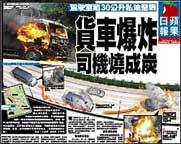
On the Tolo Highway in Taipo, a truck caught fire due to leaking fuel and
the driver was killed.
So what is the news value in a traffic accident? That is because both
newspapers obtained photographs of the driver burned to charcoal (see Photo
1 and Photo 2).
Media lesson #1: A newspaper is an emotional product. Media lesson #2:
Therefore, pathos sells. But the English-language media in Hong Kong
will never show you those kinds of pictures. So what is their lesson?
(1) Emotions don't matter to their readers; (2) their readers can't handle
reality; (3) their readers are different from and must be handled
differently from Chinese-language newspaper readers.
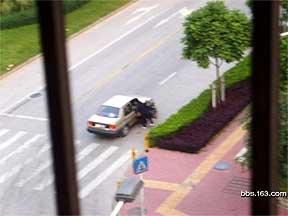
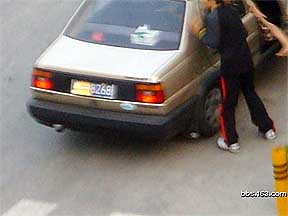
[102] Yet Another Internet Posse (10/25/2006) (163.com) Early morning on October 22, the netizen with alias
[101] Child's Play - Part 2 (10/25/2006) In the matter of the 6-year-old triad girl (see Comment 200610#093), the police has attempted to rectify media reports. (SCMP: Reports of 'kid triads' not true, say police, Celine Sun)
爸 爸 你 快 些 回 來" (in translation: "Daddy, come back soon").Three young girls widely reported to have threatened two teenage boys with "triad language" before calling in 10 other boys to beat up the pair have no known links with any triad society and are in fact witnesses in the case, police said yesterday. Kwai Tsing assistant district commander Leung Chin-wah said media reporting of the assault in a Kwai Shing East Estate shopping mall on Sunday was not accurate, according to investigations.
Some Chinese-language newspapers reported that the three girls, aged eight to 10, calling themselves "kid triads", had asked the two teenagers for cigarettes then called in the others when they refused. But police said the assault was caused by unfriendly eye contact between the two groups of boys. The girls witnessed the melee when they were in the shopping centre. "The three girls are only our witnesses," Mr Leung said. "There has been no any evidence suggesting that they asked for cigarettes, or that they have any connections with the 10 young boys assaulting the victims."
So how did the various Chinese-language media get the story 'wrong'? This was not just one or two newspapers, but they all got it 'wrong.' They only spoke to the two assault victims as well as eyewitnesses. Sorry about that. They should have checked with the police and report whatever the police fed them. You know, it's that thing about social stability and harmony.
Meanwhile, Apple Daily had some background on the three girls. Two of the girls attend a local school where a classmate told reporters that the two girls are used to saying things like: "My dad and mom were triad members. My dad was chopped to death!" A neighbor said: "The mom was married twice, and one husband died in a gang fight. She takes care of seven children, some of whom are children of her ex-husband. She has an office job during the day, and she works as a security guard at nights. Therefore, she is never home to take care of the children."
(Apple Daily) When the reporter went to the girls' home yesterday, the door was padlocked and nobody answered to door knocks. However, the reporter could hear the sound of girls talking inside as well as heavy objects hitting the wall. If there should be a fire inside the apartment, the children will be unable to exit.
In the hallway, a cleaning woman was scrubbing graffiti off the wall.
What was written on the wall? "
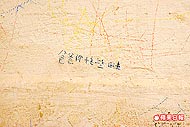
[100] I
Am Not A Podcaster (10/25/2006) I am neither podcaster nor
vblogger, because I feel that I don't speak well and I don't look good, and
that is why I prefer to only write. Another reason is that I am a
theoretical computer scientist and I believe that the amount of information
that can be communicated within a fixed time period is much greater through
reading texts than listening to podcasts or watching videocasts.
But some of that opinion may have changed since listening to SideCast 061025:
[099] The Terrorist Attack at Taiwan Parliament (10/24/2006) (ETTV)
For the debate on the military armament purchase, independent legislator Li
Ao was given 6 minutes of speaking time. He began by taking out a gas
mask (based upon the movie V for Vendetta). When the legislators laughed, he said: "Do not laugh.
What do you think this is? This is a gas mask. I will be taking
something out. What is this? Tear gas. I have nothing
against you personally. Today, will the ladies please leave first? My method is to use scorched earth tactics. I am an old
man. I'm going to risk my life here!" Because someone asked
him not to play with his life, he said: "Do not come near me. I
repeat. Do not come near me. Because if you come near me, I have
this other thing (note: an electric stun baton)."
People obviously did not take him seriously as there was laughter and the
atmosphere was light-hearted. So Li Ao sprayed the tear gas a couple of
time. Then he said: "I have demonstrated its power. I can
see that you are not able to withstand it. If you can't withstand it,
you should all get out of here." As the legislators began to feel the
effect and start to leave, he sprayed six more times. All the
legislators had tears in their eyes, except for Li Ao who wore a
gas mask. Li Ao then exited quickly. Afterwards, the KMT
legislator Joanna Lei motioned to have Li Ao referred to the disciplinary
committee for sanctions. Li Ao said that Joanna Lei is ugly and,
besides, her dad went to jail on account of a prior corruption case related
to military armament purchase.
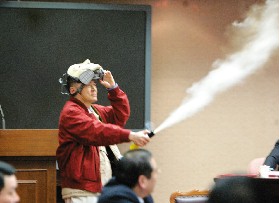
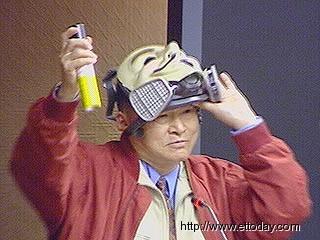
Is there anyone left whom Li Ao has not offended?
YouTube video: Part
1, Part 2,
Part 3
[098] Taiwan
By The Numbers (10/24/2006) (Central
News Agency) (poll results from the Democratic Progressive
Party central; no sample size or methodology published)
Support levels for Taipei City mayoral election:
Hau Lung-kin (KMT): 35%
Frank Hsieh (DPP): 23%
James Soong (no party affiliation listed): 10%
Li Ao (no party affiliation listed): 7%
Clara Chou (TSU): 1.5%
Support levels for Kaohsiung City mayoral election:
Huang Jun-yin (KMT) went down by 4% and Chen Chu (DPP) went up by 5%
(note: no absolute percentages were given).
[097] Blame The Media (10/24/2006) For coverage of the Tour Guides General Union rally, see Tour guides turn up heat (Albert Wong and Wendy Leung, The Standard, October 24, 2006). This makes for interesting reading about the barbs betweem the Tour Guides General Union and the Travel Industry Council about who or what is to be blamed in the debacle reported in Comment 200610#085. In The Standard article, there is one sentence: "Others complained of the negative media reports, saying the press should try and help the industry." This is elaborated in Ming Pao (which was the newspaper that broke the story about the Qinhai tour group).
[in translation]
At the rally, the tour guides criticzed the "zero charge" tours but they also pointed to the Hong Kong media for exposing the tour guides. One tour guide said: "I hope the reporters would have mercy and not pick at the scabs of the travel industry."
Yesterday, the Hong Kong Journalists Association chairperson Serenade Woo said that tour guides forcing tourists to purchase merchandise involves overriding public interest. As such, the media should investigate and expose these improper acts. She said: "While the tour guide involved in the incident is understandably unhappy, the blame cannot be shifted onto the media."
... At the rally, a tour guide named Yeung blamed the recent problems on the media. She picked up the microphone and told the 500 or so attendees: "The Hong Kong Tourism Board spends tens of millions a year to promote Hong Kong, but the media ruined everything with one or two negative reports. The central government is asking for harmony. So why do the media want to smear Hong Kong's name? The media exaggerated thing by saying that we are profiteering. I say -- a bottle of water goes for 16 dollars in Ocean Park but Park n Shop sells three bottles for 10 dollars. Did you call Ocean Park for profiteering?" After a round of applause, Yeung said that this incident had been blown up by the media. "The commission system for tour guides is not unique to Hong Kong. Hong Kong is the shoppers' paradise. To shop here and make money off it is the natural law of Heaven and Earth."

[096] More
Chinese Media Bans (10/24/2006) (Beijing
News) According to an emergency notice from the General
Administration of Press and PUblication and the State General Administration
for Industry and Commerce, all newspapers and publications must not carry
the following 12 types of advertisement effective November 1, 2006.
This notice indicated that some newspapers have been publishing fake, vulgar
or illegal advertisements which negatively affect public trust in the news
media.
Here is the list of 12 types of subjects that will not longer be advertised:
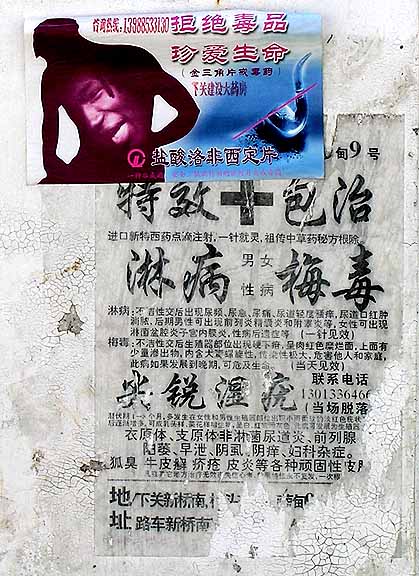 神豬俠侶.
In this 48-second clip, a young couple is in a shopping mall walking a small
pig. Occasionally the pig squeals. When people tried to take
photographs, the security people tried to stop them. This is strange,
but not that strange. So far, the video clip has been seen more than
80,000 times.
神豬俠侶.
In this 48-second clip, a young couple is in a shopping mall walking a small
pig. Occasionally the pig squeals. When people tried to take
photographs, the security people tried to stop them. This is strange,
but not that strange. So far, the video clip has been seen more than
80,000 times.[094] The History of Blogging (10/24/2006) In the history of blogging in mainland China, there is a characterization of three generations so far:
Generation #1: The first people who knew how to blog and maximize the technical capabilities were people involved in Information Technology (IT). Thus, the first generation of bloggers were those who tried to preach the technology of blogging.
Generation #2: Once the gospel of blogging technology becomes simplified and widespread, the next issue is content. What good is a technology if there is no content? So the second generation of mainland Chinese bloggers turned out to be media workers. Why? Because these are the people who knew their topics (both the backgrounds as well as the latest developments) and the writing techniques. For the same story, they can say and argue it better than most others.
Generation #3: Once blogging achieved a certain momentum threshold, the major portals (such as Sina.com and Sohu.com) decided that they can be blog service providers too and invited a number of celebrities to become their bloggers. This initiated the age of celebrity bloggers, and Xu Jinglei and others would top the Technorait popularity list for the entire planet.What is Generation #4 in China? I wouldn't know (or else I would be a prophet). Instead, I am interested here in the construction of a history of blogging in Hong Kong based upon the experience in mainland China.
Who is in Generation #1 in Hong Kong? According to mainstream media, it seems that the first generation of Hong Kong bloggers were mostly the Xanga-like teenage online diarists. Compared to China, the IT people were not major players in Hong Kong.
Who is in Generation #2 in Hong Kong? Out of the the Xanga-like cacophony, there emerged a small group of clear influential voices (to me personally) which are difficult to classifly -- they are definitely not from the IT sector, they do not appear to be media workers and they are definitely not celebrities. Will this illuminate on Generation #4 in China?
Imagine my surprise (well, this is actually a confirmation of my suspicions all along) when I was invited to attend an informal self-organized dinner with some of my respected Hong Kong bloggers! Whereas they cannot disclose their identities on their blogs, they could do so freely in a social context (with the implicit understanding that their identities shall not be disclosed by the attendees). Guess what? They all work in media/PR-related industrial sectors. From the ensuing gossip exchange, many more absentn well-known bloggers work at media organizations. It was like: What about blogger X? Oh, she works at newspaper Y, and so on. After a while, I lost track of who's who.
What gives? This is about media corporate codes of conduct. In Hong Kong, many media workers have been told in clear and certain terms that maintaining a personal blog about their job situations would be cause for immediate dismissal. I have posed the blogging question directly to media workers ("Why don't you have a blog?") in front of their bosses ("Why won't you let your reporters keep blogs?), and they replied that legal liability was a major concern -- if the published newspaper report was at variance with the blog post, that would constitute evidence of biased/unbalanced reporting in a court of law. So it is that the Hong Kong media workers go through a great deal of contortions to conceal their identities on their personal blogs. And that was why I could not figure who did what until I met them personally in private. To me (and to them), this does not matter as long as they continue to blog . So, keep blogging!
Going back to the issue of mainland China, I hope that you understand why I spend so much time translating the blog posts such as Fu Jianfeng's An Investigative Reporter's Year-End Review and many others. The openness of their boldness is what moves me to write about them. A media worker does not have to self-immolate to prove his/her worth as a martyr. I am saying that the Internet has the capability of delivering a message to the public without official retaliation against oneself (note: please take all the appropriate cautionary measures, in terms of technology as well as the contents!). In either mainland China or Hong Kong, media workers do not have an easy time, but the space is still open. In each case, the media workers' blogs are influential (minimally, they influence me!)!
[093] Child's
Play (10/23/2006) On the front page of Apple
Daily (Hong Kong): "6-year-old girl uses gangster
language to query Form Five (fifth year middle school) students."
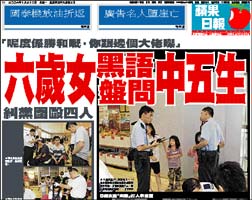
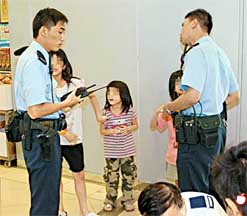
Ming Pao
had a diffrent headline: "Eight-year-old child uses gangster talk to
threaten Form Five student." So is the child six or eight years
old?
At a Kwai Shing East Estate shopping mall, two male and two female Form Five
students were sitting on a park bench and discussing about a show that they
were going to put on in school. At the time, there were some small
children playing.
(Apple Daily's version of the incident) Three girls approached the
four: one of them was six years old, under four feet in height; the other
two 8 and 10 years old, under five feet in height. One of the girls
(age unspecified) used a child's voice to articulate violent language:
"Do you know that this area is owned by the Wo Shing Wo triad!
Who is your gang boss?" The four Form 5 students were
stunned. Another girl added: "I asked whether you have a gang
boss!" The four decided that that they were going to just ignored
these little children. At that time, more children joined the
crowd. Another girl said: "You are so arrogant. Should I
call for my friends to beat you up. You must stay up!" Then
the three girls signalled to about ten or so 14 to 15 year old boys to
attack the four. The two male students were thrown to the ground, and
then kicked and punched. The two female students were also thrown to
the ground. When the police came, the attackers were gone but the
three little girls were there. The 6-year-old showed no emotion; the
8-year-old was in tears; the 10-year-old was laughing.
(Ming Pao's version of the incident) While the four were talking, some
young people asked them for cigarettes but they said that they didn't have
any. They were then asked: "You're arrogant. Which gang are
you with? Do you have a gang boss"? The two male students
did not know how to answer. Then three girls age 8 or 9 approached
them and said: "Hey, they're asking you if you have a gang boss!
What aren't you answering? You want a beating? Do you want me to
call people to beat you up!" At that point, a swarm of boys went
in to assault the four students.
Related Link:
[092] Yellow
River Turns Red (10/23/2006) (Lanzhou Morning News via Wenxue
City) At around 3 pm on October 22, red water began to be
discharged from the drainage pipes into the Yeloow River near the Nanbinhe
Sports Park in Lanzhou. When the reporter got to the scene at 4pm, he
observed the red water discharge and smelled a foul odor.
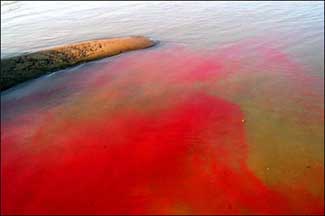
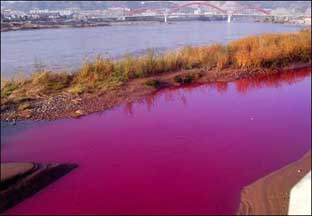
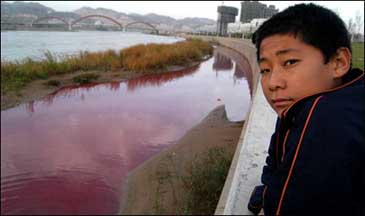
Citizens speculated that the red water came from the heating systems
operated by circulating heated water through the system of pipes. The
water is intended to be used for heating purposes only. In order to
prevent water theft for drinking purposes, a red dye was added to the
heating water. So the discharge was probably due to someone testing
the heating system before winter arrives.
[091] Taiwan
By The Numbers (10/23/2006) (China
Times) (1,092 Taipei city respondents and 1,036 Kaohsiung
respondents interviewed October 18-20; sample was drawn using the telephone
directory as the frame).
Q: If the Taipei mayoral election were held today, whom would you vote
for? (for Taipei residents only)
Hau Lung-kin (KMT): 53.1%
Frank Hsieh (DPP): 23.3%
James Soong (PFP, but registered in the election without party affiliation):
12.9%
Q: If the Kaohsiung mayoral election were held today, whom would you vote
for? (for Kaohsiung residents only)
Huang Jun-yin (KMT): 54.5%
Chen Chu (DPP): 38.5%
Q: What is the likely outcome of the two mayoral elections? (Taipei
residents only)
Option 1: KMT wins in Taipei and DPP in Kaohsiung: 66.4%
Option 2: DPP wins in Taiepei and KMT in Kaohsiung: 19%
Option 3: DPP wins in both Taipei and Kaohsiung: 0.8%
Option 4: KMT wins in both Taipei and Kaohsiung: 2.0%
[090] A
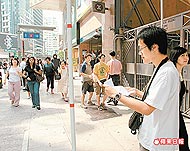
Hong Kong Flash Mob (10/23/2006) (Apple
Daily) There is a virtual Internet organization in Hong Kong
known as the Anti-Kong-Typed-Women Association. It was formed by a
bunch of Hong Kong guys bitching about Hong Kong women. This is not a
generic against all Hong Kong female residents. Rather it is about
"certain typical Hong Kong women with serious psychological flaws"
including: forcing their boyfriends to buy LV products, treating their
boyfriends like dogs, insisiting that women are always right and men are
always wrong, etc. "At least Hong Kong women have Kong-Typed
characteristics!"

The flash mob incident was planned by the convenor named
[089] Do Not Star In Movies (10/22/2006) (Boxun) You can mark this one down as being "highly suspicious" (and also "highly tiltillating").
[translated in summary]
In the matter of the Shanghai corruption scandal, the Central Disciplinary Committee interrogated tycoon Zhang Rongkun. In order to save himself, Zhang provided the list of Shanghai officials with whom he had dealings. Furthermore, he provided the investigators with a set of videotapes about those officials starring in 'blue' (in English, but 'yellow' in Chinese) movies.
When Zhang Rongkun first arrived in Shanghai, he was a nobody. But through charity work, he met many family members of senior officials and then he built relationships with former Shanghai Baoshan district leader Qin Yu and former Shanghai Social Security Bureau chief Zhu Junyi. When Qin and Zhu were interrogated by the Central Disciplinary Committee about their involvement in the case,, they intended to refuse to cooperate. But then they had to confess after the investigators showed them those 'blue' (or 'yellow') movies.
[088] My
Review of the Far East Economic Review (October 2006 issue)
(10/22/2006) I received a complimentary copy of the Far East Economic
Review today. I was a FEER subscriber in the 1990's when I lived in
New York City, but the far east was just too far away for me to sustain my
interest and I eventually let the subscription lapse. So this is the
first time since moving back to Hong Kong that I am looking at the new and
improved monthly edition of FEER. It was excellent. I think I
will get a new subscription.
First of all, you can read editor Hugo Restall on the Singapore ban on his
publication (see From
The Editor). Another good essay is Singapore’s Founding Myths vs. Freedom
by Garry Rodan. Please allow me to quote a couple of blog-related
paragraphs and then you can read the whole thing yourself:
One of the contemporary challenges for the PAP in the control of political expression has been the Internet. The essence of the government’s response has been to superimpose the spirit of the Societies Act on cyberspace. This includes the requirement for registration with the Singapore Broadcasting Authority of political Web sites and the barring of nonparty political associations from political promotion, advertising or campaigning during elections. As Senior Minister of State Balaji Sadasivan explained: “In a free-for-all Internet environment, where there are no rules, political debate could easily degenerate into an unhealthy, unreliable and dangerous discourse, flush with rumors and distortions to mislead and confuse the public.”
These controls have proved remarkably effective. However, during the May election, individuals defied the government edict barring political blogging and podcasting. There were around 50 Web sites and blogs producing political or semipolitical content during the election, according to the Institute of Policy Studies in Singapore. Among other things, this provided venues for critical analysis and views to be aired by individuals and it enabled videos of sizeable opposition rallies, blanketed in the state-controlled media, to be made available. This is an important development, since it challenges the PAP preference for all forms of political expression to be channeled through state-controlled institutions and the idea that the alternative is dangerous. A more serious challenge, though, would involve the technology’s facilitation of collective political action or mobilization. The PAP’s priority will be to prevent this.More important for my China-themed readers is the essay China's Online Mobs by Anne Stephenson-Yang. This is available only to FEER subscribers. But I will give you a couple of paragraphs just to get you interested. Here is the sections on Internet posses:
In the absence of a segmented Internet offering authoritative content to specialized user groups, China has developed an online mob dynamic in which a blog can fuel a sudden social fire, which then becomes subject to the autocatalytic effect of mass copying by sites who want to participate in the traffic surge. The irony is that the perculiarly Chinese "Internet posse" -- people who try to identify, pursue and seek justice against those of whose postings they disapprove -- would seem to be a byproduct of the government's effort to control precisely the distributed aspect of Internet communications that is viewed as so threatening to the Communist Party's rule.
... Chinese netizens act essentially like bees, swarming to whichever bulletin board system (BBS) or chat room has the most people and the most intriguing conversation. BBS traffic is fickle and is happy to follow scandal to the next site, as long as others are there as well ... hot chat rooms could easily jump off the screen to become real-life conflagrations.
And here is the paragraph on trust:
There is no published information on how many government-sponsored agents post information on China's Internet, but the government publicly promotes a program of chat room propaganda in localities nationwide and estimates several tens of thousands of agents taking part. Certainly, the average Chinese citizen thinks that political dissent will be noted promptly by ubiquitous authorities and many people fear government entrapment online in conversations about democracy, Japan, religion and other sensitive topics.
This regulation creates an environment in which everyone is role-playing. Companies pretend to be your friendly online advisor. Media operators pretend to be objective presenters of the news. True reformists or dissidents might use discussion of a film as a surrogate for political debate. Government agents pretend to be dissidents. Journalists pretend they are independent. In the end, everyone suspects everyone, and even sincere motives are questioned. Try this next time you are in China: ask a Chinese acquaintence whether he or she believes the weather report. Many Chinese believe that the government lies about temperatures that are too high or too low, because some state-owned companies are supposed to pay subsidies to workers on very hot days.
Oh, yes! I've tried asking that exact question this past summer. My informants (of mainland Chinese working-class backgrounds) all assure me that the temperature figures are 'cooked.' For example, they assure me that since state-owned company workers are allowed to go home once the temperature gets past 40 degrees centrigrade, the weather bureau will only report figures like 39.5 degrees centrigrade no matter what your own thermometer says. This is for the sake of the gross domestic product, of course. But this summer, I got the opportunity to counterpose: "But they reported that the temperature reached 45 degrees centigrade in Chongqin this summer!" The counterpoint was, "Well, it must have shot past 50 degrees centrigrade and they could not hide it!"
[087] Taiwan
By The Numbers (10/22/2006) (TVBS)
This is a tracking poll with results to the survey questions at various
points in time. The key underneath each graph gives the moments at
which the poll was conducted.
Attitude towards Taiwan independence since Chen Shui-bian became president (dark
purple: maintain status quo; bright
purple: lean towards independence; bright
red: lean towards unification)
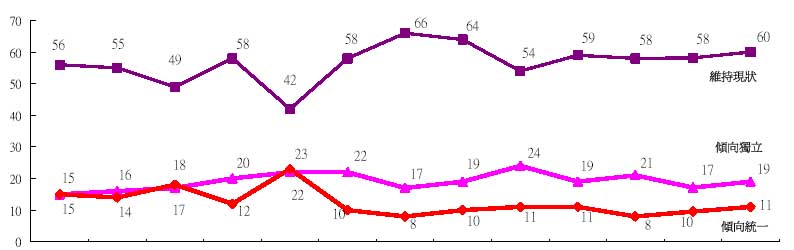
Time period key (from left to right):
(1) 03/13/2000: Zhu Rongji's speech
(2) 05/20/2000: President Chen's inaugural speech
(3) 04/30/2001: President Chen's first anniversary speech
(4) 03/31/2002: One Shore, One Nation thesis
(5) 03/31/2003: Third anniversary of ruling party change
(6) 06/30/2003: President proposes referendum
(7) 12/05/2003: Referendum law
(8) 05/07/2004: One week before referendum
(9) 09/07/2004: President Chen visits Central America
(10) 12/22/2004: Richard Armitage speech on Taiwan
(11) 03/13/2005: China's anti-separation law
(12) 04/28/2005: Lien Chan visits mainland China
(13) 10/18/2006: After the second presidential recall vote
Ethnic/national identity preferences (yellow:
Taiwanese are Chinese too; dark blue:
Taiwanese; bright purple: Chinese)
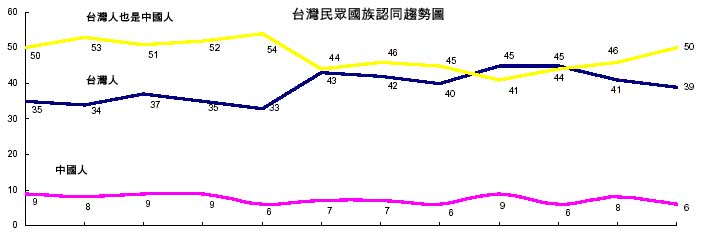
Time period key (from left to right):
(1) 07/12/1999: Two Nation thesis
(2) 03/06/2000: Before the presidential election
(3) 04/28/2000: Before inauguration of President Chen
(4) 08/09/2002: One Shore, One Nation thesis
(5) 04/14/2003: One year before next presidential election
(6) 03/01/2004: After the 2/28-related activities
(7) 08/11/2004: Emergency Legislature meeting
(8) 09/01/2004: Winning Olympic gold
(9) 09/07/2004: President visits Central America
(10) 03/28/2004: After the 3/26 march
(11) 05/05/2005: James Soong visits mainland China
(12) 10/18/2006: After the second presidential recall vote
[086] Taiwan
By The Numbers (10/22/2006) (TVBS)
(888 persons age 20 or over interviewed on October 17 in Taiwan; sample was
drawn from telephone directory with last four digits randomized).
There are two numbers for each major political figure: one is the
satisfaction rate as of October 17 (after the "siege" of the
Presidential Office) and the other is the change in satisfaction from the
previous poll on September 20, 2006.
Wang Jin-ping: 56% (+2%)
Ma Ying-jeou: 52% (-6%)
Lien Chan: 45% (-4%)
Shih Ming-teh: 42% (-16%)
Frank Hsieh: 33% (-5%)
Su Tseng-chang: 32% (-1%)
James Soong: 31% (-10%)
Li Teng-hui: 27% (-7%)
Annette Lu: 26% (+1%)
Yu Shyi-kun: 23% (+1%)
Chen Shui-bian: 16% (+3%)
[085] Civilian
Photojournalists Everywhere (10/21/2006) The most memorable
scene to me from Hong Kong Disneyland was in this video (at InMediaHK):
The Disneyland staff tried to take action against some demonstrators, but the counterattack did not come in the form of raging protestors
charging back with Molotov cocktails and baseball bats; instead, it was a bunch of people armed with digital cameras and video recorders, and they couldn't wait to post their works on the Internet.
The following story appeared on the front page of The
Sun:
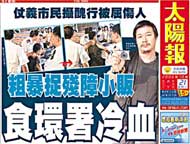
The headline screamed: "Cold-blooded Environment & Food Bureau
violently arrests physically handicapped hawkers." The tip for
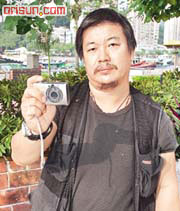
this story and the accompanying photographs came from a civilian
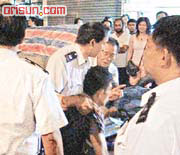
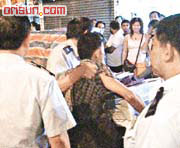
photojournalist named Lau. In the Shumshuiipo district, a dozen
Environment & Food Bureau workers were sweeping the street
hawkers. One worker pounced on a hawker and screamed: "I am going
to arrest you. Show me your ID!" The man did not
comply. So three workers then grabbed him by the neck and shirt collar
and twisted his arms behind him. The man was in tears. What is
the problem here? The man is a deaf-mute who did not understand the
command! Then the workers turned their attention to the next hawker,
who happened to have a diminished mental capacity. Oy!
A pedestrian named Lau took out his camera and began to take
photographs. Immediately, another worker stood in front of him and
started taking photographs of him. In 1999, there was a famous case
concerning an egg-vendor who was improperly arrested. From then on,
the Environment & Food Bureau workers will videotape their arrests for
evidence. But that does not mean standing in front of civilian
photographers and blocking their views. So Lau brushed the worker
aside. When touched, the worker flopped to the ground, claimed to be
injured and asked his co-workers to summon the police. Lau was
arrested for battery. Three eyewitnesses went with the police and
stated that Lau did not assault the other party.
[084] The Pengshui SMS Case (10/21/2006) (Southern Metropolis Daily) For the details of the case, see Satiric SMS or libel? Writing political poetry in Chongqing ( Joel Martinsen, Danwei). This is a classical case of watchdog journalism. The original case was a SMS that was distributed among several dozen people and therefore the impact was miniscule. But the national media picked up the story, and now Pengshui is famous for despotic backwardness and everybody knows the details about the unfinished construction projects (Baiyun Middle School, Hukou Hotel and Rainbow Bridge) and the police excavating a dead man's body because it was not buried by an officially designated funeral home. (Southern Metropolis Daily) Here is what a commentator has to say:
[in translation]
Yesterday both Southern Weekend and Southern Metropolis Daily reported on a the poem case in Pengshui (Chongqing). Because of a sarcastic SMS, citizen Qin Zhongfei is facing trouble. Several dozens of others were interrogated by the public security bureau because they had received the SMS. Regardless of what the motives were, the Pengshui public security bureau has terrorized some meek people into shutting up about politics. But the silence does not seem to satisfy them, because they also found photographs of national leaders in the chat session records of Qin Zhongfei -- in their eyes, this is an even bigger crime.
This case angers and shocks people, but then it is actually commonplace.
Firstly, this is commonplace because when people talk about poltiics, they habitually and sub-consciously use metaphors and allusions. The readers have the corresponding habit to be hyperalert about the unwritten messages behind the words. This phenomenon did not emerge because of any self-absorption with flower linguistic constructions, nor the secret delight in solving a puzzle. This phenomnon was created by the tradition of restricting speech by the rulers of China, and therefore people learn that bad things occur as a result of what ones says.
Qin Zhongfei used a obliquely worded SMS to satirize current affairs, instead of making an open criticism in the civic spirit. This is depressing enough. Behind this twisted thinking is an instinctive fear: When interrogated by the police, his immediate reaction was to deny everything because he seemed to think that writing poetry was a crime. The issue is: As a citizen protected under the constitution, what he was afraid of? He did not scare himself; he was scared of something that really exists.
Secondly, this is commonplace because at the grassroots level, especially within the society of acquaintences in counties and towns, there is a force that creates fear. In the case of the Pengshui poem, we read the media reports and we clearly see that the public security bureau and the procuratorate were serving the leaders. The machinery of violence and the local government are joined as one like the local "rulers" in ancient times -- they are not there to uphold the law, they are not serving the people and they only want to consolidate their control of society. These local powers are enough to make people afraid, and make people like Qin Zhongfei become the "royal subjects" of the past.
Looking next at how the public security bureau handled the case, they obviously wanted to use an suppressive method to obtain a superficial tranquillity: "This poem nearly negated all of the accomplishments in Pengshui," "if a SMS such as this one is disseminated broadly in society, it will impact the Pengshui economy a lot" and "it will definitely affect social stability and political stability." With these righteous sounding accusations, the local officials may not realize that while they seem to have borrowed the latest political terminlogy, they were actually still relying on the tradition of suppressing speech in the despotic systems. In either the speeches of these leaders or the actions of the local public security bureau and procuratorate, we cannot see any evidence to show that their thinking is aligned with the new Chinese civic concepts.
From the political storm in a small county, one can observe the classical double suppression: on one hand, the citizens use indirect means of expression to suppress themselves; on the other hand, the local authorities use the marchinery of violence to suppress speech. The former type of suppression is the result of the latter type, and therefore those suppress speech are fully responsible. As long as the relationship between the suppressors and suppressed continue to have a stable existence, absurd cases such as this one will naturally occur. Interpreting this case in the legal spirit, the people in charge of the Pengshui case must answer these simple questions: What are the bad consequences of a SMS that was sent among several dozen people? What right does the public security bureau have to monitor and control the SMS from ordinary citizens, and how can they read the chat records of an innocent person without cause? Does Qin Zhongfei have any civil rights? Do the citizens of Pengshui have any legal rights? Is Pengshu ignoring the overall situation in China and stuck in the despotic past?
Related Link: As Grip of Censors Endures in China, A Satirical Poem Leads to Jail Time Edward Cody, Washington Post
[083] Real Name Registration of Chinese Blogs (10/21/2006) (Ta Kung Pao) The Ministry of Information Industry asked the Policies and Resources Committee of the Internet Society of China (
Those who support the real name registration system said that Internet anonymity allowed a small number of netizens to spread malicious speeches, violate others' rights and libel others. The expression of viewpoints should be based upon responsibility, and a real name registration system will allow accountability on people who make malicious speeches.
Apart from the abstract ideas about free speech on the Internet, the industry experts who oppose the real name registration system believe that there are three practical issues that may abort the registration system:
1. A good technical identification system will be required. Most rights violators will show up anonymously with no other information besides the temporary IP address.
2. There is the legal issue of protection of personal information. There are presently no mainland laws with respect to the protection of privacy and personal information. In the absence of such laws, there is no guarantee that the private information collected for the blogger real name registration will not be misused.
3. The practical effectiveness of the implementation is in doubt. Based upon the experience with the real name registration with Internet cafes and mobile telephone, the blog service providers will not seriously implement the work of registration because this will be against their commercial interests. If registration is to be based upon the national identification system, then the blog service providers must access that database which charges 5 RMB per query. This means that full implementation will be costly. Besides, there is no effective method to deal with false information (such as someone registering under someone else's name and identification number).
More generally, a China Youth Daily commentator said that the correct approach to the problem is through the private and not the public sector. Instead of setting up more laws for the government to intervene in such matters (which treat private disputes as national crimes), it is better to have civil laws and processes that allow citizens to seek legal remedy on their own in order to defend their rights.
Related Link: Anonymity Ending in China Blogs? Kaiser Kuo, Red Herring
[082] The Anti-Competitiveness of Hong Kong Supermarkets (10/21/2006) (Apple Daily) By By
裕 記) built a business from the back of an old truck and now has more than 60 store locations with plans for a stock offering. CitySuper is doing great too. If Park n Shop and Wellcome really have monopolistic power, Yu Kee and CitySuper could not be suceeding!Over the past two weekends, there were two television programs about monopolies. At a time when the government is about to consult the public about the "fair competition law," it is suspicious that the television stations should be leading the cheering now.
The television programs mentioned the frequently cited case of supermarkets. This example is easy to understand because citizens visit supermarkets very often and therefore the example gets their interest. No wonder that when the legislators talk of monopoly, they use Park n Shop and Wellcome as example. But let us make it clear that when we discuss monopoly, the focus should be the interests of the consumers, just as the government document stated clearly. The question is whether the interests of the supermarket customers have been damaged by Park n Shop and Wellcome?
There is no doubt that these two supermarkets are the leaders in the industry. They also want to increase their business and nobody will believe that they have no expansion plans. But is it possible for them to completely prevent new competitiors? Yu Kee (
What about the consumers? The supermarkets are forced to improve their services in order to attract the customers. Their stores must be bright, clean and spacious and they must stock a large variety of goods. The customers are smart and they shop daily, so they are impossible to fool. To increase sales, prices cuts are used. When the prices go down, the consumers benefit. Yet some legislators complain about the excessively cut-throat prices. Isn't that strange? This is underestimating the wisdom of the consumers.
The more customers a supermarket has, the more merchandise it has to order, the greater its ability to negotiate with suppliers and the lower the prices it has to pay. To compete in the market, the supermarket shares the price savings from the suppliers with its consumers. It can be said that the role of the supermarkes is to aggregate the power of the consumers in order to negotiate with the supplier. While customers are glad to see the supermarkets negotiating prices with the suppliers, the people who don't want to see the supermarkets get bigger must be those suppliers. Where anti-monopolistic laws exist, who do you think complains against the supermarkets -- the customers or the suppliers?
[081] I Hate Democracy (10/20/2006) Let me begin with the public opinion polls on Taipei mayoral candidates (see Comment 200610#072). Regardless of their support levels, here are my personal impressions of the candidates. Please note that these are my personal impressions expressed under freedom of speech as guaranteed in Hong Kong SAR/USA and therefore this does not constitute libel (because I am not making up anything -- these are just my own opinions):
James Soong (PFP): Why isn't he in jail for life for grand-scale corruption given the expansive evidence?
Hau Lung-kin (KMT): Smaller-scale corruption compared to his dad, who is smaller-scale compared to James Soong.
Frank Hsieh (DPP): A thorough political hack in his current position as DPP chairman and a proven failure in his prior position as Premier. Also implicated in corruption scandals.
Li Ao (IND): A big mouth without any substance and an unmitigated disaster as administrator if ever elected as mayor
Clara Chou (TSU): Who?But I am not a resident of Taipei and I have no right to vote. So why should you care about my whining about the lack of choice? I am just a naive outsider who wonders why the citizens of Taipei City cannot just have the best administrator possible without worrying about his/her political party color (blue/green/red/orange/whatever).
The personal reality is that I live in Hong Kong, where there will be an election for a Chief Executive in 2007. Here are my personal impressions of the known candidates expressed under freedom of speech as guaranteed in Hong Kong SAR/USA and therefore this does not constitute libel (because I am not making up anything -- these are just my opinoins):
Sir Donald Tsang: How can I possibly vote for an insurance salesman (because that is what he is to me)? The point is that he treats his customers with contempt as passive objects of his grand messages.
Alan Leong: In what way is he qualified to be Chief Executive of Hong Kong SAR? In my opinon, he is unqualified and would be an unmitigated disaster in that posiition since he knows zilch about government adminstratiion. He is there only because of the credential: "I am NOT DONALD TSANG."
Bus Uncle: This is the clown show. No further comment necessary ...In all of the preceding, I am either ineligible or the election is a long time away. But here is a very immediate event. I am looking at the absentee ballot from the New York City Board of Elections which I have to return immediately. I am going to vote for my representatives in the US Senate and Congress.
For the US Senate, here are my personal impressions expressed under freedom of speech as guaranteed in Hong Kong SAR/USA:
Hillary Rodham Clinton (DEM): This is Ms. Triangulator herself. I have no idea what she stands for, except whatever positions that maximize the number of votes. If Iraq is the biggest issue of the moment, then I have no idea what her position is. She will say what pleases the audience of the moment accprding to the focus group results. If the preferences are uncertain, she will waffle in her choice of language.
John Spencer (REP): Here is a real clown who completely destroyed himself. (Wikipedia): On August 18th, 2005, Spencer gave a radio interview where he attacked District Attorney Jeanine Pirro, another candidate for the Republican nomination, calling her chances of winning the Conservative Party nomination "a Chinaman's chance." Spencer was asked to apologize for the comment after an outcry from the Asian community that the statement was derogatory.For the US Congress, here are my personal impressions expressed under freedom of speech as guaranteed in Hong Kong SAR/USA:
Carolyn B. Maloney (DEM): The only thing that I know about her is that an insane gunman named Colin Ferguson went on a shooting rampage on the Long Island Railroad, killing her husband and others. But she does not have any negatives that I know about.
Danniel Maio (REP): Who? How am I supposed to vote for this person with zero information?In any case, the New York races are pointless because the Democratic Party candidates are overwhelming favorites. My only issue is: Should I save the postage stamps? The conventional wisdom is that I must vote to register my personal voice. Eh ... I am uncertain because I do not enjoy the idea that my vote will be taken as an endorsement of the practice of Hillary Rodham Clinton.
In summary, I hate democracy because I am not happy with my limited choices. I resent being forced to choose among crooks, liars, sycophants and fools. In addition, the super-message is that democratic elections are won by those who are good at winning elections (instead of being the best at the contested positions), and this is tautoligically true.
P.S. Then again, I also resent being given no choice (as in: NO-ELECTIONS in YOU-KNOW-WHERE). What gives?
[080] The Attitude Towards Learning (10/20/2006) (Steven N.S. Cheung, Next Weekly)
应对GFW Flypig's Weblog)[in translation]
When my column gets posted on the Internet, the comment ratio is about 3 out of 1000 (or 0.3%). Half of those comments (0.15%) are abusive invectives. Frankly, I have now developed steel body armor and so it does not bother me. However, I am worried about the young people who abuse me, because if they have the wrong attitude towards learning and unless they change, they cannot -- and they will never -- accomplish anything knowledge-wise. I have no evidence that they are stupid, I am not saying that they are undedicated, but I know for sure that their attitude is wrong. First, they are clueless. Second, they shoot their mouths off without thinking. Third, they think personal attacks make brilliant assassins. Fourth, they think that abusing professors makes them better than professors. Fifth, they completely disregard logic and reason. This is an extremely pointless exercise. You can do this for ten thousand years without learning a thing.
[in translation]
Recently two different Internet reports announced that Google is falling farther behind Baidu in China, so the most urgent issue for Google (=Guge) is to normalize the performance of its search engine. The crux of the matter is that 90% of the Chinese users are accustomed to using Google.com and oblivious to the existence of Google.cn. When some of their search keywords get "walled off," their user experience suffers and they will move to Baidu. What is to be be done? One approach is to promote .cn more, but that requires lots of investment. The other approach is to solve the problem by technical means to comply with Chinese laws.
Here is Google's solution (when .com was unable to work):
[a screen capture of a search for the name of a former Communist Party chairman with the note: "www.google.com is temporarily unavailable. the search results on this page are provided by www.google.cn."
The only problem is when the Beijing-based foreign correspondents use Google.com to search for certain terms and they find themselves at the Chinese website, how would they feel?
I ask: Would the foreign correspondents prefer the blank screen instead? In any case, my argument was always whether the Chinese netizens would be better served by that blank screen. My answer was NO and it has been borne out by the loss in market share for Google -- it has been bad for both Google and the Chinese netizens. Is "We don't do evil and we have a 1% market share in China" a good slogan for Google? Maybe outside China, but not inside China.
[078] Donald Tsang Needs To Get A Second Life (10/20/2006) (Wanszezit) (note: This is one of the two top bloggers in Hong Kong -- Wanszezit (aka The Insider) publishes his blog (=column) in Apple Daily, while Central Blogger publishes his blog (=column) in am730 and therefore both have hundreds of thousands of blog (=column) readers.)
[in translation]
... The social problems in virtual worlds are very similar to those in our normal lives. For example, Second Life's most pressing problem is inflation. As the number of members increases sharply, capital is pouring into SL and the currency supply is therefore rising sharply. The daily currency flows and transactions are untaxed. So the American government is studying how to impose taxes in the virtual world. But the problem is just how the American Internal Revenue Service is going to collect taxes from a Guangzhou child who kills monster every evening and then sells the weapons left behind?
... Although nobody knows what the virtual world of SL will become, I can say that if people in the real world know how to apply SL, they can definitely improve our lives in unexpected ways. When I was studying in university, the Internet was still a primitive space and the total number of users was just over 100,000. But already certain far-sighted scholars were beginning to use the Internet to simulate social experiments, especially in public policies. Unfortunately, it has been more than 10 years now and the academics have concentrated mostly on international relationships and the training of policymakers without any breakthroughs in public policy applications.
Actually, there are now more than 1 billion Internet users and the basic infrastructures and communication technology are mature and so the experimentation with policy analysis should be feasiable. In a virtual space such as SL, a public policy model can be simulated at very low cost. If the Hong Kong SAR wants to test the impact of the GST (Goods and Services Tax), why don't they set up two virtual islands? One would be a big non-interventionist government that collects GST, and the other would be a free market without GST and in which the government lives within its own means. The results will show whether the citizen's objections are valid.
Donald Tsang is surrounded by his subordinates all day and he does not hear the true voices of the people. When he goes into the city, he is afraid of being yelled at. He may have also lost touch with popular opinion after being in a high post for so many years . Therefore, he ought to try to get a second self in the virtual world of SL, say, as a handicapped minority new immigrant and experience the stripping away of the dignity of work and the chance to blend into society in a world with minimum wage levels. Then maybe he will understand the problem better.
Of course, he can also try to read his policy address in the virtual world and see if the policy group members will come to support him. Or else he can try to see if someone will protest the virtual legislation. Or maybe he can try an election contest for Chief Executive to make up for the lack of a competition in real life.
Virtuality is not necessarily fake, but the reality is not necessary genuine. Do you understand?
Related link: A Virtual World but Real Money Richard Siklos, The New York Times
[077] Don't Write Poetry (10/19/2006) (United Evening News) In the early afternoon of August 15 in Chongqing, public servant Qin Zhongfei was checking his SMS messages and read a poorly written poem about current affairs. He thought that he could do better and spent about 20 minutes to write the following poem written in the manner a classical song-poem:
《沁园春·彭水》
马儿跑远,伟哥滋阴,华仔脓胞。看今日彭水,满眼瘴气,官民冲突,不可开交。城建打人,公安辱尸,竟向百姓放空炮。更哪堪,痛移民难移,徒增苦恼。
官场月黑风高,抓人权财权有绝招。叹白云中学,空中楼阁,生源痛失,老师外跑。虎口宾馆,竟落虎口,留得沙沱彩虹桥。俱往矣,当痛定思痛,不要骚搞。Then Qin sent it out without a thought. A few days later, the police came to see him. They asked: "There is a SMS with bad influence on society. Someone said that it came from you. Who sent it to you?" "I can't remember." About 10 more minutes of questions later, Qin confessed. He was arrested and charged with libel against the county party secretary and the mayor.
Chinese poems are hard to translate exactly. But the point here is that this poem is about party/government misdeeds (such as the municipal administrators beating people, etc).Related link: Satiric SMS or libel? Writing political poetry in Chongqing Joel Martinsen, Danwei (comment: and this is a much more detailed presentation of the case than here).
[076] Chao
Chien-ming Loses His Job (10/19/2006) After President Chen
Shui-bian's son-in-law Chao Chien-ming was detained for investigation, he
was suspended from his osteopath job at the National University
Hospital. Now that Chao is out on bail awaiting trial, he has applied
to be re-instated to his job as is his right.
(China
Times) At a meeting of hospital affairs, a secret ballot was
taken on Chao's application for re-instatement. The final vote was 57
against, 1 for and 1 abstention. Therefore, Chao Chien-ming will not
be back.
What were the possible considerations? One was the issue about Chao
Chien-ming's endorsement deal with an umbilical cord blood bank worth NT$17
million. Chao had not declared it (not even to his wife) and now owes
back taxes.
(United Daily
News) According to information, the principal objection to the
return of Chao Chien-ming was that he was suspected of receiving commissions
from pharmaceutical companies, which is regarded as a violation of medical
professional ethics. The overwhelming final tally also meant that
someone was lobbying behind the scenes.
(TVBS)
Another reason for the vote was news reports such as this one. If Chao
Chien-ming should be re-instated, then anti-Bian people planned to go in
large numbers to National University Hospital, ask to see him and then
humiliate him by saying things like "I recommend that you heal your
ethics first," "I thought you only how to sell umbilical cord
blood but you know osteopathy?" "I will ask him to heal my
illness, which is Ah-Bian." The 'reds' will not be deterred by
the several few hundred dollars for the registration fee, because they want
to lecture him in person. "If he had any sense of shame, he
should keep a low profile. He should not show up at the National
University Hospital. This is an insult to the doctors of National
University Hospital and a blow to the Hospital itself."
[075] A
Mass Incident in Shenzhen (10/19/2006) (Apple
Daily; The
Sun) This incident in Shenzhen began when municipal
administrators refused to let a cobbler set up a stall in the street.
The cobbler protested that he had paid rent for the space and he fetched the
landlord. During the discussion, the municipal administrator slapped
the landlord in the face. The landlord then brought a bunch of
friends to ask justice.
According to an eyewitness who was dining at a restaurant, he observed a
group of municipal administrators wearing camouflage uniforms and carrying
steel pipes assembling outside. Then another group of people appeared
from the other side of the street. The two sides faced off for more
than twenty minutes, as more people came to join the sides. By the
time there were more than 100 people on each side, a brawl began.
Another eyewitness said: "It was chaotic. Someone was even
wielding a knife. This was like a gang battle." After about
five minutes of fighting, a large contingent of police officers arrived and
used tear gas to break the fight up. More than 30 people suffered
injuries.
Will this go into the statistics of mass incidents/human rights
defense? It is about rights -- the right to administer and supervise
vendors. The other group of people were the militia police. Previously, the
militia administered all vendors in the district. Recently, this
became the jurisdiction of the municipal administrators. Since there
have been friction between the two groups, and this is just one more fight
in a whole series.
[074] The
Thieves' Forum (10/19/2006) (News365)
If the Internet is a business facilitator, then it will facilitate all
manners of business. At Post.Baidu.com, the reporter found out
yesterday that there were forums such as Thieves' Cafe and Robbers'
Cafe. At the Thieves' Cafe, people wrote things such as:
"Specialized electronic codebreaker can be used to break electronic
locks. Contact me if you need it." Others posted offers to
purchase: "If anyone gets a hold of a high-end notebook computer,
please contact me." There are even people who are looking for
partners: "I am seeking a partner who is an expert
safecracker." Then there are those who want to learn, as in
"I'm willing to pay 5,000 RMB for someone to teach me the art of
lockpicking."
The reporter then contacted one of those people who claimed to have a manual
that had the secrets for breaking through the anti-theft devices on more
than 20 makes of automobiles. The manual was advertised at 5,000
RMB. The deal did not go through because the other party would not
provide information on the veracity of the claims.
Actually, the Thieves' Cafe and the Robbers' Cafe were not designed to be
trading hubs for techniques, loots and manpower. There are other
netizens who analyze what thieves do, they post anti-theft tips, they list
the crime hot spots and so on. After the reporter contacted Baidu
about these posts, the company removed those posts and banned the associated
user ID's.
[073] The
World's Largest Newspaper Skirt (10/19/2006) (Apple
Daily) In Beijing, a Japanese female artist exhibited a skirt
made of several hundred Chinese newspapers. She had to be hoisted up
by a crane in order for the skirt to reach its full length on the
ground. This event was one of the activities held during the
celebration of the 10th anniversary of the Sino-Japanese Friendly and
Peaceful Development Foundation.
[072] Taiwan By The Numbers (10/18/2006) (United Daily News) (Sample based: 820 Taipei city voters were interviewed, while 120 persons refused. The survey was based upon random selection from the Taipei City telephone directory and then randomizing the last two digits)
This is a tracking poll, so there are two numbers (one for the poll results on September 6 and the other one for October 17). This poll is about the support levels for the Taipei city mayoral candidates.
Hau Lung-kin (KMT): 50% -> 34%
Frank Hsieh (DPP): 15% -> 14%
James Soong (PFP): 10% -> 9%
Clara Chou (TSU): 1% -> 1%
Li Ao (IND): ? -> 5%
Undecided: 24% -> 36%
Clearly, there is a huge drop in the support for Hau Lung-king. Some of the support went to the newly announced candidate Li Ao but most of it goes to the Undecideds.
Is this yet another push poll like some fundamentalists say all published polls in Taiwan are? Their assertion is that all published polls come from pro-China, pro-blue organizations and are therefore push polls. President Chen Shui-bian showed leadership when he said, "I don't read the news and I am very happy." Meanwhile, it is peculiar that the pro-green organizations never conduct and/or publish any polls. Is it professional ethics, or is it because the situation is so bad that it is impossible to spin? Anyway, if you want an interpretation of this poll, here is pro-blue China Times:Based upon past experience, the pan-blue candidates' actual support levels correspond to what the popular polls say, but the DPP candidates are understated because there are many hidden supporters who do not want to be identified. This is obvious from what happened to the DPP mayoral candidate Li Ying-yuan, who never received more than 20% in the polls and eventually ended up with 37% of the votes. Frank Hsieh is more formidable than Li Ying-yuan and he should therefore have bettter than 40% support. Even so, Frank Hsieh is a long way from winning. Therefore, he should play up the Taipei's Olympics bid and gather more support.
When you are done with trashing these comments, you should click on the link (if you can't read Chinese, get someone to translate for you) and figure which political hack made these comments.
(TVBS) (917 Taipei city persons interviewed on October 17; sample was drawn randomly from the telephone directory with last four digits being randomized).
Of the five people who have registered or otherwise indicated intention to run in the Taipei City mayoral election, which one would you vote for assuming this is election day? (the tracking study covers September 28 and October 17).
Hau Lung-kin (KMT): 53% -> 44%
Frank Hsieh (DPP): 13% -> 19%
James Soong (PFP): 12% -> 10%
Clara Chou (TSU): 0.4% -> 1%
Li Ao (IND): ? -> 9%
Undecided: 21% -> 18%
[071] The
Wedding Banquet (10/18/2006) (The
First) Where in the world is Pengzhou (Sichuan)?
Probably not many people knew until the wedding banquet hit the national
news circuit. The local people's congress standing committee
vice-chairman held a wedding banquet for his daughter at the the best hotel
in town (3 stars). There were 60 tables of people. Since the
hotel did not have a big enough hall, the party was split into two rooms
linked together by a live television broadcast.
This ostentatious display then drew the attention of the national media
(see, for example, Southern
Metropolis Daily) because of the photograph of the row of cars
(including government ones) waiting to get into the hotel parking lot.
Since this was national coverage, investigations are being conducted by the
Penzhou city party disciplinary committee, the Chengdu city party
disciplinary committee and the Sichuan provincial party disciplinary
committee.
(Zhejiang
Online) According to the Pengzhou Party Disiplinary Committee
(note: somehow none of them were present at the banquet), government cars
may not be used for personal reasons, including "travel, wedding,
visiting family, picking up children." So has it come down to a
point of reading the license plate numbers on those cars from the media
coverage? Yes, Chengdu city has already punished the people who went
there in the police cars. Meanwhile, the people's congress standing
committee vice-chairman has made his reported to the party discplinary
committee, after which he has taken a sick leave because he was "too
upset."
To read this above news story, let me recall this part from How the Chinese Government Controls the Media:
As for the media function of "opinion supervision," Chinese media professionals make the following classifications:
* It is easier for an upper-level news unit to supervise/monitor a lower-level government unit. For example, a national-level media organization such as CCTV or People's Daily will find it easier to supervise/monitor a local government than the local media. Public relations and direct line-of-authority do not work as well against the upper-level news unit.
* It is easier to beat up on a 'dead tiger' (namely, officials who have already been listed as corrupt by the Chinese government) than a 'live' one.
* It is easier to 'beat up on a fly' (that is, a low-level corrupt official) than 'beat up on a tiger' (that is, a senior-level government official).So this was a case of a "small fly" (vice-chairman of the people's congress standing committee in a small county). Once the news has gone national, the local party disciplinary committee has neither the will nor power to bottle the case up. If the argument is made the the story is detrimental to social harmony, then the counter-argument is that it would be even more detrimental to social harmony if the story were disappeared by executive fiat.
[070] Hong Kong By The Numbers (10/18/2006) (HKU POP) PPoll of 1,022 persons about their appraisal of the local news media.
Freedom of press in Hong Kong: Satisfied 59%; dissatisifed 13%
Perceived local media in their reporting: Responsible 18%; irresponsible 47%Perceived local media in with respect to freedom of speech: Gave full play 73%; did not give full play 21%
Perceived local media in respect to freedom of speech: Misused/abused 74%; did not misuse/abuse 18%.Perceived local media in respect to self-censorship: Practicsed: 41%; did not practice 44%
Perceived local media coverage of HKSAR government: Had scruples 34%: had no scruples 61%
(Exclusive Chinese-language survey result) Perceived local media coverage of central government: Had scruples 63%; had no scruples on 31%How awful can this get? We have the freedom of speech, except the media misued/abused it by acting irresponsibily. The media have no scruples about slamming the HK SAR government, but it shuts up about the central government. This is not necessarily fact, but it is the public perception.
[069] Yet Another Magazine Interview for ESWN (10/17/2006) Following the example of Sidekick, this is my version of a magazine feature article generated by an automatic feature article writer (Zonble
面向傳媒炒作的時候
—在激烈的全球競爭中,東南西北依然脫穎而出,他到底有什麼致勝秘訣?
鏡頭拉到猛鬼橋。凌晨四點,當整個猛鬼橋 都還沉睡在睡夢當中,東南西北才拉下了「強國統戰中心」 的鐵門。三年前東南西北,不顧家人的反對,毅然投入了傳媒炒作產業,但是三年過去,在所有人都不看好的狀況下,東南西北儼然已經成為了金手指一哥,帶領「強國統戰中心」成為傳媒炒作中的箇中翹楚。
「強國統戰中心」創造了兩個世界第一。第一個第一是年產量一一五萬噸的流料,是全球流料產量最高的公司。第二個第一是去年創造九千八百兆的營收,每人平均產值十八兆台幣。
七年級前段的東南西北外表看起來鬼鬼馬馬,說話時洋溢著一種古古惑惑的神采。「那個時候環境實在是非常的疲態畢露。」東南西北喝了一口手中的滴露,摸了摸氧氣機,接著說。「不過,就算環境是多麼的疲態畢露,我依然相信,『Don't Cry For Me Argentina 』。」
東南西北的座右銘是「兄弟﹐吹雞班齊馬去劈友」,他便是靠著這樣的精神,刻苦走來。「一開始真的是很糟,後來稍微好了一些,但是就在以為稍微好一些的時候,結果又遇到了重大的失敗,不過,咬咬牙,最後還是過去了,那段時間過去之後,總算是有一些起色,但是最近還是不怎麼好」東南西北散發著不凡的樂觀與自信。
東南西北出身於一個無陰功的家庭,父親是西瓜刨,母親則是Hello Kitty,從小灌輸東南西北傳統無陰功的教育,在大學時主修憤青打倒一切主義與凡是派主義,同時也修習了俄、德、法、義、美、日、英、澳八國語文,在這樣一段平淡的日子中,東南西北卻深深體會到了僵化教育體制下的不足。「這樣的日子,不是我要的!」在大學的第三年,東南西北便著手創辦「強國統戰中心」。
作為西瓜刨的兒女,他的辛酸沒人知。做得好,人家會說,就算他做的是傳媒炒作,可是還是歸功於他是西瓜刨的兒女,是父親的庇佑;做得不好,人家說他是敗家子。壓力沈重的東南西北,卻不躁進的從細節開始扎根。
東南西北強調細部設計的重要性,因為不僅要有個別深入的專業技術,還要了解其他技術能力。工務部的任務是當工廠與機器設備等基礎工程完成後,工程師要負責提高設備的效率、安全,並降低成本。為了達到這些目標,細部設計需要擁有不同專業領域的知識,掌握各種細節,例如溫度、壓力狀況,進行調整,發揮效率。
東南西北重視細部訓練,強調任何工作都要遵循標準作業程序,每個細節都要徹底執行
即使如此,第一年「強國統戰中心」還是虧損了九千三百六十二億四千五百八十萬元,除了必須要靠信用卡度日,甚至還必須向地下錢莊貸款,到後來仇家甚至花錢買兇,黑道組頭也揚言要殺他全家,殺人手法包括縱火、下毒、假車禍、開瓦斯氣爆、還有一桶汽油外加一跟番仔火…儘管如此,這都不能夠動搖東南西北堅持發展傳媒炒作產業的決心。
這時候,東南西北遇到了一生中最重要的伴侶瀨尿蝦,帶領他開始閱讀《龍虎豹第394期》,給了他精神上的支持。「如果那時候沒有的話,我真的不知道我會怎麼辦」東南西北長長地嘆了一口氣,「那時候,我真的差點要去吃拖鞋飯了!」
「傳媒炒作就跟柔道一樣,不是一天可以練成的!」痛定思痛之後,東南西北也對傳媒炒作從此有了更多的體悟。「但是,成功也不是一切。對我而言,這個世界上還有更重要的價值。」
東南西北明年七月十五日即將帶著「強國統戰中心」前往北京秦城監獄發展。米田共認識東南西北已經長達十年之久,三年來,看到東南西北怎樣一步一腳印走向成功。「認識這麼久,我必須要說,東南西北,真的,他,真的很不簡單。」米田共這麼說。
[068] A
Video Hit (10/17/2006) (Apple
Daily) There is a YouTube
video clip allegedly taken at a McDonald's in Jietai Plaza, Guangzhou.
As of this moment, it has garnered more than 200,000 viewings.
What is going on? Here is the script: Throughout the scene, the camera
is behind a couple. In the first part of the scene, the female is
supposed to be doing something with her left hand. But the action is
blocked from view, and one can only see the response of the male.
Later in the video, the male begins to do with something with his right
hand. But the video stops quickly. So is the magic formula
"suggestiveness"? That may be true in the context of
YouTube, because explicit sex would violate the terms of use.
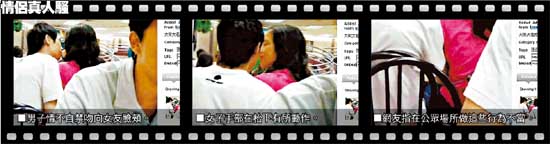
[067] The Horrors at the HKICPA (10/17/2006) HKICPA is the Hong Kong Institute of Certified Public Accountants, which is in the news in a big-time manner. Here is Central Blogger (in Chinese) on the two major issues:
Issue number one is the promotional video HKICPA Recruit Commercial. What is your image of CPA's? Well, it may not correspond to the latest recruitment video which shows a bunch of hip-hop artists dancing and singing in Admiralty. Here are the lyrics:
Well I'm a CPA and that's what I do
I know it doesn't sound sexy to you
But I can tell you I'm a person of repute
And it's all because I belong to the 'Tute
CHORUS
I wear a suit
I belong to the 'Tute
I wear a suit
I belong to the 'Tute
Now accountants are seen as boring and bland
We're no movie stars or guys in a band
But you'll see us in action when you give us your loot
Because we're the folks who belong to the 'Tute
CHORUS
You can tell that we're good because we've got QP [note: "Qualification Programme"]
It don't come easy and it don't come free
Those long lettered people ain't so astute
It takes just three letters to belong to the 'Tute
CPA, CPA, CPAThe Central Blogger was stunned because he cannot believe that such was the image of CPA's. The blogger advises: "Catch this before the video gets removed." Tip: Search for "HICPA" on YouTube because multiple versions have been posted.
Related Link: Video accountants hope they can really count on Justin MitchellIssue number two: The CPA's of Hong Kong form a functional constituency in the Legislative Council. During the last elections, pan-democratic Mandy Tam was elected. Recently, the HKICPA has declared that it will no longer allow Ms. Tam to have access to the membership list to distribute her newsletter. The reason was that Ms. Tam has been assertive in a number of positions (such as universal suffrage, the Goods and Services Tax, etc) contrary to those of the HKICPA as believed by its senior officials. Therefore, we have a situation that the elected representative has no access to the members. What is going on here?
[066] Newspaper Circulation Figures in China (10/17/2006) (ReporterHome.com)
[in translation]
I went back to visit a relative at an elementary school in a mountainous village of Longqiao town, Longhua district, Haikou city. This elementary school has 12 teachers including the prnicipal. The school has been forced by the Department of Education to subscribe to 16 copies of Haikou Evening News. Of these, four were under the name of the school office while the twelve teachers had to get one subscription apiece. Two of the teachers are married to each other, but they had to get one subscription apiece. By comparison, the directive from the Department of Education only required the school to subscribe to two copies of Hainan Daily News.
Although it is common for Chinese party newspapers to have subscriptions imposed by order, I am angry. To the f*cking c*nts at Haikou Evening News, you can go home and f*ck your ancestors but you should not be squeezing the blood-and-sweat money out of the mountainous village folks!
In Facts and Prejudices, Apple Daily boss Jimmy Lai asserts that a newspaper is an emotional product. What is the emotional relationship between Haikou Evening News and these subscribers? Love or hate?
(translated in summary)
I was watching a television program with the title, "Were you misled by the western media?" There were two eminent guests from the top television channel and the top news agency in China respectively. These two experts felt that the western media have misled the entire world. These western media (such as AP, Reuters and AFP) control the discourse and mainstream opinion because they own wealth and experience.
The western media controlled the speech rights. They only say bad things about China and they never say good things about China. They even demonize China. A specific quotation from an American media professional was cited: "There are two unwritten rules -- never say bad things about the Jews and never say good things about the Chinese."
I don't know if such rules exist and it is impossible to verify because they are unwritten. I don't think that the Jews are bad people, even though they are not always portrayed favorably in western novels. I have heard good things said about China, including the appearances of many of our leaders on the front pages of TIME. Even our maintream media trumpeted those appearances. One of our leaders had a amicable chat with Mike Wallace on "60 Minutes." So now I am getting confused and skeptical.
The experts said that the western media are protecting western values and national interests. I should think that this is normal. We can defend eastern values and national interests too. Besides, values should not be dichotomized into eastern/western; they should be dichomized into right/wrong.
The program then interviewed some citizens and discussed some instances in which they had been misled by the western media. Then the program flashed the words: "Were you misled by the western media?" So I started thinking about how I might answer. After some time, I decided that this was a false question, because I don't have access to western media! Here are my reasons:
1. I have never traveled outside of China.
2. My English is terrible. I can recognize the 28 (27?) alphabets. Forget about my French.
3. In China, western media such as the Washington Post are not publicly sold.
4. I am not a high-ranking official, and so I am not allowed to read any internal reference materials.
5. Western values cannot misguide me without relying on the media. If they could, then they must be riding the wind into the night without making a sound.Therefore, it is ridiculous for me to consider "Were you misled by the western media?" The next problem is just to whom that particular television program being shown? Who is trying to educate whom? Who is qualified to be "misled by the western media"?
[064] Taiwan By The Numbers (10/16/2006) (China Times) (1,133 persons interviewed between October 11-12, using the telephone directory as the sampling frame)
Q1. As of today, do you think President Chen should leave his post?
Yes 67%; No 31%; no opinion 2%.Q2: If the president recall vote fails to be passed by the Legislature on October 13, the anti-Bian headquarters will begin a recall campaign against Democratic Progressive Party. Do you support that?
Yes: 58%; No 40%; no opinion 2%.Q3. If the silent sit-in continues "indefinitely," will you support it?
Yes 36%; No 63%; no opinion 1%.Q4: During the anti-Bian campaign, are you satisifed with Ma Ying-jeou's performance?
Yes 48%; No 46%; no opinion 6%.
[063] The Late Friendlies (10/16/2006) (Wenxue City) This was how the five mascots of the 2008 Beijing Olympics were originally presented.
Without fanfare, this is the new and improved version.
What is the difference? The Friendlies have how become "Fuwa." Why? This was the result of Internet opinion pressure.
First, the noun "Friendly" means either a "friendly person" or "a friendly competition between sport teams." The plural in both cases is "friendlies."
Secondly, the pronunciation of "Friendlies" is close to "Friendless" and may cause misunderstanding.
Thirdly, "Friendlies" may be pronounced as "Friend"+"Lies" and cause misunderstanding.P.S. A reader wrote: "I almost fell off my chair at CCTV this evening when I read the report on this. Using Dr Li's logic, the Fuwa Nini will also have to be renamed, since she sounds like ninny and this could cause misunderstanding - and laughter. Also, Huanhuan's hair is on fire. This might encourage children to set light to themselves, prompting parents to file expensive law suits. And China will have to be renamed Zhongguo in case foreigners think the country is a plate."
P.P.S. As Lian Yue noted, Fuwa is the name of a district in Gifu prefecture, Japan. Uh oh ...
P.P.P.S. Olympic Friendlies come under fire Jane Macartney, Times Online
[062] The Other Blogosphere (10/16/2006) For this blog, one might go away with the impression that there is only English and Chinese and nothing else. So here is a relevant post from the French blog Quand la Chine déblogue:
Il est impressionnant de voir comment la censure est désormais capable de nettoyer le Web chinois des informations jugées sensibles. Bon d'accord, ces infos sortent (grâce à la rapidité et à la fluidité de l'Internet, au grand nombre d'internautes, à l'anonymat relatif des BBS...). Elles restent assez longtemps à l'air libre pour se répandre un peu partout. Mais elles finissent par être supprimées.
On le constate dans le cas des émeutes de Ruian, près de Wenzhou (le 7 et 8 septembre). Une Française de Ruian qui réside à Pékin, et qui a suivi pendant plusieurs jours l'affaire Dai Haijing, me dit que toute mention de Ruian ou des incidents sur BBS est désormais neutralisée par le modérateur du site. Les blogs et sites qui montraient des photos des incidents, et avant ça, de la manifestation lycéenne ou de la victime (la prof. d'anglais "suicidée" par son mari), mènent à des messages d'erreur.Je me demande quel cheminement a suivi l'ordre de Net-toyage : venait-il du gouvernement muncipal, de la préfecture, a-t-il été répercuté par le département de la Propagande dans tout le pays ? Sans doute, car la presse chinoise, qui quelquefois prend de vitesse les directives des autorités, a apparemment été solidement muselée sur cette affaire.
Quelques photos, et des liens désactivés, ont survécu sur EastSouthWestNorth : c'est en anglais et made in Hong Kong. C'est étonnant que ce blog ne soit pas encore filtré en Chine pop. Chut !
[061] How To Destroy Your Local Tourist Industry - Part 2 (10/16/2006) Part 1 was in Comment 200610#010. Ming Pao has Part 2 on its front page:
[in translation]
A tourist group of 12 people from Qinghai province came for a three-day trip to Hong Kong for about 3,000 RMB per head (including a sidetrip to Macau as well). They were taken under the care of a Hong Kong tour guide named Yim.
Yesterday morning, the group was taken to a jewelry shop and they spent just over HK$1,000 in total. Yim told them that this was not enough to cover hotel/meal expenses, so they ended up spending more than $4,000 in total.
After lunch, Yim took them to a watch shop. On the bus, Yim told them that their tour fees were insufficient to cover room and board and insisted they must each purchase a HK$100+ memorial watch. The group ended up buying 15 of those watches.
When they got on the bus, Yim gave them an ultimatum -- each person must purchase a HK$100 keychain or else he would dump them in the street and not take them back to the hotel. Yim also showed them a newspaper article about how a Sichuan tour group was dumped on the streets for not making enough purchases and ultimately had to pay more than HK$500 each before they could go back to their hotel. Then Yim dumped the group off in Kowloon City and left them to make a decision within 20 minutes.
The tourists then called Ming Pao which contacted the Hong Kong Travel Association, which contacted the travel agency. The bus came back later to pick up the tourists and took them back to their hotel.
When interviewed by Ming Pao, tourist guide Yim said that this group was a "zero fee" group and therefore sales commissions were needed to make up for the hotel and food expenses. As soon as he saw the photographer, Yim left the scene. Later in the evening, Yim called the reporter back and explained that he was only trying to help the tourist in the "shoppers' paradise" known as Hong Kong. He believed that there must be some Tibetans in this group who failed to understand what he was saying.
For the record, here are the tourists showing off the jewelry, watches and key chains that they were coerced to buy under the threat of being abandoned in the streets.
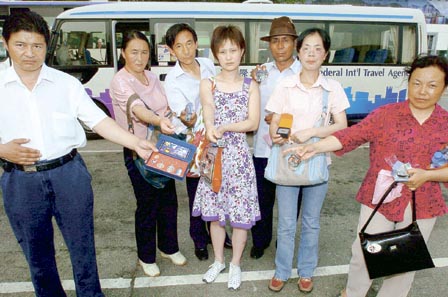
[060] Counting
The Dead in Iraq (10/15/2006) A reader asked for comments from
this statistician/blogger on the Lancet paper (Mortality
after the 2003 invasion of Iraq: a cross-sectional cluster sample survey
by Gibert Burnham, Riyadh Lafta, Shannon Doocy and Les Roberts). For
media coverage, see Iraq casualty figures open up new battleground
by Dan Murphy, Christian Science Monitor, October 13, 2006.
In terms of methodology, here is Les Roberts' description given at Democracy
Now:
Sure, we, as you said, went to about 50 neighborhoods spread around Iraq that were picked at random, and each time we went, we knocked on 40 doors and asked people, “Who lived here on the first of January, 2002?” and “Who lived here today?” And we asked, “Had anyone been born or died in between?” And on those occasions, when people said someone die, we said, “Well, how did they die?” And we sort of wrote down the details: when, how old they were, what was the cause of death. And when it was violence, we asked, “Well, who did the killing? How exactly did it happen? What kind of weapon was used?” And at the end of the interview, when no one knew this was coming, we asked most of the time for a death certificate. And 92% of the time, people walked back into their houses and could produce a death certificate.
I also do cluster samples in Latin America (see the description of survey methodology for Los Medios y Mercados de Latinoamérica). This is standard sampling methodology used in practically all door-to-door surveys for reasons of cost efficiency. While it would be more efficient (in the sense of having smaller sampling error) to run a unclustered sample, it would cost a lot more (visiting 2,000 sampling locations instead of 50 locations in the Lancet study). The actual sampling error is accounted for in the confidence interval of (420,000 - 790,000) reported in the Lancet study (which was calculated by the bootstrap method, which I also use). Of course, my surveys are not about mortality; rather, I might ask about your automobile purchases and sales over the past 3 years and so on. But the principles are the same. So I don't have any issues with the methodology.
Following the Internet discussions on this subject (see, for example, Glenn Greenwald), there certainly seems to be a lot of peripheral issues related to the practical implementation of the methodology. I can add even more to this list, but I do no see any one factor (or even a combination of factors) that could swing the numbers dramatically. The whole 'debate' around this paper disgusts me because most of the comments come from innumerate political hacks.
I see that some people are now rushing to embrace the Iraq Body Count estimate which is compiled from media reports. I have to shake my head and revive this blog post Reporting the Iraq Body Count (July 7, 2005). Those were the media reports and criticisms when Iraq Body Count released their numbers more than a year ago. The same political hacks are now clutching the smaller IBC number that they had previously savaged. Yesterday's dodgy data are today's conventional wisdom. In June, 2005, this Los Angeles Times report began with this sentence: "At least 50,000 Iraqis have died violently since the 2003 U.S.-led invasion, according to statistics from the Baghdad morgue, the Iraqi Health Ministry and other agencies." This was the previous conventional wisdom until the Lancet study came along. In another year's time, the Lancet study will probably become conventional wisdom.
P.S. It was suggested by Les Roberts that the media can easily verify the numbers. (Democracy Now) "It is easy -- it’s going to be very easy for a couple of reporters to go out and verify our findings, because what we’ve said is the death rate is four times higher. And a reporter will only have to go to four or five different villages, go visit the person who takes care of the graveyard and say, “Back in 2002, before the war, how many bodies typically came in here per week? And now, how many bodies com in here?” And actually, most graveyard attendants keep records. And if the number is four times higher, on average, you’ll know we’re right. If the numbers are the same, you’ll know we’re wrong. It is going to be very easy for people to verify this." Well, that will be an under-estimate on account of what happened in this old post The Soccer Fields of Fallujah -- this is not a regular cemetery.
Related Links:
Flypaper for innumerates - Part 1 Deltoid
Flypaper for innumerates - Part 2 Deltoid
655,000 Dead: Reporting the Reporting Eric Alterman, Huffington Post
The Science of Counting the Dead Rebecca Goldin, STATS.org
How the Media Covered The Lancet’s Iraqi Casualty Study Robert Lichter, STATS.org
... but all that is irrelevant statistical exegeses compared to Down The River from Billmon.
[059] Family
Secret (10/15/2006) Apple
Daily reports that the tax department in Taiwan is attempting to
collect unpaid estate taxes from the late Kung Ling-wei, who was the niece of
Madame Chiang Kai-shek (=Soong May-ling). The amount owed is NT$129
million, plus fines of NT$28 million.
Another Apple
Daily article tells more about Kung Ling-wei. She was said to
be the favorite niece of Madame, who had no children of her own. Kung
Ling-wei was famous for dressing like a man because she had short hair, wore
a man's suit with riding boots and smoked a pipe. Here is a photograph
of Kung Ling-wei.
Here is a piece of family secret from me. No, I am not related to that
Soong family -- we just happened to share the same last name. This is
about a deceased family member (not named Soong) whom I shall call X
(because I don't want to cause problems for X's surviving family in
Taiwan). The following was related to me by my father.
Once upon a time, X was the personal secretary of Madame. As such, X
knew a lot of Madame and her personal matters. One day, X made an
observation to Madame about Kung Ling-wei, who had just fallen in love with
a married woman who divorced her husband to be with Kung. X suggested
that Madame should probably advise her niece to be less flagrant in engaging
in socially unacceptable behavior at the time. Madame promptly fired X for daring
to talk about her family this way. X did not necessarily regret
leaving. However, for the next few decades, X found himself unable to
travel outside Taiwan. It was probably not because Madame forbade it,
because she certainly had more important things to care about. Rather,
when X applied to travel, his application went to a government
official. The official would not dare to ask Madame about this and he
was not going to accept personal responsibility. Therefore, it was
easier to deny the application. It would be after the death of Chiang
Kai-shek before X immigrated to the United States. X has never said a
thing about his experience with Madame (to my parents or anybody else).
[058] Protecting
Ella X (10/15/2006) This is the matter of singer Ella Koon
being forcibly kissed by a man who has now been charged with indecent
assault (see Comment 200610#030). (Ming
Pao) According to the legal regulations regarding sex-related
crimes, information that will allow the public to idenitfy the victim must
not be disseminated in print or broadcast media. That is why we have
people like Miss A and so on. Exceptions can be made when the
presiding judge believes that such restrictions were unreasonable and issues
a waiver in the public interest.
At the initial hearing of this case, the judge did not issue any
waiver. Yet, on the next day, the newspapers printed the name Ella
Koon in the headline. While this has technically violated the
regulations, there is no chance of judicial action. First of all, the
incident occurred in a public place that was covered widely by the
media. Many people have watched the replay on YouTube (
[057] The
Great Beijing Hutong House Auction (10/15/2006) (The
Sun) At the inaugural Hutong House Auction in Beijing, 18
houses were offered but there were no bids. The lack of action was
attributed to two reasons. First of all, ten of the eighteen houses
were closed to foreign bidders (including Hong Kong and Macau residents) on
the grounds of "national secrets." How so? The houses
were located within 500 meters of important party, government and military
offices.
This meant that most of the action would have to come from Chinese
buyers. The eighteen houses were valued at the combined total of 143
million RMB. But this is a very bad time for a Chinese to make such a
high-profile purchase. How so? You wouldn't want your name on
the front pages for making a high-priced purchase at a time when the
government is actively fighting corruption.
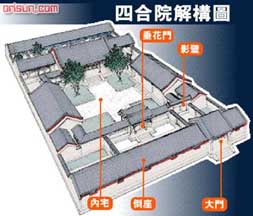
Related Link: Scruffy English have the money
Richard Spencer
[056] The Confession Of A Hong Kong Newspaper Reader (10/15/2006) On the RTHK Radio 2 show "eWorld," I was asked: "How many newspapers do you read every day?" I said "A lot" because I could not come up with the exact number. I added that I am grateful that in this age (note: when I was a child, my father had eight newspapers delivered to our home), one can read online newspapers instead of having to purchase the printed copies at HK$6 per copy. But here is my daily online reading list of Hong Kong newspapers:
-Apple Daily
-Ming Pao News
-Oriental Daily
-Sing Pao
-Sing Tao
-South China Morning Post
-The Standard
-The Sun
-TaKungPao
-WenWeiPoMy strategy is as follows: I begin by reading the English-language South China Morning Post and The Standard, and I try to remember their major stories. Then I sweep through the Chinese-language newspapers. There are two things that I look for. First, is there any story that the English-language media totally missed? This is usually some blood-and-gore story that our still-colonial-minded media feel that their readers should not have their beautiful minds soiled with. That is when I pounce and show you all the glorious details such that you puke your guts out at the sight. Secondly, I am looking for contradictions among all the newspapers, no matter whether they are in Chinese or English. Here, I am asserting a citizen's right for the facts (and nothing but the facts). As a citizen, I am outraged by the fact that I am presented with multiple versions of the same event that are completely irreconciliable. I do not know what the truth is. I can only document the various incompatible versions. I leave it up to the media to explain why they report whatever they report. You will have to trust me when I say that they have plenty to answer for.
[055] The RTHK eWorld Interview (10/15/2006) I was interviewed on the RTHK Radio 2 program "eWorld" on Saturday between 700pm-730pm. The complete program (which went from 6:00pm to 8:00pm and is conducted in Cantonese) can be heard here in either Windows Media or Real Media format. Apart from the program itself, here are some relevant issues:
First, should bloggers take interviews and publicize them? Here are some Chinese-language links to Hong Kong bloggers on this issue:
我(終於)被訪問了 香港仔公國
由YouTube(可能)被收購談起 聞.見.思.錄
也談訪問 網絡暴民
傳媒訪問、工作、與轉載的二三事 大腦角落
I will just translate this section from the Duke of Aberdeen:
On one hand, we can say that the mainstream media misunderstand the ecology of Hong Kong bloggers while on the other hand we decline to meet them. If you don't meet with them, how do you expect them to understand you? When we were initially misrepresented (note: as teenage online diarists hosted at Xanga), we signed a joint open letter about it. I used my meagre knowledge to respond to the queries from the media and I even agreed to be interviewed. I didn't feel that I was sufficiently representative and therefore I encouraged our convenor Sidekick to give interviews too. Like many bloggers, Sidekick did not particularly like self-promotion and preferred to keep a low profile. But I felt that Sidekick had the influence and reputation and if she (or the other representative bloggers) could face the media squarely, this would help to improve the image of bloggers for the public/media. Later on, Sidekick was interviewed by Next Weekly and other media, and I am grateful to her as a blogger. After all, this was not something that everybody enjoys. Today, bloggers being interviewed by the media is no big deal.
Secondly, during the program break, the eWorld hosts noted that I seemed to like the Diuman Park blog and those two bloggers had previously been on eWorld on September 2, 2006. So I asked, "What were they like?" It seems that Yip Yatchee was more talkative while Wild Crab was more laid back. That seems to match my impression. But I did not get to explain on air why I like Diuman Park. For my readers, here is the translation of Yip Yatchee's blog post on Hong Kong chief executive Donald Tsang's policy address. I was keeling over with laughter.
Concerning the minimum wage for the occupations of cleaners and security guards in Hong Kong, chief executive Donald Tsang proposed to allocate over HK$10 million to promote the minimum wage guarantee. The money would be spent on encouraging the employers in those two fields to provide a minimum wage level and the results will be reviewed in two years' time. Some scholars believe that the HK$10 million plus should be spent on hiring Regina Ip who has just returned to Hong Kong to re-enter politics. Why? "Because she was the Secretary of Security, and she had a broomhead hairstyle. Therefore, she must know more about the security and cleaning industries better than any other person!"
The following is the cover of the book titled "Broomhead":
As a bilingual Hong Kong resident, I have the best of both worlds. In English, I have Hemlock and in Chinese, I have
刁民公園 (aka Diuman Park).[054] Civics Exam (10/14/2006) (Apple Daily) In Taiwan, the following question appeared in a middle school exam on civics.
「阿扁總統在扁嫂的SOGO禮券案、女婿的內線交易案中,飽受民眾要求自動辭職下台的風暴,若是阿扁真的主動辭職下臺,阿扁的表現顯示出民主政治的何種特色?」
(in
translation) The people have been asking President Ah-Bian to
voluntarily resign on account of his wife's SOGO gift voucher and his
son-in-law's inside trading case. If Ah-Bian really resigned
voluntarily, which features of democratic rule will this demonstrate?
(A) Rule by public opinion; rule of law
(B) Rule of law; party politics
(C) Accountable governance; party politics
(D) Accountable governance; rule by public opinion
Never mind which is the right answer, because the obvious outcome is that some parents are complaining about the political implications. This question was not devised by a teacher, but lifted straight off a book. The book publisher said that the subject was chosen because this is what is happening in real life without any particular political stance. What do you think? Should lessons on civics involve discussion about current affairs? Or about we stuck with discussing Confucius and his times?
[053] Citizen
Radio Raided Again (10/14/2006) Last evening
at 745pm, about twenty Office of Telecommunication Authority workers and Hong
Kong police officers went to the industrial building in Chai Wan in which
the underground Citizen Radio was located. They removed five pieces of
equipment, including an unlicensed transmitter that is suspected of being
used by Citizen Radio to broadcast. District Councillor Tsang
Kin-shing and Legislator Leung Kwok-hung were taken down to the Chai Wan
police station to assist in the investigation. Tsang denounced the
government for suppressing freedom of speech. He said that he had had
applied for a radio broadcasting license since September of last year, but
still has not received a reply. The government spokesperson said that
the illegal transmissions interfere with the signals of licensed operators.
Related Link:
Citizens' Radio in Hong Kong
[052] More
on the Albert Ho Case (10/14/2006) When the story of the
arrests of four suspects first broke out, different newspapers had different
versions about what happened (see Comment
200610#051). Last evening's television news showed two
suspects being taken to the crime scenes to reconstruct the sequence of
events. Jonathan Cheng has the details at The
Standard. One suspect with black hood over his head was taken
to Sai Kung to show where he threw a police baton in the sea, bought a white
t-shirt in a shop, discarded his hat and old shirt in a trash bin, and then
took a taxi to Kwun Tong to catch a cross-border bus to China. All
these details were covered live on television in a media frenzy. Was
this truly necessary? Or was this public show used to pressure certain
people?
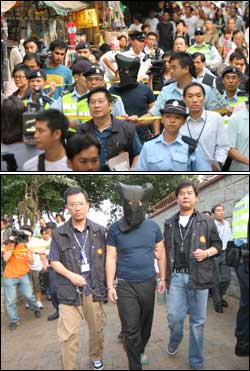
Meanwhile, the newspapers continue to diverge in their explanations.
The Standard took the path of not really offering any explanations, either
of how the arrests came about or why the suspects committed the attack on
Albert Ho. But here are the Chinese-language media:
(Ming Pao)
The police were able to break open the case in less than two months because
of (1) the closed circuit television systems in the neighborhood of the
crime scene; (2) the investigations on the mainland conducted by the public
security bureau; (3) most importantly, the valuable tip offered by an
informant.
(Sing Tao)
The Hong Kong Island major crime unit and CIB detectives obtained more than
three hundred reels of video tapes from the traffic monitoring system and
commercial buildings in the neighborhood as well as several hundred mobile
telephone records. After cross-checking and verifying, they locked
onto the target suspects. A comparison against the closed circuit
television tapes from the border control checkpionts showed that the
suspects had fled into the mainland. Thus, the Hong Kong police
referred the information to the mainland Chinese public security bureau. Later, one
suspect returned to Hong Kong whence he was put under constant surreptitious
surveillance but not arrested. When the suspect thought all was clear,
he called the others and two more returned to Hong Kong. The police
then arrested three men and one woman in Hong Kong. The fourth male
was arrested in Zhongshan by the public security bureau which tracked down
his telephone. This individual has admitted that he committed the
assault on behalf of someone as a debt collection effort. The police
do not exclude the possibility that he is saying this because he was paid to
protect the mastermind behind the scene. The
Sun offered essentially the same story but added that the person who
hired the fourth male was a "Brother X" who has no known means of
contact.
(Apple
Daily) The police said that the four male suspects had triad
background (14K and Wo Hop To), including prior criminal records. The
female suspect was believed to have hidden the weapons. The police
were able to obtain fingerprints and DNA from a police baton left behind and
then used the closed circuit television tapes from the neighborhood as well
as the border control checkpoints to lock onto several individuals.
The Hong Kong police then transmitted the information to the mainland public
security bureau. Meanwihile the Hong Kong police monitored the
telephone calls of the families and were able to intercept the calls.
After being arrested, the suspects readily admitted that they did it for
several tens of thousands of dollars. "The boss said that someone
refused to repay a debt of more than 1 million dollars. So he sent us
to teach him a lesson." The police doubt that it is so simple,
because the confession smelled like reciting a script. They tend to
think that the suspects may have been paid off to accept full responsibility
if arrested.
[051] The
Different Versions of the Albert Ho Case (10/13/2006) How many
newspapers do you have to read in order to get the right story? There
is no answer to that question, because reading more newspapers will only get
you even more confused.
(Ming Pao)
After the assault on Albert Ho, the police reviewed the closed circuit
television films in the area as well as collected eyewitness testimony to
come up with artistic sketches of two of the suspects. Recently, the
police received a tip and took action to arrest 3 men in different
places. Based upon exchange of information with the mainland public
security bureau, another man was detained in Shenzhen.
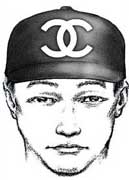
(The
Standard; also in Sing
Tao) Police and government sources confirmed four men have been arrested in connection with the August 20 attack at a McDonald's in Central.
Three were held in Hong Kong and the other in Shenzhen. The breakthrough came after Shenzhen authorities detained a man, who was on a stoplist, at a border checkpoint.
Since the attack, investigators have collected video tapes from nearby buildings and returned to the scene to distribute questionaires and interview witnesses.
They also went through a lengthy record of telephone calls made in the area around the time of attack. They narrowed the list to about 20 suspected
numbers, whom they followed and monitored.
(Apple
Daily, later quoted by SCMP) According to information, the
police successfully obtained fingerprints from a police baton left behind by
the suspects and hence they locked onto the suspects who had gone to hide in
mainland China. Recently, one suspect returned to Hong Kong but the
police refrained from taking action. The suspect thought that he was
safe and told the others to come back gradually. Those who returned
then came under police surveillance. When the fourth and last one came
back, he was stopped at the border checkpoint and then the Hong Kong police
immediately rounded up the other three at their respective places of
residence.
So was it a tip? Or the mobile telephone calls? Or the
fingerprint on the police baton? The more you read, the more confused
you get ...
Update (6:00pm) (Sing
Tao) At around 4pm, the police took a hooded male suspect to
Sai Kung pier to reconstruct the crime scene by which the perpetrators
disposed of their weapons and clothing. Afterwards, the police
confirmed that three men and one woman have been arrested in Kowloon Bay and
Shum Shui Po, while another male was arrested by the public security bureau
in Zhongshan, Guangdong. All suspects are Hong Kong citizens between
the ages of 27 to 57. The four men were believed to have participated
directly in the assault on Albert Ho. The police spokesperson
emphasized that they are still investigating the motive, collaborators and
mastermind of the case.
[050] Hong
Kong By The Numbers (10/13/2006) (HKU
POP) (1,027 persons inteviewed on October 11, 2006).
Overall appraisal of Hong Kong Chief Executive Donald Tsang's policy
address:
2006: Satisfied 34%; half-half 42%; dissatisfied 25%
2005: Satisfied 48%; half-half 33%; dissatisfied 9%
Rating of Donald Tsang:
October 11: 59.8%
October 3-6: 62.9%
Vote of confidence in Donald Tsang:
October 11: 56%
October 3-6: 64%
[049] Taiwan
By The Numbers (10/13/2006) (TVBS)
(telephone interview of 993 persons aged 20 or over drawn randomly from the
telephone directory and then having the last four digits of the telephone
number randomized)
Q1. Do you support Shih Ming-teh's Million Person Anti-Corruption
Movement?
A: Yes 49%; no 33%; no opinion 18% (compared to 55%/30%/15% on September
18)
Q2. Where do you think the Million Person Anti-Corruption Movement
should go?
A: Stop now 37%; wait for judicial resolution 25%; persist until
President Chen is deposed 26%; no opinion 13%.
Q3. Do you agree with a referendum to recall President Chen?
A: Agree 72%; disagree 17%; no opinion 12%.
Q4. At the Double Ten National Celebration, there were certain clashes
and unanticipated incidents. Do you think that it was serious?
A: Very serious 37%; somewhat serious 23%; not very serious 19%; not at
all serious 9%; no opinoin 13%.
Q6. The prosecutor's case about the First Lady's involvement in the
SOGO gift voucher case has been closed, while another case about the First
Family in the national security funds is still ongoing. How much
confidence do you have that the judicial system will investigate the latter
case all the way?
A: Confident: 26%; not confident 57%; no opinon 16%.
[048] Reality
Bites (10/13/2006) (Xinminnet via 6Park)
Reality shows are about ... realiity! On the Tianjin TV reality show
"I am the principal," a recent episode shocked the viewers.
The program group issued a fake employment notice and attracyed a girl from
an impoverished mountain village to apply. When she turned up for
work, they coerced the girl to marry a dwarf. Afterwards, the program
host explained the ruse to the victim and tried to calm her down.

Understandably, this program caused outrage. Some netizens wondered
why the program group pushed the innocent girl into one trap after another
in pursuit of realism. Where are the human values in torturing this
girl mentally and physically?
When the newspaper interviewed the program producers, it was revealed that
this was a case in which the program was just being too successful. The
purpose of this show was to educate the public that such things exist in
society and people should take care not to be deceived and trapped. In
the program, the mountain girl was played by a professional actress who knew
exactly what she was doing and played her role with a high degree of
realism.
The producer said: "If we used a simple narration, will this educate
the public? The standard educational method is completely desensitized
by now. The only way is to rouse up the public in order to create
sympathy and atmopsphere, and then the result can be educational."
A scholar demurred: "The whole society is emphasizing trust. The
government and the media should be the leaders in building trust. But
this television station is running a deceptive program, and so it is leading
the way to mistrust!"
[047] NCC Imposes Penalties (10/12/2006) (Comment 200608#091) In August, on FTV News, former DPP legislator Lin Cheng-chieh (
[046] Man
Or Beast? (10/12/2006) (The
Sun) A 26-year-old Hong Kong man named Chen pleaded guilty in
court yesterday of sexually abusing four girls between the ages of 12 to
14. On the night before the incident, Chen got acquainted with the
12-year-old over ICQ and exchanged phone numbers. Then he began to ask
her to come over to his apartment to chat. After she refused, he
continued to call her. The girl told her three classmaes and they went
over to his apartment to warn him. When they enetered, he began to
touch their bodies parts, including all the naughty bits. The girls
told their teacher, who called the police.
The judge noted that the defendant had been convicted in a previous case of
17 charges, most of which are sex-related crimes. So the judge
wondered: "Are you man or beast?"
Now this case is remarkable because of the headline: "AC Nielsen
[045] The Hong Kong Economic Journal Editorial (10/12/2006)
[in translation]
The Taiwan anti-corruption "dump-Bian" headquarters laid out their "siege" yesterday in Taipei. The "dump-bian" headquarters claimed 1.5 million participants, but the Taipei police said that there was only 120,000 people. The official and civilian numbers are different by a factor of more than 10, which is quite ridiculous. But based upon the televised images, most people will tend to believe the 1.5 million figure.
The lack of trust in public institutions is one of the effects of the "dump-Bian" movement and it is also a major cause of the chaos in Taiwan right now. The prosecutor's office and the judiciary are covering up for the central, so that the people cannot believe that these institutions can independently carry out their duties. Thus, the people have no choice but to go into the streets and use the most "primitive" form of people power to force Chen Shui-bian to quit. Some say that Taiwan already has universal suffrage, so it is unnecessary to use street demonstrations to fight back because all the problems can be handled within the system. But the evidence of impotence and secrecy within the prosecutor's office and judiciary gives people no confidence in their fairness and ability to handle the corruption cases in which Chen Shui-bian is involved.
During the 2004 "election," Chen Shui-bian was shot with two bullets. Various evidence created many doubts, but the prosecutor closed the case down quickly and the "suspect" died mysteriously! The lack of seriousness made people believe that the law enforcement agencies closed the case under political pressure. As for the other principal in the Chen Shui-bian case, the "First Lady" Wu Shu-chen was suspected of accepting SOGO gift vouchers. The Taipei district prosecutor confirmed that Wu Shu-chen did receive gifts, but since there was no proof that she interceded in the fight for control of the SOGO company, the case was "declared closed without the need to disclose the details." These repeated legal farces made the people realize that there can be no answer within the system, and therefore they can only go into the streets.
The balance of power is the foundation of democracy. Since 2000, Taiwan set a precedent with "direct elections." But one-person-one-vote is only one part of a democratic system. When there is a problem with the directly elected leader, does the system have ability to correct? The judicial system is the last line of defense. The courts and the independent prosecutors are the ultimate entities that will seek out the truth and decide if the government leader acted in accordance with the law. But in this anti-Bian chaos, outsiders only see that the judiciary was under the power of the "president" and "government" and acted as a tool for the government.
If the judiciary was impotent, the "legislature" is even worse. The Democratic Progressive Party "legislators" treated the "anti-Bian" movement as the restoration of a political power from the outside. Therefore, they did everything to fight back and block any attempt to censure or recall the "president," in the manner of gang members protecting their boss. It can be said that the last two months of the "anti-Bian" movement in Taiwan has exhausted any chance of Taiwan being referenced as a model of democracy. For those who long for democracy, it should be clear that a democratic system is more than one-person-one-vote, but it is necessary to put the rule of law, public trust, the judiciary system and the anti-corruption system together. Taiwan has a long way to go before getting there.
Now, this is a remarkable essay. I don't mean the original item that appeared in the Hong Kong Economic Journal. But it is remarkable because it appeared in Southern Metropolis Daily (Guangzhou). It was noted that some editing had to be done (e.g. the customary quotation marks around "legislature," "president" and "government"). This is remarkable because here is an op-ed essay in one of the top newspapers in China about the relationship among democracy, universal suffrage, rule of law, public trust, corruption of the leadership, balance of power, independent prosecutors, independent judiciary, independent anti-corruption departments, etc. This is even better than the Brazilians writing about Greek colonels. You can go back and re-read the essay while substituting the Taiwan context to some kind of China context.
[044] The Future of Communications (10/11/2006) I got out of bed early to attend the talk by Text 100 Public Relations CEO Aedhmar Hynes on the topic of "The Future of Communications." From the Text 100 website, here is the description:
捉到鹿唔識脫角 案內人隨筆The Hong Kong General Chamber of Commerce and Text 100 Public Relations would like to invite you to a breakfast seminar on 'The Future of Communications'. The discussion will be led by Text 100's CEO, Aedhmar Hynes, who'll examine how traditional media outlets are increasingly sharing headlines with so-called 'citizen journalists'.
The fact that Hong Kong's 'Bus Uncle' made global headlines is testament to this. Blogs, chat rooms, wikis and instant messaging are changing the way people interact with businesses. If your public relations program is measuring success solely by the weight of press clippings, then it may be time to examine alternatives. Discussion topics include:
* What this all means for the future of communications and its practitioners
* Consumer-led demand for authenticity has fuelled the rise of peer media, influencer relations and CSR, but what will really entrench communicators in the boardrooms and living rooms of the future?
* The latest thinking on connected communications and how some companies embracing it
* Steps your business should take to join this connected worldMy question was narrowly restricted to blogs. In the traditional communication model, a corporation (possibly through an agency) communicates with the consumers through traditional media (newspapers, television, radio, etc). This traditional model is now defunct due to the proliferation of new media such as blogs. So how would a corporation communicate through or with blogs, which seem to have an immense impact on its brand image? The first-level response today is: You have to monitor what the blogs are saying about your brand (e.g. through Technorati, Google Blogsearch, Nielsen BuzzMetric, etc). The second-level response is: You have to communicate with the bloggers to get your message across.
Here are my personal observations as a blogger. I cannot say whether corporations (or their agencies) are responding at the first-level, because I have no feedback whether they read my blog or not. I don't know and I don't care. But I can say that the second-level response is non-existent for a number of reasons.
First and foremost is that past PR practices do not apply to bloggers. In the traditional model, a PR agency may approach a journalist to pitch a story, including offering privileged information and facilitating exclusive interviews with the principals. This means nothing to bloggers such as myself. Sending me a press kit or offering me the opportunity to interview the CEO means nothing to me whatsoever. As a blogger, I am usually responding to published information. In most cases, a corporation may be concerned about something that was specifically written by me on the blog. If the corporation demurs and wants to have its say, it has to be a fact-based and very specific statement. If it is just a difference of opinion without new facts, all I can suggest is: "Publish it on your own blog!" In fact, many bloggers will resent it and hold that against the corporation for being pushy.
Secondly, a corporation may get a traditional media outlet to place its marketing communication messages unobstrusively or sublimely, in return for exchange of favors, interests and advertisements. This means nothing to financially independent bloggers such as myself. Nothing that you offer can entice me to do your bidding. Any attempt to do so will likely damage the corporate brand because it will likely be reported on the blog.
Thirdly, the blogging phenomenon should be recognized as not an egalitarian state. Not all blogs are equal, as a small number of A-list blogs dominate public discourse. How do these A-list bloggers emerge? They do so by earning respect consistently over time. Since the A-list blogs are few, it should not be so difficult to engage them. But you have to remember that it has to be on their terms. They derive their positions precisely because of their independence. You will have to convince them on a rational basis with the facts.Meanwhile, I will state that the current state of engagement with the bloggers by the corporations (or their agencies) in China is non-existent. I offer the well-known cases of the problems of Google, Yahoo! and MSN Spaces in China. Public opinion was driven by the bloggers such as myself, and there was no attempt whatsoever to engage me by these corporations. It is as if they are stuck at the first-level and prepared to suffer the pain. With due respect, if you believe that blogs are important, then you must engage them -- on their terms!
Related Link: eBay
前幾天,思哲以blogger的身份,出席一個本地的業界聚會,主題是Corporate Communication在互聯網底下的變遷。講者是一家PR Agency的CEO,她在演講中清楚地剖析互聯網及Web2.0,如何徹底地改變了企業的營商環境。最精采的部份,是在問答環節,座上一位本地知名的Blogger,提出一個非常刁鑽的問題,其大意是:「昔日,企業公關的角色,是處理傳媒關係。在Web2.0及Blogger的時代,人人皆是傳媒,請問該怎樣處理?」
這條問題難答,因為昔日的傳媒關係已經不再。今天的Web2.0時代,舊傳媒的影響力逐漸下降,另一方面,企業亦形同全面「透明化」。企業不可能再靠傳媒關係,傳播或遮掩某些資訊,來達到某種目的。這可能是消費者的福氣,以後,企業價值第一守則:誠實。
[043] The Declaration of Independence (10/11/2006) Hong Kong blogger Spike wrote the following in the Hongkie Town blog:
Some of you seem to think that this is a democracy, that you have some say in what I will or will not write.
This blog is not a democracy.
Once in a rare while someone suggests I should mention America less and Hong Kong more and I do see the validity in that one. I rationalize it thusly: A) I'm American and someday may have to live there again; B) The incompetence of the current HK administration fucks up the lives of HK residents but not too many beyond that, while the vile stupidity of the Bush administration has the potential to fuck the entire world in the ass; C) again, it's my blog, I'll write what I wanna write.
Some of you disagree with the political statements and links that I post and take the usual Republican tactic of attacking the messenger rather than the message.
Fuck off.
See, I don't really care about number of hits or Technocrappi rankings. This blog is not a commercial venture; I don't make dime one off it.
No one is forcing you to read this. You don't like what you're reading, change the channel, go find another blog that's more in tune with your thinking. Or start your own blog, if you haven't already.
I kinda feel like Woody Allen in Stardust Memories, people moaning about how they prefer his early "funny" movies.
[042]
Taiwan By The Numbers (10/11/2006) So how many people
were at the 'siege' of the Presidential Office on National Day? (Apple
Daily) The police estimated that there were 124,000 red
participants. Following the usual 60% discount rule that the police
tend to use, there should be about 200,000 out there. The anti-Bian
headquarters claimed 1,500,000 persons. In the evening, the
headquarters even claimed as many as 2,000,000 persons were marching.
[Of course, this had been billed as the 2-million-person siege beforehand.]
So what shall one put on the headline? 1.5 million or 124,000?
Or 'tens of thousands'? Or whatever. The Apple Daily headline
was
simply "Siege on Double Ten" with a photo and no numbers. If
you flip to the inside, you will see the numbers above. Under these
circumstances, the two numbers are so wildly different that it would be
wrong to print one. It appears that no Taiwan media outlet did.
Of course, the 124,000 figure was probably based upon an areal calculation
around noontime. The Taipei police has no idea who is coming or going
for a demonstration that went from 9am through 5am. The 1.5 million
figure was based in a sense about the number of petitions that were picked
up -- the one million printed copies were picked up and more copies had to
be printed. However, it is possible that a single participant may be
picking up many copies to distribute among the social network, not off all
of those members were attending the demonstration.
But here are the Hong Kong newspaper front pages. In the first row,
am730, Headline Daily, Apple Daily and Sing Tao all featured the 1.5 million
figure prominently. In the second row, The Sun and Oriental Daily
showed the 1.5 million figure and shared the front page story with local
news (The Sun: "Elite school teacher molests aide" and Oriental
Daily: "Steel pipe missiles destroyed nine cars"). Sing Pao
was the only one which did not carry the 1.5 million figure; instead, it had
the headline "Ah-Bian stop Double Ten celebration from now on"
plus photos of the fights in the stands.
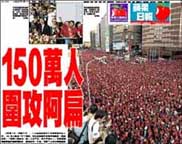
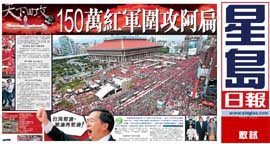
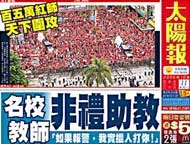
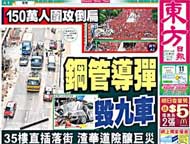
As I have said before, the Hong Kong media will take the larger number and
run with it. They do so not because they believe that it is the right
number, but because they know that all the competitors will do so and they
don't want to be left behind. This is a sensationalistic heading, but
whether it has anything to do with reality is not revelant and, more
importantly, there will not be blowbacks from their readers (as in mass
audience boycott). So why wouldn't the Hong Kong media do this?
Supplementary Data: According to the Taipei Metro, there were
1,013,246 passengers yesterday, which is 140,000 more than the same day last
week (868,344 on October 1). The two previous 'red' demonstrations
drew 1.16 million on September 9 and 1.02 million on September 15.
[041] The Responsibility of News Media (10/11/2006) (Ming Pao via Yahoo! News) The following item was published at 11:55pm.
(in translation) On the eve before Chief Executive Donald Tsang delivers his policy address, some organizations held a candlelight evening assembly to ask the government to introduce minimum wage legislation. Several dozens of people participated in the assembly, some of whom will sit silently through the night until Donald Tsang finishes his address.
Technically, it can be said that the media (specifically, Ming Pao) was there and reports were filed. But do you have a clue what the issues are? Why are these people there? The minimum wage issue is not a straightforward wrestling match between the downtrodden working class and the greedy multinational capitalists. Does the responsibility of the news media stop with a head count? Or should there be some explanation about why these people are out there? How many extra words does that require (on a website)?
[040] The Departed (10/11/2006) Low blog productivity today because I sneaked out to see the Martin Scorcese movie The Departed, which was based upon the Hong Kong movie Infernal Affairs. This is not a verbatim transcription, as Scorcese certainly created something that stood on its own. Here is an extract of a movie review by
The story was transplanted to Boston and the director and scriptwriter were skilled enough to present the background very quickly ... but unfortunately there was too much talking and so this 2-1/2-hour American version got very long-winded. The second half of the movie got better and the roof-top crisis, gun-fights and final confrontation were exciting, even for those who have seen the original version.
The American version had some better script details, such as combining the two characters of Kelly Chen and Sammi Cheng into a single female psychiatrist who formed a triangular relationship with the two male principals. The character of Anthony Wong was split into roles performed by Martin Sheen and Mark Wahlberg. The ending entailed a twist that was more complete amd precluded the necessity for a sequel.
As for the cast, Leonardo DiCaprio was better than both the original Tony Leung and Matt Damon (who had Andy Lau's role). Jack Nicholson as the gang boss was more cunning and deceptive than Eric Tsang and he is likely to get an Oscar nomination for best supporting actor. Martin Sheen was not as outstanding as Anthony Wong, but Mark Wahlberg stood out even though he did not appear often enough.
After viewing The Departed, my sense is that Hong Kong can produce good scripts that are still dramatic even in verbose Hollywood adaptations. But can the Hong Kong movie industry regain its self-confidence? They need to apply more brain power to develop their script ideas.
[039]
Only Half Of Nathan Road (10/10/2006) (Apple
Daily) What is the yield of the North Korean nuclear test
bomb? South Korea recorded a tremor of 3.58 Richter scale; the US
Geological Services measured 4.2 Richter scale. Based upon these data,
South Korea puts the explosion as being equivalent to 550 tons of TNT, or
2.6% of the 1945 Nagasaki atomic bomb. However, Russia estimated the
yield to be 5,000-15,000 tons, or equivalent to the Hiroshima atomic bomb
which killed 240,000 people.
But here is the my favorite quote from the president of the Macau
International Military Study Society: Never mind destroying Tokyo or Seoul,
this could have "only destroyed half of Nathan Road."
Apart from anyone killed in the blast immediately on Nathan Road, a few
million more people living in the so-called "Zone of Alienation"
(30 kilometer radius) will be contaminated by the radioactive fallout.
Oh, by the way, the Zone of Alienation will be uninhabitable (except by
cockroaches) for a few thousand years afterwards.
[038]
What Not To Say To Your Child (10/10/2006) I was sitting
in a restaurant last evening and I was reading the complimentary copy of Apple
Daily. Somewhere in there was a tale of a mother in Fanling
(Hong Kong) who told her 7-year-old child to do her homework. When the
child was inattentive, the mother used a fruit knife to threaten her
daughter, hurting her in the process and leading the police to rush to the
scene.

刁民) (=an evildoer; a villain; an infidel; a heretic; a person without moral scruples). So here is what this miscreant blogger wrote about some really dangerous parent-child conversations:From Yip Yatchee at the Diuman Park blog comes this reminder to all the parents out there:
However, this is very much understating the case. What is Diuman Park? It is a park (or public space) for Diuman. But what is Diuman? It is the Chinese term for a 'miscreant' (
Parent: Are you stupid! What is wrong with you! You have no brains! You are useless!
Child: This proves the tremendous explanatory power of genetic inheritance.Parent: You are stupid. How did I give birth to you?
Child: The two of you are smart but I am stupid. Maybe half of my genes came from someone else?Parent: You act docile at school, but you are tough at home!
Child: YOu act docile at work, but you are tough at home! I'm only imitating you. We are one family. That is what the advertisements say.Parent: Why are you so useless? Look at other people ... their child is so good. Look at yourself ...
Child: Their child is awesome because the parents are awesome ...Parent: You scram! I don't want to see you!
Child: Why don't you scram instead!Parent: I am not your mother! I'm so disappointed in you!
Child: You don't even know how to cook rice. Before you learn to cook rice, you already knew how to eat rice.[By this point, some parents are undoubtedly upset: "You are 100% a miscreant. You dare to teach the child to talk back. You have not even attached any warning about "Forbidden to those under 18" or 'Parent guidance required.' This is immoral, unethical and incoherent."]
The miscreant known as Diuman Park said: "If you say in English: 'I'd rather have given birth to roasted pork than to you (
生舊叉燒好過生你)', you could improve your child's English-language vocabulary. I learned that phrase from the South China Morning Post (October 9, 2006)."[037] The Case of Yan Lianke (10/09/2006) Censor sees through writer's guile in tale of China's blood-selling scandal Jonathan Watts, The Guardian. The following is an excerpt, and I strongly recommend that you read the whole thing.
Millions of pints of blood are pumped through underground pipelines from a big developing country to wealthy consumers in the United States and elsewhere. The blood trade has produced the most spectacular boom in human history. In just five years, the formerly dirt-poor state at the heart of the haemo-business has become the richest nation on earth.
Such is the scenario of the novel that Yan Lianke - one of China's greatest living authors and fiercest satirists - was planning to write until the censors intervened. Based on a three-year study of the blood-selling scandal in his native Henan province, The Dream of Ding Village was to be the defining work of his career; not just an elegantly crafted piece of literature but a devastating critique of China's runaway development.But it has turned out to be one of the most traumatic experiences of his artistic life. For his attempt to tackle a harrowing man-made disaster, Yan received a ban from the censors, became embroiled in a legal dispute with his publisher, and - worst of all - suffers a lingering sense of shame that he compromised too many principles.
In a rare insight, the author told the Guardian how he attempted forestall a ban by doing the censors' work for them. Out went the novel's most ambitious features: the blood pipeline, the global trade angle and direct criticism of national politics. Instead he narrowed the focus to a single village, where blood is bought and sold with horrific consequences. "This is not the book I originally wanted to write," says Yan, who has won China's top two literary awards. "I censored myself very rigorously. I didn't mention senior leaders. I reduced the scale. I thought my self-censorship was perfect."
But the authorities still issued a "three nos" order: no distribution, no sales and no promotion. Yan found out it was banned when he tried to sue his publisher, the Shanghai Literary Arts Publishing Group, for failing to pay a promised advance on his royalties and a donation to the village where the book was researched.... Now the author fears he sacrificed too much. "My greatest worry is that self-censorship has drained my passion and dulled my sharpness," he says. However, he sees some improvements in the censorship climate. In 1994, when his first novel was banned, he was forced to write self-criticisms for four months. Now, there are no personal repercussions and his work is published overseas. The first English translations of his novels are expected next year. "My work has caused more disputes than those of any other author in China. But the attacks on me have become fewer. I think this shows that in many respects, society is improving, reforming, developing".
Yan is never going to be a cheerleader for China's development. It would go against the grain of a self-taught peasant whose novels are rooted in the soil. He feels different from other mainland writers. "Contemporary Chinese literature is gripped by a desire for popularity. It is like a soft-bone disease," he says. "But I come from the bottom of society. All my relatives live in Henan, one of the poorest areas of China. When I think of people's situation there, it is impossible not to feel angry and emotional. Anger and passion are the soul of my work." ...
Related Links: Serve The People; Discussion of Two Novels About Blood Selling; Being Alive Is Not Just An Instinct.
[036]
Taiwan Media Under 'Siege' (10/09/2006) Regardless of
the outcome of the so-called 2-million person 'siege' of the Presidential
Office building, the role of the media will be scrutinized very
carefully.
(ETTV)
At issue is the coordination among the demonstrators. They will not
have a podium fitted with a large projection screen and they will not have a
public announcing system, because this activity is illegal (in the sense of
not having a police permit). So how will the demonstrators know where
to go, what to say and what to do?
It is said that certain radio and television stations will serve to relay
messages from the anti-Bian command headquarters, either voluntarily or even
selling off blocks of commercial time. This would mean that these
media are not just out there to gather the news -- they are one of the
forces that are creating the news. Against this possibility, there are
rumors of counter-measures that will be taken by either the government, the
military, the opposing political parties and/or civilian opponents (such as
underground radio stations) -- jam the electronic signals of these radio and
television stations!
(China
Times) Afterwards, there may be sanctions from the NCC (National Communication Commission)
against the radio and television stations for using the public airwaves to
aid and abet an illegal assembly. The penalty to a radio station is
suspension of three or more days but not more than 3 months and fines of
NT$30,000 or more but not more than NT$400,000. (Taipei
Times) Premier Su Tseng-chang yesterday said that "siege" protest organizers who attempt to "give orders" by radio may be breaking the law. "It is my understanding that a permit for the activity [the siege protest] has not been approved as yet. As long as it is not a legal activity, by law, they [protesters] are not allowed to use radio stations to give orders or they will be violating the Broadcasting and Television Law," Su said. Comments by NCC Chairman Su Yeong-ching contradicted what Su said.
"I think their [the protesters] utilization of radio will be fine as long as they go through legal radio stations with operating licenses," Su Yeong-ching said. "As long as the messages they broadcast have nothing to do with violence or pornography, they will not violate any law."
Wen Jiun-yu, the deputy director of the NCC, said yesterday that it would be against the law if the anti-corruption protest headquarters decides to use underground radio stations to give orders and make announcements about today's siege.
However, it will be considered appropriate if radio stations spread news through interviewing the event organizers.
Should the headquarters announce the news on radio by purchasing air time, the content could only be reviewed after it was broadcast, he said.
(United Daily
News) In practice, the activity will be harder to define
exactly. According to the "creative director" of the
anti-Bian campaign Jerry Fan, various radio and television stations will be
running special programs during which the hosts may call up to interview the
campaign commander Shih Ming-teh. During those conversations, Shih
will naturally update people on the situation of the 'siege.' Jerry
Fan said that any radio station (legal or underground) can get a live
connection to their command headquarters. This is a simple matter of
freedom of press as well as a straightforward business decision for the
radio stations.
The cable tv news channels TVBS, ETTV, CTI TV and Era TV will be
broadcasting live information about the 'siege.' The channel directors
all said that they are not helping the anti-Bian command headquarters to
disseminate information. Instead, they are just reporting the new --
whenever the anti-Bian command center makes a decision and informs its
people, the TV channels will report the information immediately. So at
which point is this pure news reporting versus being a 3C (command, control
and communication) tool?
The other communication technology is mobile telephony. So there is
also talk that the government will blank out all mobile telephone signals in
the vicinity of the Presidential Office building. This is fairly easy
technologically (for example, it is done in certain restricted areas such as
examination halls). Of course, TVBS
has run a report that whoever does so will bear responsibility for anything
that happens with the medical equipment at nearby National Taiwan University
Hospital.
(China
Times) At 8:30am on October 10, the anti-Bian headquarters
announced that radio stations News 98 (FM 98.1) and FM 99.5 will be
broadcasting its orders.
[035] Yet Another Mass Incident In China (10/09/2006) (Nanguo Metropolis Daily via Boxun) In Zhonghuo town, Danzhou county, Hainan province, there have been three consecutive days of rioting in which twenty to thirty villagers attacked the local police station. The door into the station was kicked down, the desks and air-conditioners were wrecked, the window glasses were smashed, several motorcycles in the courtyard were overturned and a police car was overturned and tossed into a ditch (see photograph). Several police officers were injured -- one was stabbed in the stomach by a dagger, while two others were injured in the chest and back.
What happened here? Before you say "human rights violation," you should read the description. On the evening of October 3, about 20 youths from Changshatian village got into an arugment with youths from Zhonghuo village at a dance hall. This turned into a mass brawl, in which the youths from Changshatian village used iron bars, rocks and machetes to fight with Zhonghuo village youth in the middle of the "triangle street" During the fight, Zhonghuo resident Zhong Guangshen sustained serious injuries and died. The Zhonghuo villagers blamed the police for not taking action against the perpetrators, and that was why they laid siege to the police station. While there may be some "human rights issue" somewhere, this is not connected to land rights or onerous taxes.
[034] Lost in Translation (10/09/2006) (HKGolden Forum) The title of this forum post was
[033] The Dark Night and the Diabolical Sunshine (10/08/2006) (ReporterHome.com) This is the statement from reporter Zhu Shunzhong, who reported on the Zhengzhou scandal of the government units buying apartments directly for officials.
[in translation]
At noon on September 30, a long-distance from Guangzhou shook me up. This friend who used to work with me at Southern Metropolis Daily asked me with a sense of urgency: "Shunzhong, what happened to you? How did you become an 'Internet celebrity'? Why are you leaving Henan? What will you do? What about your family? How will you find work? ..."
When I hung up the phone, tears were flowing down my face. Yes, why am I leaving Henan? What about my parents? How to find work? What to do? I did not know how to answer this string of questions. Only drifters know what it feels to miss home; only the aggrieved people know how tears come out of the eyes. For me, I have too many feelings that are too direct and deep.
"I don't want to leave home, I don't want to lost my job, I don't want to move away from my parents. Yet, I have no choice from the moment that Dahe News decided to deal with my case." The words that I just exchanged with my friends were still echoing in my years as I looked at the majestic newspaper office building through the tears in my eyes -- this is the place that I had dreams and I fought in (even though I know that this building can only give me the resolution to leave). Before walking out the front door, I sent a SMS to a deputy editor whom I got along with. I signed it: "For the last time as your subordinate, Little Zhu." The reply was: "You are still young. You have assets. No matter where you go, you remember that you are a good reporter."
I never dare to say that I am a good reporter. A good reporter should be liked by everyone; when people like you, you should be read frequently -- what good reporter gets booted out of his hometown? According to this logic, I can only say that I am a trouble-making reporter. So is it good to make trouble? I don't think so, but one has to live with one's conscience and journalistic ideals. Trouble-making reporters can at least get the sympathy of the colleagues.
That night, I came to ReporterHome.com (Xici Hutong), and I read many sympathetic posts. What they say may not be totally accurate, but they were filled with sympathy and encouragement. I want to thank those who cared about me; I want to thank those who scolded me in various situations. Finally I want to say: since 2003, I have never done anything against my ideals or the word "journalism." It is inconvenient for me to say anything more about the other stuff, because it can only get me into bigger trouble.
On June 12, I wrote the in-depth report <The Story Behind The Place Without A Sales Office> (note: late on, people tended to call this <Zhengzhou City Units Bought 126 Apartments>. This report created a big stir across the country, causing the Central Disciplinary Committee and the Audit Department to investigate. Of course, I became the "trouble-making reporter" in some people's minds. But I accept the responsibility and I believe that my topic was proper and my work was thorough. Today, I still say: "I have no regrets."
Yet, I paid a huge price. Among all the grievances, the worst one concerns my mother. To her mind, her son is a honest child. But there was no reason for me not to lie to her -- because I love her, I cannot let my 60-year-old mother shed tears over her 29-year-old son. As the Mid-Autumn Festival is due to arrive and the moon is the roundest for the whole year, no child can tell his mother that he will be leaving and going elsewhere. On account of a 4000-word essay, a thirty-year-old son lied to his 60-year-old mother -- this is the greatest price and grievance to me. Each time when I went home for the Mid-Autumn Festival, I always buy some nutritional stuff for her so that she can reward me with a smile. But each time she shook her head and said: "Too expensive. A bag of candy is just as good as mooncakes. Save the money to buy a house in Zhengzhou ..." This year, I finally borrowed money for an apartment, and she should be happy.
So early this morning, she called me and said: "When you come over this time, you should bring something such as pickled cabbage because your dad likes to eat them with his instant noodles ..." When I put down the telephone, I cried. Through my tears, I seemed to see the tall, broad and forceful newspaper office building!
Netfriend "The Red Flag Is Flying" said it well: "The flowers are still blooming, but it is not far from the snowy winter season." A philosopher once said, "Winter is here already, so could spring be faraway?" My ex-boss, the former chief Cheng Yizhong of Southern Metropolis Daily, had said an even more classical sentence: "Winter is especially cold this year. But even during the coldest winter, there is no such thing as a dawn that does not arrive or a dark night that does not end."
Since there is no dark night, who is afraid of the diabolical sunshine? I think, the sunshine in autumn should be pleasantly warm, right?
(South China Morning Post) Reporter sacked over exposé on welfare housing swindle. By Kevin Huang. October 19, 2006.
When Zhu Shunzhong from Henan's Dahe Daily started work in May on a story about local government officials illegally buying low-cost welfare housing, he never expected the report would attract countrywide attention and cost him his job.
"I am still quite confused about how the whole thing developed into such a bad situation," Mr Zhu said. "I feel very aggrieved." But the 29-year-old journalist is also unrepentant about drawing attention to what had long been an open secret in the provincial capital, Zhengzhou.
Mr Zhu's story, which appeared in the Dahe Daily, Henan's most outspoken newspaper, in mid-June, detailed how some officials in Zhengzhou were banding together to buy more than 120 apartments categorised as "affordable housing" at a discount. His article also described how some buyers profited on the properties by reselling them at market price.
Under the mainland's affordable housing policy introduced in the early 1990s, subsidised homes are sold to the needy at well below market price. The apartments must also be built to government specifications, restricting their size and auxiliary facilities. But lax supervision means the policy has failed to benefit the many people who need the homes, allowing many wealthy buyers to take ownership of the properties. Some were built to luxury designs.
The interviews and detailed figures in Mr Zhu's article ensured it was soon picked up by other media across the country, including state outlets, to highlight corruption under the policy. He said a deputy Henan governor and Zhengzhou's party chief were ordered to Beijing to explain the matter several days after the story appeared. Then the warnings started. Mr Zhu said that through his employer, the municipal government warned him to back away from the issue, and senior newspaper management who had once supported him told him to "prepare to leave".
He was finally dismissed last month for "accepting interviews for follow-up on the story from China Central Television and a Beijing newspaper without the company's permission", an explanation Mr Zhu and his friends believed was simply an excuse for his employers to get rid of him because of "pressure from the authorities". At the same time, the State Council punished provincial and city officials for the Zhengzhou government's illegal requisitioning of land for a university town.
Mr Zhu's report was widely seen as the fuse that triggered the State Council crackdown because the welfare housing and the university town are in the same district of the city, an area notorious for illegalities committed by government officials. In addition to losing his job, Mr Zhu has been locked out of any other work in Henan media and faces the prospect of having to move away to find employment, meaning he will not be able to take care of his elderly parents.
"I didn't want to lose my job; I didn't want to leave my home town and work far from my parents, but I was given no choice when the Dahe Daily made the decision to tell me to leave," he said. "I insisted I had done the right thing because the story could alert the authorities and urge them to improve the welfare housing system. I am a reporter sticking to my journalistic ideals and would like to do something meaningful to promote the progress of our society. I will never regret doing that."
Mr Zhu said his only regret was that he would be unable to satisfy his mother's wish for him to have a stable job in Henan, get married and have a child as soon as possible. He had promised to bring a girlfriend home next Lunar New Year, but that appears to be out of the question. "The biggest suffering is that I will have to break my promise to my mother, and only because of a 4,000-word story."
[032] Who's Got More? (10/08/2006) (Apple Daily)
A Chinese netizen posted a photograph on the Internet, showing off her stacks of 100 RMB bills and a brand name wrist watch.How do other netizens put her down where she belongs?
Here are two responses:
This Chinese male netizen drew a wristwatch on his hand. For financial assets, he showed some loose foreign change (e.g. a US one-dollar bill). Then he added a Chinese lottery ticket.
This Chinese female netizen wore a plastic toy alarm clock around her wrist. For financial assets, she brought out a whole bunch of pre-reform-era food coupons plus a license for a bicycle.
Who's got more money then? That depends if it was a winning lottery ticket, or if the era was 1970 in mainland China ...
蒋雯丽) played a mother with a lovely five-year-old son.
The following cosmetic advertisement appeared on CCTV 6. Actress Jiang Wenli (
Son: Mom, when I grow up, I want to marry you.
Mom: What?
Son: I want to marry you.
Mom: What about dad?
Son: When I grow up, dad will be old. (The two embrace each other happily) Mom will never get old! (voice over: Brand X cosmetics will keep mom forever young)
This ad caused some netizens to accuse it of promoting incest. When Jiang Wenli was interviewed, she said: "Actually children don't know what is 'marriage' or its real meaning. When I read the creative idea, I thought is was good. My son is 5 years old and when adults tease him: What kind of girlfriend do you want when you grow up, he says that he wants to marry his mother. If you ask him further about what is marriage, he does not know. This ad wants to communicate a certain kind of mother-son love, so I hope that netfriends can be a bit more tolerant."
Relevant Link:
蒋雯丽"乱伦广告" YouTube[030] The Ella Koon Affair (10/08/2006)
強吻!娜娜!). As of 11pm last night, there have been 47,000 viewings at the rate of 2,000 per hour.
(Oriental Daily via Yahoo! News) The headline screamed: "Terror of the wolf's kiss: every female star is worried." The background story is about singer Ella Koon, who was at a Tuen Mun Gold Coast shopping mall as a show guest when a man proceeded to grab her around the neck and kiss her forcibly. The man was subsequently arrested and will be charged with molestation (pending psychiatric evaulation, etc).
The whole scene was captured on television and posted on YouTube (
This leads us to the meta-media story in Apple
Daily:
Yesterday, two Commercial Radio disk jockeys of the group I Love You Boyz were
performing in Telford Plaza, Kowloon Bay. This was done in total jest,
irrespective of how Ella Koon felt about the incident. When the
management company (an outfit appropriately named Silly Thing) was contacted,
the response was that they were only trying to inform the fans not to forcibly
kiss other people -- this purpose was to emphasize that this is not a good
practice, as opposed to making fun of Ella Koon.
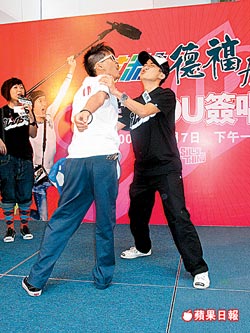
[029] Horse Fart Culture (10/07/2006) (Taipei Times) Chen Shui-bian tours military facilities. October 7, 2006.
陳水扁) conducted an inspection tour of various military bases on the Mid-Autumn Festival holiday yesterday to greet military personnel and thank them for their devoted service to the country. In his capacity as commander-in-chief, Chen visited Air Force Operations Command in the company of Minister of National Defense Lee Jye (李傑), Air Force Commanding General Shen Kuo-jen (沈國禎) and other ranking military brass.
(photo: Sam Yeh, AFP)President Chen Shui-bian (
Chen listened to briefings on joint operations of the Air Force and offered special bonus money to Air Force personnel as a token of his appreciation for their services during the holiday. The president then made a whirlwind tour of military bases around the northern military area of Linko (
林口), where he visited a military police base, a marine corps base and an army command base. Chen was welcomed by commanders and representatives of various military units stationed in Linko. Chen expressed his admiration for the high morale shown by all the troops in the units and their contributions to national defense.But ALL the Chinese-language media had a different emphasis (Apple Daily, China Times, United Daily, Liberty Times, ETTV, TVBS)
大帥哥!大帥哥!總統,總統大帥哥
At the military police base, the soldiers lined up and cheered:
巧克力!巧克力!你是我的巧克力! At
the marine corps base, the soldiers lined up for the photograph. At the
command: "1 That was yesterday. So what happened today? (TVBS)
At the naval base today, the ceremony took place behind a steel gate with the
media being kept 200 meters away. The media only saw the president
entering and leaving. In the Apple Daily
story, there is a listing of similar past examples of "horse's fart culture" ( [028] More
Media Misdeeds (10/07/2006) (Apple
Daily) Here is another case of media snooping on
celebrities. As with these cases, the offense was committed by
EastWeek and therefore Oriental Daily, The Sun and Sing Tao will be quiet,
whereas Apple Daily put it on the front page.
Here
are the details of the case: At 11am, October 1, an Indonesian national
Yuyun went into the Internsive Care Unit of Queen Mary Hospital in Hong
Kong. At the time, actress Lydia Shum ( Upon
investigation, Yuyun was found to be employed as a domestic helper by an
EastWeek editor. EastWeek subsequently issued a public statement that
the magazine does not approve of anyone entering a patient's room to gather
news; in this particular, the senior management had no prior knowledge of this
activity. This leads us to an actual
photograph of Lydia Shum coming out of the ICU. It appears on the front
page of Sudden
magazine, which is part of Next Media (and therefore a sister publication of
Apple Daily). Did this photographer have permission to do so? I
doubt it. If
not, then this would be a violation under Hospital Authority Regulations
Article 7 and the evidence is in the published picture. What gives? On September 21, the central displinary committee
workgroup in Shanghai gave its report on Shanghai party secretary Chen
Liangyu to the Central Politburo . The preliminary audit shows that
the illegal activities under Chen involved more than 10 billion RMB.
The report also noted that the work of the group was subjected to heavy
interference, including six statements from Chen Liangyu himself: -
"Someone wants to attack and hurt Shanghai. The goal is to debase
and negate President Jiang and use the excuse of anti-corruption to
marginalize Qinghong and Huang Ju." On
the afternoon of September 22, the Central Politburo met to discuss the
report. The Politburo secretary Wu Guanzheng provposed three
points: Based upon the audited material, Chen Liangyu is guilty of
severe job misconduct and shielding criminal activities. Therefore: At 1pm on the September 23, the
meeting continued and ended at 10pm. A vote was taken on the original
three points. The result was 6 votes in favor (including Zeng
Qinghong) and 3 abstentions (Jia Qinglin, Huang Ju and Li Changchun). On
the evening of September 23, Chen Liangyu was watching Liu Xiang winning the
110m high hurdles in the Shanghai track meet. At 8am, September 24,
Chen Liangyu took the special central government airplane to Beijing to
attend the meeting of the full Central Politburo. Upon arrival, he was
placed under detention. In the evening of September
24, Zeng Qinghong arrived and met with the Shanghai Party Standing
Committee. Representing the Central Politburo, Zeng announced the
decision on Chen Liangyu. He issued multiple warnings:
"Corruption in Shanghai is very serious. Do not think that you
are smart and try to take the initiative by appealing to the
higher-ups. The eyes of the people of Shanghai are snow-clear.
Their judgment is powerful. I repeat again: You cannot get out of the
problems. Do not fantasize that I will take care of this for
you."
I labeled this item "Fiction or Fact?"
This item contains the details from the Central Politburo meetings. How did
such information reach a Hong Kong magazine with a small circulation? Remember that there is only
a very small number of people who can have access to such kinds of details,
and the penalty for leaking state secrets is ... death. We are not
talking about the foreigner toiling at China Daily for whom there are not many
genuine state secrets to speak of, because these are the meeting minutes of
the Politburo.
You can decide if this is
"Fiction or Fact"? Whatever else, this is a gripping account
if you are not worried about the truth of the matter.
[026] Hong
Kong Referendum (10/06/2006) (The
Standard) Tsang challenger rejects poll plan. By Carrie
Chan.
The man chosen by a coalition of democratic groups to challenge Donald Tsang Yam-kuen in the chief executive election next March said Thursday a territory-wide referendum planned by a pro-democracy group for polling day is undesirable.
Civic Party legislator Alan Leong Kah-kit said referendums carried out by such groups would always be treated with suspicion and that academic surveys were preferable.
...
The Human Rights Monitor group had earlier said it planned to hold an unofficial territory-wide referendum on polling day with ballot boxes placed at schools, university campuses and, if possible, parks and playgrounds. Residents will be asked to vote on who they would like to see as the territory's leader, the goods and services tax and universal suffrage by 2012. For a previous Hong Kong referendum exercise,
see Hong
Kong By The Numbers and July
1 Afternoon March Estimates.
[025] The
Official Responses to the NTSCMP.com case (10/06/2006) As
unsatisfying as this is to some people, here are the official responses as
recorded by blogger Sidekick
who actually cared to ask the prinicipals directly:
(Netvitgator) With regards to your last email about the website (www.ntscmp.com).
Inform by our backend engineering department, the problem had been (Office
Of Telecommunciation Authority) With reference to your earlier complaint on blocking of access at the website www.ntscmp.com, we would like to reply as follow:
This Office has made enquiries to PCCW-IMS Limited and Hutchison Global Communications Limited regarding the issue. However, there is no evidence showing that they have wilfully blocked the website “www.ntscmp.com”. Therefore, this Office cannot take any regulatory action under the Telecommunications Ordinance at this stage. We will continue to monitor the situation.
Related Links:
"Chocolate!
Chocolate!
You are my chocolate!"
(note: based upon a commercial by entertainer Aaron Kwok for a chocolate
beverage)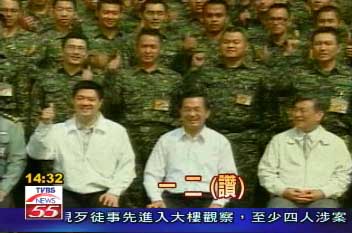
Video: 巧克力總統
(CTI TV via YouTube)
沈 殿 霞)
was awake, questioned Yuyun and summoned the police. The police
discovered that Yuyun was carrying a backpack whose strap contained a pinhole
camera. Yuyun was therefore arrested under Hospital Authority
Regulations Article 7: "Taking photographs/videos of a hospital patient
without permission."

- "The work group will not quit unless they can come up with
something. We must be mentally prepared."
- "70% of the macroeconomic adjustment is directed at Shanghai.
This is obviously aimed at attacking Shanghai, and also marginalizing
Qinghong and Huang Ju."
- "No one knows if the Shanghai party and government are completely
trouble-free. But if there are big problems, then I Chen Liangyu
wouldn't be so bold."
- "The Shanghai party committee raises both hands to support the fight
against corruption. But we do not accept using public opinion to
attack the city party commitee."
- "If there are any problems, don't tell the central government.
Who delights in ruining Shanghai? Please don't be so naive."
(1) Chen Liangyu shall be relieved of his job as Shanghai city party
secretary;
(2) A full meeting of the Central Politburo shall be convened to discuss the
Chen Liangyu problem;
(3) The Politburo shall announce that Chen Liangyu has been placed under
"double regulations" in Beijing, and his case will be presented to
the Sixth Plenum of 16th CPC Central Committee to decide.
Jia Qinglin, Huang Ju and Li Changchun opposed the three points based upon
these four reasons:
(1) the incident is still under investigation, so it is premature to reach a
conclusion and render organizaitonal decisions;
(2) a decision at this stage may led to political consequences, social
disturbance, economic ripples, international adverse reactions, etc;
(3) it is inappropriate to present the case to the Sixth Plenum of the 16th
CPC Central Committee due to social reception:
(4) the Shanghai problem shoulld be resolved internally within the party,
for the sake of the grand picture, unity, work and stability.
The meeting went from 2pm to 10pm without resolution. The meeting was
postponed until the afternoon of September 23. In the interim, former
Politburo members were apprised of these developments. Among the
former members, Jiang Zemin, Zhu Rongji, Liu Huaqing and Li Fengqing had no
comments, but all others supported the anti-corruption efforts of the
Central Politburo.
"A referendum on the chief executive's election organized by pro- democratic groups is bound to give rise to suspicion and criticism aimed at distorting public support," Leong said.
As such, Leong said, he preferred the findings of polls by Hong Kong University and the Chinese University.
According to Human Rights Monitor chairwoman Cyd Ho Sau-lan, pollster Robert Chung Ting-yiu of Hong Kong University's Public Opinion Program had promised to advise the group on the referendum.
"But," Leong said, "no matter how hard the organizer strives to distance the referendum from political groups, it will never be seen as an independent exercise."
事件的跟進
何許人誌
resolved. Please kindly try to access again.
So not the censorship on NTSCMP
Fluorescent Paradise
Brave
New World Hamish McKenzie, bc Magazine
The NTSCMP Affair: Final Words
Mister Bijou
ntscmp
[024] Brave New World (10/05/2006) This is the article titled Brave New World by Hamish McKenzie in the October 5th issue of bc Magazine about the Hong Kong blogosphere, covering bloggers Roland Soong (EastSouthWestNorth), the Central Blogger, Angus Ho (Dukedom of Aberdeen), Charles Mok, Io Lee and even Dr. George Adams (ntscmp.com).
[023] The
Most Awesome University Entrance Gate in the World
(10/05/2006)
Q: What university? A: Liaocheng
University, Shandong, China.
Q: How much did the gate allegedly cost? A: 80
million RMB.
Q: How many impoverished students can graduate with 80 million RMB in
financial aid? A: ...
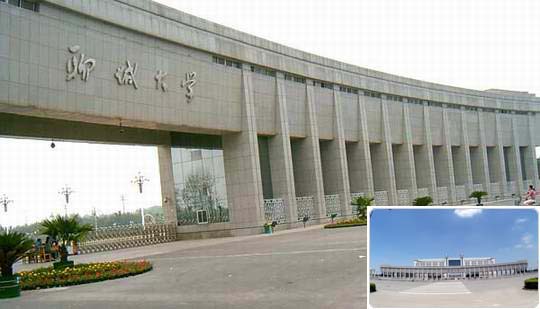
[022] The
Broadcast Schedule for Citizen's Radio (10/05/2006) (Ming
Pao) Citizens' Radio is the underground (and quite illegal)
radio station run by district councillor Tsang Kin-shing. Previously,
the police had raided and seized most of the equipment of Citizen's Radio
(see Comment 200608#110). So
here is the comeback schedule.
Yesterday, at the Mongkok pedestrian mall, Tsang Kin-shing set up a booth
for a two-hour broadcast session. Civic Party's Claudia Mo was the
host, and other guests included former radio host Raymond Wong, Democratic
Party Lee Wing-tat and Legislature Councillor Leung Kwok-hung. Claudia
Mo said that she was risking arrest to conduct the program, and Tsang
Kin-shing and Leung Kwok-hung said, "Arrest me!" The
spectators applauded them.
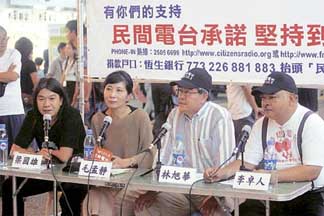
Tsang Kin-shing has the following schedule as long as he does not get his
radio broadcast license:
Two weeks later, he will broadcast from outside the Office for
Telecommunication Authority;
Another two weeks later, he will broadcast from outside Government House.
[021] All The News
Not Fit To Print (10/05/2006) (SCMP) A suspected mainland illegal immigrant who apparently hid under a cross-border bus to sneak into Hong Kong died yesterday after he was dragged for about 100 metres under the vehicle in Yau Ma Tei.
The accident happened at about 10.45am as the bus, carrying more than 10 passengers, was travelling along Jordan Road. Police said the victim was found trapped under the right front wheel of the bus after he was dragged along.
A passer-by banged on the door of the bus to alert the driver to the incident at the junction of Jordan and Nathan roads.
The victim was freed by firefighters and taken to Queen Elizabeth Hospital, where he was declared dead at 11.13am. No identification documents were found on him.
What about the parts that were not not to print? You'll find them in
the Chinese-language media (Apple
Daily, The
Sun, Oriental
Daily)
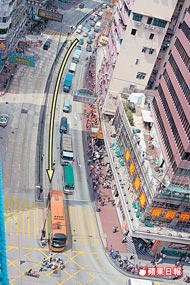
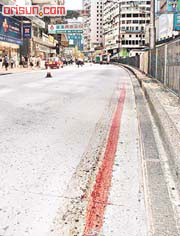
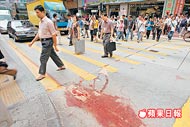
As for the really disturbing stuff of the deceased man, here are photo
1 and photo 2.
[020] Alex
Ho Forgets About His Memoirs (10/05/2006) (Ming Pao via Yahoo!
News) Kwun Tong district councillor Alex Ho was detained in
Dongguan (China) for patronizing a prostitute in 2004. Ever since
returning to Hong Kong, he has been writing a book about his
experience. He said that from September to November last year, he
received three very "strange" phone calls from people who asked
him not to publish the book, including from persons who claimed to be with
the Ministry of National Security: "I want to let you know that your
book cannot be published. Do not think that you are safe just because
you are not coming back to mainland China. You think about
it." Ho said: "I wondered myself if this was really from the
Ministry of National Security. I cannot prove that it isn't."
At the moment, Alex Ho has put his publication plans on hold. He said
that he had contacted three or four publishers: "They were very
enthusiastic at first and said that they would discuss with me
further. Then they do not respond in spite of follow-ups."
He said that nobody has seen the manuscript so he does not know if it was
the sensitive content that caused the "Ministry of National
Security" person to call him. For the sake of safety, he has
decided to put the book on hold. Since then, he has not received any
more "strange" phone calls.
Now this case probably deserves a review because one should not take Alex
Ho's word for everything. When the case first broke out right before
the 2004 Legco delections (see The Headline News In Hong Kong - Part 2),
the Democratic Party immediately went into the attack mode against Communist
intervention. This was immediately followed up by disclosures of the
case details by the Dongguan Public Security Bureau that the Democratic
Party had not been aware of. The Democratic Party backed off from its initial claim of political
persecution.
When the western media began to take up the cause of Alex Ho, the Dongguan
Public Security Bureau held an unprecedented press conference in which they
produced the photographs and other evidence (see The Headline News In Hong Kong - Part 4).
It was impossible for the Democratic Party to rebut the evidence while Alex
Ho was still being held incommunicado.
When Alex Ho was finally released back to Hong Kong, he called for a press
conference that will go down as one of the most bizarre episodes in history
(see Alex
Ho Meets The Press). I watched it live on
cable tv news and I am afraid that no written report could convey the
bizarre atmosphere. I heard about one of those miracles in which
"I was talking to this ordinary karaoke DJ female friend in my hotel
room at 4am and suddenly my clothes fell off my body."
My theory in the unfolding of this case was that the Dongguan Public
Security Bureau was being purposefully reactive in this information
war. They were going to let the other side dig a hole and bury
themselves. They let Alex Ho and the Democratic Party make whatever
assertions, and then they retaliated massivelly with photographs and
descriptions against their opponents who either did not have the information
or did not want to address the details. It was no contest.
Some tabloid magazines/newspapers will have a field day in Hong Kong if and
when Alex Ho publishes his book, because they will receive the complete file
(such as more explicit photographs, confessions and descriptions of sexual
performances) on Alex Ho from the Dongguan Public Security Bureau.
That is the real threat to Alex Ho, and not some anonymous phone calls.
[019] Party
ID (10/05/2006) How would the partisans defuse the disaster
known as homosexual pedophiliac Republic Congressman Mark Foley? This
screen capture is an all-time treasure (via Daily
Kos). On Bill O'Reilly's show at Fox News, Mark Foley is
identified as a member of the Democratic Party!
Way to go, Bill!z
[018] The Hong Kong Situation (10/05/2006) (World Journal via ChineseNewsNet) On September 23, at the award forum of the National Endowment for Democracy in San Francisco, a group of overseas Chinese democracy activists discussed the situation in Hong Kong:
[in translation]
Between Hong Kong and mainland China, will China become like Hong Kong or vice versa? New Century Net editor Zhang Weiguo believes that Hong Kong is becoming like mainland due to the pressure from the Chinese Communists. Hong Kong Alliance in Support of Patriotic Democratic Movements in China chairman Szeto Wah pointed out that "if China does not democratize, Hong Kong will find it hard to move towards democracy."
Seton Hall professor Yang Liyu said that the Chinese Communists promised "one country, two systems" to Hong Kong but did not fulfill it. "It was empty talk." He said: "The Chinese Communists are stupid, because if 'one country, two systems' succeeds in Hong Kong, it will be very attractive to Taiwan."
Szeto Wah said that the two most important things in Hong Kong are to elect the Chief Executive and all the members of the Legislative Council through universal suffrage. He pointed out that universal suffrage will be difficult to achieve, because there are three thresholds: acceptance by two-thirds of the existing Legislative Council; agreement of the Chief Executive; approval by the National People's Congress Standing Committee. Although it will be difficult, Szeto Wah said: "Universal suffrage is a democratic demand. Even if we cannot get it now, we will persist to fight for it."
... Chengming magazine editor Wen Hui said that since the 1930's, the Chinese Communists have systematically infiltrated into the Hong Kong media, financial sector, universities and middle schools. "University students were the principal sources for the Hong Kong underground Chinese Communist Party." "Today the people and the democratic forces of Hong Kong are facing a very powerful anti-democratic hostile force, which has the manpower, financial means and political resources."
Speaking of universal suffrage in Hong Kong, former Chinese Academy of Social Sciences Political Research Institute director Yan Jiaqi said that just like the election of National People's Congress in mainland China, the Hong Kong candidates are the "official candidates." It is necessary to strive to abolish this system of official candidates. If Hong Kong can abolish this system of official candidates, it will be very influential in the mainland.
Chinese Association to Advance Constitutional Government chairman Wang Dan said that 500,000 Hong Kong people marched in the streets on July 1, 2003 to oppose the Article 23 legistlation. This showed that there is a stable middle-class that will be helpful towards gradual development of democracy. The democratic demands of the Hong Kong middle-class also encourged the Chinese middle-class to demand the same.
Democratic Constitutional Government Forum director Wang Juntao said that the mainland suppresses democracy in Hong Kong because it is afraid that the democratic voices of Hong Kong are threatening mainland politics.
New Century Net chief editor Zhang Weiguo said that the Chinese Communists have infiltrated in every aspect of Hong Kong. He said that many mainland Chinese admire Hong Kong media. But the Chinese Communists are not only oppressing the mainland media, they are also using very methods to "transform, co-opt and divide Hong Kong media." Therefore the Hong Kong media appear to be sliding backwards.
Zhang Weiguo therefore said that the question about whether "the mainland is becoming like Hong Kong or vice versa" is answered by "the pressure from the Chinese Communists is increasing everyday, and the mainland-ification trend is beginning to impact the lifestyle of the Hong Kong people."
[017] How To Annoy A Lot Of People, If You Must (10/05/2006) (
雅阁女) has been red-hot popular.[in translation]
In the last couple of days, an ordinary netizen known as Accord Girl (
The reason why she is red-hot is because she has uploaded several videos to promote the adulation of rich people. In this most recent video, she even proclaimed that "anyone who makes less than 3,000 RMB per month is lower-class." Here is part of what she said:
... In my view, earning less than 3,000 RMB per month is basically lower-class. Isn't that so? For a woman, the monthly expenses are definitely far higher than this number. Take me as an example: I buy clothes first, next I buy cosmetics, then finally I have entertainment expenses. What would 3,000 RMB be good for? Don't tell me the reason you make so little money was not your fault. If you are as good as I am and you take your work seriously, you can be like me and become a high-quality established white collar person. I know that people will be suspicious of what I say, but it does not matter what jealous people have to say. I only want to say that instead of being jealous and condemning, you ought to try working harder. It is not shameless of me to start this website, because this is the reward of my hard work. As for those who make less than 3,000 RMB per mmonth, you are lower-class because your work ability is lower-class.
Unsurprisingly, the video drew enthusiastic condemnatory responses. Supposedly, the video has drew more than 5.8 million viewings.
When I saw this news, my first response was to wonder if this yet another brilliant promotional strategy. ... Here are my doubts:
1. Why promote the adulation of wealth? Adulation of wealth is not unusual, but why promote this viewpoint on the Internet? This Accord Girl is not a preacher of ideas, so why was she so enthusiastic about promoting this viewpoint? Besides, promoting the adulation of wealth will definitely draw attacks on the Internet, so why did she pick this risky topic? I can only wonder if she chose this "sensitive topic" precisely because it is the easiest topic to arouse disseimination and controversy, and hence create a hit.
2. Why use a video? To express one's viewpoint, it is definitely easier to write rather than to take DV and then post the edited video on the Internet. Why did she forsake the easy method and chose the complicated one?
3. Why did the video first appear at Qyule.com, a video website? For the entire incident, the biggest beneficiary is this website. Why did Accord Girl choose that website? Could Accord Girl herself be a hired gun for this website?
4. Why didn't she show her face? If she is using videocast, it means that she thinks words were not enough. If she doesn't want to show her face, she should post an audiocast. This makes me even more suspicious that this was an action to promote the video website.
[Addendum: This post contains a spoof video at the bottom with the title: When Accord Girl meets the world's richest man Bill Gates]
Related Link: The Most Popular Forum Post Ever In China; Internet mobs hunt Accord Girl Jeremy Goldkorn, Danwei
[016] Raymond
Wu: In Memoriam (10/04/2006) (SCMP) National People's Congress (NPC) deputy Raymond Wu Wai-yung, who was also a renowned cardiologist in Hong Kong, died in Queen Mary Hospital yesterday, aged 69, suffering from acute leukaemia.
Through out this website, there are scattered mentions of Raymond Wu.
He lived in the same building as my family for decades. My dealings
with him are three-fold. First, he uses my parking space for free
because I don't have a car; in return, his wife sends over mooncakes and
other stuff during festival tiime. Second, this is with respect to the
affairs of the apartment building (for example, he was the doctor in The
Dinner Conversation). He was the chairman of the board of
directors in the building. Thirdly, he is a doctor and therefore I
have asked him to come over to check on my mother in emergency situations (always
without charge). Before my father passed away, he was also a great
help on medical issues (such as arranging for emergency hospital
admissions). So here I want to show my appreciation for his kind help
to my family over the years.
In case you wonder, I have never spoken politics with him. He does not
know that I write a blog; actually, he may not even know what a blog is.
And then there is his famous quotation: Hong Kong people have lost their fighting and entrepreneurial spirit. It's because they have been fed too many dog biscuits
Raymond Wu speaking at a forum on constitutional development in February 2004.
If you read The
Dinner Conversation, you may understand better where this sort of
thing comes from.
Related Link: Fearless Dr Wu loses battle with leukemia.
Justin Mitchell, Michael Ng and Carrie Chan, The Standard.
[015] Minimim Wage in Hong Kong (10/04/2006) (Apple Daily) By
[in translation]
... I was in Mongkok and I saw people collecting signatures to support legislation on minimum wage levels. It is normal to want to go and sign up. With one stroke of the pen, the various large, medium and small enterprises will live up to their consciences , increase the pay to the lowest paid employees and reduce poverty incidences. So how can one not sign?
The problem is, What are the consequences after the legislation on minimum wage levels is in place?
An employer hires several employees who are being paid HK$20 to HK$25/hour. After a minimum wage of HK$30 per hour is mandated by law, the payroll has gone up by 30%. If the employer can raise prices and transfer the additional costs to the customers, that would be best. But in a competitive market, it would be not easy to raise prices by 30%.
If cost transfers to the customers cannot be achieved, the employer will have to reduce the headcount. Who to release? Under the new rules, HK$30/hour is mandated. Should you retain the employee getting HK$25/hour or the one getting HK$20/hour right now? The answer is obvious. Under minimum wage laws, the first ones to lose their jobs are the poorest paid ones with the least amount of skills.
So the ones who used to get HK$20/hour by working with their hands to earn their living now have no jobs. Unemployment welfare is just about the only option. Once one goes on welfare, it is not just a matter of dignity because it is very difficult to get out of the welfare trap. Once accustomed to not working, it is not unusual to lack the motivation to return to society. Besides, the longer one is away from work, the further one is disconnected from society and it is harder to find work.
In the market, there will no longer be any HK$20/hour work. That is, one cannot find such jobs. In desperation, the other choice is to become an illegal cheap laborer. Whenever there is a minimum wage law by which bureaucratic means were used to interfere with prices and distort the market, underground markets emerge. In the underground market, there may be some HK$20/hour jobs. But there are obviously many disadvantages in switching from the former legal job to an underground job which offers no legal protection. Either unemployment or underground job? How can this be said to help?
The noteworthy thing is that those who support this legislation rarely mention the basic problem: Why are the market prices for certain types of jobs so low? From another angle, why are there so many people fighting to get these low-skill jobs and thereby depressing the wage levels? There are at least two reasons:
Firstly, it is an age-old problem. The Hong Kong economy is changing its structure. Certain sectors are contracting, even disappearing. If one cannot switch sectors, one has to get take a low-skill job. Secondly, ever since the daily 150 quota of immigrants was established, more than 50,000 people come from the mainland to stay in Hong Kong each year. The law stipulates that the new arrivals cannot obtain welfare payments for the first seven years, and therefore quite a few of them will actively look for low-skill jobs.
If the Legislative Council passes minimum wage laws, some people will benefit but others will suffer, especially the ones who are least skilled and most marginalized. Is turning employed poverty into unemployed poverty considered to be mission accomplished? Whatever else, this is obviously not solving the poverty problem. The next time that someone tries to sell you the idea of signing in support of minimum wage, please ask: What happens if minimum wage raises income for some people but causes others to lose their jobs? Is this actually going to hurt the workers at the very bottom? ...
[014] Chairman
Mao Killed in Taiwan (10/04/2006) This is a follow-up to the
story about the Taiwan tourist bus which tipped over and resulted in 6
deaths and 15 injuries. As listed in China
Post, "the five Chinese tourists who died included two men -- Zhao Shifeng and Wang Lixian -- and three women -- Wang Shaofei, Li Huimei and Liu Hung."
So why was the heading of this item, Chairman Mao Killed in Taiwan?
That is because Wang Lixian was an actor who often portrayed Chairman Mao
Zedong (see Wang's photograph below).
[013] The
Chinese Medicine Exam Scam (10/04/2006) (Yanzhao Metropolis
Daily via Wenxue
City) How do you get a license to practice Chinese
medicine? You have to take an examination, and that means you have to
know your stuff. What if you don't know your stuff? Well, you
can try to cheat.
In the city of Baoding (Hebei province), several hundred examinees responded
to flyers from the Qiyou Exam Training Center and paid anywhere between
2,400 to 5,500 RMB to ensure that they pass. What is the gimmick
here? The Center promised to provide a wireless ear phone through
which the answers to the questions will be given while the examinees are in
the examination hall.
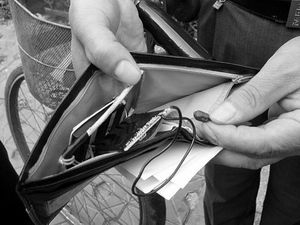
According to one examinee, "On the day of the exam (September 23), I
went early in the morning according to the instructions from Qiyou to a
certain hotel in Baoding. Qiyou had hired the entire hotel. Once
I got there, they gave me a wallet which contains a magnetic card and a
micro-earphone after I pay the money. The place was packed, and there
were at least several hundred people."
So what happened? The exam began at 9am and lasted 2-1/2 hours.
These examinees went in and then they waited for the answers which never
came. At around 10 minutes before the end, a voice came through the
microphone: "Our inside sources cannot get out of the exam hall, so you
must try to answer on your own." Thus, there were several hundred
blank booklets in this exam.
What happened here? The operational model would be for a Qiyou person
to pretend to take the exam, memorize the questions and then leave
immediately (by faking illness or some such). Once outside, he would
recite the questions for the experts to compose the answers that will be
delivered over the air. However, the exam hall regulations had been
modified so that no one can leave before the finishing time.
How about a refund? Once the examinees got out, they went to Qiyou and
found the place shuttered. The principals had fled with all the
money. Why wouldn't they? What were the clients going to
do? Call the police?
[012] The
SOGO Case (10/03/2006) (China
Post) The Presidential Office expressed satisfaction with prosecutors' decision to drop the probe against first lady Wu Shu-chen in a case that alleged she received gift vouchers for free and could have intervened in the transfer of the ownership of Pacific Sogo Department Store.
... The alleged improper receipt of free gift vouchers by President Chen Shui-bian's wife was one of the major factors that sparked the ongoing "anti-corruption and depose-Chen" campaign in Taiwan seeking to oust the president.
What do the people think? Here is Apple
Daily's instant telephone phone poll (sample size 540; date October
2; computerized voice interviewing). In the SOGO case, Douglas Hsu
will be prosecuted but the President's wife took NT$270,000 in gift vouchers
and go free. Can you accept this outcome?
- 70.7% unacceptable; 24.2% acceptable; 5.0% don't know/no opinion.
Why is there so much incredulity?
This goes back to the chronology of the case (see Apple
Daily):
April 8, 2006: The President's Office said that the President's wife Wu Shu-chen
did not receive hundreds of thousands in gift vouchers from Lee Kuang-chun.
Since all vouchers are numbered, it is easy to verify.
April 10, 2006: The President's Office said that Wu Shu-chen
did not have the SOGO vouchers, and therefore there is nothing to match
against.
April 13, 2006: President Chen Shui-bian swore that if his wife Wu
Shu-chen or any other family member accepted SOGO gift vouchers from any of
the four accused persons, he will resign.
April 13, 2006: The President's Office said that Wu Shu-chen used
just over NT$30,000 in SOGO gift vouchers which were purchased along with
friends.
June 20, 2006: President Chen Shui-bian said on television that no
SOGO gift vouchers were directly
received from the accused four and there was no interference with the
corporate ownership battle.
July 9, 2006: Wu Hsu-chen was interviewed by the prosecutor and
admitted that she received SOGO gift vouchers from the family physician Huang Fang-yen
as a present to her grandsons. Huang had received those vouchers from
Lee Kuang-chun as a present. Wu Hsu-chen said that she was personally
unaware of the source of the gift vouchers. Those gift vouchers were
then given to the President's daughter to spend.
September 5, 2006: In Palau, President Chen admitted indirectly
that apart from the SOGO gift vouchers purchased directly, Huang Fan-yen
also took gift vouchers from Lee Kuang-chun's sister and gave it to his
grandsons as New Year presents.
The incredulity is derived from a lack of trust in a president who seems to
admit (and only admit) to wherever the latest evidence diiscloses and who
plays legal word games. The televised statement about gift vouchers
not being received directly immediately
led people to conclude that gift vouchers were indirectly
received. But instead of dealing with the issue head-on, the
President's Office retreated behind the wall of silence of not commenting on
a case in progress. If that excuse were really true, then the
televised speech should never have taken place. But the net
consequence was that the public discourse was ceded to more criticisms and
speculations without rebuttals, thus piling more damage to the reputation of
the president and his family.
[011] No
Comments at Mary Ma (10/03/2006) Recently, I read somewhere a
study in which it was reported that 95% of convicted corrupt
government/party officials were found to keep mistresses (one or
more). So when Shanghai party boss Chen Liangyu fell from grace, it is
natural to ask: How many mistresses? And who are they? The first
rumor referred to an unnamed "top model." The next project
is obviously to name that model.
(Apple
Daily, Apple
Daily) This is Shanghai and the most famous model is Mary Ma
(Ma Yanli

[010] How
To Destroy Your Local Tourist Industry (10/03/2006) (Ming
Pao) Here is the photograph of Mrs. Zhang, a mainland tourist
visiting Hong Kong for the purpose of fulfilling the dying wish of her
lung-cancer-afflicted husband to visit Hong Kong. The couple joined a
tourist group of 43 senior citizens from Qinghai. When visiting the
Avenue of the Stars, their local tourist guide demanded HK$280 per head when
in fact the locale was a free public space. The tourist guide also
told them: "You must buy stuff in Hong Kong or else you will have to
sleep in the street."
The tourist guide Ms. Hui denied all these charges. But so what?
This is the headline story in Ming Pao with the photograph of the weeping
Mrs. Zhang who said, "I cannot believe that I would get exploited in
China."
(Oriental Daily via Yahoo!
News) A Mr. Wong who had been a tour guide for two decades
told the newspaper that some tourist groups which did not accumulate enough
purchases were then taken off their scheduled siteseeing and punished to
spend several hours at the Wo Hop Shek crematorium instead.
Furthermore, Mr. Wong said that the travel agency was paying the restaurants
HK$13 per meal per tourist. After deducting regular expenses, that
left HK$6 for food. What kind of quality do you expect as a result?
Meanwhile over in Taiwan, a bus carrying mainland Chinese tourists tipped
over resulting in six deaths and fifteen injuries. Here are the six
dead bodies laid out on the front page of Apple
Daily.
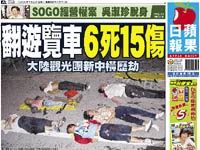
Apple
Daily also described the lightning-fast 6-day package tours that
covered all of Taiwan as "
[009] The
Japanese
Military Police Baby (10/03/2006) For the Ming Pao report
on The Shanghainese in Hong Kong,
I supplied a photograph of my mother holding me in her arms.
With due respect, I was a horrid-looking baby. Here I need to invoke Comment
200512#032 titled The Deep Roots
of Anti-Japanese Feelings in China:
日本憲兵)! He has overflowing excess flesh on his face (面上賤肉橫生)!" And they would still think that this is a cute baby! As I said, in Chinese culture, the Japanese owns certain conceptual realms. We are much less likely to hear this particular characterization nowadays, since the younger generation wouldn't know much about Japanese military policemen. But that was then, and I hope that you understand why my elders get upset when someone says that the Japanese came to China to bring economic co-prosperity. After all, they had to bow in front of the Japanese military policemen every time that they passed the guard posts of the Japanese Imperial Army.... I was a fat baby. How would you describe a fat baby? Maybe as a cute little bull-dog? Well, my elders would rather use: "Oh, this baby looks like a Japanese military policeman (
[008] North versus South (10/03/2006) The problem with media interviews is that when I read the published report later, I wish that I could have been more explicit on certain things. In The Shanghainese in Hong Kong
[007]
The Income of the Zhengzhou Mayor (10/02/2006) (The
Sun) To showcase a transparent government, Zhengzhou officials
recently interacted with netizens on the government website. When one
netizen said that he wanted "very much like to know the annual income of the
Zhengzhou mayor," the response was that this was "private
information that does not need to be disclosed to society." This
was not the right answer for the netizens. The mayor is a public
servant, and it is strange that his employer (the people) is not allowed to
know how much he is getting paid.
The problem here is that there are white, grey and black incomes in China.
The white income for public servants is based upon the position, rank and
seniority and it should be easy to figure out the salary for a mayor of a
city of the size of Zhengzhou.
The grey income is based upon the bonuses that are issued by the specific
units. This is discretionary, and exists at all levels from the
central government leadership all the way down to the grassroots
cadres. Revealing the size of the bonus may cause some problems with
the unit because it may be too large or too small, but it is not necessarily
criminal to hand out bonuses.
The black income is money obtained from corruption. Disclosure of such
incomes leads to prison time, or even the death penalty. So no
official will even discuss the potential existence of such types of income,
much less the actual amount that they are getting.
[006] Free Newspapers in China (10/02/2006) (Oriental Daily; no link)
[in translation]
Following the footsteps of free Shanghai subway newspaper Metro Express, the free Yangcheng Metro debuted yesterday in Guangzhou and Beijing is anticipating its own free subway newspapers.
Traditional newspapers are finding it harder to compete against the electronic and Internet media. This is a problem common across the globe, and mainland Chinese media are no exception. According to the new Chinese Media Blue Book, mainland's traditional media has slowed down its growth due to the loss of younger readers and the shrinkage in sales while advertising revenues has fallen after twenty years of high growth. Meanwhile, the new media on the Internet are getting about 70% increase per annum in ad revenues.
The loss in newspaper circulation and effectiveness is the result of the struggle with Internet media. Ironically, the Internet media used newspaper contents to establish and consolidate their positions while the newspapers became the cheap laborers for the Internet media. In recent years, the global newspaper industry is trying to leverage their advantage in content to find a way of survival. The first model is to publish free newspapers to regain the readers and fight for advertising based upon the huge circulation. The second model is to establish their own websites and earn money through paid content and advertising. The third model is to develop new media such as mobile phone news, online newspapers, online magazines, and so on. Of the three models, the third is the most promising and visionary.
Most mainland newspaper lack brand equity and their contents are vastly similar. Thus, they depend less and less on circulation and more and more on advertisements. That is why free newspapers have come out. The subway is an important transportation mode in a modernized city. So just like overseas and Hong Kong, the subway newspapers are appearing in the large cities that have subways. It is expected that this will lead to more intensive competition and market reforms, although the authorities would not be loosening their strict controls over the media.
[005] Public
Art? (10/02/2006) Take a look at the following photograph
which appeared in Apple
Daily. There are four dogs perching on top of computer
monitors on the beach of Big Wave Bay (Tai Long Wan) at Sai Kung (New
Territories). What a strange sight!
What is the symbolic meaning of this piece of public performance art?
It turns out that there is no symbolic meaning. Recently, about a
hundred computer monitors appeared on the beach, believed to have fallen off
a smuggler's boat and washed ashore. Citizens walking their dogs came
over and set up this photograph. But it is a strange sight.
P.S. South China Morning Post carried a photograph of the computer monitors
without the dogs. It was much less powerful.
[004] September
2006 Website
Statistics (10/02/2006) For the month of September 2006, the total
website statistics were:
- 4,075,268 hits (including htm, jpg, gif, wmv, xml, etc)
- 482,805 page views (htm files only)
- 429,414 unique sessions
- total time spent = 78,977 hours
On an average daily basis:
- 135,842 hits
- 16,094 page views
- 14,314 unique sessions
- 11:02 time spent per unique session
[003] The
Kaohsiung Rally (10/01/2006) (Taipei
Times) At a rally in Kaohsiung yesterday celebrating the Democratic Progressive Party's (DPP) 20th birthday.
Organizers said 350,000 people took part in the march, but an initial police estimate put the crowd at 105,000.
Apple Daily did not use this story on the front page. Instead, the
front page was about how a famous cosmetic surgeon was kidnapped and
tortured.

But there is an story inside Apple Daily about the rally with this
photograph:
The media were perhaps more interested in the media 'boycott' or possible
violence (see Comment 200609#104).
Apple
Daily has this coverage on the media boycott: "The Southern
Taiwan Society once again asked the people of Taiwan to boycott 'red media,'
specifically China Times, United Daily News, CTI TV, ETTV and TVBS and
recommended these named 'red media' not enter into the event venue
yesterday. The police deployed more than 100 officers around the television SNG (Satellite News Gathering) vehicles. During the
procession, Southern Taiwan Society members raised white banners and chanted
"Don't watch CTI TV, don't watch TVBS" but they were prevented
from approaching the vehicles. According to a scholar, any person or
group may disagree with the media ideas and they can also initiate consumer
boycotts. "But to ask the media to stay away from specific
situations is very inappropriate." Most of the named media
declined comment, only saying that they were concentrating on doing their
jobs.
Here is the special column at China
Times by Lin Yulin (
轟趴)" only for people in the green camp.[in translation]
In the anti-Bian and pro-Bian movements, the diversity of the media is a valuable part of freedom of press. Regrettably, the Southern Taiwan Society wants certain media outlets not to cover the birthday celebrations of the Democratic Progressive Party. Not only does this kills freedom of press, but it mistakenly regards the DPP birthday celebrations as a "home party (
The media are the means by which information is communicated. Through the media, strangers who are hundreds of miles away can know about our demands for or against Ah-Bian. But the information can only be communicated through the media.
... The Southern Taiwan Society was worried that the 20th anniversary celebration march would result in a recurrence of the 916 Taiwan Society attack on the media, and therefore hoped that the five "red media" would not be at a "green event." ... The DPP birthday celebration is a mass event listed on the itinerary of the President and Vice-President, and the media are obliged to be present. The Southern Taiwan Society is not the event organizer, so it is presumptuous for them to demand certain media not to gather news.
The roles of the media in the struggle between the anti-Bian and pro-Bian sides are controversial. But monitoring and evaluating media are a different matter from banning media news gathering. Banning media coverage is like a king who refuses to listen to displeasing sayings and prefers to stay shuttered in his own frame. After all, the more extreme the oppositions, the more room is required for rational debate. This is the same for the masses and for the media. The politicians want the media to take off their colored lens, but certain short-sighted politicians also need to wear corrective lens before criticizing the media.
The clash between the anti-Bian and pro-Bian sides brings an opportunity for civic lessons for Taiwan. If these clashes can gradually lead society to know their media better and also lead the media out of the former mechanistic reporting of north-south Taiwan, this may be the best outcome for Taiwan society.
[002] The National Anthem Videos (10/01/2006) (Ming Pao) By
心繫家國 and 心繫家國), and suddenly the discussion within the classroom got heated.[in translation]
A few days ago in the classroom, I discussed with the students about the complex relationships between national identity and cultural identity. A student mentioned the civic educational short film produced by the Hong Kong SAR government (see
One student said that this stream of video images accompanied by music did not "provide any surprising delight" and therefore he/she never paid careful attention to the contents. Another student said that this short film was a severe "hard sell" and "very disgusting." Another student said that when the short video first appeared, the introduction of the national anthem was bone-chilling, but after so many prime-time exposures, he/she has become numb. I do not have large amounts of supporting data, but my overall impression was that this video was not popular among 20-year-old university students.
After class, I went to YouTube to search for other related movies and accidentally came across a spoof video created by a local netizen (see
心繫膠國). The video used the same national anthem as background music, but it included sarcastic images such as fake watermelons, pirated video games, urinating at the Great Wall and other things ... I think that whether this is about the complicated relationships between national and cultural identifies whereby you decide whether you are a Chinese person, or whether you sneer at the spoof video, it is worthwhile for us to celebrate the freedom of information in Hong Kong before this piece of counter-propagandistic video got intentionally banned by someone (or the Internet service provider).[001] Best
Selling Book (10/01/2006) I'm flipping through this week's Asia
Weekly (Yazhou Zhoukan, October 8, 2006), and there are the usual
bestselling lists at the back. In Shanghai, the best selling book is The
Selected Essays of Jiang Zemin. In Beijing, that book did not make
the top ten bestsellers. I thought: That figures because this is the
Shanghai clique thing.
Then I read this month's Ming Pao Monthly (October 2006), and here is
Hu Hua (
[in translation]
In the past, various party and government organizations used their authority to compel grassroots members to subscribe to newspapers, thus causing hardship among rural cadres and teachers. For the past two years, the authorities realized that this was unacceptable and therefore ended this practice. Apart from a few party organs such as People's Daily and other party magazines, people can now subscribe on a voluntary basis.
But the nightmare has just returned. In August this year, The Selected Essays of Jiang Zemin were published, and the grassroots members were once again given quotas. Each county was given an exact quota to fill, and so the county committee had to distribute it to the towns, whose town committees had to distribute it to the villages, whose party members do not have reading habits. The Selected Essays of Jiang Zemin come in three volumes priced at 34 RMB, 30 RMB and 31 RMB respectively in the paperback editions, for a grand total of 95 RMB. That amount was more than the living expenses of a rural peasant. So it is understandable that people do not want to buy the books. When the books do not sell in the villages, the town authorities get worried because they don't know what to tell their county bosses. The towns do not have surplus budgets and typically have large debts, so they don't know how to accomplish the mission.
The publication of The Selected Essays of Jiang Zemin should have been an occasion for the current leadership to pay respect to the previous one. Although Jiang Zemin has retired, he is still formidable. Even though there was no formal celebration on his 80th birthday, the Central Document Research Institute collected some essays and the People's Publishing House published the volumes, just like they did for Mao Zedong and Deng Xiaoping. Hu Jintao gave a speech in Zhongnanhai to ask people to learn from the books, and that event was attended by the entire Chinese Communist leadership to show their respect.
... Mao Zedong was a charismatic figure. When he was alive, the Chinese people adored him like a god. His book of sayings was called the Precious Red Book and several hundred million people read them every day. His theories and words were treated as truth and his one sentence is worth ten thousands sentences from others. But from the 913 incident to the discussions of the standard of truth, the aura on Mao Zedong's head has been smashed. Meanwhile, Deng Xiaoping was a strong man and his selected works were published while he was still alive. The authorities organized people to learn from the works, but not on the scale for Mao Zedong. The party officials have simply appropriated whatever they needed from his works. The works of Jiang Zemin are really the end of the line, so it is a total farce to organize the entire party to learn from them. It is one thing to spend party funds to buy the books so that party officials can read them and put on a show. But to use a quota system to force rural party members and cadres to pay for them becomes a social disruption.
It is not certain whether these actions are meant to express love for former secretary-general Jiang Zemin, or to set him up for a fall.
Archives