[107] Top 10 News Stories For Hong Kong Middle School Students (12/31/2006) (Ming Pao) The following was voted by 95,000 students from 114 schools in Hong Kong in a poll conducted by the Hong Kong School Net:
1. Gillian Chung being photographed while changing clothes during a concert.
2. Bus Uncle Roger Chen's short video clip became an Internet hit
3. The scandals surrounding Taiwan President Chen Shui-bian and the resulting mass demonstrations
4. Smoking ban in public places was passed by Legislature and will take effect next year
5. Pluto was removed from the list of planets in the solar system
6. Off-duty police officer Tsui Po-ko killed another police officer and was killed himself
7. Margaret Chan became the first Chinese director-general of the World Health Organisation
8. Some Hong Kong middle school students are suspected of cheating in the School Certificate exams via mobile phone
9. Program hosts Sammy and Shiu Yee were suspended two months for running the Ten Actresses That You Would Like Most To Sexually Abuse contest
10. Zinedine Zidane ends his soccer career with a headbutt in Italy, which won the World CupAccording to the Hong Kong School Net spokesperson, there is no economic news in the top ten list and only three political news items made it. Certain events related to the development of the political system such as the snooping law and Alan Leong's announcement to run for the Chief Executive did not even make the top 30. This showed that the middle school students lack the ability to read and interpret political news and they cannot grasp the abstract principles behind those events. The spokesperson recommends schools to put in various types of news as discussion topics in general knowledge classes.
[106] Robert Ehrlich and Yu Shyi-kun (12/31/2006) (Apple Daily; Apple Daily) In defense of DPP's ban on China Times coverage, the DPP is citing an article by veteran media worker Lu Shih-shiang
[105] Summary
of Yu Shyi-kun PK China Times (12/31/2006) This is an explanation of
the post Yu
Shyi-kun PK China Times. As deep background,
the ESWN blogger is a media researcher (e.g. a person who conducts
television ratings, print readership surveys, Internet surveys, public
opinion polls, etc. around the world). As such, the ESWN blog has a
distinct media tilt. Thus, I am interested in censorship issues in
China (see recent long posts such as: A
Chinese Reporter And His Source, The List of Banned Terms in Xinhua News
Reporting, Top Ten
Sex-related Incidents In China During 2006, Beijing
News versus TOM.com, The Gao Qinrong Interview in yWeekend,
The
Gao Qinrong Interview in Southern Weekend, The
Gao Qinrong Interview in Southern Metropolis Daily in mainland China, Yu
Shyi-kun PK China Time in Taiwan and Star
Ferry: The Beginning of a New Social Movement? in Hong Kong). I am
interested in anything that affects the watchdog role of the media as the
Fourth Estate anywhere in Greater China.
Along comes the post Yu
Shyi-kun PK China Time. This is obviously a major step taken by a
political party against a media outlet in Taiwan. Specifically, the
DPP central has declared it will not accept any questions from any China
Times reporter until as such time when its current chief editor is
removed. In that post, I aggregated and translated these
reactions:
From the pan-blue camp -- KMT party chairman Ma
Ying-jeou and Legislative Speaker Wang Jin-pyng
take the position that they would not have done the same against any media
outlet. They refuse to condemn Yu Shyi-kun because they probably
realize that it is easier for Yu to self-destruct whereas their condemnation
would have made this a bi-partisan fight once again.
From the pan-green camp -- President Chen Shui-bian and Vice-President
Annette Lu said nothing. Premier Su tseng-cheng and former premier
Frank Hsiek both took the high road and said that they believe in peaceful
and rational interactions with the media, as hostile as this might be
sometimes but not beyond reasoning at this time. Many of the less DPP
figures (such as DPP caucus whip Ker Chien-ming)
have weighted in with regrets about Yu's action.
At Taipei Times, the editorial was titled: "Yu slaps himself in the
face."
From the Taiwan Journalist Association, the statement is that a politician
can always object to a specific piece of reporting through a demand to
retract/clarify or resorting to legal action otherwise. But to issue a
blanket ban on a media outlet (until its chief editor is removed) is an
infringement on freedom of press and the right of the people to know.
From the print media, all the editorial pieces are against Yu's action --
Liberty Times, Apple Daily and China Times.
In my blog post, I have summarized all the pieces from various parties that
I have come across the mainstream Chinese-language media in Taiwan. If you only read English, you may have not have
read all of them. So I was just collating the reactions and
translating them from Chinese to English as a public service. For balance, you can read Taiwan
Matters.
For comparison, I ask you to imagine:
At a Chinese Ministry of Foreign Affairs press conference, the spokesperson declared that no questions will be taken from New York Times reporters until as such time as their China bureau chief is removed on account of a specific article as well as what is perceived as persistent negative criticisms.
At a Hong Kong Government Information Office press conference, the spokesperson declared that no questions will be taken from Apple Daily reporters until as such time as its chief editor is removed on account of a specific article as well as what is perceived as persistent negative criticisms.
At a White House press conference, the spokesperson declared that no questions will be taken from the Washington Post until as such time as its chief editor is removed on account of a specific article as well as what is perceived as persistent negative criticisms.
Worldwide reaction would be overwhelmingly against those hypothetical decisions. This is the reason why Yu Shyi-kun was almost universally condemned across the board -- blue and green. Given all that is said, what would you do in Yu Shyi-kun's place? This is not just about your personal reactions, but also about your sense of global reactions from others. My purpose in going through those collations/translations is to pose that question to you, whether you are in mainland China, Hong Kong, Taiwan, the United States or elsewhere. If you believe that Yu Shyi-ku's actions are correct, please say so to the whole wide world.
[104] More On Gao Qinrong (12/30/2006) From the January 7 issue of Yazhou Zhoukan:
[in translation]
... On the second last Saturday of 2006, Gao Qinrong appeared at a certain Media Opinion Watchdog Discussion Forum organized by a certain university in Beijing. He was invited to attend and he made a speech. This was the first time in eight years that he faced the media from all over China and publicly told about his wrongful jail sentence.
... Gao Qinrong's sudden trip to Beijing was at the invitation of two renowned Internet portals. He held a highly publicized interaction chat session with netizens and he also met with reporters from many print media in Beijing. This was his first public appearance since coming out of jail. But on the day before the activities were to take place, the organizing website was informed by the relevant authorities that the event must be canceled.
On the next day, the event indeed took place, but the contents of Gao's speech was not published on the website. His meeting with the print media reporters was also turned into a simple meal. Next, the name Gao Qinrong became a keyword on the Chinese Internet. On the first day, "Gao Qinrong" would generate several tens of thousands of relevant news reports on the Internet. Shortly afterwards, such a search yielded zero results at one of the largest search engines in China.
... "Just arrest Gao Qinrong first and I can't believe that we cannot find something wrong with him." After Gao Qinrong was arrested, he head about the instructions from a certain senior leader in Shanxi province. "The people who ordered my arrest was Huang Youquan and Yan Huoping." At the time, Huang Youquan was the Yuncheng Administrative Department commissioner, while Yan Huoping was the public security director of of Yuncheng. Eight years later today, Huang Youquan is the director of the Yuncheng People's Congress while Yan Huoping is the Shanxi province public security bureau deputy director and the Taiyuan city public security director.
... Gao Qinrong denied the charges of bribery, fraud and pimping filed against him by the Yuncheng procuratorate. "Someone borrowed 30,000 RMB and repaid 25,000 RMB with a receipt. They said that I accepted a bribe. In 1996, I brought my daughter who was onl several years old to a hotel to visit a friend and I entered the wrong room. They said that I was pimping. This was based upon someone else's verbal say-so from two years ago." He said that he did not know whether to laugh or cry about the charges. "As for the fraud charge, I don't even know where to begin to talk about it."
[103] The
Curse (12/30/2006) (China
Times; Apple
Daily)
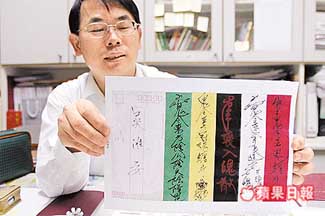
At am on November 29, 2006, National Yunlin University of Science and
Technology Legal Research Institute professor Wu Jinn-an said that he found
a letter addressed to him. Inside the letter were six pieces of paper,
one containing his name and the five were Taoists magic figures that invoke
the spirits from all directions to bring bad fortune to the named
person. The Institute director Chang Kuo-hua also received a similar
letter.
Wu then checked the closed-circuit television tapes and found this segment
at 10:44pm, November 29, 2006. It can be seen that a female wearing a
black suit and white gloves depositing material at Wu's and Chang's office.
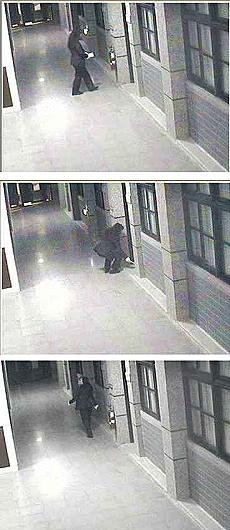
Based upon this video segment, Wu Jinn-an determined that the female was
assistant professor Wang Mei-hsin.
Yesterday, Wu held a press conference on the matter. Afterwards, Wang
told the press that she was indeed the person caught on video. She
said that she was only depositing a progress report of her cooperative
project with the Hung Sheng Cable Company. As for the white gloves,
Wang said that it was cold outside.

However, both Wu Jinn-an and Chang Guo-hua have denied having seen any
such plan, and the president of Hung Sheng Cable Company denied that there
was any cooperative project with Wang.
P.S. Previously, Wang Mei-hsin was Apple Daily front page material this year
(see Comment 200604#011).
[102] The
Departed Will Not Arrive In China (12/28/2006) (Apple
Daily) The movie The Departed was directed by Martin Scorsese
based upon a story from the Hong Kong movie Infernal Affairs.
The Chinese distributor was optimistic that the Hollywood movie could gross
over 50 million RMB in China. However, the movie has run into a stone
wall with the government censors. After two months of negotiations,
efforts have now been abandoned to bring the movie to China. The
censors insisted on certain cuts, but director Martin Scorsese has refused to edit his
film.
What are the 'sensitive topics'? In the movie, the American criminals
(led by the Jack Nicholson character) were attempting to sell some
high-technology chips to Chinese-American gangsters who want to sell them to
Chinese government officials. At the meeting, the Chinese-American
gangsters showed up with sub-machine guns. Jack Nicholson said:
"In America, we always deal with money in one hand and the merchandise
in the other hand. If the Chinese guys want to nuke Taiwan into
flatland, you better give me my million dollars first!"
[101] Mass
Executions (12/29/2006) Mass murderer Qiu Xinghua (see The
Psychological File of a Mass Murderer) was executed yesterday
50 minutes after the middle court rejected his appeal of the lower court's
death sentence.
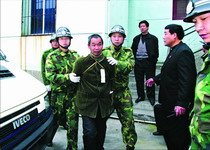
(Ming Pao)
Meanwhile, in Zhuzhou city (Hunan), seven persons were executed on December
26 following a public meeting. On December 22, the Sichuan provincial
supreme courtcondemned five persons to death in Yanshou county and executed
them immediately. Early this month, two murderers were executed in
Yucheng (Henan) were executed. On December 1, a murdering robber was
executed in Shenyang (Liaoning).
Why the spate of year-end executions? Pursuant to the decision of the
National People's Congress, the right to grant the death penalty in criminal
cases will be withdrawn from local courts and concentrated in the sole
possession of the National Supreme Court. The lack of judicial
independence in certain localities was the supposed cause of wrongful
executions in some cases. The Supreme Court is likely to be more
careful and less likely to impose the death penalty in the interest of
"maintaining social harmony and stability." Meanwhile, the
local governments are engaged in the 'reaching home before sunset.'
[100] Non-existent
IPR Violations (12/28/2006) Yes, we are present at a stage
when the earthquake south of Taiwan has broken several fiber-optic cables
south of Taiwan. Since the server for this website is located in
Southern California, many people in East Asia cannot access it. This
whole thing is a matter of catch-and-miss since this is a function of the
Internet Service Provider's setup. Some people in East Asia can access
this website, but others cannot. During this period, I posted The
List of Banned Terms in Xinhua News Reporting. This was
cross-posted at Danwei
with the foreword: "If you're on the Mainland and can't view ESWN
because of the earthquake-induced broken cable, you will have missed this
translation: Banned Terms in Xinhua News Reporting, a translation of a post
on the popular Tianya forum." The ESWN translation was then
published in full.
Should I be upset at this alleged IPR violation? Well, the original
post appeared at Tianya forum. I never asked the poster for permission
to translate. So what rights do I have? Furthermore, the
purported post was an original Xinhua internal notice, which would not be
released to the outside world anyway. So who am I trying to kid here
about IPR?
From my perspective, I spent several hours of my short life on this planet
to translate this item because I believe that it is informative, revealing,
instructive, whatever. I posted it on my website. I would like
to see this read by as many people as possible. If Danwei can generate
more readers, why would I be upset? I invite more bloggers out there
to re-publish the item, with or without acknowledgement to me. I am
therefore grateful to Danwei for making the message known to a broader
audience.
[099] Next Weekly Must Be Desperate For News Too (12/28/2006) This is the week between Christmas and New Year's Day, and it is a slow news week. The news is slow not necessarily because less is happening. Rather, the news is slow because many media workers are away on vacation and don't get to report or write. When they do write, it may be like me in this comment: This Blog Is Dying to fill in some space about why I don't have time to blog. I was therefore quite surprised to find that item being cited on Page 92 of this issue of Next Weekly!!!
宋 以 朗 係 統 計 學 家 , 佢
 濠 江 馬 場 作 過 實 證
調 查 , 發 覺 外 籍 騎
師 果 然 贏 面 較 大 。
西 人 零 舍 有 專 業 精
神 ?
第 二 度 唔 係 俾 人 釘
濠 江 馬 場 作 過 實 證
調 查 , 發 覺 外 籍 騎
師 果 然 贏 面 較 大 。
西 人 零 舍 有 專 業 精
神 ?
第 二 度 唔 係 俾 人 釘  牌 , 使 乜 去 澳 門 做
騎 師 ? 雖 然 係 咁 ,
外 籍 騎 師 始 終 較 有
專 業 精 神 、 搏 殺
牌 , 使 乜 去 澳 門 做
騎 師 ? 雖 然 係 咁 ,
外 籍 騎 師 始 終 較 有
專 業 精 神 、 搏 殺  咁 講 , 由 是 贏 面 較
大 。
咁 講 , 由 是 贏 面 較
大 。 唔 用 得 鬼 佬 二 字 矣
) 咁 有 專 業 精 神 ?
你 問 我 , 我 問 邊 個
?
唔 用 得 鬼 佬 二 字 矣
) 咁 有 專 業 精 神 ?
你 問 我 , 我 問 邊 個
?
I have previously described this
as being an "act of treason for profit (賣國求利)"
to always choose Caucasians over Chinese. I can defend this decision,
but it should not be mixed up with other situations. [Administrative Note]
(12/28/2006) When some fiber-optic cables were severed due to the
earthquakes, the traffic was re-routed to the surviving routes which were
overwhelmed. However, one might expect that there is much more traffic
going from Asia to the Americas (think Google, Yahoo, MSN, etc) than vice
versa. Therefore, the congestion is worse during daytime in east Asia
compared to nighttime. Thus, I cannot access my website and email
during the day in Hong Kong, but there is no problem at all late night
(2am-4am). So this is how this website is getting updated. [Administrative Note] (12/27/2006)
There was an earthquake south of Taiwan last evening. As a result,
some of the underwater fiber-optic cables used for communications have been
severed. Overall, Internet connections from Hong Kong to the United
States have been slow or non-existent. The server for this site is
located in southern California. While it is still possible to view the
web pages because this site has a minimalist design, I have not been able to gain ftp access. Therefore, I have
not been able to update the site (which means that you can't read this
message!).
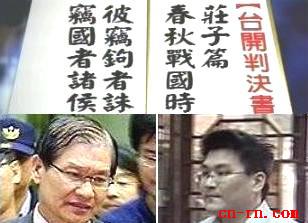
[098] Zhuangzi
on Justice (12/27/2006) (United
Daily News) At 3pm, the verdict of the Taiwan Development Corp
insider trading case was read out. The president's son-in-law Chao
Chien-ming ( [in translation] This
summer, my daughter returned from her studies in the United States.
Her American friend came to visit her in China in the fall, and then they
were going to go to Mongolia. When my daughter inquired at the
Mongolian embassy in China, she found out that Mongolia does not accept solo
tourists from China. This severely wounded my daughter's sense of
national dignity. Compared to Mongolia on every aspect, shouldn't
China be considered a large nation and a strong nation? Don't Chinese
tourists also spend American dollars in Mongolia? Later, I found out
that people from Taiwan and Hong Kong were not subjected to this
restriction. When I traveled overseas
in the past, I was always on business and therefore I had not suffered the
pains of getting a personal via. Earlier this year, I needed to travel
overseas for some personal matter. I found out what a lot of trouble
that was. At these foreign embassies in China, a passport does not
establish your citizen status. You need copies of your hukou
registration, you need a signed approval from your unit leader, you need
proof of the legality of your unit and you even need to provide evidence of
your assets as if all Chinese citizens go overseas to become refugees.
Which country's citizens are harassed this way if they want to come to
China? I also found out that the citizens of certain countries (e.g.
Japan) do not require visas to come to China. Obviously, Chinese
citizens should have the same rights but our government was willing to
forego. In other words, the rights of Chinese citizens do not seem to
within the protected zone of national dignity. Among
the civilized nations of the world, the treatment of their citizens
elsewhere is a major issue in terms of national dignity and diplomacy, even
leading to war sometimes. An American president had even pleaded to
another government to spare an American teenager from being caned. Actually,
China has always been a grand nation in the world. As late as early
19th century, China led the world in international trade. Therefore,
rather than studying the history of how the other nations rose, we are
better off reflecting on why China fell during recent history. One of
the most important issue is the system set-up with respect to the position
of the people in the country. If the citizens are still little people
with no constitutional rights (e.g. the nation continues to develop nuclear
weaponry while millions of its people are starving to death), then the
'rise' of this nation will be highly problematic.
[096] An
Unreported Crime (12/27/2006) (Ming
Pao) On December 21, a Guangzhou Daily reporter named Dong Zhe
at the Dongguan bureau was about to go home at 1am when he was kidnapped by
six men in a van. The men demanded Dong's ATM code. When Dong
refused to cooperate, he was assaulted. The men stabbed him thrice and
hit his arms and legs multiple times with an iron hammer. At 3am, the
men finally extracted the code from Dong and withdrew the money. They
threw the injured Dong in the wilderness where he was found the next morning
and sent to hospital. According to the doctor, the men did not want to
kill Dong, for his injuries were not fatal. However, the iron hammer
caused multiple soft tissue damage. [095] Undercover
Traffic Police (12/27/2006) (Apple
Daily; The
Sun) In Tsuen Wan (Hong Kong), there were complaints from
drivers, citizens and district councilors about the parking spaces on a busy
street being occupied by cars which do not feed the parking
meters. The police sent in an undercover officer to observe the
situation. When the report came back that there were many lapsed
parking meters, dozens of uniformed police showed up to issue parking
tickets. At issue is the fact that their tickets were based upon the
observations of the undercover officer. [094] Yet
Another WoW Scandal (12/26/2006) (Information Times via Sina.com)
It began with this post from
I am a single 20-year-old MOP user. I
want to find a handsome white-collar young man, preferrably a World of
Warcraft player so that we can have a common interest. Please contact
me at QQ418923XXX. Do not bother if you are not in Shanghai, or a
middle-aged uncle, or an under-aged boy. Then the following MOP post from
I am a 24-year-old man who has been working
in Shanghai for over a year. My monthly salary of 4,000 RMB will only
allow me to live frugally in this cosmopolitan city. I don't have any
special hobbies except for World of Warcraft in which I lead a guild of
about 100 people or so. Several months ago, I saw a MOP post from a
Shanghai girl who was interested in meeting a male WoW player. Last
Friday, she invited me out. We went to the BonBon bar in Huaihai
Middle Road. Then she suggested going to a hotel and we stayed there
until noon the next morning. (Tom.com)
From
1. I'm
2.
According to the MOP administrator, the IP addresses of
3.
[093] The
Hong Kong Residents Hotline (12/26/2006) (Ming
Pao) The Hong Kong Immigration Department maintains a 7/24
hotline (#1868) to assist Hong Kong residents when they are overseas.
This has proved useful in major emergencies such as the Southeast Asian
tsunami. On the average, the hotline gets about 100 calls per
day. While most of these are emergencies, some are distinctly peculiar
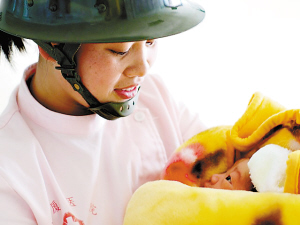
(apart from the usual wrong number dials to the lottery results (#1888)). [092] The
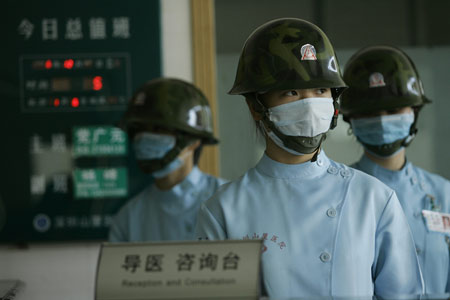
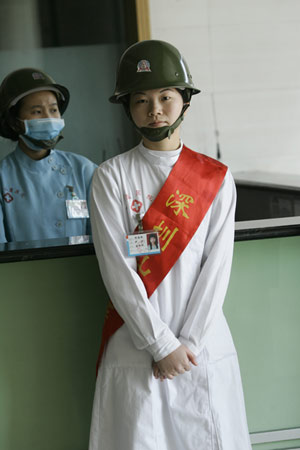
Nurses With The Steel Helmets (12/25/2006) (Guangzhou Daily via Dayoo)
At the Shanxia hospital in Shenzhen, the doctors and nurses have been
showing up at work wearing steel helmets. This has caused visitors and
patients to wonder about what is going on. The reporter asked a nurse
with a steel helmet, and she said: "We have no choice. The
hospital issued steel helmets to everybone for our own safety." [091] This Blog Is
Dying (12/25/2006) I apologize for the precipitious drop-off
in blogging rate recently. There are many reasons. The excuse for December 24, 2006 was that I
made a day trip to Macau. This was a non-trivial matter for this Hong
Kong resident who is a "parachutist."
When I stepped up to the Macau immigration booth and handed my Hong Kong ID
to the officer, she scanned the ID card, stared at the computer monitor
screen and asked me: "Mr. Soong, could it be possible that you have
never previously visited Macau before?" I replied:
"Yes. That's correct." Indeed, this is factually
correct and it is truly amazing that a Hong Kong resident of my age has
never ever stepped foot on Macau. This was my maiden voyage. [090] The
Naked Women On The School Uniforms (12/24/2006) (YCWB via Apple
Daily) In Guangzhou, a group of students were doing physical
exercises in the sports field when they were caught in a sudden
rainstorm. Amazingly, when their school uniforms got wet, various
silhouettes of naked women in different poses began to appear with as many
as thirty of them in one case. [089] Breaking
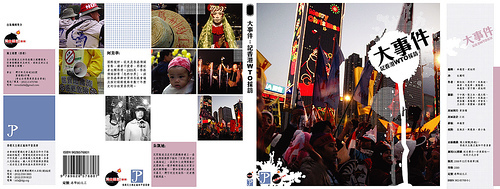
News (12/24/2006) Breaking News is the title of the
Johnny To movie. But here I want to present some advertisement for the
book titled <Breaking News: News Reporting about WTO Hong Kong>.
I am looking at a complimentary copy as the book is not distributed in Hong
Kong bookstores. If you must, you can contact inmediahk@gmail.com
if you want to obtain a copy. I think that you may recall the movie
<Breaking News> directed by Johnny To. This is a movie which
combines criminal-police shootings with news coverage. The people who
were interested in digging out the truth were unprofessional entertainment
reporters. The 'truth' of the event was the result of negotations by
multiple parties and there would be no final and conclusive version at the
end. The WTO coverage was like
"Breaking News." In consideration of the market for the
book, we decided to use the title <Breaking News -- News Reporting about
WTO Hong Kong>. When we began to
study the news coverage of the WTO conference in Hong Kong, we were not
thinking about publishing a book. But during the process, we found out
that every reporter who covered the WTO had some valuable exeprience.
One year later, the WTO MC6 is faraway and we have the time and space to
reflect on certain problems in news coverage in Hong Kong. Actually,
we are all concerned about news coverage in Hong Kong. Apart from the
standard issues of the free space of news coverage, reporters are concerned
about various other restrictions such as how news organizations operate, the
overwhelming public relations campaigns, the ignorance and indifference of
readers and reporters about social and international issues, advertising,
marketing, personal livelihood and so on. Whenever we see journalists
being arrested or harassed for their work, we will be extra concerned about
the freedom of speech. At the same time, society must have certain
expectations and criticisms of the reporters. They believe that the
media "guess" that "the market" (=readers) must like
certain infammatory and entertainment reports which increase
advertisements. Thus, certain publications end up invading personal
privacy or mislabeling certain social groups. Professional journalists
are distraught about these accusations, but they find it hard to deal with
these problems on their own. On the
other hand, independent media and blogs have emerged in recent years.
Dialogue is missing beteween them and the professional journalists, and the
debate became more heated during the WTO period. Therefore, we hope to
create a dialogue through this particular book. On account of our
background as reporters, we believe that we all want better journalistic
reporting, whether we are professional or civilian journalists. The
media are the instrument of the civic society and serve the "Fourth
Estate" function to monitor the government. In terms of news
gathering and interviewing, the media should proivde fair, accurate and
balanced reporting. It is also expected to show more social concern,
to present the diverse social voices and to provide more diversified views
and knowledge to the audience.
[088] Surveillance
(12/24/2006) Once upon a time at the Central Park Track Club website,
I ran something known as a Global Surveillance System (tm) (see Google
search) that kept track of what my teammates did around the
globe. Prior to that, I was the FBI/DEA expert translator on
surveillance tapes (see Translation and its Discontents).
So this leads me back to Hong Kong and specifically to this casual mention
in Oiwan Lam's forum post at InMediaHK:
[in translation] ...
I returned [to Hong Kong] yesterday and I hurried over to Star Ferry to
attend the first People's Planning Meeting and try to find out what happened
over the past week. My friends seemed to be in a tense battle-ready
state. All our mobile telephone calls are being monitored. All
important matters have to be communicated through the most primitive
mouth-to-mouth method.
Wow! Is this paranoia? Is there a
police man behind every bush? Is that click that you hear when your call
gets connected just random noise or Big Brother listening in? Or is this
yet another publicity stunt to game the media (which have been gamed often
enough already by all sides)? Here was an
empirical test: According to Star
Ferry: The Beginning of a New Social Movement?, many of the actions
taken were improvisional. Upon information and belief, two persons came
up with the idea of showing up at Suen Ming-yeung's place and they began
calling a dozen of their colleagues to converge at the location. When
they arrived there ... surprise! ... the police got there first! What
were they supposed to think? Were their telephone calls being monitored, or
could one or more of them be police informants? Who knows? [087] Private/Public
Lives (12/23/2006) Lavender Cheung is a news program host at
Hong Kong Cable TV. On her personal blog, she recent commented on the Star
Ferry issue. If she were an ordinary citizen, her personal
opinions would not have drawn too much attention. But since she is a
media worker, there is some discussion about the relationship between her
personal views and her public credility as a news program host. There
is a deeper issue here about the relationship between any public figure and
his/her personal views. A public figure is necessary a human being,
who will necessarily have some kind of view on all aspects of their
lives. Do we expect our public figures to have minds and memories? [086] Cats
And Dogs (12/23/2006) A Hong Kong story made it into the front
page of Apple Daily but you may not have seen it in English. [085] We
Are All Heroes! (12/22/2006) (Liberty
Times) At around 9pm on the day before yesterday, netizen
vot1077 posted at the "Hate" forum of the popular ppt.cc BBS
board. She said that her friend Yang had been suffering from
depression and emotional problems and was going to commit suicide by
charcoal burning in a room on the eighth floor of a hotel in
Kaohsiung. However, the name of the hotel was unknown. The
netizen was asking for Internet help to save her friend. [084] Rebecca
MacKinnon's Survey of Foreign Correspondents (12/22/2006) (RConversation)
Here are selections concerning ESWN:
ESWN
and Danwei appear to be
substantially more important to correspondents than other English-language
China-focused blogs. Of the 48 people who responded to this question, 66%
said they read ESWN at least weekly; 61% read Danwei at least weekly.
38% said they read ESWN "daily," with 25% claiming to read Danwei
daily ... As you will see by clicking
on the chart
and looking at all the other blogs, none is as widely read by journalists
answering the survey than ESWN and Danwei. One respondent wrote:
"ESWN is so much more important than other blogs that it almost
deserves a category by itself. No other blog comes as close to serving as a
bridge between Mandarin and English media." People also cited several
story ideas they've gotten from Danwei. One journalist said she finds Danwei
particularly useful because it follows Chinese media regulations very
closely and links to original regulations ...
"Reliability
isn't what draws me to some blogs. For instance, I look at Roland Soong to
see what's cooking in all sorts of spheres that I would never see
otherwise. It's a virtual news tip sheet. Some of it is translation, so
reliability may be a big question. But Roland does a huge service by
bringing it to our attention."
... This is
very much the way I have tended to describe the relationship between blogs
and journalists: journalists approach blogs as raw sources. Thus asking
whether blogs are reliable is just as useless as asking whether people are
reliable. Each tipoff or story idea coming from any human source must be
judged in a very specific context: Does that person have any real expertise
in the subject at hand? Is his/her knowledge first, second, third or fourth
hand? Does he/she bear a grudge or conflict of interest? What is his/her
agenda in telling you the information? Etc.
[083] The
Guangxi Mass 'Epidemic' (12/22/2006) (Xinhua via Apple
Daily)
Last Saturday in Shanglin county, Guangxi province, more than 180 students
did not come to school because they were 'sick.' But the teacher
observed later that the students all looked bright and healthy. So the
teacher questioned some of the students and found out that a new Internet
cafe had opened in the neighborhood. On that Saturday, the Internet
bar offered free Internet access and free mineral water too.
[082] The
Criminalization of BT in Hong Kong (12/22/2006) ( [in translation] Inside
an upscale restaurant, there is a conversation between a senior
administrative official and an Internet Service Provider person. "It
is like this, Ricky. I am hoping to get your support over the issue of
the criminalization of BT downloading. We are seeking public feedback
and we are interested in your opinion as a service provider. In the
final analysis, we are neutral towards whether legislation should be enacted
or not." Then
the senior administrative official got up to use the restroom. By
chance, a young waiter walked by and the following conversation took place. "Hey,
bro, I'd like to ask you a question. Do you use BT?" [081] Chinese
Court Trial via QQ (12/22/2006) (yWeekend)
In early 2006, a female plaintiff in Gaoqiao, Fujian province filed suit
against her husband. According to her, he had gone to Shenzhen for his
business three or four years ago and has not come back. He is alleged
to have a new girlfriend. The Gaoqiao court then attempted to locate
the man. The man's family said that they did not know how to reach him
and local newspaper notices obviously did not work. The judge Yu
Lungbin tried one more time to talk to his sister and informed her that the
defendant will lose certain legal rights because a judgment may be
automatically issued against him in his absence. The judge then left
behind his business card. [080] Chasing
The President's Son (12/21/2006) (United
Daily News) On the day when the First Lady appeared in court
to stand trial and passed out, the President's son Chen Chih-chong flew to
the United States. The various American bureaus of Taiwan media went
into full alert to look for him. [079] Q&A
at Lung Ying-tai's Speech in Washington DC (12/20/2006) (New
Century Net)
[in translation] After
Lung Ying-tai's speech, an audience member asked about the
"de-Sinofication" issue in Taiwan. Lung said: "The
nation that I identify with should be tolerant, respectful and understanding
(including in its understanding of 'de-Sinofication'). After the first
50 years under Tokyo and another fifty years talking about the Yangtze and
Yellow Rivers, why would 'de-Sinofication' emerge in Taiwan? What is
the reason? If we trace the footsteps, we will see -- the historical
view of people are formed by the most immediate events in front of one's
eyes. When our cultural identity is being suppressed, we will react
strongly. Our hurt feelings make us embrace localization, and the
manipulation of these sentiments by politicians makes things even more
extreme and overwhelming. It is only natural that this type of
thinking should emerge." In
response to a question about "Taiwan actually has a limited
understanding of mainland China, because Taiwan tends to focus on economic
development while ignoring culture," Lung replied: "Actually,
'de-Sinofication' was most extreme in mainland China during the past 50
years. At first, it was total Russification as Marxism ruled
China. Today, capitalism is the mainstream. Both sides of the
straits should be doing a lot more for Chinese culture." Lung
said that she established the Lung Ying-tai Cultural Foundation for the
purpose of finding a third fresh and free space to generate new ideas and
bring out people with international concerns and visions. In
response to the question about "the impact of the Freezing Point affair
on the progress of democracy in mainland China," Lung said: "For
those Taiwanese who still do not know about this affair, they ought to do
more to understand mainland China." Then she summarized the
Freezing Point affair briefly, and stated her understanding of and
sympathy for mainland Chinese intellectuals. She said: "The
ability of Freezing Point to publish again shortly after being banned showed
some progress, but mainland China is a long way from respecting public
opinion. The forces of evil cannot be underestimated. This
affair showed that press control on mainland China was worse than during the
Jiang Zemin era. But we need to understand and appreciate mainland
China and use our power to influence the good forces. Taiwan will have
better chances when mainland China becomes more open, peaceful and rational,
and that will help to promote world peace too. With respect to this,
tiny Taiwan can have a huge impact." An
audience member asked: "The Chinese culture had made a tremendous
contribution towards the world over five thousand years. What do you
think that the Chinese people in mainland China, Hong Kong and Taiwan can do
for the world?" Lung said: "Facing a world that is plagued
with wars, diseases and poverty everywhere, China's main contribution would
be to deal with its own people. One quarter of the population in the
world lives there. China is facing problems about human rights and
inequality of wealth. Solving those problems will be a contribution to
the world. Since the 1980's, China has made some contribution in terms
of the elimination of poverty. Secondarily, China can contribute
towards bringing peace within its powers." In
response to a question about the civic movement in Taiwan, Lung said:
"The civic movement in which a million people participated showed that
Taiwan is maturing. The whole process shows the development of a
mature civic society." She believes that a mature civic society
must develop only gradually from chaos to realization. An
audience member asked about the future trends in mainland China and
Taiwan. Lung said; "I cannot predict. It should be
universal to respect life and human dignity. Thus, mainland China
should go quickly in the direction of respecting human rights and
rationality. The core values of both sides of the straits should be
human rights and rationality, which are even more important than
unification." When asked about her views on politics she said:
"If you don't care about politics, you will be hurt. The ultimate
realization of politics is concern for people. Although everyone
thinks politics is disgusting, it is a noble conduct in which one's hands
have to be dirtied." Someone asked about Ma Ying-jeou, but Lung
said with a smile that she declines to answer all questions about Ma. An
audience member asked Lung about her other pursuits beyond her
writing. Lung said: "An individual is insignificant in the
almighty flow of history. I only move along following my own moods,
interests, concerns and curiosities. I am often muddled.
Presently, the most important thing for me is to spend time with university
students. Unfortunately, we only have three years together and we will
split apart. Do not be fooled by my essays. I like to watch
movies, grow plants and make friends. I'm a normal person." Finally,
Lung said: "Human nature is such that everybody lacks tolerarance and
gratitude. Hatred is caused by ignorance. We need to understand
the things that we hate and oppose. The two sides of the straits do
not understand or care enough about each other. They should both see
the global trend, or else they will be rolled over by the wheels of
history."
[078] The
Exclusive Libel (12/20/2006) (Apple
Daily) In February, Exclusive Report magazine of Taiwan
published an article titled "Delicated and pretty female university
complained about being drugged and raped by professor who took a video of
the process." The professor named Chiang from the Chia Nan
University of Pharmacy and Science in Tainan filed a lawsuit against
Exclusive Report magazine. The magazine will have to publish a
full-page apology plus paying NT$200,000 in compensation. [077] The
Paradox of IPR infringement in China (12/20/2006) With respect
to Jeremy Goldkorn's The
paradox of IPR infringement in China at Danwei, my statement
comes from an old ESWN blog post dated
October 29, 2005:
Prior to departing, I had posted some long
translations. While I was away, Musing
Under The Tenement Palm provided a detailed comparison
of the ESWN translation of the Panyu government statement on Taishi village
with the China Daily version. The conclusion: "I think we can
safely say that ESWN was in fact plagiarized. If a student handed this in,
I’d bust ‘em." Next, Musing Under The Tenement Palm produced
another line-by-line comparison in ESWN
Vs. China Daily Round Two: This Time It’s Not Just About Grammar
about an article on a hair salon girl and concluded: "The editors of
this article, however, were not editors of style. They were censors, much
like those who snipped sensitive sentences from the Washington Post and
International Herald Tribune ..." What was I going to do? Nothing.
If I were a journalist and those were my original work, I might be
indignant. But all I did was translate something from Chinese into
English without the permission of the original owners. So who am I to
complain then? In the proper perspective, I went through the effort to
translate those kinds of articles because they appealed to me in some way
and I wanted to share it with the English-only reading world. If China
Daily is able to introduce these articles to an audience not reached by
ESWN, even though it was with some minor editing and censorship, then that
would be to my satisfaction. The Gao Qinrong case was all the more amazing. While
the rest of the mainstream media and the Internet portals and forums contained
nothing on the name, the China Daily website apparently never received the
order and proceeded to publish my translation. Why would I not be happy to see that? After all, I spent
hours translating those two interviews and posted them on my own website for zero
revenue (direct and indirect). I did it because the articles moved me
and I felt that the rest of the English-reading world should also read them in
their entirety. If that China Daily article reaches people that I don't,
then I am quite happy. Please keep doing this, China Daily! [076] The
Moral Of The Lesson (12/19/2006) From Liberty
Times, here is the political lesson that should be learned from the
case of the The Taipei Guesthouse.
[in translation] It
is no secret in politics than blue and green politicians frequently go to
guesthouses connected to businesses. When the DPP government officials
and legislators were caught on tape visiting the guesthouse this time, there
was no conclusive proof about any government-business collusion. But
still, presidential aide Kuo Wen-pin
and DPP Central Review Committee chairman Gao Jyh-peng obviously did not
learn from the case of former DPP chairman Hsu Hsin-liang. How can the
DPP which holds itself to the highest moral standards have members who fail
to be careful about they do and say? Hsu
Hsin-liang once said something famous: "Anyone who has not been to a
bar is not a man." He said that during his term as DPP chairman,
and he was strongly criticized by women's organizations. Whether it is
visiting bars or private guesthouses, it is regarded negatively by
society. If one can help it, one should avoid trouble. The
DPP members are believed to have been at a guesthouse in which "spice
girls" were their drinking companions. Even so, this is not a
crime. But the DPP should not lower themselves down to the KMT
standards. The Central Review Committee is the organization for party
discipline and Gao Jyh-peng is its chariman. Although he claimed to be
visiting Tsai Ming-chief's office and not the guesthouse, it is hard to
quell the imagination of the outside world. The chairman of the
Central Review Committee should hold himself to the highest moral standards,
for how else can he convincingly discipline others? Kuo
Wen-pin is a public servant, even though his work is mostly related to
liaison and communication with the outsdie. Certain DPP legislators
are sympathetic with his job-related need to socialize, but when he was
filmed driving away with a "spice girl" early in the morning, it
will trigger an adverse social reaction. After
the mayoral elections in Taipei and Kaohsiung, the DPP proclamed that it
will continue with the reforms. But a political party that emphasizes
non-corruption and holds itself to the highest moral standard should have
all its party officials restrain themselves in actual actions, and that is
how to win the trust and support of the people.
Here is the wrong way to go about this because
this is just pouring oil on the fire in a race to the bottom (via United
News Daily).
DPP legislator Tsai Chi-fang was once
photographed by Next Weekly as going to a KTV to look for "spice
girls." He said that "What is the fun of drinking without
girls? We are not saints." He complained that Gao Jyn-peng
did not invite him along when there was fun to be had. At the press
converence this morning, he put the blame on Next Weekly and Apple Daily for
coming to Taiwan -- previously, politicans can go openly to bars and
restaurants. Today, private guesthouses proliferate because politicans
and businessmen can go in privacy while the business have shriveled for bars
and restaurants. Tsai Chi-fang said
that most guesthouses are set up like KTV suites. It is too boring to
talk businesses and drink by yourselves. It is a lot more fun when you
have girls there. This is plain and ordinary. He emphasized that
presidential aide Kuo Wen-pin must have been giving the woman a ride
home. If they were really having sex somewhere, the paparazzis would
not have passed that opportunity. DPP
legislator Lee Chun-yee said
that Taipei mayor Ma Ying-jeou has visited the Fubon guesthouse several
times. He later even sold the Taipei bank. People did not seem
to mind.
[075] The
Will And The Way (12/19/2006) As Jonathan Ansfield noted in
Gao
Qinrong Silenced Again, the name "Gao Qinrong" is now a
sensitive term for which the Chinese search engines no longer return any
results. If there is a will, there is a way.
Situation #1: Let us say that I want to buy a pair of shoes. My
primary objective is to have a pair of shoes to wear and walk around.
Should I buy one "Made In China" or one "Made In Italy"
(assuming that the labels are honest)? Buying a pair that says "Made
In China" shows that I support China and the purchase will provide income
to a Chinese manufacturer and secure future employment for Chinese workers.
You can reasonably describe that this was a patriotic action. You can
sneer about this characterization, but you should bear in mind that the
Spaniards or Italians did not speak any differently when they burned Chinese
shoes in Spain and Italy and demand people to buy their own national products.
This is a case in which the argument has some kind of validity. I should
point out that I personally never ever look at labels or brand names. For
me, a pair of shoes is a pair of shoes and I am only interested in the
functionality.
Situation #2: Let us say that I want to buy a notebook computer.
Should I buy the Chinese Lenovo or the Japanese Sony Vaio? What is my
objective here? I want a notebook computer with which I do my work -- it
is no good otherwise. I once had an IBM Thinkpad (Lenovo today). The
monitor screen cracked due shipping. I took it to the IBM service center
and was told that the cost of a new monitor screen would exceed the price of the
original notebook computer. Huh? Say what? It turned out that
IBM ordered a few hundred thousand monitor screens on a one-time-only basis from
a Malaysian supplier which stopped the production line afterwards.
Therefore, it was immensely expensive to obtain one more monitor screen.
The IBM representative assured me that their company was just forwarding the
repair cost directly without any mark-up. Great! I can actually
appreciate that. As a businessman, I would not have done otherwise.
However, IBM/Lenovo can never expect to get my business again. I did not
get that IBM Thinkpad repaired, because I went out to buy a brand new Sony Vaio. I
am a very simple person. All I want is a notebook computer that will allow
me to do my work, which is fairly straightforward. I will keep buying the
same brand as long as it works for me. My business is for you to lose.
I really don't care if this was a Chinese, American or Japanese company.
Situation #3: Let us say that I am at the Macau horse-racing track.
What is my objective here? To win money. Based upon previous
records, the Caucasian jockeys lead the field in total number of wins and places
by a significant number. If this is a critical variable, then what should
I do? Buy quinellas for the Causian jockeys ten races in a row? Or
buy quinellas for the Chinese jockeys for the sake of showing patriotic support?
My assertion is that if you want to throw your money away, it should not be given to
the Macau horse-racing club. You ought to give it to a Chinese orphanage
if you are a genuine Chinese patriot.
趙建銘
) was sentenced to 6 years in
jail and fined NT$30 million. Chao's father Chao Yu-chu (
Yes, but so what? Dong Zhe was a reporter for Guangzhou Daily.
The newspaper prepared a long article that detailed the local public safety
situation, including ineffective law enforcement, collusion between police and
criminals, etc. When the town government realized that a critical
article was forthcoming, it immediately appealed to the Dongguan party
publicity department. Through intervention, the newspaper finally
agreed to spike the article. The Guangzhou provincial party publicity
department has also notified all provincial media not to report on this
case.
Although there are no public reports, the news story is known in the
Internet. Here are some comments: "Earlier in the year, the new
Dongguan party secretary promised that the party will apologize to the
citizens if public safety does not improve this year. It seems that
the apology will occur soon." "In Dongguan, being robbed is
common." "Best wishes to the injured reporter for an early
recovery, hoping the public security bureau can show their 'ability and
conscience' to arrest the perpetrators quickly."
警察禁住抄牌實案(1)
Immediately, the car owners showed up with excuses such as:
- "I was getting lunch and I forgot to feed the meter."
- "I'm about to leave, so I was not going to put in more money."
- "Do I look like a robber? Why won't you let me leave?"
- "You are obliged to be accountable to the citizenry."
- "My watch was going too slow!"
- "Why don't you attempt to understand the situation first? I
just pulled in and I did not even have time to insert a coin!"
- "I've sought legal advice. You are wrong ... You can send in
undercover officers to catch prostitutes and drug dealers, but who has ever
heard of undercover officers to issue parking tickets? I'm really
terrified right now!"

Yes, but so what? The Internet-based twist to this tale is that the
people who were given tickets took some videos and posted them on the
Internet, in the belief that it will show how unreasonable and wrong the
Hong Kong police were. Unfortunately, the evidence led the
commentators to go against the 'victims' and support the infinitely patient
Hong Kong police. Those videos are here at YouTube:
-
-
警察禁住抄牌實案(2)
ヾ洋囡々
on November 8 at the MOP forum:
烈狱孤魂
appeared on December 15, 2006.

Our guild had a raid scheduled, and she said that she wanted to watch.
So we went to an Internet cafe and she stayed with me for about an
hour. Then she said that she had some family matter and she
left. After an hour later, I got disconnected. When I tried to
connect again, the message was "Incorrect password." My
account had been stolen. Another guild member called me to say that
"I" had just signed in again and announced that the guild has been
dissolved. I got back on QQ with that girl and asked her if she had
stolen my ID, she wrote, "Do you think Shanghai MM will go to bed with
you for nothing?" I asked why she dissolved the guild after
having taken the equipment already. She replied: "There is only
50,000 G in the the warehouse. This kind of garbage guild is too
embarrassing to keep around."
ヾ洋囡々.
The MOP account was not registered by myself, although the photograph and
the QQ number are mine. In other words, someone stole my photograph
from my QQ space, registered as
ヾ洋囡々
at MOP and posted a personal ad using my photo and QQ number.
Here is the best story: A Hong Kong man found himself locked inside a
mainland hotel restroom. What to do? He called the Immigration
Department hotline. The person on duty went over a detailed analysis
of the restroom and proposed some hints about how to break out.

According to a hospital spokesperson, a patient came to the hospital some
time ago and was operated upon. Afterwards, the patient recovered
well. Two weeks later, the patient was in the process of getting out
of the hospital when he went into shock and died. The patient's family
wanted the hospital to pay compensation, but the hospital said that it
needed to have an autopsy to determine the cause of death before assuming
liability. The family is not allowing the autopsy to be
conducted. Instead, the family has organized people to demonstrate at
the hospital, holding out banners, burning paper, cursing out the doctors
and nurses and engaging in physical contact with the hospital staff.
A hospital spokesperson also hinted that some of the protestors had
participated in previous disputes with the hospital. Thus, these
people might be professional troublemakers who expect to profit from such
disputes.
Many more photos (Southern Metropolis Daily via NetEase)
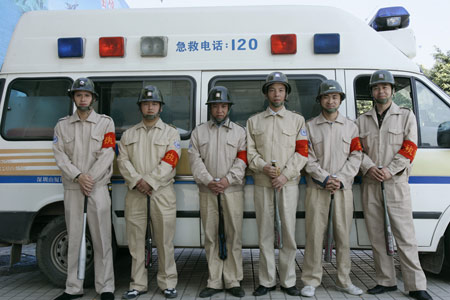
Here are the the different versions of the story:
According to hospital security guards, more and more family members and
townsmen began to show up over time and they hung around the plaza in front
of the hospital, the lobby and even the patients' rooms. At the peak,
there were more than 100 people. They burned paper money at the
entrance, set off firecrackers, burned shoes and clothing, blew horns and
caused trouble.
According to Dr. Cheng from the Out-Patient Department, he was working when
more than 20 people charged into the office. A couple of the men
punched and kicked him, and spit on him.
According to hospital general manager Yang, he refused to pay 150,000 RMB in
compensation without an autopsy. Yang was also tipped that unless the
money is deposited with the bank by 2pm yesterday, the family will 'flatten'
the hospital to the ground. Therefore, the helmet-wearing Yang stood
guard at the front gate yesterday. But nobody came.
According to the Pinghu police station, the militia police went to the
hospital to mediate. During the process, the hospital security guards
hit the family relatives with iron rods. Although there were many
friends and relatives, there was no violent action. When the friends
and relatives burned paper money and clothes, the militia police ordered
them to stop. Both sides were fairly restrained. The hospital
did not inform the police that doctors were beaten or spit upon and the
family did not threaten the personal safety of the hospital staff.
According to the family, they and their townsmen came to the hospital to bid
farewell to the deceased. Following the custom of the Henan hometown,
they burned paper money and set off firecrackers. They denied having
assaulted any hospital staff. They had previously got the government
to mediate and a hospital deputy director had signed an agreement to pay
150,000 RMB in compensation The family is therefore counting on the
government to come through.
According to the deputy director of the provincial department of health,
"this affair is absurd. At first, I thought this was a
movie. I did not thought that it was an 'emergency action' taken by
the hospital. No matter what the rights and wrongs are, this
'excessive' defensive action requires us to think carefully. Although
we can condemn the hospital for lacking legal and civic sense, we need to
understand why people keep causing trouble at hospitals. Are there
deep structural problems with our healthcare policies, administration and
management? Should we increase the legal knowledge and civic
education? Unless these structural problems are solved, the healthcare
workers cannot be assumed to be safe even if they wear steel helmets."
According to a netizen, the hospital appears to be creating opinion pressure
against the family so that the government departments can intervene.
When the first incident occurred, the hospital called the police.
Since there was no fight or vandalism, the police could not intervene.
But if there was no fight or vandalism, why was it necessary to wear steel
helmets? The hospital is suspected of putting on a show.
賣國主義."
Of course, I am accustomed to such cross-examinations. In 2003 (right
after I parachuted into Hong Kong and obtained my three-starred Hong Kong
ID), I applied for a re-entry permit to mainland China. The China
Travel Agency person looked at my application and asked me,: "Mr.
Soong, could it be that you have never ever visited mainland China
before?" I replied: "Yes. That's correct."
She then said: "I'll have to inform you that there are severe
consequences if you are found to be lying." I replied:
"Yes. I understand that. But I am telling the truth."
While I should be the parachutist who provides a fresh look at certain
things, I will have to say that I'm just tired right now. On this one
single day, I was exposed to certain historical landmarks of Macau, the
racehorse track (note: the only other racehorse track that I have ever been
to is the one-time-visit to Happy Valley in Hong Kong) at which I came out
ahead, the major casinos (Casino Lisbao, Wynn, Galaxy), the walkaround in
the basement of the Casino Lisbao to gawk at the parade of mainland
Chinese women looking to score some action, etc. Actually, I have
nothing to say about any of these things because you don't need a
parachutist to tell you about the obvious.
I do have some pieces of gambling wisdom. At the horserace track, my
guide (note: a university schoolmate from more than 30 years ago) imparted
this piece of wisdom -- the Macau jockeys are basically people who have lost
their licenses to practice elsewhere and that is why they find themselves in
this outpost. However, the hierarchy is clear in that the Caucasian
jockeys have performed better than their Chinese counterparts. For
lack of any another strategic tip (since I cannot be expected to grasp and
process all
the data points in one single session), I was advised: "Buy quinellas
for all the horses ridden by Caucasian jockeys." Following this
tip, I came out ahead. Of course, I played for peanuts and therefore I
ended up with X times peanuts (where X is a relatively small number greater
than 1.0). I also informed my advisor that the name of this strategy
is "treason to the Chinese people
Meanwhile at the casinos, I did not make a single bet. Why?
Because I am professional statistician and I know the statistical basis behind
the games. The odds are stacked against the gamblers
(because the casino has to make some money), and
therefore I refused to be the sucker (over the long run in the statistical
sense). My advisor believed that he could discern certain patterns from
previous outcomes. I gave him a lecture about the theory of runs
tests. His eyes glazed over during my speech. My notion is that
people are not very good fakers or recognizers of statistical data.
When given a series of "yes" or "no" (e.g. "banker
wins" or "player wins" in baccarat), people generally believe
that a random series should flip-flop frequently. When they see a long
string of "banker wins," they think that this is an extraordinary
run of luck commanded by some invisible gods and they would bet on the
string to continue (or revert). In fact, true random series contain many such
'runs' and the outcome of the next in the series is in fact independent of
all previous outcomes. The preceding statement is not totally true,
but it might as well as be because you cannot exploit the advantage unless
you are a truly gifted card counter.

When other students heard about the phenomenon, some of them tried to pour
water on their uniforms to check it out. Some even took a video to the
process and posted it on the Internet.
According to the school, the school uniform manufacturer used some special
clothing material by accident. The school has terminated its contract
with the manufacturer.
The WTO MC6 conference took place more than one year ago. As is well
known, there was a great deal of unhappiness about mainstream media
coverage. For personal reasons, I felt that the most outrageous
coverage was at The Sling Shot
at the Hong Kong WTO. But this book is not
about more bashing as it includes a number of writings from the mainstream
media workers.
Here is the foreword by Oiwan Lam (in translation):
What surprises me is the nonchalant attitude of the purported subjects of the
surveillance plan. "Oh, the same thing happened during the WTO
demonstrations in December last year. The surveillance stopped after
three months."
It is likely that I am trapped in this surveillance network as well, as I
happened to have made one innocuous telephone call to one member of the
network. If my telephone phone calls are monitored over the next three
months, they will probably be boring, confounding, irrelevant and
facetious. In fact, I would suggest that the people in the network to
make as many facetious telephone calls as possible and overwhelm the system of
monitors.
Given my interest in signal processing with respect to homeland security in
the United States, I immediately proposed setting up a trap for the police --
that is, you make a telephone call to your network about meeting at a certain
place to engage in a certain action. Instead, you tell the press to go
there first and set up to wait for the rushed arrival of the police! I was
told instead, "Yeah, somebody mentioned that already. But we have
some genuine matters to deal with instead of playing games." So
that is where I came up very short again. I was more interested in the
media game than anything else ...
Here are some more examples:

(China
Times) The presiding judge at the trial of the First Lady is Hsu
Chien-huei. A blog post titled "The Hsu Chien-huei that I
know" describes her as speaking fluent Chinese with a Beijing accent,
she describes herself as a Chinese person and she has also criticized
President Chen. The blogger had chatted with Hsu Chien-huei
twice. The blogger asked Hsu whether she was a Chinese person who grew
up in a military police village, but Hsu did not reply. Hsu only said
that she spoke Taiwanese dialect as a child too. According to this
blogger, Hsu's party partisanship will affect the outcome of the trial.
(Apple
Daily) The public prosecutor at the trial of the First Lady is
Chang Hsi-huai. In October, Chang had received invitations from Peking
University, Tsinghua Unviersity, Renmin University, Sinan Political Law
University, etc to give speeches in mainland China. After he received
permission from the Ministry of Justice, he paid his own way to give two
speeches titled: "Changes and Prospects in Criminal Litigation Law in
Taiwan" and "The Practice of Excluding Illegal Evidence in
Criminal Litigation" for the purpose of scholarly exchange. Chang
Hsi-huai also donated 10,000 RMB for a scholarship for students (mainland or
elsewhere) interested in criminal litigation and evidence law.
According to some Taiwan legislators, Chang is therefore showing a pro-blue
bias.
There is of course the opposite argument. By symmetry, would Hsu and
Chang also be excluded if there is 'evidence' about pro-green bias? In
fairness, that should be the case too. Thus, the only possible judges
and prosecutors in political trials have to be people with blank minds
politically. Where do you find such people?

(Apple
Daily) A bit of history: Sir Chow Shouson was the founder of
the East Asia Bank and the first Chinese member of the Executive
Council. He studied in the United States during the Qing
dynasty. When he returned to Hong Kong, he set about abolishing some
of the old uncivilized (in the western view) Chinese customs. Chief
among this is a ban on eating dog meat. In 1950, rabies was
rampant. Hong Kong enacted the "Regulations on Cats and
Dogs" wherein the slaughter of a dog or cat can result in 6 months in
jail and/or a fine of HK$5,000. (see Letters
from China) Historically, fines have been imposed
but no one was ever sent to jail until now.
(Apple
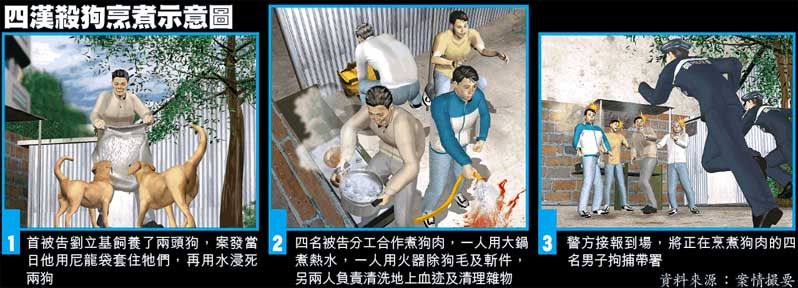
Daily) On November 12, in a New Territories villa, four men
slaughtered two dogs for consumption purpsoes. The police received a
complaint and went to the scene. Here is what they found. The
first defendant was boiling a big pot of water; the second defendant was
using a chopper to cut up the dogs and using a blowtorch to get rid of the
fur; the third defendant was mopping the blood from the floor; the fourth
defendant was cleaning the place. On the floor was a beheaded
dog. Other physical evidence included a nylon bag, iron wires,
chopping knife and pot.
(Apple
Daily) Here are some choice quotations from the court
proceedings which ended with a sentence of 30 days in jail for each
defendant.
Lawyer:
"It is cruel to kill, but that is only a charge and not a factor in the
sentence."
"In all previous cases, there were only fines and a jail sentence has
never been imposed."
"The third defendant hurt his leg and the fourth defendant has
tubercolosis, so that are unfit for serving community service.
Therefore, their sentences should be suspended."
Judge:
"Do you mean that a case of deliberate injury should get a heavier
sentence than murder?"
"Times have changed and the precedents are not appopriate. In
order to communicate the fact that society does not tolerge the slaughter of
dogs, there has to be a first case of a jail sentence."
"The defendant fell down and hurt his leg while attempting to flee from
the police. Thus, it was his own fault. Health status is not a
reason to reduce the sentence."
(Apple
Daily) When South Korea was a co-host of the 1998 Olympics, it
imposed a ban on eating dogs. After the Olympics, the ban was
rescinded. There are more than 4,000 licensed dog meat restaurants
there.
Comment: Another excuse is that a Hong Kong resident can easily go to eat
dog meat in Shenzhen. But that cannot be used as the reason why the
"Regulations on Cats and Dogs" should be abandoned in Hong Kong.
This is about any absolute sense of morals and ethics, as opposed to a race
to the bottom.
Related Link: St.
Louis judge's outspoken book causing controversy December 26,
2006. Robert Patrick, St Lous Post-Dispatch
Immediately, the post was cross-posted everywhere with the relevant details
(including Yang's name, school, etc). The police was called, the
military instructor at the school was notified, etc. All of that was
conventional. The uniquely Internet part was that another netizen
produced a list of all the 240 Kaohsiung hotels with eight or more floors,
including the telephone numbers. So the netizens (including some who
do not live in Kaohsiung) organized a telephone calling campaign to check
the hotels, including a live update on which ones have already been checked
out. At around 10pm, the netizen named Huang called one hotel and told
the receptionist about the problem. He heard an exclamation,
"Could it be that the woman who just checked in?"
Apparently, Yang had checked in around 8pm and received a room on the eight
floor. So the hotel staff immediately went to the room. They
knocked, received no answer, broke down the door, found a smoke-filled room,
opened the windows and put out the flame. Yang was still
conscious. The hotel staff moved her out of the room immediately and
called the ambulance.
Once the rescue mission succeeded, there was a celebration on the
Internet. Netizens vot1077, v86662 and liquorice were lauded as
heroes, but they only said, "We are all heroes! We are all good
people!"
案內人隨筆)
甜片)
... there are no distirbutors in Hong Kong, so these are hard to find and
must be downloaded."
"Of course, you would say that. Ha ha. (Aside: Without
BT, wouldn't my business be ruined?)"
"What? Oh ... sometimes ... occasionally."
"What do you download?"
"Me? Usually, Japanese anime, computer software, also
"sweet movies" (
"(What exactly are "sweet movies"?) So do you
download Hong Kong movies, or songs by local singers?"
"Hong kong movies? Even my mom does not watch them.
Most Hong Kong movies are garbage. Forget about paying to see them in
cinemas -- I won't waste my time downloading them. Also, the local
singers are awful! The exception is Eason, and I download his songs
and buy his albums. As for the others, I rarely listen to them
..."
"If there is a new service that offers you an online album with new
songs and movies that take only 77 seconds to download (faster than
BT) for a fixed monthly fee, would you be interested?"
"New service? What is the point? Legal downloading of
movies and songs are already available in the United States with
peer-to-peer technology (that is, BT). They have the songs from all
the four big record labels as well as the Hollywood movies. They are
also free. Will your service charge money?"
"(Damn, how come no one at the company updated me on this new
development? Do they want to lose their jobs?") Oh, is that
so? They are for free? That is, it will have no impact on you if
they criminalize BT in Hong Kong?"
"Yes, there is. I will die if I can't get my Japanese
anime. So I'll just have to buy pirated disks. Oh, I have some
former classmates who entered the piracy business because they could not
continue with their education. They will be the happiest people if BT
is criminalized, because their businesses will be booming."
"So you won't use BT anymore?
"If BT is really criminalized, who is going to dare do so?
The government is setting up an example. I don't think anyone in Hong
Kong will be using BT. Also, I don't want people to know which
websites I go to, which discussion forums I left comments at and what I
wrote on my blog."
"(Damn! The highspeed broadband services won't have an edge
anymore.) If someone tells you that a certain Internet Service
Provider will guarantee the privacy of their users and make sure nobody can
find them, what will you do?"
"I will definitely switch over to them! But which Internet
Service Provider is going to be so great?"
Late afternoon on April 23, the defendant called the judge from
Shenzhen. The man still did not want to come to court and he mentioned
that he was planning to open up an Internet bar. So the judge quickly
offered his QQ number to the plaintiff and arranged for a video
conference. When the judge saw the defendant, he recognized him as a
convicted thief whose trial the judge had once attended as a jurist.
Thus, he understood why the man was reluctant to return. The judge
then proceeded with some small talk (e.g. about the plaintiff's current
status, etc). While the man ultimately agreed to attend the trial, it
was too late because the trial was scheduled to begin at 8:30am the next
morning. Then the judge was struck by an inspiration: "Why don't
we hold the trial tomorrow via QQ video conference?"
On April 24, 2006, a trial was held in a court in Gaoqiao, Fujian
province. The female plaintiff was present at court, while the male
defendant was in Shenzhen, Guangdong province. The communication
method was video conferencing via QQ. This is believed to be the first
such case in China.
Judge: Plaintiff, is the person that you see on the monitor the defendant?
Plaintiff: Yes.
Judge: Defendant, is the person that you see on the monitor the plaintiff?
Defendant: Yes.
These are standard questions in any court (except for the bit about the
monitor). The court trial then proceeded and ended with an agreement
to have mediation.
From April to now, the Gaoqiao court has handled four cases of
divorce/alimony via QQ video conferencing. Next week, there will be
the first international case in which the defendant is in Peru.
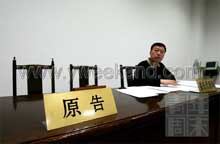
The defendant is missing from court
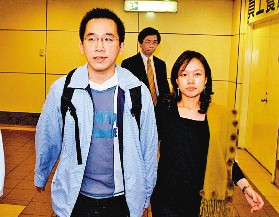
When the media finally located Chen Chih-chong at his hotel, he was puzzled
and asked the reporters:
"How did you find me?"
"We called one hotel after another."
"So you kept calling until you found this one today?"
"Yes."
"Hey, you're pretty good."
"We are quite pitiful!"
"If you're pitiful, then so am I! I just wanted to deal with some
simple matter! Great! We will both be liberated. I'll be
going back and so will you ... Frankly speaking, I want to condemn you but
you are being pressured by your bosses. If you keep tailing my car,
you are at risk and so am I. After all, you are not chasing robbers
... I came here about the school! You are being
hyper-imaginative. You should not make up stories such as the lost
journey or whatever."
Afterwards, the two sides promised not to play "hide-and-seek"
anymore. The reporters also promised not to tail Chen's car.
Chen tried to confirm: "You won't trail my car?" Reporter:
"Yes, yes, yes." Chen: "Thanks, thanks."
Chen Chih-chong came to the United States on this occasion about a doctorate
degree in law. As such, he needed to talk to the school and the
professors.
P.S. Here are my personal thoughts after reading this story. The story
is not terribly interesting in itself. But I believe that I know so
much more about the children of President Chen Shui-bian through the media
than I ever care to or have the need to. My reaction to this story
was, "Hey, I don't care!" By comparison, I believe that I
know a lot less about the children about "blue" politicians such
as Lien Chen, Ma Ying-jeou and so. Come to think of it, I don't even
know if "green" politicians such as Frank Hsieh, Su Tsing-cheng,
Annette Lu and Yu Shyi-kun even have children. This is not a scientific study,
but I have an uneasy feeling that President Chen Shui-bian's children are
being given special treatment in the media.
Exclusive Report had received a letter about Chiang drug-raping a female
student. It also found an Internet forum post by an anonymous netizen
using the alias "Rethnomusicology" and interviewed that person via
instant messaging. During the trial, it was revealed by
"Rethnomusicology" that the Internet forum post was not written by
her and therefore she had no knowledge of the case. Exclusive Report
also interviewed the university military instructor of the said student and
was told "the student denies being sexually assaulted and/or spreading
any rumors." Therefore, the judge believed that Exclusive Report
should have reasonable doubts about the story before publishing
it.
Although Exclusive Report put a mask on the face of the professor and used
an alias for his name, it was still possible for people to recognize
him. Exclusive Report had also interviewed the professor before
publication, and he showed the reporter many emails and SMSs from the female
student professing love for him to show that she was lying, the magazine did
not accept or report any of that.
Now we can complain that the Internet is a place full of unreliable
rumors. But why did a print magazine pick up this Internet
rumor? After all, it had all sorts of evidence to doubt the story.
运城假渗灌
(translation: Yuncheng fake irrigation).
There were 2,530 results. Here is the screen capture of the top result.
The following illustrates such an exercise. First, you ask yourself:
If the name "Gao Qinrong" is mentioned, what comes immediately to
mind? It is the Yuncheng fake irrigation project. So I went to
to Baidu and searched for
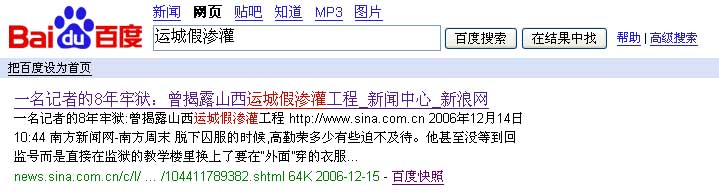
If I click on the sina.com link, it returns a 404 error message ("Page not
found"). Sina.com has done its job well. But if I were to click
on the Baidu cache on the bottom right, I recover the article that I translated
in The
Gao Qinrong Interview in Southern Weekend.
If there is the will, there is the way.
P.S. Here is another surprising way through which the Gao Qinrong story is still
being told in China:
Sketch of a media blackout Joel Martinsen, Danwei
The paradox of IPR infringement in China Jeremy Goldkorn, Danwei
[074] Little
Gege (12/19/2006) (Boxun)
This is one day from the continuing saga of Little Gege, the 13-year-old
daughter of lawyer Gao Zhisheng. Gao is presently arrested awaiting
trial for subversion. The narrative comes from AIDS volunteer Hu Jia,
who is presently under house arrest.

On Friday, December 15, 2006, Little Gege had a fever and therefore did not
go to school. On Saturday, December 16, Little Gege went to the school
for remedial lessons. She rode to school on a bicycle by
herself. As usual, the Ministry of National Security police followed
her on four bicycles and seven Buick MPV's. At noon, Little Gege got
out of school. Her classmates were going to play tennins. Little
Gege knew that she could not go with them, but she walked with them to the
bus stop. Since the classmates have not eaten, Little Gege bought them
a bowl of fried noodles.
At that moment, the Ministry of National Security police told Little Gege
that she cannot go with her classmates. So she kicked the police
officer's bicycle. The police walked up to her and confronted her,
whereupon Little Gege threw the bowl of noodles at his face. Then
three male and three female police surrounded the 13-year-old girl and
proceeded to pummel her. A tall police man picked her up and threw her
on the ground. A police woman pulled her hair and cursed her.
Her classmates heard the the police woman cursed her: "F**k! This
little bitch's hair is long!" and then she stomped her foot on Little
Gege's thigh. Eventually the police officer hauled Little Gege into
the police car. During the process, Little Gege felt someone pinching
her back hard. All her classmates were stunned, and nobody tried to
stop the police. When the police officers took Little Gege back to her
home, they complained to her mother that Little Gege had been uncooperative
and refused to come home.
On Monday, December 18, Little Gege went to school and the teacher asked her
to come in for a "talk." The teacher asked her if she had
destroyed the four bicycles belonging to the police officers. Little
Gege was astonished and hurt at such a question. She asked the
teacher, "Have you ever seen someone trying to destroy bicycles while
they were busy being beaten?" Little Gege wondered if her
schoolmates destroyed the police bicycles instead. But after careful
questioning, she determined that it was not the case. The classmates
who witnessed the scene were afraid; some female students were even crying.
On the evening of December 16, Little Gege examined her physical
condition. Her back was purplish from pinching and her thigh was
bruised. On December 18, she was asked if it still hurts and she
replied "If I touch it, it still hurts but it is alright
otherwise."
Little Gege was quite honest about what happened. She admitted that
she was angry when the police prevented her from being with her classmates
and therefore she kicked the tire of one of the police bicycles. But
no matter what, the cause of incident was when the large group of police
officers prevented a 13-year-old girl from being with her friends of the
same age, which is something that she has the right to do. This type
of thing has been going on with Little Gege for more than four months
already.
[073] The Person Of The Year (12/19/2006) (The Sun; ChineseNewsNet) The list of finalists of Southern Weekend's Person Of The Year include:
Zhou Ruijin, the former deputy editor-in-chief at People's Daily who wrote about how former Shanghai party secretary Chen Liangyu charged into the hotel in which Deng Xiaoping was staying in 1992 because Chen wanted to play tennis there.
Qiu Chengtong, the mathematician who said that most of the professors that China brought in from overseas are not delivering results (both in research and teaching)
Chen Xiaolan, the doctor who revealed the dark secrets about medical care in the Zhabei district of Shanghai
Eric Chen, the Taiwan prosecutor who indicted the First Day for embezzlement, perjury and falsification of documents.
Shi Ming-teh, who formed the "Red Army" to protest against President Chen Shui-bian
Chu Yi, the Taiwan legislator who made a name for himself by coming up with with all sorts of exclusive reports of scandals.
Yu Fang, the Yichang school teacher who exposed the contest scandal in the National Chemistry Olympiad
Hu Ge, the young man who made the 20-minute spoof of the Chen Kaige movie "The Promise"
What if any of these people won?
[072] The
Taipei Guesthouse (12/18/2006) Alleged Rule #1 at Apple Daily
(Taiwan): No photographs of politicians shall appear on the front page,
because history has shown that retail volume drops. This is amended by
Rule #1A: Photographs of politicians shall appear on the front page when
they are caught in a scandal.
Yesterday's Apple
Daily front page has such a scandal.

For a description of the events, here is Taipei
Times today.
高志鵬 ) and Yu Jan-daw (The Presidential Office yesterday said that it had launched an inquiry into allegations that one of its officials visited a Taipei guesthouse and that the guesthouse's owner had won a project contract with the office. The action came in response to a front-page story in the Chinese-language Apple Daily yesterday, which claimed that Democratic Progressive Party (DPP) legislators Gao Jyh-peng (
The newspaper ran pictures of Gao, Yu and Lee each leaving the guesthouse alone before dawn while a series of four pictures showed Kuo giving one woman a ride. Another picture showed a young woman in the arms of man in a white Mercedes around midnight, but the man was not identified.
Yu told a press conference yesterday that
he had been to the guesthouse five to six times, but he did not do anything
illegal there. Yu said guesthouse owner Tsai Ming-chieh (
Gao's cellphone was turned off yesterday morning, but he told reporters yesterday afternoon that he only went to the guesthouse to raise campaign funds for DPP Taipei City councilor candidates. "I can't say that I have never been to places I should not have been to, but I can say I've never done things I shouldn't have done," Gao said. He said there had not been any escorts when he was at Tsai's guesthouse.
When asked for a response to the story, DPP
Deputy Secretary-General Tsai Huang-liang (
Here are the Apple Daily photos (Page 1 and Page 2):





Here are the Apple Daily photos of presidential aides Kuo Wen-pin and leaving with one of the girls. Kuo has explained that he was only giving the girl a lift home at the request of Tsai Ming-chieh.
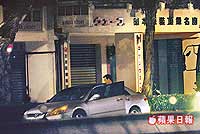


By the way, Tsai Ming-chieh is an important figure in the state affairs fund case for which the First Lady and several others are being tried in court right now. Tsai, his sister and brother-in-law gave the most number of receipts to the First Lady for reimbursement from the state affairs fund. Also Tsai's company has received a number of government contracts, so that this incident creates the appearance of government-business collusion.
[071] What Is Missing In The Gao Qinrong Interviews (12/18/2006) The two interviews at The Gao Qinrong Interview in Southern Metropolis Daily and The Gao Qinrong Interview in Southern Weekend were either right on or just over the invisible line. We'll find out soon if someone gets into trouble as a result. As 'daring' as these two interviews in the present environment, there is something that neither interviews dared to broach. These are obvious questions that should have asked of Gao Qinrong. Instead, you can read it in the RFA interview (via Boxun):
黄有泉).Q: In your report back then, you named the person responsible [for the fake irrigation project in Yuncheng]. Was that person punished later?
Gao: Not yet. He is still an official. The person who struck back at me in retaliation was a commisioner in Yuncheng for five years, and then he became the party secretary for five years. He is presently a director for the People's Congress. His name is Huang Youquan (
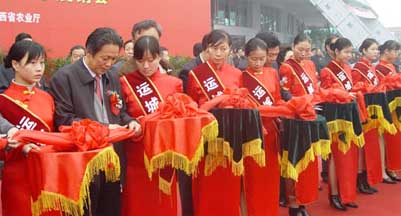
These interviews are one-sided stories. If the name of Huang Youquan is mentioned in a negative way, then the reporters are obliged to contact the subject for his side of the story. But if Huang is informed about the purpose of the interview, he will just make sure that the story is "executed by firing squad" (i.e. "spiked"). Therefore, the interviews were published without any detailed explorations into how Gao was convicted on false charges.
[070] You ... or maybe not (12/18/2006) TIME magazine's Person Of The Year is ... You!

At Daily Kos:
But as I went to read the piece, a Chrysler ad took over my screen before I could get to the article. And check out the opening line of the ad:
[069] Collective Historical Memories (12/18/2006) With respect to Star Ferry, I am challenged as to whether I am capable of sharing any form of historical collective memory. I am going to retrieve the following items from the ESWN archives:
Cambodia Travel Notes - Part 2 (Tuol Sleng) (2/4/2005)
Cambodia Travel Notes - Part 3 (Choeung Ek) (2/8/2005)
Cambodia Travel Notes - Part 4 (Siem Reap) (2/8/2005)
This is somewhat unfair because I should not wish such a fate/experience on any nation/people for the sake of having a valid collective memory. But I believe that I am leaving you with no doubt that there were no ulterior political or commercial motives behind those historically preserved sites. Or even if such motives existed, they are overwhelmed by the humanistic issues. That is, I was quite willing to hand over my money to the commercial organizers on account of what I learned.
P.S. Not mentioned in the original description is the following fact. There were 16 people in the tour group. On the optional tour to the Siem Reap war museum, the tour guide said that they would require 10 persons each paying US$10 to make the trip. I and two other women opted in. It would not have happened. However, I pulled the tour guide aside and offered to pay the entire US$100 to make it occur (without the knowledge of the two other women). It was worth my money to learn all that.
[068] The
Coming Re-organization of Southern Metropolis Daily
(12/17/2006) Think about The
Gao Qinrong Interview which was published in the Southern Metropolis
Daily -- a ex-reporter had been convicted of "fraud, swindling and
pimping" and served eight years in jail. When he got out, a
newspaper interviewed him. During that interview, the reporter
repeatedly stated that he was completely innocent and he went to prison only
because he had told the truth about a fake irrigation project. The
Internet forum comments are predicting a "re-organization" of
Southern Metropolis Daily as a result of this interview.
Addendum: Wow, oh wow! It seems that there is an
internecine rivalry with the publication of The
Gao Qinrong Interview in Southern Weekend.
Which one of them wants to the first moth in the Southern Daily group to be consumed by the fire?
Or do they believe in strength in numbers, perhaps? So will the Central Publicity Department
act against the entire Southern Daily group? Lurking behind is the
entire Internet forum/blogosphere (see Letters
From China). The calculation is whether it is worthwhile
incurring the wrath of Internet hell versus protecting a few local officials
in Yucheng (Shanxi) who are long gone.
P.S. In Gao
Qinrong Silenced Again, Jonathan Ansfield
noted the name "Gao Qinrong" has already been scrubbed from the
Internet portals and search engines. I have just recreated Chinese
backup copies of the two interviews.
[067] McDonald's
Becomes Homeless Shelter In Beijing (12/17/2006) (TOM.com)

Ever since going with the 24-hour-a-day schedule, McDonald's has become a
homeless shelter. Last night at after 11pm, the reporter went to the
McDonald's in the Shuangyushu district. He observed that people keep
entering without ordering food and proceeding to sleep in various manners
(such as leaning against the wall, lying the head on the table, sleeping on
a row of chairs, etc. The reporter counted about 15 people who came
here solely for the purpose of sleeping (and munching on food left behind by
customers).
According to a McDonald's worker, the restaurant used to remind people that
this is a restaurant, but if the people do not wish to leave and they are
not interfering with other customers, there is nothing that the restaurant
get do. McDonald's does not have a suitable management policy at
present.
Hmm ... how about following McDonald's policies in the USA -- post a sign
that says "No loitering. 20 mInute time limit consuming food" and
then rigorously enforce it?
[066] Hong
Kong By The Numbers (12/17/2006) (Apple
Daily) According to a public opinion poll of 704 persons conducted
in November, here are the parties that have the "highest
potential" to govern.
Civic Party (14%)
Democratic Alliance for the Betterment of Hong Kong (9%)
Democratic Party (6%)
Liberal Party (5%)
Hong Kong Federation of Trade Unions (1%)
The Frontier (1%)
Association for Democracy and People's Livelihood (1%)
The Neighborhood and Workers Service (0%)
None of the above (29%)
Don't know/no opinion (33%)
[065] Cheung Chuiyung on Latin America (12/16/2006) I apologize for the drop in blog updates. Due to personal committments (interviews, conferences, etc), I have slowed down from the 5+ blog entries per day. Of course, you know that the standard excuse is about the quality and not the quantity. Anyway, on this particular day, my excuse is that I attended the talk given by Cheung Chuiyung at Cité Bookstore (Wanchai) this afternoon scheduled from 3pm to 6pm (see the announcement at her blog). This talk is titled "A Talk on Latin America". Since I am well-known to be an Latin Americanist, I made sure that I attended. After spending three years in Hong Kong, the only person that I know with a genuine interest in Latin America is
[064] The
Mongkok Incident (12/16/2006) Yesterday, I was walking from
Mongkok towards Grand Century Place on the pedestrian walkway. Then I
noticed that everybody had stopped to look towards Fa Yuen Street.
Like everyone else then, I also looked but I could not see anything. I
did see the firemen rushed towards a building with a ladder, but I could not
see what was going on. So I had to wait to check the newspapes the
next day.
(Ming Pao)
Yesterday, five men showed up at a fifth-floor Fa Yuen Street apartment to
collect debt from a man named Wong. According to Wong, he was forcibly
thrown out of the window by the five men. Fortunately, he landed on
the awning over the first-floor ledge. The street was crowded at the
time, and people starting to shriek when they saw a man falling down.
The police and fire departments were summoned, and the man was taken to the
hospital with only an arm injury. But according to the men, Wong had tried
to climb out of the window himself and fell off on his own.
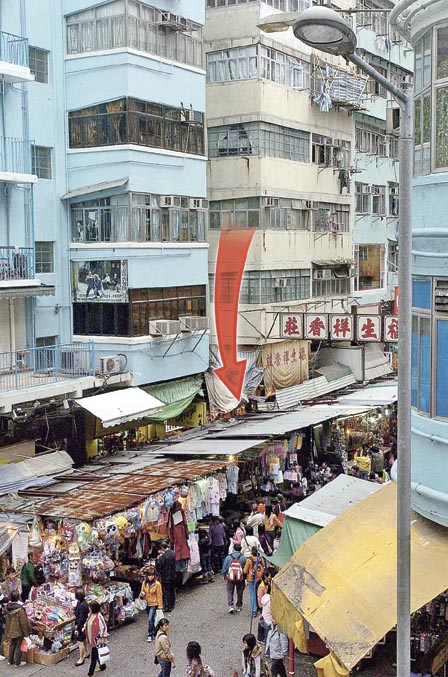
The way that this turned out shows the difference between a blogger and a
newspaper reporter. This blogger was physically present but only saw a
group of people looking upwards. The newspaper reporter went later and
took a photograph after the whole thing was over already. However, the
reporter was able to follow up with the police and obtained the different
versions of the story. This is not what a blogger can be expected to
do.
P.S. Here is a social experiment that could be used to test threshold
theory. Experiment 1: Hire a person and ask him to stand and look
upwards; measure how quickly another 100 people will imitate and look for
that nothing. Experiment 2: Hire two people and do the same,
etc. Oh, this experiment has already been done by a social psychogist
in New York City about half a century ago. Never mind ...
[063] Media
Report As Extortionist (12/15/2006) (China
Times; China
Times) While you may think that this is the kind of thing that
mainland Chinese journalists engage in routinely to supplement their meager
income while being protected by freedom of press, this big case happened in
Taiwan.
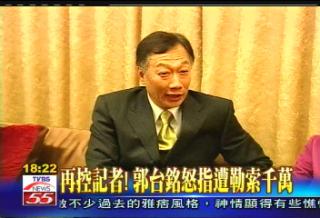
The richest person in Taiwan is Terry Guo (

[062] The
Model Student (12/15/2006) (XinminNet via Wenxue
City; Beijing News via Wenxue
City) In early December, the media gave broad coverage to
21-year-old fourth-year university student Wu Yingying become the Excecutive
Vice-President of an American company TopCoder. Yes, a pretty
undergraduate student, a multinational corporation, EVP for the Asian
region, an annual salary of more than 500,000 RMB, 100 inventions, ...

A netizen then proceeded to challenge Wu Yingying's resumé item by
tiem. Wu Yingying claimed to have more than 100 'inventions' and four
patents. So the netizen went and looked up the national patents
database, and found only two listings about certain ways of looking up
dictionaries quickly.
The media reports referred to Wu Yingying as being a vice president in Asia
for the Association for Computing Machinery and the first Chinese to be part
of the ACM Presidium. The netizen pointed out the in Wu Yingying's
company's website, she was only described as "a member of the American
Psychology Association and the Association for Computing
Machinery." The Association for Computer Machinery is an academic
association that anyone can apply to, whether they know anything about
computers or not. [Personal note: How do I know? I am a dues-paying
member of the ACM and have been one for decades!]
As for the multinational American company TopCoder, Wu Yingying is its only
employee in the Asian region. As such, she is Executive
Vice-President, General Manager, Financial Officer, Accountant, Treasurer,
Office Manager, Administrative Assistant, Clerk and Janitor all in one.
When Wu Yingying was interviewed, she said that the principal reason for the
publicity was that she is one of the two model students that the Central
Publicity Department intends to promote. That may or may not be
true. But so far, the publicity has not been good. It also makes
one wonder whether the notion of a model hero such as Lei Feng is possible
in this post-modernist era.
[061] A
Murder in Guangzhou (12/15/2006) (Southern
Metropolis Daily) At 9pm on September 21, there was a fight in
front of the Zumiao Station and a man was murdered by another man who fled
the scene afterwards. The whole thing happened in a flash. So
what is the police to do? They went and reviewed the surveillance
video tapes in that neighborhood. Here are the screen captures:





From left to right: (1) a dispute between a man in blue and a man in black;
(2) man in blue kicks man in black; (3) man in blue walks away while man in
black reaches into his white bag and takes out a knife; (4) man in black
stabs man in blue twice in the back; (5) man in black runs away with knife
in hand.

The police released this other photo of the man in black and asked the
public for assistance. On December 13, a member of the public called
the police to say that the man has been spotted in a park. When the
police rushed up to tackle the man, he said: "I know. You are
arresting me because of the incident at the Zumiao Station." The
citizen tipster received 10,000 RMB in reward money.
[060] The
Guizhou County Mayor's Murder (12/15/2006) (yWeekend via Wenxue
City) This was a sensational case in which the Guizhou county
mayor, four other family members and a nanny were butchered in their home on
November 27. On December 3, the case was pronounced solved and the
perpetrator was the individual known as Cao Hui. The motive was
robbery. However, the public is skeptical -- is it necessary to kill 6
people in a simple robbery?
China Youth Daily reporter Tang Yonglin worked on the story, and he recorded
his impressions of the two press conferences.
On November 30, the first press conference was held with more than 100
attendees. Well, it was not a press conference in the traditional
sense. Instead, it was an occasion to gather all the media together
and inform all the Guizhou provincial media to use only the official Xinhua
report and not otherwise discuss the case. At the time, the Xinhua
report consisted of fewer than 200 words, to the effect that a special
police case squad had been formed.
On December 2, the second press conference was held and reporters from more
than 20 media outlets across the country were present with lots of
questions. At the press conference, the officials were seated on stage
and one of them took out a piece of paper and read for 5 minutes. This
would eventually become the Xinhua report, which had just over 500
words. After the reading was over, the officials got up and left.
Tang Yonglin wrote: "Frankly speaking, I was not too angry. It is
normal in this sort of thing that they just won't tell you. What can
you do? I just felt that I must be strange because I actually held
great hopes for those two press conferences. I had planned to
interview many local officials. When I called these people, they told
me that I had the wrong number, or they referred me to the Publicity
Department instead, or they told me frankly that they are not allowed give
interviews. When I showed up in person, they refused to see me.
I went to one place and asked to see someone; I was directed to the wrong
room and then I found out that the person who deliberately gave me the wrong
direction was the one that I wanted to see! It was awkward because all
the people are there; you can ask them but they just will not answer.
Meanwhile, the buzz on the Internet continues even after this case was
'solved.' But no one is answering the many questions."
Meanwhile Xinmin Chenbao reporter Du Chen was racing towards the home town
of the alleged murderer Cao Hui after the December 3 press conference in
which the case was said to be 'solved.' He was accompanied by a
reporter from Chengdu Commercial News and a reporter from Guangzhou
Daily. The three got to Cao's home and spent an hour interviewing his
mother and elder brother, and even got some photographs.
The three headed back to their hotel. The next day, they got a
telephone call from Cao Hui's elder brother to say that his mother fell
ill. The three reporters felt guilty about bothering the old lady the
previous evening, so they purchased a basket of fruits and went back to the
Cao home. Therefore, they saw Mrs. Cao quite healthy in the company of
three police officers. The three were then taken down to the police
station. They were asked for identification and they were interrogated
about what they had done so far. Then they were told to go back.
As to their question of "The police can sue the reporters for
inaccurate reporting, but was forced detention before publication
necessary?" none of the police officers answered. So maybe only
these three reporters managed to interview the Cao family, but it does not
matter because nobody was allowed to report on it anyway.
This is where yWeekend has been very effective. If they are not
allowed to cover the original case themselves, they will talk to the
reporters who attempted to cover the case and discuss that experience.
Then we get some indirect discussion of the case as well as descriptions of
the practice of journalism in this abnormal environment.
[059] Taiwan
By The Numbers (12/14/2006) (Straits
Exchange Foundation) (1,073 persons interviewed on November 26-27)
Survey results (direct translation of the report at the bottom of the linked
page)
(1) Over the past 20 years, 35% of the respondents have visited mainland
China. Assuming there are 17.1 million persons age 20 or over in
Taiwan, then 6 million of them have visited mainland China. Of these 6
million, 75% did so for tourism. In 2006, 12% of the people have
visited mainland China, which is 2.05 million.
(2) 15% (=2.5 million persons age 20+) of the respondents have family
members who are business owners, workers or residents in mainland
China. 17% (=2.9 million persons age 20+) of the respondents either
personally stayed or have family members who stayed more than 3 months on
the mainland.
(3) 34% of the respondents feel good towards mainlanders and 32% do not feel
good, with 20% having no opinion. Among those who have been to the
mainland, 47% feel good and 30% do not; among those who have never been to
the mainland, 28% feel good and 32% do not. Similarly, among those who
have family members on the mainland, or who have either personally stayed or
have family members staying on the mainland for more than 3 months, 53% feel
good and 25% don't.
(4) In terms of trade, 55% are worried about the huge Taiwan investments in
mainland China. 31% are dissatisfied with the import/export situation
across the straits, 22% are satisfied and 40% have no opinion.
(5) With respect to the figure of 4 million visits made by Taiwanese to
mainland China, 32% thinks that it can be increased while 26% thinks it
should be decreased. Among those who have positive feelings towards
mainlanders, 47% think it should increase and 22% think it should
decrease. Among those with negative feelings towards mainlanders, 28%
think it should increase and 51% think it should decrease.
(6) While almost 70% agree that the government should try to get more
mainland tourists to visit Taiwan, about 30% thinks the current policies are
too strict and about 30% think the policies are too loose.
(7) 60% of the respondents do not agree with the way in which the Chinese
Communist government deals solely with the opposition parties and refuses to
deal with the government. 60% of the respondents believe that the
Chinese Communists' actions towards Taiwan are more evil than good.
This shows that the Chinese Communists' desire to appeal directly to the
people of Taiwan is ineffective.
(8) Concerning the future of Taiwan, 34% of the people chose independence,
23% of the people chose unification and 24% chose maintaining the status
quo. If told that the status quo cannot be maintained, then 42% chose
independence and 31% chose unification.
(9) Concerning self-identity, 59% think that they are Taiwanese, 16% think
that they are Chinese and 17% think that they are both Taiwanese and
Chinese.
Relevant link: The Taiwanese Want Independence
[058] The
Baby Snatcher (12/14/2006) (Southern
Metropolis Daily; Wenxue
City) In Shenzhen at around noon on December 8, the woman
named Yuan reported to the police: "My son was snatched in broad
daylight!" At around 9:50am, Yuan had gone out to stroll in the
neighborhood. At around 11am, she was walking down the street and she
stopped at an intersection to wait for the pedestrian light to turn
green. A black sedan car stopped and a man wearing a black jacket came
out of the car. The man snatched the baby from her, got into his car
and quickly drove away. Yuan hailed a taxi to try to follow but lost
trail. Then she went to file a report at the police station.
This is the type of story that would turn Shenzhen into a city of fear.
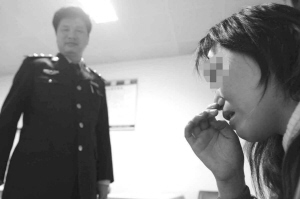
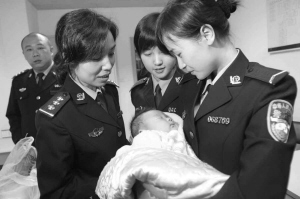
Here is what happened during the police investigation:
- The police reviewed the surveillance video tapes for the neighborhood and
did not see what Yuan described.
- The police interviewed security guards, cleaners and other people in the
neighborhood but nobody saw anything.
- The police checked with all the taxi companies, but could not find the
taxi that Yuan hailed to follow the kidnapper.
- The police investigated Yuan's husband Lei and other family relatives and
found nothing suspicious.
- The police then shifted their focus back to Yuan and other persons related
to her. They found out that she has a lover named Sun.
- Sun has a sister living in the neighborhood where the incident took
place. The police found Sun and his sister appearing with a baby in a
surveillance tape taken at 11:21am on the day of the incident.
- On December 12, the police found the snatched baby at the home of Sun's
mother.
- On December 12, Sun and Yuan were brought down to the police
station. After being shown the evidence, Yuan broke down and
confessed. She thought that her son looked more like her lover than
her husband, and wanted to give the baby to her lover instead.
Therefore she made up the baby snatching.
How many years will Yuan have to serve in prison for damaging the fair image
of Shenzhen?
For filing a false report, Yuan has been sentenced to 10 days of
administrative detention plus a 500 RMB fine. Since Yuan is still
breast-feeding the baby, the administrative detention will not be
implemented. She went free.
[057] A
Tale Of Three Stories (12/14/2006) It is the same tale, but
which story do you like best?
(SCMP)
A con artist posed as a doctor and an orphanage worker in an attempt to get money from passers-by, police said yesterday. They believe he may be linked to cases in Wan Chai and Central in which three victims were cheated out of HK$10,000 in recent months. Police have arrested a man and were questioning him last night.In one incident yesterday, a man stopped an accountant on the first-floor podium of Sun Hung Kai Centre in Harbour Drive. "The culprit told the woman that he lost his wallet and he was in a hurry to return to the hospital on Cheung Chau, and asked to borrow money from her," a police investigator said. The man, in his early 60s, also presented a bogus doctor's name card to the woman but she did not believe his story, the officer said.
About five minutes later, at 3.35pm, he stopped a man and said he worked for an orphanage. "The fraudster claimed that he had brought a group of orphans from Cheung Chau for an urban tour but had lost his wallet and asked to borrow HK$500 to take the children back to Cheung Chau," the investigator said. The potential victim, a clerical worker, ignored him.
... [The] suspect was arrested when officers from the Hong Kong Island regional intelligence unit conducted an operation against "quick-cash" crime in the Harbour Drive area yesterday.
(The Sun)
The suspect named Lam is a 64-year-old unemployed man. Two years ago, he watched a crime re-enactment television program and saw that someone had posed as a doctor to commit fraud. So he decided to do the same thing. On each occasion, he wore a suit, and as well as a stolen doctor's badge. He would say to the targets: "I'm a doctor. I just lost my wallet and I need to go to the hospital to conduct surgery."
Yesterday at around 2pm, this fake doctor was working again near Central Plaza in Wanchai. At that time, the female police officer nicknamed "Big Eyes Girl" saw him and remembered that he was a wanted criminal. "Big Eyes Girl" used to be a central district accountant, so she is particularly good with remembering numbers and faces.
A man has been posing with fraudulent identities (such as a doctor, a preacher or an orphanage worker) for forty years in order to swindle money from kind-hearted people. So far, he has 36 cases of prior arrests. The earliest arrest was in 1966 when he was 24 years old. In 1995, he was sentenced to two years in jail. In 2002, he was sentenced again to two years in jail for the same types of offense with the judge saying: "You are a repeated offender without any remorse ... you have been a fraudster most of your life. You have decreased the citizens' enthusiasm to help others. You have increased mutual mistrust which will ultimately turn Hong Kong into a heartless society." In recent months, the police learned that someone has been using the same techniques (e.g. wearing a doctor's white robe and carrying a stethoscope) and therefore they issued a lookout notice. Yesterday, a plainclothes police woman nicknamed "Big Eyes Girl" known to have photographic memory spotted the man and effected an arrest after observing him in action.
Here is a file photo from 1996:
[056] Why Does Anyone Still Work At Sing Pao? (12/14/2006) (Apple Daily)
The 67-year-old Sing Pao newspaper has been plagued by issues with unpaid wages recently. Recently, a two-hour meeting was held over the unpaid November wages. In the early hours of yesterday morning, the workers demanded that the management must state when the October and November wages will be paid and to provide details of specific financing so that they won't have to hold their hands out for alms every time. They hinted beforehand that they cannot exclude the possibility that individual departments may go out on strike but the bomb appeared to have been defused.
According to reports, the management agreed to pay the October wages for upper manangement by December 20th (note: the lower-level employees have already been paid for October). They will try to pay the November wages of all employees before the end of December. The employees have no choice but to resume their work based on this response from the management. Some employees believe that they have to accept the word of the management unless they intend to leave. As for the next step, they are uncertain but they are glad to have received some of their pay. It is unlikely that they will go out on strike. They will probably take it one step at a time.
[055] CSM
Media Facts (12/13/2006) Fons Tuinstra (China
Herald) discusses whether CSM (the joint venture of CTR Market
Research and TVS Group) can be counted to provide objectively neutral
television ratings in China. The conflict of interest is that the
majoirty owner of CTV Market Research is the state television broadcaster
CCTV.
For a disclaimer, my company is a joint venture partner of CSM's television
ratings competitior AGB Nielsen around the world (including China but
excluding the United States). However, my only involvement in TAM
(television audience measurement) services is in Latin America. I have no
dealings what so ever with AGB Nielsen in mainland China, Hong Kong or
Taiwan.
Could CSM be producing biased television ratings that favor CCTV? I
can almost say that it is not possible. Why? Because it is
actually very hard. Have people ever done that? Yes, there once
was a Latin American company that owned a television station and a
television ratings company. A shift in one television rating point in
the direction of the television station should bring in enough advertisting
revenue to cover the cost of operating the television ratings company.
My company bought out that television ratings company and we concluded that
the best thing to do after auditing the operation was to shut the company
down. But cheating was possible only because it was a small company in
a small market, and only a small number of people can pull it off.
CSM is a much larger operation, and there would have to be a large number of
people involved to play with the numbers. It is impossible to keep it
all secret over time. It is actually not very easy to pull this
off. This is because there are data analysts who can sniff out the
problems in a flash. Therefore, I'm inclined to think that cheating
does not occur. Besides, both CSM and AGB Nielsen are likely to be
audited by outside specialists.
What do the data look like? Is there an unexpected skew in favor of
CCTV? As a national service, CCTV's has uneven coverage and
penetration. The legend is that it is not received well in Guangzhou,
where CCTV is regarded as a 'northern' television network. Here is the
list of the top ten television channels in Guangzhou as published in CSM's
"2006 China Media Facts." The numbers are the market shares
among persons 4+ for the year 2005.
1. Hong Kong Jade Channel (via Guangzhou Cable), 14.5%
2. Hong Kong Jade Channel (via Guangdong Cable), 12.4%
3. Guangdong TV Zhuhai Channel, 7.6%
4. Guangzhou TV, 7.6%
5. TVS Movie & Drama Channel, 6.1%
6. Guangzhou TV News Channel, 3.2%
7. Hong Kong ATV Channel (via Guangdong Cable), 3.0%
8. Hong Kong ATV Channel (via Guangzhou Cable), 2.9%
9. Xing Kong Wei Shi, 2.9%
10. TVS Children Channel, 2.5%
There were no CCTV channels among the top ten. This condition is
well-known both over history as well as through the parallel service
operated by AGB Nielsen. Media planners at advertising agencies all
know that a national plan based upon CCTV buys must be supplemented by local
Guangzhou buys. If CSM numbers should ever diverge, it will be hell to
pay in the ensuing audit/investigation/lawsuit.
[054] The
Little Angel (12/13/2006) This is the first time in memory for
Hong Kong that a blog appeared as the front page story in Apple
Daily.

The story is about a baby girl Ko Lam-lam who lived a total of nine days in
this world. Her parents began the blog to record her brief life.
The blog has been visited by more than 50,000 people and there were more
than 2,000 comments [note: the comment-to-visitor rate is unusually high].




(Apple
Daily)
Day 1 (October 7, 2006): Baby Lam-lam arrived quietly in the world.
She did not cry and she did not move. Her condition was stabilized by
injection of medicine and use of a respirator. So her parents were
delighted that she made it past the first hurdle. However, they were
worried that because the doctor told them that her stomach was shifted
upwards, which is affecting the development of the heart and lungs. An
operation would be necessary.
... Day 4: The baby has been born for four days already, but the parents had
not yet been able to physically touch her. They could only try to get
next to her over the respirator ...
... Day 9: The parents brought toys and clothes for Lam-lam and put them by
her bed. Palm prints were taken. On this night, Lam-lam is the
prettiest baby in the world. She seemed to be so serene as she
prepared to take the journey ... in the early morning, the doctor removed
the breathing tube. So the parents got to physically hold their
daughter for the first time, and it would also be the last time. But
Lam-lam was enjoying the joy of babyfood while her parents warm tears flowed
upon her. She closed her eyes and opened her mouth slightly. Her
parents kissed her little lips ... after more than an hour, the parents
began to feel her body grow cold. Finally, Lam-lam has left this world
peacefully in her mother's embrace.
Relevant link: Thousands
read blog tale of tragic tot Lam-lam Donald Asprey, The
Standard
P.S. If you are an online reader, you will no doubt observe the obvious
difference in the generous use of photographs by Apple Daily versus the
text-only story in The Standard. This gets back to Apple Daily owner
Jimmy Lai's view that a newspaper is an "emotional" product --
photographs are just so much more emotional than words.
P.P.S.: One day later after the Apple Daily front page coverage, the visitor
count is 180,000 with more than 5,000 comments.
[053] Hong
Kong By The Numbers (12/13/2006) (Ming
Pao) According to the latest study by the Public
Administration Research Department at Ling Nan University (601 persons
interviewed November 30 to December 3), if the Hong Kong Chief Executive
election were held with the only candidates being Donald Tsang and Alan
Leong, then 61% preferred Tsang and 12% preferred Leong. Compared to
the similiar study in the previous month, Tsang is down by 2.1% and Leong is
up by 1.4%. Please note this poll was taken before the December 10
election for the Election Committee.
According to the latest Hong Kong University Public Opinion Programme poll
on government figures in Hong Kong (1,010 persons interviewed November 30 to
December 6), Donald Tsang received a vote of confidence from 63% (+1%) and
no confidence from 17% (-3%). His popularity rating is 62.0%.
[052] Who
Did What? (12/12/2006) (The
Sun; Apple
Daily) According to Legal System Daily, a popular forum post
appeared in August about how a bathhouse in Shijiazhuang was vandalized by
military personnel. The incident began when the commander went to the
facility with a friend and broke a teacup. The staff demanded
reimbursement of 500 RMB. When the commander objected to the amount,
the bathhouse summoned more than fifty men to surround the commander, who
was forced to pay up. Afterwards, the commander summoned several
truckloads of
armed soldiers and
smashed all the equipment at the bathhouse.
This post created quite a stir, and the central displinary committee even
investigated the case. The bathhouse said that no such incident ever
occurred.
The forum poster was identified as a Shijiazhuang resident. The
military division is suing the poster in civil court for defamation to the
tune of 150,000 RMB in
damages.
However, the named poster said that he did not write the forum post.
Instead someone else must have stolen his user ID and password to post.
So the only thing for certain in this case is that there is a lawsuit.
P.S. Also known is that the the army involved is the 27th Division,
which was one of the main forces deployed at Tiananmen Square in June, 1989.
[051] SCMP
News (12/12/2006) (Apple
Daily) The drama over at the South China Morning Post has not
stopped. Yesterday, there was a new development as chief editor Mark
Clifford sent an internal email to the entire staff to announce the
departure of business editor Stuart Jackson for personal reasons.
Everybody knows that Jackson was Mark Clifford's favorite general who came
together from The Standard. Therefore, the departure of Jackson
surprised the SCMP staff. According to informed sources, Jackson was
forced to quit because there was a SCMP news report in which a photojournalist
identified the wrong person. The photojournalist has already been
dismissed, but Stuart Jackson was also held accountable. As to who was
misidentified, you will have to spend some time to think about it yourself.
P.S. Here is the relevant correction note:
We wish to state unequivocally and categorically that the photographs we published on the front page of the main section and on the front page of the business section of the South China Morning Post yesterday, October 26, 2006, purporting to be of Charles Schmitt were not in fact photographs of Charles Schmitt. They were of Mr Rainer W. Rommel. Mr Rommel has nothing to do with Charles Schmitt's conviction, sentence or crime.
The photographs were published as a result of an error by the SCMP.
We wish to apologise wholeheartedly and unreservedly to Mr Rommel for the distress and concern that this will undoubtedly have caused him.
Mark Clifford
Editor-in-Chief, South China Morning Post Publishers Limited
[050] No
Comment (12/12/2005) Obviously, no comments are allowed at
this site. This policy was determined a long, long time ago when I
opened a website in 1996 and the first comment was an offer for an illegal
service. At that time, I decided that I refuse to dedicate a
significant part of my life to "spam patrol." For that
decision, I have been accused of: "Oh, he is just like InstaPundit,
because he does not allow 'comments.'" For once, I am sympathetic
with InstaPundit.
For justicifcation, let me relay this sequence of blog posts (through my
convenient sequencing, of course):
I will be moderating comments for the time being until I can figure out how to minimize the spam comments that have been increasing at an alarming rate recently. I promise pretty quick turnaround.
[in translation]
This website uses the Wordpress platform which has the Akismet software against spam comments. Previously, Akismet has been effective by updating its list of spammers. The Anti-spam tool has two purposes --it is tolerant but not excessive and it is not severe to the point of wiping out all well-meaning netizens. Sometimes Akismet has been remiss and let through several dozens of spam comments per day.
I then joined Anti Spam Image, which was very effective. After all, most spam comments were mechanical in nature and the requirement for all commenters to enter the visual code practically eliminates all the mechnical spam engines.
More recently, spammers are utilizing trackback/pingack spam. This is impossible to avoid.
For the past two days, I have received almost thousands of trackbacks per hour. I have put the IP addresses of the spammers on my blacklist.
(聞.見.思.錄)
[in translation]
Within the past 24 hours, I have been attacked by spammers. Akismet was not performing and many spam comments were getting through. At the very worst, more than 1,000 spam comments were getting through per hour.
I am using three lines of defense right now: Akismet, and also Spam Karma and Anti Spam Image. The situation is under control at the moment, but I'm worried that certain proper comments have been wiped out. Please let me know if this happened to you. Thanks.
So maybe I'm a person with lots of time on hand. But should the time be given to spam patrol? I voted NO a long time ago. Instead, I believe in the free market. I created and kept up a blog as I personally wanted it. I do not care what the rest of the world thinks (and therefore I rejected the idea of COMMENTS), whether they like it or hate it. The market will eventually decide. If people hate it, they don't have to read or mention it. EVER. If they like it, they will come back. I write this blog for me, not for anyone else. If you are a blogger too, I hope that you share the same attitude.
A Danwei source has sent in some gossip:
I hear that Gallup’s entire senior management was been laid-off by the US parent on Wednesday last week, following heavy pressure from the local authorities. Apparently Gallup has been somewhat too supportive of a certain “government” across the straits, despite frequent warnings.I have no actual information about the situation. Therefore, what follows are my speculations, which do not pertain to the reality of Gallup China at all. I repeat -- there is nothing in my comments about the present situation in the Danwei 'gossip.'
Professionally, I have used Gallup companies as sub-contractors in various Latin American countries. My understanding is that the Gallup organization is not a top-down hierarchy, as many of the local foreign companies are independent franchise operators. Therefore, Gallup China (or Gallup USA) may have zero influence as to how some of the other local companies (such as Gallup Taiwan) run their businesses. This may be something that the local authorities were unable to comprehend.
More interesting is the work of Gallup China itself. Consider this example from February 1, 2005 (via The Gallup Poll):Internet Use: Behind "The Great Firewall of China"
Internet use exploding in China
by Richard Burkholder, International Bureau ChiefAs recently as Gallup's 1997 survey, only 10% of all Chinese had even heard of the Internet. Now, 12% of Chinese have actually used it -- including half of all young adults aged 18 to 24. One in 10 say they use the Internet "to access international media," although rigorous government censorship blocks any foreign Web site deemed to be threatening or subversive.
Does this not seem that Gallup China has been running Chinese consumer surveys about public opinions towards government censorship? Maybe they were not, but this write-up sure sounds like it with the additional qualifier "although rigorous government censorship blocks any foreign Web site deemed to be threatening or subversive." Richard Burkholder could not leave it with "One in 10 say they use the Internet 'to access international media'" but he had to append the qualifier.
Why would the Chinese authorities take umbrage? You can invoke the standard forumations about how they are terrified of freedom, liberty and democracy, but you have failed to understand the position of their side. You can answer the following question:
When Chinese netizens access overseas websites, which of these websites are they most likely to go to?
(1) BBC
(2) Boxun
(3) ClearWisdom
(4) RFA
(5) VOA
(6) 99bbsThe correct answer is 99bbs by a wide margin. Who is 99bbs? Read The Greatest Internet Crime Trial in China. Do you believe any of the other websites have those kinds of audience statistics? And do you believe this piece of reality is adequately covered in the Gallup phrase: "although rigorous government censorship blocks any foreign Web site deemed to be threatening or subversive"? As I wrote in Hinano Mizuki: The Case for Internet Censoring in China.
The situation is like two trains passing each other on adjacent tracks in opposite directions and not noticing the other. On one hand, the western world is focused on freedom of speech and media in China, but not addressing any problems with imposing socio-cultural standards (with respect to pornography, for example) on everybody else. On the other hand, China refers to its own efforts as trying to stem pornographic websites, "phishing" for bank details or other confidential information, and what it euphemistically calls the "spreading of false information." Neither is paying attention to the other.
[048] The
Tower of Fear (12/11/2006) (Apple
Daily) At a number of Hong Kong discussion forums, there is a
rumor about a certain shopping mall. Without naming the mall, the
hints are that it opened in recent years, it looks sleek and superb on the
exterior and it is located in a Kowloon area with a previous reputation for
unsavory activities (namely, a concentration of saunas, massage parlors and
hourly-rate motels).
The rumor is this: "According to certain construction workers who
participated in the construction of this mall, the most solid part of the
building are from the basement to Level 3, because the builder invested the
most capital in those levels. From level 4 up, the builder took short
cuts in the interest of cost savings. There are fewer steel beams and
those that were used are more fragile than the potato chips that you are
chewing right now." Allegedly, the construction workers will not
visit that shopping mall. Within a few years, there will be a major
incident there because the short cuts have resulted in a 'dangerous
building.'
What do you think? If the building collapses, will the Levels 3 and
lower be spared? No, because the site will be buried under thousands
of tons of rubble. The basement level is connected to the Mong Kok
station of the MTR system. Even if the building does not collapse but
only signs of danger (e.g. cracks on the wall) are visible, will the
building be allowed to continue to function at Level 3 and lower? No,
the entire building should be condemned. Besides, who would shop there
knowing that Level 4 and above are endangered?
[047] The
Phenomenon of Vote Reporting in Taiwan (12/11/2006) (Apple
Daily) This item refers to media behavior. On this past
Saturday, the Taipei and Kaohsiung elections finished voting at 4pm, and
then the polling stations began to call their votes into the
headquarters. Meanwhile, the cable television stations continuously
reported the vote tallies as the numbers get published by the election
authorities. The final result was known sometime after 7pm. That
makes more than three hours of exciting viewing for political junkies.
Which cable television station shall you watch? In this situation, the
political position of the cable television station is less important than
the timeliness of the vote results. In theory, all the cable
television stations should be receiving identical information from the
election authorities. In practice, they process the information
differently. This has some unintended consequences.
For example, you scan through the dial: at station X, the top two candidates
are running at 251,393 versus 243,298; at station Y, these same two
candidates are running at 187,418 versus 182,551. It seems that
station X is doing a better job and you will therefore get the trend and
final results over there faster than station Y. So you watch station
X.
Some cable television stations are therefore tempted to pump up their
numbers in order to get the television ratings. This has happened time
and again. Occasionally, the cable television stations get exposed
when their reported numbers exceed the eventual final numbers!
On this past Saturday, at around 5:40pm, most of the cable television
stations showed James Soong with over 20,000 votes but FTV News was already
showing Soong has more than 54,000 votes; one hour later, the other cable
television stations showed Soong has more than 49,000 votes but FTV News
still had him at 54,000 votes. At 7:50pm when the tallying was drawing
to an end, FTV News brought Soong down to 53,000 plus votes with more than
1,000 fewer.
Meanwhile, at around 430pm, most of the cable television stations showed
that about 10,000 votes have been tallied, but Sanli TV was already up to
more than 40,000 votes. At 6pm, Sanli TV was running the
"exclusive" report that Huang Jun-yin was leading the race.
But at least Sanli TV was not caught with a physically impossible interim
result.
Meanwhile, CTV went totally by the books in according with the results of
the Central Election Commission. For the first half hour after the
counting began, CTV TV showed zero votes tallied. Do you suppose the
viewers will stay with CTV?
[046] The
Flying Trapeze Show (12/11/2006) I regret that I sometimes put
up recommended links without adequate explanation due to time
pressures. Such was the case yesterday.
Here is the belated background context given at Ming Pao (via Sina.com).
This concerned the TVB fund-raising program
[045] Blog
Service Providers in China (12/10/2006) (Daily Economic News
via MediaChina.net)
There are 1,460 blog service providers in China, which is 55% more than last
year. But of the top 100 blog service providers in China last year,
20% have gone out of business.
There are 52,300,000 Chinese-language blogs in China maintained by 1,987,000
bloggers at 2.6 blogs per blogger. Only 0.43% of the bloggers own
individual domain names, which means that most bloggers are using blog
service providers.
Here are the top ten blog service providers in China:
1. qzone.qq.com)
2. blog.sina.com.cn)
3. spaces.msn.com
4. blog.sohu.com
5. hi.baidu.com
6. blog.163.com
7. www.51.com
8. www.bokee.com
9. www.blogbus.com
10. blog.hexun.com
[044] Johns
TV (12/10/2006) What is a john? According to Answers.com,
a john is "a man who is a prostitute's customer." This note
is about Comment 200611#115 in
which more than 100 johns and prostitutes were paraded in public Shenzhen (China). The matter has apparently infuriated the
Chinese netizens over the apparent violation of human rights.
For the sake of being fair and balanced, Chinese netizens should be informed
about how this type of thing is treated in the United States of America, which is the land
of the free and the home of the brave. Here is what happens in Denver,
Colorado (via American
City and County):
美国是怎样将嫖客妓女示众的(视频) 呆碩傻博, ChineseNewsNetTo discourage local prostitution, the city and county of Denver are broadcasting mug shots of men convicted of soliciting prostitutes. "Johns TV," which airs twice daily, debuted on July 25 on a local cable channel. The television show is supplemented by a Web site, www.denvergov.org/johnstv.
"The city has given ample warning to those who choose to engage in the crime of prostitution," Mayor Wellington Webb said in a press release announcing the debut of the new service. "If you choose to risk being arrested for prostitution, if you choose to risk catching a sexually transmitted disease, you now also choose to take the risk of having your picture appear on TV and on the city's Web site for the whole world to see."
The city and county of Denver follow in the footsteps of other cities -- including Aurora, Colo.; Orlando, Fla.; Oklahoma City; St. Paul, Minn.; and Kansas City, Mo. -- that print photographs of "johns" in newspapers, on TV or on the Web. They began the practice following requests from residents to help drive prostitutes out of neighborhoods.
Here is the snapshot from the website (for the period 10/3/2006 - 11/6/2006):
Do you believe that this is what Shenzhen should be doing instead? www.Johnstv.cn? This is completely constitutionally and legally alright in the United States of America.
P.S. A reader points out the Chicago Police Department has this web site: "The Chicago Police Department in conjunction with the Mayor's office have now made prostitution solicitors' information available online. By using this website, you will be able to view public records on individuals who have been arrested for soliciting prostitutes or other related arrests." Please note: The individuals have been arrested but not convicted yet. The photo and personal data are published with the footnote: "These individuals are presumed innocent until proven guilty in a court of law."
Video Links:
[043] A
Proposed Research Design For Taiwan (12/10/2006) In Public Opinion Polls and Election Outcomes
in Taiwan, I compared the pre-election public opinion polls against the
actual election outcomes in the Taipei and Kaohsiung mayoral
elections. Unfortunately, this is insufficient to construct a
bias-correction model (see Comment
200612#038) because the
totality of evidence is contradictory. I conjecture that one of the
problems is the identity of the interviewers' organization. If TVBS or
Liberty Times calls, the respondents are likely to lie according to their
personal agenda or else slam the phone down hard.
To sort out the biases induced by the identity of the organization, perhaps
an independent organization such as the National Cheng Chi University can
organize a survey in the next major election and divide the sample into
three equal portions with these introductions:
(1) Hi, I'm XXX from TVBS and I would like to ask you some questions about
the election ...
(2) Hi, I'm XXX from Liberty Times and I would like to ask you some
questions about the election ...
(3) Hi, I'm XXX from the National Cheng Chi University and I would like to
ask you some questions about the election ...
We may learn a lot from the differences in the response rates and the
detailed responses about the issues and preferences under these three
conditions, especially cross-tabulated against party preferences.
If you are ask the same questions to the three groups, you should get the
same answers within the margin of sampling error. If the deviations in
the answers go beyond the margin of sampling error, it is induced by the
identity of the survey organization.
Here is the American model. Over there, there are media organizations
with sufficient credibility that they can run their own surveys without
respondent bias (for example, ABC/Washington Post, CBS News/New York Times,
NBC/The Wall Street Journal). Fox News is controversial, and therefore
it has the Fox News/Opinion Dynamics poll. While Fox News pays the bill,
the research company Opinion Dynamics runs the operation according to
professional standards. Opinion Dynamics has a much bigger business
than the Fox News polls alone and it will therefore adhere to professional
standards. If Opinion Dynamics consistently misses out on election
results, it will lose other businesses. A similar situation exists with the CNN/USA TODAY/Gallup
poll. The Gallup organization simply has too much at stake to be
tinkering around with this one study which could totally destroy its brand.
Look at the Taiwan newspapers. Who is squeaky clean? Apple
Daily, China Times, Era TV, ETToday, Liberty Times, Sanlih TV, United Daily
News, TVBS? None of the
above.
The preferred situation is for all the media outlets in Taiwan to walk away
from survey research themselves and simply outsource those tasks to large
independent organizations whose professional quality and integrity are over
and above all doubts.
Of course, nothing is ever this clean. It is likely that when the
telephone rings, someone may be saying "Hi, I'm XXX from YYY survey
research company." And you have never ever heard of YYY, but at
least it is not China Times, Liberty Times or TVBS. So you agree to be
interviewed. First question: Are you satisfied with the job that
President Chen Shui-bian is doing? You say "Yes."
Before you know it, you are in survey hell with questions such as "Why
do you support corruption?" blah blah blah. You are now reduced
to slamming the phone down, argue with the interviewer or just
prevaricate. In any case, you walk away with the lesson that you will
never take an interview from anyone anytime for the rest of your life.
[042] Flying
Sword (12/09/2006) (The
Sun) The following is the cover of the DVD for the Chinese
movie <Flying Sword>. The advertising picture focuses on a
bare-backed Eva Huang, who was once in Stephen Chow's <Kung Fu
Hustle>. The first line of text says that Eva Huang is giving up
her "pure and innocent" image to play a "comfort
woman." The second line of text says that this is a "erotic
film about Japanese soldiers mistreating Chinese women."

But if you bought this DVD and watched the movie, you will realize that you
have been conned. Eva Huang had a less-than-one-minute bit role in
which she was fully clothed in a student dress and she had one line of
dialogue: "Sister-in-law, I've just come back from the
city." The movie opened the Shanghai Film Festival and had
nothing to do with "Japanese soldiers mistreating Chinese
women." The movie distributor admitted that the packaging was
designed to stimulate sales, which has not been good. 30,000 copies
were distributed nationwide in China two months ago, and half of them have
been returned already. However, the publicity has been good on the
Internet, in the negative sense.
[041] Internet
Noises (12/09/2006) Here are two cases in which the
perpetrators will probably be punished by the law.
(Apple
Daily) A Taiwan netizen posted at a BBS that he was originally going
to vote for DPP candidate Frank Hsieh in the Taipei mayoral election.
Then he and his neighbors received NT$1,700 each in a vote-buying campaign
on behalf of Hsieh. Therefore, he was having doubts about whether
Hsieh was the right person to vote for. But the Hsieh campaign
reported the incident to the police who arrested this netizen. The
netizen is an intern reporter with United Daily News.
(Ming Pao)
At the Hong Kong news discussion forum NNTP, a post appeared with the title
"Confidential: Public Disclosure of Internal Police Confidential
Information." The post includes many police files, including
memorandums, contact information for police officers, personal information
about suspects, case details, etc. The following graphic shows six of
the pages. Page 1 has the names of police officers and their contact
information; pages 2 and 3 have information about suspects (page 3 refers to
a murder case in Sham Shui Po) and page 4 is an incident report.
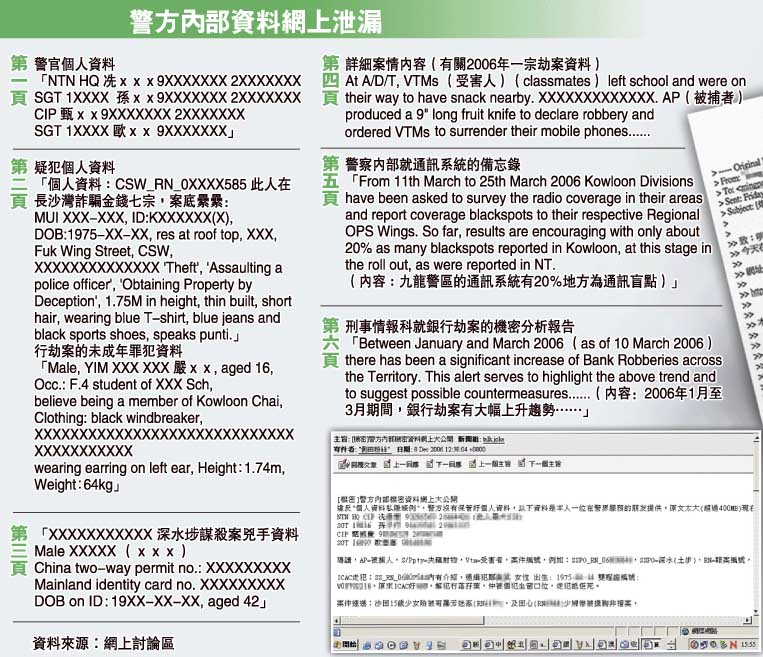
[040] Predicting
Voter Turnout (12/09/2006)
(TVBS)
The Central Election Committee estimates that the voting rate may exceed 70%
in today's Taipei and Kaohsiung mayoral elections. (Ming
Pao) The Democratic Progressive Party thinks that the voting
rate will be about 65% in both cities. These numbers look like they
just fell out of someone's head. What is the basis?
The following are ratio estimates derived from survey data. It is known
that if you ask people whether they will vote, the result will be
over-stated since it is socially desirable to say YES. But there may
be a relationship between the survey result and the actual vote. Here is the
simplest model.
(TVBS)
Taipei city
In 2002, 87% of survey respondents said that they would vote.
In 2002, 70.6% of all voters actually voted.
In 2006, 81% of survey respondents said that they would vote.
In 2006, the estimated voting rate is 81 x (70.6/87) = 65.7%
(TVBS)
Kaohsiung city
In 2002, 86% of survey respondents said that they would vote.
In 2002, 71.4% of all voters actually voted.
In 2006, 87% of survey respondents said that they would vote.
In 2006, the estimated voting rate is 87 x (71.4/86) = 72.2%
(Addendum) Here are the actual voter turnout figures (UDN):
Taipei city: 64.52%
Kaohsiung city: 67.93%
(Addendum) (Apple
Daily)
There were 2,08,434 registered voters in Taipei city this time, which is an
increase of 61,265 over year 2002. But the number of people who
actually cast votes was 79,072 fewer. In Kaohsiung city, the number of
registered voters increased by 47,442 but 5,321 fewer people cast votes.
[039] Why
People Lie (12/09/2006) It is known that I am a survey
researcher by profession. So how would I explain why the public
opinion polls can sometimes deviate from actual election polls in Taiwan by
a magnitude far beyond the theoretical margin of sampling error? In
other words, why would people deliberately and willfully lie to the
interviewers?
This gets back to my time working for Roger Ailes at CNBC/America's Talking
(see the ESWN blog post In
Defense of Roger Ailes). The same situation must be happening
today at Fox News, where Roger Ailes is the current president. Suppose
you are the research supplier conducting the tracking survey for Fox
News. How will your interviewers introduce themselves over the
telephone? The most typical script is: "Hi, I'm Mary from the
Public Opinion Research Institute of America. I would like to ask you
some questions about cable television news channels. Did you watch CNN
yesterday? Fox News? Headline News? MSNBC? etc" If the script
was: "Hi, I'm working on a survey on behalf of our client Fox News
..." a completely different set of responses would be elicited (such as
people hanging up the telephone immediately).
In like manner, I wonder how the media organizations in Taiwan run their
surveys (and the published information does not explain in sufficient
detail). Suppose the interviewers introduce themselves with the
script: "Hi, I'm Ah Ching from TVBS (or Liberty Times) and I would like
to ask you about your voting preferences in the upcoming election
..." I imagine that a significant number of people will be
hanging up the telephone as soon as they hear the name of the media
outlet. If I was assigned the task, I know that I would have
instructed my interviewers to 'mislead' the respondents by saying: "Hi,
I'm Ah Ching from the Public Opinion Reseach Institute of Taiwan. We
are an independent organization and we would like to ask you about blah blah
blah ..." even though the named organization does not exist. Why
would I lie? Because I rationalize that I am interested in learning
the truth! Technically, TVBS (or Liberty Times) can easily make this
honest by formally establishing the Public Opinion Research Institute of
Taiwan as an independent organization on the outside for the sole purpose of
the public opinion polling.
It is understandable why people would hang up the telephone when they hear
the name of a media outlet that they subjectively believe is a serial
liar. Is there something more? In the United States, there is
the notion of a "push poll." From Wikipedia,
"A push poll is a political campaign technique in which an individual
or organization attempts to influence or alter the view of respondents under
the guise of conducting a poll. True push polls tend to be very short,
with only a handful of questions, so as to make as many calls as possible.
Any data obtained (if used at all) is secondary in importance to negatively
impacting the targeted candidate." So you can imagine the
following exchange in a "push poll" in Taiwan:
Q: "Which candidate will vote for in the Kaohsiung mayoral
election?"
A: "Chen Chu."
Q: "Does this mean that you support the corrupt behavior of Chen
Shui-bian? (add on all the follow-up questions about the indictments
of the first lady for embezzlement, the president's son-in-law for insider
trading, etc).
A: "...."
After you have received a few telephone calls of this nature, you will have
learned to lie, as in "Oh, I really haven't made up my mind yet"
when you may be holding a profound resentment about the non-stop intrusion
into your personal decision (and it is your personal
decision!).
But you are going to note that there is an issue with sample size. All
the media outlets are running their surveys on samples ranging between 600
to 1,000 respondents (sometimes as many as 3,000 in order to poll the local
council elections). There are millions
of registered voters out there. So these public opinion polls are not
"push polls." Push polls have to involve hundreds of
thousands of people out there.
Addendum: I'm sorry about losing the link to something that I
read today. Allegedly, the People First Party objected to the public
opinion polls run by the media outlets because their internal polls of
110,000 voters showed that James Soong is doing a lot better than
indicated. With due respect, this mass number qualifies it immediately
as a "push poll." To pollsters, there is no technical reason
to interview that many people in order to get a reliable figure. Even
in the United States which has a larger population base, the polling
organizations typically interview only about 1,000 respondents.
[038] The
Surveys Say ... (12/09/2006) From Don't Trust
Those Taiwan Public Opinion Polls: I wrote: "
Historically, public opinion polls have been inaccurate in Taiwan when compared to actual
election results. According to public opinion polls, Chen Shui-bian
would not have elected mayor of Taipei city and then president of Taiwan. Why? If the professionals know, they would
have done something about it. They just don't know and that is why
they are sometimes (but not always) very wrong."
Here are the numbers for the Kaohsiung mayoral election:
Liberty Times (12/5): Huang Jun-yin (34.38%) versus Chen Chu (34.09%)
China Times (12/4): Huang Jun-yin (43%) versus Chen Chu (29%)
TVBS (12/3-12/4): Huang Jun-yin (51%) versus Chen Chu (31%)
United Daily News (12/2): Huang Jun-yin (39%) versus Chen Chu (27%)
Era TV (11/26-11/27): Huang Jun-yin (41%) versus Chen Chu (26%)
ETTV (11/24): Huang Jun-yin (41%) versus Chen Chu (29%)
According to Liberty
Times, KMT candidate Huang Jun-yin has taken an ad out to question
why the Liberty Times figures are different from the others. The South
Society responded that the reason was obvious: the "Chinese media"
are biased and therefore things happen in their public opinion polls.
As examples, the South Society said Chen Shui-bian was not picked by the
"Chinese media" in the last two presidential elections, but he won
both times; four years ago in the Taipei mayoral election, DPP candidate Lee
Ying-yuan polled below 20% but he ended up with 36% of the votes. This
proves that the polls by the "Chinese media" are way off and
untrue.
Does that contradict what I wrote in the beginning? Not at all,
because there have been many elections as well as many public opinion
polls. The ones cited by South Society favor their case. They do
not tell you about examples that contradict their case.
(BCS via Yahoo!
News) In the Taipei county election last year, the polls from
all except one media outlet favored KMT candidate Chou Hsi-Wei
over DPP candidate Lo Wen-chia by at least 10 percentage points. That
exception showed the two candidates in a dead heat. In the end, Chou
won by 190,000 votes (=10.5%). Yes, it was Liberty Times which was the
exception.
What is happening this time? Nobody knows until afterwards. But
previous performances are not a good predictor -- if you are willing to
consider the totality of the evidence instead of a selective slice.
P.S. Here is something else that I am suspicious about. Liberty
Times conducted a poll for Kaohsiung. What about Taipei? There
is nothing from them. Does Taipei matter to their readers? Does
Frank Hsieh matter to them? Did they just leave the pan-blue polls out
there convincing the voters not to bother to vote? Or did they
actually conduct a poll and thought that it was strategically advisable to
withhold the information because this was a hopeless situation.
P.P.S. Why won't you want more interviews when you can afford it?
Because the quality of the work deteriorates. For example, I only need
about 20 to 30 interviewers in order to complete 1,000 interviews per
evening. Those interviewers may be on my permanent trained
staff. I can guarantee the quality of the work. But in order to
complete 100,000 interviews in one evening, I'll need 2,000 to 3,000
interviewers. I cannot possibly have those people on my regular
payroll. So I'll just have to haul in a lot of temporary workers who
are not sufficiently trained. Every professional survey researcher
will tell you that this is a recipe for disaster. You are just
throwing money away to get bad data.
[037] The Sun Does Not Shine On The Green Party (12/08/2006) The story at Taiwan Blogs For The Green Party is about how Taiwan bloggers got together spontaneously for the Green Party. This story is now showing up in the mainstream media, including this amazing story in The Sun. This is amazing because the newspaper managed to get it totally wrong.
As the Taipei and Kaohsiung mayoral elections are counting down, there is a "I Vote Green Party" typhoon on the Internet! Some netizens wanted to help the green camp and designed special banners with words like "I Vote Green Party" and "Vote for Green" for "pro-green" netizens to use. Within three days, more than one hundred Taiwan blogs have responded. Aso, some netizens have made the speeches of the green-camp legislature candidates into podcast for downloading, as is the fashionable trend among young people.
The problem here is that the "Green Party" is being confused with the "green camp." The bloggers are supporting the "Green Party" and not the "green camp." See Wikipedia for the definition of the pan-green coalition. The Green Party is not part of the pan-green coaltion or green camp.
[036] The Alan Leong Photo (12/08/2006) (Apple Daily) The following photograph of Hong Kong Chief Executive candidate Alan Leong is characterized as a 'disaster'? There is enough realism factors and political symbolism for students of art history and fans of <The Da Vinci Code> to spend days on.
(A) In looking at this photograph, can you tell what is the disaster?
Recommended answers:
(1) Why select a tram in order to illustrate intimacy with the citizenry? Is this for the sake of nostalgia? Is it because trams use a lot of wood and are therefore as 'wooden' as Leong? Besides trams only run on Hong Kong Island and not in Kowloon or New Territories. So is it a wise choice to take a public transport used by a small group of people in order to show that Leong cares about all the people of Hong Kong?
(2) Is it necessary to wear a full western suit? How many years ago was it that you last saw someone in a suit riding a tram? Is this one of those east-west crossover advertisements used by brands such as Armani?
(3) The biggest weakness in the image of the Civic Party is their extraordinary righteousness is disconnected from the masses. In this photograph, Leong is not looking at any citizen and listening. Instead, he he is standing high and tall, holding on the rail like Moses holding his staff at the Red Sea for the seated lady to look up to. Isn't this making the Civic Party's negative image even worse?
(4) The worst part is that the seated lady is not cooperating. She is tilting her body away in order to increase the distance between her and Leong. She is using both hands to protect her handbag and she shows doubt on her face. But you would probably also do that in her place.
(B) Please fill in the appropriate words in the white boxes in the photographs. Then proceed to post them at the popular discussion forums. The goal is to find the right words that will guarantee the photograph be found and published in Apple Daily's Internet news page.
(C) If you were Leong's spin doctor and you saw the photograph with the words in Apple Daily, how will you defuse the mini-disaster?
Here is an interesting project -- track the appearance and dissemination of the many photographs which will undoubtedly be appearing at the discussion forums.
[035] Taiwan
By The Numbers (12/08/2006)
(TVBS)
(808 persons age 20 or over interviewed on December 4 and 5. An
initial sample was randomly selected from the Taipei city telephone
directory and then the last four digits of the selected telephone numbers
are randomized)
Q: If the Taipei city mayoral election were held tomorrow, which of these
six candidates will you most likely vote for? (the change from the
December 3 poll is given in parentheses) [note: the
base are those who said that they will be voting]
Hau Lung-bin (KMT):52% (-2%)
Frank Hsieh (DPP): 21% (+1%)
James Soong (IND): 7% (-2%)
Li Ao (IND): 3%(no change)
Ke Tze-hai (IND): 2%(+1%)
Clara Chou (TSU): 1%(+0.8%)
Undecided: 14%(-1%)
(TVBS)
(989 persons age 20 or over interviewed on December 5 and 6. An
initial sample was randomly selected from the Kaohsiung city telephone
directory and then the last four digits of the selected telephone numbers
are randomized)
Q: If the Kaohsiung city mayoral election were held tomorrow, which of these
five candidates will you most likely vote for? (the change from the
December 4 poll is given in parentheses) [note: the
base are those who said that they will be voting]
Huang Jun-yin (KMT): 50% (-1%)
Chen Chu (DPP): 36% (+5%)
Lo Chih-ming (TSU): 2% (no change)
Undecided: 11%(-5%)
[034] Taiwan Blogs For The Green Party (12/08/2006) (China Times) In the Taiwan blogosphere, the biggest story right now is the Green Party campaign. This is the story of a spontaneously organized grassroots campaign. It began when the blogger


[033] The
Television Cameraman Was The Star (12/07/2006) (Ming
Pao) In Ngau Chi Wan (Kowloon, Hong Kong), a 43-year-old
divorced woman went to confront her ex-husband about missed alimony
payments. A quarrel broke out and the woman allegedly stabbed her
husband twice in the back. The police was summoned and the woman was
arrested.

But why was the television cameraman a star?
A television cameraman arrived at the scene to observe the woman trying to
stop the bleeding on her ex-husband's back. When she saw the
television camera, she began to walk away. The cameraman asked the man
whether the woman stabbed her. He said "Yes" and the
cameraman began to follow the woman with the camera running. About 500
meters away, the woman hailed a taxi and tried to leave. But the
cameraman and three estate security guards stopped the taxi and prevented
the woman from leaving until the police arrived. Here are some shots
from the cameraman's video.
[032] Virtual
Prediction Markets in the Taiwan Elections (12/07/2006)
(UDN)
The Center for Prediction Markets,
National Chengchi University established a futures market for the Taipei and
Kaohsiung city mayoral elections. The rules are that you can offer to
pay for a contract for a specific candidate to win. You pay a price
between 0 and 100 dollars, and you can sell that contract to others if you
think that you are getting a good price under the new situation. After
the election, the winning candidate's contract will be worth 100 dollars
whereas the contract of all other candidates will be worth 0 dollar.
So here are the latest trades.
Taipei City:
Hau Lung-bin $88.6; Frank Hsieh $7; Li Ao $2; Clara Chou $1; Ke Tse-hai
$0.1$; James Soong $0.1.
Kaohsiung City:
Huang Jun-yin $77.5; Chen Chu $25.
Another prediction market is the underground gambling odds. The standard
method is to offer a handicap. (UDN)
In Taipei city, the syndicates are offering a handicap of 170,000 votes for
Hau Lung-bin over Frank Hsieh. In other words, if you bet on Hau
Lung-bin, then he has to win by more than 170,000 votes for you to collect;
if you bet on Frank Hsieh, then you win if he loses by fewer than 170,000
votes (and Hsieh can even win too!). (UDN)
In Kaohsiung city, the syndicates are offering a handicap of 15,000 for
Huang Jun-yin over Chen Chu.
Virtual markets are not always correct and there is no systematic bias (or
else the market would have corrected itself for that is the whole point of a
market). However, virtual markets are different because they can
incorporate additional information not known to the general voting public.
[031] The
HKD-RMB Exchange Rate (12/07/2006) (Ming
Pao) How much do you think it is nowadays? Yes, there
are reports that it is 100:98, but the following story gives a different
figure.
The story was reported on the personal blog of an official with the Chinese
Ministry of Information Industry. This official attended the ITU
convention in Hong Kong recently. As hotel rooms were unavaible near
the airport (where the convention was being held), the Ministry of
Information Industry booked the group of 100 plus persons at a four-star
hotel in the Tsing Yi. To his surprise, there was no Internet
connection in his hotel room. As a result, he had to access the
Internet at coffee shop terminals. Over at the convention site, WiFi
access was also flaky.
In the end, he moved to the Royal Palace Hotel in Mongkok. The room
rate was HK$2,600 per day. Internet access was available in the hotel
room at HK$240 per day. But since he was paying in RMB, the hotel
charged him HK$300 per day instead! So there you have it: the Royal
Palace Hotel has a HKD-RMB exchange rate of 100:125!
By the way, the blog post was titled: "I may never stay in Hong Kong
again."
[030] A45
In Peril? (12/07/2006) (Apple
Daily) If it is hard to run a media outlet, then it is harder
for a political party to run a newspaper! A45
is the newspaper of the Civic Party and it presently only has money left for
one or two weeks.
The newspaper began with a HK$ 1 million donation from a businessman and it
has advertisements from a few real estate companies plus Richard Li's
PCCW. The newspaper is distributed for free and its costs more than
HK$60,000 per week to print. But after the political reform package
was voted down by the Civic Party and its allies, the advertisements dried
up and now PCCW is the only advertiser left.
While they can complain about a business boycott of a pro-democracy
newspaper, the fact is that businesses cannot be forced to advertise because
that would be antithetical to the notion of democracy. This means that
either the Civic Party or its members will have to dip into their own
pockets and literally put the money where their mouth is.
[029] Don't Trust
Those Taiwan Public Opinion Polls (12/07/2006) (Central News
Agency via Yahoo!
News) In the Taipei city mayoral election, the KMT candidate Hau
Lung-bin estimated that the DPP candidate Frank Hsieh has an actual support
between 36% to 43%.
But the actual public opinion poll results are:
UDN (12/02): Hau 44%; Hsieh 17%; Soong 8%
China Times (12/05): Hau 48%; Hsieh 22%; Soong 5%
TVBS (12/03): Hau 54%; Hsieh 20%; Soong 9%
Era TV (11/27): Hau 41%; Hsieh 20%; Soong 8%
Historically, public opinion polls have been inaccurate in Taiwan when compared to actual
election results. According to public opinion polls, Chen Shui-bian
would not have elected mayor of Taipei city and then president of Taiwan. Why? If the professionals know, they would
have done something about it. They just don't know and that is why
they are sometimes (but not always) very wrong. Nevertheless, the
tendency seems to be their polls favor the pan-blues. Hau Lung-bin's
personal opinion was that "Frank Hsieh's numbers are too low because
many of his supporters will not express their true opinions when contacted
by telephone but they will vote for him on election day."
Of course, a democratic election is not about public opinion polls; it is
about casting a vote on election day. That is the only true public
opinion vote (which is not a poll based upon a sample of voters).
So what is the point about all these public opinion polls? That is
because without these public opinion polls from 'independent' organizations,
all you will get is spin from the candidates about how their 'confidential
internal polls' show that they are leading by large margins. Well,
Hau, Hsieh and Soong can't all be leading by wide margins, can they?
Therefore, the public opinion polls should serve as some kind of reality
check (as in Soong is unlikely to be leading at 50% support level at this
time).
[028] The
Kneeling Reporter (12/06/2006) (Beijing
News) On November 13, Liang Jinzhu of Henan province was
diagnosed with bone cancer. Meanwhile his wife was eight months
pregnant. The economically distressed Liang thought about selling his
child. After receiving media coverage, a Zhengzhou hospital treated
him for free.
On November 30, Jinri Anbao reporter Duan Junwei handed 100 RMB plus
presents to Liang. His wife and brother got down on their kneels to
thank Duan and fellow reporter He Yonggang. No matter what the
reporters said, the two would not get up. So He Yonggang did something
surprising -- he got down on his kneels and the three stayed there for more
than 10 minutes. That was why He Yonggang completed the interview.
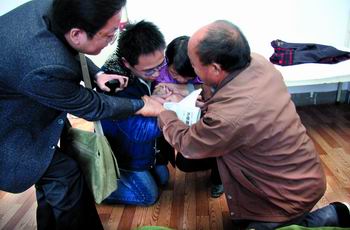
What was He Yonggang thinking? "I was only looking a kind of
equality. I was not thinking about anything else. They wre all
older than me. The patient's brother was 56 years old, which is older
than my father. There was also a pregnant women. How could I be
receiving this form of thanks?" I only wanted to express my
feelings at an equal level.
What did the Internet think? Not universally favorably. Was he
too inexperienced? Did he lost control? Was he looking to become the
story himself by this grandstanding act? Other comments were more
favorable, since these reporters were doing something for citizens as
opposed to re-printing corporate press releases.
Related Link: When
The Journalist Plays The Lede Jonathan Ansfield, China Digital
Times
[027] Undercover
Police Streetwalkers in Hong Kong (12/06/2006) (Ming
Pao) The opening of Langham
Place in Mong Kok had the effect of raising neighborhood
rents. This meant that the shady denizens in the Portland
Street/Shantung Street/Soy Street area have been displaced southwards
towards Jordan, where the local residents do not like their new
neighbors. Specifically, local females are being mistaken as
prostitutes and propositioned in the street.
Yesterday between 4pm to midnight, the police sent out seven undercover
female police officers into the area around Shanghai Street between Kansu
Street and Nanking Street. Sixteen men (including a 72-year-old
American citizne) were arrested for persuading others to commit immoral
acts.
(Ming Pao)
The rules of engagement for the Hong Kong female undercover police officers
are very explicit.
- The dress code does not allow low-cut sexy clothing. In the summer,
they wear t-shirts and jeans; in the winter, they wear sweaters and long
pants.
- They cannot initiate a conversation themselves.
- They must move along the street. They cannot stand on the street for
longer than one minute because this would constitute a signal. When
they walk, they are allowed to take a few steps, pause briefly but they
start walking again.
- They are trained to answer the queries. For example, if asked
"Are you available?" or "Do you have a place?" they are
supposed to ask "What for?" or "Do what?"
After ascertaining that the purpose was a sexual transaction, then the price
can be negotiated.
(Apple
Daily) It should be made clear that it is not a crime to
patronize a prostitute in Hong Kong. But it is a crime to solicit
others to engage in an immoral act. For example, stopping a woman in
the street and asking "How much?" is sufficient evidence for a
conviction that carries a maximum sentence of six months in jail and a fine
of HK$10,000.
[026] Taiwan
By The Numbers (12/06/2006) (Liberty
Times) (725 Kaohsiung city voters were interviewed on December
4-5. An initial sample was selected from the Kaohsiung city telephone
directory. The last two digits of the selected telephone numbers were
randomized.)
Kaohsiung city mayoral election support levels:
Huang Jun-yin (KMT): 34.38%
Chen Chu (DPP): 34.09%
Undecided: 24.72%
Political party support levels:
Democratic Progressive Party: 19.70%
Kuomintang: 16.84%
Taiwan Solidarity Union: 0.75%
People First Party: 0.15%
Independent: 62.56%
88% of DPP supporters favor Chen Chu; 87% of KMT supporters favor Huang
Jun-yin; among independents, 30% support Huang Jun-yin, 28% support Chen Chu
and 32% are undecided.
[025] Lung Ying-Tai at Harvard (12/06/2006) (China Times)
Lung Ying-tai gave a speech at the John King Fairbanks Center for East Asian Studies titled <The isolated, besieged, marginalized but extremely important Taiwan -- the influence of the democratic experiment in Taiwan on the Chinese-language world>. During the speech, she spoke about the international isolation of Taiwan today and the historical path of its marginalization. She described the democratization of Taiwan over fifty years. She recalled how Lian Chan and James Soong went to visit mainland China, after which China Youth Daily's <Freezing Point> published Lung Ying-tai's article about democracy in Taiwan. This caused the Central Publicity Department to ban <Freezing Point>. But already the progress of democracy in Taiwan had a critical impact in mainland China. Therefore, within the current "China fad," the unique position of Taiwan and its contributions cannot be ignored.
The first audience question came from the viewpoint of Great China chauvinism when Lung Ying-tai was asked if she still considered China to be her 'motherland.' She said that this is not a complicated question at all. "Chinese culture is my motherland, but the China that is currently ruled by that kind of government is definitely not my motherland." Any nation that does not respect the core values that she personally treasures cannot be her "motherland."
Another Chinese scholar wondered why Lung Ying-tai idealized Taiwan democoracy while skipping over the various risible and undesirable aspects. Also, she does not propose how China ought to implement democracy. So was she being responsible? Lung Ying-tai said that Taiwan and mainland China are in different stages and they are facing completely different problems. Therefore, any discussion should not mix them up. Mainland China only makes libelous and negative reports on Taiwan democracy and emphasizes that democracy is unworkable in China under the present conditions. Therefore, she needed to present the non-official view. As a writer, her responsibility is to point out the blindspots for the readers to think out. It is the responsibility of politicians to solve the problems themselves.
She said: "I am not the aide to Hu Jintao. So why should I be responsible for carrying it out?" With respect to the saying that the people who are actually running the state have to confront many problems, whereas a writer has it easy because all she has to do is lift a pen, she said: "But it is not as easy to criticize current politics as you think. The best proof is when offending publications are banned." She added, "It is the duty of a writer to criticize and it is the duty of a politician to respond to those criticisms." Applause broke out at this comment.
[024] Doctor Report (12/06/2006) (AFP via SCMP)
Supporters of Hong Kong’s pro-democracy candidate for the city’s leadership on Tuesday accused China’s government of hacking into his computer and using false information to discredit him. Lawmaker Alan Leong Kah-kit’s campaign organisers say Beijing went through classified emails, minutes of meetings and survey reports and posted doctored versions of them on the internet to cast him in a negative light.“We have software built in to track the hackers — and they all have Beijing IP addresses,” fellow pro-democracy lawmaker Audrey Eu Yuet-mee, who is managing Mr Leong’s campaign to be Hong Kong’s next chief executive, said. An IP, or Internet Protocol, is the electronic address code given to a web-connected computer. “It is what we expected and quite common, especially in the run-up to an election here,” added Ms Eu.
Ms Eu said the hackers had doctored Mr Leong’s computer files before making them available online to cast doubt on his political independence. The altered documents made it appear as though Mr Leong had received huge donations from Taiwan, China’s sworn rival, and from the United States. “We are not so concerned, because Alan has nothing to hide — everything we do is above board,” said Ms Eu. “All these allegations [against him] are lies.”
For one thing, this is technically wrong, because a good hacker can disguise the IP address (and make it into anything including the White House) if necessary. The more interesting aspect is how the information gets transmitted in the Internet age. Previously, the information would have been sent to various newspapers by anonymous postal mail. Now, the newspapers received emails and, furthermore, there is an anonymous MSN Spaces blog titled Doctor Report (in Chinese). Will Alan Leong go to the Hong Kong court to ask MSN Spaces to remove that website, just like the Chinese government did to the bloggers Michael Anti, Lian Yue and others?
I'm not going to translate from that website. I do not see anything wrong with hiring a public relations company to assist in a political campaign (note: that standard would have disqualified most candidates for public office in the United States). But there is one interesting point. The Doctor Report blog entry of December 4, 2006 contains the itemization of media "promotion" fees:
Apple Daily: HK$ 50,000 (discounted)
Ming Pao: HK% 80,000 (discounted)
South China Morning Post: HK$ 189,379 (to be confirmed)
Hong Kong Economic Times: (awaiting reply)
In addition, there was HK$ 71,700 for website prodcution, including a brand new server and a personal firewall that guarantees maximum security against hacker attack.
Here is what I don't understand -- what exactly is a "promotion" fee paid to a newspaper? I do not believe that there are any advertisements for Alan Leong at this time. Does this mean that the newpapers are getting paid for editorial content favorable to Alan Leong? That would have meant the end of journalism as I understand it ...
Of course, I'm whistling in the wind here. Neither Alan Leong, the Civic Party, Apple Daily, Ming Pao or SCMP will answer my question. After all, I'm just a "dirty f**king hippie" blogger ...
Terminology (from Answers.com) (note: this was necessary because certain people may think that they are all one and the same)
- The activity of attracting public attention to a product or business, as by paid announcements in the print, broadcast, or electronic media.
- The business of designing and writing advertisements.
- Advertisements considered as a group: This paper takes no advertising.
- The act of promoting or the fact of being promoted; advancement.
- Encouragement of the progress, growth, or acceptance of something; furtherance.
- Advertising; publicity.
- The systematic propagation of a doctrine or cause or of information reflecting the views and interests of those advocating such a doctrine or cause.
- Material disseminated by the advocates or opponents of a doctrine or cause: wartime propaganda.
- Propaganda Roman Catholic Church. A division of the Roman Curia that has authority in the matter of preaching the gospel, of establishing the Church in non-Christian countries, and of administering Church missions in territories where there is no properly organized hierarchy.
- (used with a sing. verb) The art or science of establishing and promoting a favorable relationship with the public.
- (used with a pl. verb) The methods and activities employed to establish and promote a favorable relationship with the public.
- (used with a sing. or pl. verb) The degree of success obtained in achieving a favorable relationship with the public
So one should hope that this was not a case of buying favorable editorial/comment opinions. Is that too much to ask in an open and transparent society? I expect the media to state cateogrically that that willl never ever occur.
[023] The
Taipei City Mayoral Election (12/06/2006) The Taipei
city mayoral election will be held on December 9. The comment below
has some polls results. TVBS has Hau Lung-bin at 54%, Frank Hsieh at
20% and James Soong at 9%; UDN has Hau at 44%, Hsieh at 17% and Soong at 8%;
China Times has Hau at 48%, Hsieh at 22% and Soong at 5%. Why are these numbers so different (beyond the stated margin of
error)?
There are some minor differences, as when TVBS interviewed persons age 20 or
over and tabulated who said that they will vote whereas UDN interviewed
registered voters. In the United States, some
polling services prefer to use 'likely voters' instead. The more
significant difference is in the phrasing of the question. TVBS
imposed a forced choice: "If the election were held tomorrow, who would
you vote for?" whereas UDN/China Times only ask about whom they support.
Therefore, TVBS has 13% undecideds whereas UDN has 26% undecideds.
But if you want to understand the dynamics of the vote, you should check the
cross-tabulation of voter preference by party identification from TVBS.
According to this survey, party identification in Taipei city is as follows:
Kuomintang: 39%
Democratic Progressive Party: 11%
People First Party: 4%
Taiwan Solidarity Union: 1%
Independent/unaffiliated: 39%
Thus, no single party has an automatic majority. In fact, nobody can
win without a high share among the independents.
Here is the cross-tabulation of voter preference by party
identification. Each column is supposed to add up to 100% (which is
the total number of people for that party affiliation).
Mayoral choice TOTAL KMT DPP PFP TSU IND Hau (KMT) 54% 83% 8% 33% 0% 37% Hsieh (DPP) 20% 3% 85% 3% 81% 22% Soong (IND) 9% 7% 1% 56% 0% 8% Li Ao (IND) 3% 2% 0% 5% 0% 4% Ke Tze-hai (IND) 1% 0% 1% 0% 0% 2% Clara Chou ( TSUIND)0.2% 0% 1% 0% 5% 0% Undecided 13% 5% 4% 1% 5% 27% The votes for those who identify with the two major political party have basically been committed, probably a long time ago. They can only be shifted by dramatic actions such as the withdrawal of a candidate (e.g. Hau withdraws to make way for Soong). The fight is going to be at the bottom-right cell: the 27% of independents who are still undecided and who account for about 10% of all persons age 20 or over.
[022] Taiwan
By The Numbers (12/06/2006)
(TVBS)
(2,853 Taipei city residents age 20 or over interviewed between November 29
and December 3. An initial sample of telephone numbers were drawn from
the Taipei city telephone directory. The last four digits of the
selected telephone numbers are then randomized. This is a huge sample,
because the poll all asked about the Taipei city legislature candidates.)
Q: If the Taipei city mayoral election were held tomorrow, which of these
six candidates will you most likely vote for? (the change from the
November 20 poll is given in parentheses) [note: the
base are those who said that they will be voting]
Hau Lung-bin (KMT):54% (+5%)
Frank Hsieh (DPP): 20% (+2%)
James Soong (IND): 9% (-1%)
Li Ao (IND): 3%(no change)
Ke Tze-hai (IND): 1%(no
change)
Clara Chou (TSU): 0.2%(-0.8%)
Undecided: 13%(-5%)
(TVBS)
(1,086 Kaohsiung city residents age 20 or over interviewed between December
3-4. An initial sample of telephone numbers were
drawn from the Taipei city telephone directory. The last four digits
of the selected telephone numbers are then randomized.)
Q. If the Kaohsiung city mayoral election were held tomorrow, which of
these five candidates would you vote for? (the change from the November 5
poll is given in parentheses)
[note: the base are those who said that they will be voting]
Huang Jun-yin (KMT): 51% (-1%)
Chen Chu (DPP): 31% (+2%)
Lo Chih-ming (TSU): 2% (no change)
Undecided: 16%(no change)
(UDN)
(1,080 Taipei city voters interviewed on December 2, with 167
refusals). An initial sample of telephone numbers was randomly
selected from the Taipei city telephone directory. The last two digits
of the selected telephone numbers were randomized)
Support levels for Taipei city mayoral candidates:(the change from
the November 25 survey is given in parentheses)
Hau Lung-bin (KMT):44% (+2%)
Frank Hsieh (DPP): 17% (-2%)
James Soong (IND): 8% (no change%)
Undecided: 26% (-1%)
(UDN)
(1,092 Kaohsiung city voters interviewed on December 2, with 167
refusals). An initial sample of telephone numbers was randomly
selected from the Kaohsiung city telephone directory. The last two
digits of the selected telephone numbers were randomized)
Support levels for Kaohsiung city mayoral candidates:(the change from
the November 24 survey is given in parentheses)
Huang Jun-yin (KMT): 39%(+1%)
Chen Chu (DPP): 27% (-2%)
Lo Chih-ming (TSU): 2% (-1%)
Undecided: 32%(+3%)
(China
Times) (759 adults interviewed on December 5. An initial
sample of telephone numbers was randomly selected from the Kaohsiung city
telephone directory. The last two digits of the selected telephone
numbers were randomized. The survey results were weighted by gender,
age and geography)
Support levels for Taipei city mayoral candidates:
Hau Lung-bin (KMT):48%
Frank Hsieh (DPP): 22%
James Soong (IND): 5%
Li Ao (IND): 2%
(China
Times) (760 adults interviewed on December 4. An initial
sample of telephone numbers was randomly selected from the Kaohsiung city
telephone directory. The last two digits of the selected telephone
numbers were randomized. The survey results were weighted by gender,
age and geography)
Support levels for Kaohsiung city mayoral candidates:
Huang Jun-yin (KMT): 43%
Chen Chu (DPP): 29%
Lo Chih-ming (TSU): 1%
Undecided: 27%
[021] Chinese
Hate Sites (12/05/2006) (Apple
Daily) According to a rough estimate, there are more than
10,000 mainland Chinese websites that specialize in enabling people to vent
their anger. Most of these sites are free, but there are also pay
sites which charge several RMB per post which can be permanent.
YaYaPay.cn classifies the subjects into almost 20 categories, including
work, society, education, etc. Within society, there are
sub-categories such as "the rich are too rich and the poor are too
poor."
Shanghai white-collar worker Ms. Xu has spend almost 100 RMB already.
"I'm obsessed with the idea. I let off my anger about being sold
fake merchandise or mistreated by boss."
At the Chinese Hate Wall (hatewall.com), there are almost 1,000 posts,
including
- cursing the boss ("I f**king hope you die in a crash when you get in
a car and your brain bleeds when you drink alcohol")
- cursing the rich ("I hope all the rich people in the world die")
- cursing the stock market ("The index has reached 2,000 but my stock
has not gone up. F**k!")
- cursing a rival ("Here is the mobile telephone number of the woman
who stole my man")
According to a lawyer interviewed in Qingjiang Evening News, it is against
the law to curse someone out by name. The website also shares
responsibility. The victim can report to the Internet Complaint Center
Against Illegal and Harmful Websites.
[Comment: I don't know how to come up with an estimate of 10,000 'hate'
websites. Supposing that the number is large, then this is a piece of
Internet business that has quietly developed without too much attention.]
[020] Chinese
Vocabulary (12/05/2006) (6Park)
How is a foreigner supposed to learn Chinese? There are so many
synonyms!!!
Wife: 1,
[019] Yet
Another Celebrity Endorsement (12/05/2006) Following Wentworth
Miller's endorsement of prostate treatment at a Fujian hospital (see The
Prison Break Ads), comedian Steve Martin has
also endorsed the Beijing Tian Lun Sterility Hospital.

[018] Comrade
Wu Comes To Hong Kong (12/05/2006) (Apple
Daily) The chairman of the National People's Congress Wu
Bangguo paid an official visit to Hong Kong. If you read the
newspapers, you will have learned about how Comrade Wu addressed a
telecommunications conference and also visited a low-income family and
presented them with a home computer as gift. These are media shows
that the general public cannot be present (certainly, no seven million Hong
Kong citizens in the same place at the same time).
Instead, the citizens are participating through roadside gawking, such as
this YouTube
clip of the motorcade.
[017] Presence/Absence
(12/05/2006) On the whole, I would rather be absent than
present. This website is sometimes characterized as a translation
blog, in which articles of interest written in Chinese are translated into
English. The goal was allegedly to show the English-only reading world
about what is happening in the Chinese-reading world. Someone once
said, "If it is not reported in English, then it didn't
happen." Therefore, this blog exists in order to rectify the
imbalance. Or so it is claimed.
But I cannot hope for any pretense at fairness, objectivity, unbiasedness or
balance. Millions of things are reported in Chinese each day. So
why do five items get reported on this website on the average? Why
these five and not some others? Because they represent my personal
preferences, predilections, etc. So this is how my presence intrudes
when absence is preferred. I am the person who chose those five items
as opposed to the many others that I have read. So those choices must
reflect my biases, preferences, predilections, tastes, idiosyncrasies, etc.
When you go to a blog, why should you care who the blogger is? Why not
just consider the blog contents on their own merits instead? The
answer to this question also explains why tabloid journalism is so
popular! This is because your interest in the blogger probably
overwhelms your interest in the blog contents! This is particularly
upsetting since I don't date people such as Zhang Ziyi or Joey Yung.
In the end, you must understand that I do what I do because this is what I
want to do. You can pursue your other agendas about my personal being,
and you are entitled to how your want to waste your time.
[016] Yet
Another Horror Story About Chinese Tourists in Hong Kong
(12/05/2006) ... or how to send your brand equity up in flames.
This story received coverage from Ming Pao in five parts.
(Ming Pao;
Ming Pao; Ming
Pao; Ming
Pao; Ming
Pao) Earlier this year in March, a group of about 100
educators attended a conference in Shenzhen. Afterwards, they
participated in a tour of Hong Kong organized by a Shenzhen travel agency.
On the first day, the tour guide took the educators to visit a Hong Kong
elementary school in Causeway Bay. Then the group went to Ocean
Park. As it was already almost 5pm, the group got to stay for only one
hour and were able to do two rides because the park was closing.
On the second day, the tour guide took them to a number of designated shops,
including the "Golden Toilet," "the Geneva International
jewelry/watch shop," "The Global Exhibition" and a
"duty-free shop." When the tourists did not purchase enough,
the tour guide cursed them out as "cheap bastards" and
"trash" and walked out on them. The group sat on the bus for
over an hour unattended to. Finally the tourist guide returned with
another member of the travel agency. After some arguments with the
tourists, this newcomer also cursed them out as "trash" and left
with the tour guide. Eventually, the bus driver took the group back to
Shenzhen and the rest of the tour was canceled. The tourists said:
"We had a good impression of Hong Kong before. It is a society
ruled by law ... but we are enraged and we will never come back!"
At the duty-free shop, one tourist purchased more than HK$2,000 worth of
cosmetics. Afterwards, he happened to come across a SaSa store and
went in to check the prices. He had paid one-third more at the
'duty-free shop.' At an electronics shop, the salesperson recommended
the 10-megabyte FujiPro to the tourists. With the list price of
HK$2,900, the tourists purchased more than 10 digital cameras at the
discounted price of HK$1,800. Unfortunately, they found out that this
was not quite a "brand that all Hong Kong people use" and the
quality of the photographs was bad.
But there are more issues here than the standard ones. Here is the
first element: this was a group of educators who traveled on business from
all over China to Shenzhen to attend a professional conference. Thus,
this Hong Kong tour was a side-trip while on official business. This
meant that none of them wanted to be quoted by name because they did not
want to explain why they went on a shopping spree funded by public
money. This also means the Hong Kong Tourism Board cannot take action
against the tour guide or the travel agency for the lack of a complainant.
Now comes the best part -- why did the relationship between the tour guide
and the tourists reach a level of irreconciliable differences? The
tour guide was flippant and made casual remarks about the Chinese Communist
Party, including saying that the caligraphy of former CCP chairman Jiang
Zemin looked like it came from an elementary schoolchild. The tourists
were mostly school cadres and principals who are also simultaneously members
of the Chinese Communist Party, and they took those comments as personal
attacks.
However, these are cadres and principals from elementary and middle schools
in eleven provinces, including Beijing, Dalian, Fujian, Guangxi, Shenzhen,
etc. The reputation of Hong Kong as tourist hell is now widespread
among mainland Chinese educators.
[015] An
Internet BBS With Unique Chinese Characteristics (12/04/2006) (Boxun)
This is an admininistrator announcement page at the Ziling Bulletin Board
System. The notice is on BBS rules and regulations:
"Characteristics of posts that shall be deleted from the Ziling BBS:
those about Chinese political parties, government, law enforcement
departments, state leaders and state systems; those that insult the glorious
image of China; those about corruption; those about local governments; those
about marches, demonstrations, riots, evil cults and other sensitive
subjects. Thank you everybody for your cooperation." The
notice is positioned right on top of an advertisement for 24-hour-a-day
continuous showings of different movies of passion ...

[014] The
Body Paintings (12/04/2006) (Bandao)
What is the purpose of the Internet? One purpose is to empower
individuals to set up platforms where they can express themselves and engage
in commerce. A male model in Nanjing named Mao went to the popular
Xici Hutong website and set up a page titled "Najnjing Human Body (Body
Painting) Model Center." Then he posted some photographs of the
human body. Within a couple of days, he already had more than 2,000
visitors.


Then came trouble: "At 6pm on November 21, I tried to open the website
but I received an error message instead. I called the Xici Hutong
customer service line and I received the answer: 'We have deleted your page
because it has pornographic contents.' I was dealing with art, not
pornography. So I asked, 'In your eyes, what is pornography?'
The answer was: 'Anything that shows the vital parts is pornography?'
'Showing the vital parts is pornography? Then what about the
photographs of actress Tang
Jiali? Is that pornography?' 'Yes!' If they are going to
consider Tang Jiali as pornography, then I am speechless."
Under article 364 of the criminal law, the crime of "disseminating
pornography" does not necessarily have to involve monetary
profits. As long as the website disseminates pornographic information
and has more than 200 photographs, or more than 10,000 visits, or more than
200 registered users, then this is a crime punishable by up to 2 years in
jail.
But what is pornography? It is not as simple as "showing the
vital parts" because exclusions are made for any literary works with
artistic values; works of art that present the beauty of the human body;
information on physiology, biology, family planning and disease prevention;
natural and social studies of about sexual behavior, ethics and sociology,
etc. Thus, in practice, there is no exact criteria.
Anyway, Mister Mao intends to sue Xici Hutong in court for shutting down his
web page.
[013] Chinese
Screens (12/04/2006) When the words "Chinese screen"
is used, one is likely to conjure the image such as the following.

The environmental group Green Sense is interested in a different kind of
screen --
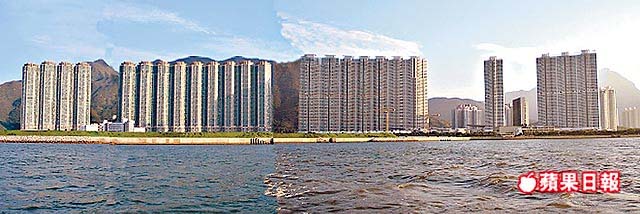
[012] Inequality Measures in Taiwan (12/04/2006) (United Daily News)
According to the Directorate-General of Budget, Accounting and Statistics, Executive Yuan, over the past six years, the mean income of the 700,000 households with the lowest income just fell from NT$52,820 to NT$34,866 from year 2000 to year 2006. Thus, their mean current income is less than NT$3,000 per month.
Meanwhile the mean income of the 700,000 households with the highest income went from NT$1,621,747 to NT$1,741660 from year 2000 to year 2006. Thus, their mean current income is over NT$145,000 per month.
Meanwhile, the GDP is expected to grow by 4.14% per annum.
Under these circumstances, this is like the M-form society as proposed by Japanese scholars. With globalization, the rich can seize the resources and opportunities to profit tremendously and increase their weath; the middle-class will lose their competitiveness and become lower-middle class. This mean that the distribution of wealth becomes more polarized -- more people get rich and more people get poor, while the middle-class disappears.
[011] Democracy and Its Discontents (12/04/2006) (Juan Cole's Informed Comment)
Rumsfeld spends more time plotting out how to manipulate the American public than how to win the war. Everything is about spin, about giving the image of progress even in the face of a rapid downward spiral into the abyss. Consider these phrases:It is about how we talk, how we are perceived to set goals, what is made to look like progress. It isn't actually about getting progress. The point of going minimalist is to reduce expectations among the American public. If you tell them you can only move the ball a yard, you get a lot of points for moving it two yards.' Publicly announce a set of benchmarks agreed to by the Iraqi Government and the U.S. — political, economic and security goals — to chart a path ahead for the Iraqi government and Iraqi people (to get them moving) and for the U.S. public (to reassure them that progress can and is being made) . . .
Announce that whatever new approach the U.S. decides on, the U.S. is doing so on a trial basis. This will give us the ability to readjust and move to another course, if necessary, and therefore not “lose.”
Recast the U.S. military mission and the U.S. goals (how we talk about them) — go minimalist. . . 'There is nothing in the memo about effectively stopping the daily sectarian massacre in Iraq. Rumsfeld does not even appear to think there is a problem here. He doesn't see the basis on which the fabric of Iraq is coming apart. But God forbid he should be seen by the US public as failing. So let's set some vague "benchmarks" and make it look like progress is being made.
[010] The
Money Issue (12/04/2006) For background, please read New
on the Web: Politics as Usual by Daniel Glover and Mike Essl, New
York Times. In brief, the mainstream media want to know if all
bloggers have ulterior motives.
Every time that I do an interview, I am asked about the money issue.
How do I earn my living? How do I pay for this website? How much
do I earn from this website?
I discern two principal reasons for the interest. First, it would seem
to some people that it requires a superhuman effort to maintain the quality
and quantity of information coming from this website that is allegedly run
by one individual. Is it possible that I have secret funds to hire
dozens of translators and writers to churn out all the reading materials,
comments and translations? Who are the funding sources? The
speculations seem to be divided between the CIA and the Chinese Communists,
usually based upon the dislikes about the contents on this website.
The fact that there is this division of opinion means that neither the CIA
nor the Chinese Communists could be paying for someone who deviates badly
frequently for their purposes. That is to say, it would be difficult
for the CIA or Chinese Communist handlers to justify funding for some of the
contents on this website. I will state here this website is mine
alone. You will have to prove otherwise; but you probably have no idea
how difficult it is to hire qualified people to provide a consistent tone,
style and substance.
Secondly, everybody wants to know how to make an independent living as a
blogger who does not answer to an editorial boss. Yes, indeed, who
wouldn't?
I'm sorry to report that my answers have always disappointed. I just
happen to have a working arrangement that allows me to have lots of free
time. As I have told all those who interviewed me, I reside in Hong
Kong but I work for a company based in New York City. My working hours
are (Hong Kong Time) 9pm-midnight when it is (New York City time)
9am-noon. My job is simply to answer work-related questions, if
any. Otherwise, all my other time is at my personal disposal. I
will also spend the month of March in New York City for company work.
As a result of that commitment, I am financially independent and can work on
my personal blog.
How much does this blog costs me? Every month, the web hosting service
charges me US$15.95 (around HK$120 or 120 RMB). This is less than my
monthly bill for the mobile telephone or cable television services. I
can afford to do this as long as I live.
How much do I earn from this website? The answer is NIL. You
will notice that there are no Amazon.com affiliate programs and no Google
Adsense ads here. I have decided that my blog traffic can only bring
in trivial amounts of money and it is simply not worth my time to deal
with the administration of the advertisements. I also scrupulously
refuse to derive any income from blog-related activities. There is no
such thing as an interview fee because I will speak to any conference,
reporter or student for free. If invited to speak at a conference
about a suitable subject, I will pay my own way (in travel/hotel expenses);
if the organizers should offer an honorarium or expenses paid, I would ask
them to fund a needy student instead.
I have also been invited to write for both Chinese-language and
English-language mainstream media. I have always declined. Much
of the blog contents here are media-related, and I refuse to be put in a
no-win situation. If I write a regular column for a newspaper, then I
am screwed either way on account of conflict of interest. If I do not
comment on a situation at that newspaper, then I must be looking out for my
pocket; if I criticize my newspaper, then I am a traitor. I see no
reason to put myself in that situation when I don't need the money.
Anyway, my situation is unique because I don't need money. Not
everybody can say that. You might be jealous, but you have no idea
what I had to do in order to earn this position.
[009] The
Passports (12/03/2006) For the past week or so, the biggest
story is about the status of President Chen Shui-bian's son Chen Chih-chong,
who was staying in New York City with his pregnant wife. There were
multiple issues: Is Chen Chih-chong seeking a 'green card' in the United
States? Is he trying to bring out 'dirty money' from Taiwan to the
United States, where it is invested in real estate as well as a super-market
chain? Is Chen Chih-chong's pregnant wife going to have the baby
delivered in the United States, which would confer automatic American
citizenship? Somehow these issues were dwarving the substantive issues
in the mayoral elections in Taipei and Kaohsiung cities. As a result,
Chen Chih-chong and his wife have returned to Taiwan just to clear up the
(very poisoned) air.
The first order of business is a press conference given by Chen Chih-chong's
lawyers in which the travel documents were displayed.
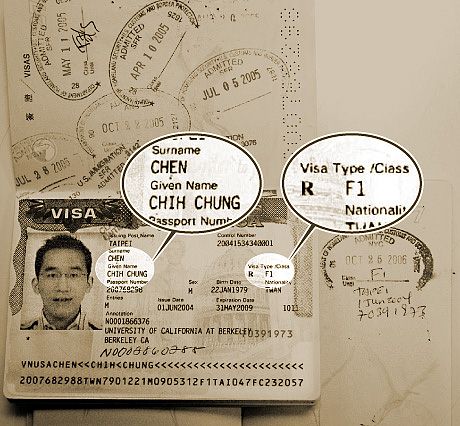
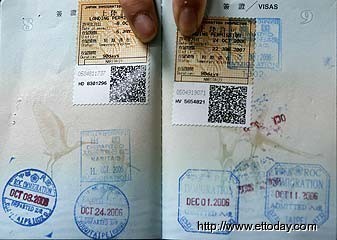
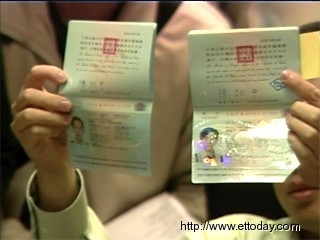
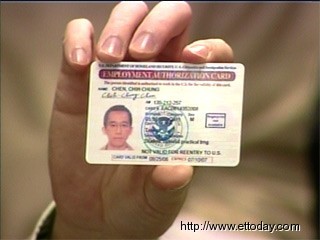
Okay, so maybe it is time to get back to the substantive issues that serious
people should be considering? Of course not. A passport was
displayed, but the assertion was that Chen Chi-chong has another passport
under the pinyin-spelling Chen Zhi-zhong. It is perfectly legal for a
person to own multiple passports (note: I do), and therefore producing one
passport means nothing whatosever. The F1 student visa and the
Employment Identification Card were produced, but that does not prohibit the
person from moving money from outside the United States for investment
purposes. So the debate will go on.
As for my personal opinion, I don't really care and I don't think anyone
should care. Chen Chih-chong is an adult and he should be entitled to
make his personal decisions, whether it is to get a "green" card
in the United States, or have his baby in the United States. It is
just sad when personal choices are limited by virtue of family ties to
political figures. For example, the 2006 American Congress/Senate
elections did not depend on whether the Bush twins decided to enlist to
fight in Iraq or go to nightclubs in Buenos Aires.
[008] Three
Urban Legends (12/03/2006) (Apple
Daily) There are presently three Internet legends about the
Dongmen district in Shenzhen. The three locations are the Wangjue
Shopping Mall, the Jiulongcheng Shopping Mall and the New Women Shopping
City. These locations are popular destinations for entertainment,
massage and shopping among Hong Kong citizens.
In version one of the story, two Hong Kong women went for manicures on the
fourth floor of the Wangjue Shopping Mall. During the session, one
woman went to the restroom and did not return. The other woman went
looking for him and found the body in a big trash can in the restroom.
The corpse had an incision mark. Later, the autopsy showed that the
woman had her heart, liver, spleen, lungs and kidneys removed.
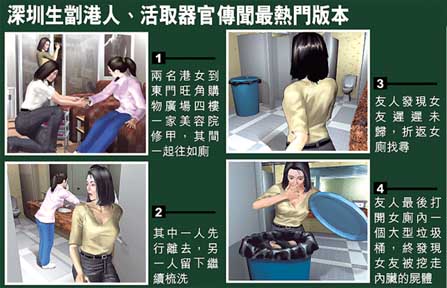
In version two of the story, a group of Hong Kong women went for
manicures. One of them went to the restroom and disappeared.
Later, her friends found her body on the restroom floor with her eyes gouged
out. In version three of the story, another Hong Kong woman shopping
in the mall was dragged into a stairwell and robbed of her physical
organs. Her body was left in the stairwell. Here are the
'bloody' handprints left on the wall in the stairwell. (By the way, the
'blood' turned out to be hair dye material)

Where do these rumors come from? This was made popular by the late
night call-in program known as the "Terror Hotline" on Metro Radio
in Hong Kong. On Wednesday, four different listeners called in talk
about how their friends or family members were killed and robbed of their
physical organs. The legends were then kept alive at the Internet
forums.
Okay, the arguments against these urban legends are: there are never actual
names being brought up as if was always something that happened to the
friend of a friend; the tabloid newspapers and magazines have not gone near
this story (and they would have if there is even any remote chance that it
happened); the legends are only given on radio call-in programs and Internet
forums, which have no verifications processes.
Relevant Link: You've
Got To Be Kidneying Snopes.com
[007] November
2006 Website
Statistics (12/03/2006) For the month of
November 2006, the total
website statistics were:
- 3,217963 hits (including htm, jpg, gif, wmv, xml, etc)
- 464,066 page views (htm files only)
- 410,159 unique sessions
- total time spent = 75,990 hours
On an average daily basis:
- 107,265 hits
- 15,469 page views
- 13,672 unique sessions
- 11:07 time spent per unique session
[006] The
Towering Inferno (12/02/2006) (The
Standard) More
than 100 workers were evacuated from a nearly completed multi- story
building in Kowloon Bay Friday after a fire broke out on the 17th floor.
Firefighters took about two hours to put out the four-alarm blaze at the
Enterprise Square Five commercial building which started at 11.38am. Several
fiberglass water tanks used to cool the building's air-conditioning system
were destroyed. No one was injured. ... Thick smoke from the fire billowed
several hundred meters into the air and was clearly visible from several
areas across the harbor.
Well, why use words when there are photographs?
(Orisun)
(Orisun)
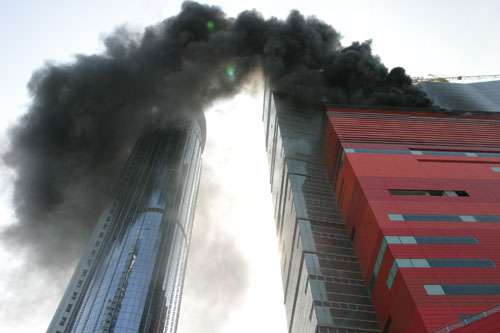
(Ta Kung
Pao)
[005] "The
Rise of Nations" and Democracy (12/02/2006) (Southern
Weekend) Interview with Peking University professor Qian
Shengdan, who acted as the academic consultant to the CCTV television series
"The Rise of Nations."
Q: Some people think that "The Rise of Nations" caused a
sensation because it was broadcast by CCTV and therefore they think that
there are political implications. What do you think?
A: I wanted to emphasize the issue of common historical knowledge.
It is essential for every country to educate its people about history.
Actually, history had been very important in Chinese tradition. But
after the Cultural Revolution, society began to de-emphasize history for
various reasons, especially about world history. Therefore, we wanted
to present popular history to the people, so that they can understand how
history came about. This is obviously a very good thing.
Q: The rise of the west is usually attributed to the reforms of their
systems. Do you agree?
A: Yes, they benefited from the reform of their systems. But there
are many systems, including the economic system, political system, judicial
system, financial system, commerce system, human relations system, and so
on. It is wrong to talk about only democracy as the system. If
you watch the 12 episodes, you will find a lot of stuff about the
systems. After the Industrial Revolution took place, there was a new
economic system. This is a system too. Before the Industrial
Revolution took place, the mercantilism in Portugal and Spain is also a
system. We cannot use narrow geography to understand these issues.
Q: As the creators of the series, what were you trying to communicate?
A: Do we know what happened during the five centuries of competition
among the great nations? How did each nation choose its own
path? We needed to see that. Also, each nation is unique and its
moves forward in its unique way with its unique history behind it.
This is what we considered. We feel that each nation must manage the
relationship between its own history and the direction of its innovations
and progress.
Q: Some people read freedom and democracy in the series. Is that a
message that you wanted to communicate?
A: I don't agree with this type of narrative. I don't like this
way of interpretation. A television series does not have that kind of
impact, and we were not that ambitious. In the rise of each nation, I
see two aspects. One is its tradition. With different traditions
come different choices of the paths to follow. Democracy in France is
different from that in Germany. France is different from
England. England and the United States are different too. What
does that say? We cannot summarize the whole problem simply with
democracy alone. That would be partial. I do not agree with this
simple abstraction, and I don't even like to use the word. This
abstract interpretation deviates from the intent of the creators.
[004] Taiwan
By The Numbers (12/02/2006)
(China
Times) (718 adults interviewed on November 29 by telephone.
The initial sample was drawn from the Taipei city telephone directory.
The last two digits of the selected telephone numbers were randomized)
Taipei city mayoral election:
Hau Lung-bin (KMT): 48%
Frank Hsieh (DPP): 21%
James Soong (IND): 5%
Li Ao (IND): 2%
On the question of the basis of their choices, 64% said that it was
completely based upon the qualities of the candidates while 18% said that
this was a vote of confidence on Chen Shui-bian/Ma Ying-jeou.
(China
Times) (711 adults interviewed on November 29 by telephone.
The initial sample was drawn from the Kaohsiung city telephone
directory. The last two digits of the selected telephone numbers were
randomized)
Kaohsiung city mayoral election:
Huang Jun-yin (KMT): 44%
Chen Chu (DPP): 30%
Lo Chih-ming (TSU): 1%
[003] The Usual
Pre-Election Scandal (12/01/2006) One of the most despicable
election tactics is to produce a scandal shortly before an election, such
that it is shocking enough to affect some voters but without allowing time to
refute the charges. This is an inevitable consequence if elections are
going to held on a scheduled basis. The antidote is for the voters to
know how to screen the fake charges from the real charges, but this is not
easy.
(ChineseNewsNet)
This latest example is about DPP's Taipei mayoral candidate Frank
Hsieh. This is actually unusual because it is a double use of the same
last-minute 'smear' tactic and is therefore quite instructive.
Phase One: In 1998, Frank Hsieh was contesting for the mayor position
in Kaohsiung city, Taiwan. He was lagging behind the KMT candidate Wu
Den-yih in public opinion polls. The new story is that on November 18,
1998, Frank Hsieh met with DPP legislator Chen Chun-sheng
and a third party. Hsieh allegedly handed over an audio tape to Chen
from which one can infer a sex scandal between Wu Den-yih and a female
reporter. Subsequently, Chen released the audiotape to the
media. Ultimately, Frank Hsieh would win the mayoral election narrowly
by 4,565 votes.
Afterwards, KMT candidate Wu Den-yih sued Chen Chun-sheng. The final
verdict was that the court believed that the audiotape had been
manipulated. On September 22, 2005, Chen was sentenced to 6 months in
prison (which was substituted by paying a fine) and the loss of civil rights
for one year. During the court proceedings, Chen never revealed who
supplied the audiotape to him.
Phase two: On December 1, 2006 (one week before the current
Taipei mayoral elections in which Frank Hsieh is a candidate), Chen
Chun-sheng called a press conference. Chen said that he wanted to
restore the truth to history and disclosed for the first time that the
audiotape had been provided by Frank Hsieh. Furthermore, he claimed to
have retained the original cassette tape on which Frank Hsieh's fingerprints
should be present.
There are many doubts about Chen Chun-sheng's account. For example,
Chen lost his court case in September 2005 but why did he wait until one
week before this election to come forth?
How did Frank Hsieh respond? "Would you believe the words of a
liar who lost his case in court? Everybody in Kaohsiung knows that I
didn't get along with him. If I supplied the audiotape to him, then
why didn't he speak out or sue me earlier?" Will Frank Hsieh sue
Chen Chun-sheng for the pre-election smear? No, because this is just
fanning the publicity.
The question is just how many voters will be influenced by this type of
tactic. Some of them were probably influenced in the 1998 Kaohsiung
election. What about the Taipei election now? I hope for NONE.
[002] Confession of Pain (12/01/2006) (TVBS via Yahoo! News) Actor Takeshi Kaneshiro (
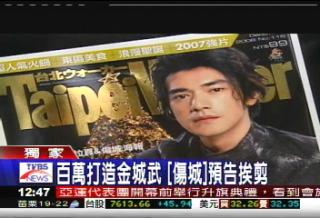
[001]
The Rape of Nanking - Nanjing Massacre (12/01/2006) This
item was the top Apple
Daily international feature yesterday, with three separate stories on the same
subject. Although <Nanking> has not yet been
screened, the Japanese right-wing elements are already nervous. On
Sunday, the Japanese newspaper Sankei Shimbum used the frontpage
headline to condemn the United States for "making anti-Japanese
movies." Sankei Shimbum said that although this film
<Nanking> claims
to be documentary, it is based upon the "anti-Japanese historical
viewpoints" of the late author Iris Chang (who wrote the book <Rape of
Nanjing>). China's CCTV has
already paid for broadcasting rights inside China. Although there
was some Chinese interest in investing in the project initially, Leonsis
turned the offer down so as to avoid any appearance that this was a
Chinese-financed anti-Japanese project.
Meanwhile, the other American film
<Nightmare in Nanking> by Rhawn Joseph is already being screened
across the United States. <Nightmare in
Nanking> began production in 2005 and it cost the producer around
US$100,000 to purchase rights to all the documentary footage. The original
version ran for 120 minutes, but it has been edited down to 77
minutes. Recently, the film was shown more than 50 times to the
public in California, Washington and New York states. Each showing
was packed, with people standing in the aisles, doors and even on window
sills. When the audience saw the Chinese corpses piled up and
the women butchered after being raped, some of them shed tears.
After the showings, some Chinese citizens immediately donated money in amounts
from several hundred to ten thousand American dollars in the hope that
the film can be shown to a broader audience.
<Nightmare in Nanking>
is available in Chinese and English online for free at the website Rape
of Nanking - Nanjing Massacre as well as on YouTube: Part
1 and Part
2. P.S. These video links originally
appeared on the recommended reading list of this website as I had no time
(due to pressing personal engagements) to deal with the
translation of these Apple Daily stories for the context. You might
be interested in reading the comments over at The
Peking Duck.

Apple Daily's international front page
with all the gory photographs.
There are presently four different film projects about the Nanjing massacre
being made -- two are American, one from mainland China and one from Hong Kong.
The one that has received the most worldwide attention is the American
production titled <Nanking>
because of its acceptance into competition at the Sundance Film Festival in
January (see Washington
Post). That film will also be at the Cannes Film Festival in
May next year.
<Nanking> is based upon the stories of the dozens of foreigners
including American missionaries and a Nazi German businessman John Rabe who used their
influence to set up a safe zone that provided protection for 250,000 Chinese
citizens. The comparison is to <Schindler's List> and a
tentative slogan for this film is: "What would you do (in that situation)?"
(Apple
Daily)
The film <Nanking> is financed by Ted Leonsis, who is an AOL vice
chairman and the owner of the Washington Capitals professional ice
hockey team.
(Apple
Daily)
Archives