[095]
Wang Dan's Chances (02/28/2007) In
Why I Want To Teach In Hong Kong, Wang Dan
explains why he wants a teaching job in Hong Kong. In practical terms,
he needs to cross two hurdles. The first step is to get a job offer
from a Hong Kong university. The second step is to obtain a visa from
the Hong Kong SAR government. What is the likelihood of Wang Dan
making it?
The reason stated in the open letter is that he wanted to be closer to his
parents, especially his mother who has a heart condition. That will
not get him an academic appointment. No department chairman is going
to offer Wang Dan a job just so he can be closer to his parents because
there will be faculty rebellion. If Wang Dan wants a university
teaching job, he had better start talking about his academic
credentials. There is nothing in that open letter about that (except
that it will take him eight years to complete his dissertation).
Even if a Hong Kong university makes a job offer to Wang Dan, he will still
need a visa from the Hong Kong SAR government in order to enter. In
his open letter, he refers to the fact the KMT/PFP chairmen and former KMT
generals are visiting mainland China nowadays. But Wang Dan is not a
octagenarian retired KMT general. For example, he was named last
November as a recipient of US$100,000 from the Taiwan presidential state
affairs fund (see Chen
Shui-bian, Wang Dan and the Overseas Chinese Democracy Movement). Wang
Dan wrote: " We
feel strongly about the support from the Taiwan government and the civilian
sector to support our activities against the Chinese Communist totalitarian
government." Are you sure Wang Dan is coming here to teach, or to
agitate? How is any Hong Kong SAR security officer going to let him
in?
So why did he write the open letter? This is an open letter to the
public. It was not intended to appeal to any university nor the Hong
Kong SAR government. It was intended to generate public sympathy with
the emphasis on filial piety. Suppose there is a groundswell of public
support for Wang Dan. Should some university give him a job? And
should the Hong Kong SAR government give him a visa?
[094]
The Lan Family Thanks Hu Jintao (02/28/2007) (Wen Wei Po
via Wenxue
City) According to Lan Chengzhang's laywer Xu Zhanqin, the
murder case of reporter Lan Chengzhang by an operator of an illegal coal
mine in Shanxi was rapidly solved after Secretary-General Hu Jintao
personally issued a directive. As a result, Lan Chengzhang's eldest
daughter Lan Lulin asked the lawyer to forward a personal letter of thanks
to Secretary-General Hu after her father was buried on February
14.
13-year-old Lan Lulin wrote that just when the family felt helpless after
the death of Lan Chengzhang, Secretary-General Hu gave an directive marked
as important. "Then the reporters came to our home; the police
uncles quickly arrested the criminals; Xu Zhanqin and others from the
Beijing Lawyers Association provided legal aid; the Central Legal
Committee's Huang Jingjun provided kind help to us so that my dad's affairs
can be dealt with in accordance with the law."

Lan Lulin said that she wants to be a reporter when she grows up.
Relevant Link: The
Death of a Shanxi Journalist
[093] Media Hyping of Residency Issue (02/28/2007) (Southern Metropolis Daily)
Now that the Chinese New Year holiday is ending, there is another traffic peak for outside workers returning to Guangzhou. The train stations and airport are bustling with people in the return phase of the Chinese New Year rush. After a brief period of calm in Guangzhou, we are now back to the noisy daily life again. Another media outlet in Guangzhou reported that a netizen posted at a forum that Guangzhou was so nice and quiet compared to the normal din that we ought to consider imposing controls on outsiders coming to Guangzhou for better quality of life.
It is one thing to say that individual citizens are making such pleas because this just represents their own preferences and prejudices. But it was a mainstream medium that choice the moment of the return of the outside workers to make a focus report. Although they seemed to be quoting from both sides, but it is enough to make someone gag. The Chinese New Year is an important festival for all Chinese people. Government organizations, social organizations and elementary/intermediate schools all close while the outside workers at various corporations leave Guangzhou to return to their hometowns. Many Guangzhou residents go and visit friends and families, or go on vacation outside of Guangzhou. The whole city went into half-gear and therefore the usual urban problems disappeared temporarily. It is logically wrong to attribue the calmness during the Spring Festival solely to the departure of outside laborers. For a mainstream medium to hype up an illogical issue with no public value in order to attrack eyebals can only be said to be an outburst of prejudice about urban-rural and outsider-insider differences. Even though the expression may seem nostalgic and subtle, it is simply conservative prejudice.
What is most comprehensible is that the media have been able to pump up this issue successfully with reports about "almost 80% of arrested criminal suspects come from outside Guangzhou," "more than 70% of illegal curbside vendors are mobile population from the outside" and "Reseach shows: 70% of local Guangzhou netizens agree to raising the threshold for staying in Guangzhou." All of these reports are making veiled accusations that only increase misunderstanding against the interest of the overall trends of history in China by providing a haven for the much-detected system of residency. To propose the control of outsiders at the time of Spring Festival makes one wonder aabout the values, positions and reporting tactics of the media.
[092] Civilized Deceptions-Part 1 (02/27/2007) (Diuman Park)
[in translation]
On the day before yesterday, there were several news reports about commercial deception. Apple Daily reported: "Non-drowsy flu medication is deceptive; the manufacturer admits that it has no effect on running noses." Ming Pao reported: "Overseas broadband access speed only 30% as advertised; we tested four ISP's and price bears no relationship to results."
Many people then piled on to condemn the businesses for deception. Actually, what is the big deal? As long as you take in the money, so what if you lie? When the young girl Ah Dan broke the law and won HK$ 740,000 at the Macau casino, she held up a stack of $1,000 bills to pose for the cameras and thereby became a much admired heroine. She now has fame and fortune. In the Year of the Pig, the winner takes all. Therefore, a successfuilly deceptive ad is a successful ad.
Of course, some people think that if you can successfully deceive foreigners, then that is delightful; but if you get deceived yourself, then it is a different story. Oddly enough, advertising is already a form of "civilized deception." In this age, it is incomprehensible that anyone would trust advertising (or the propaganda from the Party in the motherland).
Recently, I was reading Professor Lo Shi-kwong's <The Punishment of History> in which the civilized deception of advertising was discussed. This deception is "civilized" because it has become part of the social life or system and we have grown accustomed to it without thinking that this might be problematic anymore. In Chapter 8 (<The Concealment and Deception of Dreams>), he wrote:
"The basic purpose of advertising is a form of deception with a smiling earnestness. Each and every commercial organization is trying to convince the consumer about the false promise in the ad that its product is the best product. When it issues such a promise, it does not pay any attention as to whether the product meets the quality described in the ad. They only pay attention to whether people believe it (in other words, if the consumers are enticed by the ads)."
That essay was written in 1963. More than 40 years later, this kind of civilized deception is more persavive, with greater credibility and acceptability. This is not unexpected, because a civilized tumor will probably take decades or even centuries to excise.
[091] Civilized Deceptions-Part 2 (02/27/2007) (Diuman Park)
Ming Pao reported on the Chinese-language name change of the Tai Mei Tuk district in Taipo from the original 大尾篤 to the identical sounding 大美督. The change came as a result of the Land Administration Office responding to the local citizen representatives' request.
The original 大尾篤 was named for an ancient village which considered itself to be at the far end of Taipo. Thus 大 refers to 大埔 (Taipo), 尾 refers to tailend and 篤 refers to the extreme tip. In recent years, some villagers felt that it was unlucky "to be reaching one's end (of life)." Thence came the request for a name change.
The new 大美督 sounds the same. But 大 can be taken to mean "grand" or "great"; 美 is "beautiful" or "American"; 督 is "supervisor" or "governor." Perhaps it may be taken to mean that this location (which is a popular spot for holding barbeques) is beautiful.
The original name had a specific meaning about the location of the village with respect to Taipo, but the new name really does not say anything. This can be construed as a destruction of historical values. If the new name is used for another thousand years, there may even emerge a legend that the name came about in commemoration of the "Great American government" who invested in the construction of Plover Cove Fresh-water Reservoir just off Taipo.
This short of deceptive name-change is similar to the replacement of the word "China" by "Taiwan" earlier in Taiwan companies and organizations. It was done for the same type of reason, but the effects were different. Whereas we condemned Taiwan, we were all happy about the new and beautiful Tai Mei Tuk. History is always revised by the powers-that-be.
[090] Why I Want To Teach In Hong Kong (02/27/2007) (ChineseNewsNet) By Wang Dan (王丹).
[in translation]
It has been almost eighteen years since 'June 4.' Over these eighteen yeras, many intellectuals and democracy activists had been forced to leave their own country, bid farewell to their families and take the path of exile. During these eighteen years, they all look forward to return to their own country and meet with their families and friends again. Of course, I am no exception. Especially during a traditional festive day such as the Lunar New Year, I want more so to have New Year's Eve dinner with my family. While the family reunion is a natural act for other families, I have not been able to do so for more than ten years already.
After studying in the United states for almost eight years, I am planning to enter another phase of my life in June this year. As a doctoral student, the main professional choice is to teach. If I have a choice, I want to find a teaching position in Hong Kong. First of all, I have special feelings for Hong Kong. During the June 4 period, the people of Hong Kong joined their fates together with ours. It can be said that we shared the sorrows and pains of the time. In addition, Hong Kong persists in holding large-scale June 4 commemorative activities each year and stood as a bright light in the long dark nights. I want to do something in return for the warmheartedness of the people of Hong Kong.
Actually, there is another big reason why I want to work in Hong Kong, which is close to mainland China. Ever since the solo travels started, family visits are easier to do. Both my parents will be 70 years old this year. Although they can come to visit me in the United States, it has almost been the case that the black-haired person should visit the white-haired persons and not the other way around. Besides, the travel distance between China and the United States is so long and it is harder and harder for elderly people to undertake. Therefore, the chances of them visiting me is getting more and more remote. I obviously want to be close to them, especially my mother who is not in good health due to a heart condition. As her son, I obviously hope to be close to her and take care of her.
So who amongst us does not have parents? Today, I want to come to Hong Kong largely because of the wish of a child to be with his parents. I can understand that the Chinese government (including the Hong Kong SAR government) may object on account of my political position. But China has a cultural tradition based upon basic human feelings. I do not believe that the authorities will abandon these feelings on account of political positions. Today, the Kuomintang (KMT) may have had a blood feud with the Communists in the past, but the KMT chariman can visit mainland China. Those KMT generals who killed innumerable Communists back then can also go back and visit their relatives. I really don't understand that why those peaceful demonstrators who were demanding democracry back then could not be permitted to return to mainland China after eighteen years has passed? If the Chinese Communists are afraid of even a student, then a big question mark must be placed on the stability of their rulership.
[089] Translation Enhancement (or It's Bust To Be A Translator) (02/25/2007) From Brendan O'Kane:
I noticed in your translation of the article on the Spring Festival Gala that you translated "做女人挺好" as "it's good to be a woman." This is the literal meaning, of course, but it's actually a reference to a joke in the movie 大碗儿, in which "做女人挺好" is the slogan for a brand of breast-enlargement cream -- hence, a pun on "挺." In the subtitles for the movie, it's cleverly translated as "it's not a bust to be a woman."
[088]
Twenty Forbidden Subject Areas (02/24/2007) (SCMP; no
link) According to minutes from a meeting of the State Administration
of Radio, Film and Television (SARFT) Propaganda Administration Department
dated January 12:
- Anti-rightist Campaign: It should not be mentioned in principle; if
mentioned, then state that the campaign was necessary but its scale was too
wide-ranging
- Cultural Revolution: Possible to say that mistakes were made, but
discussion should not be geared towards denying the "historic
accomplishment of the party and Mao Zedong."
- Nanking Massacre/July 7 incident: should serve the current situation and
must not adversely impact on Sino-Japanese relationship.
- 90th anniversary of Russia's October Revolution: strictly censored; plus
discussion of the collapse of the former Soviet Union and its eastern
European satellites should be played down.
- Other banned areas:
- judicial corruption
- activists' campaigns to protect individual rights
- sexual crimes
- aristocratic lifestyles of high-income groups
- reporting on affairs with mistresses
- state-sponsored construction plans
- affirmation of private ownership
- pig character (because of sensibilities of ethnic minorities)
[087]
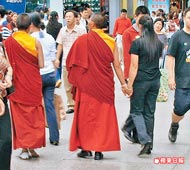
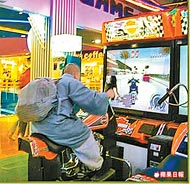
Modern Buddist Monks (02/24/2007) (Apple
Daily) Is this called supervision of religious affairs by
public opinion? These two pictures are drawing comments on the
Internet.
[086] Even Better Than Better (02/24/2007) At Chinese Content, I posted the question on the Pengshui SMS case.
The Pengshui county party secretary in the poem case is now assigned to become the director of the statistical bureau of Chongqing. Is that a promotion or demotion? This requires further investigation. If this is a promotion, what kind of Internet opinion is out there, given that he was removed from his job due to that pressure in the first place?
At issue was whether the government official who abused his authority was being promoted/demoted as a result with his recent appointment as Deputy Director of the Statistical Bureau in Chongqing city. RFA Unplugged wrote Is you is or is you ain’t promoted? and I made Comment 200702#079. But if you want a very thorough review of Chinese Internet opinion, you must read John Kennedy's Disgraced Party member promoted at Global Voices Online. This is not just the usual keyboard-banging raving and ranting by angry young people, because some of the comments were based upon detailed research of the government system of official rankings.
So maybe you are not interested in what happened as a result of a SMS message from an ordinary citizen in a city somewhere in China. What is the big deal anyway?The big deal is that the GVO post is just showing one case study in which Internet public opinion has taken a vibrant life of its own beyond the purview of either mainstream media or the notorious 30,000 Internet censors. When such a topic shows up, the comments appears from all over the place. These are reasonable questions, so neither the Internet censors nor the website administrators have real cause to stop them because they would end up with a much bigger controversy on their hands if they tried to stop it. So the best bet is to keep a stiff upper lip and hope the storm will blow over. The lesson for the next time is that no other official is willing to stick their necks out to 'promote' someone in that position (even if they did, they would not dare announce it publicly), because they have seen what happened this time. This is called "watchdog journalism" or "supervision by public opinion" -- with a unique Chinese characteristic, of course. This is one particular case, but there are so many other similar cases going on right now. How to stop them? They cannot be stopped (short of turning off the Internet) ...
[085] A
Death In The Family (02/24/2007) As you may have noticed,
blogging rate fell off recently and that was due to a death in the
family. My uncle Henry Soong Hsi (宋希)
passed away in Adelaide, Australia. While he was not a famous cultural icon, his
name appears in some of the letters collected in <The Letters of Fu Lei 傅雷书简>.
Fu Lei is a famous translator and the father of pianist Fu Cong (傅聪;
also known as Fou T'song). Fu Lei was a neighbor of my family in
Shanghai and that was how he became acquainted with Henry Soong and my
father Stephen Soong Chi (宋淇).
Here are translations from some of the letters. Those letters were not
intended to deal with high-minded intellectual stuff, but to show the
mundane issues that intellectuals have to deal with from day to day.
December 5, 1951, Letter to Stephen Soong:
I ask brother Hsi to buy a few western men's pants for me. In Shanghai, it is expensive. The price for the cloth material is equal to that for woollen material in Hong Kong; besides, cloth material wear down easily. Both my son and I work while we sit and so our pants wear down quickly. Therefore, when he goes shopping, he should pick some more durable material.
September 14, 1954 evening, Letter to Henry Soong:
Brother Hsi:
... I asked to purchase Hindmith: Elementary Training for Musicians (two copies) but I have not heard from any news? Can you please inquire again. Also, if Paris' Daniélou wrote to you directly to tell you about the price, please remit the money as soon as you see the letter. If I ask him to look for a book and then notify me afterwards, there will not be enough time. Books in Paris are usually sold out quickly. I suggested previously to use traveler's cheques but you have not told me if it will work. Please write and tell me.
Also Fu Min has run out of violin strings again. Please purchase 2 G strings, and D, A and E strings one apiece. They should all be steelless stain ones. Please mail them separately in two packages and write on the outside: "X number of violin strings" with the receipt enclosed inside. I heard that custom taxes are required right now. Therefore, I ask you to send it separately to two places so that the taxes do not get too high for one person.
[084] Reflections of a Foreign Correspondent (02/23/2007) (Zaobao via ChineseNewsNet by Han Yonghong 韩咏红)
[in translation]
I went home for the Chinese New Year and met with friends and relatives. Some people would ask: How do you gather news in China? Do the officials allow you to interview them? Where does the information come from? Are you worried about being arrested?
These questions usually make me feel awkward, because I don't know where to begin to talk about this. But there is a question that is worth thinking about -- why did the family elders ask this way? They do so because they have this impression that it is hard to obtain information in China and journalists can easily get into trouble.
At the end of last year, the Chinese authorities announced new regulations that relaxed the restrictions on foreign correspondents, who can now freely travel across provinces and interview anyone who gives his/her consent. No permission is needed from the foreign affairs department and it is not necessary to have a local reception unit. At the same time, the names and telephone numbers of several dozen national and local government spokespersons were published. So the information channel has actually broadened significantly. At the time, the Chinese- and English-language newspapers in Singapore published many reports on this development, but it seems that most people have the same impression about press control in China as before. This shows that the cumulative impression and misunderstanding of the people will be hard to change in a short time.
So is it hard go gather news in China? What is so hard about it? Like foreigners doing business in China or actually doing anything, one needs assistance to find the channels and methods, to understand the hidden rules and, even most trying of all, to have the physical strength, stamina and willpower to invest for the long term.
Compared to before, the environment for news workers has really improved by a lot. There are too many press conferences and forums for reporters to attend. The experts and scholars are willing to deal with the media, and they speak openly without avoiding opinions that are outside of the mainstream.
Although the number of activities does not bear an absolute relationship to the value of the information and officials who hold press conferences do not always respond to every question from the reporters, one cannot say that there is no opportunity for asking questions. There are many opportunities, but can you seize every opportunity? Are you prepared and ready all the time?
Apart from press conferences, other information can be dug out. Of course, there is much information that you cannot dig out no matter how hard you try, and then there is information that you better not even think about digging out. It often takes a large amount of time and effort to dig out the information -- you must gain the trust of the people and the officials and you must gather the information a bit at a time. In a transitional society, there are so many strange phenomena that can and should be spotted and followed up. The information is in a semi-transparent state, with a great deal of confusion. Therefore, your capability, experience, intelligence and investment are absolute prerequisites to do anything.
Since 2004, "China rising" has become a commonly used term internationally. As this nation achieves economic growth and expands its diplomatic role, the transparency of information is slowly raised. Within the space between transparency and opacity, the domestic and overseas media try their best to find the information.
In this environment, a person's actions and efforts seemed to be monitored tightly but invisibly while the payoff can be calculated in exact detail. The difficulty for outsiders is that we can only use our limited viewpoints and experiences to imagine the vastness and complexity of China. Yet, this difficulty is perhaps one reason why China has fascinated generation after generation of outsiders.
In response to the questions from my friends and relatives, I often say: There are more and more press conferences nowadays. The Ministry of Foreign Affairs has two each week and the State Council Information Office has one or two each week, or even three or four. Since last year, the Ministry of Public Security and the Ministry of Education and other departments have regularly scheduled press conferences every month or quarter. I think that there are still some difficulties, but I can say that it is a lot easier now than before.
[083] Domain Registrations and CCTV Spring Festival Gala (02/22/2007) (Southern Metropolis Daily)
During the CCTV SPring Festival Gala, the skit <策划 Planning> had contained the phrases "博客白云飘飘 Blog WhiteCloudsFloating."
Previously, in the leaked script, Song Dandan's dialogue contained the phrase "WhiteCloudsFloatingBlog.com. This led the blogger 双叶 (DoubleLeafBlade) to register the domain 白云飘飘博客.com (WhiteCloudsFloatingBlog.com). But in the live broadcast, Song Dandan ended up saying "BlogWhiteCloudsFloating.com." DoubleLeafBlade immediately attempted to register 博客白云飘飘.com (BlogWhiteCloudsFloating.com), but someone had already done so just seconds ago.
Who was ahead? A Zhejiang netizen Zhang Wei said that he was watching the CCTV Spring Festival Gala. As soon as he heard the dialogue, he registered the domain 博客白云飘飘.com (BlogWhiteCloudsFloating.com). According to the official record, the time of registration was 23:30:25, February 17, 2007. The skit had not even finish at the time. The cost of registration was 60 RMB. Zhang Wei is considering selling the domain and the price that he has in mind is 10,000 RMB. Zhang Wei claims to have bought and sold several thousand domain names already, and his income from those transactions is higher than his regular wages.
[082]
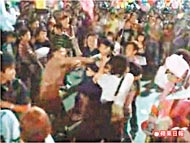
Some Famous Faces (02/21/2007) (Apple
Daily) At the night market in Victoria Park on early Chinese
New Year morning, a group of seven individuals had a dispute with the couple
who operated a stall over prices. Suddenly, one man threw a left hook
punch at the male store owner. Then another man punched the store
owner on the head, while a third man hit him hard with punches on the back
of the head. Afterwards, the men cursed the store owner out and left
the scene.
When asked, the police confirmed that such an incident had occurred.
While the police does not comment on progress in any ongoing investigation,
it was clear to Apple Daily that they missed one important piece of
evidence. Someone had used a mobile telephone to record the incident
and posted the video on YouTube (2007
feb 18 victoria park CYN market fighting 維園年宵打人事件)
(see screen captures below). The party of seven are now famous faces
on Hong Kong discussion forums and BBS's.


[081] Reception Gaps in Hong Kong (02/21/2007) (The Standard)
The body of 42-year-old hiker Lo Si-fai was found at the bottom of a cliff on Lantau Island on February 4 after a week-long search that involved more than 100 people. Lo's body was discovered only after telephone operators helped narrow down his mobile signal to around Ngong Ping, police said.
The government regulator hopes its cooperation with private operators to install base stations in Hong Kong's extensive country-park network will help prevent more accidents from occurring. There are 12 base stations scattered throughout the territory and the government said new stations located in southern Lantau Island, Tai Lam Chung and eastern Sai Kung have been installed.
Although Hong Kong is relatively small, the area includes an expansive system of 35 parks and marine reserves. Hikers have long complained that mobile-phone signals are cut when they are walking in country parks, putting them at risk if an emergency occurs.
But Hong Kong's hilly terrain presents a substantial obstacle for radio signals. OFTA maintains detailed maps on its Web site outlining the quality of mobile reception at all points along Hong Kong's network of hiking trails, but also suggests hikers use walkie-talkies operating at 409 MHz for short-range communication. It is "unavoidable that some locations [have] no or poor mobile-network coverage," OFTA said. "Hikers should not rely solely on mobile phones to seek emergency help."
In Eastweek (issue 182, July 21, 2007), a completely opposite story was reported. Why did it take a week to find Lo Si-fai's body? According one of the volunteer searchers, "there are at least three groups of signal stations in Ngong Ping and the telecommunication company did not explain which group received the signal from Lo. Later on, an industry insider told us that it came from the Ngong Ping market station. That insider also pointed out that each signal station did not have 360 degree coverage; instead, the transmission angle was only between 60 to 90 degrees."
Ultimately, on the sixth day, the volunteer searchers brought their own measurement instruments to detemine the direction of the Ngong Ping signal stations and hence figured out that Lo must be on the west side of Lantau Peak (Phoenix Mountain). Thus, the search area was reduced to just several hundred square meters. Lo's body was found the next day.
The volunteer searcher said, "If we had sufficient information to begin with, we would have concentrated on the west slope. There is only one perilous cliff there, and that was where Lo was. Instead, the searchers had to start from the center of Ngong Ping market in a circle of two kilometer radius, including a number of streams which could not even receive the signals. This was a waste of manpower and resources."
What about the detailed maps on the OFTA website? Here is the relevant map. Would this map help in a search? No.
[080]
Wage Survey in Hong Kong (02/20/2007) (Apple
Daily) The Clothing Industry, Clerical And Retail Trade
Employees General Union interviewed 227 store service workers, stock clerks
and cashiers and found that Watson paid HK$27, Manning paid HK$25,
ParknShop, OK, Wellcome and 7-11 paid between HK$20-22 per hour. An
interesting feature is that the wages are not uniform across Hong Kong for
the same store chain. The highest rates are for the Manning and 7-11
in Tsimshatsui at HK$30 and the lowest at HK$16 at the 7-11 in the Tin Tsz
estate in Tin Shui Wai.
Why would 7-11 pay HK$30 in Tsimshatsui but HK$16 in Tin Shui Wai? The
problem was not even restricted to 7-11, because the average hourly wages of
the interviewees from Tin Shui Wai was HK$18. Here is the explanation
-- Tin Shui Wai is too far away from the other districts. If you live
there and take
another job outside of the district, it will probably cost you two hours of
wages for your daily commute (as well as two hours in personal time). Therefore, the store chains can depress
the wages in Tin Shui Wai without fear of having no takers.
The Clothing Industry, Clerical And Retail Trade
Employees General Union is using the survey research as support for imposing
a HK$30/hour minimum wage. The economic phenomenon above would predict
that if wages were uniform across Hong Kong, then it will be difficult to
hire people in Tsimshatsui. If one has a choice of HK$30 either near
home or far away, one would obviously choose the former and save the commute
fare. You can predict that if they pay HK$30 in Tin Shui Wai, they
will have to pay HK$40 plus in Tsimshatsui.
[079] Is You Is Or Is You Ain't Promoted (02/20/2007) Here is some collaborative blogging:
I first posed the question:
The Pengshui county party secretary in the SMS poem case is now assigned to become director of the statistical bureau of Chongqing. Is that a promotion or demotion? This requires further investigation. If this is a promotion, what kind of Internet opinion is out there, given that he was removed from his job due to that pressure in the first place?
From Dreamburo at RFA Unplugged comes: Newsdesk: Is you is or is you ain’t promoted?. Here is the key paragraph:
“Promotion? No, no, no,” [a Pengshiu government official who would not give his name] told RFA’s Cantonese service. “It’s the same. Even if he was promoted he would still be the county chief. “Yes, that’s right, [Lan Qinghua] has stopped working here. I don’t know much about it. Perhaps you should ask the municipal work organisation department because I don’t know the details. Municipal-level governement would be behind any movement of local leaders, not the county level.”
Meanwhile, I found a sentence in a ChinaNews article at Sina.com. 行职级别反而由原来的正处升为副厅 (translated as: His administrative position was elevated from the original country-level department head to city-level department deputy head. Now I am not familiarity with the classification of government officials in China. I imagine a typical ascendant career to be something like: village cadre -> village committee head -> village mayor -> town department head -> town deputy mayor -> town mayor -> county department deputy head -> county department head -> county vice-mayor -> county mayor -> city department deputy head -> city department head -> city deputy mayor -> city mayor -> provincial department deputy head -> ... If this were true, then "county mayor -> city department deputy head" is a promotion.
[078] Bon, I'm Jissbon (02/20/2007) (Rui Chenggang's blog)
[in translation]
I've watched the movie <Casino Royale> twice. I nearly fell asleep both times. I saw it the first time when I was overseas and I did not feel anything other than noting that the western audience reacted to certain dialogue stronger than we do. But when I saw the movie again inside China, there was an unexpected result: before the movie began, there was a condom advertisement which is of international quality. A condom wearing dark glasses walked back and forth just like 007 and then he suddenly turned around and fired a shot at the camera. This was an imitation of the standard James Bond movie opening. The condom also spoke the classical self-introduction of 007 "I'm Bond, James Bond" as "I'm Bon, Jissbon."
This condom has a foreign name that sounded like 007: Jissbon. The advertisement has an international flavor. So I thought that this was an international brand, but I later learned that it was manufactured by a Wuhan company ... According to a Sydney Morning Herald, the president of the Australian company that obtained majority share in this company: "Jissbon (杰士邦) is the Chinese translation of James Bond." His assessement seems inappropriate, so it is not clear who told him that.
Then I read on the Internet about how many Chinese moviegoers also saw this amusing ad and they also saw various models of yellow condoms in front of the cinemas. A foreign girl wrote in her blog that she went to watch 007 in China and received three free Jissbon condoms along with the ticket. She is astonished because she wondered if the Chinese need them when they go to watch movies.
Related Links: Jissbon condoms, James Bond and Durex Jeremy Goldkorn, Danwei; Jissbon condoms' dodgy logo Jeremy Goldkorn, Danwei
[077]
Better Than I Ever Imagined (02/20/2007) What? Chinese
Content. The whole thing began as some exchange about some
thoroughly silly Internet incident, but the logical conclusion was that
there was a need for a website to exchange information and ideas about
translation projects among the Chinese-themed bloggers. So it took
John Kennedy to actually set up the wikispaces website. The site is
now up and running.
What is the membership requirements? I don't think that this should
ever be defined, because any definition will only restrict (just as I have
always refused to define what a blog is). However, it would seem that
bilingual skills are required. All the primary references are directed
towards Chinese-language links, which are either being currently translated
by specific bloggers or else proposed as possible projects for others.
In any case, people should be allowed to read the contents and decide on
their own whether this is meaningful to them.
What is in this for the bloggers? For one thing, this helps the
bloggers to avoid duplicating the efforts of others. I have been there
before when I rushed a translation job only to find a superior effort
already in place! (hint: February 6, 2007)
For another thing, it provides new ideas for bloggers who are out of ideas
for the moment. I have also been there because there are days when
nothing seems to be happening and I have nothing in the pipeline.
There are also bloggers who are competent in reading Chinese (more or less),
but are reluctant to engage in translation because they think that they
spend too much time on researching certain details. This wikispaces
website would be useful in seeing what the other bloggers are working on
right now. This gives a 'heads-up' about what will be appearing.
Since the original Chinese links are present, they can even go there and
read (in Chinese) ahead of time. Alternately, this whole matter began
with a request from one blogger to another to translate a certain
statement. Wouldn't it be easier just to go to the wikispaces page and
appeal to the entire community?
So what? The substantive question must be: Is this working? This
website has only been running a couple of days and it is premature to
tell. But I don't really care because I can only do my share. So
far, I have been faithfully telling you what I am up to. I don't know
whether this means anything to you one way or the other, and I don't
care. In the end, I can only account for my own actions and I cannot
force anyone else to do anything.
But how about the following? Let us say that I wrote that I was in the
process of translating the opinion essay 春晚的众口难调体现中国的变迁
published in Southern Metropolis Daily. I personally thought that this
was truly remarkable because I did not read this essay as just being about
the CCTV1 Spring Festival Gala program. I read this as a statement
about the entire system of cultural control. The essay argued that the
twenty-seven years of reforms have irrevocably made cultural control infeasible
because it conflicts with market and commercial interests. Wow!
So I did the initial version of The
Inevitable Decline of the Spring Festival Gala. Someone reads my
original post and advises: "By the way, the SMD essay was redacted --
you can find the original essay at the 兔王手记
blog." I went there and made a comparison. It suffices to
say that it was very instructive what the SMD editor felt that needed to be
excised in order to remain politically correct (for example, "Under these circumstances, the urban youth
will probably not be interested in the politicization and traditional
propaganda methods (such as the "harmony" theme that appeared
throughout the whole show, the hosts representing various social sectors to
thank the Party and the government, the leaders visiting the masses and
factory production lines, etc). On the contrary, they might feel that
these things are hilarious, disgusting, vulgar and backwards." was
erased). That one tip was enough to make this better than I ever
imagined.
Related Link: Join
the Open Source Translation Blogging project
Rebecca MacKinnon, RConversation
[076]
The Unreasable Customer At Jusco (02/19/2007) Imagine
that you are a salesperson at a Jusco Department Store in Hong Kong. A
woman comes in and says something like: "I may or may not want to buy
an MP3 player. But I need testing. I want you to download MP3
songs onto every one of your product models so that I can check them
out. I don't care about any copyright issues, because you can
immediately delete them afterwards. I want you to explain the
characteristics and features of each and every single product model of
yours. Why am I doing this? Because I am a consumer. I
have my f*cking rights. I can f*cking make you do anything that I
want. You have to download the MP3 songs onto each MP3 player and
explain the features on the machine. It does not matter whether I am
paying any attention to what you say. You have to go through the
drill. If you don't like this, you can f*cking call the
police." To repeat, the above is a summary based upon one
person's impressions.
A summary of what? A summary of an extended YouTube video recorded
through a mobile phone camera:
吉之島無理顧客_part1
YouTube
吉之島無理顧客_part2
YouTube
Based upon the current reactions at the Hong Kong discussion BBS's, this
video clip is going to be big. Just wait for the English-subtitled
version to show up!
[075] Am I Leftist or Rightist? (02/19/2007) (From the Rose Garden blog by Luqiu Luwei)
Chinese people are definitely familiar with leftists and rightists. I personally understood the campaign against rightist restoration in the Cultural Revolution as an attempt to take the capitalist path. Then I went to high school and my classmates called me an old Marxist lady. In retrospect, this was because I was a good cadre who heeded my teacher and lacked the spirit of liberalism. Today, there are still many instances in which people are labeled leftist or rightist. When a person is called 'leftist,' it usually means that the person is ossified in his thinking and somewhat dictatorial. More recently, there is a debate between the camps of the new left and new right in China. But I must frankly state that I have not figured out the standards of definition. In socialist China, aren't we all in the leftist camp?
The notion of left and right began in Europe and the division was even more accident. Some people advocated one theory and others opposed it. Thus, the left and right camps were formed. Academically, there is nothing derogatory or commendatory in those labels. In the 1990's, the rightwing camp won an electoral victory in Italy. The Italian scholar Noberto Bobbio wrote an influential book: "Left and Right: The Significance for a Political Distinction." He acknowledged that at different stages of development in a society, the distinction between left and right may differ. He believes that both left and right have their extreme forms of belief: Communism versus Fascism. These two ideologies are completely different, but they share a common point -- both reject democracy. Both the left and right also have their moderate wings which accept democracy. Liberalism exists in both the left and right camps. The difference between left and right is based upon the interpretation of fairness. The left does not accept an unfair society whereas the right believes that unfairness is natural and inevitable.
.... While the left believes that people are different biologically, it also believes that if the system is unfair, then it must be changed. The right believes that people are born unequal. Therefore they oppose any effort to obtain fairness via re-distribution under the system. I still feel that it is the responsibility of the government to go through the system (such as using taxation) to re-distribute wealth and lessen inequality. The government also has the responsibility to use tax revenues to provide basic healthcare and educational services. If that is how it is judged, then I ought to be considered a leftist.
[074]
The 'Rating' for the CCTV1 Spring Festival Gala
(02/19/2007) (Sina.com)
The bottom line number seems to say that the television rating for the CCTV1
Spring Festival Gala was 93.6%.
But what exactly is behind this television rating? The description is
this: Since 1996, the research company CTR (note: CCTV is an owner) has
conducted coincidental telephone survey of Spring Festival Gala
viewing. This year, the survey was conducted in 406 counties and went
on for more than 3 hours. By midnight, 2,002 households were
interviewed, of which 1,844 were tuned to the CCTV Spring Festival
Gala. When the sample results were weighted to project to all of
China, the percentage of tuning households was 93.6%.
Does it mean that 93.6% of 1.3 billion Chinese persons watched this
show? Not really.
There are a number of hidden aspects in this number. First of all,
this is a household telephone survey. Therefore, the universe consists
of those households that own fixed telephones. There are still
households in China that do not own telephones and/or television sets.
Secondly, if the call reaches a telephone number which nobody answers, it is
not counted as a non-tuning household. On one hand, the members of the
household could be at their parents' home watching the Spring Festival
Gala. On the other hand, the members of the households could be
strolling in the night market. Thirdly, this is a measurement of
household tuning and not personal viewing. That is, the television set
could be on, but maybe no one was watching or maybe the entire extended
family of 30 had traveled from all over China and are watching the show.
Eventually, CTR will come out with an audience number from their system
(which consists of meter and diary measurements). That will take
time. For now, this is the quick-and-dirty overnight 'rating.'
[073]
Lost In Beijing (02/19/2007) (MOP)
The movie formerly known as <Lost in Beijing> was exhibited at the
Berlin Film Festival. To get permission from the State Administration
of Radio, Film and Television (SARFT) to be shown, the film was reviewed six
times and reduced from 112 minutes down to 97 minutes after 50 cuts.
Lost too was the name <Lost in Beijing> because it is now known as
<Apple>.
There is a little bit of ambiguity here -- did the Berlin audience watch the
97-minute or 112-minute version? Previously, certain films that went
abroad without approval were penalized. But there is no precedent
about entering a different version of the movie at a foreign film
festival. The film producer said that he was unsure, but he thought
that it was the 112-minute version because there wasn't enough time to do
the sub-titles for the 97-minute version.
According to the producer, there was a 'generation gap' between the director
Li Yu's creative ideas and the film review board. "They do not
understand each other with respect to the film language." On the
first review, 15 serious opinions were rendered. The director was
ready to cry upon reading the written report, but still went with the
amendments. For example, a supporting actress who came from the rural
area to work as a prostitute in the city was eliminated from the film.
The scene in which the foot-washing shop boss patronized a prostitute (and
there was no sex scene) was eliminated. Even a shot of the male lead
actor walking past a pool of dirty water in the street had to be cut.
The producer said that after so many cuts, "the story is no longer the
same and the film is no longer the movie that we hoped to make ... still a
film that was originally deemed 'not suitable to go to the Berlin film
festival' was resurrected in the end. This is a result that both sides
can accept, so I think it is not bad."
[072] 義氣 or 兒戲? (02/19/2007) (Broadcasting Authority Hong Kong)
Television programme "Super Adult & Child" (超級大細路) broadcast on the Entertainment Channel of Hong Kong Cable Television Limited (HKCTV) on 4 November 2006 from 8:00pm to 9:00pm.
Three members of the public complained that the programme hostess' remarks that a child had "義氣" (loyalty/comradeship) with regard to the child's refusal to disclose the name of a wrongdoer in a game segment were irresponsible and would mislead children into thinking that dishonestly keeping secret for wrongdoers was a proper behaviour.
In the episode under complaint, there was a game segment involving three children. The three children were placed in the studio set individually with either the host, the hostess or the guest in the absence of their parents. The host/hostess/guest then deliberately broke one of the props (道具) displayed on the table in front of the child and then requested the child not to tell others what had happened. Later on, the children were separately asked by other adults to reveal the person who had broken the prop. Among the three children, two identified the culprits and one said she had no knowledge and claimed that the prop was already broken when she saw it. The hostess commended that the child who refused to tell had "義氣" (loyalty/comradeship).
...
HKCTV was advised to observe paragraph 1 (programmes be scheduled with an awareness of the likely audience in mind) and paragraph 8 (programmes are suitable for their likely audience) of Chapter 2; paragraph 1 of Chapter 3 (programmes be handled in a responsible manner); and paragraph 1 of Chapter 7 (likely effects of broadcast material on children) of the Generic Code of Practice on Television Programme Standards.
(SCMP) TV show rapped for 'lesson in deception'. By Sherry Lee. February 17, 2007
Broadcaster and commentator Leung Man-to said the authority had gone crazy. "It is so trivial. If they found the remark problematic, a lot of other programmes have problems too. In TV shows and movies, robbers, because of `comradeship', often refuse to tell police the whereabouts of their accomplices. Would this be banned too?"
[071]
Gao Yaojie Can Visit USA (02/18/2007) For the
general background, see Jim Yardley (NYT) at China
Covers Up Detention of AIDS Doctor. The general situation is
well-covered t here and elsewhere, but there is one specific piece of
information not included in the western media. From Apple
Daily (HK), "According to information, Hillary Clinton wrote
personally to President Hu Jintao and Vice-Premier Wu Yi to express her wish
that Gao Yaojie could personally come to the United States of America to
receive the award from Vital Voices Global Partnership. She emphasized
in the letter that her attendance would bring honor to China as well as
positive impact on China and its government."
According to information from whom? That is the journalistic
question. This may be why the Hillary factor was not mentioned in
western media. Apple Daily does not really explain. But this is
the Internet age and ordinary citizens have access to all sorts of primary
sources of information. When Gao Yaojie's telephone was re-connected
after the siege by Henan police, she called Beijing-based AIDS activist Hu
Jia, who recorded that telephone conversation (at 20:02 on February 17,
2007). Among other places, it is posted as "2007年2月17日8点02分高耀洁教授与胡佳的对话"
at ChineseNewsNet.
During the conversation, Gao Yaojie mentioned that Hillary Clinton wrote to
Hu Jintao and Wu Yi. Journalistically, one is supposed to have a
second independent source. Hillary Clinton has stated that "she
is glad that Hu Jintao accepted her request."
[070] Mind Control Drugs (02/18/2007) For background, read Commercial media and police in Guangzhou face-off over "daze drug" rumors David Bandurski, China Media Project. The following is a blog post re-published at xys.org.
[in translation]
On February 14, the Guangzhou police publicly announced the results of its investigation into the sensationalistic "daze drugs." Based upon the information that the police has, the street talk had covered three different kinds of drugs: "The first kind involves placing narcotic drugs into drinks or food and cause people to lose consciousness; the second kind involves using drugs that have components such as pepper gas, ammonia water and tear gas and spraying it into the face so as to cause strong stimulation in the eyes, nose and throat that results in temporary loss of the ability to resist; the third kind is the legendary 'mind-control drugs' which allows someone else to take control of one's mind through a pat on the shoulder, a handshake, a spray in the face or a sniff. According to police information, criminal elements have used the first two kinds of drugs, but the police has not yet verified a single instance of the third kind of so-called 'mind control drug.'" In simple terms, they have not yet found any 'mind control' drugs.
Previously, <New Express> published a series of stunning reports (e.g. you can buy 'mind control' drugs anytime; a white mouse was immediately paralyzed when sprayed; many victims recounted their stories; reporters tried the experience personally, etc). With this police report, the newspaper needed to save face. So on the same day that it reported the police statement, <New Express> immediately said: "We noticed that the police was reserved in their use of language. They are saying that it is still possible to use 'mind control' drugs to commit crime. It is just that 'the police has not yet verified a single instance.'"
The <New Express> reporter was very rigorous in the analysis. If the police said 'not a single instance has been verified,' then the possibility still exists. Furthermore, even if the Guangzhou police had said that "mind control drugs do not exist," the Beijing police, the Shanghai police, the American police ... have not said so; even if all the police around the world said so, the entire scientific community has not said so ... Anyway, the possibility will always exist -- for example, on another planet or 1 billion years later on earth. Therefore, <New Express>'s interpretation is absolutely correct.
... <New Express> wants to provide a better news product for the masses of readers. Unfortunately, the quality of their product exceeds the ability of earthlings to understand. How about learning some earthbound knowledge first? A very simple piece of knowledge is what a drug dealer said: "If there is such a thing as a mind control drug, would we be doing this?" If there are drugs that can control the minds of others, those drug dealers would not have to work so hard to earn the relatively piddling sums of money from drug-dealing. They can just go and find a 'fat cat' like Bill Gates, tapped him on his shoulder, seize control of his mind and get him to transfer all his savings and stocks over to them. Osama bin Laden would not need to recruit people to fly into buildings. He can just shake hands with Bush and then take over the United States.
[069]
Getting A Job (02/17/2007) (Comment
200702#034) Steven N.S. Cheung: " If a
person really wants to find a job, he should have no problem getting a job
at 600 RMB per month. You go to Dongguan and you will find a job
immediately. If you don't want to work at a 600 RMB a month job and
you want a 800 RMB a month job instead, you may have to spend two to three
days looking for it. As for the 1,500 RMB job? It is a bit
harder to find."
For those remarks, Cheung drew criticisms because 600 RMB does not
constitute survival wage in a big city nowadays. But capitalism (which
is known as 'socialism with unique Chinese characteristics' in China)
rewards people for ingenuity and innovation. The following is an
example about how an Anhui person makes 3,000 RMB per month in a
non-standard occupation.
(Anhui Commercial Press via KDnet)
An Zhenya said: "When I first went to work in Hangzhou, I went to use a public restroom at West Lake. I dropped my mobile telephone into the cesspool. So I found a piece of magnet, tied it to a string and then drew the mobile telephone out again. To my surprise, I found a few more coins. I did not think much about that at the time. In time, I came across several people who were using pipes embedded with magnet to suck metal coins from the restroom cesspools in West Lake."
So An Zhenya decided to do that as a full-time job that led him to travel all over China in search of high-yielding cesspools. When away from home, he has to pay for room, board and transportation at about 70 or 80 RMB per day. "Usually I can make 100 or 200 RMB per day, with a maximum of 900 RMB once. After accounting for the expenses, I net more than 3,000 RMB per day. This is better than working for someone." During this spring festival, An Zhenya is patrolling the various restrooms in Ningbo train stations and he gets more than 500 RMB per day.
"In traveling all over the country, I have gained a lot of experience. Although the southern coastal cities are more affluent, their restrooms are more sophisticated. Two years ago, I went to Guangzhou where I stayed for two days, but I lost money. Their restrooms are too modern and there are no cesspools."
"My wife and two kids live in Hangzhou right now. The elder son is attending university and he is doing well. I have wonderful kids. They know that I work very hard. When I return home, they help me clean out the rust on the coins. The money retrieved from the restrooms enabled me to settle and feed my family. After having worked this for so long, I don't feel the stench from the restrooms anymore. I just want to make money so that my wife and kids will have better days!"
[068]
The
Internet in Macau (02/17/2007) (RTHK
Media Digest)
The following table shows the penetration of Internet usage in Macau 1995 to
2006. In 2006, this was based upon a survey of 1,800 Chinese-speaking
Macau residents between the ages of 6 to 84 years old. A person is an
Internet user if he/she uses the Internet at least one hour each week
(desktop/notebook computer, but not PDA/mobile telephone).
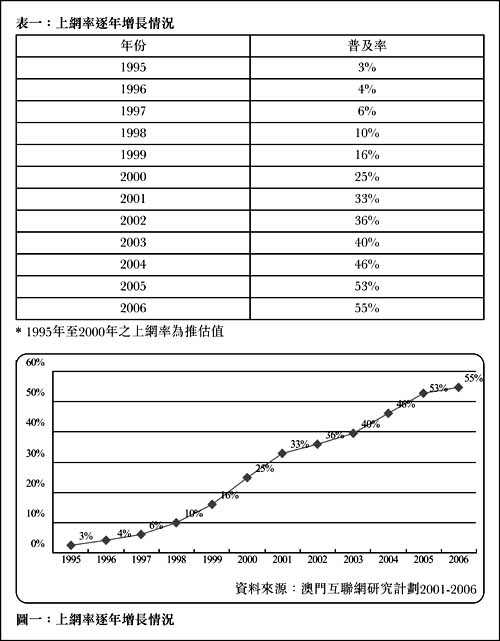
Other key summary points from this survey:
- The number of Internet-connected households is 115,000 (=72%). Of
these 89% use broadband and only 10% use telephone dial-up.
- Internet usage reached 95% among university graduates and 89% for those
with some university diplomas.
- 80% of Macau netizens visit Hong Kong websites, 43% visited Macau
websites, 27% visited Taiwan websites, 25% visited mainland Chinese
websites, 17% visited foreign websites.
- As much as 60% of Macau netizens are still unsure about Internet
content. More than three quarters of netizens believe that Internet
information needs to be 'placed under control' (需要管制).
[067] Huangfu Ping on Chinese Leftism (02/17/2007) (ChineseNewsNet)
[in translation]
Q. It there a contest with "leftist" ideas in the current debate?
A: In this debate, the socialism-versus-capitalism issue was raised again. We were said to have transplanted capitalism and western liberalism over here, and the leadership has fallen into the hands of people who are groomed on western neoliberal economics. So "leftist" ideas have become popular again. In terms of overall policy, it is revolutionary to be "left" and therefore "leftist" mistakes are treated relatively lightly. Rightist mistakes are usually severely punished. Therefore, the administrative policies favor the existence of "leftist" ideas. If you recognize the source, then "leftism" is dogmatism and the market economy and democratic governance in the reforms are naturally opposed to leftist dogmatism and therefore these things are grouped under capitalism.Q: What is the difference between the so-called left in China versus the left in the United States and Europe?
A: The left in US/Europe are different from the Chinese left. In the US/Europe conception of political governance, they presuppose market economy and democratic government and then they decide to balance between economic efficiency and social fairness. The US/Europe leftists tend to pay more attention to social fairness, and they can advocate socialist democracy. But the Chinese leftists are opposed to market economy and democratic government, and therefore they are very different.Q: Don't the so-called Chinese leftists claim that they are "defending the interests of the socially weak groups"?
A: When the so-called Chinese leftists claim to represent the interests of the people and the socially weak groups, they are only shouting empty slogans because they never take any practical actions. When they say that they represent the weak groups, they want to dump the market economy and return to the planned economy and they want to go back to the class struggles instead of democratic governance. Therefore, this claim to represent the weak groups is not the same as the US/Europe leftists seeking social fairness. What they want to do is to go back. The twenty-eight years of reform proved that there is no future going back that path. They are not talking about fairness or efficiency; their 'fairness' is based upon equal sharing of poverty.Q: What is your assessment of the current censorship of websites, books and newspapers?
A: This is the manifestation of "leftism" in publicity, news and publishing. At the Fourth Plenum of the 16th Congress of the CCP in 2004, the governance capacity and quality of the party were stressed. In particulare, three principles about party control of ideology and publicity were described: scientific management, democratic management and management in accordance with the law. It has been several years now, and I still have not see the related departments make any efforts or reforms following these three principles. They are still doing the same old censorship thing, such as the <21st Century World Herald> incident, the <Southern Metropolis Daily> incident, the <China Youth Daily> Freezing Point incident, and the recent banning of the forums, books and websites. Where are they showing any scientific management, democratic management or management in accordance with the law?
In recent years, administrative management techniques have been introduced in the area of ideological control. But the publicity department does not study trends and developments in ideology in order to formulate policies that are favorable for the general situation. Instead, they just adopt the administrative management techniques and assert detailed control of a newspaper page, an essay and even a headline. The publicity department leaders take over the duties of the newspaper chief editors. Then they found a bunch of old, retired journalism/publishing workers to form the so-called "Critical Reading Group" and use their opinions as the basis for determining correctness. What is the scientific basis? How is this democratic management? So many media now treat the "Critical Reading Group" members to meals and this is a bad atmosphere. There is also no legal basis for using their opinions as the standard.
[066] Open Source Translation Blogging (02/17/2007) (Under The Bridge) Following the discussions and suggestions between a number of translation bloggers, Feng37 has set up Chinese Content at wikispaces:
Bloggers can drop in when they have time, share ideas with other, steal ideas from each other, prevent pieces from getting translated twice, ask questions, answer questions, and even team up for larger projects if they were to ever feel the need. At ESWN's suggestion I've gone and set up Chinese Content at wikispaces.
[065]
Public Opinion and the Broadcasting Authority
(02/17/2007) (Ming
Pao) When the Hong Kong Broadcasting
Authority issued an "advice" to TVB for the movie <An
Autumn's Tale> because "the foul language exerted a bad influence on
children," it was based upon the complaint from one member of the
public. The same notice also considered the case of the RTHK program
<Hong Kong Connection> shown on TVB for "biased towards
homosexuality, promoted homosexuality and contained discriminating
elements." That meant that this program also "exerted a bad
influence of children." This other complaint was based upon 22
complaints. The general public (especially the blogosphere) did not
have much good to say about that decision.
Yesterday, BA chairman Daniel Fung
Wah-kin met with the media and justified the
decisions by the Broadcasting Authority on the basis of public
opinion. What public opinion? It was hard to see any groundswell
of support for those instances anywhere.
Here is the Broadcasting Authority's public opinion measurements.
After the decisions were announced, the Broadcasting Authority received 5
supporting letters and 18 opposing letters in the case of <An Autumn's
Tale>. The Broadcasting Authority also announced that it received
166 supporting letters and 153 opposing letters in the case of <Hong Kong
Connection> and <An Autumn's Tale> combined. This is a
peculiar way of presenting the numbers. But if you do the subtraction,
you will find in the case of <Hong Kong Connection> 161 supporting
letters and 137 opposing letters.
Hong Kong Film Directors' Guild president Gordon Chan said that the Broadcasting
Authority "was selectively using public opinion" and the approach
was "absurd." Do you believe that public opinion is
represented by these letters from the public? Or will the public use
"foul language" or "foul gestures" when they read
about this?

On September 9, an essay titled: <Evaluating Deng Xiaoping by Translation: He Was Irreplaceable At The Critical Moment in History> was featured prominently at Sina.com. Sohu.com, Netease and other portals. The writer was Doctor Gao Zhikai, who had been Deng Xiaoping's English-language translator in the 1980's.
Although he had translated English for Deng Xiaoping and thus accompanied Deng Xiaoping in meeting many international luminaries, the 45-year-old Gao Zhikai is unfamiliar to many people. At the time, he was barely into his 20's, so by what right did he become the link between the world and the "Great Man of the Century"?
At the time when Gao became Deng's English translator, he was only 23 years old. He graduated from what is now the Beijing Foreign Language University's English Department and had been working in the Ministry of Foreign Affairs for just two years.
"It was both accidental and inevitable that I should become the translator of Deng Xiaoping. It was accident because the Ministry of Foreign Affair's English Translation Office was much bigger than the offices for other languages. The likelihood of being selecting from that office to translate for the top leader of the country was very low. I was lucky."But it was also inevitable that I should translate for Deng. First of all, I was a beneficiary of Deng's open reform policies. In 1977, Deng decided to restore the university entrance exams. At the time, I was 15 years old and studying in first year high school. I entered the foreign language department at Suzhou University. In my third year, I became a graduate student at the Beijing Foreign Language Institute; one year later, I was accepted in the training class for United Nations translators. After I obtained my masters degree, I was assigned to the Ministry of Foreign Affairs' foreign language translation department to work as a translator.
"At the time, our nation lacked skilled people. When I joined the Ministry of Foreign Affairs, the forebears such as Zhou Wenchong and Si Yan had been working in the front lines for ten, twenty years. They needed people to take their places urgently.
"Many people say that I have a talent for language. But I understand that my accomplishments at the Ministry of Foreign Affairs was due to hard work. When I worked at the Ministry of Foreign Affairs, I lived at the typing room in the translation office. There was a small bed inside. During the day, I folded the bed away and I bring it out at night to sleep. I did that for five years. During this era, when my colleagues get off work, I continued to learn and work at the office. Usually, I used my evening hours to work and study. So I finished my written translation work for the next day beforehand. So when my comrades come in the next morning, I was usually done with my work and I asked for new assignments. This happened day after day. The more I steeled myself, the more invaluable the results were. During my time at the Ministry of Foreign Affairs, I was like a sponge that absorbed as much specialized knowledge and foreign policies as I could.
[063]
Hong Kong By The Numbers (02/16/2007) (HKU
POP) (1,013 respondents surveyed on Feburary 12-14, 2007)
Results of a hypothetical voting between Donald Tsang and Alan Leong among
all persons:
73% voted for Donald Tsang
16% voted for Alan Leong
11% were uncertain
Of the demographic breakdowns, the most relevant one is political
inclination (self-selected from pro-democracy (25%), pro-China (6%),
moderate (37%), no preference (28%)):
Donald Tsang:
73% all persons
58% pro-democracy
92% pro-China
80% moderate
74% no preference
Alan Leong:
16% all persons
36% pro-democracy
3% pro-China
12% moderate
7% no preference
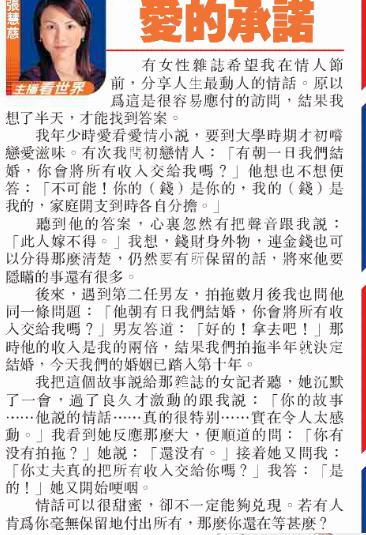
[062] The Promise of Love (02/16/2007) (Diuman Park) It's Valentine's Day and an essay by Hong Kong television anchorwoman Cheung Wai-tsz is red-hot (and not necessarily favorably).
(in translation)
A certain women's magazine wanted me to say something lively about lover's talk before Valentine's Day. I thought that this would be easy, but it took me half a day before I could think of an answer.
When I was young, I loved to read romance novels. But I only tasted romance when I entered university. I asked my first lover: "We will get married some day. Will you turn your income over to me?" He replied without any hesitation: "Impossible! Your money is yours and my money is mine. We will bear out family expenses separately."
When I heard that response, a voice inside me said to me: "Do not marry this person." I thought that money was extraneous, but this person was even so calculating about such extraneous matters and wanted to keep his distance. It goes without say that he will have plenty else to keep away from me.
Later on, I met my second boyfriend. We dated for several months and then I posed the same question: "If we get married some day, will you give me your income?" This boyfriend said: "Fine! Take it!" At the time, he was earning twice as much money as I was. In the end, we dated for six months and we decided to get married. This is the tenth anniversary of our marriage.
I related this story to the female magazine reporter. She was silent for a while and then she said in an excited way: "Your story ... what he told you ... it is really special ... it is really moving." When I observed that overwhelming response, I asked: "Are you dating anyone?" She said, "Not yet." Then she asked me: "Did your husband actually gave you everything that he earned?" I said: "Yes!" She began to sob.
Love talk can be sweet, but it is not always realized. If someone is willing to give you everything without holding back, then what are you waiting for?Relevant Links (in Chinese):
最動人的情話 葉一知, 刁民公園
打倒貪婪情人! Life is but an empty dream.....
[061]
Wisers Index For Hong Kong Chief Executive Election
(02/16/2007) It would appear at this time that two (and only two)
candidates (Donald Tsang and Alan Leong) will be nominated by the Election
Committee (note: there are eight hundred members in total and a candidate
needs 100 or more votes to be nominated). As the election campaigns
roll out, the battle will be fought out in the media in
order to win the hearts and minds of the 800 Election Committee members and
the general public. Oh, yes, these are two completely different
campaigns: the first one determines the actual election outcome, but the
second one may be even more important for the future (see Alan
Leong's Choice).
Here, I would like to point out the resource known as Wisers
Index. This is a service that tracks the news reports in 18
major newspapers in Hong Kong: am 730, Apple Daily, China Daily (HK
edition), Hong Kong Commercial News, Hong Kong Commercial Daily, Headline
Daily, Hong Kong Economic Journal, Hong Kong Economic Daily, Metro, Ming
Pao, Oriental Daily, South China Morning Post, Sing Pao, Sing Tao, The
Standard, The Sun, Ta Kung Pao and Wen Wei Po. The reports on the
Chief Executive election were identified and classified.
At the simplest level, the question is how many articles mentioned Donald
Tsang and how many mentioned Alan Leong.
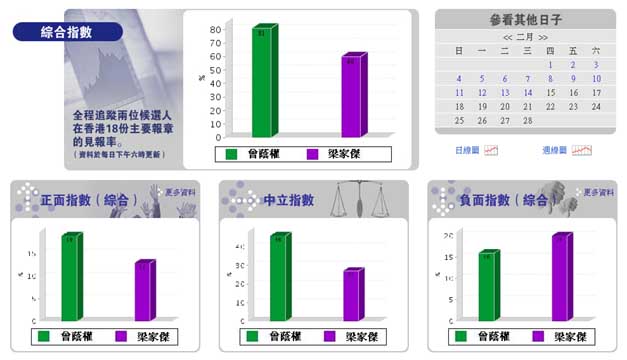
So 81% of the articles mentioned Donald Tsang and 60% mentioned Alan Leong.
But this is not about the absolute numbers, because a mention can be a
praise, a criticism or a neutral statement. So here is the count:
Positives: 19% Donald Tsang, 13% Alan Leong
Neutral: 46% Donald Tsang, 27% Alan Leong
Negatives: 16% Donald Tsang, 20% Alan Leong
So this is not a fair and balanced media landscape. However, you have
to think about whether this ought to be completely balanced.
Hypothetically, let us say that "Alan Leong" is replaced by
"Roger Chan (aka Bus Uncle)" -- why should the press be compelled
to give equal number of positives and negatives to Donald Tsang versus Roger
Chan? Therefore, this is more complicated than demanding equal
time/space for the candidates.
There is another side of the argument, and that involves whether many of the
18 newspapers have vested interests in seeing the establishment's candidate
(namely, Donald Tsang) win. It is not clear
how that can be scientifically quantified.
[in translation]
On February 7, Xu Jinglei's commercial made for <Red Leaf Umbrella (红叶伞)> appeared on the video website YouTube. The Chinese media screamed: "American website crowned Xu Jinglei as the Queen of Bloggers." Immediately the "Xu Jinglei YouTube affiar" became an instant hot new topic. Since a YouTube celebrity can become an Internet star, will the 70 million pageviews at Xu Jinglei's blog turn her into the number one Internet star?
The media that reported this news were "Daily Economic News" and "Information Times." It cited industry insiders who said that <Red Leaf Umbrella> achieved more than US$1 million worh of advertising value.
... The reporter searched for "xujinglei" on YOuTube and found the advertisement. The video runs for 45 seconds. The first 15 seconds showed the English-language sub-title: "Who will be the first blogger to be read 100 millino times? The Queen of Bloggers is a Chinese woman. Here is Xu Jinglei's latest video!" The advertisement has been seen 4,969 times at this time. It was posted by netizen 'zbj110.'
The reporter contacts 'zbj110,' who is a Mr. Liao from Sichuan. A friend sent him his video clip which was captured from television and he posted it on YouTube. Mister Liao works at a television station and he is a loyal Xu Jinglei fan. He added the English-language title. Thus, YouTube did not assert that Xu Jinglei was "the Queen of Bloggers." Instead, one of her admirers did so on his own initiative.
The reporter contacted manager Wu of <Red Leaf Umbrella> in Zhejiang province. He said that he received a telephone call from an Internet planning company in Xiamen and the claim was that they could help him distribute Internet video commercials. "I was busy in a meeting, so I asked him to send me an email. I haven't read it yet." That commercial was filmed in November 2006, and costs 1 million RMB to dake. But the response only came within the last couple of days -- Manager Wu received inquiry calls from many reporters to the point where he was even perplexed. Although he was astonished at the communication power of the Internet, his company does not plan to have an Internet video campaign at this time.Relevant Link: The Queen of Blog YouTube
[059]
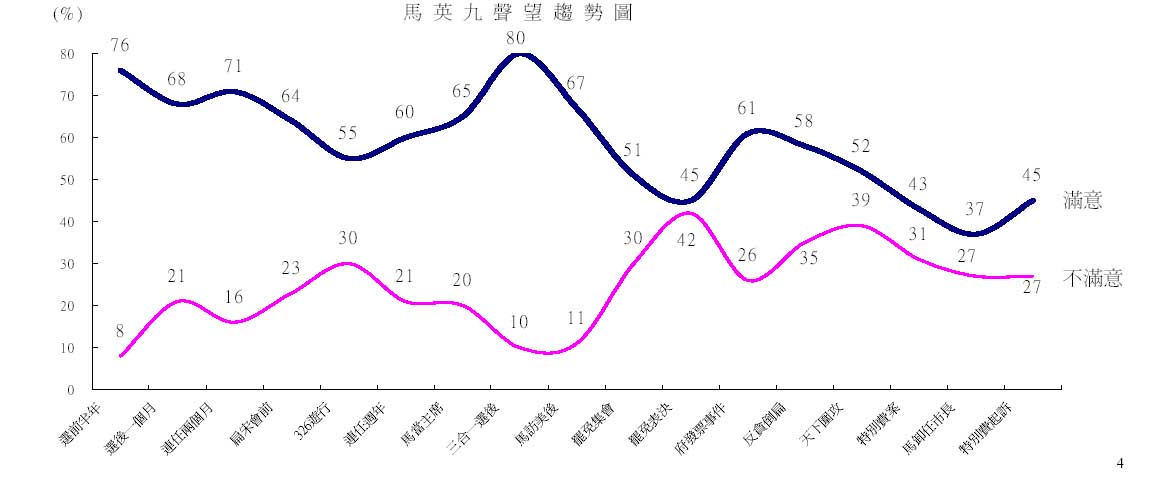
Taiwan By The Numbers (02/15/2007) There is a correction
to this chart about the support levels for Ma Ying-jeou according to the
TVBS tracking poll.
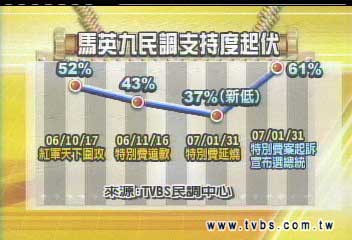
According to this chart, the suport level for Ma Ying-jeou went from a new
low of 37% on January 31, 2007 up to 61% on January 31, 2007 after Ma's
indictment for embezzlement. That obviously made no sense whatsoever,
either because numbers cannot jump that much or because the indictment was
issued on February 13, 2007.
(TVBS)
There were in fact two separate questions:
Q1. Are you satifisfied or dissatisfied with Ma Ying-jeou's job
performance? The new number is 45% satisfaction, up from the new low
of 37%.
Q2. Ma Ying-jeou has announced that he will run for the presidency in
2008. Will you support him?
Feburary 13, 2007:
61%: Yes
25%: No
14%: No opinion
January 29, 2007:
52%: Yes
30%: No
18%: No opinion
[058]
The Background Behind the Translation of the Lawyer-Blogger Letter (02/15/2007)
On February 12, 2006, ESWN published the translation of The
Open Letter to Sina.com from the Lawyer-Bloggers. So what?
That Chinese-language had been posted everywhere despite attempts to swat it
down. An English translation therefore does not mean much. But
this English translation takes on an additional significance because of what
occurred at the Letter from China blog: Confessions
of a C-list Blogger and Am
I a Shoe Shine Boy?. You have to read the
comments in those two posts in order to understand the issues.
Generally speaking, ESWN can be characterized as a 'translation
blog.' I do not like to talk too much about my personal
opinions. Instead, I prefer to identify the primary documents of
interest at the moment, translate them into English and let the readers
decide for themselves. Of course, you may decide that the translation
is misleading and inaccurate, or else the selection was prejudicial.
But you also have the choice of coming to this blog or not. If you
(and the general readership) detest my translations and choices, then this
webisite is done for; if the general readership keeps coming, you have to
decide about the mental capacity of those critics.
At issue in this case is the specific translation about The
Open Letter to Sina.com from the Lawyer-Bloggers. The ESWN blog
usually deals only with published information. While the blogger has
many personal friends and sources, all of those communications with them are
usually considered privileged and never disclosed. This is one reason
why people trust the blogger and speak to him freely, because of that record.
Some people have been talking to him for years without a pipsqueak showing
up on the ESWN blog.
For this case, the ESWN blogger will disclose the record about that Open
Letter. This project began with a Skype chat session between Rebecca
MacKinnon and ESWN (=Roland Soong). The chat session is reproduced as
follows:
RM: hi roland! hope you're well. did you see this? http://www.ncn.org/asp/zwginfo/da.asp?ID=70739&ad=2/9/2007
RS: yes, i don't know if this is going to do any good. it is that faceless sina.com admin and they never show their faces. the only effective option is for a MASS campaign to boycott sina.com blogs. i doubt the celebrity bloggers want anything to do with that.
RM: yes, that's true. but it may still be significant that they are publicly protesting such censorship, and raising awareness about it among chinese internet users. out of curiosity, were you planning to translate that letter?
RS: i did not plan to do so at first, but i could.
RM: well, i am sure you are plenty busy with other things, but if you did decide to translate it that would save me some time :) i think the fact that people are speaking out about this behavior by blog hosts is significant whether or not it has any immediate impact, and is good for the english-speaking world to know about.
RS: it is short. i'll do it some time tonight. i'm doing that state bureau religious affairs director's deleted essay about iraq right now. i'm almost done.
RM: wow, cool. that's a really good one to translate too. thanks. how are you doing? how is your mother?
RS: okay. nothing going on around here.
RM: :)What was going on? I was helping out a friend. It was easy for me to do a translation for a friend who had something to say but was pressed for time. Is that so hard to understand? Besides, my general philosophy is that the English-reading public should be told the full story. In the case of this open letter from the lawyer-bloggers, are you satisfied with the summary/quotation/paraphrasing by mainstream western media (such as SCMP)? Or would you rather read the entire letter? Rebecca MacKinnon and Boing Boing apparently felt that having the whole letter was more powerful and compelling, and I enabled that to happen quickly.
You also noted my initial note of despondency. I recognized that my translation of the open letter would probably achieve nothing. However, I recognized that if Rebecca MacKinnon leveraged that letter, she may achieve a much more powerful impact than I can. That was why I volunteered my services. The fact that Boing Boing picked the item up proved that this was correct.
But no, instead a certain blogger prefers to make this an issue about media agenda-setting and undue influence by the ESWN blogger. Would you rather that I reply to Rebecca MacKinnon: "Sorry, Rebecca, I'd love to do that translation but I can't deal with another diatribe from DTL"?
My goal is to work towards a multicultural, diversified and tolerant blogosphere community. Therefore, I do not spend my time making personal attacks on other bloggers for opinions that differ from mine. I do not make personal attacks against them by calling them names such as Chinese Communist shills, or CIA agents. But there are some bloggers who seem to spend their whole time attacking other bloggers about everything conceivable without an inkling of the facts. While this is not the kind of society that I care to live in, I let it go because I believe in the wisdom of the readers to decide for themselves about what they want.
It is one thing if this was just directed at me and I would not have cared to respond. But this also involves the good names of Rebecca MacKinnon and Lfc, That is why I have chosen to make this statement. RM and Lfc do not necessarily agree with this response, which is purely my own.
If you believe that I have done wrong on the basis of this published record, you do not ever have to come back here. It will not bother me because I cannot help but be true to my own self. That is my essence.
Relevant link: Hong Kong bloggers, the SCMP, and influence on the Web Rebecca MacKinnon, RConversation
[057]
Taiwan By The Numbers (02/14/2007) (China
Times) (700 adults interviewed on the evening of February 13
using the telephone directory as the base for drawing telephone numbers and
then randomizing the last two digits)
Q1. Ma Ying-jeou's job performance
55%: Satisfied
18%: Dissatisfied
[note: Historically, Ma Ying-jeou used to be in the 60's. After the
"dump Bian" movement in mid-2006, his standing dropped below the
50's and had stayed there for the past six months. Thus, the
indictment actually caused a rise.]
Q2. Ma Ying-jeou's guilt
22%: Yes
46%: No
[note: When Ma Ying-jeou was questioned by the prosecutor last November, 19%
thought he was guilty and 41% not guilty.]
Q3. Ma Ying-jeou's presidential run in 2008
55%: Yes, he should
20%: No, he should not
[note: When Ma Ying-jeou was questioned by the prosecutor last November, 40%
thought he should run and 31% not.]
Q4. Wang Jin-pyng's as KMT presidential candidate
37%: Yes
36%: No
27%: No opinion
[056]
Taiwan By The Numbers (02/14/2007) (UDN)
(913 adults were interviewed on the evening of February 13 (with 326
refusals) using the telephone directory as the base for drawing telephone
numbers and randomizing the last two digits)
Q1. How is Ma Ying-jeou's performance?
62%: Satisfied [52% on November 18, 2006]
23%: Dissatisfied [24% on November 18, 2006]
14%: No opinion
Q2. Is Ma Ying-jeou 'clean'?
61%: Yes
17%: No
21%: No opinion
Q3. Are you satisfied with the prosecutor's decision to indict?
25%: Satisfied
47%: Dissatisfied
26%: No opinion
Q4. Do you believe that Ma Ying-jeou embezzled money?
23%: Yes
57%: No
19%: No opinion
Q5. Do you support Ma Ying-jeou running for president in 2008?
66%: Yes
21%: No
13%: No opinion
Q6. Should Ma Ying-jeou run as a KMT member? On as independent?
46%: KMT member
20%: Independent
32%: No opinion
Q7. Who would you like to see represent the KMT in the 2008 presidential
election?
60%: Ma Ying-jeou
18%: Wang Jin-pyng
5%: Other person
17%: No opinion
Q8. Who do you support between Ma Ying-jeou and Su Cheng-tseng as next
president?
59%: Ma Ying-jeou
21%: Su Cheng-tseng
20%: No opinion
Q9. Who do you support between Ma Ying-jeou and Frank Hsieh as next
president?
61%: Ma Ying-jeou
20%: Frank Hsieh
18%: No opinion
[055]
Taiwan By The Numbers (02/14/2007) (ERA
TV) (740 persons age 20 or over interviewed via
random-digit-dial computer-assisted telephone methodology at 18:20-22:00 on
February 13, 2007)
Q1. This afternoon, the prosecutor indicted Ma Ying-jeou for embezzlement
of special funds. Do you believe that Ma Ying-jeou is 'clean'?
30.4%: Very much
22.9%: Somewhat
12.5%: Somewhat not
10.7%: Very much not
23.4%: Don't know/refused to answer
Q2. Ma Ying-jeou announced that he will run for the presidency in
2008. Do you believe that the KMT should amend its anti-corruption
regulations for Ma Ying-jeou personally?
27.1%: Yes
42.9%: No
29.9%: Don't know/refused to answer
Q3. If the KMT does not amend its anti-corruption regulations, do you
support Ma Ying-jeou running as an indepedent candidate?
30.9%: Very much
24.0%: Somewhat
15.4%: Somewhat not
14.4%: Very much not
15.4%: Don't know/refused to answer
Q4. The prosecutors issued indictments in the cases for President Chen
Shui-bian's state fees and Mayor Ma Ying-jeou's special fees. Do you
have confidence in in the fairness of the prosecutorial system in Taiwan?
9.8%: Very much confident
27.3%: Somewhat confident
25.7%: Somewhat not confident
25.4%: Very much not confident
11.9%: Don't know/refused to answer
Q5. After Ma Ying-jeou's indictment, would do you think is the most
suitable candidate for the KMT (Read list)?
21.3%: Wang Jin-pyng
6.5%: Lian Chen
48.0%: Ma Ying-jeou
6.3%: None of the above
17.9%: Don't know/refused to answer
Q6. After the resignation of Ma Ying-jeou as KMT party chairman, who do
you think is most suitable to assume the position?
24.8%: Wu Poh-hsiung
32.1%: Wang Jin-pyng
17.0%: Lian Chen
26.2%: Don't know/refused to answer
[054]
The 'Greening' of China (02/14/2007) (Yunnan Metropolitan
Times via Apple
Daily) In Fumin county, Yunnan province, a new office building
was constructed for the county party committee. Soon afterwards, a
'greening' project was implemented for the stone quarry facing the
building. However, the 'greening' did not consist of planting
vegetation; instead, it was about spray-painting the soil/rocks in green.
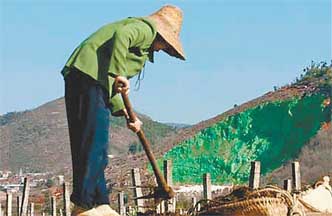

Why, oh why? When asked, the painters said that the local forestry
department thought that it was bad 'fengshui' for the office building to be
facing a barren hillside. Therefore, they elected to implement
'greening.' The locals demurred: "How could the government
believe in 'fengshui'?"
Since the paint created an awful smell, some local residents had to move
away temporarily. Meanwhile local netizens are more blunt: "This
sort of thing can only happen in China!" The 'greening' of China
has been happening in China for the longest time. In order to win the
bid for the 2008 Olympics, Beijing had spray-painted the withered grass in
Tiananmen Square and other parks in green.
[053]
Taiwan By The Numbers (02/14/2007) (TVBS;
TVBS)
The following poll results were obtained on the evening after Ma Ying-jeou
was indicted for embezzlement (announced at 4pm). There is no
information on sample methodology in this first release.
Question: Do you support Ma Ying-jeou entering the presidential election?
61%: Yes
25%: No
Question: Since the Kutomintang party regulations will not allow any party
member under indictment to be an election candidate, that party is thinking
about amending its anti-corruption regulations. Do you support that?
47%: Yes
34%: No
Question: Do you believe that Ma Ying-jeou is 'clean' (i.e. not corrupt)?
58%: Yes
25%: No
Question: If the 2008 presidential election were between Ma Ying-jeou and Su
Cheng-tseng, who would you support?
62%: Ma Ying-jeou
20%: Su Cheng-tseng
Question: If the 2008 presidential election were between Ma Ying-jeou and
Frank Hsieh, who would you support?
61%: Ma Ying-jeou
19%: Frank Hsieh
Question: If in the 2008 presidential election, the greens nominate Su
Cheng-tseng, the KMT nominates Wang Jin-pyng and Ma Ying-jeou runs as an
independent, who would you support?
16%: Su Cheng-tseng
14%: Wang Jin-pyng
53%: Ma Ying-jeou
Question: If in the 2008 presidential election, the greens nominate Frank
Hsieh, the KMT nominates Wang Jin-pyng and Ma Ying-jeou runs as an
independent, who would you support?
15%: Frank Hsieh
15%: Wang Jin-pyng
54%: Ma Ying-jeou
[052]
Ma Ying-jeou Indicted for Embezzlement! (02/13/2007) (TVBS)
Former Taipei city mayor Ma Ying-jeou was indicted today for
embezzlement. During the course of eight years as mayor, Ma Ying-jeou
had NT$1.632 million transferred from the mayor's special fees into his
personal account. While it is true that the special fees do not
require receipts, they must still be spent for public purposes. Of
these, it was determined that NT$1.1 million had no indication of being
spent on public matters. Furthermore, the amount was also reported as
personal assets for tax purposes. Therefore, the prosecutor determined that there was
sufficient evidence to indict for embezzlement. In addition, Ma's
secretary was indicted for falsification of documents as well as
embezzlement of NT$760,000.
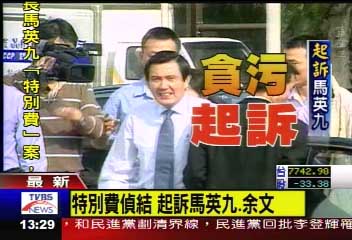
Ma is presently the chairman of the Kuomintang party. He will likely
resign from that position.
(in Chinese)
Indictment
document (Part 1)
Indictment
document (Part 2)
Indictment
document (Part 3)
[051]
The Joss-Stick Burning Panda (02/13/2007) (Beijing
News) For 2006, the honor for the most destructive computer
virus/worm of the year went to the "Joss-Stick Burning
Panda." If your computer is infected, then any attempt to run an
.exe file will only bring up the picture of the joss-stick burning
panda. Millions of computers have been infected.

Who was the creator? At first, the belief that it must be from someone
selling anti-virus software/solutions. But now, six suspects have been
arrested in Wuhan, Hubei. The author is 25-year-old Li Jun. His
motivation is unusual, because he made more than 100,000 RMB in ill-gotten
gains through selling the virus source code to others. These other
people then modified the source code so that they can seize control of
computers to create a "network of zombies" as well as steal
various online game and QQ account information. It was not revealed
how the public security bureau tracked down Li Jun. But it seemed that
Li Jun was being quite open about his sales activities, either personally
dealing with buyers or using representatives.
[050] Female Hong Kong Student Brought Down Shenzhen Factory (02/13/2007) This appeared as the top story in Southern Metropolis Daily today. For the background, see Disney Cutting & Running at Interlocals.net. Here are excerpts from the SMD story:
Chronology of events:
June 2005: SACOM (Students and Scholars Against Corporate Misbehavior) was established in Hong Kong, and began investigation of four mainland factories that produced merchandise for Disney.
September 2005: SACOM released its Phase 1 report on Disney and claimed that four factories were sweat shops.
June 2006: SACOM went to the Pearl Delta and conducted a second investigation of Disney-authorized factors, including Huang Xing.
September 2006: SACOM released its Phase 2 report to the media and Disney's Asia-Pacific headquarters. Disney sent auditors to investigate Huang Xing. Disney stopped its orders afterward.
January 31, 2007: The 18-year-old Huang Xing dismissed more than 800 workers and shuttered the factory.
February 1, 2007: Almost one hundred factories blocked the road at Huang Xing to protest.
February 6, 2007: SACOM protested at the Disney Asia-Pacific headquarters about the order stoppage that resulted in the workers losing their jobs.
When the more than 800 workers at Huang Xing Light Manufacturing Factory lost their jobs, they blamed the factory owner and they also detested an unfamiliar name: Vivien Yau (丘梓蕙). The workers learned that name from the Internet as well as the explanation from the factory director. "She is a Hong Kong girl who came last year to investigate at our factory and she published information unfavorable to our factory." The factory electrician Mr. Qiu who had worked there for 15 years said that Vivien Yau cost them their jobs. The 40-something-year-old Mr. Qiu will receive a compensation of just over 2,000 RMB after 15 years at the factory. During the interviewing, many workers expressed the same views as Mr. Qiu.
How could the words of a Hong Kong female university student cause the factory in another city to shut down? On the afternoon of the day before yesterday, the reporter met with Vivien Yau at the SACOM office in Hong Kong. This 20-year-old girl is a Chinese University of Hong Kong student and she plans to do social work.
During the summer vacation in 2006, Vivien Yau and fellow SACOM investigator/CUHK student Ah Bong showed up outside the Huang Xing factory. At the time, the workers who were interviewed thought that the students were just doing summer work/study and therefore answered their questions about wages, overtime, benefits, etc. "We work 12 hours a day; we get paid 3 RMB/hour for overtime ..." While this was nothing unusual for the workers, it was excellent material that SACOM could use to condemn Disney for using sweat shops. In September 2006, Vivien Yau published the investigative report on three exploitative factories used by Disney, including Huang Xing.
"Why do we protest against Disney? Because they made an open promise to society that they will supervise the factories that manufacture Disney merchandise and they will make sure that all the products with the Disney label are not based upon exploitation. But the reality was different."
The reporter also interviewed the factory manager, who does not want his name published. Huang Xing was actually a Japanese-capital company which got its orders mostly from Disney Japan at razor-thin margins. The manager said that the re-organization requirements reflect strong foreign values that do not correspond to Chinese reality. "For example, there were issues such as providing free condoms and soap bars. If these items were placed out there, they would be immediately taken by the workers, so that an infinite amount will be required. The factory was also required to let the workers leave their work stations without registering or being fined. The company did not think that it could do so. While it is normal for workers to use the restroom, the requirements will mean that a worker can go to the restroom five times a day, half an hour each day. This will make management and production impossible." Since the factory felt that it could not comply with the requirements at the razor-thin margins, the decision was made to close.
[049] Why Wen Jiabao Has Trouble With Getting On The Internet (02/13/2007) (Apple Daily)
[in translation]
Last Friday, Vietnam premier Nguyen Tan Dung went on to the Internet to chat with netizens for 2-1/2 hours. The subjects included democracy, freedom, privacy, etc. This was reported widely around the world and the outspoken Southern Metropolis Daily wrote an editorial. This led mainland Chinese netizens to wonder when they can get to chat with their Premier Wen Jiabao on the Internet.
Today, quite a few state leaders and major officials have done web chats or have blogs. Wen Jiabao is well known to be personable and he has publicly said many times that he read popular opinion on People's Net and Xinhua Net. So why hasn't he spoken directly with people on the Internet yet?
Concerning Wen Jiabao's web chat, the first problem is the technical barrier. Internet blocking in mainland China must be the most advanced technology of its kind in the world. The number of sensitive keywords blocked on web chats must also be the biggest in the world, and these include "Wen Jiabao," "Premier Wen," "64," "Zhao Ziyang" and "FLG." Unless these blocks are removed, the netizens cannot even say, "Premier Wen, how are you?" So what can they say then? Things will only get excited after these blocks are removed, but it is not sure that the official websites can deal with it?
The second problem is a matter of face. When Russian president Putin went on web chat last year, a 17-year-old Russian girl asked him about his first sexual experience. Nguyen Tan Dung was asked about why he let his son go study in the United States. For the Chinese leaders who never tell the media about their children, personal health or sex lives, they may not be able to overcome the fact that public figures have no privacy?
The biggest problem is the political one. Vietnam is a one-party state like China (namely, ruled by a Communist Party) and there are large numbers of Internet dissidents in jail. Nguyen Tan Dung was questioned by netizens for controlling the media and the Internet contrary to the reform promises. If Wen Jiabao were to get on the Internet, he could not avoid being asked about the issues of democracy and freedom.
Actually, the last paragraph in the Southern Metropolis Daily editorial must irritate the authorities: "We look at the reform of the political system in Vietnam with expectations. But the test of the outcome will depend on how power came about, how it is used and how it is put in check; it will depend on how the people can participate in political life; it will depend on the conditions of freedom of press and human rights."
If the word 'Vietnam' is replaced by 'China,' then this editorial is equally relevant. Perhaps precisely for this reason, Netease has deleted this editorial from its website. The netizen comments at Sohu.com and Sina.com have also been deleted. If even such an editorial is suppressed, then it is truly premature to expect Wen Jiabao to hold chat sessions on the Internet.
[048]
Pockmarks (02/13/2007) Are Chinese netizens aware that
censorship exists in their midst? For someone who deals with sensitive
topics (such as evil cults, June 4 1989, etc), this must be a living
reality. Thus, their forum posts are deleted, their blog posts are
deleted and their forum comments are deleted. But what about the
majority of the netizens who have nothing to do with sensitive topics?
Well, it would still be a way of life. For example, the subject may be
as simple as the professional status of an apparently multi-talented
professor. You proceed to make a comment on a post at a forum, and you
can be deleted for unexplained reasons. Maybe the world would not be
wiser apart from this particular commentator. However, certain forums
have this habit of numbering the comments in sequential order. Suppose
you are the person who made comment #3421 that said: "Down with the
running dog Professor XYZ who is a party shill!" Within ten
minutes, the system administrator has deleted your comment. But there
is a technical problem. Comment #3422 might say: "I agree that
Professor XYZ is an admirable figure" and Comment #3423 might say:
"To the person who posted Comment #3422, I must respectfully disagree
because the historical record is unclear. Let me explain further
..." If comment #3421 were deleted and all subsequent comments
renumbered, then the ensuing comments would make no sense when they referred
to the old numbering scheme. For that reason, when a comment is
deleted, a blank slot is usually left with the numbering scheme preserved.
Here is an example from KDNet
about "Professor Ding Xiaoping":
Comment #10314: "The comment from this user has been hidden by the
administrator"
Comment #10315: "The comment from this user has been hidden by the
administrator"
In that sense, there is a historical trail of the labor of the
administrators. You can call them 'pockmarks.' By the way, this
particular KDNet forum post has been read 1,021,762 times with 10,320
comments. I'll leave it up to some foundation-funded researchers to
count how many of those comments had been 'hidden' by the adminstrators.
The point here is that there is no way for a Chinese netizen not to be aware
of the ubiqitous existence of the omnipotent administrators, even on topics
that are seemingly innocuous (for example, is Professor Ding Xiaoping a
"charlatan"?).
[047] The Sayings of Sha Zukun (02/12/2007) (Beijing News) Sha Zukun is the newly appointed under-secretary-general at the United Nations. Sha became famous when he told the United States off on the matter of military expenditure by China ("It's better for you to shut and keep quiet. It's much much better."). Here are some more sayings from Sha Zukun:
Another story was that Sha Zukun almost came to blows with the US Secretary of Health and Human Services while attending a WTO meeting. The cause was about the Taiwan issue.
Reporter: What happened there? Were the media reports accurate?
Sha: The media was inaccurate when they said that there was physical issue. How could there by physical contact? He had used some very rude language. In the United States, there is a saying that is equivalent to us saying "letting out dog fart" in China. The Americans say instead "BULLSHIT." He said, "Don't do this. I don't want to listen to this BULLSHIT." That shocked me. Then I became impolite too. I said, "I used to think that I was the crudest person, the most uncultured person and the most boorish person in the world. But after meeting Mister Secretary, I realized that you are someone who is even more uneducated, uncultured and uncivilized than I am. I feel very relieved that you have become the top person, the number one in the world."Reporter: How did he react?
Sha: He looked very embarrassed. I said, "In spite of the fact that you were so rude, I'm still willing to explain this to you." I continued to explain to the Secretary of Health and Human Services about the "understanding" that I had previously reached with the US ambassador. After each article, I added "NO BULLSHIT." When I finished, I turned and left. "I don't care whether you listen to me." Maybe he had never met a tough ambassador like me. Afterwards, we became the best of friends. He wrote me a letter. There was a reception that evening and he embraced me warmly when he saw me. He also rang the glass and asked for quiet in order to announce that we are the best of friends, NO BULLSHIT.Reporter: Why was there such a drastic change?
Sha: I don't know. I think this is probably the character of American people, especially his individual personality. He was very public. Once I made things clear with my explanation, our misunderstanding was eliminated.
[046] The Gini Cofficient in Hong Kong (02/12/2007) The Gini cofficient is often cited to show that wealth inequality is worsening in Hong Kong. If you google 'Hong Kong'+'Gini index', you will actually find an ESWN page (Gini Index in Hong Kong) as the top result. Today's opinion column (Income distribution and the Gini Cofficient in Hong Kong (本港的收入分佈與堅尼系數)) by Kwok Kwok-chuen (郭國全) in Ming Pao has an even better technical explanation.
[in translation]
... The Gini cofficient is a number based upon household income in order to summarize income distribution. If all families receive the same income, the Gini cofficient is 0; if one family receives all the income and no other family receives anything, the Gini cofficient is 1.
The Gini cofficient is simple and direct, but it can be easily misinterpreted. A basic and frequent misinterpretation is that if all families receive the same income, then the distribution is fair. Yet, families have different number of members, different number of workers, different age distributions, different levels of education and so on. Therefore, equality of household income is a different kind of unfairness.
Hong Kong has been moving from the large families of the past to more smaller families now. As family size continues to fall, there is a slowdown in household income growth. There are now many more elderly families or single senior citizens, and therefore the number of low-income families is rising quickly. Many elders live apart from their children. They live off savings or are supported by their children and they may receive social welfare subsidies. Had these elders continued to live with their children, those kinds of families would not be considered to be low-income.
The Hong Kong economy has also been changing and creating values in the form of more high-paying job opportunities. There are more professionals and managers with university education, and this has affected income distribution in several ways:
1. The income gap between high-paying and low-paying jobs has increased.
2. As the proportion of high-pay employees grows, the Gini cofficient rises.
3. The income gap among high-pay employees is greater than that among low-pay employees.
4. The median income of low-pay employees will decrease after middle-age whereas the median income of high-pay employees will increase after middle-age. Therefore, the ageing of the population causes the income gap to grow.
During an economic downturn, it is more common for low-pay employees to face unemployment, underemployment or wage reduction than for high-pay employees. This caused the income distribution to become more spread out between 1998 and 2003. The economy bounced back in 2003, which increased job opportunities for the grassroots and the situation for the low-pay workers has improved.
The government also provides services in education, healthcare, housing and welfare which has the effect of re-distributing income. Income and property taxes also re-distributes income. Most Hong Kong families, including "middle-class families," should have higher incomes with these items were factored in than without.
Some commentators compare Hong Kong's Gini cofficient with foreign data. Data from different places are based upon different definitions. The Gini cofficient reported for Hong Kong uses ordinary family income along with welfare payments, but it does not deduct any income tax. By contrast, many other places uses income data after various kinds of taxes have been removed. There are also some places which will include the impact of government redistribution Therefore, it is easy to come to erroneous conclusions if the Gini cofficient for Hong Kong is directly compared with foreign data.
In conclusion, the analysis of Gini cofficient and household income distribution must consider other factors such as society, family structure, population ageing, economy and others before a reality-based conclusion can be made. For example, the number of low-income Hong Kong families is increasing. If the main reason is that the number of elderly families is growing, then how shall their standard of living be improved? Would you improve work wages? Or would you improve retirement guarantees and other senior citizen benefits?
[045]
The Sina.com Censorship Mechanism (02/12/2007)
I'll declare that that the following is all speculation, but it is what I
would do if I were put in charge of the censorship operation at
Sina.com. First up, the western media like to talk about 30,000
Internet patrol police officers that monitor the Chinese Internet
opinion. By the numbers, this is just hogwash. -- somewhere else, I
have done the number-crunching and deduced that each Chinese blogger (of
which there are tens of millions) will receive 3 seconds of attention from
an Internet police officer. How is the police officer going to figure
about the content in that very brief period? I believe instead that censorship is out-sourced to
the Internet Content Providers/Internet Blog Service Providers. Each
of them is initially provided with a list of absolutely prohibited subjects
(such as certain 'evil cults,' June 4 1989, the Gang of Four, Lin Piao,
etc). Periodically, the leaders of the ISPs/BSPs are invited to
debriefings in which the latest proscribed list is read out (always orally
and without written distributed documents).
If I were Sina.com, I would probably have a department of dozens (or even
hundreds) of 'censors' working around the clock. When a post is made
to a blog, a copy is flashed in front of the 'censor.' Usually, the
'censor' takes a brief glance and okays it (for example, a comment on an
entertainer). Sometimes, the post may be deleted for excessive
emotionalism (i.e. "XXX is an ugly-looking slut."). More
intriguing are the sensitive materials.
There is probably an automatic trigger mechansim on certain keywords (e.g.
Zhang Yihe at this very moment). That will probably flash on the
censor's screen and be deleted within seconds of its posting, regardless of
its import. Zhang Yihe is a "NO-NO."
Over time, Sina.com has probably accumulated a list of troublesome bloggers
based upon the accumulated number of deletions. The next time that
another post is made from this blogger, it may trigger an automatic
refererral to a supervisor for review. Such is likely the case for the
lawyer-bloggers in The
Open Letter to Sina.com from the Lawyer-Blogger. They have become
'sensitive persons.'
While the lawyer-bloggers are demanding a public explanation from Sina.com,
they are unlikely to get one. Sina.com hosts several million
blogs. Right now, four bloggers have complained. Unless a
significant number of other bloggers also complain, Sina.com will not feel
compelled to respond. It is doubtful that the celebrity bloggers at
Sina.com (such as Xu Jinglei and others) will join this campaign.
Sina.com probably does not even know how to make a public response.
The whole point was that they were never given any clear and explicit
instructions from the relevant authorities. While certain areas were
clearly out of bounds (such as "evil cults"), other current topics
were deliberately left vague. As such, the Sina.com is left to its own devices -- if they were lax in enforcement, they will be punished; if they overstepped,
they do not face any official sanction apart from public dissatisfaction which goes
nowhere. What do you think Sina.com will end up doing?
However, it is also important to let Sina.com feel that an outside pressure
group exists. Otherwise, they can act with impunity.
[044]
The Secret Network (02/12/2007) Late evening on
2/11/2007, the following inquiry was received: "Are you interested in
translating the open letter from the four lawyers/bloggers against
Sina.com?" I replied with something like: "Actually, I did
not think that it would amount to anything. It would matter only if we
can mobilize a MASS protest campaign but I truly doubt the celebrity
bloggers would join in." In any case, I volunteered to give you The
Open Letter to Sina.com from the Lawyer-Bloggers. For context and
interpretation, I defer to Rebecca MacKinnon at Chinese
lawyers protest blog censorship by Sina.com (add: Please
State Your Reasons
Susan Jakes, The China Blog (TIME)).
The title of this blog post was "The Secret Network." This
refers to an existing network of bloggers who communicate with each other on
a regular basis and exchange information along the lines: "Are you
translating this article?" and so on.
For example, if you read this collection on the death of news worker Lang Chengzhang:
- The Death of a Shanxi Journalist (collected articles at ESWN)
- Journalist murdered in Shanxi Province: Local leaders insist he was a "fake" reporter David Bandurski, China Media Project
- Debate begins in the Lan Chengzhang Case: what does it mean to be a "real" journalist in China? David Bandurski, China Media Project
- CCTV on Lan Chengzhang CCTV (translated at ESWN)
- The China Economic Times Report on the Lan Chengzhang Case Wang Keqin, China Economic Times (translated at ESWN)
- Top officials order "swift" investigation into the murder of reporter David Bandurski, China Media Project
- Real Scoop On Fraud Journos: Q&A W/ Wang Keqin Jonathan Ansfield, China Digital Times
- Dirty Newsrooms: Wang Keqin's Missing Ending Jonathan Ansfield/Mo Ming, China Digital Times
- The yWeekend Report On The Lan Chengzhang Caset yWeekend (translated at ESWN)
- Oriental Outlook on Lan Chengzhang, N/A Online Jonathan Ansfield, China Digital Times
- Fake Reporters In Datong, Shanxi Beijing News (translated at ESWN)
then you should realize that some of the work was done through careful coordination to avoid unnecessary duplication.
As I have told some members of this 'secret network', "I have no idea that such a network really exists and I don't really care. I only know that we each do whatever we feel like and we are able to find each other somehow through some common values and practices. Without trying to figure out any clearly defined goal, let us just go ahead in a collaborative effort without wasting our limited resources while maintaining certain standards."
[043] 燈火欄柵處 (02/11/2007) From one of my regular reads on the blog roll, instead of the usual commentary on current affairs, there was a 40,000+ word story. In his postscript, the blogger noted that blog traffic doubled as a result. So here are all 12 chapters of the story for your reading pleasure.
[042]
Bloggers versus Real Journalists on the Big Soccer Brawl
(02/11/2007) When I argued that The
Big Soccer Brawl - Part 1 and The
Big Soccer Brawl - Part 2 presented a better description of the
incident, the complaints came in that the two jorno-bloggers were obviously
biased.
So let's me walk you through the process. Let us agree that this is an
important story at this time, more because of what is happening inside
China. How shall a mainstream western media reporter do the proper
reporting? Let us start by getting the facts straight by talking to
those present at the match on that day. The Chinese Olympic
team? They are not talking apart from that one public apology.
When one Chinese player arrived in Beijing, he hid in the restroom to avoid
the media. Queens Park Rangers? They are not talking until the
investigation is completed. The Football Association? They are
not talking until they get the referees' reports. Let us see some
western mainstream press reports that are sourced:
(Associated Press via International Herald Tribune) China's Olympic soccer team coach Ratomir Dujkovic termed as "unacceptable" a fight that broke out between his club and English team Queens Park Rangers during an exhibition game in London ... "That's the style of English soccer," Dujkovic told the Beijing sports daily Titan. "But no matter what they do, it shouldn't be a reason for fighting. I am really disappointed. It is not acceptable." Titan reported that Chinese player Zheng Tao was knocked unconscious in the brawl and may have a broken jaw. Chinese striker Gao Lin, who was involved in the initial incident that sparked the fight, is being sent back to China, Titan said.
(The Electric New Paper) The China Olympic team was provoked into a fight. So said a Chinese journalist who was in London covering the team's training tour. Titan Sports' deputy editor-in-chief Ma Dexing witnessed the mass brawl between the Chinese and Queens Park Rangers players. Speaking to The New Paper from London, he said it was an 'incident waiting to happen'. 'QPR players were playing a very dirty game. They were not just physical. They were rough,' said Ma. 'Their tackles were filled with bad intention and their manners were even worse. They kept screaming abuse at the Chinese players. Perhaps they thought our players didn't understand, but actually they did. The turning point came when we scored an equaliser through Gao Lin to make it 1-1. It was a mistake by the defender (Patrick Kanyuka) that saw the Chinese player score the equaliser. After that, the player kept provoking Gao with crunching tackles. At one point, Gao even screamed his concerns to the bench, saying, 'If we continue playing, we might get killed'. Around 15 minutes before the end, after Gao and Kanyuka challenged for an aerial ball, Hao turned and swung his arm at his opponent. It sparked off an argument that escalated into a shocking brawl.'
So it looked like the most talkative source at this time is Titan Sports, through its deputy-in-chief Ma Dexing. Oh, yes, Ma Dexin is the journo-blogger who wrote The Big Soccer Brawl - Part 1. So if Ma Dexin wrote something himself, he is biased. When western media quote/paraphrase what Ma Dexin wrote/said, it is alright (because it appears in quotation marks).
But let's say that you don't like to talk to eyewitnesses because they might be biased. Actually, even if you have access to the Chinese Olympic team, the Queens Park Rangers, the referees and the Football Association, you can bet that they will be biased for their own reasons. For something totally objective, how about that QPR China Brawl video on YouTube?
(Associated Press via International Herald Tribune) Footage of the fight aired Thursday by Hong Kong's Cable TV showed Gao throwing downward punches after being picked up by a Rangers player. Both players fell to the ground, then others joined the fight.
(Telegraph) This is what we see: after a couple of niggly tackles and off-the-ball shoves, the Chinese striker, Gao Lin, behaving as if he is an extra from Crouching Tiger, Hidden Dragon, suddenly leaps at a QPR opponent, wraps his legs around the player's waist and starts boxing his ears. As the Englishman struggles to free himself, the pair fall to the turf. At which point, not only do all the other Chinese and English players on the pitch join in, but so do half the members of the Chinese coaching staff. The scrap that ensues is far more aggressive than the standard push-me-pull-you of football handbags. When order is finally restored, the footage shows one of the visitors spark out on the ground. This, it turns out, is the defender, Zheng Tao, who was taken to hospital with a fractured jaw.
Well, the Chinese commentators are complaining that the video had been edited down (see the Chinese videos at Sina.com) and it does not show everything that was happening on the field before and then at the time. In any case, do you get any of the context from a video alone? So it looks like you are still going to have to read or talk to Ma Dexin.
Notwithstanding the fact Ma Dexin may be seriously biased, would you like to read what he wrote in full glorious detail? Or some quotation/paraphrase thereof? In addition, please remember that these two blog posts are the definitive eyewitness accounts. Would you like to read most Chinese are presently being influenced by with respect to this affair?
[041]
Freedom of Press in Hong Kong (02/11/2007) (Apple
Daily) The Hong Kong Journalist Association commissioned
Lingnan University to conduct a mail survey of news workers and 506
responded.
Compared to July 1, 1997, is there more or less freedom of press in Hong
Kong?
11.6% more freedom of press
58.4% less freedom of press
30.0% same freedom of press
Compared to the British colonial government, does the current Hong Kong
SAR government attempt to influence the press more or less?
46% more
6.2% less
At the same time, more than 700 citizens were randomly selected by Lingnan
University and interviewed by telephone.
Compared to July 1, 1997, is there more or less freedom of press in Hong
Kong?
31.2% more freedom of press
27.4% less freedom of press
31.2% same freedom of press
10.2% don't know/no response
Compared to the British colonial government does the current Hong Kong
SAR government attempt the influence the press more or less?
54% more
14.2% less
(SCMP; no link) Journalists' group calls for higher standards. Liz
Heron. February 11, 2007. A call for higher media standards
has been issued by the Hong Kong Journalists Association after a survey it
carried out found 30 per cent of journalists had censored themselves during
the past year. Forty per cent said they knew either their colleagues
or supervisors did so, while nearly 60 per cent of journalists believed
press freedom had declined since the handover and self-censorship among the
media had got worse, according to the survey released yesterday at a panel
discussion on press freedom. Of that 60 per cent, almost
three-quarters considered self-censorship to be the most important reason
for the decline, while 13 per cent blamed tighter information control.
The three most serious forms of self-censorship, cited by 506 journalists
who responded to the survey, were downplaying issues and information
unfavourable to the central government or believed to be unfavourable, and
downplaying those unfavourable to media owners and their interests. Yet
self-censorship came only fourth in journalists' views of the most serious
problems facing the industry, after frivolous news, depressed wages and
benefits, and sensationalism.
Relevant Link:
Self-Censorship
In Hong Kong Austin
Ramzi, The China Blog (TIME)
[040]
"You Cannot Leave Until You Put 5,000 RMB In Your Pocket"
(02/11/2007) (Shanxi Evening News via 163.com)
China Trade News worker Lan Chengzhang was beaten to death for allegedly
attempting to extort 5,000 RMB from an illegal coal mine operator.
Here is the opposite story.
On January 31, the Shanxi Evening reporter proceeded to Zhanglianggou where
illegal coal mines were reported to be operating. From a hilltop, he
saw an awesome sight: a deep cliff had been cut out into a hillside with an
artificial ditch 100 meters deep and more than 1,000 meters in area.
Five trucks were waiting to load coal. As the reporter took photographs,
someone who looked like a watchman approached him although no attempt was
made to stop the reporter. "It is not easy to dig so deep.
Who is the boss?" "Oh, it took a few earthdigging machines
more than a year to get this far. The boss is named Cheng Nian.
Where are you folks from? Go and take photographs. If you have
anything in mind, please speak up. We'll try our best to
please." This security guard seemed like a real slicker.
As the reporter got ready to leave, the watchman raced over: "Leaving
already? You must give an explanation." The reporter
pretended that he needed to visit some other place. So the watchman
let him go, but he reminded the reporter to stop by the pumphouse at the
bottom of the hill because the boss will be waiting there.
The reporter proceeded ahead and went on top of another hill. He saw
that there were deep ditches all over the hills, and one coal mine field
after another dotted the landscape. There must be at least 60 illegal
coal mines in the Zhanglianggou area. The biggest one produces 2,000
tons of coal per day and the small ones produce several hundred tons.
Most of them are 'connected.' When there are inspections, the illegal
coal mines halt production and resume activity after the inspectors leave.
Five hours later, the reporter was on his way back. Suddenly four or
five men and a dog emerged and stood in the road to stop the car. A
middle-aged man opened the car door and invited the reporter to come
out. He explained that he was a coal mine owner, and he invited the
reporter to come into a house for a chat. After a while, the reporter
was ready to get up and leave. The boss stuffed 5,000 RMB over.
When the reporter declined, the boss looked grim: "There have been many
reporters here already, and there hasn't been anyone who didn't take the
money." So the reporter had to take the money just to get
away. When he got back to the office, he told his supervisor and asked
the newspaper to return the money.
The next day, the reporter went to see Zhanglianggou town State Land
Resources Department director Meng Linzhong about the illegal coal
mines. Meng declined to be interviewed. When the reporter
insisted, Meng said something that only the reporter, the coal mine owner
and the newspaper supervisor should know: "Didn't you gain something
already? What more do you want?"
[039]
The Media Story Behind the Big Soccer Brawl (02/11/2007)
In The
Big Soccer Brawl - Part 1 and The
Big Soccer Brawl - Part 2, the basic story was simple: there was a
brawl between the Chinese Olympic team and the Queens Park Rangers reserves
in a warm-up match somewhere in London. So what? Who
cares?
Since this is China, any such even will touch on the nationalistic nerves of
certain "angry young people." Similarly, this event has
drawn commentary inside England too. The media story is this: Do you
have the right to speak authoritatively if you were not there to witness the
incident?
The two posts above are blog posts written by Chinese sport reporters who
were present at the match. As such, they can tell you
"authoritatively" just what happened as they saw it. In
their view, they saw something that they believe is different from what The
Mirror and Sky Sports are reporting, or what the Chinese Internet
"armchair critics" are saying, or what the eventual FA
investigation (based upon the referees' report) will say. It is hard
to argue with that.
But is being there everything? As an exercise, you can read those
those blog posts and then make sure that you understand the stories from the
two journalists-bloggers. Then you can watch the video QPR
China Brawl on YouTube. The YouTube video represents another
person's perception of the incident (note: the two journalists-bloggers both
explained the precipitating factors leading up to the
incident). Having seen what was on the video as that other
person, what kind of story would you have written? Would it the same one as
the two journalists-bloggers?
There is also a question of style. Ma Dexin and Xiao Liangzhi were the
sport reporters present at the match and wrote blog posts. Please bear
in mind that both had also filed news reports with their respective news
organizations that conformed to traditional journalistic norms. These
blog posts included a lot of subjective opinions that would not appear in
traditional journalism. For myself, I must say that I would rather
read these more personal reports than the "fair and balanced"
official reports (see, for example, the stories quoted at the start of The
Big Soccer Brawl - Part 1).
[038]
The Paper Airplane War (02/10/2007) (SCMP) Police
officers went above the call of duty - literally - in their efforts to
protect Donald Tsang Yam-kuen from protesters yesterday. They leapt
into the air to swat away paper planes launched at the chief executive by
demonstrators, who were earlier involved in a scuffle with police during
which one officer dropped his gun. The barrage of planes came as Mr Tsang
walked to his limousine after meeting social workers and unionists in Yau Ma
Tei.
(Apple
Daily) The part about the dropped gun was interesting because
there was an inept cover-up job immediately afterwards. What happened
was that a member of the Chief Executive's protective service (G4) dropped
his Glock 17 gun and at least two bullets on the ground. The detective
did not realize that the gun was dropped and it was being kicked around on
the ground. It took 30 seconds before the detective realized what had
happened and then found the gun on the sidewalk.
This incident was witnesses by many people. However, the police
refused to comment to the media for hours. At the scene, one police
officer responded to a reporter that someone had dropped a battery from a
loudspeaker.
At what point did the police acknowledge the incident? Perhaps the
public relations department really did not know, but then the photos and
videos started to show up:
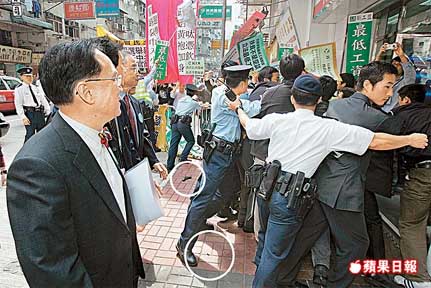
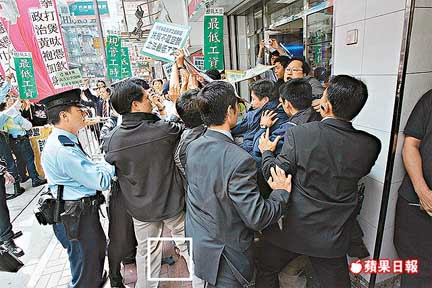
How about a close-up? Does this look like a battery?
[037]
More About Those 'Banned' Books (02/10/20007) (Ming
Pao) At a press conference in Beijing, General Adminstration
of Press and Publications deputy director Yan Xiaohong was asked about the
"banned books" incident. He noted that peple have been
discussing this. But this time, GAPP really did not ban those eight
books ... When GAPP inspects books, they act in accordance with the
law. Ordinarily, they would determine the contents of the book
first. Following that determination, they would act in accordance with
the law."
Yan Xiaohong said that according to the law, the affected party will be
informed of the decision first. "We can say that this time, GAPP
has inspected these eight books in accordance with the law. For
example, some may be pornographic, some may cause religious propblems
between people and some may affect national security. But this time,
GAPP did not ban these eight books." As for whether these eight
books will be re-printed, Yan Xiaohong said that "this is a matter
between the publisher and the author."
The author of one of these books Zhang Yihe said that she heard from
"more than just one or two, and probably more than three" sources
that GAPP deputy secretary Wu Shulin announced that her book was
banned. The sources were uniform about the "ban." She
said, "It is their usual thing. Up to today, they have never ever
admitted fault about anything even if they know internally that they made an
error. To apologize for a mistake does not happen for our
officials. Those kinds of civilized behavior are only used to teach
common people."
[036]
Taiwan By The Numbers (02/10/2007) (TVBS)
(975 persons age 20 or over interviewed by telephone on February 8, 2007;
telephone numbers were randomly selected from the telephone directory and
then the last four digits were randomized)
Q1. Do you agree that all state companies with names such as
"China" or "Chinese" should eliminate the terms
"China" or "Chinese"?
21% agree
55% disagree
24% no opinion
By party affiliation:
52% agree/34% disagree (DPP)
7% agree/82% disagree (KMT)
0% agree/83% disagree (PFP)
75% agree/ 8% disagree (TSU)
22% agree/44% diagree (independent)
Q2. Do you agree that the military should remove all bronze statues of
President Chiang Kai-shek from their installations?
19% agree
51% disagree
30% no opinion
By party affiliation:
48% agree/29% disagree (DPP)
6% agree/82% disagree (KMT)
0% agree/78% disagree (PFP)
58% agree/33% disagree (TSU)
21% agree/37% disagree (independent)
Q3. DPP chairman Yu Shyh-kun proposed that the military remove the guards to
the tomb of President Chiang Kai-shek. Do you agree?
24% agree
52% disagree
23% no opinion
By party affiliation:
55% agree/31% disagree (DPP)
9% agree/83% disagree (KMT)
5% agree/74% disagree (PFP)
85% agree/15% disagree (TSU)
26% agree/39% disagree (independent)
[035]
Hong Kong By The Numbers (02/09/2007) (HKU
POP) (1,011 respondents surveyed on Feburary 2-7, 2007)
Results of a hypothetical voting between Donald Tsang and Alan Leong among
all persons:
73% voted for Donald Tsang
18% voted for Alan Leong
9% were uncertain
Of the demographic breakdowns, the most relevant one is political
inclination (self-selected from pro-democracy (25%), pro-China (6%),
moderate (37%), no preference (28%)):
Donald Tsang:
73% all persons
52% pro-democracy
88% pro-China
79% moderate
80% no preference
Alan Leong:
18% all persons
39% pro-democracy
6% pro-China
13% moderate
10% no preference
[034] Stephen N.S. Cheung Speaks Out (02/09/2007) (Southern Metropolis Daily)
[in translation]
Reporter: The issue of rich-poor gap and polarization is a hot topic for economists inside and outside of China . Some people are concerned about the tendency towards Latin Americanization.
Cheung: That is just hogwash. This was made up by the World Bank and many busybodies. The Chinese peasants have improved their lot a great deal in recent years. The gap is increasingly smaller. That is obvious. I don't understand where their data for polarization come from. Since beginning in 2001, the rural sector has been improving rapidly. It is undeniable and beyond doubt.
The book <The Chinese Peasant Study> is wrong. There may be such cases in isolated places and you write about the worst things. But this is not true for all of China In many poor rural villlages, nobody plants tomatoes anymore and the farmland lie fallow because everybody has left to work outside. You tell me how many full-time farmers are left in China? Most of them have gone outside to work. You go out, you learn a few months, get a driver's license and you can get a job that earns more than 1,000 RMB per month. This is definitely not hard.
The lives of the peasants are improving quickly. I've been out to the rural villages to investigate many times. I have seen that their lives are improving. Things are different each year. Of course this is not like the cities. Of course they are still poor. But we can see that their lives are improving. That is the main theme. But it is nonsense to say that China is polarized! What kind of data is that? Where did the data come from?Reporter: The internationally established Gini cofficient. The Gini cofficient for China shows that the wealth gap is very large.
Cheung: How was this calculated? Who calculated it? Have these people done any studying? They are not even qualified to become my students.Reporter: Are you saying that their method of calculation is wrong?
Cheung: Many peasants who go outside to work earn money but they do not pay taxes. There is no way for you to count it. You can ask him, but he will obvously say that he has no money! Do you expect him to tell you that he earned a lot of money (note: in which case he may have to pay taxes)? But you can still see it. You can see what they eat at home. You can see if they have a television set. How many peasant families do not have television sets? You can also see that they have electrical refrigerators.Reporter: Do you think that the unemployment situation in China poses a serious threat?
Cheung: There is no problem whatsoever. Because many of those who leave their jobs do so not because their bosses fired them; rather they fired their bosses. A company is doing well if it only loses twenty percent of its work force per year. A friend of mine has a software company in Dongguan and he loses 50% of his workers each year. What can be done? The workers want to switch jobs themselves. The bosses don't want to fire them So workers can leave anytime and they change jobs rapidly. You cannot call these people jobless.Reporter: But according to the government data, the unemployment rate is high. Many university graduates cannot find jobs.
Cheung: It depends on how you calculate those statistics. If a person really wants to find a job, he should have no problem getting a job at 600 RMB per month. You go to Dongguan and you will find a job immediately. If you don't want to work at a 600 RMB a month job and you want a 800 RMB a month job instead, you may have to spend two to three days looking for it. As for the 1,500 RMB job? It is a bit harder to find.
[in translation]
... For this Chief Executive election, Donald Tsang used the slogan "我要做好呢份工﹗!" (translated by Tsang into English as "I'll get the job done!"). When the slogan hit the streets the first day, the bad reviews poured in. A scholar made the criticism: "Everybody has hopes and visions for the Chief Executive. The citizens hate how the senior officials treat it as work -- they shirk their responsibility when things go bad but they claim credit when things go well! This phrase creates negative feelings in people. It is incomprehensible that Donald Tsang is actually using it. This is his biggest mistake!"
But I hold a different opinion. In 2005, Donald Tsang's slogan was "強政勵治" ("strong governance"). That created a certain loftiness and did not draw the public close. So this time, he may be carefully crafting a phrase that citizens can easily use themselves. This will set a trend among citizens and create an image of a "Chief Executive of the people" which erases the image of the arrogant senior bureaucrat that the outside world accuses him of being.
This was just like twenty years ago when the government had its most successful slogan with Andy Lau saying, "In these times today, this kind of service attitude isn't going to work." The most significant characteristic of this slogan is that it applies not only to government situations, but the citizens can also use in their daily lives. People can also use it to laugh at themselves. This became a social campaign that went deep into the lives of the citizens and became a part of the Hong Kong lifestyle attitude.
This time, the academics and some political elite disapproved of "I'll get the job done!" But the fact is that its rate of communication and broadcast was very fast. A radio host said: "I'll get the job done for this program hour!" In Hong Kong Economic Journal, Tsiu Sio-ming wrote: "I'll get the job done for this column!" Yesterday, on page A23 of Ming Pao, there were creative interpretations of this phrase by various sectors. I believe that there will be t-shirts with this slogan on sale at the Chinese New Year's Eve markets.
Tsui Sio-ming also made the unique perception that intellectuals often evaluate those in power in terms of refined culture and lofty values. But Donald Tsang chose to use common culture and phrasing to appeal to the masses. Therefore the scholars, journalists and culturati do not have good feelings towards Donald Tsang. Obviously Tsang must realize that. To be close to the common folks and away from the intellectuals results in the price of having good public opinion polls and bad commentary. In Tuesday's Ming Pao, 李先知's column reported that Tsang's public opinion polls showed that the majority of the citizens "accepts" this phase.
The above story showed that many academics and even political elite in air-conditioned rooms fail because they are too lofty and like to fancy wordplay. While this makes them feel good, they do not realize that they are increasingly distanced away from the emotions and pulses of the masses.
The American political commentator William Safire once analyzed that a "good" political slogan begins with a good sense of rhyme and rhythm (simply put, it can be spoken smoothly); but a "great" political slogan has to touch people in their hearts and and tap into the unhappiness and anger inside, or else it has to release the lofty sentiments deep in the soul.
Using this as a standard, we find that Alan Leong's slogan "誰想去贏一場沒有對手的競賽﹖" fails. It is not only difficult to say -- just about none of my friends could successfully say it -- and it is also out of tune with the daily lives of the people (it should be mentioned that the English version of the slogan is "Who wants to win a race without competition?" That is at least smoother to say than the Chinese version. I think the four barristers are used to thinking in English. So they came up with the English slogan first and then made an awkward translation into Chinese).
[032]
The Police Photographs (02/09/2007) Recall that when
Hong Kong Legislative Councilor Albert Ho got assaulted, the Hong Kong
police released artist's sketches of two suspects.
From Next
Weekly magazine, there is this photograph from the protest march
earlier in the afternoon. The two suspects are shown marching behind
the Albert Ho (at bottom right hand corner). This is very CREEPY!
[031] These Books Are Banned ... NOT! (02/09/2007) (Central News Agency via China Times)
[in translation]
... On January 19, Zhang Yihe made an announcement: "On January 11, 2007, the General Administration for Press and Publications called an "information" meeting. At the meeting, deputy director Wu Shulin read out a list of 'books that were improperly published in 2006.' Among the books named, 'Past Stories of Peking Opera Stars' was listed at the number three position."
The announcement also said: "Mr. Wu said (more or less) about the publisher Hunan Literature Publishers: '... you have the nerve to publish this ... this book was banned because of the author.'" What followed was naturally the severe punishment meted out on the publisher.
Wu Shulin attended the forum on "Minnan dialect dictionary" organized by the People's Publishers. Afterwards, a reporter asked Wu Shulin if he did say that "the book was banned because of the author."
Wu Shulin said, "I added 'Cannot' in front." The reporter followed up: "Did you say that 'a book cannot be banned on account of the author.'" Wu Shulin replied: "Yes!"
Concerning the international controversy raised by the book ban, Wu Shulin said that the General Administration of Press and Publications had issued an authoritative clarification through Singapore's Zaobao. "There is no need to clarify any further." Wu Shulin has no comment on those debates.
The problem is this: the only way that they can convince the general public (Chinese or overseas) is to see new printings of these books in bookstores all over China. More speeches mean nothing.
[030]
The Liposuction Riot (02/09/2007) (Boxun,
Boxun)
There was some kind of mass incident but it did not make total sense.
So here is the story.
On February 3, 2007, the wife of the Land Taxation Department director died
while undergoing a liposuction procedure at the Leiyang City Chinese
Medicine Hospital Cosmetology Department (specially at the Hanmei
Cosmetological Center). When the reporter went to the location, there
were people milling around in front of the hospital. Wreaths were
stacked at the front entrance one after another, and firecrackers went off
continuous. The police were on full alert at the site.
Upon information, the 43-year-old wife of the Land Taxation Department
director went to the center to have liposuction. During the process,
her heart rate fell down precipitously. But the staff concealed her
condition and delayed aid so that she expired. The family was
outraged. The center offered 980,000 RMB in compensation. But
the Land Taxation Department director apparently did not lack money and her
money wanted those responsible persons held accountable for the death.
Okay, so why is this a mystery? If you want to have a riot, you have a
riot -- like charging into the building, vandalizing the place and setting
it on fire. That is the standard paradigm. But what is this
business about setting off firecrackers as if this is a celebratory
event? And the wreaths in the photographs are far too colorful.
Aren't most funeral wreaths made from white orchids or some such? If
anything, this would be consistent with celebrations over the death of the
wife of the Land Taxation Department director!
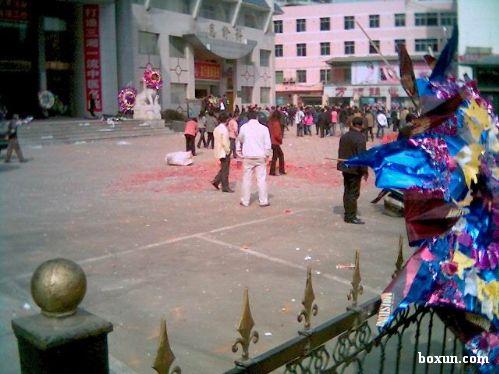
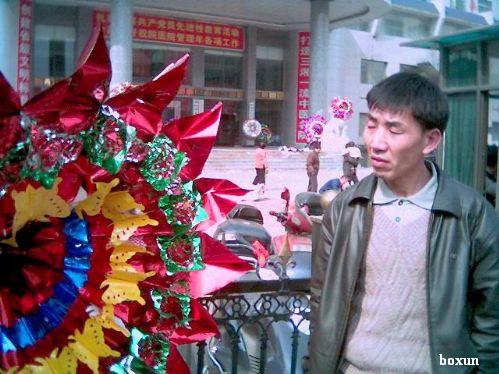
[029]
Sexual Harassment On The Internet (02/08/2007) (Apple
Daily) The female victim named Hsia plays a plucked string
instrument in a Chinese musical orchestra. In May last year, she was
promoted to become a section leader and she distributed a memo to members in
her section. A male player in another section saw that memo and wrote
to complain about her use of the English-language word "watch,"
which carries connotations of surveillance, attention and careful
observation and is therefore inappropriate in the context He cited the
Longman's and Oxford dictionaries and he asked her: "Will you be good
enough to just speak Chinese instead? As Premier Su said, there is no
point in arguiing. If you are wrong, you just admit it." At
first, Hsia had replied politely to say that she believed that she was
right, but Lin would not stop. This went on for after a week and then
the battle stopped.
On June 23, Hsia received more than a dozen strange phone calls, "from
unidentified men asking her out for one-night-stands. Some of them
even start moaning and groaning immediately." One of the them
said: "I just chatted with you at the kkcity adult chatroom. Do
you want to spend the night ..." Finally, she asked one of the
men to send her the transcript of a chat session. Then she confirmed
that someone had assumed her identity and posted at chat rooms. She
reported the police who tracked down the IP (Internet Protocol) address of
the sender and determined it to have come from Lin's residence. Lin
has admitted that he distributed the information but explained, "I did
not publish her full name" But since he published her personal
telephone number, his intent was obvious.
This is a simple enough case, so why is it plastered on the front page of
Apple Daily? Because of the sex angle plus the fact that the defendant
Lin is a Ph.D. in information engineering from Tamkang University and is
presently an assistant professor in the Department of Information Science at
Asia University. In other words, if the defendant Lin were a warehouse
watchman, then this item might have been buried deep in the local news
section.
(Apple
Daily) What exactly are the statutes for such crimes in
Taiwan?
- Example: At an Internet chatroom or over Internet IM, you ask "What
are your physical measurements?" "How old were you when you had
your first sexual encounter?" and so on.
Relevant criminal law: <Prevention of Sexual Harassment Law> carries a
penaty of NT$10,000 to NT$100,000, and the victim can demand civil
compensation
- Example: You send pornographic photographs via email or you post them at
websites
Relevant criminal law: <Law on Endangerment of Public Moral> carries a
jail sentence of up to 2 years and/or fines up to NT$30,000
- Example: You distribute information (such as telephone numbers, IM
address) that someone is working as a paid escort or looking for a
one-night-stand
Relevant criminal law: <Law on Damaging Reputation> carries a jai or
detention sentence of two years or fines up to NT$1,000.
[028] What Gets Reported And What Does Not (02/08/2007) Beijing News)
[in translation]
According to Southern Metropolis Daily, it has been suggested that various media reports have had bad effects on society. Provincial People's Congress representative and Provincial Party Publicity Committee deputy director Hu Guohua responded: the number of reports is not connected to the reporters themselves.
Hu Guohua said: Guangdong is in the golden age of economic development, and therefore various conflicts are manifesting themselves. The publicity department is extremely busy with dealing with the various kinds of problems that show up in the media reports. There have been more social conflicts, and therefore more news reports. Some of the reporters have created many problems because they did not grasp the direction and therefore made inappropriate decisions with respect to their understanding, presentation and positioning. Every day, we receive telephone calls from various departments in various places not to allow the reporting of this or that. Basically, we will consider their requests. But in the long run, it is not a good management approach to disallow the reporting of this or that. How can news management be done this way?
Some people have said that the increasing number of reported cases is related to the reporters. The increase is related to economic development. There are problems related objectively to the process of social development and that has nothing to do with the reporters. From the viewpoint of news management, what are the reporters supposed to be doing? According to party secretary Zhang Dejiang, he said to treat the media well, use the media well and to manage the media well. Managing the media does not mean not letting them report on everything.
Hu Guohua said that it is impossible without public opinion monitoring. Without public opinion monitoring, many social problems cannot be solved and vulnerable social groups have no speech rights. These groups need public opinion monitoring to gain social attention and then get their problems resolved The supervision of the People's Congress, public opinion, the masses and the internal monitoring systems inside the various government departments are important, of which public opinion monitoring is an essential part. During the monitoring process, the quality of the media workers can be improved.
Hu Guohua said: "Some of the masses have complaints about certain judicial departments. I think that is normal. I think that it is normal that some newspapers may run exposés. The leaders do not have to be held responsible for everything that their underlings do. One report does not smear us." He believes that the various departments should increase their ability to accept criticisms and pay attention to how they interact with the media. Information transmission is well-developed in modern society, so that it is impossible to lock up all information. This used to be possible, but not any more. The Internet did not exist before. But if you do not allow reporting nowadays, the information will appear immediately on the Internet.
[027] How To Blow Up My Web Server (02/08/2007) I want to write about what I want to, but the world seems to prefer something else. So how do I cater to the mass demand? I've figured out that if only I am willing to run a regular (e.g. twice-a-week) publication of letters to or from Chinese writer Eileen Chang, I can easily get enough traffic to blow up the web server. Here is a preview: The Eileen Chang Letters - Part 2. This is enough to make many people flip out at the information about censorship, openness, confidentiality, etc. However, I'm still uncertain that I actually want to do this. After all, I want to write about what I want to ...
[026]
Ersatz Viagra (02/07/2007) (Apple
Daily) While it is well-known that fake medicine is a huge
problem in mainland China, this story from the Huashangbao provides detailed
insight to the inside operations.
This illegal pharmaceutical factory is located inside a two-storey
residential building in Xian city. The principal product is male
potency enhancement pills. When sold, it is advertised as imported
from South Korea with ingredients such as Chinese caterpillar fungus
(cordyceps sinensis), ginseng, Songaria Cynomorium herb, deer antler, deer
penis, etc. In truth, the medicine is just a mixture of "Viagra
powder" and starch. The incredients costs about 2 to 3 RMB, but
it can be sold at 40 RMB.
For each production run, a retired medical researcher determined how to mix
the ingredients purely based his subjective experience. Usually, one
pill contains only 3 milligrams of "Viagra powder." To test
the potency of the product, a male employee is given a pill to take and the
response is tested. If necessary, the proportion is adjusted and more
testing is done. This must be considered a gross simplication of the
concepts of quality control/assurance. The photograph below shows the factory production
floor. Is this where you want your Viagra from!!!???
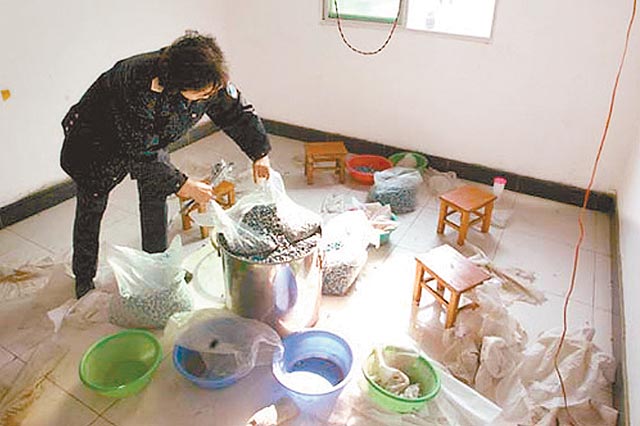
So why hasn't this factory be caught soon? The owner of the factory is
a doctor at a local hospital. However, he does his business away from
the factory or hospital. Instead, he has business offices at many
places. Usually, each business office is closed after a couple of
months in operation just in case news gets around. And then another
business office will pop up elsewhere.
[025]
Chinese Court Ordered Website Shutdown (02/07/2007) The
original story was covered in My
Dad Is Worse Than Ximen Qing -- A daughter Wang Jing complained to the
authorities that her father was keeping a mistress, but her complaints were
dismissed for lack of evidence. This is year 2006, so the daughter does
the obvious thing: she builds a website about her perfidious father.
(KDNet)
However, the female whom Wang Jing accused of being her father's mistress
filed a civil suit for public insult and libel. Wang Jing was found
guilty of insult and put under supervision for two years. She also has five
days to delete the "My Dad Is Worse Than Ximen Qing" website as
well as all pages that insulted the plaintiff in her other
"Anti-Mistresses Website."
The blogger "Midnight" blamed her parents. On her mother's
part, she injected hatred into her daughter's heart to the point where
extreme public actions were taken. On her father's part, he obviously
failed to communicate with his daughter, even though he may have been the
victim.
The blogger "Midnight" also blamed the media for having no
scruples. At first, they reported everything from Wang Jing's side
with report titles such as "Wife lives on sixth floor, mistress lives
on first floor." The frequent use of "daughter sues
father," "government official," "paying for a
mistress" generated public interest. This had the effect of
turning Wang Jing into being even more extreme. "From start to
end, the administrator of a certain website controlled Wang Jing. In
order to raise the hits, the administrator planned various 'sensationlisms'
for Wang Jing. When she met with her father, it was under the control
of this administrator. Even the conversations with her father had to
be instructed by this administrator. This seemingly well-intended
conspiracy is every more repulsive than the act of keeping a mistress."
The blogger "Midnight" also said that a much larger group of
people were also using Wang Jing. These are the netizens who hate
corruption. When Wang Jing claimed that her father was keeping a
mistress, they rose up in anger without looking into the facts They
only want Wang Jing to "fight against corruption." Wang Jing
became the opening through which they poured out their hatred of
corruption. This was another reason why Wang Jing became more and more
extreme.
While Wang Jing's original stated goal was to re-build the family. All
these other people made sure that the opposite happened.
P.S. In the CCTV report on Wang Jing, there was a shocking scene. Wang
Jing was making food and found there were ants on the window sill. She
immediately put down the cooking utensils and tossed out the food. She
reprimanded her mother sternly for failure to maintain cleanliness and she
refused to eat. "This food is inedible." More people
believed that Wang Jing's psychological health should be a matter of
concern, but her parents, the media and the public all had their own
agendas.
[024]
Hong Kong By The Numbers (02/07/2007) Hong Kong Lingnan
University's Public Governance Programme conducted a public opinion poll
about the election of the Hong Kong SAR Chief Executive. The poll was
conducted between February 2-4. The telephone sample was derived by
randomly sampling numbers from the telephone directory and then randomizing
the last two digits; within the household, one 18 year old permanent
resident of Hong Kong is randomly selected. The response rate was
57.9% and the total number of completed interviews was 861.
Survey Results:
Q1. Do you support current CE Donald Tsang serving another term?
- 23.5% one hundred percent support
- 44.5% support
- 8.5% fifty-fifty
- 8.0% do not support
- 2.2% one hundred percent do not support
- 3.5% undecided
- 9.9% don't know/no opinon
Q2. If only Donald Tsang and Alan Leong are the candidates, who would you
support?
- 70.3% Donald Tsang
- 12.4% Alan Leong
- 1.0% support both
- 2.4% support neither
- 6.3% undecided
- 7.4% don't know/no opinion
Q3. If only Donald Tsang and Alan Leong are the candidates, do you want to
see them debate policies publicly?
- 33.8% one hundred percent want
- 44.8% want
- 3.1% fifty-fifty
- 4.9% do not want
- 2.4% one hundred percent do not want
- 10.9% don't know/no opinion
Q4-Q9. Please evaluate which of Donald Tsang or Alan Leong is better along
the following attributes:
Tsang better Leong better Equally good Equally bad Don't know
/no opinionQ4. Governance 72.7% 3.6% 2.8% 1.3% 19.5% Q5. Leadership 71.2% 4.2% 3.3% 1.5% 19.7% Q6. Trustworthiness 42.4% 14.4% 8.9% 3.9% 30.2% Q7. Clear path of development for Hong Kong 58.2% 8.2% 3.7% 4.2% 25.6% Q8. Better relationship with central government 88.4% 0.9% 0.6% 0.2% 9.6% Q9. Closer to mainstream Hong Kong opinion 45.2% 26.5% 4.2% 2.3% 22.0% Q10. Which of the following items should the next Chief Executive give priority to? (Read list of seven items in randomized order)
- 28.8% transformation of economy
- 26.6% inequality of wealth
- 12.5% education
- 9.3% environmental protection
- 6.4% food safety
- 5.7% development of democracy
- 2.3% housing
- 2.6% other
- 5.7% don't know/no opinion
Q11. Who do you think will win the election?
- 89.8% Donald Tsang
- 0.8% Alan Leong
- 9.1% don't know/no opinion
[023]
Baidu versus Google: The ESWN Version (02/07/2007) For
deep background, please read Has
Google Failed in China? (Shaun Rein, SeekingAlpha)
first. Here is the statement from the individual search engine user
known as the EastSouthWestNorth blogger. This is based purely upon the
idiosyncratic requirements of one person. But the fact is that when
looking for the latest developments in the matters of The
Death of a Shanxi Journalist (i.e. Lan Chengzhang) or The
Mass Incident in Dazhu County, I must say that Google is completely
irrelevant -- they do not search the newspaper websites well and they are
missing in action with respect to the BBS's, forums and blogs. I am
strictly utilitarian (that is, I believe that that the value
of a thing or an action is determined by its utility)
-- if I need to get to the latest development in the case of Lan Chengzhang,
I couldn't get less about slogans (such as "Do no evil"). My
bottomline is: "Can you deliver?" At the moment, I don't
even look at Google for developing news stories inside China. More
press interviews with the Google founders will not change my position; only
search results can.
The converse statement is this: If Google can deliver the results (that is,
to meet the requirements of users such as myself), then Chinese users will
be beating down on their doors irrespective of the Great Internet
Firewall. They will use proxy servers and whatever else to get
there. But if all the only thing is a slogan and no substance, then
I have no sympathy.
[022]
Hong Kong By The Numbers (02/07/2007) In Leung Man-tao's
scenarios in Alan
Leong's Choice, here are two outcomes from Alan Leong's campaign to run
in the small circle election for Hong Kong SAR Chief Executive.
Scenario #1: Alan Leong wins in the public opinion poll, but loses in
the voting by the 800-member Election Committee. This will prove that
the small circle election was 'absurd.'
Scenario #2: Alan Leong loses the public opinion poll as well as the
voting by the 800-member Election Committee. This will prove that the
small circle election actually produces a reasonable result.
Presently, Alan Leong has more than 100 and possibly as many as 130
nominating votes (which does not mean that these electors will vote for
Leong in the election phase of the process). 100 out of 800 is 12.5%.
(Sing Tao,
Ming Pao)
According to a random sample telephone survey of 861 respondents
conducted by Lingnan University,
(1) 68% support current CE Donald Tsang to continue serving, while 10% do
not.
(2) if the election was reduced to between Donald Tsang and Alan Leong, 70%
supported Donald Tsang and 12% supported Alan Leong.
(Apple
Daily) According to a survey of 501 adults on January 30-31,
the responses to the question: "If you have the right to vote, who
would you choose as the next Hong Kong SAR Chief Executive?"
- 53% (Donald Tsang)
- 32% (Alan Leong)
- 15% (don't know/no opinion)
[021]
The Threatening Letter (02/07/2007) (Ming
Pao) This is a rare opportunity to see a threatening letter in
its totality. The following was sent to the Ming Pao newspaper in
Hong Kong:
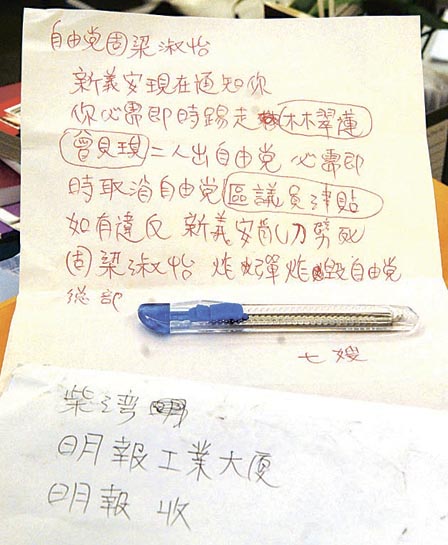
(in translation)
Selena Chow (of the Liberal Party)
The "Sun Yee On" triad gang informs you right now that you must immediately expel Lam Chui-lian and Tsang Pui-kei from the Lberal Party. You must immediately rescind the Liberal Party's subsidies to district councilors. If you disobey, Sun Yee On will chop Selena Chow to death with knives and bomb the headquarters of the Liberal Party. Signed "Sister-In-Law Number Seven." [a utility knife was attached with the letter]
Note: Lam Chui-lian is an elected district councilor and Tsang Pui-kei is the instructor at social dance classes sponsored by district councilors.
[020]
CKS Statues (02/07/2007) For more details about the
removal/replacement of Chiang Kai-shek statues from military bases, see Taipei
Times.

(Apple
Daily) There are presently 213 statues of Chiang Kai-shek and
15 statues of Chiang Ching-kuo. According to someone in the Democratic
Progressive Party, if Premier Su Cheng-tseng can accomplish the tasks of
removing these statues plus changing the name of the Chiang Kai-shek
memorial hall, his public opinion polls should soar by 20% and put him ahead
of ex-Premier Frank Hsieh.
(Apple
Daily) According to a survey fo 403 adults conducted by
computer-generated voice on February 5,
- 53.6% do not agree with the removal of the statues (because it is ruling
by ideology and manipulation for election ballots)
- 31.8% agree with the removal (because this is the right time and it has
nothing to do with politics)
- 14.6% don't know or have no opinion.
(TVBS)
Caught in the squeeze is Minister of Defense Lee Jye.
(TVBS)
Here is the conversation between Lee Jye and reporters at an international
academic conference.
Lee: "Why not remove them?"
Reporter: "Why remove them?"
Lee: "You tell me why not remove them? This is a democratized
country. I am in an awkward positin, right or not? The ruling
party has some idea that they want me to carry out. The opposition
party also has its own opinion and it does not want me to carry this
out. So what do you say that I should do? Removing the bronze
statues does not mean discarding them. It is to move them to where
they belong. As you say, you are the opposition right now. If
you become the ruling party next time, you can tell me to bring the statues
back again. It is such a simple issue. Why are you arguing about
this all day?"
Reporter: "The blues are not happy, but the greens are not happy
either?"
Lee: "Yes."
Reporter: "Could it that you feel pressed and aggrieved?"
Lee: "Then I ask you to help me. Please do not keep picking up
rocks and throwing them at me."
[019]
The Black Hand Behind The Curtain (02/06/2007) In The
Black Hand Behind The Attack on Albert Ho, a number of theories
published in newspapers were rounded up about the assault on Hong Kong
legislator/Democratic Party member Albert Ho. It turns out that none
of these theories were closed to what was disclosed in court yesterday
(note: which is not necessarily the "truth").
(The
Standard)
Cheung Wing-ho, 29; Leung Kwan-ping, 44; Chan Chun-kit, 27; and Leung Fu-keung, 57, pleaded guilty at the District Court Monday to a joint charge of conspiring to wound Ho with intent ... Defense lawyer Henry Lok Hing-sun ... said Leung Kwan-ping, a mainland migrant and former construction worker, had organized the attack on the politicians and was the "pay master." Leung in his statement to the police said he wanted to seek revenge against Ho after the politician failed to help him apply for public housing and social welfare. He said that when he went to Ho's office in Tuen Mun last March to seek help in applying for public housing, welfare assistance and employment, he was asked to wait. Ten days later when he called up Ho's office, he was given the same reply and had not heard from Ho since. Leung said he became upset and decided to hire the other three defendants to help him assault Ho. Lok described Cheung and Chan as "mere mercenaries," who were paid HK$8,000 and HK$17,000 for their roles in the assault.
Ho Monday dismissed Leung's claims as "incredible" and a "joke." He said: "If Leung can pay others to assault a legislative councillor out of resentment, no one knows how many legislators or bureau secretaries would be threatened with their lives in danger." Ho also questioned Leung's ability to bankroll the attack, pointing out that when Leung approached him for assistance, he claimed to have trouble even feeding himself. "How's it possible that Leung has the money to hire people to ambush a legislator? I'm sure there are lots of inside information - the syndicate behind this may have been the mastermind."(SCMP)
Responding to Judge Kevin Browne's question of why Leung Kwan-ping had the money for his co-attackers despite his financial plight, solicitor for the defendants, Henry Lok Hing-sun, said the money came from jobs Leung undertook as a construction contractor after the attack.
(Ta Kung Pao) [The following is a more detailed description about how it happened.]
On August 20, the mastermind Leung Kwan-ping learned from a newspaper that Albert Ho was going to participate in the anti-GST demonstration march. So he arranged the three other defendants to meet in Kowloon Bay and then they proceeded in two groups to Wanchai. At Wanchai, they got on a cargo truck. Apart from the four defendants, there was a man named Michael who was the driver. They inspected the march route first and then planned the attack process. Then they returned to Wanchai.
The march began at Southorn Playground through Admiralty to Government Headquarters. The march began with Albert Ho in front. Leung Kwan-ping and Cheung Wing-ho marched behind Albert Ho and kept in contact with their fellows by mobile telephone. When the procession reached Government Headquarters, they still had no opportunity.
After the march was over, Albert Ho went alone to a basement fastfood restaurant to meet another Democratic Party member. Leung Kwan-ping thought that this was the ideal opportunity and quickly called the other two defendants to come. When they arrived, Cheung Wing-ho, Leung Kwan-ping and Chan Chun-kit charged into the restaurant with police batons in hand, while Leung Fu-keung left on his own. Leung Kwan-ping hit Albert Ho on his head, while the others also in the assault. After about a minute of beating, Leung Kwan-ping said, "Go" and they left the scene.
Leung Kwan-ping and Cheung Wing-ho escaped to Kowloon Bay while Chen Chun-kit took a taxi to Sai Kung by himself. The four met that evening at a Jordan restaurant. Leung Kwan-ping said that he left his police baton at the scene. The next day, they went to Shenzhen. In October, they were arrested.
(Apple Daily) [The Tao Kung Pao narrative is linear and smooth, but it was synthesized from the defendants' statements. In practice, the defendants contradicted themselves in a way that was quite unbelievable. Apple Daily points out the contradictions.]
According to Leung Kwan-ping, one or two days before the incident, he was borrowing money from Chan Chun-kit. While inebriated, he complaint that Albert Ho refused to help him and he wanted to beat Albert Ho. He also contacted Leung Fu-keung to help. Through Chan Chun-kit, Cheung Wing-ho was also recruited.
According to Chan Chun-kit and Leung Fu-keung, eight days before the incident, Leung Kwan-ping had instructed them to keep watch outside Albert Ho's Tuen Mun office. Leung Kwan-ping pointed to a Albert Ho poster and said that this was the target of assault. Hereafter, the defendants and two more fugitives named PC Chung and Michael were kept watch each night between 6pm to 11pm in Tuen Mun, but they never saw Albert Ho there.
So did this thing start one or two days before or eight days before the incident? Someone is not telling the truth.
P.S. As for the mystery about which evidence helped most to solve the case (see Comment and Comment), (The Standard): Outside the court, the officer in charge of the case, Tony Ho Chun-Tung, said 200 recordings on close-circuit television taken from buildings in Central and Wan Chai had been the major source of evidence in their investigations.
P.P.S. Here were the police sketches at the time:
Here is the Apple Daily court reporter's sketch:
Can you match them up?
[018]
The Event Of The Day (02/05/2007) Today, Taiwan
intellectual Lung Ying-tai published the essay Lung Ying-Tai Confesses Her Crime
that appeared simultaneously in China Times (Taiwan), Ming Pao (Hong Kong),
Sing Chew Daily (Malaysia) and Southern Metropolis Daily (Guangzhou,
China). As noted in Southern
Metropolis Daily runs first post-Freezing Point mainland essay by Taiwanese
intellectual Lung Ying-tai (David Bandurski, China Media Project),
that last appearance is eye-catching. Early last year, the Freezing
Point supplement of China Youth Daily was shut down for re-organization on
account of a history essay. However, former Freezing Point editor Li
Datong (who was ousted during that re-organization) believed that the real
cause was the essays of Lung Ying-tai, including A
Chairman Bowed Formally Three Times and The Taiwan That You May Not Know About.
However, it would have wrecked havoc to cross-strait relationships if Lung
Ying-tai was identified as the cause, and therefore the history essay was
selected as the pretext instead. Today's event is the first
re-appearance of Lung Ying-tai in a mainstream newspaper on mainland China.
This essay is going to have some reverberations in mainland China, with
respect to how many mainland Chinese government officials can speak of as "having an
obsession with moral cleanliness." If there is a crackdown on
Southern Metropolis Daily, then will Lung Ying-tai be named or some other
pretext be found?
[017]
Yet Another 'Banned' Book (02/05/2007) (Ming
Pao) What Zhang Yihe seemed to have done is to bring about a
paradigm shift. When her first two books got 'banned,' she did not
make a public issue. When her third book was 'banned' with her being
publicly named by a GAPP deputy minister, she went public and she is
planning a lawsuit. As such, she is setting an example for others.
Former senior Xinhua reporter Yang Jisheng has now gone public about the
history of his book <The Analysis of Various Strata in Chinese
Society>. The book was originally supposed to appear in 1999 by
"China Today" but the publisher got into trouble for something
else and his book got "spiked" as well. In 2002, the
Sixteenth Congress of the Chinese Communist Party Central Committee brought
up the subject of social strata and "Beijing Joint Publishing
Company" was going to publish that book. But the central
government issued an ban on this type of research. At end of 2005,
Guangzhou's "Huasheng Publishers" took over and printed 8,000
copies in anticipation for a book fair. However, Yang had previously
published <Political Struggles During The Reform Era In China> (which
included an interview with former Chinese Communist secretary-general Zhao
Ziyang) and he was blacklisted. Just before the bookfair, the Central
Publicity Department director and a General Administration of Press and
Publications senior official banned the book from the book fair. The
book was then taken over by the "Kansu People's Publishers."
Last December, 18,000 copies were printed when "a directive from
above" ordered all copies withheld and not to be sold.
Fortunately, most of the books had already been shipped. So only the
print templates were confiscated so that no more copies can be
printed. The publisher was forced to cease operations for three months
and had 20% of its book number quota for the year taken away (note: a book
has to have a book number in order to be published and each publisher
receives a finite quota of book numbers each year).
Possibly observing what Zhang Yihe is doing, Yang Jisheng is also going
public. Yang has written a letter to his former colleague Liu Wenshan,
who is presently the Central Publicity Department director and a member of
the Politburo. In the letter, Yang said that he does not believe (1)
the Central Publicity Department has a "publishing blacklist"; (2)
the Communist Party would ban all writings from certain persons; or (3)
deprive certain persons of their right to speak on account of having
published controversial books previously. Liu Wenshan will most likely
not respond, but Yang Jisheng is playing to the public, inside and outside
of China. Liu Wenshan's non-response simply pours oil on the fire.
Once upon a time, a fairy tale began when a pretty young Chinese girl named Ai Qingqing attempted to trade a paper trip for a villa (see Trading Places). At the time, there were suspicions that this was just another commercial promotional project. This project began on October 15, 2006 and had a planned lifetime of 100 days.
Eventually, the trades as recorded on Ai Qingqing's blog were:
(01) a paper clip
(02) a photograph of a pedestrian
(03) a jade buddha pendant
(04) a mobile telephone
(05) a pearl necklace
(06) a digital camera
(07) a set of stamps
(08) two bottles of wine
(09) a pipa musical instrument
(10) a pipa music CD
(11) a cosmetic mirror used by actress Irene Wan
(12) an original American poster
(13) a Korean buddhist script
(14) the publication rights for a photo album for Ai Qingqing's quest to trade a paper clip for a villa
(15) a jake bracelet worth 128,000 RMB
(16) a recording contract.
At this time, though, the blackhand behind the curtain has appeared in the form of the promoter Li Er. He claimed, "If the trading act were a direct broadcast, then I am the producer and executive director." Li Er claimed to have approached the Super Girl production company initially for one of the lower finishers to participate in this project, but they did not take him seriously. But he met Super Girl contestant Wang Xiaoguang by chance and transformed her into Ai Qingqing. The cousin who took the photographs was just a friend. Li Er claims to have personally provided many of the trading items (e.g. the mobile phone). As evidence, Li Er provided information such as the email account, QQ account and other things of the person known as "Ai Qingqing." He claimed to have written most of the blog posts because Wang Xiaoguang did not like to get on the Internet herself. He is coming forth at this time, because Ai Qingqing has reneged on her contract with him.
Photograph of Ai Qingqing (Wang Xiaoguang) with Li Er
(as provided by Li Er)
Some netizens were dismayed: "There are too many nice netizens in China, and this hurts." "I feel like an idiot for being used. This is shameful!" "These people ought to go to jail for deceiving the people!"
Meanwhile Ai Qingqing stated on her blog: "I'm presently recording the Spring Festival Gala program for Shandong television. My cousin did not come with me, and I am asking someone else to take pictures."
[015] Those 'Banned' Books (02/05/2007) The productivity at the Recommendations and Brief Comments sections here have fallen over recently because I was concentrating on the review of those 'banned' books in China. To do that, I have to read those books first and then select excerpts for translation. Here are the blog posts so far on six of the eight books:
I Object About former Hubei province People's Congress representative Yao Lifa.
The Press A novel about newspaper workers in a hypothetical Chinese city.
Ruyan@SARS.com A novel about a female Internet forum master during the SARS crisis.
Eras of History Historical snapshots of political/cultural/social lives in Our 1970's and Our 1980's.
Past Stories of Peking Opera Stars The lives and times of Peking opera stars in the post-liberation era from Zhang Yihe.
The Other Stories of History Qian Gang reviews former People's Daily deputy chief editor Yuan Ying's book.
I did not read these books and translate excerpts just for fun. I was trying to derive a logic for the censorship. After all this work, I profess that I don't get it. I can name any number of other books that should have been 'banned' as well because they were 'far more out there.' In that sense, I don't understand any logic that would allow me to answer: "Why these eight instead of any of the hundreds of others?"
My other reaction about the censors is provided by Qian Gang:Each of their bad deeds is enough to turn their superiors' most recent "enlightened" statement into an instant lie; they are the most effective saboteurs of international trust in the Chinese Communist Party.
After all, I know that I would not be reading these books without the General Administration of Press and Publications bringing them to my attention. Qian Gang quoted the phrase 顾全大局 ("in consideration of the overall situation") -- this GAPP move could not be worse for the general situation! If the GAPP people had attentive superiors, they would have come down on them like a ton of bricks.
[014] Chinese Book Ban Could Be A Good Thing (02/04/2007) (Ming Pao editorial)
Famous mainland writer Zhang Yihe decided to use the law to defend her freedom to speak and publish on account of her book being banned by the General Administration of Press and Publications. She stated that she will use "her life to defend her words." Although the affair is still development and the outcome still uncertain, the overseas media have reported on this book ban affair at great length and other mainland writers have offered public support. As a result, the GAPP has lost face. If the Chinese Communist leadership headed by Hu and Wen can examine the domestic and overseas reactions in a positive light and reflect on all the improper actions that the Chinese Communists have taken against the freedom to speak and publish since they seized power, this affair may turn a bad thing into a good thing and make China more open and enlightened.
The GAPP's ban on Zhang Yihe's "Past Stories of Peking Opera Stars" and several other books aroused attention inside and outside of China, and it severely damaged the international image of China. But the outside world can see that today's China is not longer in the eras of the Anti-Rightist Campaign and the Cultural Revolution. The current developments of the book ban showed the changes in China in which the Chinese Communists have moved towards a relaxation of control. It this were the Anti-Rightist Campaign, the Cultural Revolution or even the ten years after June 4, the outside world would never have heard about Zhang Yihe's angry call about using "her life to defend her words, never mind about her getting volunteer lawyers to sue GAPP deputy director Wu Shulin in court. Other well-known persons such as former Xinhua publisher Li Pu and famous Shanghai dramatist Sha Yexin offered righteous support to Zhang Yihe and asked the GAPP to "do more harmonious good things and fewer murderous bad things."
Faced with the strong attention from inside and outside China, the GAPP officials had to come out and clarify that "there is no issue of bans. We did not ban a single book this time."" No matter whether the denial is consistent with the truth, we have at least seen that the Beijing government agrees that any action to suppress freedom to speak and publish are universally unacceptable.
In conjunction with the Beijing Olympics next year, the government has given more freedom to non-mainland media. Overseas reaction has been good because it is more convenient for the non-mainland media to gather news, but also because this will advance the reform of press freedom in China. Outsiders do not know who or why the book ban was taken by the GAPP. But this was obviously inconsistent with the desire to build a harmonious society that the Chinese Communists led by Hu wanted to build, and it is also inconsistent with the image of a good strong nation that the Chinese Communist leaders want to project. We applaud the GAPP for denying that there was any ban and we hope that this is the truth; but if this is not the truth, then they have doubled their sins.
[in translation]
The ordinarily low-keyed, mysterious and private Next Media Group chairman Jimmy Lai held a rare public meeting yesterday afternoon. The incisive Jimmy Lai said that he came to start a newspaper in Taiwan because the place was very democratic. Then he switched gears and criticized the Democratic Progressive Party, even using the word "rotten 爛" to describe it.
In his first public speech, Next Media Group chairman criticized the government. He said: "I'm very optimistic about Taiwan, even though their government is quite rotten. But I think that even with this rotten government, your democratic system is running very well."
Six years ago, he came to Taiwan to start a newspapers at a time when the government changed hands and democracy was rising. Jimmy Lai did not imagine that the newspaper industry would be re-organized because of him. Jimmy Lai said: "When we came in, we saw the market situation and we found out that it was quite easy. At the time, we were astonished. Could it be so easy?" The reporter: "Do you mean that your opponents were very weak?" Jimmy Lai: "They have improved now."
Concerning about how his media people often photograph celebrities and irritate people, Jimmy Lai's response when he receives worried telephone calls is: "I said, 'Hey, you're the one who went out with the girl, not me. You don't have to do it. After you did it, you expect others to protect you. It is unfair.'"
Since he refuses to succumb to friendly pressure, Jimmy Lai says that he does not have good human relationships. He says that he has very few friends. But his famous saying is, "If you have fewer friends, you get to read more." The thoughts of a media madman is definitely out of the ordinary.
[012]
The Sing Pao Case (02/03/2007) (Apple
Daily) Sing Pao Daily News was charged with 11 counts of failure to
pay wages to employees in Hong Kong. Magistrate Joseph
To Ho-shing imposed fines of
totalling HK$4,200. That decision led to popular outrage (because it
encourages deadbeat employers) to the point that the magistrate initiated
the possibly unprecedented step of requesting a review of his own decision.
Well, the magistrate has completed his review and he has upheld his
decision. Thus we see another round of grumbling about how the fine
for spitting or littering is greater than for not paying your
employees. The photograph shows Sing Pao Daily News' lawyer flashing
the victory sign.
[011] The CCTV Spring Festival Gala (02/03/2007) (Southern Metroplis Daily, opinion essay by Ma Qing)
According to reports, this year's director of the CCTV Spring Festival Gala Jin Yue announced solemnly a few days ago that the media will be legally prosecuted if they divulge the contents of the television show beforehand. At first, I was shocked; then I was amused. It would seem that someone issued emergency warnings and imposed martial law for a "harmonious and celebratory" gala program. They must think that they are the Pentagon.
Another piece of news say that the Guangdong province People's Congress has decided the government's budget proposal will no longer be stamped "secret." The representatives can bring the reports back home and publicly discuss the amounts of money being spend on the various government departments. While the government is getting more transparent, the Spring Festival Gala looks to be even more bureaucratic than bureacrats.
Although CCTV has many channels and they show many programs, the Spring Gala Festival is still its flagship program. It has become a traditional and unmovable object. But the world is flat today, and people can download American television shows for viewing; this is the era of web 2.0 in which everybody is his/her own small television station. So what is getting increasingly unpopular? Things that think that they are the most authoritative and important.
Fortunately, we are in Guangzhou and we don't care about the Spring Festival Gala. Most Guangzhou residents have the custom of parading in the flower market on Lunar New Year's eve. Besides, they can watch Cantonese-language programs. They can watch programs from Hong Kong, and the local programs are getting better nowadays. They don't have to watch the CCTV Spring Festival Gala.
I know that there are many people in China who still watch the CCTV Spring Festival Gala. I know that the entertainment reporters will really go to dig up news. But here is a more convincing -- in Guangzhou, we had other choices since more than twenty years ago and therefor people are no longer impressed by the Spring Festival Gala. When people get more and more choices elsewhere in China, then can the CCTV Spring Festival Gala maintain its position (even if we factor in viewing habits and nostalgia) for long?
[010]
The International Distribution of ESWN Readers
(02/02/2006) I use the WebTrends software to analyze my log
files. There is a function that allows for individual IP resolution of
the country of origin of each page view. However, the software is very
slow because each IP address is resolved by a query to the WhoIs? service.
For the week of January 22-28, it took four hours to process the page views
for country of origin. About 40% of the IP addresses were said to be
of unknown origin.
Here are the top 20 countries (and their percentages):
1. USA (70.7%)
2. Hong Kong (6.6%)
3. Singapore (3.6%)
4. Canada (2.6%)
5. UK (2.3%)
6. Japan (1.9%)
7. Australia (1.9%)
8. Germany (1.8%)
9. China (1.7%)
10. Taiwan (1.6%)
11. Turkey (1.5%)
12. Netherlands (0.9%)
13. France (0.5%)
14. New Zealand (0.4%)
15. Malaysia (0.4%)
16. Italy (0.4%)
17. Belgium (0.3%)
18. Mexico (0.3%)
19. India (0.3%)
20. Poland (0.3%)
I suspect that the story here is that the WhoIs? service just does not have
much information the IP ranges in China.
[009]
January 2007 Website
Statistics (02/02/2006) For the month of
January 2007, the total
website statistics were:
- 3,339,687 hits (including htm, jpg, gif, wmv, xml, etc)
- 464,582 page views (htm files only)
- 416,209 unique sessions
- total time spent = 75,844 hours
- total bandwidth: 74,087,997 Gbytes
On an average daily basis:
- 107,732 hits
- 14,987 page views
- 13,426 unique sessions
- 11:19 time spent per unique session
- 2,389,935 Gbytes in bandwidth
Please bear in the mind that this was the month of the earthquake south of
Taiwan and trans-pacific Internet access was slowed down. The
following charts show the historical trend of bandwidth consumption.
This first chart shows the bandwidth consumption from May 1, 2003 to January
31, 2007. Not much to see here, because the vertical scale is
dominated by a single day avalanche of 100 Gbytes in April 2005. That
was when EastSouthWestNorth v.1.0 had to be buried alive.
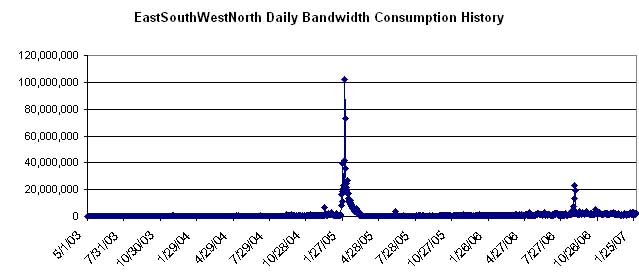
In the next chart, I have chosen a logarithmic scale for the vertical axis.
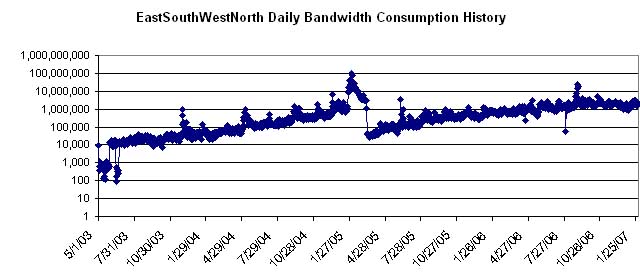
But of course the interest is just what happened over the past couple of
months. Here is the chart for the period December 1, 2006 to January
31, 2007. The earthquake occurred on December 26, 2007. But the
trend was already down before then. In any case, it looks like
recovery (if I can call it that) occurred around mid-January.
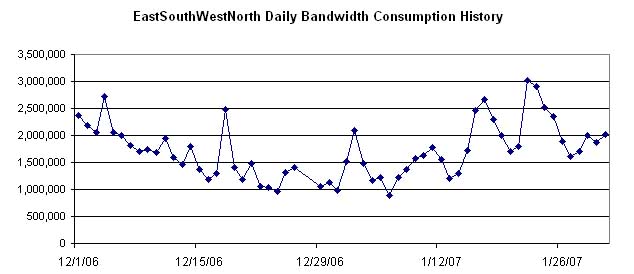
By the way, this website is not a good indicator for the earthquake effect,
because the audience is dispersed around the world. So maybe people in
China have a hard time reaching the website, but US-based readers would not
have any problems.
[008] Zhang Yihe on the Definition of Ban (02/02/2007) As noted in GAPP: books criticized, but not banned (Joel Martinsen, Danwei), the General Administration of Press and Publications has denied that eight books have been banned. This drew another statement from the 'banned' author Zhang Yihe. This is translated at the bottom of Zhang Yihe's Statement and Position. Here is the extract about the definition of a 'ban' based upon Zhang's personal experience.
Finally, let us talk about the "ban." Based upon my personal experience, the "bans" in existence are either "quick bans" or "slow bans." As soon as my second book ("A Gust of Wind: Leaving us Melodies of the Centuries") completed its print run, it was immediately placed into storage. That would be a "quick ban." My first book ("The Past Is Not Like Smoke") was placed under a "slow ban," which means that "it was not to be re-printed after the current batch sells out." Actually, the "slow ban" occurred at the same time as a "quick ban" because I have here a receipt from a Zhejiang city for a number of copies of "The Past Is Not Like Smoke." As for the third book ("Past Stories of Peking Opera Stars"), the supervisory department made an announcement that said (more or less): "The Internet talk about the eight banned books is seriously erroneous." But a Mister Dai called from Zhangjiagang city at 18:30 on January 28 to tell me: "A private bookstore just received a notice to turn in a number of books, including 'Past Stories of Peking Opera Stars.'" Does it look like my book is being banned and I am being prohibited from publishing? Your supervisor issued a statement to deny the existence of any ban, but you go ahead with the ban. Aren't you slapping your supervisor in the face?
[007] The Next Weekly Tapes (02/02/2007) (Apple Daily (TW))
[in translation]
Lee Teng-hui was interviewed on television on the day before yesterday (and he said the same thing later at a Taiwan Solidarity Union press conference) and he criticized Next Weekly for distorting the contents of his interview with the magazine. Since this interview has created ripples of emotions across Taiwan, Next Weekly is obliged to publish the tape so that the people can decided whether Lee is backing off what he did say or the magazine is misleading its readers.
The clarifications made by Lee are very important for Next Weekly's quality and credibility. Over the past two days, the broadcast hosts and newspapers have been discussing the change-of-mind by Lee Teng-hui. If all this came about because of a weekly magazine's sensationalized sales gimmick, then everybody has been conned -- they need to apologize to society and Lee.
Conversely, if Lee indeed said it during the interview but reneged after he saw the huge outcry, then Lee should apologize about his dishonesty to society and the weekly magazine. The tape recording of the interview is the only thing that can determine the truth. So we ask Next Weekly to publish it for society to judge.
First, Lee pointed out "the headings were totally inconsistent with the fact." He said, "I did not say anything about wanting to see China." He said: "There is something wrong with this report."
Secondly, the weekly magazine reported that Lee wanted to give up Taiwan independence. Lee said: "Taiwan is already an independent nation. There is no need to pursue independence. This has always been my position." But he emphasized that Taiwan has to pursue normalization, a proper name and a constitution. Therefore, the weekly magazine was not wrong about the part on not wanting to pursue independence, but the magazine did not emphasize the normalization part. Therefore, the heading was partial.
Thirdly, Lee emphasized that he did not want to go to China. After repeated questioning by the weekly magazine reporter, Lee replied: "They might want me to do, but the present circumstances do not permit this." The reporter pressed again, so Lee told a joke: "Will I be arrested if I go there?" If true, then the weekly magazine was misleading its readers . Lee said that concerning the route that Confucius used to visit the states, it was in response to the reporter asking where Lee would go if he were to travel. Lee named the "North Road to the Deep North" in Japan (the subject of a novel), Egypt and Confucius route to visit the states. At this time, this was not about any Chinese trip, but about overseas travel.
Fourthly, Lee advocated trade with China. The weekly magazine said about the same thing as what Lee said in his clarification. Lee pointed out that his views were consistent and the Taiwan Solidarity Union has not changed directions either. But if his clarification is the correct version, but did he really not change? Just the idea of trade exchange with the introduction of Chinese capital into Taiwan is earth-shattering already.
Who is right and who is wrong? Next Weekly has the obligation to play the tape to correct the record.
[006]
GAPP 'Ban' Not Real 'Ban' (02/01/2007) From GAPP:
books criticized, but not banned
(Joel Martinsen, Danwei): "The representative said that there was no
so-called "eight banned books" situation. However, five books were
indeed subject to criticism at the meeting, including The Family History
of an Ordinary Chinese because readers complained that it whitewashed
the Japanese invasion force. Hunan Literature and Arts Press was also
criticized at the meeting for publishing Past Stories of Actors.
The representative repeated GAPP deputy-director Wu Shulin's words to the
meeting: "How and what an author writes is part of a writer's creative
freedom. We don't scrap people because of books, or scrap books because of
people; however, publishers should respect the country's legal stipulations
regarding publishing."
As noted by many, the eight books are currently available in Chinese bookstores and
Internet booksellers. While this GAPP announcement has put a dent on my motivation to
translate excerpts from all eight books (so far, I have only done I
Object and The
Press), I should make a note about a certain phenomenon: Public opinion
on this matter was completely one-sided -- there is nobody arguing for the
correctness of the 'ban' or even 'criticism' (note: even that one isolated
case turned out to be a waffler (Comment
200701#079 and Comment 200701#099).
But considering that it took GAPP so many days before it issued the
clarification, the public opinion pressure must have been gnawling at them.
If the whole thing had vanished in two days, they would not have
responded. The fact was that the pressure was kept on until they
realized that they had to make a public statement which was a beatback.
[in translation]
... Several months ago at a dinner with a celebrity (of course, the celebrity was the guest and not yours truly), the conversation led to a discussion about Apple Daily. In Hong Kong, Apple Daily is extremely tilted towards the democrats, whereas Apple Daily gives no quarters to either the blue or green camps in Taiwan. These positions were not necessarily chosen in the name of social justice, but because they represented unoccupied market spaces. There is no democratic universal suffrage in Hong Kong and there was no newspaper that dared to cross the authorities (including the family that brought us the oil fish); in Taiwan, the political parties have their own mouthpieces but there was no neutral newspaper. Jimmy Lai is a smart businessman and he will take all the money that other media bosses dare not earn. Supposedly, if Hong Kong should ever get universal suffrage and the democrats actually attain power through the elections, Apple Daily (Hong Kong) will adopt the Taiwan strategy and be critical of both sides. The point is to satisfy the majority of the readers. Apple Daily's winning formula is to become close to the people. But are the people always right? For example, there are certain cover stories that people all criticise even though they are fervently reading those stories in the meantime. But there does not seem to be any dissent about the market-led philosophy of Next Media.
I don't have any dissent either. I really don't dare to stand on the opposite side of the masses. I don't dare to supervise/monitor the media.
Do you dare? Never mind the mass media such as TVB or Apple Daily. How about certain emergent Internet media groups such as HK Golden Forum, InMediaHK or even the newly emergent Mysinaglog? Do you dare to discuss their collective partiality and biases? It is not impossible, but you have to willing. It can quite often increase your fame (although it is hard to say whether it will be positive or negative). But the problem is that the process can be quite tiring. The amount of courage and effort required to stand out an independent is unexpectedly large.
I sometimes feel that I am especially cowardly. I would like to have some companions on the way.
[004]
A Different Rental Market in Hong Kong (02/01/2007) (Next
Weekly) In Hong Kong, elementary school applications are based
upon residential address. This meant that apartments in certain
districts (such as Kowloon City, Wanchai and Central-West) command premium
prices because of the elite schools there. But it does not mean that
one actually has to buy or rent an apartment. There is a new industry
of special rental contracts.
The big real estate agencies do not engage in such activities, but there are
enough mom-and-pop shops that will cater to this market segment.
According to one such agent: "You only have to sign a six-month
lease. You are only required to establish that you live there for a
few months. The monthly rent is ony HK$4,500. But if you really
want to rent an apartment, you'll have to pay HK$7,500." The
landlord and the tenant will each pay the agent half a month's rent.
So what does it mean to "not really rent an apartment"? Here
is how it works -- you sign an agreement which states clearly that you
cannot move into the apartment; however, the landlord will put the
electricity bill, water bill and other proof of residency under your name
along with a mailbox key so that you can pick up any correspondence from the
school. The school does not require the applicant to swear that the
information is true, so that the perjury laws do not apply. Even if
discovered by the school, the landlord and parents will not be prosecuted.
In Kowloon City, there are more than 1,100 elementary school applications
each year. According to the Education Planning and Manpower Bureau,
four cases of false addresses had been detected over the past five
years. According to a Kowloon City district council investigation,
half of the residents had allowed their relatives to use their addresses at
some point for the purpose of elementary school applications. The
number of special rental contracts is unknown.
[003] The Mysterious Ways of Western Media (02/01/2007) A number of bloggers have been covering the case of Lan Chengzhang:
- The Death of a Shanxi Journalist Chronology of primary reports (translated at ESWN)
- Journalist murdered in Shanxi Province: Local leaders insist he was a "fake" reporter David Bandurski, China Media Project
- Debate begins in the Lan Chengzhang Case: what does it mean to be a "real" journalist in China? David Bandurski, China Media Project
- CCTV on Lan Chengzhang CCTV (translated at ESWN)
- The China Economic Times Report on the Lan Chengzhang Case Wang Keqin, China Economic Times (translated at ESWN)
- Top officials order "swift" investigation into the murder of reporter Lan Chengzhang David Bandurski, China Media Project
- Real Scoop On Fraud Journos: Q&A W/ Wang Keqin Jonathan Ansfield, China Digital Times
- Dirty Newsrooms: Wang Keqin's Missing Ending Jonathan Ansfield/Mo Ming, China Digital Times
- The yWeekend Report On The Lan Chengzhang Caset Ma Jun, yWeekend (translated at ESWN)
- Oriental Outlook on Lan Chengzhang, N/A Online Jonathan Ansfield, China Digital Times
- Fake Reporters In Datong, Shanxi Beijing News (translated at ESWN)
With this much known, then there are some mystery as to what is showing up in western press reports.
Example 1: Hu orders quick investigation into journalist's killing. By Howard French. January 25, 2007. "Lan and his colleague, Chang Hanwen, were set upon by as many as 20 attackers on the way to an interview with the mine owner, Hou Zhenrun, who has been accused of organizing the attack." On January 17, 2007, the Datong city government had already issued a bulletin stating a total of eight attackers had gone from Datong to the mine in two vehicles a BMW and a Toyota Camry. Of the eight attackers, six were named and two were described as still being under investigation.Hou Zhenrun, male, 29, Huainren county resident. A Datong city precision tools factory laid-off worker. Presently living in a dormitory of the Datong city buildings committee. Owner of an illegal mine. Presently in flight.
Wu Qiang, male, 32, Datong Nanjiao district resident. Unemployed. Presently in flight.
Kong Quanming, male, 28, Ying county resident. Chauffeur for Hou Zhenrun. Presently in flight.
Cheng Wenping, male, 22, Datong Nanjiao district resident. Unemployed. Arrested.
Ma Li, male, 21, Datong Nanjiao district resident. Unemployed. Arrested.
Cheng Hongrui, male 28, Hunyuan county resident. Employee of Hunyuan county Wucheng school. Surrendered himself to police.If there is a source that indicates 'as many as 20 attackers,' then this is a breakthrough. It is unlikely that twenty people can fit into two small sedans, so the police must have gotten certain simple details wrong and this will challenge their entire investigation. That is a significant development. However, the number is just thrown out there without elaboration. Why?
Example 2: Killing Puts Focus on Corruption in Chinese News Media. By Howard French. January 31, 2007. One of the shortcomings of the investigative reports by Southern Metropolis Daily, Southern Weekend, China Economic Times, Oriental Outlook and China Newsweek is their inability to track down and speak to Lan Chengzhang's colleague Chang Hanwen. Here is the breakthrough part from the New York Times:
The police report about the killing said Chang Hanwen, the beaten colleague of Mr. Lan’s who had teamed up with him in the coal mine reporting, had stated that Mr. Lan had promised that the mere display of press credentials at the mine would produce “at least 1,000” yuan, about $130, in payoffs. But in a telephone interview, Mr. Chang strongly denied that. “I don’t know where they got that from,” he said. “When I saw it on a Web site, I was really mad.”
But for everybody else, the biggest question is the job position of Chang Hanwen. The China Trade News' Shanxi bureau apparently has a grand total of 5 employees. According to what is known, Chang Hanwen has junior high education and used to work as a porter before being hired in January 2007 as the English-language news center director of China Trade News' Shanxi bureau. Other reporters are extremely dubious about Chang Hanwen's professional status (and I am putting this quite charitably). Since the New York Times was able to interview Chang Hanwen on an exclusive basis, one should think that it would be obvious to probe his command of the English language, because that would help a long way to explaining just what is going on there. If Chang Hanwen had no English-language competency, then the whole news bureau must be a sham as other media reporters suspect. The credibility of Chang Hanwen also depends on it. But there is no indication that this important question was asked by the New York Times. Why?
From the NYT article, we have:In Datong, the city where he was killed, he was quickly labeled an imposter, the implication being that he had visited an illegal coal mine to shake down its owner, promising not to write about him in exchange for a payment. The city quickly threatened to start a campaign against “fake journalists.”
It is also clear from the Internet forensics that Datong had initiated the campaign against 'fake journalists' on the morning of January 10, before Lan Chengzhang was beaten and subsequently died. "The city quickly threatened to start a campaign against “fake journalists”" is wrong unless there is new evidence.
[002]
Lee Teng-hui Interviewed by Next Weekly (02/01/2007) The
Next Weekly article itself is not yet online, but here is the summary in Apple
Daily. First, Lee Teng-hui said that he is not the
"Godfather of Taiwan independence." "I have never
advocated Taiwan independence, and I don't think that there is any need to
pursue Taiwan independence" because Taiwan is already an independent
sovereign nation. He advocated opening up Taiwan to permit Chinese
capital to enter and to let mainland Chinese citizens come in as
tourists. "Do not treat every person from mainland China as a
spy."
(Apple Daily) (Poll of 393 adults in Taiwan via automated computerized
voice interviewing at randomly drawn telephone numbers on January 31,
2007) "Lee Teng-hui does not think it is necessary to pursue
Taiwan independence and he advocates bringing in Chinese capital. What
do you think about his change in attitude?"
- 64%: this is a political trick to swindle votes
- 18%: he really wants the best for Taiwan and its people
- 17%: don't know/no opinion
[001]
Google Earth Draws Ire (02/01/2007) (肝胆香皂)
(In translation) "Today, my classmates told me that the names of
buildings in Shenyang city shown in Google Earth are being given in
Japanese. I went to check. I opened up the "google earth
community" shown in the bottom left "layer." Then I
proceeded to Shenyang city, where I found many places have been changed into
Japanese. ... We are Chinese, we are patriotic Chinese! I'm very
angry! I hope that all Chinese people who see this post will support
it! I'm very angry! I and my fellow students have posted at the
big forums in order to receive more support from Chinese people, from
patriotic Chinese people! I love my China!"
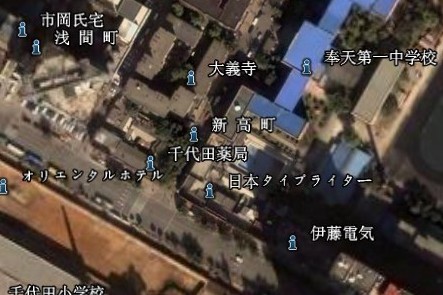
(Apple
Daily) The reporter followed the instructions and entered
Google Earth. There were indeed many Japanese names from the Manchuguo
era (when Manchuria including Shenyang was ruled by a puppet government
controlled by the Japanese). But it was also annotated that Manchuguo
has been extinct since 1945. Google China's representative said that
the names of the places in Google Earth are freely annotated by the users
themselves, and Google will not censor those names. For example, some
netizen may insert "So-and-so used to live here."
Archives