
Why do users today go to Baidu Post and Tianya?
If you watch carefully, you will note that the loyal users of Baidu Post or Tianya go there basically "every day" to "hang around." Within this group, the majority of them never post a single word. They are purely "submariners" who read the posts (More people post at Baidu Post than Tianya because the product characteristic there encourage users to post).
How can so many "submarine" users still result in the high stickiness? Based upon prior experience, we say that the user want to chase away their bordeom: "No matter what their educational level is, the young Chinese netizens do only one thing -- they get together and they chat. At Tianya, Baidu and Touban, Chinese netizens do the same thing -- they get together and they chat." But this idea is only half right. "Getting together and chatting" can explain the "small groups" at Touban. But over at Baidu Post and Tianya, this can only explain the small minority of "keyboard-active" users. For the many more "submarine" users, they don't say anything and so they cannot be "chatting."
The loyal but silent users at Baidu Post and Tianya go there ever day in order to read the "non-official news"; especially the "non-official" social and entertainment news. That is to say, Baidu Post and Tianya are news websites for the many loyal but silent uers. Everybody needs to know the news every day, and that explains why Baidu Post and Tianya are so "red-hot popular" now.
This also explained why the large BBS communities are so popular on the Chinese Internet. In the western world, the traditional media are strong and powerful and they can satisfy the basic needs of the people for news. In China, for reasons that we all know about, the people hold a delicate attitude towards official news. Therefore, when they are unsatisfied with official news, they get the rest from the BBS's. It is the strong need of the users for news that may those BBS communities so popular.After sorting through this point, then the fact is that Baidu Post and Tianya are competitors against each other . These two websites are the major "unofficial" news portals, just as there are four "official news portals (Sina.com, Sohu.com, QQ and NetEase). Interestingly, Baidu Post and Tianya have specific strengths. Baidu Post is stronger in unofficial entertainment news while Tianya is stronger in unofficial social news. In the competition between the two, each has to maximize their strengths while improving their weaknesses.
For Baidu Post, the key is the front page because it is presently not being attended to. The product model of Baidu Post makes its front page even more important than at other BBS's. In other words, the Baidu Post users need more "guidance" in order to popular spots, especially about social news.
For Tianyu, the key is to "get more servers." Tianya does not lack anything else, but it needs more servers.
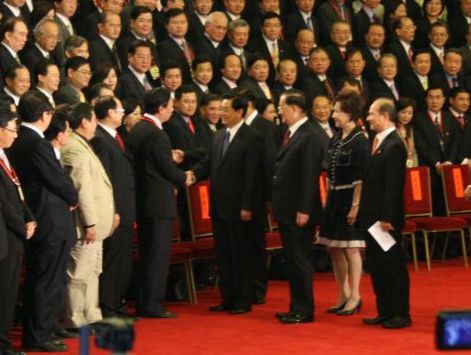
Hong Kong's major newspapers last week gave prominent coverage to how Chinese President Hu Jintao shook the hand of Donald Tsang — who's heavily favoured to be Hong Kong's next leader, or chief executive. The papers were all looking for signs of an official anointment when the men locked hands on Monday in Beijing.
"Donald Tsang shakes hands with Hu Jintao for 11 seconds," the mass-market Apple Daily said in a headline. Ming Pao Daily News put the timing at 10 seconds, adding that "other leaders were very affectionate toward Donald Tsang". ... Apple Daily pointed out Tsang's Monday handshake with Hu was five seconds longer than their handshake in Macau in December, before Tsang emerged as a likely candidate for Hong Kong leader.
The handshake analysis isn't that far-fetched. Former Chinese President Jiang Zemin apparently sought out Tung Chee-hwa in a large group for a public handshake before he became Hong Kong's first leader after Britain gave it back to China in 1997. TV news reports have been replaying the footage of Jiang zeroing in on Tung in the large crowd. The South China Morning Post noted that while the Hu-Tsang 11-second handshake was "impressive", Hu still gave Tsang two seconds fewer than Hong Kong businesswoman Pansy Ho, daughter of Macau casino tycoon Stanley Ho.
Forget it! The record has been broken (6park)
At the third Cross-Strait Economic, Trade and Cultural forum, Chinese Communist Party Secretary-General Hu Jintao shook hards with Taiwan's Hon Hai Group chairman Terry Gou for more than 22 seconds.
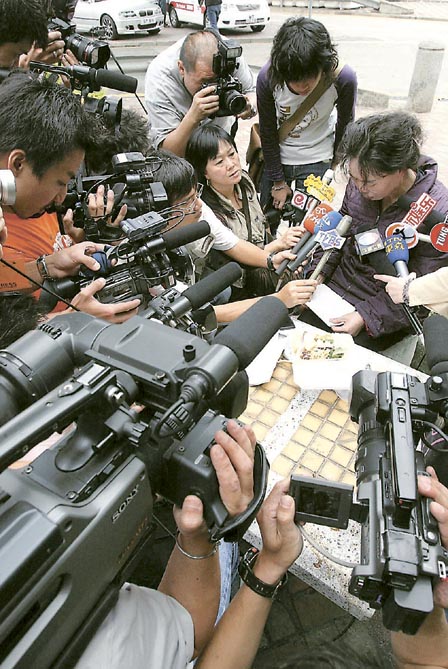
Afterwards, Terry Gou was showered with questions from the media. "Little Ling is getting married. How do you feel?" and "You spoke with Chairman Hu Jintao for a long time. What did you talk about?" Terry Gou parried off the questions with remarks such as "I need to use the bathroom" and "I have a meeting to attend."
The number of "mass incidents"... is probably one of the most abused (by journalists seeking to prove a point as well as government officials trying to do the same thing), squishiest numbers in China, a subject on which Roland Soong of EastSouthWestNorth blog wrote the definitive analysis.
At this point, I wish to interject and dispel the notion that mainstream western correspondents based in China are either lazy copy-and-paste hacks or agenda-driven sabotage agents who have no qualms about abusing numbers. I wish to address the question of the origin of that so-called 'definitive' post.
Before that post appeared, I had been sniping at those statistics (see Mass Incidents in China, 1/20/2006) and complaining that I don't understand the meaning of the 74,000 or 87,000 which is quoted so often by foreign correspondents. In November 2006, I had an in-person meeting with a worker for a major media outlet and I put the question to him directly: "What is the deal with this story? How can it be? Why is this being recycled all the time when it is dubious?" This person gave me a detailed explanation about the exact origin (including the precise event, the names of the persons/organizations involved, the unfolding of events and the revelant research afterwards). I was astonished. I asked (naively): "So why can't you write a report to rectify the impression?" The response was that in view of the audience market of this particular western media outlet, there was no way that such a complex and convoluted story could ever be published. Then this person turned it around and said, "But you can write something about it!" At that point, I really did not have a choice. Right?
Subsequently, I received a list of the major documents (e.g. the definitions for mass incidents/public disturbances from Ningxia, Jiangsu and the People's Republic of China Code of Criminal Law) that this western media outlet had found from its research efforts. I wrote the original post and then my informant made some significant corrections. The final result is that so-called 'definitive analysis.'
This end product is still unsatisfactory to me, because I didn't think that I had reached closure. I was less interested in the description of the historical process than the 'true' number, which remains shielded. In any case, I wish to point out here that the project was made possible by a member of the western mainstream media. At a minimum, one of them is not a hack/saboteur. Austin Ramzy is the second one. Of course, there are many more (unless you are of those who keep quoting the 87,000 number for 'mass incidents'!).
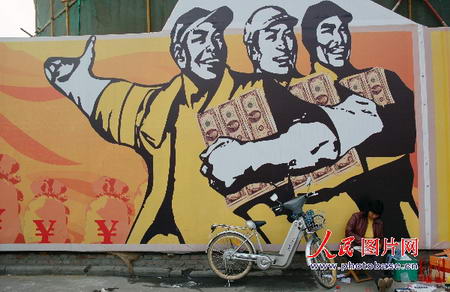
The reporter asked a couple of people who were chatting on a bench. "Who are the three people holding the American money?" One of them said, "Aren't these The Worker, The Peasant and the Soldier?" The other person quickly added, "The Worker, the Peasant and the Soldier are trying to make money nowadays."
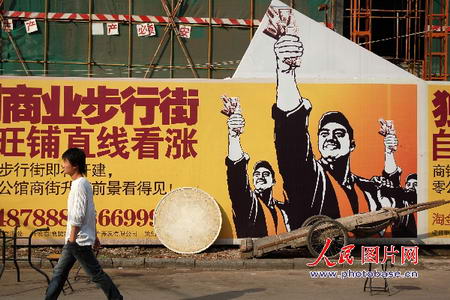
On the western wall, there are three "flood-flighting warriors" wearing orange life-saving vests raising fistfuls of foreign currency bills (British pounds or whatever)?
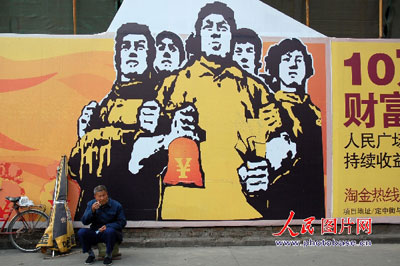
On the eastern wall, there are five or six heroic looking men and women holding money bills and bags of cash in their hands.
An official in charge of reviewing outdoor advertisements told the reporter that these boards were submitted for review but had not been approved. "I remember the one about The Worker, The Peasant and the Soldier. How can this possibly be approved? The Worker, The Peasant and the Soldier were the product of a particular era. They were known for holding Mao's Red Book in their hands. How can that be switched for money bills and bags? This is too mocking!"
The reporter found the ad designer, who said: "The design was based upon the needs of the developer and the conditions in the local market. The local consumers has to remember it. Why the money (including American money)? Investing in commercial shops is about earning money! The ad tries to convince consumers that investing in the shops will earn money! The revolutionary martyrs and the flood-fighting warriors? That is what you think, because my ads do not indicate who those people are. One can only feel and sense these things, because it is impossible to explain clearly. The ads use drawings and color to provide a sense of beauty."
Do you accept the proposed route for the Olympic torch for the 2008 Beijing Olympics?
50% yes
16% no
35% don't knowBy party affiliation, 84% support by pan-blues, 33% support (and 48% oppose) by pan-greens and 48% support (15% oppose) by independents.
Should Taiwan participate in the 2008 Beijing Olympics?
70% yes
5% no
Are you concerned that China will use the Beijing Olympics to pressure Taiwan?
30% yes
57% no
(Apple Daily) (former Chinese Taipei Olympic Committee information group director Lin Yung-fu)
... Frankly speaking, outsiders are clueless about the history of the several decades of disputes between the sides of the strait. During the 2000 Sydney Olympics, I met many European, American and African athletes and coaches and more than 90% of these foreigners do not understand why Chinese Taipei and China have different Olympic Committees, or why Chinese Taipei is used instead of Taiwan. The International Olympic Committee is tired of the "troublemakers" who continued to create political bickering.
When I was working for the Chinese Taipei Olympic Committee in 1998, I met IOC chairman Juan Samaranch who said something that impressed me. He said, "It was a huge concession for Taiwan to be able to participate in the Olympics (note: he was referring to the 1981 agreement with the IOC in which Taiwan agreed to use "Chinese Taipei"." This meant that he was hoping the two sides would cease interfering with sports with politics.
... Whether to reject the presence of the Olympic torch in Taiwan or not is no big deal, because this is just a prelude for the Olympic Games and not the games themselves. I am worried that the government leaders will refuse to send representatives to the Beijing Olympics in consideration of the presidential election? This action may cause the IOC to exclude Taiwan outside of the international Olympic family and lose the ability to participate in all future international sports competition. That will mean the loss of a apolitical international stage ...
According to Chinese Taipei Olympic Committee Secretary-General Chen Kuo-yi, since February 12, the Chinese authorities have used the term "China Taipei" to refer to Taiwan. The Chinese media have also used "China Taipei" to refer to Taiwan. "We obviously feel suppressed by the other side whose attempt to lower the stature of Taiwan is obvious. After communication failed to achieve any effect, we made the decision not to accept the Olympic torch on April 23."
(ETTV via ChineseNewsNet)
President Chen Shui-bian explained that at the Tokyo Olympics, the Olympic torch came from some other country (not China) and left for another county (not China). Therefore, Taiwan will not be lowered in stature this time.
What if the IOC bans Taiwan from participating if they refuse to let the Olympic torch pass through? Premier Su Tseng-chang said that Taiwan must not lose its national stature. Su said that he can accept the use of "Chinese Taipei" to attend the Beijing Olympics because this had been previously agreed upon. But "China Taipei" would damage sovereignty and lower the national stature. If the Beijing Olympic Organizing Committee were to use the name "China Taipei," Su said firmly that Taiwan "will not participate and will not accept."
[in translation]
The Olympic torch incident occurred right at the moment of the primary election of the Democratic Progressive Party. What had been 50% political has now become 100% political. What can one say?
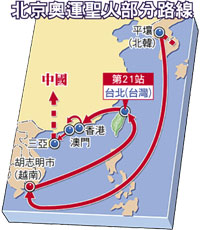
China's arrangment of the Olympic torch route was tricky. From Japan, it goes to South Korean and then to North Korea. From North Korea, it goes south to Vietnam while bypassing Taiwan. From Vietnam, it goes back north to Taiwan. Then it goes to Hong Kong, Macau and then China. Any route designed by a mentally normal person would go Japan->South Korea->North Korea->Taiwan->Vietnam->Hong Kong->Macau-China. This is the least economically wasteful route and it is also basic knowledge in Euclidean geometry (namely, the shortest distance between two points on a plane is a straightline). There was no reason to circle around. In China, everything is about politics. If the route goes from Taiwan to Hong Kong to Macau to China, then it shows that Taiwan and Hong Kong are part of China. This is the same old trick by China, and so it is no wonder that the Democratic Progressive Party (which is in the midst of a primary presidential election) refused to go along because they are afraid of being cursed out by the deep-green voters.
The Democratic Progressive Party and the Chinese Communist Party are political animals and they know all about each other's tricks. There will be one casualty in the battle of the DPP election and the Olympic torch. Either China compromises and restore the route to the logical one: North Korea->Taiwan->Vietnam->Hong Kong->Macau->China, or else the Olympic torch will bypass Taiwan. Prometheus stole fire from the heavens in order to save mankind, but apparently with the exception of Taiwan. The ancient Greek Olympic flame has been polluted by Chinese politics to serve "One China." What do the gods of Olympus think about the debasement of the sacred fire?
Even so, it is necessary to figure out what went wrong. How come the Chinese Taipei Olympic Committee signed an agreement in March in Beijing to agree with this route and then our government changed its mind in the end and rejected the route? As a result, CTOC chairman Tsai Chen-wei is being condemned from all sides. China even brought out the signed agreement to cause Taiwan to become known internationally for betrayal of confidence. There is undoubtedly an impact on the presidential primary election in Taiwan. It is also possible that the Chen Shui-bian administration wants to use the Olympics to explain the differences and conflicts between Taiwan and China to the international community, including their current situation and the desire for independence. Thus, they rejected the route that they originally accepted in order to show that China is oppressing Taiwan and lying to the world.
While this may achieve some effect, it comes at the cost of betrayal of confidence. Actually, when the Olympic torch arrives in Taiwan, they can initiate a demonstration to express their will in front of the international media. This should be more impactful than the betrayal of confidence at present. Besides, where does the Chinese Taipei Olympic Committee stand right now? How is anyone going to believe their promises? How can they negotiate on behalf of the government? This is a case in which the government has just slapped itself.
[in translation]
The ideologically driven ruling Democratic Progressive Party rejected the route for the Olympic torch for the 2008 Beijing Olympics on the grounds that it "lowered the stature" of Taiwan and thus set a precedent for the international community. The Taiwan authorities brutally used politics to interfere with sports, and this will only damage the international image of Taiwan. If Taiwan chooses to exclude themselves from the international Olympics family, the International Olympic Committee and the Beijing Olympics Organizing Committee can chose not to have the Olympic torch going through Taiwan.
The IOC and the BOOC announced the route of the Olympic torch on the evening before from Ho Chi Ming City (Vietnam) to Taipei (Taiwan) to Hong Kong to Macau. This route was confirmed in an signed document between the Beijing Olympic Organizing Committee and the Chinese Taipei Olympic Committee in February. But the DPP authorities now think that this route treats Taipei as an "international route" and lowers the stature of the sovereignty of Taiwan. Therefore this was absolutely unacceptable.
People must be asking: When the Chinese Taipei Olympic Committee chairman Tsai Chen-wei was negotiating with Beijing, did he communicate beforehand with the Taiwan authorities and received their authorization? The answer is obviously that it is impossible. The Beijing Olympic Organizing Committee executive vice-president Jiang Xiaoyu exhibited a "Meeting memorandum on four points of consensus" about the Olympic torch route and Tsai Chen-wei's signature was on it. Jiang Xiaoyu then accused the Taiwan authorities of "betrayal of confidence."
The precedent-setting act by the Taiwan authorities of refusing the entry of the Olympic torch lets the world see that the Democratic Progressive Party is steeled in its determination to promote Taiwan independence and they are insisting that the Olympic torch must enter Taiwan from some county and leave Taiwan for some other country. The purpose was clearly to highlight the fact that Taiwan is a sovereign country and to inflame the populist emotions of the pan-green supporters in Taiwan, thus assuring the continued rule of the DPP next year. Beijing has no choice but to reject this unreasonable betrayal of confidence.
The DPP authorities created this storm over the route of the Olympic torch and let everyone see that they will do anything to win the 2008 Presidential election. The DPP may be successful in hijacking public opinion in Taiwan and make the Olympic torch bypass Taiwan. But the IOC must sternly state their principle of "One China" and condemn the political interference into sports by the Taiwan authorities.

Taiwan on Wednesday resumed diplomatic ties with St Lucia, scoring a small victory in its diplomatic war with China. Premier Su Tseng-chang, while campaigning for his bid to join the 2008 presidential election, told a mass rally in Chungli City that St Lucia became Taiwan's ally on Wednesday. 'I have a good news to tell you. That is St Lucia will become our 25th diplomatic ally tonight,' he said. But Taiwan's Foreign Ministry has yet to make a formal announcement regarding Taiwan and St Lucia's restoring ties.
Was this actually a trap (i.e. St Lucia announces later that it will continue to recognize China)? Su Tseng-chang has made his bet. What do you think?
Update: (Radio Jamaica) St. Lucia has officially announced that it will be establishing diplomatic relations with Taiwan. The announcement to parliament by Foreign Minister Rufus Bousquet came on Tuesday during debate on the 2007 budget.
Rudy Giuliani said if a Democrat is elected president in 2008, America will be at risk for another terrorist attack on the scale of Sept. 11, 2001.
But if a Republican is elected, he said, especially if it is him, terrorist attacks can be anticipated and stopped.
“If any Republican is elected president —- and I think obviously I would be the best at this —- we will remain on offense and will anticipate what [the terrorists] will do and try to stop them before they do it,” Giuliani said.
Where is the evidence? On the September 11, 2001, a terrorist attack occurred under the watch of a Republican president, a Republican Senate, a Republican Congress, a Republican New York State governor and a Republican New York City mayor (=Mr. Giuliani himself). So there you have it ... 9/11 wouldn't have happened if the Republicans were in charge! Oh, but they were in charge ... it's terribly confusing ...
... now we get back to the regular scheduled programming (e.g. (Anti-)China Bashing For Dummies: "The Coming China Wars" (and Other Hysteria) David Scott Lewis).
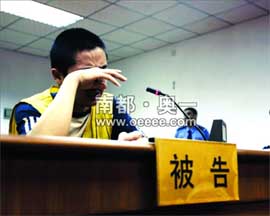
The deputy director of the mainland's press watchdog, Liu Binjie, will be elevated to the post of chief censor, replacing his sidelined boss, authorities announced yesterday.
The Central Party Committee and the State Council officially announced that Mr Liu, first deputy director of the General Administration of Press and Publication (Gapp), would be promoted to director after four years in his current position -- overseeing crackdowns on pornography and illegal publications.
Authorities also announced that outgoing director Long Xinmin would no longer "hold his positions as Gapp party secretary and National Patent Administration director".
Xinhua said Mr Long would be transferred to the Central Party History Research Centre to take up a job as deputy director, but his ministerial-level rank remained unchanged.
... Gapp has come under increasing criticism over the past year, under Mr Long's leadership, for tightening its control on dissenting publications -- especially its decision earlier this year to ban eight controversial books by mainland intellectuals.
(RFA via ChineseNewsNet)
One of the eight banned authors Zhang Yihe said that it would make no difference: "You can say that I and my friends are happy about the transfer. That is a genuine state of mind. But this elation is not about globating about him personally. Wu Shulin who named me directly has not moved. Why are he happy? Because China is ruled by people. We hope that his transfer will change the brutal and arbitrary way in which the products of Chinese intellectuals are treated. ... China is ruled by people. Liu Binjie has now come on and I hope that he will bring something new and not 'business as usual.' In this legal system, it does not matter who is in charge. This is a special characteristic. Why are the Chinese people so concerned about the personnel arrangements from the Seventeenth Congress? That is because they are hoping that better people will be put in there, especially the small number of people and groups that rule over the spiritual products of intellectuals. We need to work harder on the situation. ... This is not just about one essay, or one person, or one book. The government/party in China can ban newspapers, periodicals and books at will. This has to stop. I feel that China must go down the path of the rule of law. But we cannot expect that it will be handed over to us; every citizens must work for it."
Lin believes more than 5,000 mainland Chinese spies are operating in Taiwan. Lin himself stumbled upon one who was driving a taxi here in 1995.
“The driver spoke with perfect Pekingese and admitted that he was from Beijing, briefed by the Taiwan Research Institute [affiliated with the People’s Republic of China’s National Security Ministry], with a master’s degree from Tsinghua University in hydraulic dynamics, and was here in Taiwan to ‘serve the broad masses by comparing the strengths and weaknesses between the capitalist and socialist systems,’” he said.
Lin reported the matter and discovered that the Ministry of Justice Investigative Bureau (MJIB) was already aware of the man.
Critics say that both the MJIB and the National Security Bureau are fully aware of spies, but refuse to arrest them for fear of damaging business ties with China. When spies are caught, they are normally repatriated to China. Many times, they are simply put under surveillance without taking action, MJIB sources said.
Examples abound of Chinese prostitutes working in karaoke hostess bars (KTVs) near military facilities in Taiwain. Sources say some of the worst examples include areas near the Tsoying Naval Base in Kaohsiung and Army headquarters in Taoyuan.
However, some doubt the effectiveness of using mainland taxi drivers and prostitutes as spies.
“Is it worth planting a honey trap in a KTV to gather info from an E-4 [a junior rank level for American enlisted personnel], when perhaps the same info could be obtained from open sources?” said a former U.S. intelligence officer who has worked in both Beijing and here. “Taiwan is a fairly transparent society, but in the military and intelligence fields, they’ve learned from the same sources in terms of masking the truth, distortion, compartmentalization, etc.”

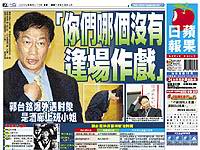
Hon Hai Group chairman Terry Guo called a press conference yesterday to address questions about his own love affairs. He was confident and reassured as always. But when the richest man in Taiwan asked, "Has anyone here not joined in the fun on occasion?" it is enough to remind people of Jackie Chan's "I made the mistake that every man will make." This may cause even more problems when society criticizes his mistaken values.
Based upon the evidence in this 19-year-old extramarital affair, irregardless whether the Chen woman trapped him or became jealous, the fact was that Terry Guo had been unfaithful to his wife. While Terry Guo may genuinely believe that "every man under heaven has joined in the fun on occasion," this obviously contravenes good social custom. For a person who had been unfaithful to make that statement brazenly in a press conference is socially unacceptable.
Worst yet, Terry Guo's forthrightness and honesty might cause some men to admire and praise him. This is ignoring the fact that his name has been recently linked to various actresses and therefore in the social limelight. Now he is emphasizing that "I paid money" during his affair with the Chen woman. This will inevitably cause people to feel the "arrogance of rich people."
Terry Guo questioned yesterday whether Taiwan has adopted the American media culture, in which certain people with high social standing are brought down by smears in order to make other people feel better. "Why are you people interested in me? Am I that important?" He also said that if the media can have a pact of self-discipline to not report on him anymore, he will erect a bronze statue for every reporter.
Terry Guo may feel wronged. But how could the finances, words, ideas, social visions and moral values of the richest man in Taiwan not be important? How can the media not be interested? Terry Guo does not have to deprecate himself as a "hypocritical philanthropist." With his wealth and position, he can be a "genuine philanthropist" who can contribute to Taiwan.
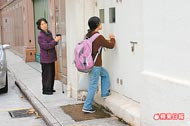
Citizens in Bao'an have been saying that it was absurd that criminals are leaving their telephone numbers on outdoor walls to advertise the sale of counterfeit money. On March 19, the reporter followed up on the tip from a citizen and found a telephone number on the wall by the side of Seashore Middle School in Bao'an District 41. There were four or five similar numbers on the same wall.
This reporter called the telephone number and expressed the desire to purchase counterfeit money. The man who took the call said that he was selling counterfeit 100, 50, 20 and 5 yuan bills, plus 1 yuan coins as well. He offered a price of 10 yuan for each counterfeit 100 yuan bill and he stipulated that the total face amount of counterfeit bill must be at least 10,000 yuan. He made an appointment with the reporter to meet the next day at the Bao'an Plaza and he promised to transact in person.
On the afternoon of March 20, the reporter went to the Bao'an Plaza to meet the man as scheduled. The man called to say that he was out of 100 and 20 yuan bills at the moment but he had 20 and 5 yuan bills. He said that these counterfeit bills were all stored away and cannot be inspected in person. However, he was willing to send over a sample to this reporter.
Ten minutes later, the man called again to say that the sample has been delivered. He instructed the reporter to proceed to a public telephone booth at the corner of the Bao'an Plaza. He claimed that there is a sample bill placed at the top of one of the telephone booths. The reporter reached for it and found a 5 yuan bill. This was a brand new bill and it was impossible to tell whether it was real or counterfeit.
The reporter then called the man, who refused to transact in person due to safety reasons. He asked the reporter to wire the money to an account at the Bank of Agriculture and he promised that the counterfeit bills wll be at a hotel near Bao'an Plaza. "As soon as I receive the money, I will send the hotel room key to you."
Although the reporter considered that this may be fraudulent, he wanted to get to the bottom of the mystery and so he wired 500 yuan over. Then the reporter called the man. The man verified that the money was there and he said that he has already obtained a hotel room in which the counterfeit money has been placed. He said that he would send the hotel room key over. Then he added that the hotel room fee was pre-paid by his friend. He asked the reporter to wire 200 yuan to his account to pay for the room.
At this time, the reporter demanded strongly to meet the man. After some excuses, the man then announced the truth: "I don't have any counterfeit bills. This is a pure con game." The man said, "You are the second victim today." The man said that he had been defrauded previously in the same way. Afterwards, he realized that this was perhaps a good way to make money. The man then explained the method to the reporter. At the end of the call, he even said, "If you are interested, you can cooperate with me. You can bring some people over. After I take their money, I will give you a percentage."
Under the banner of opinion monitoring, muckraking became popular in the United States in the 1960's and 1970's and it has now become popular in China too. When the media industry caught onto investigative journalism, the reporter becomes not just a report but an investigator who has to be brave and risk-taking to delve into investigations.
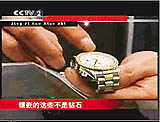
Muckraking can come up with good news stories. For example, CCTV's <Economy 30 Minutes> reporter Sun Jing posed as an ordinary tourist to participate in a three-day tour in Hong Kong and secretly filmed the tourist traps in Hong Kong: the $10,000 "diamond watch" had glass but no diamonds.
There are other times that reporters get into trouble during the process. There is just a thin line between "exclusive" and "inaccurate" and between "fame" and "calamity." One can find oneself easily on one side or the other.
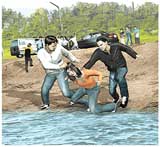
On April 6, 2007, CCTV's <Economy 30 minutes> reporters went to Qinhuangdao (Hebei) to investigate an illegal and polluting factory, they were attacked by more than 20 identified thugs who seized their filming equipment. One female reporter was almost drowned in the river. During the assault, the thugs were crying: "One more dead is another gone."
In August 2006, Taiwan richest man Terry Guo's Foxconn sued two China Business News reporter over their inaccurate report about "overtime work" practices. Foxconn demanded 3,000,000 RMB in compensation and froze their personal assets. Later they reduced the amount to a symbolic 1 RMB. In the end, Foxconn and China Business News issued a joint statement: Foxconn agreed to withdraw the lawsuit; the two sides apologized to each other. China Business News chief editor Qin Shuo admitted later that the broadly quoted closing paragraph in the news report ("we work harder than mules, we eat worse than pigs, we rise up earlier than roosters, we get off work later than night club girls, we act more obedient than grandsons, we look better than anyone else now but we will look older than anyone else five years later") may seem exaggerated.
In September 2005, Henan Commercial Press was suspended for one month on account of a story about 480 "reporters" showing up at a mine which had an accident to receive "bribes for shutting up." According to informed sources, the report was accurate. But because there are numerous fake reporters who go around extorting coal mines and this report had a huge negative impact, the authorities decided to deal with it this way.
More recently, the "infected tea" investigative report has caused a stir in Chinese public opinion and this led to a debate about professional ethics.
In this story, a certain reporter posed as a patient and submitted tea for urine analysis at ten Hangzhou hospitals. Six of them came back with a diagnosis of infection and five of them prescribed anti-infection medicine worth around 1,300 yuan. The "infected tea" case immediately drew the attention of netizens with some people condemning the doctors for wrongful prescriptions intended to rip money off patients.
But the doctors struck back in less than 3 days. According to China Youth Daily, doctors at 92 hospitals around China organized "tea-for-urine" tests and 127 out of 136 reports showed "infection." This showed that if you use tea for urine analysis, it is normal for infection to be diagnosed. Thus, this has nothing to do with the medical ethics of doctors.
Ministry of Health spokesperson Mao Junan said that the equipment was not designed to tell urine from tea. When the reporter substituted tea for urine, the testing system is disrupted. "If the media wish to plan these types of news in the future, they may use beer tomorrow, soy sauce the day after tomorrow ... In order for the hospitals to deal with these types of situations, they will need to insert one additional step before the test -- they will have to determine if it was urine first and then they can conduct a urine analysis. This can get complicated." Mao said that this type of report violates the professional requirements for journalists and misleads the public.
When Minister of State Administration of Work Safety Li Yizhong was interviewed by <People's Daily> and he said: "The Ministry oversees safe production, but it has to be supervised by the media at the same time. The media are not the Central Disciplinary Committee. They are not an investigative work group. You cannot require that they be correct in everything that they say."
When Li Yizhong said "the media cannot be required to be correct in everything that they say," it may seem like tolerance and trust of the media. But some believe that Li Yizhong is actually making a even tougher demand on the media by requiring them to use more rigorous self-discipline in return for the tolerance and trust. If the tolerance and trust are misused, then this is socially irresponsible and will cause the media to lose public trust.
The allure of "investigative reporting" is due to its effort in revealing "the news behind the news." The muckrakers are praised for uncovering the truth. Conversely, if the muck is wrongly raked, they will be soiled.
On my computer, I am looking at two identical Sina.com blogs. They have the same photograph, they have the same name for the blogger and they have the same blog posts. But I look at them carefully and I discover that the domain name is off by one letter. Furthermore, the blog posts were published at different times.
I had discovered accidentally that there was another Rose Garden at Sina.com blogs and the blogger was also me. It should not have mattered because I write things for people to read and I don't mind (and I actually welcome) re-publishing. But this new "me" is very eerie. After all, in the Internet world, who can prove which one of two "me's" is the real "me"? If one day, the other "me" began to publish things that I did not write under "my" name, how can I defend myself? How can other people tell the real "me" between the two "me's"?
... This "other me" is also different because there are Google ads. I don't know if the large number of visitors meant that Sina.com is allowing users to make money on their turf and then splitting the receipts. No matter what, I am getting somewhat angry. It is alright for you to make money, but why are you using my name? Then I felt a bit lost. Who is suppose to be responsible for this kind of problem?
Like many other people, I think a lot about how to blog. I am certain that I am not the only one who has come across such a "creative" act to create another "me." Does the blog service provider have the responsibility to think about how they administer such problems?


The claim former permanent Secretary for Education and Manpower Fanny Law Fan Chiu-fun said Hong Kong teachers were "all so stupid" was a manufactured story to create media sound bites, an inquiry heard on Thursday. Lisa Wong Kwok-ying SC, counsel for the Education and Manpower Bureau, accused the academic vice- president of the Hong Kong Institute of Education, Bernard Luk Hung-kay, of manufacturing his claim Mrs Law criticised Hong Kong teachers when he met her at an official cocktail lunch in Canada in 2000.
Professor Luk denied the accusation at the inquiry into allegations of government interference at the institute. He told the inquiry on Saturday that when he was introduced to Mrs Law at the lunch, she said: "Tell me something bad about Hong Kong teachers." "I said: 'there are bad things, but also good things'¡K I said 'for example they work very hard' and she said, 'but they are all so stupid'."
The lunch was held when a Hong Kong government delegation, led by Michael Suen Ming-yeung, then secretary for constitutional affairs, visited Canada. Mrs Law was director of education at the time, but her appointment as permanent secretary had been announced. Under cross-examination, Ms Wong put it to Professor Luk that he "manufactured this story in order to gain sound bites in the media". But Professor Luk replied: "Not true".
The version in the Sing Tao story actually contained a great many details of the examination.
Bernard Luk testified that on the afternoon of Mary 2000, he was introduced by the Hong Kong Trade Office (Toronto) director to Mrs Law and he was arranged to sit to the right of Mrs Law during that lunch. He said that Mrs Law had to leave after the entree was served because of an appointment with local education officials. Luk said that he was taken aback when Law said: "Hong Kong teachers are all so stupid."
Lisa Wong then produced the seating chart for that day and quoted the Hong Kong Trade Office deputy director who said that Luk did not dine next to Law and that the director was busy with Secretary Michael Suen on that day.
Now isn't that a strange turn of events? In April 2007, Luk recalled a dinner conversation with Law in 2000. Who is to say that it did not happen? Except a seating chart was retrieved and an eyewitness came forth. Sing Tao did not say how Luk responded to this piece of 'fact.'
The other part in the questioning of Luk pertains to that old issue about who spoke of 'firing people.'
On a radio program, the host asked Luk whether the speaker was a "principal officer under the accountablity system."
Luk declined to answer and thus created the impression that it was indeed Secretary of Education Arthur Li.
Lisa Wong: "You are a historian. You look for accuracy on everything. What did you not clarify on radio?"
Bernard Luk: "Either I did not hear the word 'accountability system' or else it was just a radio talk show -- in any case, it was not in a court of law and there was no need to be too clear."
Lisa Wong: "Why didn't you tell the media that it was not Arthur Li who spoke of 'firing people'?"
Bernard Luk: "I am a teacher. I am used to letting the students find their own mistakes."(SCMP) Empty seats at dinner 'back all so stupid' claim. Liz Gooch and Polly Hui. April 19, 2007.
The lawyer for the vice-president of the Hong Kong Institute of Education Bernard Luk Hung-kay yesterday cast doubt on claims that the former permanent secretary for education and manpower never told his client that teachers were "all so stupid" during a lunch in Canada. Martin Lee Chu-ming SC revealed new evidence to challenge two witness statements claiming that Professor Luk could not have spoken to Fanny Law Fan Chiu-fun at the official lunch in Toronto in 2000 because they were not seated together. "We checked. We found three of the people listed to sit at Mrs Law's table did not actually attend [the luncheon]," Mr Lee told the inquiry into allegations of government interference into the HKIEd's internal affairs sparked by Professor Luk.Mr Lee's revelation came after Benjamin Yu SC, for the commission of inquiry, read out a witness statement given by Donald Tong Chi-keung, then director of the Hong Kong Economic and Trade Office in Canada, which organised the event. Contrary to Professor Luk's testimony, Mr Tong claimed he did not recall introducing the vice-president to Mrs Law, neither did he hear her making the remarks: "Tell me something bad about Hong Kong teachers" and that Hong Kong teachers were "all so stupid". Mr Tong's statement also said his office would have sat more important guests next to Mrs Law, who was then director of education.
Lisa Wong Kwok-ying SC, for Mrs Law, earlier presented a seating plan to the commission, showing that Professor Luk was sitting at a different table. She also submitted a statement given by Eddie Cheung Kwok-choi, then deputy director of the Toronto trade office, whose evidence supported Mr Tong's. But Professor Luk stood by his testimony. He said after he was introduced to Mrs Law at the reception, "I walked towards the table with her, still talking. We never stopped talking until she decided not to talk to me anymore. I wasn't even aware there was a seating plan for lunch." "Is there any reason for you to correct your evidence as a result of these two statements?" asked Mr Lee, referring to Mr Tong's and Mr Cheung's statements. "No, I remember clearly what happened," he replied.
The ten plus years of star-chasing by Yang Lijuan were noted by the media. The Guangdong-based <New Express> said that a Beijing television's entertainment program went to interview Yang three times in Lanzhou and reported on the starchasing career of the Yang family. According to Yang and her mother, the television station even promised to arrange a meeting with Andy Lau but they were not able to deliver.
The Henan media <Dahe Daily> said that the media had been part of Yang's dream. In April 2006, the CCTV program <The Same Song> went to vist Yang to help her "achieve her dream in a healthy way." Local Lanzhou media also tried to help her realize her dream by finding psychologists and sociologists to help her and to contact the Andy Lau fan club and management in order to get a meeting with Andy Lau.
Apart from using their media power to help Yang, the mainland media also offered financial support. <Southern Metropolis Daily> arranged for Yang and her mother to stay in a three-star hotel in Shenzhen after their Hong Kong visa had expired in order to keep close contact with them. <Guangzhou Daily> also offered help on lodgings. After Yang's father committed suicide, some media offered Yang and her mother help on lodgings and transportation.
But nothing beats the impact of this photograph:
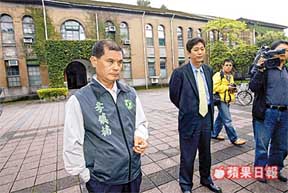
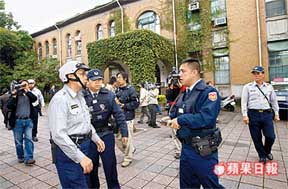
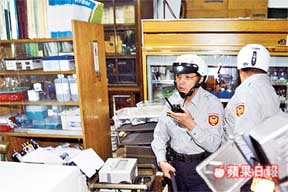
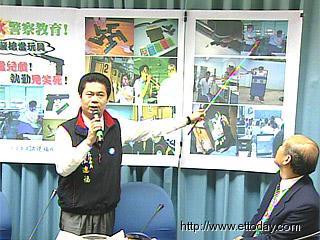
Yesterday at around 3pm, the Roosevelt Road (Taipei) police station got a telephone from the Taipei National University campus police station: "There is an emergency at the university. Send people over!" The patrol police officers arrived on campus in three minutes. The campus police said: "There are two men armed with assault rifles at the School of Agriculture and they are holding thirty students hostage." The patrol officers immediately called the police station to ask for reinforcement. Fifty-five police officers rushed to the scene wearing bullet-proof vests, steel helmets, shields, pistols, M16 rifles and even the rarely seen Swiss-made SIG sniper's rifle and the police helicopters were about to be summoned. When the reinforcement arrived at the location, they were met by DPP legislators Lin Guo-ching and Lee Chen-nan, members of the police public relations office and TV satellite broadcast vehicle(s). The legislators said that this was a "planning exercise."
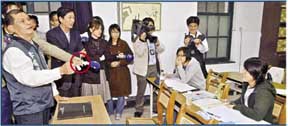
During the exercise, Lee Chen-nan used a dining fork as an assault rifle and asked the students, "What would you do in this situation?" One student said: "The university has given a card to each student with telephone numbers for emergency situations. Apart from calling the military service officer or the campus police, I don't know what else to do." Lee and Lin then checked whether the students carried the emergency notice card with them. A professor said: "Most people would not know how to act in this situation. The worst part is that even after all this, those who participated in the exercise still don't know what to do."
Lee Chen-nan gave a report card of 60 points. Lin Kuo-ching said that the two campus police officers arrived on the scene armed only with batons. They were "very brave" when they charged into the building. If there were really armed criminals, they would be dead.
Lee Chen-nan and Lin Kuo-ching wait in front of the School of Agriculture building for the arrival of the police. Lee has a stop watch in hand.
When the police rushed to the scene, Lee and Lin told them that this was just an exercise.
The two campus police officers who were made aware that this was just an exercise went upstairs to "simulate" the search for the suspects.
Lee Chen-nan held out an dining fork and asked the students: "What would you do it this were a Uzi?"(BCC) When informed about the public criticisms of his 'show,' Lee Chen-nan said: "This is crazy! How can they say that? I'm such a serious legislator and they criticize me? Is campus safety unimportant? It is alright if TVBS is criticizing me. They can do that all day." When informed that it was his DPP colleagues who are criticizing him, he said: "This is a sectarian problem. The Su Tseng-chang sect wants to take this opportunity to attack Lin Kuo-ching. Meanwhile Lin Kuo-ching said that he was called to attend at the last moment and when he got there, he reminded Lee Chen-nan not to disturb the students. "Anyone who wants to make this into a sectarian problem will be rejected by the people. If they do that, they will be ousted sooner rather than later! What have I got to do with the Frank Hsieh faction? They have too much time on hand if they want to politicize and sensitize everything."
(ETTV) From the Executive Yuan spokesperson: while the legislators have the right to monitor the government, the methods must be appropriate. The Ministry of Education workers accompanied the legislators to the simulated exercise and they will be investigated by the Executive Yuan; ditto for the Taipei National University administration. The police responded to a call and therefore did not violate any procedure. The two legislators may have violated Article 171 of the Criminal Law on making false statements and may be subjected to not more than 1 year in jail or a fine under NT$300. The legislators acted outside of the Legislative Yuan and are therefore not protected by immunity.
YouTube: 突擊!騷擾? 立委演習 55警瞎忙
Document of Decision on Administrative Penalty, Number 71723 (Gongwu-jue) year 2007
The principal: Name: Zhang Jianping; Gender: male; age: 40; ID number 320405196703010017; work unit: none; address: Changzhou XXX number 250 room 201; work address: none; legal representative: none.
The following illegal activities were confirmed:
Since October 2006, Zhang Jianping used the Internet to access overseas reactionary website <Epoch Times> in order to read information that incite subversion of the state authority and overthrow the socialist system.
The above facts were confirmed through Zhang Jianping's narrative and explanation. According to Article 2 Rule 20 of the <Regulations for the Safe Protection and Administration of the Computerized Internet>, the subject will be issued a warning and be forbidden to access the Internet for six months.
Should the defendant not concur with the decision, he may appeal for an administrative review to the Changzhou city public security bureau or the Changzhou city Wujin district people's government within six days after receiving this document. Alternately, he may proceed to file an administrative complaint at the Changzhou city Wujin district people's court within three days.
This document was filled out and sent to the person on this date.
The Changzhou city Wujin district public security bureau.


Credibility rating of local news media in general (scale of 0 to 10): 5.94
Freedom of press in Hong Kong:
65% satisfied
13% dissatisfied
Perceived the local news media in their reporting
26% responsible
43% irresponsible
Perceived the local news media on freedom of press
74% had given full play
22% had not given full play
Perceived the local news media on freedom of press
68% had misused/abused
25% had not misused/abused
Perceived the local news media on self-censorhip
50% had practiced
40% had not practiced
Perceived the local news media with respect to the HK SAR government
32% had scruples in criticizing
64% had no scruples in criticizing
Perceived the local news media with respect to the Central Government
61% had scruples in criticizing
33% had no scruples in criticizing
[in translation]
The April 15 march ended at the main stage on Ketagalan Boulevard. The organizers invited the various groups to come on stage to express their support of the Lo Sheng Leprosarium. Among the speakers was Hong Kong independent media reporter Susanna Cheung Chui-yung. But when she got off the stage, she was immediately showered with "concern" from the police. The police cited the "Article 27 of the Entry/Exit and Immigration Law" and claimed that her speech violated the terms of her application to enter Taiwan. They informed Cheung that they were going to take her directly to the police station for questioning. When others at the scene protested, the police changed their minds and warned her: "Don't do this again or you can be expelled" and made as if they wanted to arrest her. For a foreign visitor to Taiwan, this type of state violence is especially threatening.
Yet this is the typical trick that the Taiwan government has always used against the foreigners that they dislike. Eighteen years ago, the KMT government expelled Father Neil Magill from Taiwan because of his involvement in the opposition and the labor movement. After the DPP became the ruling party, they were even worse. Apart from serious violations of human rights, they showed that the Taiwan government is conservative and defensive under the government of any ruling party.
After being threatened by the police, Cheung Chui-yung tried to leave the scene quickly by walking towards the Chiang Kai-shek Memorial Hall. The media which had been waiting the whole afternoon seemed to have found their prey and quickly moved in. They were faster than all the police officers and prosecutors. Some of the demonstrators quickly "intercepted" the reporters so that Cheung would not be harassed a second time. But a short but powerful CTTV journalist broke through the cordon and chased her all the way in front of the National Library. When he was blocked again, he howled: "Let me film. I'm helping you!" When he could not get his shot, he cursed out: "You students know nothing and you are just causing trouble!" "What are these foreigners doing in Taiwan!" Then he told the students: "Your actions interfere with freedom of press and the right to gather news. I'm going to sue you!"
Afterwards, we monitored CTTV News. At the 11pm news show, there was nothing about the Lo Sheng march whatsoever. At the midnight news show, there was one short segment. In the one minute clip, three-quarters were about the Cheung Chui-yung incident: "A reporter who was gathering news somehow lost her control of emotions and got on stage to express her support." The program also mentioned the police charge against her so-called "illegal" activity without explanation the basis. The closing remark was that this "left an imperfect little spot in a peaceful march."
The state has employed "isolation" and "expulsion" in accordance with the will and power of the rulers ever since the establishment of the Lo Sheng Leprosarium since inception and has continued to do so up until today. Meanwhile, the media only look for sensationalism without questioning the logic or the truth. They spent the entire afternoon in order to come up with "the imperfect little spot." This is more than sheer depravity.

In issue 752 (June 21) of EasyFinder, Renee Lee wore a flesh-colored bra to pose for photographs on the front cover, page 25, page 42 and page 43. Apart from page 42, the magistrate did not believe that there were any hints of her breasts or nipples. The photograph on page 42 that drew the most attention showed a shadow on the left breast which may hint at a nipple. However, there was no such shadow on the right breast. In the absence of further evidence, there was reasonable doubt as to whether this was a nipple.
As for intent, the magistrate did not perceive any sense of pornography as the story was a portrayal of the growing-up process of a young girl in a weekly magazine that features entertainment, gossip, fashion and gourmet food. While certain language leaves room to be desired (e.g. "pretty face and mature body that exudes the quality of a young girl" and "pretty face attracts handsome boys but Renee also becomes the target of perverts"), but this was not the basis of a judicial decision.
The magistrate pointed out that the content of the article was similar to the 2001 song <I'm not a girl, not yet a woman> by Britney Spears. There will be differences in opinions but these are news judgments and editorial decisions. While this case has been controversial, there is no absolute answer on the rights or wrongs. The magistrate believed that if anyone should objectively read the article and look at the photographs, then the conclusion is that this was no pornographic depiction. Therefore, the defendants were found not guilty.
Meanwhile, the followping showed up in the political gossip page in Apple Daily. The relevance is that the EasyFinder case represented the conclusion of one particular magistrate, who is human after all. Another magistrate may rule differently and so what is meaning of rule of law then?
Chinese People's Political Consultative Conference member Siu Sin-por recently declared at the Hong Kong Development Forum that Hong Kong judges have no standards in their decisions. Siu cited the case in which several people were sentenced to one month in jail for eating dog meat. Siu said that people eat dog meat in the New Territories all the time and are usually fined lightly when caught. But this judge imposed an unprecedented heavy penalty. Siu thought that the judge ruled this way because he thought that eating dogs violates the cultural standards of the colonial era in which dogs are humans' favorite pets and not food. Meanwhile people eat dog meat in the streets of Beijing. Therefore the cultural standards are often the personal standards of judges.
Well, Siu may arouse pet lovers to go marching in the streets with this kind of talk, and this will disrupt social harmony and violate political correctness.
The term "news plot" became popular in journalism in recent years. "News" may be plotted or planned, but the basic foundation should be premised upon the truth. Once you depart from the truth, "news plotting" becomes "plotting news" in order to achieve a certain publicity or social effect.
... The "infected tea" case drew broad attention. The reporter posed as a patient and prepared some tea to be tested as urine at 10 hospitals. Six of the hospitals detected infection by analyzing the tea. This was obviously a case of "news plot."
But this type of "news plot" contravenes scientific practice. Recently, the Ministry of Health spokesperon quoted expert opinion and condemned the reporter for violating professional ethicis. The medical equipment was designed specifically to analyze a specific substance. If the equipment was designed for urine analysis and tea is used instead, this equipment assumed that the material is urine and will analyze it as such ... When the reporter substitued tea for urine, this is a "deceptive" behavior, for towards the hospital as well himself. He was hoping that the conclusion would be "there is a problem in the urine" when in fact there is none. Instead he got a report that there is "a problem in the tea." So how can any logical conclusion be made about potential problems if human urine were analyzed?
The news story about "the infected tea" was basically biased. The reporter might have wanted to monitor the quality of medical services and this might have been well-intentioned. But he did not realize that his actions violates the most fundamental medical knowlege and therefore came up with a biased conclusion. This type of "news plot" has the objective consequence of misleading the public.
Such a "news plot" is not an isolated incident. For example, one reporter heard a rumor that "red dye was being injected into watermelons" and the result was that watermelon farmers in Henan, Hubei, Shandong and Ningxia were hit by a public opinon "hurricane" with unsold crops rotting in the fields. Other recent incidents include "Qiao Yubo had quintuplets," "80-year-old woman gets pregnant," "Gaozhou Department of Industry and Commerce beat high school student to death," "Peasant woman in Hanshan (Anhui province) swallowed alive by python," etc. Although none of these stories stood up to scrutiny, someone "planned" it and "hyped" them into headline stories.
Why do these things happened? One important reason is the so-called "eyeball economy." When these hot stories appear, the media audience rises sharply (along with advertising revenues). Besides, there are no real consequences: when the truth is uncovered, the media only had to make an "announcement" and "say sorry." There are no other responsibilities, and the money is in the bank already.
Here are the support levels for the four announced presidential candidates from the Democratic Progressive Party:
22% Frank Hsieh
17% Su Tseng-chang
9% Annette Lu
2% Yu Shyh-kun
(None of the above: 8%; 42% expressed no opinion)
A poll at the end of February had Su at 26% and Hsieh at 16%.
If the supporters of the KMT, New Party and PFP are taken out of the sample base, the rank order is virtually underchanged. The firm pan-blue supporters do not have a good opinion of any of the four, but that is not a shocking revelation.
If former DPP chairman Lin I-hsiung were to enter into the race, the results become:
19% Frank Hsieh
16% Su Tseng-chang
12% Lin I-hsiung
7% Annette Lu
2% Yu Shyh-kun
(None of the above 6%; 40% no opinion)
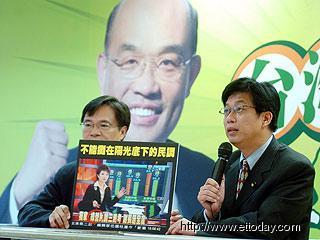
Premier Su Tseng-chang's office today doubted the exclusive report coming from SETV (San Li) television that a Democratic Progressive Party poll showed Frank Hsieh leading Su Tseng-chang 53.7% versus 35.3%. "18%? This is outrageous. This is a public opinion poll that cannot be placed out under the sunshine." The DPP subsequently declared that they had not conducted any public opinion poll whatsoever. This caused SETV to change the headline from "DPP poll" to "green camp poll." Still, Su's people wondered: "We do not challenge San Li's position and we do not challenge former premier Hsieh's position. But we are seriously concerned about the other motives of the people who provided this poll result." Meanwhile, Frank Hsieh said: "I don't know about the SETV situation. We have done our own poll and we had an even bigger lead than this!"
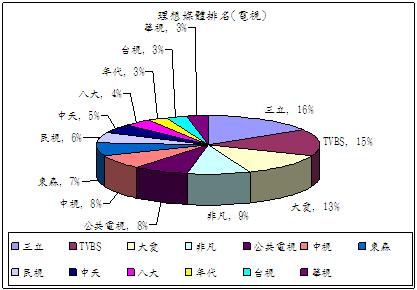
Meanwhile, Yahoo! ran an online poll which is the second annual "Survey of the ideal media." This online survey is based upon a stratified sample of 5,599 registered Yahoo members age 12 to 65. While this is better than a pop-up online survey, it is still noted that the projected universe is the collection of all registered Yahoo members and not the general population. Within the category of television, here are the results:
SETV came out on top at 16%. TVBS was second at 15% (see story below about TVBS). You would think that television channels that are consistently biased and inaccurate would be rejected by the general public. What if they do very well among the public instead? This is not a Taiwan-only problem (reference: Fox News).
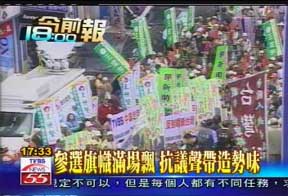
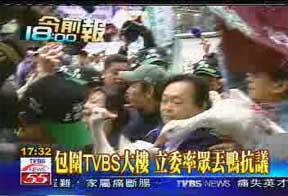
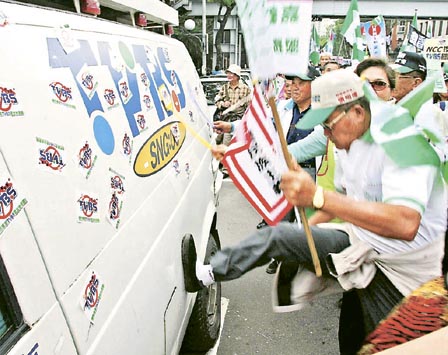
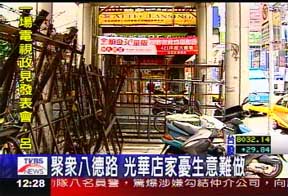
Some 500 demonstrators yesterday took to the streets in Taipei, demanding that the government shut down the private TVBS cable network for showing a gun-brandishing gangster in a recent crime story. The protesters marched down the streets to TVBS's office building, as they displayed placards reading, "the Cabinet must toughen up." They briefly scuffled with riot police, who tried to stop the protesters from pelting the TVBS building with missiles. They criticized TVBS -- invested by the Hong Kong-based TVBS -- for lacking journalistic professionalism. They charged that the cable network has been serving as China's organ, creating sensational stories to intimidate the Taiwan society.The latest saw TVBS air an exclusive footage of a gun-brandishing gangster who issued a death threat for his former gang boss. But it turned out that the footage was staged and filmed by one the network's reporters, who was summarily fired by TVBS following the revelation.
The National Communications Commission (NCC), despite pressure from the Cabinet to have TVBS's license revoked, only fined the network NT$2 million, and demanded Lee be replaced as TVBS president. Lee has stepped down as the TVBS president, but he continues to host the popular talk show. Despite calls for boycotting TVBS, the ratings of Lee's show shot up on the night when the channel admitted making a mistake. Lee lengthened the program that night, conducting soul-searching talks with his guests about media ethics.
The protesters, including more than a dozen DPP elected officials, professors and others from 26 civilian groups, also demanded the NCC stop operating. They also demanded the government revoke the licenses of all "China-funded" TV stations.
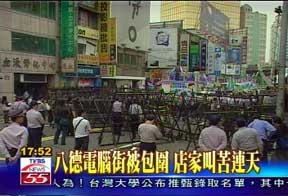
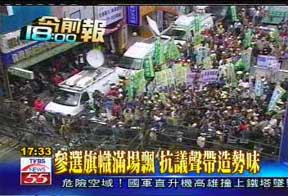
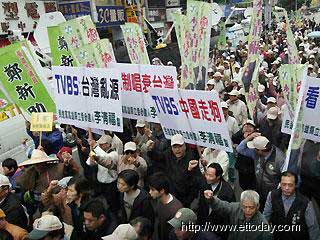
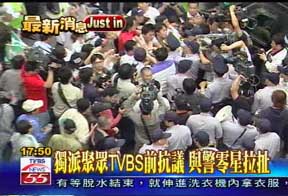
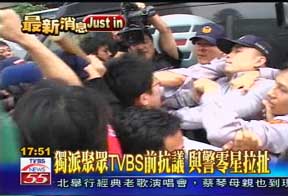
Was this a protest against unethical/unprofessional journalism? Perhaps, but there sure were a lot of election campaign banners and standards being bandied around. The title of this post was based upon one of the banners: "TVBS China's Running Dog." Other banners are: "TVBS: Source of chaos in Taiwan" and "TVBS denigrates Taiwan."
... detectives found the Mizuno sneakers worn by the bank robber were sold at 40 outlets in Hong Kong, including at two police facilities, but investigations produced nothing. Since they were convinced by then the perpetrator was a police officer, detectives put up posters in police stations and advertised in the police newspaper, Offbeat, encouraging colleagues to bring in their old sneakers. Twelve officers produced shoes, 11 of which were Mizunos. None matched forensic evidence.
(SCMP)
"We tried to lure and trap the suspect by giving out an offer of a HK$300 coupon for the sportswear shop in the police sports and recreation club in exchange for old Mizuno running shoes of four specific models," he said. "We posted ads in [the police newsletter] OffBeat and stuck posters in police stations. Three of the four models were not sold in Hong Kong and the other was the one the robber wore." The trap was not successful, although 12 officers gave up their old shoes for the coupon.
(PlasticHK by Lam Kay)
I recommend the "elite" in the Hong Kong Police be recommended to enter in all the competitions for inventions all over the world as well as the Nobel Peace Prize.
This plan is far too creative! It is so creative that the suspect can be apprehended under this condition: the perpetrator is as stupid as the person who came up with the idea -- an absolute genius who is an absolute idiot.
After hauling away several hundred thousand dollars in a bank robbery, would you covet a HK$300 coupon? Will a robber who had such a meticulous plan fall for this stupid trick? What is the likelihood? What is the likelihood that this will arouse the suspicion of the principal instead?
In Jiangmen and Zhuhai (Guangdong province), mama-sans are offering virgins to Taiwanese businessmen. The mama-sans go into the rural villages to find underage girls and bring to the city for the Taiwanese businessmen, who are acting under the belief that virgins can improve their health and/or fortunes.
Here is the an eyewitness account.
In the five-star Ligong Hotel night club, there is an endless stream of Taiwanese male patrons. The youngish mainland girl named 'Chen Qing' sat alone in the corner of a suite. She was dressed plainly and wore no make-up. Her eyes had a scared look as she scanned her surroundings. As such, she looked very different from the other girls in the suite.
The mama-san named Ah Ju entered the suite and presented Chen Qing to the Taiwanese men: "This girl just came from the rural area to work in a factory. She is a virgin. I guarantee that she will bleed when her hymen is popped. So if you big bosses want to change your fortune, you can try her."
The Taiwanese man named Tianci from the restaurant trade was somewhat intoxicated already. After hearing Ah Ju's introduction, he pushed aside the girl that he was just pawing and turned around to evaluate the shy little girl. He said lustily: "I like her type. How much?" The mama-san Ah Ju said quickly: "Only 3,000 yuan and the little girl will go with you. If you like, you can keep her for a few more days."
Another Taiwanese man said: "Damn! You have no conscience. She is still just a little girl. She does not appear to be 18 years old yet." Tianci had his rationale: "That makes her really fresh. She can change my fortune and help me earn big money. Haven't you heard?" Tianci then reached for Chen Qing, who instinctively slapped his hand away.
Later that night at around 1am or so, Tianci gave Ah Ju 500 yuan as commission and he took Chen Qing out. On the way back to the hotel, Chen Qing said: "I haven't had dinner yet. Can you get me some food first?" Tianci put off his lust and took Chen Qing and his friends out to have a midnight snack. While eating, Chen Qing disclosed: "I work at the lighting decoration factory nearby. Big Sister Ah Ju came to our home last week and told my parents that she wants to take me her to work at the factory. I could hear 800 yuan a month. So my family let me come here with her. They are still waiting for me to wire money back. I have just turned eighteen years old. I am a Tujia tribe minority member from Zhangjiajie (Hunan province). We are farmers back home. In order to earn money for my younger brother to attend school, I came here with Big Sister to work at the factory. In order to buy clothes and food, I had to borrow money from Big Sister. To repay the debt, they encouraged me to sell my virginity." Chen Qing sounded very convincing.
Tianci brought Chen Qing back to the hotel room. Obviously, he had to make her spread her legs for him to "inspect." It was quite disgusting and made Chen Qing very uncomfortable, but she had to endure it.
After the deed was done, Chen Qing did not sit and sob while holding the blanket as the movies often show. She calmly got up and cleaned herself. Then she used the blanket to cover her face and showed only her eyes. She told Tianci: "Work begins at 7am at the factory. You have to take me back. If I get back late, they will penalize my pay!" At 630am, Tianci took her back to the factory.
[Blogger's comment: Is this a true story? The general phenomenon is accepted to be true, but the evidence shown in this case (namely, the photographs) showed that a crime has been committed (at a minimum, an act of prostitution; at its worst, sexual intercourse with a minor). Any eyewitness (including the reporter) is an accessory to this crime.]
In January this year at a dinner of Taiwan business people in Shanghai, the women were gossiping about how to improve one's looks. A Liaoning helper Sister Lau interjected: "In our hometown, the best cosmetological material is placenta. It is better than taking any injection or medicine." Sister Liu recalled the hardship of the Cultural Revolution era: "At the time, we lacked everything. Who can eat meat? When you want to eat meat, you contact the rural midwife to ask for placenta to make soup or dumplings ... when I got married, I was frail and the family elders found a dead baby to make dumplings and soup for me ... Recently, I have stomach pains but they couldn't diagnose the cause at the hospital. So my hometown folks are gathering 'stuff' for me when I return home during the Lunar New year."
Our special correspondent begged Sister Lau to go to witness the occasion. Sister Lau said, "Nowadays everybody has enough money to pay. But the supply is controlled by the hospital and you have to get in line. Fortunately, I have relatives working there and she will put some good stuff aside for me." The good stuff refers to older fetuses which have more flesh; furthermore, males are better stuff than females.
One month later, Sister Lau was told that the merchandise had arrived and frozen in the icebox. So the special correspondent went to Liaoning with Sister Lau and they proceeded to the place of the cook, who is a rural woman experienced in the process. When they got there, the cook took out a small paper box which contained some frozen meat. When the wrapping was removed, a 30cm long baby fetus with eyes closed appeared. The cook then defrosted the fetus under running water while murmuring: "The body is big. It seemed to five or six months old ..." Then she exclaimed: "Oh, it's a boy. It's a boy. That is rare." Sister Lau explained: "We got this because of the hospital contact. Otherwise, you cannot buy this with any amount of money. The mother of this baby is a university student who was forced to abort by the school."
Then the cook used the long knife to carve off slices of flesh from the thighs of the male fetus. "Fetuses have tender flesh ... but there is not much flesh except for the thighs." Then the cook proceeded with the usual method of making dumplings by chopping up the meat and mixing it with chives and ginger. Meanwhile, a soup was being made with the placenta. When the food was presented on the table, Sister Lau quickly grabbed a dumpling, took a bite and then proclaimed: "So tasty!" From outward appearance, the fetus dumpling did not look very different from regular dumplings except the meat was more reddish. She offered the dumplings to the others, but everybody else was so scared that their faces turned white with fear. But the cook pleaded with Sister Lau: "My daughter-in-law has not been feeling well. Can you let her have the rest of the fetus?" Sister Lau did not agree. Instead, she took the remains of the fetus and burned it in the countryside while she offered prayers.
[Blogger's comment: Is this item accurate? I have serious doubts, because I would have heard about this type of thing if the practice was as prevalent as asserted. Nevertheless this item is translated here because it illustrates the different attitudes towards censorship in Hong Kong versus Taiwan. In Taiwan, there has apparently not even been a blink. In Hong Kong, it was classified as Category 3 obscene material. There is no absolute right or wrong about this, because different communities have different standards.]
[in translation]
Donald Tsang was elected and he also won landslide support in public opinion. Thus, the plan of the pan-democrats to demonstrate the absurdity of the small-circle election through public opinion became a thorough failure.
During the period of the Chief Executive election, the public opinion polls showed that less than 20% of the respondents supported Alan Leong for Chief Executive. Why? One explanation might be that the citizens are no longer supporting the development of democracy. But in an opinion poll last year, 60% of the respondents supported universal suffrage for the Chief Executive election and 65% supported universal suffrage for the Legislative Council election. While public opinion can change quickly, another periodic HKU public opinion showed that the citizens did not show any big change in their satisfaction with the rate of progress of democracy.
At the same time, the public opinion poll during the Chief Execution election showed an interesting phenomenon. Even among those who claimed to be democrats, more than half supported the re-election of Donald Tsang. Most of the time, the support level Alan Leong was between 20% to 30%. This shows that those citizens who support the development of democracy do not necessarily support Alan Leong. The gap between these two levels is far greater than the pan-democrats imagined ... Although the people of Hong Kong want democracy to come quicker, many of them do not identify with the pan-democrats and not many of them support the pan-democrats' candidate for Chief Executive.
These data may explain the success/failure of the pan-democrats in the past. The good news is that the mainstream opinion is leaning towards democratization and the value of democracy has taken roots in the minds of the people of Hong Kong. But the pan-democrats have been unable to convert the belief in democracy into their own political capital. Even among those who support democracy, there is not much confidence in the pan-democrats.
How did this happen? The pan-democrats cannot blame the citizens for lacking any feeling of democracy. The problem lies with the pan-democrats themselves.
Within the democracy movement in Hong Kong, there has always been the struggle between the extreme and moderate paths. The pan-democrats have not given up on the extreme path, so that the moderates are often being tagged with the labels of "compromised" and "lacking principles." The debate over the paths led to a great many squabbles of which the citizens are tired of. Under attacks from inside and outside, the moderate pan-democrats often slip up when they participate in the system and this has damaged the overall image of the pan-democrats for the citizens, who think that they are a political force incapable of accomplishing anything of practical value.
This debate of the paths is unnecessary. Both paths are needed in the democracy movement. The extreme path can highlight the absurdity of the system and inspire the sense of democracy within citizens. The moderate path can make breakthroughs in the spaces within the system so that the pan-democrats can learn the basics of policy-making in order to prepare to govern. The choice between the two paths is not a moral choice, but it depends on the strategic needs.
Since 60% of the people are steadily supporting democratization, the people of Hong Kong have moved beyond the stage of needing to be enlightened. The citizens who support democracy do not need someone to tell them how absurd the system is or how valuable democracy is. They want to see more politicians bring democratic methods to improve governance. In an unpublished research study by Professor Chan Kin-man and this writer, the focus of the narrative of democracy in Hong Kong public opinion was found to have shifted in recent years from values such as equality and freedom to the practical issues of governance. The citizens who support democracy want to see the democracy movement move towards a rational, moderate path. They hope that the movement would turn from street warriors to shadow governors. Unfortunately, the pan-democrats do not want to give up on the extreme path and they keep lingering on the moral high ground. The biggest reason why the pan-democrats are losing points is that they are falling behind strategically and they have fallen out of line with the expectations of the citizens.
Although Alan Leong's participation in the Chief Executive election did not reverse the bad situation, at least he made a small step down the rational and moderate road. The pan-democrats need to follow through with Alan Leong's election promise of setting up a shadow cabinet in order to gain the field of vision in governance and let the citizens see that the pan-democrats are potential governors. This is how the pan-democrats can recover the lost ground and elevate the development of democracy higher.
In the evening of November 30 last year during study time, the female teacher Yang found the male student Liu playing with his mobile telephone. She wanted to confiscate the mobile telephone, but he refused. So she said that she can "send him home with a teacher's note" (which is tantamount of dismissal). He was scared and handed over the mobile telephone to her. But during the process, he spit on the ground (which he claimed was innocuous but she might have taken it to be contempt). She then demanded that he erase the sputum on the ground. Since he did not have a paper towel, he asked: "Can I just lick it up for you?" Yang agreed and then Liu got down on his knee and licked up the sputum. On the day after the incident, the school advised Liu to quit. Earlier this year, Liu suied the school and teacher demanding damages to the amount of 50,000 RMB.
What was Yang's explanation? She said that she wanted Liu to fetch the mop to clean up the floor. But Liu said petulantly: "Can I just lick it up?" She thought that Liu was being provocative again and so she said: "You are a high school student. You know what to do." But she did not anticipate that Liu would actually get down on one knee and bend down to lick it up. She said: "The whole process took 3 to 5 seconds." When she saw that, she quickly pulled him up. She said: "Liu acted so quickly that I did not have time to react. I have never seen anything like this in my many years of work in the education field."
At the court hearing yesterday, Yang suddenly claimed that she was experiencing cardiac discomfort and asked permission from the judge to take her medicine. The judge announced a recess of 5 minutes. Liu had been quiet the whole time until that moment, but he suddenly got up and went over the Yang. Yang sobbed and said that she had been under a lot of pressure over this incident. Liu hugged Yang's shoulder and asked her to take care of her health. Suddenly, Liu cried: "Mama" and began to cry. Then the two embraced.
After the short recess, Liu's lawyer asked for the case to be withdrawn. "When a student sues a teacher, it is like a child suing the parents. There is no winner or loser. Liu and his father have consented to withdraw all complaints against teacher Yang and the school." The judge agreed to the motion to the applause of the spectators. Liu told Yang: "I was not being sensible. Teacher Yang, I want to say three words to you: 'I am sorry.'" Yang said: "It's alright. It's alright, child." Then the two walked out of the courtroom hand in hand.
For the mainland tourists, they must be prepared to be 'butchered' the moment that they sign on to a tourist group.
"Within the industry, these tourist groups are known as 'piggie groups.' This means that they are easily taken advantage of. The tourists are taken to many watch shops in the same district in order to do comparison shopping. In truth, the watch shops are in collusion and their prices are quite similar. This creates the impression for the mainland tourists that the fake watches are really worth the listed price." According to a watch shop worker, these mainlanders join the tourist groups for several hundred dollars. In turn, the travel agency 'sells' the tourist to the tour guide at two hundred dollars per head (note: the travel agency expects the tour guide to pay them, not the other way around!). So the tour guide's earnings depend on how much the mainland tourist buys.
The first two or three days that the mainland tourist spends in Hong Kong is on shopping. Only the last one or two days are for sightseeing and free movement. The shopping trip usually begins with jewelry and watch shops, because the spending level is higher. Within the industry, this is known as 行三站 ("making the three stops" which are the jewelry shop, the watch shop and then the department store). The industry practice is that the jewelry store will schedule the visiting times, reserving the best times for the more affluent tourist groups from Beijing and Shanghai, and the other times for tourist groups from less urbanized areas.
The tour guide's principal income is on sales commissions from the purchases made by the tourists, and this varies from 8% to 20% depending on the past performance of the tour guide. For example, if a tourist purchases $100 of merchandise at a store, the shop will give $8 to $20 to the tour guide and another $20 to $30 to the travel agency. The shop gets as little as half the sales price.
The watches sold by these shops are mostly worthless or basically 'no-name' 'self-made' brands. The shop sales people will boast that this is one of the top 10 most famous watches in the world. The shop will have some 'shill' making big purchases to set examples for the mainland tourists.
There exists a quota system between the tour guide and the travel agency. This means that the travel agency requires the tour guide to achieve a certain spending amount from his group. If the tour guide fails to achieve the level, the next group will be given to other more capable tour guides. "Anyway, as soon as the tourist group steps out of the shop, the tour guide and the travel agency will know the total spending by the group immediately. If the quota has not been achieved, the group will move to other shops to do more shopping until the sales quota has been reached."
In order to make the tourists spend money, the tour guides will resort to hard and soft tactics. For example, if some tourists refuse to get off the bus, they will turn the air-conditioner (or heater) up to make it cold (or hot). If the tourists still refuse to behave, they will cancel the sight-seeing and park the bus at wayward places like the Kowloon City Pier. Sometimes, they even threaten not to provide hotel rooms.
When a jewelry/watch shop attains wide notoriety, it will close down, get a name change and re-open. The Royal Jewelry involved in this case opened up only in August last year after its previous identity received too many complaints. The parent company was registered to two females named Fan and Chu living in a public housing estate. When the reporter contacted the householder at the address, the person claimed not to know who Fan and Chu are.
Wang Cailiang is a well-known lawyer who is the managing director of his own law firm in Beijing. He and his assistant had been to Xiangfan city eight time previously on the Gao Tianfu case.
On the afternoon of April 3, he flew to Xiangfan with a great deal of worry. "Gao Tianfu's case will be heard tomorrow, but nobody has informed me. What is happening now?" Wang Cailiang received a telephone from a police friend who told him: Gao Tianfu's case will be on trial! That telephone call should have come the procuratorate or Gao Tianfu's family, but he was never called.
On April 2, the news on the Internet was that the Gao Tianfu case will be heard in court on April 4. So Wang Cailiang flew over to Xiangfan. When he saw Gao Tianfu on the morning of April 4, he found that Gao refused to accept his pro bono service to defend him in court.
Gao Tianfu told Wang Cailiang: "I'm innocent. I don't need any lawyer to defend me." At his hotel, Wang explained to the reporter that Gao felt that way because he believed that he was innocent. "An innocent man does not need a lawyer." "If I hired a lawyer, doesn't that mean that I admit that I am guilty?" In Gao Tianfu's mind, only a guilty person needs to hire a lawyer. "He applied the logic to himself and therefore got the idea that hiring a lawyer is tantamount to admission of guilt."
Wang Cailiang is the outside lawyer that Gao's sister obtained for him. He is the only lawyer who was involved deeply in the case. In spite of Gao Tianfu's outright rejection, Wang Cailiang still showed up in court to fight for the chance to defend him. But up until the end of the hearing, Gao Tianfu did not apply for Wang Cailiang to defend him. ...
Wang Cailiang said: "This shows that I have to make the law more commonly known. If you are innocent, you don't need a lawyer; if you guilty, you need a lawyer. This is the typical behavior of someone who does not know the law. This shows that he needs to learn about the law and I need to make the law more commonly known."

[in translation] In order to survive, I will have to sell my prize medals.
My lawsuit has not reached a resolution after several years. I have not gotten my back wages. My life is in desperate straits. In order to feed my family, I have decided to go into business. I don't know what I can do, but I decided to sell clothing because I know something about that. I haven't done anything else before, but I have sold clothing. There is a practical problem which is causing me a headache. That is money: money to rent a store, money to buy clothes, etc. I don't know what to do. Where will I find that money? Earlier, my husband's 300 RMB monthly pay was cut off by the Railroad Sports Association. Neither one of us are working and we have to raise the child and pay the rent.
So I thought about the prize medals. I trained in sports for so many years and these medals are all I have left. They were my spiritual support through my sporting life. If I did not reach this stage, I would not sell them. When I earn enough money, I hope to buy them back. I don't know how much they are worth. But here are the photos. If you are interested, please send mail to aidonmei123@sina.com.
First place medal,
1999 Beijing International MarathonSo what is one blog post among the output of 40 million Chinese bloggers? Who is going to know? Except Ai Dongmei was a world-class athlete and the mainstream media picked the story up immediately. Ai Dongmei is presently selling clothes on the roadside, and the media followed her around.
(Sina.com: "If my child wants to become an athlete, I'll break her legs first")Here is her day as reported in Beijing News:
At 2pm, Ai Dongmei, husband Wang Qihai and daughter Yaoyao were in the Tongzhou district of Beijing city. They laid down the clothes and said: "This is 5 dollars, this is ten dollars ..." Wang began to turn on the gas and make popcorn. But a white van came along to park and the driver told them to move. They set up again ten meters away. In another ten minutes, a man came out of the store and told them to move. So they moved underneath a tree.
In 90 minutes, nobody made any inquiries about clothing. Wang sold one bag of popcorn. Since there were too many people gawking at her, Ai Dongmei told her husband that she would take the child home for a while. A hour later, she returned and Wang gave her the good news: "I just sold a 15 RMB suit." Shortly afterwards, Ai Dongmei sold a 20 RMB child pants. At 18:30pm, the girl was crying and so the couple closed shop. Two clothing items plus four bags of popcorn netted them 10 RMB for the day.
... The man who ordered the couple to move was puzzled when told who Ai Dongmei is: "How did the winner of the Beijing International Marathon end up like this?"
The massive mass media coverage hit at the Railroad Sports Association. According to a worker there reached by Beijing News -- it was all a misunderstanding. She said: "Ai Dongmei made contribution to the team and the country. If there are any problems, she should contact the unit directly. Setting up a street stall and selling her medals are 'ill-considered.'" As for Wang's 300 RMB monthly pay that was cut off, the worker said that "it was a clerical mistake, because Wang is entitled to 380 RMB and he will receive all the back wages."
At Southern Metropolis Daily, Ai Dongmei told the media: "I never imagined that there would be such a huge impact!" (我没想到有这么大的影响力!).
This is a well-known paradigm. A blogger writes about a personal story of injustice and unfairness, the mainstream media pick it up and there is a happy ending. There are three other considerations. First, if the blogger was not as famous as Ai Dongmei, would the mainstream media care? Secondly, if the case was about some sensitive politics (e.g. lawyer Gao Zhisheng) instead of a sports figure, would the mainstream media dare? Thirdly, if you don't have a blog, would you have any voice?
[in translation]
State Production Safety Supervision Administration director Li Yizhong said in an interview that there are no government departments or officials who are not monitored by the media. The media are not the central disciplinary committee, they are not the State Audit Bureau, they are not an investigative team and you cannot require that they be correct in every word that they say. As long as there are supporting facts, they deserve a high degree of attention (People's Daily, April 9).
As a media worker, I can tell you how important director Li's attitude about "not requiring every word of the media to be right" is for watchdog journalism! Logically, the media watchdog reports are gathered after the fact and it is extremely difficult to restore all the details of the original incident. Every incident has its process, and the initial understanding may ultimately be shown to be "inaccurate." Therefore, for the purpose of fulfilling the watchdog function of journalism, it is sufficient to be correct on the overall story and establish the principal facts.
Regrettably, in the face of media criticism, certain government departments and officials do not exhibit the magnanimity and restraint that they ought to have. On the contrary, they seize on a few minor details and counter-attack the media with their powers. They say that that they will sue the reporters. Thus, a short while ago, the Shanxi Jianxian county deputy mayor who was reported to have said "How can you take a promise seriously?" decided to evade the fact that more than 100 peasants were not paid their back wages despite his promise and wanted to sue the reporter instead.
I learned from a friend whose job was to do "post-crisis management" against media criticism the following "reactions" from certain government departments. I don't know whether to laugh or cry:
Our district government only allowed the department heads or more senior cadres to buy houses at below market prices "to the extent that the policies permit." Besides the land developer was willing to go along. So how can you accuse us with abuse of authority?
You just reported yesterday that the traffic police officers were arbitrarily issuing fines, and you have another report today. This make it look like there are no good people left in our system. Are you deliberately looking for trouble?
Our Safety Supervisory Department took action as soon as you exposed the mining disaster. How can you say that we did nothing before this?
The school got the students to go back to count the number of transient residents living near their homes. How can you say that this is like forcing the rooster to lay eggs? Roosters do not lay eggs, but are you sure that students don't know how to count transient residents?
At a certain dinner, I heard a certain man in charge of media relations for the government leak the following "secret": "Even if you are wrong, you must 'lash back.' If we don't apply some pressure on you media people, you would think that we are sissies and you will come after us the next time!" See, they have gone beyond the stage of "being hopping mad" and into the higher stage of "rational management."
What is the result? The spirit of justice for the media workers has been castrated. The editors-in-chief have to worry every time that they get an article on abuse of authority. So they mull over the possible consequences and dilute the words and details. In the end, either they avoid the issue or just glance over it like a dragonfly on the water. This has a serious impact on the quality of opinion monitoring. There are even rules that require that "the criticized person must sign to approve the criticism." Who has heard of the helplessness implied in "asking the tiger to sign before you strike him with a rod"?
The media has been accused of blowing up "with a magnifying glass" a review committee's view that RTHK should not be transformed into a proposed new public broadcaster.
Leung Tin-wai, spokesman for the Committee on Review of Public Service Broadcasting, also disagreed with the view of RTHK's director of broadcasting, Chu Pui-hing, that transforming RTHK into the new body would be the best solution. He also believed that RTHK staff were reluctant to give up their civil service status. He told a Commercial Radio programme that if Mr Chu took a closer look at the issue and understood what staff felt, he might realise the move would not necessarily resolve all the problems, including the needs of staff.
RTHK's fate has become uncertain after the government-appointed committee mapped out proposals for a statutory independent public broadcaster, but not from a transformed RTHK.
Professor Leung said committee members had been taken by surprise by the media's reaction to its comments. "The media are just focusing on RTHK. We think that's unfair to the committee," he said. "The section on RTHK is just a small part of the report. But people are blowing it all up with a magnifying glass."
The veteran journalist and journalism professor at Shue Yan University said the proposed broadcaster should start afresh and that transforming RTHK into the new body was not the best solution. "I have worked in different organisations. You can see that starting with a white sheet is always desirable and easier. Re-tailoring old clothing is difficult," he said.
From Ma Kafai's column in Ming Pao:
[in translation]
... Public service broadcasting is a cultural affair, which is unlike building a brand new healthcare administration or land planning organization. For the latter, the newer the better and it is a blessing to be able to start from scratch because there are new equipment, new people and new buildings. For the former (as well as for any cultural organization), both the direction and operation must be built over the long term because public trust and humanistic values do not appear at the snap of a finger, nor can they be bought or hired ... so before we decide to withdraw our trust and support from a 79-year-old public service broadcasting organization, we must have a basis that is ten times more concrete, more precise and more serious than just that "the baggage for RTHK is too heavy."
This leads to the true doubt in this essay: the "Seven Gentlemen" on the Committee on Review of Public Service Broadcasting did not fulfill their duty in the review perfectly.
A member of the Committee recently complained that the public opinion focused too much on the future of RTHK and ignored the other issues raised in the report. This was unfair to the Committee, etc. He is correct, but he forgot to say that public opinion was totally focused on the life/death of RTHK as he said because people valued highly the public trust and humanistic values represented by RTHK. The report did not answer people's doubts on those aspects. So was the report fair to the people of Hong Kong? Since those doubts have still not been answered, the people have no choice but continue to fight.
In the face of those doubts, the Committee chairman's usual response was: "Our duty was to review the future of public service broadcasting, not that of RTHK." He is either kidding himself, or fooling others, or both. The Committee was appointed to face the future, but the future of a society comes from the present one, right? Since even the report acknowledges that RTHK is the sole public service broadcaster over the past 79 years, how can the Committee not review and discuss it carefully? ...
For example, someone is annoyed that there is a family discord and spends some money to hire a psychologist to study the problem in order to figure out how to "build a harmonious family." The psychologist locks himself in a room (or travels around the world) to mull over the problem and writes a long report that regurgitates some conventional wisdom. Then he glosses over the family situations in just a couple of sentences and says: "The family carries too much baggage right now." Is such a report fair to the family members? Is this helpful towards family harmony?
Two weeks ago, I contacted various people in the cultural and academic fields and asked about their interest in forming a RTHK Concern Group. Most of them specified that their participation must be premised upon leaving the future of RTHK open -- if RTHK must be killed, then there has to be sufficient reason and not just because it is a negative asset. After the news was reported, it was characterized as "supporting RTHK." That is a misunderstanding. To support or not to support RTHK requires knowledge and reason. The "Seven Gentlemen" may have written a report, but they did not do all their homework. There is cause to be "concerned."
Finally: the end of the report included "a list of persons and organizations who were invited to offer opinions." This implied that the Committee had obtained broad opinions beyond the monopoly of the seven. My name was listed there! Hmmm, right, a certain secretary had telephoned me to dine out but I did not bother to go. There was also a fax sheet to ask for my opinion, but I did not bother to reply. I also encountered the Committee chairman by chance because he was sitting at the next table at a restaurant, and he complained bitterly to me that the former Broadcasting Authority chairman had refused to appear in a hearing. If the report is willing to play word games over such petty incidents to create a false impression of democracy, then it makes one doubt the credibility of the "Seven Gentlemen." What do you say, Chu Pui-hing?
[in translation]
Following the high-speed development of the Chinese economy, a number of conflicts (such as the rich-poor gap, class discrimination, government-citizen clashes, etc) have appeared. These problems that appeared during China's development are not frightening in themselves. What is frightening is if we make judgments about these issues without regard to the facts. The Chinese society is moving into an era with diversified values and cultural ideas, and the respect and tolerarance of alternate ideas is the basic approach to resolving social conflicts. If not, government administration can turn minor incidents into major incidents and make administratively low-cost matters into extremely high-cost ones.
During the past 30 years or so, China has basically been in a transitional period of opening up. Due to the broad reach of science and technology, the Chinese people today have basic knowledge and understanding of mainstream world civilization and human culture. With the wide availability of education, the Chinese people have strong notions about the legal system and human rights. Ordinarily speaking, the vulnerable social groups would not actively oppose the government unless their basic rights are severely damaged. In the conflict between the strong and the weak, the strong government can minimize the social conflict by assuming an attitude of sympathy and understanding in finding out the facts. When we advocate a harmonious society, this includes the willingness for tolerance and respect for alternate choices.
I noticed that the state has recently changed its attitude in how mass incidents should be handled. That is: it is necessary to realistically understand the basic premise why the mass incident took place and then make a judgment consistent with the facts. This allows the social conflict to be resolved with minimum social costx. Once this thinking is in place, the officials will handle social conflicts differently. The government is not facing off against enemies; it is just certain people whose interests have been damaged in this society and who have therefore over-reacted. In a society which has abandoned the theory that "the guiding principle is class struggle," the government can have the lowest-cost and highest-efficiency administration this way.
To be pragmatic means to acknowledge the existence of real conflicts and that is the way to solve the problems thoroughly. The chief designer of the reforms, Deng Xiaoping, had many very accurate assessments. For example, before the reforms, many people in Guangdong took the risk to smuggle themselves into Hong Kong. Someone reported to Mister Deng to say that this was a new trend in the class struggle as a result of actions by the capitalists and imperialists. Deng Xiaoping had a very simple assessment: Hong Kong labor wages are higher! This very simple assessment involved deep powers of observation about society and people. Without this power of observation, there would be no reforms/opening later on. Such are the courage and wisdom of politicians.
The reform of how to handle mass incidents will be useful to raising the quality of administration. Sometimes, when the thinking is adjusted, breakthroughs may appear. For the government administrators, management is an administrative action and the issue is how to use the wisdom. It requires wisdom to turn enemies into friends. By contrast, turning friends into enemies is most simple and does not require any wisdom, but it entails high administrative costs. In this era of globalization, it is impossible to block all information. Many simple things have damaged the image of the government to a large degree because the administrators lack political wisdom.
According to data from the Taiwan human resources website 104.com.tw, the growth in demand for Taiwan managers to fill jobs in mainland China had grown 22% from March 2005 to March 2006; however, the growth slowed down to 10% from March 2006 to March 2007. By contrast, the growth in demand by Taiwan managers for mainland jobs had grown 15% from March 2005 to March 2006, and 23% from March 2006 to March 2007.
Ever since the second half of last year, the number of Taiwan managers looking for mainland job opportunities was obviously increasing. In March 2007, there were 25,000 Taiwanese competing for 12,000 mailand jobs. Five or six years ago, there were two mainland job openings for each Taiwan person.
But while Taiwan people are willing to go west, the mainland is less welcoming than before. Previously, when Taiwanese managers go to mainland, they receive 1.5 to 2 times their pay in Taiwan; nowadays, they are getting only 1.1 to 1.2 times.
When Taiwan people go to work in mainland, they are most worried are being replaced by mainland managers. But they should worry more about the fact that the mainland managers do not even regard the Taiwan people as their "hypothetical competitors." In a February 2007 survey by 104.com.tw, about 1,500 managers were asked: "In the globalized competition, the people from which region poses the greatest threat to your job?" 57% of Taiwan managers choose "mainland China, Hong Kong and Macau." But the mainland managers choose Europe first at 22% and Hong Kong second; Taiwan ranked only fifth place at 10%.
What is the greatest threat to these managers under globalization. The Taiwan managers' greatest threat is "The relocation of assets overseas and the ensuing loss of opportunities in Taiwan." The mainland managers thought: "The pressure for personal future development when competing against overseas workers who have rich experience in globalization."
"The Taiwan managers look towards mainland China, while the mainland managers look at the world. The competitive stage for talents in mainland China is truly internationalized whereas Taiwan talents are just limited to mainland China only. These are different ways of thinking.
Those Taiwan managers who have worked in mainland before can count on their experience as a competitive advantage. Thus, "work experience" has replaced "professional ability" as the main competitive advantage for Taiwan corporate managers.
According to Shanghai Evening News, the American hit movie <The Pirates of the Caribbean 3: The World's End> will not be exhibited in mainland cinemas because Chow Yun-fat's scarred face was deemed undesirable. At first, this news item seems to be a netizen parody of the State Administration of Film, Radio and Television. But it is entirely possible that the SAFRT decision-makers may be rash just like that, since rashness does not seem to have negative consequences for them. But don't the SAFRT people love Chow Yun-Fat? Didn't they grow up watching <A Better Tomorrow 英雄本色>? How can they don't like the handsome Brother Mark? Impossible. Anyone who has watched <A Better Tomorrow> knows the joy of movies from outside the mainland. How could they rashly shoot down <The Pirates of the Caribbean 3>?
On further thought, this news item may not be false. The SAFRT and the angry young people may share the same opinions, and this is not the first time. <Memoirs of a Geisha> could not be shown for obscure reasons that were never disclosed. At first, the Internet sentiments were: a Chinese actress Zhang Ziyi went to portray a Japanese geisha -- this is about Japan and about geishas, and she also had passionate scenes with male Japanese actors. This hurt the nationalistic feelings of the Chinese audience (actually, it was only a small group of angry Internet youth).
But <The Pirates of Caribbean 3> is not about Japan and Chow Yun-fat did not have any passionate scenes with any Japanese. He only dressed up to play a pirate. How does this "insult Chinese people"? Based upon this logic, Chinese actors can only play heroes and emperors in the future? Even if the emperor is evil and bloodthirsty, he will lift the image of the Chinese as long as he wears golden armor.
Previously, I also felt that the angry young people and their ideas are not scary and the irrational voices are unconvincing no matter how loud the volume is. But I am beginning to have my doubts now. If a voice is particularly loud, can it overwhelm those whispering voices and the silent majority because they own the right of speech irrespective if the content is convincing? When a large group of people are arguing, the last thing you hear is not the most reasonable voice but the most hysterical, unscrupulous and irrational sharp voice that had the loudest decibels. When McDonald's read that some netizens want to boycott Rainie Yang, they removed the commercials with her. What is the sense!
Presently, we see only emperors on television. In the cinemas, there are only emperors. Ordinary men are not allowed to shed tears, because they have to maintain their dignity, they have to multiply, they have to flourish and they have to aspire high in a healthy fashion. It makes you think that the people in this nation do not visit restrooms. In fact, we don't even need restrooms in this nation. I don't know if the angry youth and SAFRT are satisfied when they turn on the television set or enter a movie house. I don't know if they become especially proud of their nation and think that Chinese are the noblest people in the world.
Related Link: Pirates are not insulting, say netizens and academics Joel Martinsen, Danwei
I was out working in the field twice in a row. How is everyone?
Shanghai is an eyeful, especially the people. Over the past couple of days, I've been meeting with a boss. A man with a square head and big ears, holding a big wallet bag. He mumbles somewhat. As soon as he starts talking, his assistant interjects: "Our boss is a peasant. His speech is unclear." The boss does not seem to mind as he just nods his head and listens.
We never figured out just what he does. He has a small office. There is not much in there related to office work. There are many bags that reportedly contain various kinds of secrets. But he does not know how to read them. He has hired retirees from various fields to give him advice. They are available upon a telephone call.
He was very interested in our current undercover investigation. He said: "Why don't you work for me? You can start a detective agency and get me some commercial secrets. Annual salary of 500,000 RMB."
He observed our uncertainty. He reassured us: "Don't be afraid. If you have problems, I will take care of it." The cameraman said: "We want to shoot the water screen at a coffee shop today. They won't let us film." After a short while, a police vehicle showed up downstairs. Then he waved to us from upstairs and say: "Come. You can film now."
We wanted to find a certain night club girl. We had no luck. He said: "No problem. They usually hang around with gangsters." So he turned around to make a telephone call. In a short while, two guys showed up. One of them was dressed in a white western suit and wore white leather shoes. He addressed the boss as "Big brother." This man gave us the telephone number and address of the girl, plus her original name when she was still in Sichuan.
After the two men left, the boss told us about the second person: "Actually, he is an undercover policeman for many years. He only receives 500 RMB in special fees each month. He can't even afford to get married. It has not been easy." Therefore, he gives the man some financial aid.
In the evening, we went undercover to the night club. The several young men in our team could not have passed muster. We looked around and only the boss resembled like a client. He did not refuse. He said: "Just say that I am a Japanese boss."
On the way over, our cameraman was wondering aloud whether the nightclub might be too dim for filming. "The lighting may not be good."
He was driving and he heard that. He took out the telephone and he said, "I'll offer them some money to turn the lights up." We had to dissuade him from making that telephone call.
We got out of the elevator. The girls were lined up on both sides of the aisle. They bowed in unison and chanted: "Konichiwa." He thrusted his stomach forward and calmly inspected the girls slowly one at a time while we were secretly filming. Then he said: "Too poor quality." And then we left.
Before we left Shanghai, we thanked him at a dinner. We were chatting: "Unfortunately, we don't know when what-is-his-name might show up, or else we could interview him too." He laughed and said: "The National Security Bureau can take care of something like that."
I was astonished as I watched him take out the telephone and made a call. Twenty minutes later, someone came through the door. It was a tall, spirited young man with a crew cut holding a briefcase in his hand. They exchanged looks. The boss got up and shook hands with the man. As he shook hands, he turned around to look at us. His look exuded both shyness and pride. He did not return that night. His big wallet bag was leaning against the chair.
Before we left, we dared not to mention work anymore. In seeking for a different topic, Xiaohong said: "How is Secretary-General Jiang doing in Shanghai now?"
"I can set up an appointment," he said. "How about this evening?"
Yesterday morning at 10:45am, Yang Lijuan and her mother left their HKD 250 per day Shumshuipo hostel and went to pay tribute to the Guanyin goddess in Mongkok. Then they took a taxi to Kadoorie Avenue to look for Andy Lau. Since they don't know the precise location of Andy Lau's house, they had to ask pedestrians. As they are already "celebrities," nobody told them anything. They also knocked on people's doors, but got nothing.
Finally, a Mercedes-Benz came out of Andy Lau's building and accidentally bumped into Yang's mother. Fortunately, she was uninjured. At around noon, the two gave up their effort to find Lau and ate a fried chicken lunch at a fast food restaurant. The two then headed back to the Nam Cheong Street hostel, but were turned away on the grounds that the place was full. As a result, the two were lost and did not know what to know. Someone called the police who came and took them back to the station. The police contacted some volunteer organizations, but the two refused anything but a room of their own. In the evening, the two left the police station and went looking for another hostel.
Ming Pao has a longer version.
Although Yang Lijuan said that she was coming to Hong Kong to take care of her father's funeral and she had no intention of looking up Andy Lau, she could not resist yesterday from going to Kadoorie Hill in search of Lau.
At 10am, Yang Lijuan and mother said that they did not want to affect the hostel's business due to the gathering of reporters and they also wanted to save money, so they checked out of their room. The two got into a taxi in which they asked the driver for a temple to pray for the father. Afterwards, the two took a taxi to Kadoorie Avenue and began to look for Lau. They pressed doorbells and asked. Soon, Yang Lijuan recognized the seven-person white van parked inside a certain building lot and asked the security guard whether Lau lived there. The security guard denied it, so Yang Lijuan started cursing.
At around 130pm, the two wanted to get on a taxi to go to lunch in Mongkok. The taxi driver recognized Yang as the famous Andy Lau fan and refused to take them. The two took another taxi, whose driver took them to their destination but refused to take payment when he saw them counting loose change to pay for the HKD 15 fare.
After lunch, the two went back to their former hostel but were told that all the rooms had been rented out. So they wandered in the street and pondered what to do. Yang said: "I don't want to see Andy Lau now. It is he who should want to see me."
At 5pm, the depressed Yang suddenly told her mother "The money is with me" and abandoned her by getting into a taxi alone.
Yang's mother began to ask pedestrians for directions to a hostel, and that drew a crowd of spectators. A police patrol came by and took her down to the police station. Meanwhile, Yang was wandering around the Wong Tai Sin temple. She was found by another police patrol and taken back to the Shumshuipo police station to meet her mother. Last evening, the two left the police station through the back door and their present whereabouts are unknown.
Where does Andy Lau live? Here is an EastWeek star map from August 2005. Andy Lau's house is in the top left corner of the map. I live in the bottom left corner.

[in translation]
I just learned someone drew a "nude portrait" to sell for money. My lawyer advised me to sue him.
I won't sue him. Sue him for what? When a person spent years to learn to pain and his most famous is act is to "sell a Xu Jinglei nude portrait," there is nothing else to feel other than pity for this painter that I have never met. In any case, he has spent some effort on the paining.
Who is Xu Jinglei? She is a public figure. Some people like her and others don't. They can make fun of her in order to become more famous themselves and set up gossip topics. I don't mind.
If someone happily buys this painting and the comrade painter happily pockets the money, we should be glad for them. If the painting isn't sold, then the whole thing fades away. Who will the painter guy think about painting next? As long as you like and others don't sue you, you have my blessing.




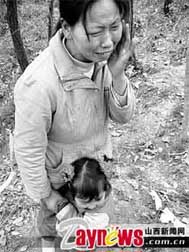
[in translation]
CCTV <Economics 30 Minutes> reporter Wang Liping said that their team of three persons were gathering news in Zhugezhuang town, Changli county, Qinhuangdao city yesterday morning when they were intercepted by a white van and a black Honda sedan. They were then pushed around and assaulted by a dozen unidentified men. The Changli county publicity department "disagreed with this description."
According to Wang Liping, at around 9:20am, the three were filming from a bridge overlooking an iron factory at Zhugezhuang town, Changli county. They were blocked by a white van in front and a black Honda sedan in the back. More than ten identified men then dragged the three of them out of the car and took away their camera, mobile telephone, car keys and driver license. According to the photographs provided by Wang Liping, she had obvious signs of injury on her stomach and hands.
At 9:30am, the militia police from the Zhugezhunag town police station arrived at the scene and took the three back for interrogation. "They did not ask about the assault incident at first. Instead, they asked whether we were CCTV reporters." Wang Liping said that they were on a regular mission with a letter of introduction and CCTV passes. At around noon, the equipment taken away (including the mobile phones) were returned to the three.
At around 19:30pm, this reporter conducted Changli county publicity department director Zhang Aijun. She said: "We do not accept that they are CCTV reporters. They were unable to show press cards and work identification."
According to <Economics 30 Minutes> editor-in-chief Zhang Kehua who rushed to Changli at 17:00pm, the three of them have a letter of introduction from CCTV Economics Channel and CCTV entry passes. Wang Liping's press card is presently undergoing the annual review.
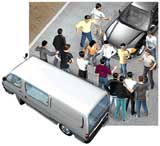
Yesterday morning, <Economics 30 Minutes> was filming the rule-breaking, polluting iron factories in Zhugezhuang town, Changli county, Qinhuangdao city. Suddenly, a white van stopped the progress of their vehicle. Then another black sedan arrived. More than twenty persons dragged the three CCTV reporters out of the car. Worse yet, some of the men dragged the female reporter to the river side (more than 10 meters deep) and attempted to throw her into the river. When a male reporter attempted to come to her assistance, he was kicked several times in the chest. During the tussle, the female reporter was injured in the hands, face and waist. During the beating, the men were yelling: 弄死一個是一個 (One dead is one down).
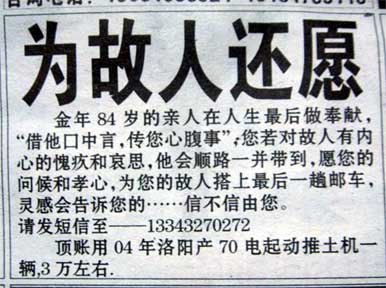
[in translation]
I'm a loyal Andy Lau fan! After watching the cold indifference of Andy Lau towards Yang Lijuan, I am broken-hearted and pained as a fan. I feel that society should be sympathetic about the Lijuan affair instead of treating her like a "mental patient"! I'm a Andy Lau and I can therefore understand the behavior and deeds of Lijuan.
The death of the father of Yang Lijuan is not an outcome that anyone wanted to see. Therefore Andy Lau should not be cold towards Yang Lijuan in because he is worried that the same thing might happen again. This is an "isolated individual" case and he should offer special concern and comfort! He should not lack human concern! At this time, Yang Lijuan and family are near mental collapse. Society is treating them like jokes! This is unbecoming!
Since Andy Lau has media and opinion on the side, he should take special care of Yang Lijuan, including even taking care of her for the rest of her life. Today, as an Andy Lau fan, I advise Andy Lau to accept responsibility for Yang Lijuan. Such are the voices and expectations of us fans! They are also the voices and expectations that society ought to have!
If Andy Lau refuses to accept responsibility towards Yang Lijuan within one week, I will kill myself in the school dormitory as a strong sign of protest! I protest the cold indifference of Andy Lau and society.
Beijing University student: Zhang Bo
What is going on? Well, this post was dated April 1st ...
Addendum: (Tianya) There is now even a video of "Zhang Bo" threatening suicide, including approaching an opened window and pointing a knife at his stomach (all with a printed letter to Andy Lau stuck to his body).
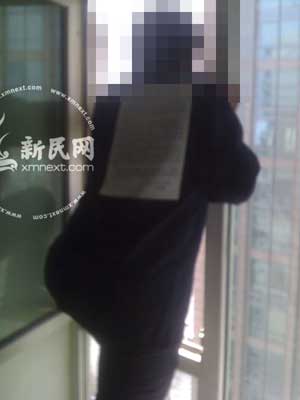
What should be done about this? One netizen suggestion is to shut the blog down. Yes, but whatever happens to his freedom of speech? Here is the blog post accompanying the photographs:This is day two. Andy Lau has not responded yet.
I am disappointed. I don't know if he is unaware or he doesn't care about my protest!
No matter what, I will continue to wait ...
After one week, if Andy Lau has not yet given Yang Lijuan a satisfactory answer, then I will keep my promise -- the promise of a martyr!
I am thinking which manner of dying will receive resonance in society,
and draw Andy Lau's attention.
Perhaps the tragic and grandiose act of jumping out of a buidling is the best choice.
I hope that the media headlines one week later will show the photograph of me with blood oozing out of my eyes, nose, mouth and ears.
Only that kind of sight will give shock
and cause netizens to reflect.
On April 3, China Youth Daily reported that the Chongqing municipal government/party has required that Chongqing Daily News can only present reports about the normal activities of the city party secretary, mayor and People's Political Consultative Council on page 2 and in not more than 1,000 words; television and radio reports will not present these reports as the top stories and any report must not be longer than 3 minutes. Instead, the vacated space shall be used to report on and serve the broad masses.
I believe that this action will be appreciated by Chongqing citizens as well as people outside. In the recent "nail house" case, the Chongqing officials did not issue a ban order on media coverage. This seemed to have elevated Chongqing's image in this regard as leading the nation.
... In thinking about the evolution of the news industry over the past 30 years of economic reform, advances came step by step. Following the appearance of the market economy and the emergence of individualized readers, the various kinds of lies (distortions, straight lies, empty talk) are still present today in the media. However, they no longer have a market and they are there only for the self-enjoyment of certain people. When a breaking event occurs, the media are going for timely and active reporting instead of choosing avoidance and silence; international news reporting is more objective and rational; the space for commentary has also increased greatly over the past few years.
But it cannot be denied that in certain places, the media (especially the newspaper front page and the top story in broadcast media) are still the private domain of officials. About twenty years ago, I worked for a local newspaper that had only four pages. The inside joke was: "It is so easy to run a newspaper. Page one is sold to the party committee; page two goes to the correspondent; page three (the literary supplement) goes to the frustrated literati; page four goes to the wicked businessmen (advertiser)."
Nowadays, there is more social news and entertainment content, but the front page looks the same. I heard that our current city party secretary stipulates that his activities shall appear on page one and the mayor's activities shall appear on page two. At the newspaper, an open secret is this: A newspaper does not have to care about whether everybody is satisfied; it only has to make sure that the party secretary is not dissatisfied.
... I also see another puzzling phenomenon: people usually believe that as the economy gets more developed, it is more likely for systems of democratic governance and justice to be realized. But sometimes the opposite happens. Underdeveloped places such as Chongqing are often more likely to have enlightened officials, whereas some more prosperous places have less space for the media to operate. This is thought-provocating indeed.
Related Link: Print and be damned Positive Solutions
At a staff meeting of Songquan Middle School (Luowu district, Shenzhen city) on November 20, 2006, the administration encouraged the teachers to enter into a national competition for the best teacher's blog. So the teacher Rong Wei (荣炜) opened a blog at the Luowu Education Net on November 27, 2006.
Rong Wei's blog became an important bridge for communication among teachers, students, parents and friends. It became a popular spot on the Luowu Education Net. Within four months, she had collected more than 110,000 hits. On January 10, 2007, at the Luowu Department of Education's Fifth Annual Science and Technology Information Festival, her blog was rated fifth place in the first-class awards and recommended to the national educational bloggers' contest.
But when Rong Wei went to her blog at 3:30pm, March 27, she discovered that her blog has been shut down.
What happened here? This was about what she put on her blog. Apart from recording her teaching and daily life, Rong Wei also reported on experiences at her former school, the Guiyuan Middle School. She had spent more than ten years there before leaving a year ago. Rong Wei recalled how she took over a class in September 2004. Thereafter, the students in her class performed well except in the subject of science. The students and parents wanted the science teacher to be replaced but their pleas had no effect on the school. One day, a deputy director named Chen told Rong Wei that the science teacher "had a deal" with the school. At a parents' meeting, Rong Wei informed the parents. The science teacher found out and had a row with Rong Wei. The next day, the principal met with Rong Wei and informed her that she was being replaced. Rong Wei summoned Chen to be her witness, but Chen promptly denied ever saying it. In front of many other teaches, Rong Wei slapped Chen in the face. Two days later, a police report was filed and Rong Wei was taken away for interrogation. The school announced the dismissal of Rong Wei, who then moved to the Songquan Middle School in February. These events were posted on Rong Wei's blog.
On March 27, Rong Wei could not access her blog. She called the website administrator and was told that the blog had been ordered shut down. The next day, Rong Wei went to the Luowu Department of Education and complained to the relevant leader. The person said that the blog had been just down because some of the posts were detrimental to unity and teaching and therefore the blog was shut down. Rong Wei demanded an explanation because she believed that her rights were being violated. On account of her vehement objections, the blog was re-opened at 3pm, and she took a snapshot of the blog. But by 6pm, she could not access the blog again. She also found that the website had new rules such as "respecting others and refraining from using violent, excessive and insulting language when commenting" and "any essay or content that violates the above may lead to the administrator deleting the essays or shutting down the blog if the person fails to heed the warnings."
[in translation]
Last week, 30-year-old Andy Lau fan Yang Lijuan's father jumped into Hong Kong harbor and drowned himself when the actor/singer would not have a private meeting with his daughter. The incident rattled Hong Kong and mainland China, and the mainland media rushed over to follow the story.
Our reporter followed Yang Lijuan and her mother back to their hometown and witnessed how the media manipulated them like puppets on strings ... On Monday, Yang Lijuan learned that she could get a travel permit to come to Hong Kong to take care of her father's funeral affairs. The mainland media then offered money and resources to push this "reality show" to new heights.
On Monday evening, our reporter received a call from Yang Lijuan in Lanzhou. She said that she had been notified that she can get an emergency travel permit to Hong Kong to take care of funeral affairs. "I cannot say that I am happy, but I am relaxed. I can bring my father back, as well as see my father together with Andy Lau." She is asking Andy Lau to pay respects to her father. More importantly, she wants to meet with him for half an hour to have a heart-to-heart chat. She plans to travel to Beijing on Tuesday to meet a singer who has promised to pay for her travel expenses. Once she receives the money, she will "invade Hong Kong again." Part of her travel expenses to Beijing is footed by mainland media. <Southern Metropolis Daily> and <Guangzhou Daily> have raised 4,000 RMB for her.
...
The drowning death of Yang's father created a sensation across China. The mainland media rushed in to cover the story. The most active one is the portal NetEase. ...
Since last Thursday, NetEase has 'wrapped up' the mother and daughter. They arranged for the two to say at the Sichuan Hotel in Shenzhen. On the next morning, the NetEase team 'brought' the mother and daughter to take the earliest flight from Guangzhou to Lanzhou. Since they expected that other media would be waiting at the airport, the group immediately raced towards the waiting van upon arrival and headed straight to the hotel. Nevertheless, three vehicles from other media followed the van.
At the hotel, NetEase asked the hotel to lock the elevator so that it would not stop on the 28th floor where the mother and daughter were staying. The hotel security staff were also instructed to guard the stairs to the 28th floor to prevent any other media from approaching the two.
According to the NetEase field commander/reporter Fu Jun: "This occasion is more than an ordinary news story. We all want this affair to be over with as quickly as possible. Therefore, we arranged for them to return to Lanzhou and we used our connections to get them the travel permits for Hong Kong as quickly as possible. You must know that the next climax is when they return to Hong Kong!"
Fu Jun was very excited and said that NetEase has already spend more than 10,000 RMB on the mother and daughter. If the travel permits become available in a couple of days, then the 'climax' will be ready to take place. Of course, NetEast will be there all the way.
Even Yang Lijuan apparently could not stand the media manipulation. One evening, she came to this reporter's hotel room and whispered: "Can you help me? You should not believe in that website. I don't know what they are up to. They insisted that I return here. They keep telling me what to do. What should I do? You tell me, what should I do?"
If the cow does not want to drink water, it will not lower its head. What to do? She knows very well herself.
According to the Jiulongpo People's Court, the two-storey building was valuated at 2.47 million RMB while the real estate developer offered a replacement shop/home building valuated at 3.06 RMB; as a result, the house owners Yang/Wu will pay back the difference of 590,000 RMB to the developer. Furthermore, the real estate develop will pay compensation to the amount of 900,000 RMB for business losses plus 105,000 RMB for property damage and moving expenses. This is coming down from the 5 million plus RMB originally demanded by Yang/Wu.
Here is the chronology:
On March 25, Wu Ping met with the court's director and executive judge and spoke for three hours. The court director noted that the two parties differ too much in their demands and they don't trust each other anymore. This made mediation very difficult.
On March 26, the two parties met for more than two hours without resolution.
On March 27, the court organized for the two sides to meet again. But the differences were still hard to reconcile and sharp words were exchanged with threats of breaking off future contact.
On March 28, Wu Ping asked to see district party secretary Zheng Hong in the company of the court director. After a meeting that lasted more than three hours, Wu Ping's attitude changed greatly.
On March 29, the court organized for the two sides to meet and discuss the concrete details of the settlement. The developer went and prepared a ladder for Yang Wu to come down.
On April 2, the two sides reached agreement. Shortly afterwards, Yang Wu came out of the building. In view of the fact that if demolition were to occur during daytime, there could be a mass gathering to observe the proceedings and that might lead to safety and security problems. Therefore, the demolition took place that night.
At this time, both parties claim fatigue and are refusing press interviews for now.

Rating of CE Donald Tsang (note: 0-100 marks given):
68.1 (compared to 66.9 on March 1-6, 2007)Vote of confidence in CE Donald Tsang: 79% (compared to 76% on March 1-6, 2007)
Satisfaction with:
Relation with Central Government: 67% (compared to 58% in December 18-20, 2006)
Maintaining economic prosperity: 56% (compared to 46% in December 18-20, 2006)
Protecting human rights and freedom: 50% (compared to 50% in December 18-20, 2006)
Improving people's livelihood: 37% (compared to 25% in December 18-20, 2006)
Pace of democratic development: 37% (compared to 28% in December 18-20, 2006)
Abjection \Ab*jec"tion\, n. [F. abjection, L. abjectio.]1. The act of bringing down or humbling.
The abjection of the king and his realm. --Joe.
2. The state of being rejected or cast out.
An adjection from the beatific regions where God, and his angels and saints, dwell forever. --Jer. Taylor.
3. A low or downcast state; meanness of spirit; abasement; degradation.
That this should be termed baseness, abjection of mind, or servility, is it credible? --Hooker.
For the details of the history, see Rainie Yang Goes To China. In brief, Rainie Yang Chenglin (杨丞琳) is a Taiwan-based singer/actress who achieved notoriety for her comments about China-Japan history on a television celebrity quiz show three years ago. As Rainie Yang began to enter the mainland market, she found herself against the Chinese patriots who revive that episode and call for boycotts. So every time that she makes another career move on mainland, she has to hold another press conference to apologize. Here is the latest one:
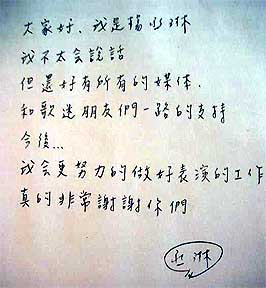

(NetEase Entertainment via 6Park) On April 3, 2007, Rainie Yang called a press conference to apologize to the people of China once again. She read out a letter: "How are you? I am Rainie Yang. I don't know how to speak very well. I am fortunate to have the continual support of all the media and fans. From now on, I will try my best to perform well. I am really grateful to you. Chenglin."
Rainie Yang said: "Actually some netizens distorted what had happened on the show. But here I want to thank the mass media for giving me a chance to clarify, or to make a sincere apology. I want to apologize to the mainland friends for my inappropriate speech at the time." Then she got up and made a bow. She sat down again and continued to speak: "On that show, I was about to explain but the host cut me off. I made the mistakes because I am not familiar with history. I hope that you can forgive me ... from now on, I will continue to study history ... thank you."
Rainie Yang was then given a history book with the explanation about contemporary Sino-Japanese history. She accepted the book and said: "I had not studied a lot because I quit school early to work. I am willing to read whenever I find the time. I believe that I will understand history better in the future. I want to thank everybody again. I also want to tell those netizens who are distorting the facts to please not to continue doing that. I will try my best with respect to my work in the future. Thanks." Then she picked up the book and started reading in front of the media.
Is this yet another acting performance from an actress? What is really going on in Rainie Yang's mind? That is for her to know and everybody else to speculate. Her case reflects the dilemma for any Taiwan-based actor/performer. Do you want a performing career on mainland China? You know that this is a much bigger and less crowded market than Taiwan. You know that you have a natural advantage because you know the language. But you also know that you must avoid certain 'politically incorrect' topics unless you want to draw the wrath of the 'angry Chinese youth.' Rainie Yang provides the case study of abjection.
[in translation]
... In the March 26 issue of TIME magazine, Hong Kong was on the front cover with the lead story being an interview with Chief Executive Donald Tsang. The local media obviously focused on this interview. In the same issue, there was a more important essay that nobody paid attention to. Not a single word was quoted by the Hong Kong media. This essay was written by the Executive Council convener Leung Chun-ying (梁振英) who is a member of the Standing Committee of the Political Consultative Council. ...
The title of Leung's essay is Child of Motherland. From the title, it does not seem to be any big deal. But the sub-heading pointed out the main point of the essay in a clear way: "As a part of China, Hong Kong cannot and may not autonomously determine its own democratic system." Leung wrote: "Unlike other colonies, Hong Kong did not become independent. It became part of a nation—China—and was given not full but a "high degree" of autonomy, under the principle of 'one country, two systems.'"
"Under the Basic Law, the central government in Beijing has the power to appoint as well as remove Hong Kong's Chief Executive. Furthermore, the Chief Executive has a duty under the Basic Law to be accountable not only to Hong Kong but to the central government. Democracy, therefore, is not for Hong Kong alone to determine.
This two-part process—election by Hong Kong and appointment by Beijing, and the dual accountability to both Hong Kong and Beijing—is unique. It's also a constitutional reality."
Then Leung got to the meat of the matter. He wrote: "Universal suffrage without regard to this reality will risk serious confrontation between the Hong Kong electorate and China. We need to assure all parties that, when universal suffrage is introduced, Beijing will retain its power to appoint the Chief Executive. Both Hong Kong and Beijing will have to accept that the elected candidate is accountable also to the other side."
To put it plainly, Leung pointed out that if the central government permitted the people of Hong Kong to elect a Chief Executive via universal suffrage and if the people of Hong Kong elect a Chief Executive unacceptable to the central government, then there will be a huge constitutional crisis. The gossip in the political circle is that the appointment of the Chief Executive is an important part of sovereignty for the central government and this line cannot be crossed, since many of the powers of the Chief Executive were conferred by the central government. But as the Hong Kong people see it, if they elect a certain Chief Executive, then they obviously expect this person to take charge. If this person does not receive the appointment by the central government, then this is a direct confrontation. If there is no credible system to deal with this matter, the political aftermath will be disastrous. Therefore, political insiders say that this is the part of the political reforms that the central government is most concerned about.
The above background explained that why pan-democratic Chief Executive candidate Alan Leong's proposal to revise the Basic Law was criticized severely by the leftists. The key point was that the Leong proposal went past the line for central government sovereignty. For this reason, when Donald Tsang met with the media on March 21 as a Chief Executive candidate to discuss the future of political reform, he used the bold words: "大家香港一齊玩一鋪勁的 Let everybody in Hong Kong play a big game together."
Informed sources say that Tsang is confident that he can handle this issue based only upon one reason: Hong Kong people are pragmatic. But it is hard to say whether the central government shares that same confidence. A person familiar with the Beijing political situation predicted privately that Hong Kong will not have an easy time with political reform.
A police cadet standing to the left in a photograph has the muzzle of a handgun in his mouth, while a classmate standing next to him, in full uniform and smiling, levels a second handgun at the cadet's temple. Other grainy photographs show similarly disturbing scenes of what Chinese Nationalist Party (KMT) Legislator Chiang Lien-fu (江連福 ) said yesterday were police cadets fooling around with guns during training. "I received the pictures as a file attached to an anonymous e-mail from a Taipei police academy and I was just appalled," Chiang told the Taipei Times after displaying the photographs at a press conference in the legislature on Friday. The file contained 30 photographs of cadets playing with guns by pointing them at one another, at a salamander and at other random targets. Other pictures showed cadets viewing pornography in class and drinking alcohol in their dormitories, he said.
But this is much less than what the Chinese-language press in Taiwan was reporting.
(China Times via 6Park) 学生用玻璃啤酒瓶、香烟、糯米肠等异物插肛门,以及徒手戳肛门、用棒冰棍拍打男性生殖器等 (translation: The students inserted glass beer bottles, cigarettes, glutinous rice wrapped sausages and other foreign objects into the anus; bare fists were also thrust into the anus; ice hockey sticks were used to slap male reproductive organs).
Why is precise reporting of the details of the sadism significant? Because the president of the Taiwan Police college Liu Chin-chang 劉勤章 was quoted as saying that these acts were just "生活花絮" (translation: tidbits of life). If you come away with the impression that these photographs (which were downloaded from a blog) were just about students shooting salamanders on the wall, reading pornography and drinking alcohol in the dormitory, you may agree that these are "tidbits of life" and that there is nothing here. You wouldn't feel anything if a beer bottle was inserted up your anus ...
The Chinese tend to view America in extreme ways. Some Chinese speak of the US as if everybody there is rich and happy — I'd say this is probably the most common viewpoint among average Chinese. But there is also a lot of talk about American poverty, violence, guns, as well as the bullying tendencies of the American government. This line of thought is often encouraged by the Chinese media. When I taught in Sichuan, my students used a Chinese published textbook called Survey of America, which included one chapter about "Social Problems." This is a sample paragraph:
"In 1981, in California University, robbery and rape increased one hundred and fifty percent. In a Cathedral school of Washington District, a girl student was raped and robbed by a criminal with a hunting knife while she was studying alone in the classroom. In a California university, a football coach was robbed on campus by someone with a gun. It is said that, in South Carolina University, gangs of rascals have been taking girl students, women teachers and wives of teachers working in this university as their targets of rape, which has caused a great fear."You can imagine how frustrating it is for an American teacher to be expected to use such a book to introduce the United States to a classroom of young Chinese. I'm sure that these incidents are true — certainly, there are rascals in South Carolina —and I imagine that the details were culled from American newspaper stories. But that doesn't make them a useful starting point for students in a small town on the Yangtze. They need context, not a bunch of scattered facts and trivia. When I talk to Chinese about America, I often find myself trying to push them away from the extremes. I don't want them to think of the U.S. as either paradise or hell. They need to see it in human, everyday terms.
How might this series of photographs be reconciled with Hessler's remark. These photographs certainly presently the Chinese in 'human, everyday terms.' But it also provides no context. As Peter Hessler wrote in Oracle Bones (see quotation):
When something dramatic caught the foreigner's eye, he pursued it: child-selling in Gansu, female sterilization in Guangxi, jailed labor activists in Shandong. The articles appeared in American newspapers, where the readers couldn't solve the problems and didn't have the background necessary to keep everything in context. It was like the Fuling (Sichuan) textbook: sometimes, the more information you have, the less you know. And there is a point at which even the intentions become voyeurism.
Yet, no sooner does a context is put forward than the individuals in the photographs get subsumed under the broad and abstract theme (e.g. modernization, uneven economic development, natural and man-made disasters, democracy, instability, inequality of wealth, etc). Wouldn't that be de-humanizing China?
Archives