The Hong Kong 7/1 March: Crowd Size Estimates (Civil Human Rights Front / Human Rights Monitor)
SOURCE #1: CIVIL HUMAN RIGHTS FRONT says 530,000
SOURCE #5: HUMAN RIGHTS MONITOR says 160,000
According to Yahoo! News, the march organizers have put in a claim of 530,000 people today, which is larger than the 500,000 last year. There were several conflicting figures from the organizers through the evening, with 350,000 at 5:00pm, 400,000 at 6:40pm, 450,000 at 6:55pm but I am going with the latest number of 530,000 at 9:20pm. Incidentally, the different numbers at different times is the reason why foreign news sources are reporting different totals depending on their deadlines.
Civil Human Rights Front spokesperson Jackie Hung Ling-yu said that the front of the march departed at 2:30pm from Victoria, half a hour before the scheduled time, and took 90 minutes to reach the Central Government Office in Central. Based upon government information, the road between Victoria Park to the Central Government Office could hold 170,000 persons. The end of the march reached the Main Government Building at 8pm. Therefore, they inferred that there must have been 530,000 persons present today.
How does this calculation work? This is not rocket science. They give this type of problem to primary school kids. Let me stipulate that I will accept all the assumptions about travel time and road capacity because I have no reason to doubt them (and no reason to accept them, either!). So here is how I did it.
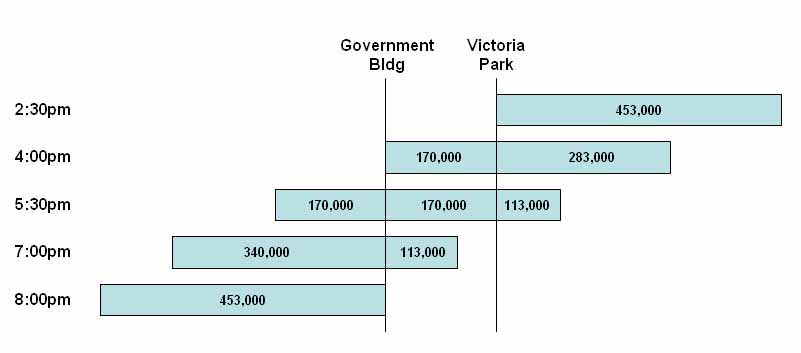
At 2:30pm, the front of the march departed from Victoria Park and arrived at the destination 90 minutes later at 4:00pm. At that point, the route is filled to the brim with 170,000 people. Good. So the running total is 170,000 people.
At 4:00pm, the next group of people departed from Victoria Park and arrived at the destination 90 minutes later at 5:30pm. At that point, the route is filled to the brim with another 170,000 people. Good. Now the running total is 170,000 + 170,000 = 340,000 people so far.
At 5:30pm, the next group of people departed from Victoria Park and they kept leaving until 6:30pm. The latest time for departure is 6:30pm because they needed 90 minutes to finish at 8:00pm. Thus, the last group of people all left within one hour, which means that the road was only two-thirds full. This means 170,000 x 2 / 3 = 113,000 people. Good. Now the running total is 170,000 + 170,000 + 113,000 = 453,000 people. This is illustrated as follows.
How did they arrive at 530,000? I am clueless (note: see comment further down after the Sun article where the organizers gave the explanation of their (incorrect) calculation).
The organizers also claimed that they had volunteers at various points to count the crowd. No methodology was described, and no clue was given as to how the two estimates were reconciled to arrive at 530,000.
By the way, the police estimate was 200,000 this year. Last year, the organizers claimed 500,000 whereas the police estimate was 350,000.
For the record, I really don't care whether the number was 530,000 or 200,000 or whatever. Nor did it surprise me that the estimates from different parties should diverge so significantly. The real point was that there were a lot of people out there, enough to influence the September elections and thereafter.
Professionally, I don't like people playing loose and fast with numbers. Let me very specific about what I did. I made no assumption about people's motives and actions. I took the assumptions as stated about travel time, crowd capacity, start and finish times, and I made a clearly described set of calculations. I am not able to reconcile my number with the claimed total of 530,000. I explained what I did and I made no judgment. Period. My professional reputation is that I am infuriatingly logical, precise and unemotional. So please don't come after me with a battle-axe ...
As protection against revisionism, here is the original article in Chinese for the record:
民陣:53萬人上街勝去年
7月 1日 星期四 21:20 更新七一遊行龍尾在八時前抵達政府總部,歷時五個半小時,民陣指有五十三萬人參加遊行,警方估計有二十萬人。
民陣宣布,今日參加七一遊行的人數有五十三萬人,比去年的五十萬人的數字為高,民陣發言人孔令瑜表示,遊行隊頭在下午兩時半出發,用了九十分鐘時間抵達政府總部,而根據政府所給的資料,由維園至政府總部可容納約十七萬人,他們以此推算數字,另外民陣亦派義工在不同地點計算人流。而警方估計,今日只有二十萬人參加遊行。
立法會議員司徒華表示,對於有五十三萬上街,感到驕傲,「你不是比一粒糖佢食,就可以呃到佢地。」
由於參與遊行的市民在二時三十分前已差不多聚集滿維園六個足球場,主辦團體民間人權陣線與警方協議後,決定提前半小時,於下午二時半出發。
大會安排潮水式放行,讓足球場內的市民分批加入遊行,以免維園外聚集得太多人。龍頭隊伍在四時前抵達政府總部,維園內仍有許多人等待出發。而龍尾亦在五時半前出發,並於八時前抵達。
在酷熱天氣下,無減參加遊行市民的熱誠。市民高喊各式各樣的口號,包括「還政於民」、「爭取07/08普選」、「重建希望」。此外,亦有市民喊出「董建華下台」的口號,亦有要求保護海港、保飯碗及反對官商勾結。
有傷殘人士坐輪椅亦參加遊行。由於天氣酷熱,不少市民攜帶雨傘出席,形成一片「傘海」,天文台錄得今年最高溫度34.6度,並發出酷熱天氣警告,有逾五百人在維園或遊行途中不適,要到醫療站接受治療,四十二人被送院。今日是有紀錄以來氣溫最高的七月一日。
在去年七一遊行,天文台亦曾發出酷熱天氣警告,中午氣溫高達攝氏31度,當時民陣估計有五十萬參加遊行,警方則估計至少有三十五萬人參加遊行。
(The Sun) Updated at 3:00 am on July 2, 2004.
[translation] As for the vast difference between the 530,000 and 200,000 estimates, the police said that they used several methods to estimate the crowd size, including counting the number of people who departed from Victoria Park, the number of people in the middle at designated points and times and then they used the average. They also used the number of people who exited the subway stations along the route as reference. Civil Human Rights Front spokesperson Jackie Hung Ling-yu said that they also used the method suggested by the police to estimate the crowd size. If the route from Causeway Bay to Central is filled, there should be 170,000 persons. A total of three groups of people passed through, so that the total is 510,000. Another 20,000 did not go up to the Central Government Office. Therefore, the total number of marchers was 530,000.
Lecturer Sung Lap-kung at the City University School of Professional Studies thinks that the Civil Human Rights Front over-estimated and the police under-estimated. Research statistician Wong Kar-Ying from the Chinese University of Hong Kong Pan-Asian Research Center questioned that the density of the march this year was less than last year, so that a figure between 360,000 and 390,000 was more reasonable.
對於統計遊行人數出現五十三萬人與二十萬人的大差距,警方消息說,他們主要透過幾個方法計算人數,包括從維園每個球場面積估計出發時的人數、遊行至中段又以特定地點及時間作統計,再取出兩者平均數值,並以沿途地鐵站出閘人數作參考。民陣發言人孔令瑜卻說,他們也是用警方提供的方式統計遊行人數,即由銅鑼灣至中環遊行路線上擠滿人時的人數有十七萬,共有三批遊行市民經過,以此推算有五十一萬人遊行,另加兩萬名沒有行上政府總部的市民,總數五十三萬人。
城大專業進修學院首席講師宋立功認為民陣高估遊行人數,警方則低估。中大亞太研究所研究統籌員王家英亦質疑,今年遊行隊伍較去年鬆動,總人數應為三十六至三十九萬人較為合理。
Here is the scenario according to Jackie Hung Ling-yu. There were three groups of people, each group of size 170,000. The first left at 2:30pm and finished at 4:00pm. The second left at 4:00pm and finished 5:30pm. The third left at 5:30pm and finished at 7:00pm. And there was an additional 20,000 somewhere; this 20,000 is a 'fudged' number because the estimate of the number of people who did not finish is extremely difficult. I agree that these people exist, but why 20,000? Why not 15,000? Or 30,000?
Overall, this is a seemingly plausible scenario, except that it is not physically possible. The groups actually have to occupy space on the road. They cannot all leave from the same spot at the same time and arrive at the same spot at the same time. For example, the leader of the first group left at 2:30pm and finished at 4:00pm. That does not mean that the entire group has finished. At 4:00pm, the end of the first group had just left the starting point and they would not finish until 5:30pm. This is clear from the chart above that I made. It takes a grand total of 3 hours for a group of 170,000 to start and finish completely. So when the third group left at 5:30pm, the leaders would indeed finish at 7:00pm. However, the end of that third 170,000 group did not leave until 7:00pm and so they wouldn't finish until 8:30pm. The march was reported to have been over by 8:00pm, and the Transportation Department re-opened the roads at 8:05pm. So this is not a physically feasible scenario.
The following letter was sent to the South China Morning Post. It disclosed an unintended piece of information that challenges one of the assumptions used by the Civil Human Rights Front.
(Sunday Morning Post) Why the count was low. Letter to the editors from Dee Hartland-Swann of Repulse Bay. July 4, 2004.
Perhaps the police, besides march organisers could explain to your readers how they arrived in their tally of 200,000 as against 530,000 marchers ("Police taught us how to count, say organisers", July 3).
Where along the route did they stand to assess the numbers? If people were being counted at the end point of the march, the Central Government Offices (CGO), then estimates will wildly undershoot the actual total. Not all marchers went on to the bitter end. Let me explain, for I was there.
After several hours of good-natured slow walking in exhausting heat, our section of the demonstration finally arrived at the Legislative Council building. Marchers then had to be funnelled on to the narrow paths leading up to the CGO. Many parents felt their children had had enough by then and opted to leave. Others left the march because they were worried that the sheer mass of people was forming a bottleneck as the wide roads of Wan Chai and Central gave way to narrow paths. They also felt that their essential point had been made. If the police were simply counting those who arrived in front of the CGO, then they will have missed well over one-third of the demonstrators, the people who were sensible enough to avoid creating chaos by mindlessly surging forward into the bottleneck.
I note that the Post's aerial photo of Central in the July 2 issue showed the march at precisely the point where the orderly, tightly packed crowds began to disperse. The crowd I was in for more than two hours on Thursday afternoon was a lot more dense than the photo suggests.
Central to the Civil Human Rights Front's assumptions is that it took the marchers 90 minutes to complete the march. That may be true for the march leaders. But Ms. Hartland-Swann said that it took her more than two hours and she did not even reach the true finishing point. If the average time was in fact 2 hours, then the crowd size would in fact be smaller by a factor of 1.5 / 2 = 75%.
(Sing Tao Daily via ChineseNewsNet)
[translation] After the Civil Human Rights Front announced that 530,000 attended the 7/1 march, the figure was questioned by many people. On July 3, Sing Tao daily received a letter from a reader who is a graduate of Hong Kong University to point out that the Civil Human Rights Front's calculation was in error. They had turned two waves into three, and therefore inflated the march crowd by one-third. When the reader's explanation was shown to Lee Cheuk-yan and Jackie Hung at the Civil Human Rights Front, they did not rebut and therefore tacitly accepted that the calculation was in error. But they did not change their estimate of 530,000.
According to Sing Tao Daily, Jackie Hung waved her hands and said, "What do you want me to do?" She emphasized that she had no need to 'exaggerate' the number. Apart from the formula, they also counted with humans and the number was similar. She also pointed out that the number was not important, and that the really important thing was that the government has to make a resonse to the demonstration.
The Civil Human Rights Front has been form on the 530,000 estimate which is based upon a set of calculations. The method is based upon police data which say that the route from Victoria Park to the Main Government Building can contain 170,000 persons who will take 90 minutes to complete. Since the march took 5.5 hours to complete, the Civil Human Rights Front divided this by 1.5 to obtain three waves of marchers. 170,000 x 3 = 510,000. If 20,000 more are added as those joined midway, the total became 530,000. But this calculation involves an elementary school error present in the "tree planting" problem by double counting the last wave.
On July 3, Sing Tao Daily received a letter from reader Yuen Chi-keung, who had just graduated in biology from Hong Kong University. He pointed out that there was a serious error in calculation, and he said that the crowd estimate was a hot topic at Internet forums.
Yuen Chi-keung pointed out that based upon the facts of the march and the assumptions made by the Civil Human Rights Front, the route can contain 170,000 persons at a time and the trip took 90 minutes. Between 230pm and 400pm, the first group of 170,000 departed. The second wave departed between 400pm and 530pm. The third wave departed at 545pm. In other words, the third wave did not contain 170,000. The whole march only contains 2.17 waves, which gives 2.17 x 170,000 + 20,000 = 390,000.
The newspaper also interviewed Lingnan University Public Administration Research Department head Lee Peng-kwong and he agreed with the calculations of reader Yuen Chi-Keung while declaring the Civil Human Rights Front's number to be in error. When Civil Human Rights Front's Lee Cheuk-yan was interviewed, he also agreed that Yuen Chi-keung's calculation was correct but he believes that there were many people who joined in the middle. When asked if their calculation was wrong, he said that he needed to go back and discuss with his people.
Jackie Hung said that apart from this calculation, they also used human observers to make counts. When asked about why Human Rights Monitor's count was only 160,000, Hung said that Human Rights Monitor Chief Executive Law Yuk-kai explained to her that if the error in the count was factored it, the number would be more than 200,000 and if more than half the people joined the march in the middle, they can still arrive at a 400,000 to 500,000 total.
香港民陣公布七一大遊行有五十三萬人,連日受到多番質疑,星島日報七月三日收到一位港大畢業的讀者來函,指出民陣計算方法出現錯誤,將本來只有兩輪的遊行錯計為三輪,以至遊行人數高估了三分之一。當天將讀者的論據向民陣的李卓人和孔令瑜求證,他們都未能提出反駁,默認計算方法可能出錯,但就未有改變五十三萬人的說法。
星島日報四日報導說,孔令瑜聽完讀者的計算方法後無奈說,「你想我點答呢﹖」她強調,自己沒有「作大」的必要,而他們除了依據公式推算外,還進行人手點算,亦得出相若的數字。她又指最重要不是數字,而是政府要回應訴求。
民陣連日來堅持五十三萬的遊行人數,是建基於一套計算方法。這套方法引用警方的數據,指由維園到政府總部這條遊行路,可一次過容納十七萬人﹔而由維園行至終點,需時個半小時。民陣於是以遊行由出發到終結的五個半小時,除以九十分鐘計算,計得可以有三輪遊行。以十七萬乘以三輪,即是五十一萬,再計算兩萬中間插入人士,即五十三萬。不過,民陣這一計算方式,卻犯了一個類似小學算術中的「植樹問題」錯誤,重複計算了最後一輪的人數。
星島日報三日收到一名剛在港大生物化學系畢業的讀者袁智強的來函,指證民陣計算方法出現嚴重錯誤,他並指上街遊行數目連日來已成網上討論區的熱門話題。 (chinesenewsnet.com)
袁智強指出,根據遊行資料和民陣提出的基本假設,整段遊行路面每次可容納十七萬人,而遊行路程為個半小時,由兩點半至四點鐘這個半小時內出發的,即為第一輪十七萬人﹔第二輪十七萬人則是在下午四時至五時半出發的人。由於最後一批出發的人士是在五時四十五分,換言之,第三輪根本沒有十七萬人。整個遊行只有二點一七輪人次,再將二點一七人次乘十七萬人再加中途插入的兩萬人,即應有三十九萬人。報導說,嶺南大學公共管治研究部主任李彭廣三日接受查詢時,認同讀者袁智強的推算方式,同意民陣的計算方法出錯。而民陣李卓人接受查詢時,亦同意袁智強的計算無錯,但他認為可能有很多人是在中間插入。問他民陣是否計算錯誤,他表示要回去再討論。
孔令瑜說,民陣除了這個計算外,亦有進行人手點算。對於民陣成員人權監察進行的人手點算只有十六萬人,孔令瑜說,人權監察總幹事羅沃啟曾向她解釋,若將人手點算的誤差計算在內,可以有二十多萬,若有一半人是從中間插入,亦可以推算出四、五十萬的數目。
The deduction by Sing Tao Daily reader Yuen Cheuk-yan is similar to my physicality argument. There is an additional piece of information that Yuen Cheuk-yan used: the third wave departed between 530pm and 545pm, which meant that the size of the third wave was only 1/6-th of 170,000. That was how he got to 2.17 x 170,000 + 20,000 = 389,000. The 545pm departure time for the last significant number of marchers is not being disputed by the Civil Human Rights Front.
As the Sing Tao Daily report said, this is elementary school mathematics and is logically irrefutable. However, the Civil Human Rights Front is assuming an unethical position in which they have made up their minds that they needed to reach 500,000+ and they are rationalising in other ways to get there.
After the central theoretical foundation of their calculation had just collapsed due to an irrefutable error, they claimed that there could have been more people who joined in the middle. In fact, there will be conveniently enough people to reach 400,000 to 500,000.
Then they said that their calculation was supplemented by counts from human observers, for which they did not cite the results. How low was that number that they were unwilling to disclose initially? The Sing Tao Daily article said that Human Rights Monitor counted 160,000 marchers, a number which the Civil Human Rights Front spokesperson does not dispute. So we are now left with the need to come up with 200,000+ phantom marchers who all joined in the middle in order to hit the production quota. This is strongly reminescent of production statistics in the Great Leap Forward era. This is 'fudgy' statistics, and the statistician in me finds this appalling.
Look, this estimation business with the Civil Human Rights Front is getting silly. Here is my recommendation for a public position:
"We thank people from different walks of life for pointing out that we made a technical error in calculating the crowd size. We agree that we were wrong. At this point, we cannot definitively provide an accurate estimate based upon the data that we have collected. All those of you who have discussed this issue would surely recognize that there are a number of theoretical ways of estimating crowd sizes, but they all seemed to have some kind of flaw. We will consult with the community to find the best method of counting for future projects, and this method is transparent and will be published beforehand in order to solicit feedback.
Meanwhile, the precise number of marchers is less important than the undeniable fact that the people of Hong Kong have once again demonstrated that they wanted ... [insert list of demands] ... to which the Hong Kong SAR and Chinese central governments are now obliged to address."
The more they try to fudge, the greater the loss in credibility. Ask yourself: would you want the people in the Civil Human Rights Front to manage the government budget? Frightening thought, isn't it? Move on already ...
The Civil Human Rights Front posted a press release on their website dated July 4, 2004.
[translation] Concerning the problem about the number of marchers on July 1, the Civil Human Rights Front emphasized again: on that day, from the first arrival at the Central Government Office to the last arrival took 4 hours; the time to go from Victoria Park to the Central Government Office is 90 minutes. Therefore, there were about 3 trips. According to the estimate provided by the police to the Front of 170,000 per trip, adding people who joined the march in the middle, we estimated that there were about 530,000 persons.
The Front's method of calculation may contain imperfections. Therefore, the Front welcomes other organizations to disclose their estimates and methods in order to let the citizens decide for themselves and also for the Front to consult in the future.
就七月一日大遊行參與人數問題,民間人權線重申,當日以第一個到達政府總部至最後一個到達的人士 共需時四小時;而由維園到政府總部共需約一小時三十分鐘,故共接近三轉。而每轉按警方對本陣線表示共十七萬人 推算,再加上中途插隊人數,故推算出約五十三萬人。
本陣線推算方法定有不盡完善的地方,故本陣線歡迎其他機構公佈有關點算結果及方法,讓市民自行判斷,並作本陣線日 後參考。
The Civil Human Rights Front seemed to be in disarray regarding a response. On July 5, a day before the Front members convene to go over the issues, the following conflicting remarks were reported by Sing Tao Daily:
Civil Human Rights Front spokesperson Hung Ling-yu admits that the announced figure is definitely not authoritative. She said that they will discuss the method of calculation in tomorrow's meeting. She emphasized that the counting done by the volunteers is reliable. She said that it is possible that they will get more volunteers to work in the future. She admitted frankly that the work of these volunteers was stressful, which was why there were only a few volunteers this time. [Comment: That is missing the point! It is not the quality or quantity of work done by the volunteers that is the problem. Nobody is blaming the volunteers, whose work was ignored in the 530,000 number anyway. To arrive at the 530,000 number, they required no resources whatsoever. They met with the police and obtained a density estimate of 170,000; they saw that the march started at 230pm and ended at 800pm; they plugged the information in a faulty formula and added an arbitrary 20,000 more without any basis. The whole job can be done by one person without ever getting out of the chair. There is no point in getting an army of volunteers if you are going to use a bad formula that ignores the fruits of their labor at the end.]
She said that that the Front will discuss the problem of the march number tomorrow. But she did not directly respond as to whether they will make a public announcement that there was a problem with the number. She only said that if there really was a problem with the number that needs to be publicly disclosed, then they will discuss it. [Comment: Very circular and confusing; lexicographic hair-splitting in the tradition of White House spokesmen Ari Fleischer and Scott McClelland.]
The assistant spokesperson Tam Chun-yin said that if the error was too large, then there should be a public announcement. [Comment: This is dodgy but absolutely correct for public relations. Large error=bad. Everybody agrees with that. But he is not saying what constitutes a large error.] Tam said that the Front's method is the only thing that they can do with the limited resources. He admits that they did not consider the problem of density. He also said that they will examine the methods suggested by the scholars and attempt to recalculate using different methods. If the numbers are too different, they will make an announcement. [Comment: Dodgy again and quite correct for public relations. This man has a future in this business.]
Another spokesperson Rose Wu Lo-sai said that they will not make another statement on the number again. She believes that there is no absolutely correct method of calculation right now, so they are not going to re-calcuate the march number. The recommendations from the scholars can be used by citizens for reference to make their own determinations. [Comment: Bad! Really bad! This problem is not that there are five different ways of estimation, each with their own minor flaws, so that it is impossible to choose. The problem is that the Front's number is now known to be very wrong due to an elementary school arithmetic error and therefore completely out of line with the other numbers. The Front does not have to be concerned about anyone else's problems with methodology or calculations, but it is responsible for the Front's arithmetic errors.]
As for any future marches, the smart thing for the Front to do is to sub-contract the job to a reputatable independent professional group, such as the Hong Kong University Department of Statistics and Actuarial Science. Let the other guys take the heat. This is not the core competence of the Civil Human Rights Front and has proven to be a disastrous distraction with respect to delivering the core messages.
On July 5, 2004, in Chai Shiu-fung's column in Sing Tao Daily, he retold the story of the reader's letter and Jackie Hung's response. Then he added the following comments:
[translation] Actually, the question to Jackie Hung Ling-yu was easy to answer. All she has to do is to admit the error, and that is the best solution.
But Hung Ling-yu did not want to admit any errors based upon several factors. First, the whole world has accepted their 530,000 figure. To say that this number was wrong and that it was a calculation error for an elementary school problem would be too weird. They will become an international laughing stock and that would be unbearable. Second, they don't know how to explain it to the citizens. A couple of days ago, a scholar said that he estimated that there were only 200,000 marchers and Hung Ling-yu accused him of being irresponsible for betraying the marchers. If they now admit to having been wrong, they are the ones who betrayed the marchers. Third, to decrease the number of marchers by such a large amount would make people think that there were only a few marchers and therefore dilute the 'power' of the protest.
But Chai Shiu-fung feels that even though this is an enormous joke, the damage would be less than if they insist on continuing to be wrong. If I am someone who is pro-China/Hong Kong, I would not want Hung Ling-yu and and the Civil Human Rights Front to admit being wrong and I would want them to continue to be wrong. Conversely, the best strategy for the Civil Human Rights Front is to admit being wrong. 200,000 is a very big number already, and there is no need to make it ever larger.
Chai Siu-fung will also mention that the number of marchers was less than last year. Yet in the newspapers next day, most of them put down 530,000 marchers underneath the headlines. Last year, the organizers claimed only 500,000. This year, there appeared to be fewer marchers, and yet there was a 530,000 figure. The media simply parroted the number without any critical evaluation.
Chai Shiu-fung has chatted with his media friends about this problem, and realized that they have a certain type of attitude. A lot of people doubted the 530,000 figure. "But since a lot of people were marching, I might as well as follow the people's will. I'll take whatever the Civil Human Rights Front says and I won't use the police estimate. This way, I won't get attacked by the pan-democratic camp or receive complaints from readers." This is an error of partisanship.
In the late 1950's, Mao Zedong initiated the Great Leap Forward in China. There were scientific farmfields that yielded ten thousand jin (a jin equals half a kilogram) of rice per hectare. This came about under the same system of thinking. The organizers were over their heads, the observers on the sidelines banged gongs and drums to publicize the people's will, and a tragedy results.
Please note carefully the discussion of self-censorship in a democratic environment. This is every bit a tyranny as under a dictatorship.
(Tai Kung Po) Was it an olive branch or an unsheathed sword? By Mei Ying. July 6, 2004.
[translation] The 7/1 march represented many demands from the citizens, not just for the double direct elections. Does the Civil Human Rights Front and the Democratic Party represent all of the citizens of Hong Kong? They don't respect the China Liaison Office in Hong Kong, they don't respect the Special Administrative Region government and they want "direct communication" instead. Is this a three-footed stool or a four-footed stool? They want to win votes to paralyze the SAR government and they want to use "the will of the people" to impose on the central government. Does this represent sincerity in communications? Was it an olive branch or an unsheathed sword?
How many people participated in the 7/1 march? Spokesperson Hung Ling-yu originally said 200,000. Then it was gradually raised to 250,000, then to 350,000, then to 400,000 and it was finally announced to be 530,000.
The police said that there was 200,000 persons.
On July 2, other than the patriotic newspapers, the other newspapers showed headlines that said 530,000 persons attended the 7/1 march. I admired Tai Kung Po for insisting on the truth with this unique headline: "Exaggerated numbers at the marcher again, 160,000 became 530,000."
This author was not among the marchers and believes that the mainstream Hong Kong public opinion is represented by those who did nothing and did not march. But I was concerned about how the Civil Human Rights Front spokesperson could arbitrarily increase the numbers and subjectively make up "statistics." So I contacted various friends until late at night, and I asked authoritative persons to provide reliable numbers. At midnight of July 2, I obtained the most reliable and most accurate estimate: the number of 7/1 marchers could not be more than 200,000.
The authoritative source told me: the police estimate could only be more, not less. The reason is very simple: the police is responsible for ensuring the safety of the citizens, and they cannot underestimate the number of marchers; on top of the observed data, they needed to add another 10% to 20% in order to made sure that the police force is adequate.
The authoritative source also told me: a foreign news agency used advanced scientific techniques to estimate the crowd size. At 3pm, that news agency estimated 100,000; at 4pm, it was 150,000; at 7pm, it was 200,000. The conclusion was that is was no more than 200,000.
The authoritative person made these calculations: the distance from the Central Government Office to Victoria Park was 5.2 kilometers. The marchers formed eight people per row, or 16 people for two rows; people are about 30 to 40 centimeters apart; each square meter of roadway can accommodate 32 people; if the roadway was full, there would be 160,000 persons. But the weather was hot and people were further apart than usual. About one half or one third of the march was less dense. "Long Hair" stood under the Goose Neck Bridge to put on a show that caused congestion in order for the media to take films to show the dense crowd. But for the whole trip, it would be lucky if there were 120,000 to 130,000 marchers. When the march leaders reached the Central Government Office, two of the six soccer fields were already empty. Because the weather was hot, many people used umbrellas and fanned themselves. So each soccer field was likely to have only about 6,000 to 7,000 standees. So the number of people at the rear of the march was at most 30,000. Thus, the police estimated that the total number of marchers from the head of the march to the tail of the march was 160,000. They then overestimated by adding another 20% in order to make sure that they have enough police resources to maintain public order and safety. Thus, they made the public estimate of 200,000.
The Civil Human Rights Front reported an inflated number and most of the media used their reported number to deceive their readers. But of the 200,000 from the police and the 160,000 from Tai Kung Pao, which is more accurate?
On July 3, Hong Kong University Department of Statistics and Actuarial Science senior lecturer Yip Siu-fei was interviewed by newspaper reporters and said that the department had sent people to count the number of marchers at two locations during the march and estimated that about 200,000 people were on the street. This is about the same as the police estimate. [Note: The final number by the Yip Siu-fei team would in fact be 165,000].
Thomas Lee is an expert in satellite photo analysis. He is a visiting lecturer teaching the Hong Kong University Department of Geography Remote Sensing course and the Polytechnic University Geographical Positioning Systems course. He used satellite photo analysis computer software to analyze aerial photos taken by a newspaper, after considering light diffraction from a typical human body. He found that there were 100 people in every one hundred square meters in the Victoria Park soccer fields, although it could be as low as 85 people sometimes. Based upon the assumption that the total road surface was 72,000 square meters, there should be 72,000 persons on the roadway at 430pm on July 1. Based upon the assumptions that each trip took 90 minutes and the march lasted 5.5 hours, excluding any people who joined in the middle, the total number of people was 264,000 with an error rate of 15%.
Facing the academic scholars who challenge the 530,000 number of 7/1 marchers, Hung Ling-yu said threateningly: "These scholars ought to behave responsibly. If they say that there were only 200,000 persons, how can they face the citizens who marched?"
Did Hung Lin-yu think about this?: If 530,000 and 200,000 differ by so much, then should the scholars make a scientific analysis? Should the police ignore the objective conditions in terms of assigning resources? All other persons and organizations do not need to conduct any independent investigation, because they can listen to politically motivated Civil Human Rights Front to arbitrarily and intentionally make announcements. Whey happened to freedom of the right to information? On July 1, the march also included many other organizations and people who were celebrating the return of Hong Kong and there were others who joined in the carnival atmosphere. But after the scandal of the exaggerated number from the organizers, the word is that the number does not matter and the important thing is that the central government and the SAR government must respond to the demands of the citizen. Whether it was the exaggerated number, or the scandalous attempt to cover up the exaggerated number, one thing is clear: the opposition is waving an olive branch on one hand b saying "to communicate not for the sake of communicate," to "converse directly without any pre-conditions" and to "let Hong Kong and Beijing cooperate fully"; on the other hand, they are organizing large marches, they are exaggerating the attendance, they are using "the will of the people" to intimate the SAR government and the central government to make the National People's Congress to change their decision about direct elections in 07/08, by "trying to make possible what is impossible."
The 7/1 march represented many demands from the citizens, not just for the double direct elections. Does the Civil Human Rights Front and the Democratic Party represent all of the citizens of Hong Kong? They don't respect the China Liaison Office in Hong Kong, they don't respect the Special Administrative Region government and they want "direct communication" instead. Is this a three-footed stool or a four-footed stool? They want to win votes to paralyze the SAR government and they want to use "the will of the people" to impose on the central government. Does this represent sincerity in communications? Was it an olive branch or an unsheathed sword?
是橄欖枝還是劍出鞘/梅英
「七.一」遊行市民的訴求是多方面的,不是單一的所謂「雙普選」訴求。「民陣」、民主黨能代表香港全體市民麼?不尊重中央駐香港聯絡機構,不尊重特區政府,要取而代之「直接對話」,這是「三腳」還是「四腳」?爭取選票以癱瘓特區政府,挾持「民意」以令中央,這有溝通、合作的誠意麼?這是橄欖枝還是劍出鞘?
七月一日有多少人參加遊行?召集人孔令瑜最初宣布是二十萬人,後來逐步升級為二十五、三十五萬、四十萬,最後晚間宣布為五十三萬。
警方宣布為二十萬人。
七月二日除愛國報刊外,本港各報均以有五十三萬人參加「七.一」遊行列為頭條新聞。我最佩服、最欣賞的是《大公報》。敢於堅持事實,作如下標題的獨家報道:「遊行又報大數,十六萬變五十三萬」。
筆者是不參加遊行的人士之一,確信不參加遊行者「無為政治」所表達的民意,才是香港的主流民意。所以既關注「民陣」召集人所宣布的那種可笑到隨意加碼,憑主觀意願宣布的「統計數字」,更在深夜與各方友好交換意見,並向權威人士索取可靠數字,於七月二日凌晨零時零點獲得最可靠、最準確數據:今年參加「七.一」遊行人數不會超過二十萬。
權威人士告訴我:警方報出的二十萬人,是有多無少。道理非常淺白,警方負責維護遊行市民安全,負有極嚴肅的保安責任,絕不能把參加遊行的人數低估;相反,要在客觀統計評估的基礎上,增加百分之十到百分之二十,以便安排足夠的警力。
權威人士還告訴我:某外國大通訊社,對香港每次大型遊行示威隊伍例必以先進科技進行測算。該通訊社下午三時統計數字為十萬,下午四時為十五萬,晚七時為二十萬,結論不超過二十萬。
權威人士還作了如下計算:從政府總部到維多利亞公園全長約五點二公里。遊行隊伍一排八人,兩排十六人;人距約三十至四十公分,一平方公尺路段內最多只能容下三十二人行進:全程人滿約十六萬人行進。鑑於天氣熱,人距大,約有一半到三分一路段人流疏鬆,儘管「長毛」鵝頸橋下站台演說,造成一段人流擁擠,似意在給傳媒拍攝出遊行隊伍擁擠之效果。但全程觀之,全程實際人數約有十二、三萬就算不錯。當龍頭抵政府總部,龍尾的維多利亞六個球場有兩個大部分空置。天氣炎熱,打傘者眾,普遍搖扇,每個球場只能站六、七千人,龍尾的四個多球場約有三萬之眾。估計警方從龍頭到龍尾以總數十六萬人計,再加上以百分之二十的比例高估,以便布置較充分警力維持治安,便作出遊行人數約二十萬之公開評估。
「民陣」報大數,大部分傳媒以其所公布的五十三萬數字誤導讀者。但警方報二十萬,《大公報》報十六萬,誰的準確?
香港大學統計及精算學系高級講師葉兆輝三日接受報業查詢時表示,該學系在前天「七.一」遊行期間,在遊行沿途路線兩個目標地點派員進行人數精算統計,確定約二十萬人上街,與警方估計相若。
從事衛星圖片科技研究,身兼港大地理系遙感課程及理工大學衛星定位應用課程的客座講師李偉鵬,利用「太空科技衛星圖片分析軟件」,用多光譜分析原理,配合人體的大小及形狀,將報章提供的高空拍攝相片作出分析。顯示每個維園球場中,每一百平方米有一百人,而最疏的人群則為八十五人,加以一百平方米有一百人計,全路段面積約為七點二萬平方米推算,七月一日四時半遊行路面約有七點二萬人,按九十分鐘一程人群計,不計中途插隊人數,遊行五個半小時內,共有二十六萬四千人,而軟件偏差率為百分之十五。
面對學者質疑「七.一」遊行五十三萬人上街,孔令瑜語帶威脅說:「那些學者說話應該負責任,他們說有二十萬人,怎對得起參加遊行的市民!」
孔令瑜是否想到:五十三萬與二十萬差距如此之大,是否學者不應作科學分析,警方不應基於較客觀現場評估而分配警力以策安全?而各方人士、機構不應獨立調查研究,只聽基於特定政治目的「民陣」的隨意性及有目的性的宣布,則自由權利,民眾知情權安在?有人七月一日前鼓吹包容盡可能多的團體和市民,包括表示慶回歸、表示以參加嘉年華心情投入的市民一起來,以壯大遊行隊伍,但在遊行組織者浮誇報大數的醜聞被揭後,又說數字不重要,重要的是中央及特區政府如何回應市民訴求。報大數也好,掩蓋報大數者醜聞也好,都暴露了一點:反對派一方面搖橄欖枝,要「不為溝通而溝通」的溝通,要「不設任何前提」的「直接對話」,「讓香港和北京全面合作」;另一方面,組織大遊行,誇大遊行數字,挾「民意」屈特區政府兼令中央,要求人大常委會改變決定,○七、○八年實行雙普選,「明知不可而為之」。
「七.一」遊行市民的訴求是多方面的,不是單一的所謂「雙普選」訴求。「民陣」、民主黨能代表香港全體市民麼?不尊重中央駐香港聯絡機構,不尊重特區政府,要取而代之「直接對話」,這是「三腳」還是「四腳」?不確認全國人大及其常委會的領導地位,不按憲法、《基本法》及人大常委會的憲制性法律決定辦事,利用多種訴求的遊行作單一的政治籌碼,爭取選票以癱瘓特區政府,挾持「民意」以令中央,這有溝通、合作的誠意麼?這是橄欖枝還是劍出鞘?
(Sing Tao Daily) The Front Will Meet Today to Discuss the March Number. July 6, 2004.
[translation] The Civil Human Rights Front was challenged about its method of estimating the 7/1 march participants and will hold a meeting today to decide whether they need to make a statement. Yip Kwok-him of the DAB believes that if an error was made, then they must state the correct figure. Some scholars believe that the Front's method was problematic, but the Front can be excused for making errors due to their limited resouces. Similarly, the police's estimate is also imprecise, so that both sides must offer explanations.
The Civil Human Rights will hold a meeting to evaluate the 7/1 march. They will discuss the disputed march number during the meeting. The Front's assistant spokesperson Tam Chun-yin was just the estimated number of people on the day of the march, and they will discuss today if it is necessary to make a clarification. Front member Chuang Yiu-kwong suggests that they can conduct a survey as remedy. If 20% of the people said that they participated, then based upon the population of Hong Kong , it means that about 1 million people marched.
Chinese University of Hong Koong Sociology Department Associate Professor Chan Kin-man, who is also a member of the Democratic Development Network, believes that there was actually fewer than 530,000 people, and he believes that the method of calculation has problems even though he understands that the Front has limited resources. He says that the Front should not "deceive themselves even if they are not to be blamed." He believes that it takes a lot of resources to obtain the march number, so that an error is not a serious matter.
The Front's Lee Chuk-yan pointed out that "number is in the people's heart" and they will not revisit the number. But they may examine various methods to see what they should do in the future. The Front's Choi Yiu-cheung was responsible last year for announcing the march number and he said that they counted the marchers at three different locations, and they ended up using the 500,000 found at Wanchai. There may have been more people who joined the march later on, so that they claimed that there were more than 500,000 people. He would not criticize the method used this time, but he respects and supports the number announced by the Front.
Democratic Party vice-chairman Ho Chun-yan still insists that the method of calculation was reasonable, and said that they understated last year's number. Democratic Party's Cheung Man-kwong said that the number is unimportant, because the important thing is to listen the voice of the citizen. People should be more open-minded, and the Front and the scholars can discuss the methods of calculation.
DAB former chairman Tsang Yuk-sing, also a legco member, said that the organizers wanted to get a bigger number than last year, so they "exaggerated" the number. But he says that it is up to the organizers to decide whether they need to clarify. Another legco member Cheng Yiu-tong said that it does not matter how many people were there; there were a lot of people out there and the SAR government needs to consider their sentiments.
民 間 人 權 陣 在 七 一 遊 行 的 統 計 方 法 , 被 質 疑 計 錯 數 , 今 日 會 開 會 討 論 是 否 作 出 澄 清 。 民 建 聯 葉 國 謙 認 為 , 有 錯 便 應 公 開 正 確 數 字 。 有 學 者 認 同 民 陣 的 計 算 方 法 有 問 題 , 但 民 陣 礙 於 資 源 有 限 難 免 出 錯 , 相 反 警 方 的 統 計 也 並 非 準 確 , 認 為 雙 方 都 應 作 出 交 代 。
民 間 人 權 陣 將 於 今 天 開 會 , 檢 討 七 一 遊 行 , 會 上 會 討 論 備 受 爭 議 的 遊 行 人 數 問 題 。 民 陣 副 召 集 人 譚 駿 賢 昨 表 示 , 五 十 三 萬 只 是 遊 行 時 統 計 出 來 的 人 數 , 會 在 今 天 研 究 數 字 真 確 性 , 再 決 定 是 否 澄 清 。 民 陣 成 員 莊 耀 洸 建 議 , 進 行 民 調 作 補 救 , 若 結 果 顯 示 有 兩 成 人 參 加 , 以 香 港 人 口 計 算 , 便 可 證 明 約 有 一 百 萬 人 參 加 。
本 身 屬 民 主 發 展 網 絡 的 中 大 社 會 學 系 副 教 授 陳 健 民 認 為 , 實 際 人 數 並 無 五 十 三 萬 , 亦 相 信 民 陣 的 計 算 方 法 有 問 題 , 但 明 白 民 陣 資 源 有 限 。 他 說 ﹕ 「 ( 民 陣 ) 唔 好 自 己 呃 自 己 , 但 都 唔 怪 得 佢 。 」 他 認 為 , 遊 行 人 數 要 花 很 多 資 源 計 算 , 計 錯 數 也 不 是 嚴 重 事 件 。
民 陣 的 李 卓 人 指 , 「 數 字 自 在 人 心 」 , 不 會 重 新 評 估 , 但 會 參 考 不 同 的 評 估 方 法 , 日 後 再 定 如 何 點 算 。 去 年 負 責 公 布 遊 行 數 字 的 民 陣 蔡 耀 昌 表 示 , 去 年 分 三 個 點 點 算 , 以 灣 仔 最 多 五 十 萬 人 計 算 , 當 中 也 有 人 加 入 或 離 去 , 故 公 布 人 數 超 過 五 十 萬 人 , 他 不 願 評 論 是 次 遊 行 點 算 方 法 , 但 尊 重 和 支 持 大 會 公 布 數 字 。
民 主 黨 副 主 席 何 俊 仁 , 依 然 堅 持 計 算 方 法 合 理 , 又 指 只 是 去 年 「 報 少 數 」 。 民 主 黨 張 文 光 認 為 , 數 字 並 不 重 要 , 重 要 是 聽 取 市 民 訴 求 , 大 家 要 放 開 胸 懷 , 民 陣 與 學 者 可 討 論 點 算 的 方 法 。
民 建 聯 前 主 席 兼 行 政 會 議 成 員 曾 鈺 成 表 示 , 主 辦 者 急 於 想 人 數 較 去 年 多 , 故 「 拋 大 」 , 但 認 為 應 由 主 辦 者 自 行 判 斷 需 否 澄 清 。 另 一 行 會 成 員 鄭 耀 棠 指 , 不 論 人 數 多 少 , 反 正 都 是 有 這 麼 多 人 上 街 , 這 是 特 區 政 府 應 考 慮 的 民 情 。
Some people just don't get it yet, because they are confusing various issues.
First, let me distinguish between the calculation error and the defective method. This year's method was based upon a density provided by the police (170,000 persons on the roadway), the observed time to go from start to finish (90 minutes) and the start and end times (230pm and 800pm). Then the calculation proceeded to make an elementary school-type error by assuming that there was time for 3 trips and thus they obtained 530,000. This is wrong. This is so wrong that an elementary school student would know. They cannot let the calculation error stand because it is scandalous. I would suggest that they re-do the calculation and the reasoning by the Sing Tao reader is fair and will lead to a revised number of 389,000.
The method is defective because it depends on the density provided by the police (170,000), and the scholars have evidence that the density may be lower. On this matter, the Front does not have to answer for it. They will simply state their methodology and the number is whatever comes out of this set of assumptions, which had seemed fair and reasonable at the time that they designed it and was done in good faith. The Front got the density from an authoritative source -- the police -- and everything else (start and finish times, travel times) is not in dispute. If scholars don't agree with the density assumption, they can make their own adjustments and different scholars seem to have different opinions. The Front's number can stay with their set of assumptions. However, that calculation error above is a different story and cannot stay.
Second, the complaint about limited resources is lame. How many people did the Hong Kong University team have? They got 11 students and faculty members to work half a day without pay. The data entry and tabulations are also negligible. They may have done 600+ interviews, but the survey response is only yes/no and all the responses could have been written down on one piece of paper as Y's and N's and then counted up. If the Front doesn't feel comfortable, they could have picked up the phone and asked someone at a university to organize a volunteer student team for an interesting and meaningful project.
Third, forget about doing that survey afterwards. If you thought that getting eleven people to work half a day was beyond the means of your limited resources, you should see the bill for conducting several hundred interviews properly (note: you can get it done a lot cheaper by doing it improperly, of course). Another big problem is that the population has been contaminated by the extended coverage of the dispute over the number, and there is no guarantee that you will get truthful answers.
Of course, everybody agrees that the number doesn't really matter because we all saw a mass of humanity out there. But this is not the point for now. At issue here is the credibility of the Civil Human Rights Front. If they decline to withdraw the 530,000 number, what is a person supposed to think? Here are the two choices:
On one hand, these people are so dense that they can't understand the simple calculation error. If an elementary school student makes this mistake, he/she gets zero points; if the Civil Human Rights Front makes this same mistake, it is alright. What will we tell our kids?
On the other hand, these people knew that they had made a calculation error but they prefer to let the big (and erroneous) number stand, either for political advantage or to avoid public embarrassment.
In either case, do you want this kind of people to be directly elected to handle the government budget and other affairs?
The next article is a report on the outcome of the Civil Human Rights Front meeting on Tuesday.
(Sing Tao) The Civil Human Rights Front insists on 530,000 figure. July 7, 2004.
[translation] The 7/1 march organizer Civil Rights Human Rights indirectly admitted that there was an error in the calculation of the number of marchers that day, but they insisted that the number of 530,000 will not change. They welcome people to propose new methods of calculation. The Civil Rights Human Rights admitted that its method of calcuatlion "definitely has imperfections" and therefore welcome other organizations to publish estimates and methods in order to let the citizens decide on their own.
On the day of July 1, the Civil Human Rights Front calcuated 530,000 persons, based upon people departing for 5.5 hours allowing for 3 waves. According to Hong Kong University graduate Yuen Chi-keung and Hong Kong University Department of Statistics and Actuarial Science Senior Lecturer Yip Siu-fei, this formula double-counted the last wave and mistakenly turned two waves into three waves. At yesterday's meeting of the Civil Human Rights Front, they revised the original formula. They used as their basis the fact that there were 5.5 hours between the time that the first marcher left and the time that the last marcher finished. But Civil Humans Right Front refused to formally admit that the original method of calculation was wrong.
According to the Civil Human Rights Front, the difference between the first and last start times was 4 hours and trip lasts 90 minutes, therefore there was almost 3 waves. Based upon a density of 170,000 per wave, plus the additional people who joined in midway, they therefore estimate the total to be about 530,000.
The Civil Human Rights Front also issued a statement to explain the new calculation. They re-emphasized that the Hong Kong SAR government must respond to the marchers. "Under the hot sun of July 1, many citizens still got out on the street. This should be treated seriously by the government and society, instead of fighting over the number of particpants that day."
Concerning the new method of calculation by the Civil Human Rights Front, Lo Chi-kwong who studied economics and statistics, says that the method of calculation already includes those people who joined in the middle. To be more precisely, based upon the logic of the Civil Human Rights Front, the number of marchers should be 450,000 and not 530,000.
Another mathematician who does not wish to disclose his name said that the Front's new calculation did not double-count. But if this formula is used, then the route should have been packed full with people at 630pm and the last one will reach the Central Government Office at 800pm. Actually, the last group of marchers left Victoria Park at 545pm, and at 630p, much of the road from Victoria Park didn't have people. Therefore, whether this hypothesis is accepted or another hypothesis that the trip time is 2 hours instead of 90 minutes, the number of waves is two instead of being near three.
Civil Human Rights Front organizer Rose Wu Lo-sai was asked after the meeting about whether they are firm on the 530,000 figure and their method of calculation. She said, "There is no possiblity of overturning the 530,000. We have calculated the number from a sound basis. The public can decide." She admits that the Front's method has imperfections, included not determining the density carefully so that they may not achieved the maximum density of 170,000 given by the police. But because the density varied at different times in different places, it is impossible to accurately calculate the number of people on that day.
She emphasized that the Civil Human Rights Front has disclosed their method of calculation and the assumpitons. They have discussed the matter and they believed that the 530,000 is an accurate figure. This figure was based upon the calculation by the Front and can be used by everyone as reference. Different organizations have their own methods, and the citizens have a right to choose to believe or not. The Civil Human Rights Front will consult other methods.
When asked whether this number will be believed by the public, she said, "Whether or not to believe the 530,000 number will be decided by the public. Why do you feel that the public may not believe it? Why don't you go ask the public? Why don't you go ask the marchers? Are the 200,000 claimed by some scholars just as accurate? Every scholar can have a point of view, but no one can offer the most accurate number. The march number is subject to variation, and there will be differences."
Human Rights Monitor made a count on the day of the march and obtained 160,000. Yesterday, Law Yuk-kai said that he did not want to be tangled in the problem of the number of marchers.
七 一 遊 行 的 主 辦 團 體 民 間 人 權 陣 , 昨 天 間 接 承 認 它 在 七 一 當 天 對 遊 行 人 數 的 計 算 方 法 出 錯 , 但 就 堅 持 五 十 三 萬 遊 行 人 士 的 數 字 不 變 , 並 重 新 提 出 新 的 推 算 程 式 。 民 陣 承 認 , 它 的 推 算 方 法 「 肯 定 有 不 盡 完 善 的 地 方 」 , 故 歡 迎 其 他 機 構 公 布 有 關 點 算 結 果 及 方 法 , 讓 巿 民 自 行 判 斷 。
民 陣 在 七 一 當 天 , 計 算 出 五 十 三 萬 人 , 是 以 遊 行 由 出 發 到 終 結 的 五 個 半 小 時 為 基 礎 , 推 算 出 可 以 遊 行 三 輪 。 但 被 一 位 港 大 畢 業 生 袁 智 強 及 港 大 學 者 統 計 精 算 系 高 級 講 師 葉 兆 輝 指 出 , 這 計 算 方 法 重 複 計 算 最 後 一 程 人 數 , 把 兩 輪 遊 行 誤 計 為 三 輪 。 民 陣 昨 晚 開 會 檢 討 後 修 正 了 本 來 的 計 算 方 法 , 不 以 出 發 到 終 結 的 五 個 半 小 時 作 為 基 礎 , 而 由 第 一 個 到 達 政 府 總 部 到 最 後 一 個 到 達 的 時 間 為 計 算 基 礎 。 不 過 , 民 陣 發 言 人 孔 令 瑜 卻 拒 絕 正 式 承 認 當 初 的 計 算 方 法 出 錯 。
根 據 民 陣 的 最 新 推 算 , 上 述 時 間 相 差 四 小 時 , 以 每 輪 個 半 小 時 計 , 故 有 接 近 三 輪 。 每 輪 按 十 七 萬 人 推 算 , 再 加 上 中 途 插 隊 人 數 , 故 推 算 出 約 五 十 三 萬 人 。
民 陣 又 發 表 聲 明 交 代 最 新 的 推 算 結 果 , 聲 明 並 重 申 , 強 烈 要 求 特 區 政 府 正 視 遊 行 市 民 的 民 主 訴 求 , 以 及 作 具 體 回 應 , 「 在 七 一 當 日 烈 日 當 空 , 氣 溫 酷 熱 , 但 仍 有 大 批 市 民 上 街 , 應 得 到 政 府 及 社 會 人 士 重 視 , 而 不 是 糾 纏 於 當 日 的 參 與 人 數 」 。
對 於 民 陣 新 的 推 算 方 法 , 讀 經 濟 及 統 計 系 出 身 的 羅 致 光 亦 表 認 同 , 但 他 指 這 推 算 方 法 本 身 , 已 將 插 隊 人 數 計 算 在 內 。 若 精 確 計 算 , 並 以 羅 致 光 及 民 陣 的 邏 輯 推 算 , 遊 行 人 數 亦 只 是 四 十 五 萬 而 非 五 十 三 萬 。
一 位 不 願 透 露 姓 名 的 數 學 愛 好 者 則 指 出 , 民 陣 最 新 的 計 算 方 式 在 數 學 概 念 上 雖 沒 有 重 複 計 算 的 問 題 , 但 若 採 用 這 推 算 方 式 , 晚 上 六 時 半 的 時 候 , 理 論 上 整 個 遊 行 道 路 上 , 都 會 鋪 滿 人 , 因 為 最 後 抵 達 政 府 總 部 的 是 八 時 正 。 可 是 , 最 後 一 批 遊 行 人 士 在 五 時 四 十 五 分 已 離 開 維 園 , 因 此 六 時 半 的 時 候 , 接 近 維 園 一 段 路 已 沒 有 人 。 因 此 , 若 採 用 這 方 法 , 較 合 理 的 假 設 , 是 每 個 行 程 兩 小 時 , 而 非 一 個 半 小 時 , 若 採 這 假 設 , 則 同 樣 是 兩 輪 而 非 接 近 三 輪 。
民 陣 召 集 人 胡 露 茜 會 後 被 問 及 是 否 堅 持 五 十 三 萬 人 和 計 算 方 法 時 說 ﹕ 「 推 翻 ( 五 十 三 萬 ) 是 無 可 能 , 我 們 有 基 礎 計 算 出 來 的 , 由 公 眾 來 判 斷 。 」 她 承 認 , 民 陣 推 算 方 法 的 不 完 善 地 方 , 包 括 遊 行 人 潮 的 密 度 未 能 仔 細 地 統 計 , 有 可 能 未 達 警 方 所 指 的 最 高 密 度 的 十 七 萬 , 但 由 於 不 同 時 段 密 度 不 同 , 故 無 方 法 準 確 地 統 計 當 日 人 數 。
她 強 調 , 民 陣 是 如 實 地 報 告 計 算 方 法 , 具 計 算 基 礎 , 他 們 經 過 討 論 後 認 為 五 十 三 萬 是 個 值 得 可 信 的 數 字 , 是 民 陣 的 推 算 及 評 估 , 大 家 可 作 參 考 , 但 不 同 組 織 有 自 己 的 方 法 , 市 民 有 權 選 擇 是 否 相 信 , 民 陣 會 參 考 其 他 方 法 。
被 問 及 今 次 數 字 會 否 令 公 眾 相 信 時 , 她 則 說 ﹕ 「 信 不 信 五 十 三 萬 由 公 眾 決 定 , 為 何 你 覺 得 公 眾 一 定 不 信 , 為 何 你 們 不 去 問 公 眾 ﹖ 不 去 問 遊 行 人 士 ﹖ 某 些 學 者 說 廿 萬 是 否 等 同 準 確 ﹖ 任 何 學 者 都 有 立 論 點 , 不 能 提 供 最 準 確 人 數 , 遊 行 可 變 數 高 , 中 間 會 有 些 出 入 。 」
人 權 監 察 於 遊 行 當 日 以 人 手 點 算 出 遊 行 人 數 為 十 六 萬 人 , 羅 沃 啟 昨 晚 表 示 不 想 糾 纏 於 人 數 問 題 。
Let me summarize this. The premise of the decision is summarized by the statement, "There is no possibility of overturning the 530,000." So the only question was how to get there. The problem that they faced is that the actual time frame for departing the march is only 4 hours, not the 5.5 hours that they originally assumed. They had assumed that there would be time enough for three waves of people taking 90 minutes each to finish, and they threw in an extra 20,000 for those who joined midway. Thus 170,000 x 3 + 20,000 = 530,000. Within the framework, there were two ways to revise the formula in order to achieve 530,000.
Plan A. There are only 4 / 1.5 = 2.67 waves of people. In order to get to 510,000, the density of the march must be increased from 170,000 to 190,000. Then 2.67 x 190,000 + 20,000 = 507,000 + 20,000 = 527,000. Done deal, except there is no reason to assume that the density is 190,000. If anything, the scholars are suggesting that the density was lower. It was time for Plan B.
Plan B. There were only 4 / 1.5 = 2.67 waves of people. Therefore, the number of marchers is 2.67 x 170,000 = 454,000. However, instead of 20,000 marchers who joined midway, there were actually 76,000 who joined in the middle. The total is now 454,000 + 76,000 = 530,000, same as before.
This new and improved 530,000 is said to be reliable, accurate, precise and all that. Dear reader, do you buy it?
There has been a reference to a "tree planting" problem given in elementary schools in Hong Kong. Here is the statement of the problem: suppose that you plant trees one meter apart in a row. If you planted ten trees, what is the distance between the first and tenth tree? The correct answer is 9 meters. The Civil Human Rights Front gave 10 meters as the answer originally, which would receive zero marks in an elementary school arithmetic class. But the Civil Human Rights Front is determined to get an answer of 10 meters. So they invented an eleventh tree and now the answer is 10 meters.
What will we tell our children? As for me, I am between laughing and crying. Most of the rest of Hong Kong, I suspect, are embracing the new and improved 530,000.
P.S. The unnamed mathematician pointed out that the the number of departures had effectively dropped to zero by 545pm, so that there was only a 3.25 hour window. The old calculation would have said that the march number is 3.25 / 1.5 x 170,000 + 20,000 = 369,000 + 20,000 = 389,000. This calculation reflects the real conditions on the ground. But by now you know what to do. There must have been 161,000 people who joined the march in the middle so that the total number of marchers is 369,000 + 161,000 = 530,000. This number is reliable, accurate, precise and all that, just as before. Blah, blah, blah. We must not let the truth change the magic number of 530,000.
Why did the Civil Human Rights Front feel that it cannot change the 530,000 number? There are two reasons.
First, the logically consistent number would habe been 2.67 x 170,000 + 20,000 = 474,000 because it corrects an arithmetic error while preserving all other previous assumptions. However, it is less than last year's 500,000 number and may reflect an erosion of support. This is off message.
Second, if they issue a press release that acknowledges the well-known arithmetic error but keeping the 530,000 number intact, the media stenographers may deem this not newsworthy and continue to use the 530,000 number from there on.
Actually, they were better than that. The decision had been made before the meeting anyway. On July 4, 2004, the Front posted this message on their website:
[translation] Concerning the problem about the number of marchers on July 1, the Civil Human Rights Front emphasized again: on that day, from the first arrival at the Central Government Office to the last arrival took 4 hours; the time to go from Victoria Park to the Central Government Office is 90 minutes. Therefore, there were about 3 trips. According to the estimate provided by the police to the Front of 170,000 per trip, adding people who joined the march in the middle, we estimated that there were about 530,000 persons.
就七月一日大遊行參與人數問題,民間人權線重申,當日以第一個到達政府總部至最後一個到達的人士 共需時四小時;而由維園到政府總部共需約一小時三十分鐘,故共接近三轉。而每轉按警方對本陣線表示共十七萬人 推算,再加上中途插隊人數,故推算出約五十三萬人。
This press release is phrased such that it can be interpreted to describe both the old and new calcuations. It says "approximately" three trips, which could mean either the 3.0 or 2.67 and it says "a number of people who joined the march in the middle" which could mean either the 20,000 or 76,000. In fact, there was no acknowledgement of any error, so this should really make the media stenographers happy.
On the same day, an editorial appeared in Sing Tao Daily.
(Sing Tao) The Civil Human Rights Front makes up the number; credibility completely destroyed. July 7, 2004.
[translation] When the Civil Human Rights Front announced a figure of 530,000 for the 7/1 march, it was criticized by various experts and intellectuals. Yesterday, the Front insisted that they were not wrong and they changed their calculation formula in order to reach the pre-determined number of 530,000. The Front did not have the moral courage to admit the mistake, and their announced number has lost crediblity totally. The only thing left to do is to set up a different estimation system for future activities.
When criticized by outsiders, the Civil Human Fights Front refused to even acknowledge that they made an error in elementary school arithmetic. Worse yet, they distorted the data. They were determined to reach the 530,000 figure and they customized a new formula to get that number. The result is that they will be subject to more challenges.
Think about it: the Civil Human Rights Front originally used the method of "planting trees" to estimate the number of marchers. The problem is stated as follows: suppose that you plant trees one meter apart in a row. If you planted ten trees, what is the distance between the first and tenth tree? The correct answer is 9 meters. The Civil Human Rights Front forgot to subtract the first tree and committed an error often made by elementary school students. This calculation error was pointed out many times by the electronic media since the first day and is well known by now. The Front did not come out and say anything. The error is known to everyone, from university teachers to elementary school teachers. But the new calculation yields a number that is identical to the original number. How can this be possible? How can this be justified to the citizens who went out on the street under the hot sun?
To refuse to correct the error is not the same as changing reality. Now that the Civil Human Rights Front is insisting on the 530,000 number, there are at least several results. One is that the related number has become a reference. Any other opinion based upon this number will be distorted. This is like cutting off part of your foot to fit the shoe that you bought.
Another problem is whether the media should continue to use this dubious and flawed number. On the day after the march, most foreign media such as The Asian Wall Street Journal did not use the 530,000 figure. The reports stated that the police estimated 200,000 and the Civil Human Rights Front claimed 530,000. They were very careful. Now that the number from the Civil Human Rights Font is obviously wrong and improper, the media are faced with the difficult choice of whether to continue to use the number.
By insisting on being wrong, the Civil Human Rights Front highlighted the problem of whether a number provided by organizers should be accepted. This creates the need to set up a trustworthy system of estimation in the future. In the past, every single event that involved more than 10,000 persons was subject to dispute with significant differences between police and organizer estimates. Some media have joked that a more reliable number is obtained by obtain the average of the two numbers. This is unscientific, but it reflects the difficulty that the media faced in reporting the crowd size.
The dispute over the 530,000 number does not involve the demands being made the marchers. No matter whether the number is the 200,000 estimated by the scholars or the 530,000 cited by the Front, the opinion of the people will be respected. In a quality society, any person's opinion --- as long as it is fair and just --- should be respected. Confucius says that when it comes to a matter of principle, one would go regardless of the number. Whether the march had 200,000 or 300,000 people is immaterial. The reason that the intellectuals are firmly pursuing the issue of the estimation of the number of marchers is that they insist on and they respect the facts. Some other pro-democratic persons also offer other estimates and methods for the same reasons. We hope that the Civil Human Rights Front will recognize their error.
民 間 人 權 陣 線 公 布 七 一 遊 行 人 數 有 五 十 三 萬 人 , 受 到 各 方 專 家 和 知 識 界 質 疑 後 , 昨 日 仍 堅 持 錯 誤 不 改 , 不 惜 改 變 計 算 方 式 來 遷 就 五 十 三 萬 人 這 個 預 設 數 字 。 民 陣 沒 有 認 錯 的 道 德 勇 氣 , 令 其 公 布 的 遊 行 數 字 公 信 力 全 失 , 惟 今 之 計 只 有 改 轅 易 轍 , 為 日 後 的 活 動 另 訂 評 估 機 制 。
民 陣 在 備 受 外 界 質 疑 下 , 連 犯 了 小 學 算 術 錯 誤 也 拒 不 認 錯 , 最 壞 的 是 為 了 扭 曲 事 實 , 在 先 有 五 十 三 萬 的 數 字 後 , 才 度 身 訂 造 數 據 的 做 法 , 結 果 只 會 惹 來 更 多 質 疑 。
試 想 想 , 民 陣 本 來 用 計 算 植 樹 數 目 的 方 程 式 去 評 估 遊 行 人 數 , 問 題 一 如 是 每 隔 一 米 種 一 棵 樹 , 種 十 棵 樹 的 長 度 是 多 少 米 ﹖ 由 於 頭 一 米 要 種 兩 棵 樹 , 答 案 應 該 是 九 米 , 民 陣 一 時 大 意 沒 有 扣 除 最 先 一 次 , 犯 了 小 學 生 經 常 出 現 的 錯 誤 。 這 個 計 算 方 法 在 當 日 電 子 傳 媒 已 經 多 番 發 表 , 眾 所 周 知 之 後 , 連 日 來 也 沒 有 澄 清 , 有 關 錯 誤 無 論 是 大 學 講 師 或 小 學 教 師 都 一 清 二 楚 , 但 現 在 新 的 計 法 , 得 出 來 的 答 案 竟 然 和 原 先 沿 用 錯 誤 計 法 的 答 案 一 樣 , 這 種 邏 輯 上 的 矛 盾 猶 如 偷 看 答 案 的 小 學 生 , 用 錯 誤 算 式 計 出 正 確 答 案 一 樣 , 試 問 又 怎 能 自 圓 其 說 ﹖ 這 種 做 法 又 對 得 起 在 酷 熱 下 上 街 的 市 民 嗎 ﹖
拒 絕 矯 正 錯 誤 , 不 等 如 可 改 變 事 實 , 現 在 民 陣 堅 持 五 十 三 萬 的 數 字 , 至 少 產 生 幾 個 後 果 , 一 是 有 關 數 字 成 為 一 個 基 準 , 今 後 作 出 評 估 時 , 雖 有 繼 續 扭 曲 , 令 人 削 足 適 履 去 遷 就 。
另 一 個 問 題 , 就 是 傳 媒 應 否 繼 續 使 用 這 個 可 信 性 存 在 極 有 缺 憾 的 數 據 。 從 遊 行 翌 日 , 大 部 分 外 國 傳 媒 如 《 亞 洲 華 爾 街 日 報 》 , 都 沒 有 採 用 五 十 三 萬 的 數 字 , 報 道 內 容 亦 申 明 數 字 由 警 方 的 二 十 萬 到 民 陣 的 五 十 三 萬 , 取 態 十 分 審 慎 。 現 在 民 陣 的 數 據 明 顯 犯 錯 而 不 更 正 , 更 令 傳 媒 陷 入 應 否 繼 續 採 用 的 兩 難 局 面 。
民 陣 堅 持 錯 誤 , 突 出 了 遊 行 組 織 者 點 算 人 數 的 認 受 性 問 題 , 產 生 另 訂 有 公 信 力 機 制 評 估 人 數 的 需 要 。 過 去 每 年 都 因 各 種 議 題 有 逾 萬 人 的 遊 行 和 集 會 , 有 關 參 加 人 數 統 計 不 易 , 警 方 和 主 辦 者 每 次 估 計 都 大 有 出 入 。 有 傳 媒 中 人 曾 經 笑 談 較 可 靠 的 數 字 可 能 是 把 二 者 加 起 來 取 個 平 均 數 ﹔ 這 個 「 平 均 計 算 法 」 並 不 科 學 化 , 但 也 反 映 了 傳 媒 在 報 道 遊 行 人 數 時 面 對 的 困 境 。
五 十 三 萬 的 數 字 爭 議 , 完 全 不 涉 及 上 街 市 民 的 訴 求 , 無 論 是 學 者 估 計 的 二 十 萬 還 是 民 陣 的 五 十 三 萬 人 , 他 們 的 意 見 都 值 得 尊 重 。 在 一 個 有 素 質 的 社 會 裏 , 就 算 是 一 個 人 的 意 見 , 只 要 是 符 合 公 平 、 公 義 , 都 值 得 尊 重 , 孔 子 說 遇 到 值 得 堅 持 的 事 , 「 雖 千 萬 人 吾 往 矣 」 , 所 以 多 了 少 了 二 、 三 十 萬 人 , 對 遊 行 不 是 最 重 要 的 因 素 。 知 識 界 近 日 對 評 估 遊 行 人 數 的 執 , 只 是 對 事 實 的 堅 持 和 尊 重 , 部 分 民 主 派 人 士 提 出 其 他 評 估 數 字 和 評 估 方 法 , 也 是 基 於 相 同 原 因 。 迷 途 知 返 , 我 們 仍 希 望 民 陣 能 再 三 反 省 , 還 歷 史 一 個 真 相 。
The following opinion column by Chai Shiu-fung appeared in Sing Tao Daily on July 8, 2004.
[translation] The Civil Human Rights Front held a meeting last night and decided not to change the 530,000 participant figure for the 7/1 march. They changed the formula, skirted around the arithmetic error and calculated "anew" the 530,000 figure. Thus, they denied the 170,000 to 260,000 figures obained by scholars at various universities. The Front gave an astonishing display of how politics overpowered scholarship.
Chai Shiu-fung has spoken to various people about this hot subject. We all believe that they ought to count whatever was there and not to make it as large as they want. We all shake our heads and sign at what the Front did. We felt that they turned a good thing into a bad thing. A well-place person in politics also offered another viewpoint that I want to share with everyone.
He believes that the Front magnified this year's number to make it larger than last year's. If it were really true, then that is what it is. If they exaggerated, then they have not thought that this Great Leap Forward may bring negative consequences.
There are many provinces and cities in mainland China which disagree with the gentle way in which the central government has handled the Hong Kong problem. Hong Kong does not contribute taxes, they have no military expenditures and the central government gives them the 'solo travel' and CEPA. All the goodies go to Hong Kong. Even in the Pearl River Delta cooperation project among nine provinces, Hong Kong and Macau were included. Objectively, this is strangling the development of the container shipment and air transport sectors in Guangdong province, which was told to yield to Hong Kong. One after another benefit goes to Hong Kong, to the dissatisfaction of the mainlanders.
There were quite a lot of people in this year's march, indicating that citizens were unhappy abou thte denial of direct elections and the perfromance of the government. The march slogans were more moderate. Fewer people marched this year. With the soft approach by the central government, there should have been some lowering of the 'temperature.' This should have been good for Hong Kong politics and economy.
Politically, since the rapprochement between the central government and the opposition was effective, the central government could continue to communicate and the opposition can gain more democracy through this communication. Economically, since the central government proved that its economic offerings to Hong Kong were working, they can continue to send more offerings to Hong Kong's benefit.
But the Civil Human Rights Front then 'forcibly' inflated the march number and said that even more people marched than last year. They don't know that this has a counterproductive effect. The provincial authorities are now saying that since the central government's soft approach had not effect, they should stop benefitting Hong Kong. There are quite a few people who support this idea, especially those in the local governments. If the central government gets tough with Hong Kong, they will be the beneficiaries.
Just because a large number was reported does not mean that all the pan-democratic people are happy. Chai Shiu-fung heard that some of the doves in the democratic camp were worried. First, there is the matter of trust. Then they also saw that some of the slogans asked the central government not to use economic incentives to trade for political compliance. So they wre concerned that this attitude of ignoring economic welfare would touch a nerve among citizens.
It is not know how the central government is interpreting the news of the 7/1 march. The opposition (especially the radicals among them) obviously believes that the bigger the number, the better it is for them because it means more pressure on the central government.
A more pragmatic person knows that this theory that bigger is better is futile. The better approach is to now how to 'talk and fight' at the same time.
(China Daily) Exaggerated rally figures aim to fool HK public. July 8, 2004.
Hong Kong people are annoyed at the brazen way that the July 1 march organizers exaggerated the number of protesters and the motives behind their action, Hong Kong Commercial Daily said in an editorial published Wednesday. Excerpts follow:
Some days have passed since this year's July 1 mass rally, and the Hong Kong Special Administrative Region (SAR) government has started to respond in full swing to the myriad demands expressed by the participants.
Nevertheless, society's scepticism over the attendance figure claimed by the Civil Human Rights Front (CHRF) has persisted.
On the afternoon of July 1, CHRF, as organizer of the rally, amended several times its estimation of the total number of participants, within a short span of two hours, and finally announced excitedly the huge figure of 530,000. This number subsequently became the standard version, widely spread by many local and international media as "fact". But is it really the fact?
Fortunately, there are still academics in Hong Kong who are not willing to believe blindly in others. They want to respect science and rationality, and persevere in the pursuit for truth. These scholars, through on-the-spot observations and serious research, were able to blow the lie sky high and recover the truth.
Among them, researchers of the University of Hong Kong formed a special statistical group to carry out a "precise" calculation; and they concluded that the protest march figure should lie somewhere between 140,000 and 190,000. Some academics used satellite photographs for analysis and came up with the higher number of 260,000.
For their internal use in assisting in the maintenance of public order and other works, the police did their own estimation and placed the figure at less than 200,000.
In fact, there was no significant difference between the results of the various researches and estimations. Only the CHRF dared to ignore the facts and pronounce to the world that the total number of participants at the rally was 530,000. Were they not trying to cheat the world?
We acknowledge that all statistical figures have a certain range of error, but there can never be such a magnitude as in CHRF's estimation. Its exaggeration exercise was undoubtedly an attempt to fool public opinion, the international community as well as Hong Kong people.
CHRF has applied this trick time and again and has never been tired of it. This time it just went too far. One may wonder why the organization was not afraid of offending the public or having its lies exposed, and what its motives and purposes were in risking the tainting of its credibility and integrity.
Judging from the subsequent moves of the "pro-democracy" camp, it is not difficult to find the answer. Once the rally was over, the "democrats" put forward the demand of revoking the decision of the Standing Committee of the National People's Congress on the 2007 and 2008 elections. It looks like they were using "public opinion" in Hong Kong to exert pressure on the central government.
As a matter of fact, any observer of the July 1 rally would agree that the participants' demands were wide-ranging and manifold. Only part of the attendees advocated a radical pace of progress for realizing universal suffrage.
Denying the facts, the "democrats" have blown up the attendance on the one hand and simplified public opinion into a request for universal suffrage in 2007 and 2008 on the other.
What they were after was clear as daylight - increasing their political chips and influence and, certainly, gaining advantage in the Legislative Council election in September. When we see the true nature of the rally behind the boisterous slogan chanting, it is not hard to understand the "democrats'" hidden motive in exaggerating the figure.
In fact, the government should listen sincerely to participants' demands and grievances and take follow-up actions no matter how large the crowd. It should do so even if only a few thousand showed up.
Anybody who is frank and aboveboard and committed to doing what is good for Hong Kong does not need to resort to deception over the attendance figure. Since the CHRF has admitted its mistake in head-counting, why does it not step forward to correct its error in front of the world? If it insists on continuing with the fraud, its effort will backfire and it will lose all credibility.
(Sing Tao) A Lie Repeated 100 Times Is Still A Lie. July 15, 2004.
[translation] "A person can fool people some of the time; a person can even fool some people all of the time; but a person cannot fool all the people all of the time." This famous saying of deceased American President Abraham Lincoln applies to the 530,000 number published by the Civil Human Rights Front for this year's 7/1 march.
One after another, experts have published estimates for crowd sizes that are vastly different. This has made the 530,000 figure a lie that is painful for supporters and delightful for opponents. The latest person to penetrate the lie is Hong Kong University Social Sciences Research Centre John Bacon-Shone. He estimated that the number of persons who passed under the pedestrian bridge at Admiralty to be just over 110,000. When this newspaper interviewed him yesterday, he flat out denied that 530,000 was possible. In fact, he even doubt that 200,000 was possible.
Bacon-Shone headed the Faculty of Social Sciences at Hong Kong University during the British colonial era. After the return of Hong Kong to China, he was a member of the Hong Kong government's Central Policy Unit. He is known for rigorous scholarship, and would not twist the facts for political reasons at the risk of ruining his own academic reputation and authority. His method involves counting the number of marchers through videotape review and he stated that he does not include those who quit the march midway. Anyone who doubts the count can watch the videotapes and count for themselves. This number is consistent with that obtained by another Hong Kong University scholar who also estimated the number of people who left or joined the march midway. The various evidence suggests that the related figures are highly reliable. Bacon-Shone published this number in the interest of truth from a research point of view. It is credible that his motive is not to serve politics or attack democracy.
In response to the goodwilled persistence of the academics, the Civil Human Rights Front has adopted an ostrich strategy. They twisted their flawed formula to "validate" the claimed 530,000. In the face of the solid calculations from the academics, the Front did not clarify the errors. Instead, they said that the citizens can decide for themselves. This is an irresponsible action. The 530,000 number was published by the Civil Human Rights Front. Quite a few media and democrats treated this number as reliable. Now they only say to "decide for yourselves" and "the truth is in your minds", then who is going to be responsible for issuing the corrections? The international parties do not pay high attention to what is going on in Hong Kong and they had received the incorrect information. If no one informs them about the truth, the error will continue to circulate. So this is no longer a pure problem about a number.
Moreover, if there is another similar event next year and the organizers uses a more scientific approach to estimate the number, the number may drop at least 50%. Does this mean that the organizers' support has fallen sharply? Or will they then and only then tell the truth about this year's number? If so, what happens to public trust?
Certainly foreign correspondents in Hong Kong did not believe the Civil Human Rights Front's number from the beginning, and so they avoided using the number in the headlines. Certainly provincial and municipal governments on mainland China were also astonished, and they used this to support the assertion that the central government was wasting their resources to favor Hong Kong. Now that this number is found to be in error, if society continues to turn a blind eye to this egregiously wrong number and let the lie persist, it will do serious damage to the honest reputation of Hong Kong. To be unscientific and unprogressive is contrary to the image of the world city.
To respect the facts and to ensure that an accurate number exists in history, the Civil Human Rights Front ought to issue an correction. For future large-scale events, the organizers or the government should consider using an independent third-party to make an authoritative estimation. This will provide truly valuable information for the police to maintain public order, for society to gauge public opinion and for the historical record.
「 一 個 人 能 夠 在 某 些 時 候 蒙 騙 所 有 人 ﹔ 一 個 人 甚 至 能 夠 由 始 至 終 蒙 騙 某 些 人 ﹔ 但 一 個 人 不 能 夠 由 始 至 終 蒙 騙 所 有 人 。 」 美 國 已 故 總 統 林 肯 的 這 句 名 言 , 對 主 辦 今 年 七 一 遊 行 後 , 公 布 參 加 人 數 有 五 十 三 萬 的 民 間 人 權 陣 , 很 有 借 鑒 作 用 。
接 二 連 三 有 專 家 發 表 了 與 主 辦 者 大 相 逕 庭 的 統 計 人 數 結 果 後 , 令 五 十 三 萬 變 成 一 個 親 者 痛 、 仇 者 快 的 謊 言 。 最 新 公 開 戳 破 謊 言 的 , 是 香 港 大 學 社 會 科 學 研 究 中 心 主 任 白 景 崇 , 他 統 計 出 當 日 經 過 金 鐘 天 橋 底 的 遊 行 人 數 有 十 一 萬 多 , 他 昨 日 在 接 受 傳 媒 訪 問 解 釋 時 , 進 一 步 否 定 有 五 十 三 萬 人 的 可 能 性 , 甚 至 連 二 十 萬 的 數 字 也 存 在 極 大 疑 問 。
白 景 崇 在 英 國 政 府 管 治 香 港 時 代 , 已 經 是 港 大 社 會 科 學 院 院 長 , 回 歸 後 又 曾 出 任 政 府 智 囊 。 他 以 治 學 嚴 謹 見 稱 , 犯 不 為 了 政 治 原 因 歪 曲 事 實 , 押 下 自 己 的 學 術 聲 譽 和 權 威 , 而 且 採 用 的 攝 錄 方 式 統 計 , 同 時 聲 明 有 關 統 計 沒 有 計 及 中 途 退 出 和 加 入 的 遊 行 人 士 , 任 何 人 質 疑 者 他 的 統 計 , 可 以 觀 看 錄 影 帶 自 行 點 算 。 這 個 數 字 也 和 港 大 另 一 位 學 者 計 入 中 途 加 入 人 士 後 評 估 的 數 字 合 , 種 種 證 據 說 明 , 有 關 數 字 可 信 程 度 相 當 高 。 白 景 崇 今 次 高 調 發 表 結 果 , 目 的 之 一 是 想 從 學 術 上 , 說 出 他 心 目 中 的 真 相 。 可 以 相 信 , 他 的 動 機 不 是 想 為 政 治 服 務 或 與 民 主 為 敵 。
「 自 行 判 斷 」 是 卸 責 藉 口
對 於 學 術 界 的 擇 善 固 執 , 民 陣 只 是 採 取 駝 鳥 策 略 , 甚 至 不 惜 扭 曲 漏 洞 多 多 的 公 式 來 「 驗 證 」 五 十 三 萬 的 報 數 。 民 陣 負 責 人 面 對 學 者 堅 實 的 統 計 , 沒 有 澄 清 錯 誤 , 只 是 聲 稱 市 民 可 以 自 行 判 斷 , 根 本 就 是 一 種 不 負 責 任 的 做 法 , 試 問 五 十 三 萬 人 的 數 字 是 民 陣 發 表 , 之 後 不 少 傳 媒 、 民 主 派 都 以 信 任 的 態 度 採 用 , 現 在 他 們 一 句 「 自 行 判 斷 」 、 「 心 中 有 數 」 , 那 麼 糾 正 錯 誤 的 工 作 又 應 該 誰 來 做 呢 ﹖ 特 別 是 國 際 間 對 香 港 情 況 未 必 時 刻 留 意 , 海 內 外 人 士 收 到 錯 誤 的 訊 息 , 若 果 沒 有 人 主 動 澄 清 真 相 , 誤 解 便 一 直 流 傳 , 所 以 事 件 已 不 是 純 粹 數 字 問 題 。
此 外 , 明 年 若 有 這 類 大 遊 行 , 主 辦 者 以 較 科 學 態 度 統 計 出 人 數 , 和 五 十 三 萬 人 一 比 , 驟 降 至 少 五 成 , 是 否 顯 示 主 辦 者 所 獲 支 持 度 大 跌 呢 ﹖ 是 否 到 時 才 調 低 今 年 的 數 字 來 還 事 實 以 真 相 ﹖ 如 此 一 來 , 公 信 力 又 何 在 ﹖
誠 信 破 產 損 港 人 形 象
一 些 外 國 駐 港 記 者 當 初 已 不 大 相 信 民 陣 的 數 字 , 避 用 數 字 作 為 標 題 , 內 地 一 些 省 市 初 期 也 對 五 十 三 萬 人 上 街 感 到 頗 為 意 外 , 甚 至 得 出 中 央 挺 港 無 效 的 說 法 。 現 在 發 覺 數 字 有 誤 , 如 果 社 會 對 這 個 嚴 重 偏 離 事 實 的 數 字 睜 一 眼 閉 一 眼 , 任 由 謊 言 持 續 , 對 香 港 社 會 的 誠 信 聲 譽 將 造 成 重 大 破 壞 , 處 事 不 科 學 、 不 先 進 , 實 在 有 違 現 代 國 際 都 會 形 象 。
為 了 尊 重 事 實 , 為 了 讓 歷 史 有 可 靠 數 字 可 稽 , 民 陣 應 主 動 更 正 數 字 。 而 日 後 再 有 大 型 集 會 , 主 辦 單 位 或 政 府 , 也 應 考 慮 委 託 社 會 公 認 的 獨 立 第 三 者 , 作 出 權 威 性 的 統 計 , 這 樣 無 論 對 警 方 維 持 秩 序 、 社 會 準 確 評 估 民 意 、 保 存 歷 史 本 來 面 目 , 都 可 提 供 真 正 有 價 值 的 參 考 。
(Sing Tao) Being too "hot-headed" may not be good for democracy. Columnist Chai Chi-fung. July 16, 2004.
[translation] The world is unpredictable. The hot topic from this year's 7/1 march was not about the wishes of the marchers, but the number of marchers. A few days ago, Chai Chi-fung attended a group dinner. Nobody there believed the 530,000 claimed by the Civil Human Rights Front. At the same time, they were surprised by the 100,000+ figures from the academics.
The attendees can be described to be the knowledgeable elite. According to them, they don't feel that there were 530,000 people but they did not imagine that there would only be 100,000 something after detailed calculations. It is likely that people do not have any ideas about crowd sizes. So Chai Chi-fung asked them, "If the academics did not come out to announce their numbers, what would you think?" One of them who is a frequent visitor of the Jockey Club said that he would believe the police figure.
Everyone asked him to explain. He replied that the Jockey Club holds large events which involve massive human flows. Based upon what he knew, the police follows international standards in crowd control. It is the same for demonstrations as for any other activities. He believes that the police have their own professional requirements and they don't "make up numbers" for political reasons.
After hearing this explanation, Chai Chi-fung thought it was reasonable. This shows that the Hong Kong people are clear-headed. They observe some things and they know what is going on. But in order to avoid headaches, they won't say so publicly. It is the same thing with the number of marchers this time. If the academics did not come out to speak the truth, he would not have said anything so as not to be criticized for being an enemy of democracy.
The Civil Human Rights Front exaggerated the number this time. Originally, they had the chance to be like George Washington and correct the mistake early on. But the organizers did not use the opportunity. Instead, they held a meeting and came up with a different calculation to cover up the mistake in the 530,000 figure. This created more doubts, and motivated the academics to speak the truth and the outside world to get more concerned.
Actually, the academics also estimated crowd sizes last year, but they did not receive sufficient attention. Instead, they were challenged at every step. This year, if the Civil Human Rights Front did not commit the blatant error for the "tree planting" problem in elementary school arithmetic, the authoritative voices of the academics might have been shouted down too.
The Civil Human Rights Front missed their golden opportunity for correcting the number. Yesterday, a newspaper came out in an editorial to admit that the newspaper had made an error in calculation. That error also involved an error for the "tree planting" problem. After the error was pointed out by an academic, that newspaper admitted its error and they acted like George Washington. Now, the pressure is turned on the Civil Human Rights Front. If they only knew that this is how it would turn out, they might not have insisted on this in the beginning.
Pro-democracy supporters obviously cannot be happy about the error made by the Civil Human Rights Front. But we can be more optimistic generally. This mistake should pour some cold water on those hot-heads who are trying to push ahead. It will also help for a more rational discourse that incorporate multiple viewpoints. This is not necessarily a bad thing for the development of the Hong Kong political system.
(Sing Tao) The Civil Human Rights Front should lay down the burden of the 530,000 number. July 16, 2004.
[translation] Academic scholars from a number of different universities conducted research and pointed out that the number of 7/1 marchers is far less than the 530,000 claimed by the Civil Human Rights Front. Cheung Bing-liang, who initiated the Joint Declaration of Core Values, believes that the CHRF should not have to conduct political negotiations or otherwise bear the burden over the number. They should just respect the results coming from the scholars and no longer insist on the 530,000 figure. He pointed out that non-government organizations' greatest asset in winning trust is being unbiased and not based upon "being able to mobilize enough people to show strength." Similarly, the scholars will not sacrifice the scientific principles because they sympathesize with democracy.
The estimates from Hong Kong University Department of Statistics and Actual Science senior lecturer Yip Siu-fei, Hong Kong University Social Sciences Research Centre director John Bacon-Shone and Hong Kong University Public Opinion Programme director Chung Ting-yiu together with scholars from the Polytechnic University and the Chinese University of Hong Kong all range between 110,000 and 210,000, and quite far away from the 530,000 insisted by the Civil Human Rights Front.
New Force Net president Cheung Bing-liang, who is the City University Public and Social Administration professor who initiated the Joint Declaration of Core Values, believed that the Civil Human Rights Front did not intentionally "exaggerate" the number when they claimed 530,000 initially. Since they had limited resources, they used the 170,000 density figure from the police as the basis to infer the number of marchers. The initial formula used by the Civil Human Rights Front contained an "tree planting problem" error and they had to make an adjustment. This shows that they were not well-versed in statistics.
By comparison, the estimates by the academic scholars were based upon video tapes, aerial photos and supplementary surveys, and these are more realistic numbers.
He said that everybody knows that different scholars use different methods but all of those methods are more detailed than the one used by the Civil Human Rights Front, which ought to respect their results. "The public knows how many people are out there. They know which method is more reliable. There is no need for the Civil Human Rights Front to accept any number. This will be resolved by public debate."
He believes that the Civil Human Rights Front does not need to insist on or protect the 530,000 figure. They only need to explain the original formula and the reasons, and to acknowledge that this method is not as accurate as those of the academics. This is different from saying that the academics' methods are just as accurate (or inaccurate) as the one used by the Civil Human Rights Front.
He pointed out that the Civil Human Rights Front is a non-governmental organization which does not have to bear any burden or to conduct political negotiations over a number or to measure success on the basis of the number of marchers. The Civil Human Rights Front is just a platform to permit citizens to express their desires.
When asked if the current dispute over the number of marchers would affect the trustworthiness of the Civil Human Rights Front in the future, Cheung Bing-liang did not reply directly. He emphasized that the greatest asset for trustworthiness for a non-governmental organization is the unbiasedness. It is not a matter of "mobilizing enough people in a show of force", just as the academic scholars would not sacrifice the scientific spirit because they sympathesize with democracy.
Up to the deadline, we have not been able to contact Rose Wu Lo-sai, the founder of the Civil Human Rights Front. The Democracy Development Net is a member of the Civil Human Rights Front and its president Chu Yiu-ming believes that the number of attendees at marches and assemblies have always been a problem over the past 10 or more years. Each time, there is a discrepancy between the organizers' numbers and the police estimates. But the discrepancy was especially large, which made it a more sensitive subject. He was unable to respond as to whether the Civil Human Rights Front ought to acknowledge the "tree planting problem" error. But he believes that it would be hard for the Civil Human Rights Front to say anything more about the number of marchers. He said that it was enough for each party to say how they found what they got. Besides, it was impossible to recount the number of marchers. He hopes that some day, the parties will agree upon a method of estimation before another march.
民 陣 放 下 53 萬 數 字 包 袱
多 名 來 自 不 同 院 校 的 學 者 進 行 的 研 究 先 後 指 出 , 七 一 遊 行 人 數 遠 低 於 民 間 人 權 陣 所 指 的 五 十 三 萬 人 。 發 起 聯 署 核 心 價 值 宣 言 的 張 炳 良 認 為 , 民 陣 無 必 要 為 一 個 數 字 作 政 治 談 判 或 背 負 包 袱 , 而 應 該 尊 重 學 者 的 統 計 結 果 , 不 再 堅 持 五 十 三 萬 這 個 人 數 。 他 指 民 間 組 織 的 最 大 公 信 力 是 不 偏 私 ﹕ 「 不 是 建 基 於 能 動 員 多 少 人 去 『 晒 馬 』 , 正 如 學 者 也 不 會 因 同 情 民 主 而 犧 牲 科 學 精 神 」 。
港 大 統 計 精 算 系 高 級 講 師 葉 兆 輝 、 港 大 社 會 科 學 研 究 中 心 主 任 白 景 崇 、 港 大 民 意 研 究 計 畫 主 任 鍾 庭 耀 聯 同 理 大 、 中 大 的 學 者 , 於 今 次 七 一 點 算 出 人 數 , 都 是 介 乎 十 一 萬 至 二 十 一 萬 人 , 與 民 陣 堅 持 的 五 十 萬 人 相 距 甚 遠 。
發 起 聯 署 核 心 價 值 宣 言 的 城 大 公 共 及 社 會 行 政 學 系 教 授 、 新 力 量 網 絡 主 席 張 炳 良 相 信 , 民 陣 當 初 公 布 遊 行 人 數 為 五 十 三 萬 時 , 並 非 要 刻 意 「 作 數 」 或 高 估 人 數 , 但 基 於 資 源 有 限 , 唯 有 根 據 警 方 提 供 的 每 轉 遊 行 人 數 為 十 七 萬 人 的 假 設 基 數 , 推 算 出 遊 行 人 數 ﹔ 另 外 , 民 陣 最 初 的 推 算 方 法 曾 出 現 「 植 樹 問 題 」 的 謬 誤 , 及 後 才 透 過 調 整 差 額 得 出 人 數 , 可 見 在 統 計 學 上 較 為 粗 疏 。
相 反 , 多 名 學 者 的 點 算 方 法 , 都 透 過 錄 像 、 星 圖 片 、 甚 至 補 充 抽 樣 調 查 等 方 式 , 來 得 出 一 些 實 際 數 字 作 為 基 礎 。
他 表 示 , 當 大 家 都 知 道 不 同 學 者 採 用 不 同 方 法 , 而 那 些 方 法 都 較 民 陣 的 相 對 精 細 後 , 民 陣 便 應 尊 重 學 者 們 得 出 的 結 果 ﹕ 「 你 認 為 有 多 少 人 , 公 眾 心 中 有 數 , 知 道 哪 一 個 方 法 得 出 的 結 果 較 可 信 , 故 毋 須 民 陣 承 認 哪 一 個 數 字 , 而 是 由 輿 論 去 定 」 。
他 認 為 , 民 陣 毋 須 堅 持 或 維 護 五 十 三 萬 這 人 數 , 只 需 解 釋 其 當 初 的 推 算 方 法 及 採 用 原 因 , 並 承 認 有 關 方 法 不 及 學 者 們 的 相 對 精 確 , 而 不 是 辯 稱 學 者 的 計 法 與 民 陣 的 同 樣 精 確 或 同 樣 的 不 精 確 。
他 指 出 , 民 陣 作 為 民 間 組 織 , 根 本 毋 須 有 任 何 包 袱 , 去 為 一 個 數 字 作 政 治 談 判 , 或 以 為 多 人 參 加 其 遊 行 或 集 會 才 算 成 功 ﹔ 民 陣 只 是 提 供 一 個 平 台 , 讓 市 民 表 達 訴 求 。
問 及 今 次 人 數 爭 議 會 否 影 響 民 陣 日 後 的 公 信 力 時 , 張 炳 良 無 正 面 回 應 , 但 他 強 調 , 作 為 民 間 組 織 , 其 最 大 公 信 力 是 不 偏 私 , 而 不 是 建 基 於 能 動 員 多 人 去 「 晒 馬 」 , 正 如 學 者 也 不 會 因 同 情 民 主 而 犧 牲 了 科 學 精 神 。
本 報 直 至 昨 晚 截 稿 時 , 仍 未 能 聯 絡 民 陣 召 集 人 胡 露 茜 。 民 陣 成 員 之 一 的 民 主 發 展 網 絡 , 其 主 席 朱 耀 明 牧 師 認 為 , 十 多 年 以 來 , 點 算 集 會 或 遊 行 人 數 的 方 法 從 來 是 一 個 問 題 , 每 次 主 辦 單 位 與 警 方 公 布 的 都 有 差 距 , 只 是 今 次 人 數 較 大 , 才 令 差 距 變 得 敏 感 。 他 無 正 面 回 應 民 陣 應 否 坦 承 「 植 樹 問 題 」 等 錯 誤 , 但 相 信 難 以 要 民 陣 再 就 人 數 表 態 , 而 各 方 已 說 出 各 自 的 點 算 方 法 及 理 據 便 足 夠 , 再 者 根 本 也 無 法 再 重 新 點 算 當 日 人 數 。 他 希 望 , 日 後 各 方 可 在 遊 行 前 先 商 議 好 點 算 方 法 。
(Tai Kung Pao) The "530,000" is already bankrupt. By Kwan Chiu. July 16, 2004.
[translation] There is a common saying: "The funeral lantern has exaggerated numbers." That is obviously not a nice thing to say. The citizens who participated in the 7/1 march were exercising their rights and should not be reproached. But the march organization -- the Civil Human Rights Front -- for undisclosed reasons that they need to please their masters exercised the "numbers on the funeral lantern" to inflate the number of marchers without bound. Numerous academic experts have used scientific methods to refuse the number. The so-called "530,000" has not become a lie and a laughing stock.
The exaggeration of the number of marchers by the CHRF was neither negligence nor negligible. According to the figures from the CHRF, there were 500,000 marchers last 7/1, and this increased to 530,000 this year. This proves that popular 'displeasure' and 'anger' have not lessened but in fact increased. This proves that the efforts by the central government to turn around the Hong Kong economy were "ineffective" and that the people of Hong Kong only want direct elections in 07/08. By repeating the number themselves with the collaboration of various media and radio programs, they did a Goebbels: "A lie repeated one hundred times becomes the truth." The "530,000" shows up in the newspapers and radio programs every day, and soon some citizens begin to believe it and society becomes more divided than ever.
At the same time, the "530,000" is not only everywhere in Hong Kong but some western media and politicians also cite the figure and spread it around. Very soon, it becomes fact and "the whole world" believes that 530,000 citizens got out on the street to protest against the government. They will lose confidence in investing, living or traveling to Hong Kong. They also lose confidence in the idea of "one country, two systems."
Therefore, the so-called "530,000" issue is not just a matter of accurate calculation. It is a man-made "political target number" that is a propaganda tool used to divide society and attack the "one country, two systems" concept.
The Hong Kong University scholar John Bacon-Shone made scientific detailed calculations and then declared that the number of 7/1 marchers should be between 105,000 and 120,000. A number of other experts also estimated numbers that are 100,000+, and far form the "530,000" claimed by the CHRF.
No doubt, as some people pointed out, even if only 100,000 plus people marched on 7/1, it is still not a small a number and their demands and discontent requires the attention of the government. That is reasonable. The SAR government should pay attention even if the number of marchers was smaller than 100,000 plus. This is not a question of measuring the number of people and the voice of their shouts, and to ignore them if they don't shout loud enough. But the problem is not that the government is ignoring the demands of the marchers. The problem is that the organizers are exaggerating the number. They are lying. When their errors were pointed out by scholars, they refuse to admit the error and changed the subject instead. This irresponsible attitude makes people angry. It is not acceptable for the citizens to be used as "political funeral lanterns."
「五十三萬」已經破產 / 關昭
俗話說「死人燈籠報大數」,這當然不是一句好說話。「七一」遊行,參與者、市民是有權行使其公民權利的,不應受到批評;然而,遊行的組織者「民間人權陣線」,由於見不得光的理由,好向主子領賞邀功,竟然「死人燈籠報大數」,把遊行人數無限誇大,結果被多位學者專家用科學方法點算得出不同數據而予以反駁。「五十三萬」云云,成了謊言和笑柄。
「民陣」的虛報、誇大遊行人數,不是一時疏忽,更不是一件小事。按「民陣」的數字,去年「七一」遊行有五十萬人參加,今年更增至五十三萬人,說明「民怨」、「民憤」不是緩和了而是增加了,中央大力助港、香港經濟好轉都是「無效」的,港人要的是○七○八普選。在他們的反覆宣傳及個別傳媒、電台節目的大力配合下,實行「戈培爾主義」:「謊言說上一百遍就會變成真理」,「五十三萬」天天見報、電台節目不停在說,一些市民信以為真,社會也因此而變得更為分化。
另一方面,「五十三萬」不僅在香港「滿天飛」,一些西方傳媒、政客也照引不誤,一傳十、十傳百,造成「既成事實」,「全世界」都相信香港有五十三萬市民上街反對政府,因而對香港這個地方是否適宜投資、居住、旅遊要重新作出估計,對「一國兩制」當然也要大大「扣分」了。
因此,「五十三萬」云云,不是計算上準確不準確的問題,而是根本上是一個人為製造的「政治指標」、「政治系數」,是用來分化社會、抹黑「一國兩制」的宣傳工具。
香港大學學者白景崇在作出多次科學、細緻的點算後,最新公布七月一日遊行的人數,應為十萬五千人至十二萬。而日前其他一些專家學者的統計,遊行人數也只在十數萬之譜,遠非「民陣」所標榜的「五十三萬」。
無疑,誠如不少人士所已經指出,「七一」遊行即使只有十多萬人,也不是一個小數目,他們的訴求和不滿也應該引起政府的關注和重視。這話是合理的。作為特區政府,不要說十多萬人,就是有更少數目的市民上街,也必須要給予足夠的重視,不是說「人多就聲大」,人少就可以不理。這是不可以接受的。但現在問題不是政府對遊行民意不重視,而是主辦團體利用市民報大數、講大話,而且在學者已經指出其謬誤後仍堅持死不認錯,顧左右而言他。這種毫不負責任的態度,是使人憤慨的。市民遊行被人利用為「政治死人燈籠」,實在不值得。
(Strait Times) 200.000 or 500,000? By Mary Kwang. July 16, 2004.
More than two weeks after the July 1 protest march, debate continues to rage over the number of people who took to the streets. Different sets of figures have been provided by academics who assessed the crowd strength at between 105,000 and 210,000.
The organiser of the rally, the Civil Human Rights Front (CHRF), which estimated the turnout at 530,000 on July 1, still stands by its count. But the police say around 200,000 marchers participated in the rally.
The size of the turnout is important because a large crowd would heighten Beijing's fears that demand for democracy could spill over to the mainland. It is also seen as a barometer for how pro- democracy politicians will fare in the Legislative Council elections in September.
Dr John Bacon-Shone, director of the Social Sciences Research Centre of the Hong Kong University, placed the figure at between 105,000 and 120,000, with 112,000 the most likely number. However, a group of statisticians and pollsters from Chinese University, Hong Kong University and Polytechnic University, who conducted a separate count, said that between 180,000 and 210,000 people joined the march.
This same group of academics, which includes Hong Kong University pollster Robert Chung, had also estimated the turnout at the first July 1 mass rally last year. Its figure last year of 420,000 to 500,000 marchers was close to the estimate by the CHRF then of over half a million.
The methods used by the different parties to arrive at the protest size involved counting the number of people walking past a given area within a certain period of time and multiplying the figure by the duration of the march.
The rally started at 2.30pm at Victoria Park in Causeway Bay and ended at 8pm at Central Government Offices, more than 3km away. Counting was complicated by the fact that several hundred joined the rally mid-way while others dropped out before reaching the destination. The marchers were protesting for a number of causes including the state of the territory's governance, universal suffrage in 2007-2008 and unemployment.
Just how many turned out has been a hot topic on radio talk shows and in newspapers.
A male listener of a radio talk programme suggested asking the Mass Transit Railway Corporation (MTRC). This is because participants most likely travelled to the rally by train since buses were diverted. However, an MTRC spokesman said it did not have passenger throughput details for individual stations.
Another caller said the turnout was not important. He said: 'What matters will be how voters cast their ballots in September.' He was referring to the Legislative Council elections on Sept 12 when electors are expected to vent their dissatisfaction with the administration by voting for pro-democracy candidates.
In its editorial yesterday, the Hong Kong Economic Times said: 'The fact that about 200,000 people took to the streets in 34 deg C heat is already an extremely serious warning, requiring the central government and the Hong Kong government to reflect on why public sentiment is so stormy.' But it also warned that exaggerating the size of the march could lead to a misreading of the public mood by the pro-democracy camp.
(Yazhou Zhoukan) Democratic exaggerations and true core values. By Cheong Chi-kong. July 18, 2004.
[translation] Different countries and places in the world have their own way and focus for doing things. But when these goals are exaggerated and inflated, that are turned into sacred objects which must be obtained by any means. In the United States, the sacred goal is anti-terrorism; in Taiwan, the sacred goal is to "love Taiwan"; in Hong Kong, the sacred goal is to "obtain democracy."
For the sake of "anti-terrorism", the United States can ignore international law and disregard the lives of tens of thousands of people in order to invade Iraq by itself. For the sake of "loving Taiwan," two bullets became the decorative pieces of the election. In order to "obtain democracy", certain publicly accepted core values such as obedience to the law, honesty, professionalism and harmony became irrelevant and completely obliterated.
For the 7/1 march, the number of marchers -- whether it was the 200,000 estimated by the police or the 530,000 claimed by the organizing Civil Human Rights Front -- do not have significantly different implications. Hundreds of thousands of citizens were out on the street to express their discontent, so the government must pay attention. There are only marginal benefits in raising a number from 200,000 to 530,000.
Based upon the size of the march on 7/1, it is not very important to obtain very accurate estimates of the number of marchers; the march can be joined at various points, so that poses certain definitional and technical challenges. But the problem that the Civil Human Rights Front had was not about the definition of the march size or the technical problem of estimation. The problems began after various university organizations and academic groups used very scientific methods, including using videotapes as proof, to come with estimates between 90,000 and 160,000. At that point, the Civil Human Rights Front displayed a hegemonic spirit that "democracy cannot be doubted." In their eyes, democracy -- or, more precisely, the quest for democracy -- is a 'pass' to use whatever means to do whatever it takes.
Democracy is not just an ideal; it is a way of living. When someone who regards democracy as a lifelong career, or when someone who is a professional warrior faced the questions from scientists and professionals, what kind of face did they show for democracy? Civil Human Rights Front spokesperson Jackie Hung Ling-yu said: "The scholars should act responsibly. If they say that there only 200,000 people, how can they face the citizens who marched!" In the eyes of Jackie Hung, promoting a demonstration is the same as selling weight reduction methods -- the customer is the most important person who must be pleased. When China first began its reform more than 20 years ago, they have from history that "practical experience is the only standard for determining the truth." They insisted on being pragmatic, and they renounced the propaganda of "5,000 kilograms of rice per hectare" during the Great Leap Forward; but twenty something years later, the "5,000 kilograms of rice per hectare" con game is back under the "fight for democracy" banner. It has repeated itself in the international city of Hong Kong using the script: "How can you face the people!"
"Fighting for democracy" is a pass that can be used not only to cheat, but it is also a shield to gather illegal campaign funds, to attack meetings and to engage in personal libel. Many well-known writers and broadcast hosts have used this pass to charge around and create havoc. There is now an invisible power bloc being formed, becoming an almost irreversible process. Even the Hong Kong media, which labels itself as being the "government watchdog by reporting the truth" has succumbed.
On the reporting of the number of marchers, most newspapers used 530,000 in their headlines and their news reports. This number has no scientific basis, and defies commonsense and experience, but they still report it while leaving more scientifically based estimates in less eye-catching places. Faced with the popular demand to fight for democracy, professional conduct in journalism became marginalized. The media were supposed to be the pillar of society, but now they just go with the flow.
Last month, three hundred professionals published a declaration that listed eight core values that were key to the success of Hong Kong. They believed that these values have been under attack and they were very concerned. The declaration did not identify who was responsible for these attacks, but the SAR government should be responsible for defending these core values. But government officials should not be the only ones responsible for defending these core values.
The current crisis in Hong Kong is that politicians are leading the mainstream opinion to devote all their energies towards changing the election procedures of the chief executive and the remaining thirty seats in the legislative council. Their definition of democracy is to achieve the direct elections of the chief executive and the 30 legco seats within the next three or four years. In the eyes of the democratic warriors, this is the only definition of democracy. All other core values of Hong Kong are insignificant and can be sacrificed as the price for obtaining this "democracy." Looking at the eight core values in the declaration from these 300 people, these professionals do not see fairness, integrity transparency, plurality, inclusiveness, respect for individuals and professionalism. Never mind the declaration by the other 600 people about the other three cores values of "pragmatism, stability and harmony."
The Hong Kong people need to ask ourselves where our problems are. What are the reasons and conditions for our success? When we have exhausted all our energies to obtain this very narrowly defined democracy, will we become what these 300 people said in the declaration: "If the core values are lost, Hong Kong will be lost."
(Sing Tao Daily) From Vindicating 6/4 to Revising 53. Commentary by media worker Hui Pak-kin. July 21, 2004.
[translation] The 530,000 figure for the 7/1 march was subjected to yet another challenge half a month later. The Hong Kong University Social Sciences Research Center found that there were at most 120,000 marchers. Actually, the formula of the Civil Human Rights Front organizers has already been shown to include an obvious error. Other than the Civil Human Rights Front, all other calculations have shown that the number of marchers is at most one half, or one-third, or even one-fourth. But the CHRF has stood firm -- "530,000" is "530,000" and not one fewer. All they called for is for people to stop debating the number.
Prior to the march, people have challenged the "Return Power To The People" slogan. Civil Human Rights Front spokesperson Hung Ling-yu said publicly that the slogan will not be changed because of doubts. That was a firm stand.
From the 530,000 number, I am reminded of another group of numbers: 6/4. In the 6/4 event of 1989, we were all pained. We were pained by the dead and we detested the perpetrators. Fifteen years later, we are still angry because they refused accept the facts and vindicate the 6/4 student movement. We are angry and we continue to insist on the vindication of 6/4.
In the 6/4 assemblies held in Hong Kong, there are usually several tens of thousands of people to demand the truth be told. The Hong Kong Alliance in Support of Patriotic Democratic Movement in China insisted on this point, and refused any communication with China. This was a black-and-white unambiguous position.
The Civil Human Rights Front includes all the pan-democratic organizations and people, and there are also the most solid supporters for the vindication of 6/4 over the past 15 years. Yet, these people who have been demanding the Chinese government to correct the historical mistake for the past 15 years are doing the same thing that they denounced. They were wrong, but they won't admit it and they kept insisting. Even the same excuse is being used --- just move on.
Actually, many commentators have pointed out that it does not matter whether the number is 530,000 or 200,000. The fact is that hundreds of thousands of people were out on the streets, and this demonstrates the discontent of the citizens. The number itself is unimportant. But the CHRF refused to correct it. Was it a matter of saving face, or was there some other reason?
If we cannot even admit to such an insignificant error and yet we have been pressing China for the past 15 years to admit a big error that affects its own material interests, aren't we pathetic? Since we are birds of the same feather, how can we keep insist on vindicating 6/4? Doesn't this make us lose our justification?
Mencius said: The shame of shamelessness is a shame. We hope the Civil Human Rights Front will have the courage to know the meaning of shame. Otherwise, how could they fight for democracy while ignoring honesty? Where does the democrats find a place to stand? They are too easy on themselves while being too harsh on others. This is just as deplorable.
A while ago, Hong Kong was discussing the core values, which includes honesty. But honesty is not just talk, it must be acted upon. No person can stand without honesty, no government can stand without honesty. If society has no honesty, responsibility and respect for facts, then a 'so-called' democracy is still dysfunctional society in which the people are the masters. Will Hong Kong fall to this stage?
(Bauhinia Magazine) Exaggerating the Number of Marchers: the Danger Signal for the Hong Kong Political Fight. August 2004.
[translation] The Hong Kong Civil Human Rights Front exaggerated the number of marchers at this year's 7/1 march and precipitated a confidence crisis. In spite of doubts raised by scholars, citizens and media, they announced that they had changed the formula but they would not revise the number. As of the deadline of this artcile (7/25), they have persisted with the mistake. This proves that in order to sell the false number of 530,000 marchers, they were ready to take the largest possible political risk. This approach is like the "Last Day Sale" sign posted by some stores.
On Queens Road, there is a store that sells household utensils. In July, they posted a sign that said "Last Day Sale." I wanted to go in and find some cheap hosuehold item, but my colleague told me not to go in because this was false advertising. Anyway, the store was still open the next day with a "Last 7 Days" sign and at the end of those seven days, they posted the "Last Day Sale" sign again. I shook my head. Had I gone in for the "Last Day Sale", I would have been a fool. Since I didn't want to be fooled, I had no more interest in shopping there.
In Sheung Wan, in Mongkok, in Tsim Sha Tsui ... there are signs everywhere in Hong Kong such as "Last Day Sale" to attract customers. Some of them are probably true, but aren't those who are lying destroying the commercial trustworthiness of Hong Kong as a whole?
The Civil Human Rights Front is a specialized "shop" for organizing marches in Hong Kong. The numbers that they claim have always been doubted. In last year's 7/1 march, they claimed 500,000 marchers but the police estimate was 350,000. Some newspaper doubted the 500,000 number but here was no widespread warning. As of now, most people will say that 500,000 people took part in the 2003 7/1 march. This writer does not believe it, and will use the 350,000 police estimate as the standard because we can trust the police. The police is out there to protect the rights of the citizens to demonstrate according to the law. People can assemble and march to express their wishes, and they should be respected. But that does not mean that the Civil Human Rights Front can lie because I don't believe that the marchers have given them the right to change the objective facts.
Concerning the false 530,000 number reported by the Civil Human Rights Front for the 7/1 march, a lecturer at the Hong Kong University Department of Statistics and Actuarial Science pointed out that the Civil Human Rights Front double-counted the last wave of marchers and that they also made the mistake of assuming the highest possible density for the entire march. The Taipo University Students Union used video recoding to determine that the number of marcher was 89,450 not counting those who joined in the middle. The Hong Kong University Social Science Research Centre counted 112,000 persons passing by Admiralty between 3pm and 7pm on 7/1, not including those who left before Admiralty and those who joined afterwards. The Human Rights Monitor counted 160,000 by hand. Ming Pao contracted a satellite photo analysis expert to determine that there were 260,000, which was later corrected to 192,000 because they too had originally double-counted the last wave. The Hong Kong police estimate was 200,000. The joint study by the Hong Kong University Department of Statistics and Actuarial Science, the Chinese University of Hong Kong and the Hong Kong Polytechnic University estimated that the number of marchers was 149,000; when added to the number of people who left in the middle of the march, the total was between 180,000 and 210,000. A geographical survey company used high-altitude photography to obtain an estimate of 220,000 persons.
The calculation of the number of 7/1 marchers is clearly divided into two classes: one is the 530,000 reported by the organizers and they are the only one; the other are the third-party estimates around 200,000, of which there are seven different parties. Many citizens pointed out that the march was a lot looser this year with many gaps between people. The inaccuracy of the Civil Human Rights Front was easy to see. But when the marchers saw what the Civil Human Rights Front claimed, they were "shocked" and they were "angry and disappointed" with the lack of courage to make a correction. The elite in the city, the common citizens, the newspaper editorials and the news reports all pointed to the truth and ask the Front to wake up. Some say that they exaggerated the number in order to force the hand of the National People's Congress to withdraw their two decisions about the direct elections; some say that they intended to exacerbate the conflict between the citizens and the central and SAR governments to reduce communication; some say that they gave up political ethics in order to commercialize democratic petitions; some say the revision of their calculation formula means that they forfeited all trust; some say that they made up the number in order to make sure that this year's number of marchers have even greater shock value than last year's number but they ended up picking a rock and dropping it on their feet; some say that they exaggerated in order to help the democrats in this year's Legislative Council elections; some say that they made an elementary and obvious arithmetic mistake but refused to apologize and this deplorable attitude is dangerous for Hong Kong.
This author believes that the Civil Human Rights Front's deed is a warning signal in the political struggle in Hong Kong.
The exaggeration of the march number created a bad example in Hong Kong's political development: lying in public. Does the Civil Human Rights Front want to inform the world that Hong Kong politics can be played like a game in which democracy does not have to include honesty? If this method were used to advance the political system, then who knows where Hong Kong will wind up?
In most of the news reports in the Hong Kong media on 7/2, they used the Civil Human Rights Front information as the headline and they mentioned the police estimate within the reports briefly. This has caused the citizens and the international media to see clearly that these media chose to put the sensationalistic claim ahead when they had to choose between reality and commercial effects. Later on, most of the media objectively reported the doubts about the false number from scholars, experts and citizens and they reported the true estimates so that they enabled a judgmental opinion on those who disregarded trustworthiness.
There is still a small number of individual newspapers that insisted on being wrong and even used contributors to lay claim that the number of marchers exceeded a million. These newspaper are merely showing how silly they are. For most of the media that believed the false number from the organizers, there is a lesson: the media have the responsibility for verification. Just because someone else lied does not excuse the media for publishing those lies, otherwise what are the reporters, editors and editors-in-chief good for? Some of them knew that this was a lie and even though they can source the infromation, they should not just report its and make a correction later. Otherwise, this allows people who make up the facts to fool the media and ruin public trust. The fact that many media in Hong Kong have low public trust is undoubtedly related to this. Fortunately, some newspapers in Hong Kong did not trust the information and were more objective in their reports. Some newspapers used the incorrect numbers but they later apologized to their readers; these are the real courageous and responsible parties.
To exaggerate the number of marchers show disrespect towards the citizens. Everybody could see what was going on at the march. To publicly inflate the number is to treat the eyes of the citizens as non-existent. For the Civil Human Rights Front to use the fact that citizens came out to march in the heat as the reason not to doubt their number is to transfer its own error onto the marchers, and it is extremely disrespectful towards the marchers. Furthermore, more than half of the 530,000 marchers claimed by the organizers are imaginary and the Civil Human Right Front is usnig them to impose on others.
As for the wishes of the marchers, there were many, including the direct elections which should require the SAR and central governments to consider. But this is no reason to exaggerate the number. On the contrary, this is an slur to the marchers' petitioner because they do not need a lie to express their wishes.
The history of Hong Kong will not be written this way. This year's march was more cordial. The participation was not incited by the media. Instead, the exaggerated number claimed by the Civil Human Rights Front caused a lot of controversy. Some citizens were worried that this misdeed will form a local disease in Hong Kong. Once this step is taken, there will be fifty or a hundred steps later on. If you don't condemn them this time, there will be another time and even ten more times. Hong Kong's will have its reputation of "society of trust" ruined. The core values of Hong Kong will be challenged. Therefore, public opinion has called for the scientific spirit; more specifically, the call for not sacrificing the scientific spirit for political points since the greatest asset for trusting the non-government organizations is their unbiased ness.
At a time when social sentiments are becoming politicized rapidly and many politicians are suffering from battle fatigue from the struggles, when marchers are professionalized with coffins on parade and personal attacks are standard fare in the streets, this rational voice is invaluable and represents the hope of Hong Kong. The number of marchers should be able to endure scrutiny. The method of calculation and the margin of error should be made known to the public.
The importance of that number is that it reflects the incidence of an opinion in the population. The importance of ten persons versus 100,000 person is different, and the opinion of 200,000 versus 6 million is also different. Besides, this affects a world city's political integrity and public trustworthiness. If this number were really unimportant, then why did the Civil Human Rights Front exaggerated it? Why is it that in spite of all the public criticism, they were incapable of correcting the number? The act of exaggerating the number implies that the number was far too important. Once the act was exposed, the only defense was that other people are overestimating the importance of that number. There is no such logic. History will not be written for a false number. Since the truth is now known, history will return to reality.
In order for the citizens of Hong Kong to have a harmonious, stable and informed society, Hong Kong should be especaily aware of what these liars have done.
In the U.S. State Department Country Reports on Human Rights Practices (link), the following sentence appears: "On July 1, 200,000 to 400,000 people marched through central Hong Kong again in support of universal suffrage and greater democracy." That is, the U.S. State Department does not accept the figure of 530,000.